
Lightweight Leather Bags: A Manufacturer’s Weight Guide
Lightweight Leather Bags: A Manufacturer’s Weight Guide
A leather bag that looks beautiful on a shelf can be unpleasant to carry twenty minutes later. Weight is the property customers notice most often and describe least precisely, and it is one of the few that a factory can still influence after the design is fixed — by choosing leather differently, changing what sits behind it, and deciding where material is genuinely needed.
As a bag manufacturer, we treat weight as a specification with a number attached. This guide explains where a bag’s weight actually comes from, how much of it leather accounts for, where weight can be saved without weakening the bag, and how to write a weight target that a production line can hit.
A leather bag is not heavy because the leather is heavy. It is heavy because of how much of it was used, and what sits behind it.
- Why Bag Weight Is a Specification
- Where the Weight Actually Sits
- Leather Weight and Bag Weight Are Different Things
- Thickness, Support and the Weight Trade-Off
- Lining and Interior Weight
- Hardware Weight
- Straps, Handles and Padding
- How Bags Get Heavy Without Anyone Deciding
- Lightweight Constructions That Work
- Where Weight Cannot Be Saved
- Weight and Comfort
- Weight and Durability Risks
- Measuring Weight in Production
- Specifying a Weight Target
- Common Mistakes in Weight Planning
- Frequently Asked Questions
- The Bottom Line
Why Bag Weight Is a Specification
Weight affects use, returns and cost.
Weight Is Felt, Not Measured
Customers judge weight by carrying.
A bag is assessed by how it feels on a shoulder after a commute, not by a figure in a specification. That makes weight a comfort property, and comfort problems surface later than appearance problems, usually as a review that says the bag is beautiful but heavy.
Weight and Returns
Heavy bags come back.
Where returns are analysed, weight appears as a recurring reason, particularly for larger totes and for bags that will be carried with contents. Stating a target weight and checking it costs little and removes a predictable category of complaint.
Weight and Material Cost
Weight is also a commercial signal.
Because leather, lining and hardware are all bought by measure or by piece, weight control tends to follow material control. A bag that hits its weight target usually hits its cost target as well.
Where the Weight Actually Sits
The largest component is rarely the one people blame.
The Component Share
Leather usually leads, but not by as much as expected.
| Component | Typical share of bag weight | What moves it |
|---|---|---|
| Leather panels | 40 to 55 percent | Thickness, hide area used, number of layers |
| Reinforcement and support | 10 to 20 percent | Board or foam type and coverage |
| Lining and interior | 10 to 18 percent | Lining material, pockets, pads, pockets’ weight |
| Hardware | 8 to 18 percent | Metal type, size, quantity, plate thickness |
| Straps, handles and padding | 8 to 15 percent | Width, layers, padding, reinforcement |
| Thread and edge finishing | 2 to 5 percent | Thread type, edge coats |
What the Numbers Mean
Small components add up.
Hardware and lining together often account for a quarter of the bag, which is why a weight reduction programme that only looks at leather usually disappoints. The most effective changes often come from the parts nobody thinks of as heavy.
Measuring Before Deciding
Weigh the parts, not the bag alone.
Weighing a finished bag tells you the total but not where it goes. Weighing component groups during sampling is what turns a weight problem into a specific list of changes.
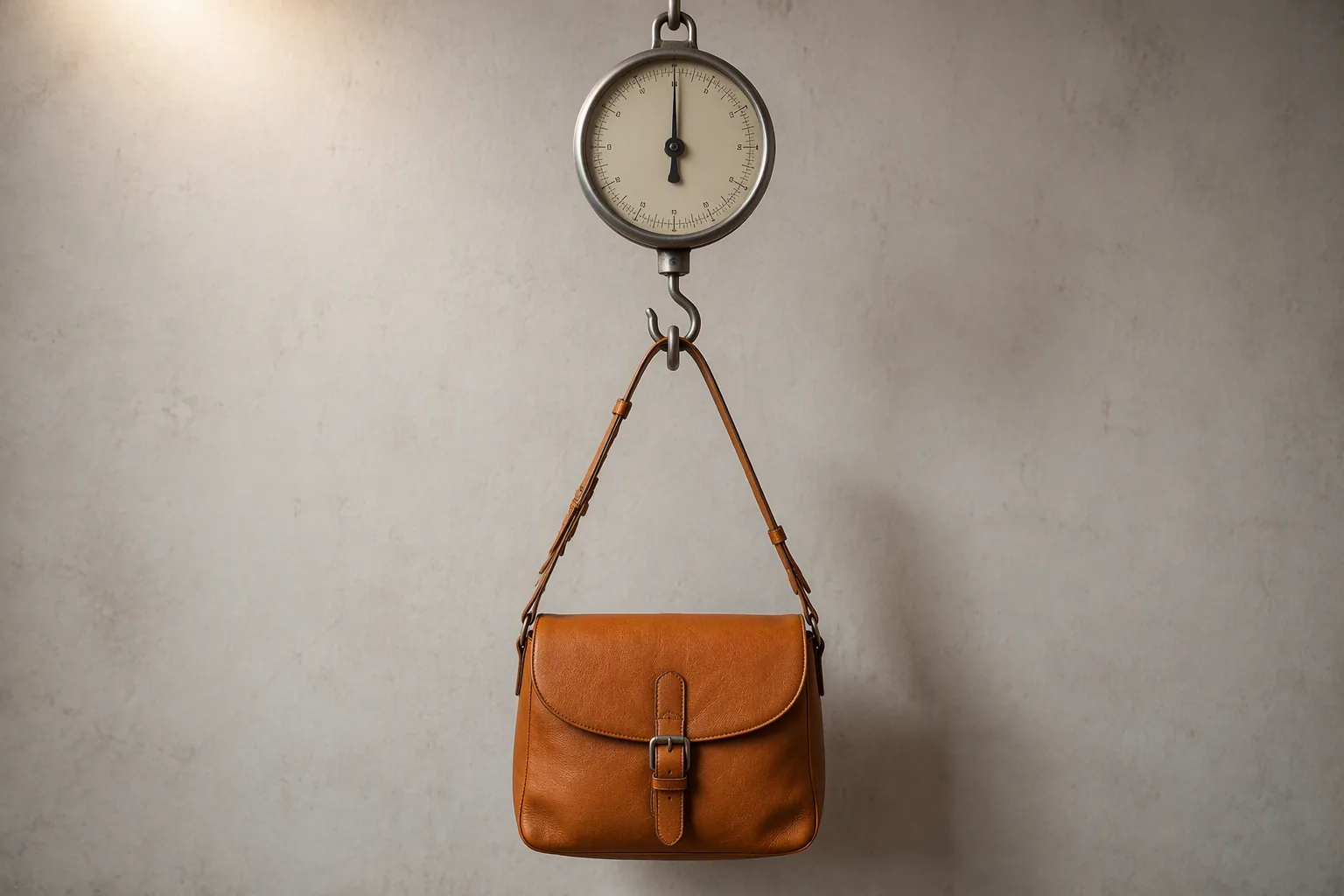
When the Weight Is Not the Bag
Contents change everything.
A tote that weighs under a kilogram empty can be carried at three times that when full, so comfort depends on how the load is distributed as much as on the empty weight. Both numbers matter, and the specification should say which one it refers to.
Leather Weight and Bag Weight Are Different Things
The two are related but not interchangeable.
Oz Weight Is a Material Measure
Ounces describe the leather in a panel.
The ounce figure used for leather describes its thickness on the panel, and it does not tell you how much leather a bag contains. Two bags in the same leather can differ substantially in weight because one uses more panels, more layers or a larger hide area.
Bag Weight Is a Total
The bag is the sum of its parts.
Bag weight includes every panel, the support behind them, the lining, the hardware, the straps and the thread. Optimising only the ounce figure while ignoring panel count and hardware will not reach a weight target.
Where the Confusion Costs Money
It leads to the wrong change.
Downgrading the leather to a thinner article is the most common response to a heavy bag, and it is often the least effective, because it weakens the panels customers touch most while leaving lining, hardware and reinforcement untouched.
Leather Oz Against Panel Weight
| Leather choice | Effect on panel weight | Effect on durability | When it makes sense |
|---|---|---|---|
| Thinner article, same construction | Lower | Lower in wear areas | Light-use bags, structured panels only |
| Same thickness, fewer layers | Moderate saving | Little change | Anywhere two layers perform one job |
| Lighter tannage or finish | Small saving | Depends on finish | Where finish protection is already adequate |
| Thinner leather with support | Lower | Maintained if support is right | Bases and panels that must hold shape |
| Heavier leather, fewer parts | Little change | Higher | Designs where fewer pieces reduce seams |
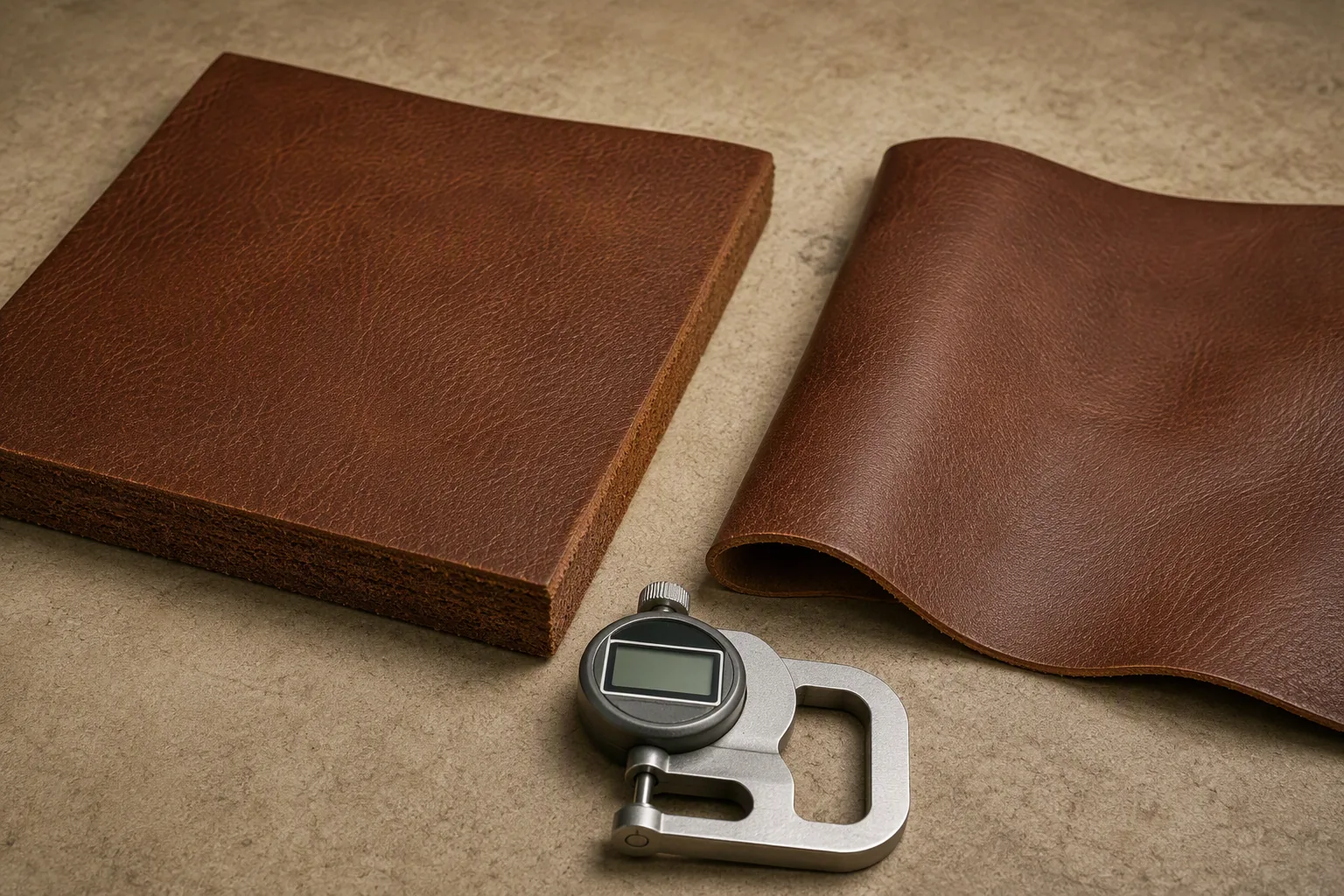
A Better First Question
Ask what each panel is doing.
Before changing leather, it is worth asking what each panel contributes: does it carry load, take abrasion, hold shape, or is it largely decorative. Panels that are decorative or protected are the sensible places to reduce material.
Thickness, Support and the Weight Trade-Off
Support is how thin leather carries load.
The Principle
Stiffness comes from structure, not from mass.
A thin leather bonded to a suitable board or interlining can hold a base as well as a heavy leather used alone, at a fraction of the weight. The trade-off is that the support has to be specified, placed and controlled, which is more demanding than simply buying heavier leather.
Where Support Earns Its Weight
Support pays for itself where it replaces leather.
A base panel that would need a heavy leather to stay flat can be made from medium leather over a light board, and the saving is real because leather is denser per unit of stiffness than a well-chosen board. The reverse is also true: adding support to a panel that already has enough substance adds weight for nothing.
Where Support Does Not Help
Comfort and drape are not structural.
Support cannot make a stiff bag soft where softness is wanted, and it cannot improve a strap that fails because of its width or its attachment. Adding support is a structural answer to a structural problem, not a general improvement.
Support Options and Their Weight Cost
| Support option | Weight added | Stiffness gained | Where it suits |
|---|---|---|---|
| Light woven interlining | Very low | Low | Panels that must stay flat but flexible |
| Non-woven interlining | Low | Low to moderate | Light structure, pocket panels |
| Foam layer | Low to moderate | Low | Padding rather than structure |
| Thin board | Moderate | High | Bases and structured fronts |
| Board plus interlining | Moderate to high | Very high | Large structured bags only |
| No support, heavier leather | High | Moderate | Small bags and simple shapes |
Making the Choice
Start from the stiffness requirement.
Deciding how stiff each panel must be, then choosing the lightest combination that delivers it, avoids both extremes: a bag that sags and a bag that feels overbuilt.
Lining and Interior Weight
The interior is heavier than it looks.
Lining Material
Lining weight varies more than expected.
A coated lining versus a woven fabric versus a heavier canvas can differ noticeably in weight, and because lining covers a large area it multiplies whatever difference exists per square metre. Lining choice is therefore a weight decision as well as a cleanability decision.
Pockets and Compartments
Features cost weight.
Every additional pocket adds lining, seams and often reinforcement, and a bag with eight interior compartments carries the weight of all of them. Trimming a redundant pocket is one of the least visible ways to reduce weight.
Pads and Removable Elements
Removable items should be weighed separately.
Changing mats, bottle holders and padded pockets are often the heaviest interior features, and making them removable lets the customer decide what to carry. It also allows the empty bag weight quoted in the specification to exclude them, provided the specification says so.
Interior Weight Reference
| Interior choice | Weight impact | Practical note |
|---|---|---|
| Light coated lining | Low | Easy to wipe, good for daily use |
| Medium woven lining | Moderate | Softer hand, less wipeable |
| Heavy canvas lining | High | Durable but adds noticeable weight |
| Large padded pocket | Moderate to high | Justify against how often it is used |
| Multiple small pockets | Low each, cumulative | Each one adds lining and seams |
| Removable pad or organiser | Separate | Lets the customer manage carried weight |
| Reinforcement in pocket edges | Low each, cumulative | Only where the pocket takes load |
Hardware Weight
Small pieces, real weight.
Metal Choice
The material matters more than the size.
Zinc alloy, steel and brass differ in density, and the difference shows once a bag carries a dozen pieces. Choosing a lighter alloy where load is modest is a straightforward saving.
Size and Quantity
Reducing count is often easier than reducing size.
A bag with a zip, two sliders, four rings, two clips, six feet and a buckle carries substantial metal. Questioning whether every piece is necessary, and whether decorative hardware can be smaller, works better than specifying thinner metal on pieces that must take load.
Plating and Finish
Finish adds a little.
Plating and coating contribute marginally to weight but matter for durability, so the plating decision should be made on wear performance rather than weight saving.
Hardware Weight Notes
| Hardware choice | Weight effect | Cautions |
|---|---|---|
| Lighter alloy on decorative pieces | Moderate saving | Keep load-bearing pieces in stronger metal |
| Smaller decorative hardware | Small saving | Check that proportions still look right |
| Fewer pieces overall | Moderate to high saving | Confirm the design still functions one-handed |
| Thin plates on load-bearing rings | Not recommended | Strength loss outweighs the saving |
| Aluminium where abrasion is low | Moderate saving | Not where pieces rub against hard surfaces |
| Decorative feet removed | Small saving | Only if the base is protected another way |
Straps, Handles and Padding
Comfort is not only about total weight.
Width and Contact
Distribution determines perceived weight.
A wider strap spreads the same load over more area and feels lighter, which is why improving strap design often does more for perceived weight than removing a hundred grams from the bag body.
Padding
Padding trades weight for comfort.
A padded strap adds weight but reduces the pressure on the shoulder, and the balance depends on how the bag is carried. For a bag that will be carried for hours, padding is usually the right purchase.
Attachments and Reinforcement
Anchor weight should not be reduced casually.
The leather and reinforcement at strap anchors carry the full load of the bag, and thinning them to save weight moves the saving into the least appropriate place. Anchors are among the areas where weight should be accepted.
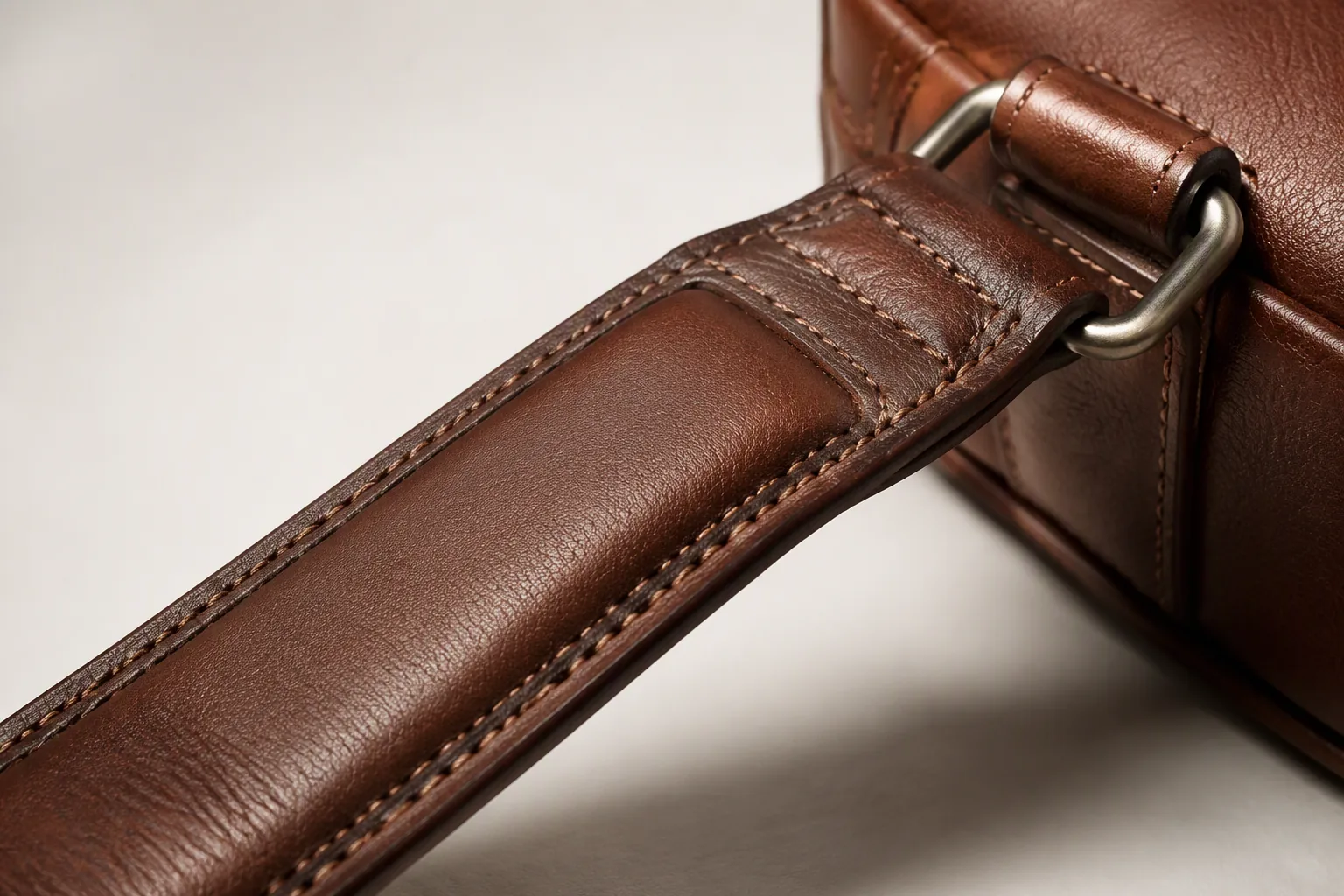
Comfort Reference
| Design change | Weight effect | Comfort effect |
|---|---|---|
| Wider strap, same thickness | Slight increase | Noticeable improvement |
| Padded section at the shoulder | Moderate increase | Clear improvement for long carries |
| Adjustable strap instead of fixed | Small increase | Allows better positioning |
| Reinforced anchor kept at full weight | No saving | Prevents the most severe failures |
| Removable strap for a tote | Neutral | Lets the customer choose |
| Rounded and finished edges on the strap | No change | Reduces cutting into the shoulder |
How Bags Get Heavy Without Anyone Deciding
Weight accumulates in small approvals.
Layers on Layers
Design changes rarely remove anything.
Adding a reinforcement panel, then a pocket, then a padded section, then an extra zip each seems small, and nobody removes anything when a feature is later dropped mentally but not on the drawing. The result is a bag that carries the weight of every version it has been through.
Over-Specification for Safety
Designers add material to remove risk.
Where a part failed once, the natural response is to specify something stronger, and the change is rarely revisited when the design evolves. Several rounds of this produce a bag built to survive loads it will never see.
Copying a Heavier Reference
Reference bags are usually larger than needed.
Designing from a reference bag that was itself overbuilt imports its weight as a baseline. Starting from the component budget and building up avoids carrying someone else’s compromises forward.
The Cost of Preparing for Every Eventuality
Overbuilding is a decision, even when nobody makes it.
A bag designed to survive a badly handled shipment, an overloaded commute and a decade of daily use is not the same bag as one designed for a two-year life in a light-use setting. Both are legitimate, but only one can be light, and the choice should be made deliberately rather than emerging from successive safety margins.
Writing down the intended lifespan and typical load turns that decision into something the design can be measured against, and it gives the factory a reason to push back when a feature is added late without removing anything.
Accumulation Check
- Count the layers in each panel and confirm each one has a purpose
- List features added since the first sample and confirm each is still wanted
- Compare the target weight against the actual weight at every sampling round
- Weigh the current version rather than assuming the change reduced anything
Lightweight Constructions That Work
Reduction should be structural.
Proven Approaches
| Approach | How it works | Where it suits | Limits |
|---|---|---|---|
| Thin leather over light support | Support provides stiffness | Bases, structured fronts | Support must be specified and controlled |
| Fewer, larger panels | Fewer seams and overlaps | Simple shapes | Cutting yield may suffer |
| Lighter lining | Large area, easy saving | All bags | Cleanability must be preserved |
| Removable interior elements | Customer chooses what to carry | Diaper bags, organisers | Quoted empty weight must be defined |
| Lighter hardware alloy on decorative pieces | Material substitution | Trim and decoration | Not for load-bearing hardware |
| Reduced hardware count | Fewer functions duplicated | Designs with redundant closures | Must remain easy to use one-handed |
| Hollow or foam-free construction | Removes padding where unneeded | Panels that do not touch the body | Not where padding is the point |
What These Approaches Have in Common
They change structure rather than substance.
In each case the saving comes from doing something differently, not from making everything thinner. That is why lightweight constructions usually look and feel the same to the customer while weighing noticeably less.
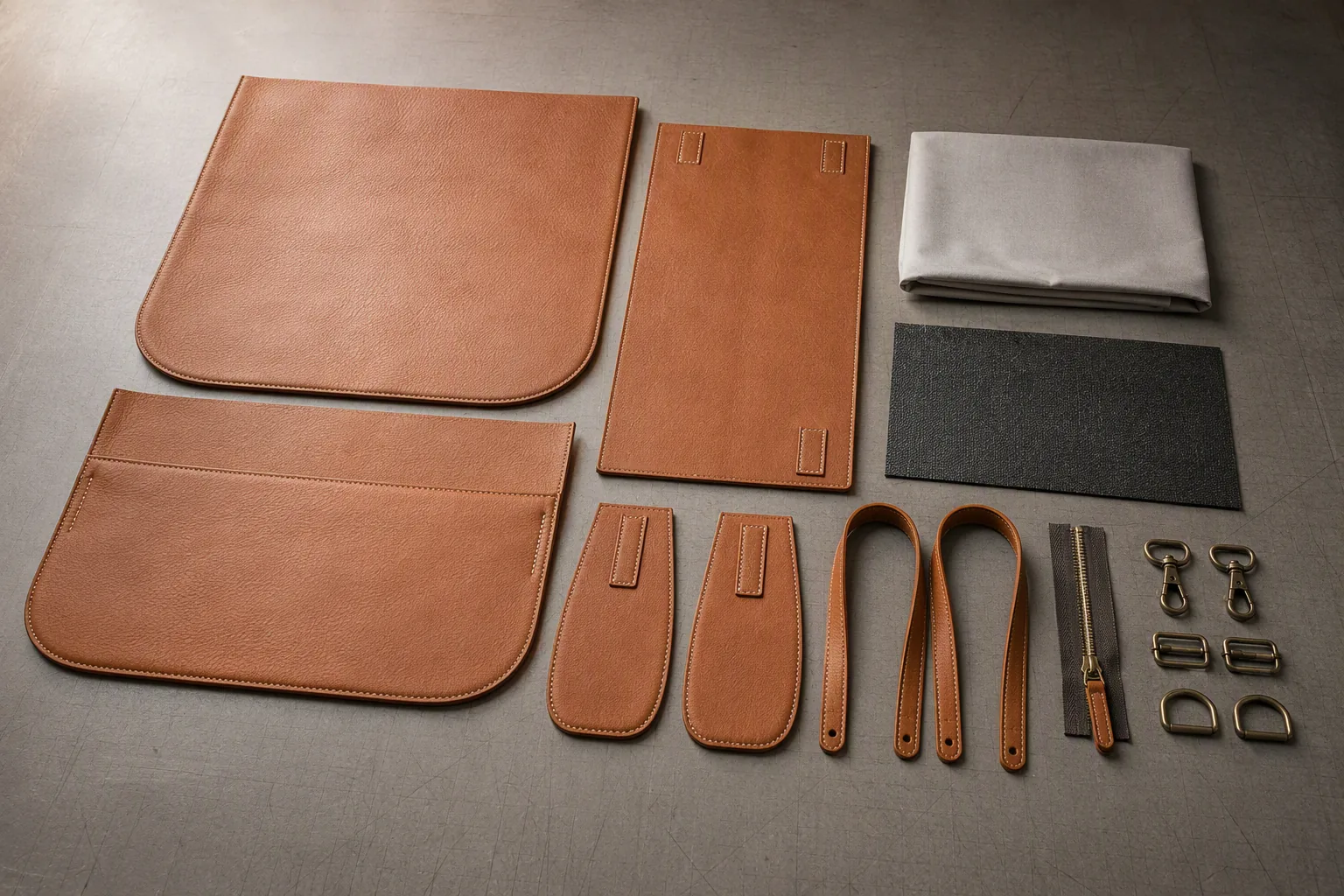
Testing a Reduction
Weigh, then carry.
Any reduction should be weighed against the current version and then carried by someone for an extended period, because the point of the exercise is perceived comfort rather than the number alone.
Where Weight Cannot Be Saved
Some parts should stay heavy.
Load Points
The anchors, handles and strap attachments carry the whole bag.
Reducing material at these points trades a small weight saving for a structural failure, and the failure will occur under exactly the conditions the bag was designed for. These areas should be specified at full strength and left alone.
Abrasion Surfaces
Bases and lower corners meet the world.
The parts that touch floors, car seats and stroller frames need substance and protection regardless of their contribution to weight, because wear is the complaint that follows.
Bag Mouth and Closures
Repeated flex needs material.
The bag mouth, flap and closures are flexed constantly, and thinning them invites cracking and distortion. Where a weight target must be met, it is better to find the saving elsewhere.
Failure vs Weight Balance
| Area | Weight saving opportunity | Why it should usually be refused |
|---|---|---|
| Strap anchors | None recommended | Carries the full bag load |
| Handle attachment | None recommended | Highest stress in daily use |
| Base panel protection | None recommended | Faces constant abrasion |
| Bag mouth and flap | Very low, with caution | Repeated flexing causes cracking |
| Exterior panel over a load | Low | Carries contents against the body |
| Interior pocket edges | Low | Small load, but visible sag |
| Decorative trim | Moderate to high | Carries no load in use |
Weight and Comfort
Comfort is about distribution.
Distribution Over the Body
Where the load sits matters more than the total.
A bag carried close to the body with a broad contact area feels lighter than the same weight swinging from a narrow strap, which is why strap width, positioning and bag depth are comfort variables as much as weight variables.
Balance While Carrying
Weight that shifts is weight felt.
A bag that tilts or swings makes the carrier compensate continuously, which is tiring in a way that static weight is not. Simpler shapes, a flatter base and a shorter strap usually improve this without touching the weight budget at all.
Weight for the Intended Use
Different bags carry different loads.
An everyday shoulder bag is judged almost entirely on empty weight, while a bag that will always be full is judged on how it carries a load. The target should name which of the two is being specified.
Weight and Durability Risks
Reduction can go too far.
Where Thin Construction Fails
Weakness appears in use.
Panels that are too thin sag under load, edge finishes crack where panels flex, and hardware pulls through material that cannot hold it. These failures appear after delivery, which is why weight reduction should always be paired with the tests covered earlier.
Warning Signs During Sampling
- Panels that deform when the bag is loaded
- Stitching that distorts the panel instead of holding it
- Edge finishes that crack when the bag mouth is opened
- Hardware that shifts or rotates in its mount
- Straps that stretch or lengthen noticeably under load
Keeping Shape While Losing Weight
Shape is the first thing to suffer.
A panel that loses substance without gaining support will bowl, ripple or sag once the bag is loaded, and the change usually appears after the first full load rather than at inspection. Checking the loaded silhouette, not only the empty one, is what catches this before a customer does.
Where a bag must stay light and keep its shape, the reliable answer is a thinner leather combined with a defined support layer, with the load points left at full strength. That combination costs more attention during sampling but delivers the result the weight target was aiming for.
Reducing the Risk
Test the reduced version as a new product.
A weight-reduced bag should go through sampling as though it were a new design: load tests, flex tests at cold temperature and carrying trials, with the target weight recorded alongside the results.
Measuring Weight in Production
Measurement should be part of the routine.
How to Weigh
| Method | What it measures | When to use it |
|---|---|---|
| Whole bag on a scale | Total weight | Every sampling round and during bulk |
| Component groups on a scale | Where the weight sits | At sampling and during design changes |
| Panel weights per square metre | Leather and support contribution | When choosing material |
| Loaded bag weighing | Real carried weight | For bags delivered with interior elements |
| Weighed against target | Compliance with the specification | On every bulk delivery sample |
Recording the Result
Weight should be recorded like any other measurement.
The figure, the scale used, what was included, and the version of the design should be written down together, so that a change in weight can be attributed rather than guessed at.
Sampling in Bulk
Weight drifts with materials.
Because leather, lining and hardware vary slightly between lots, the weight of a production run moves within a small range. Sampling a few finished bags per delivery allows that range to be monitored against the target rather than discovered in customer reviews.
Specifying a Weight Target
A weight target should say what is included.
Fields to Write
- Target weight for the finished bag and the tolerance around it
- Whether the figure refers to the empty bag, the bag with removable elements, or both
- The scale and method to be used for verification
- The measured component shares agreed at sampling
- The parts declared as excluded from weight reduction for structural reasons
- The test results, previous version, that accompany the target
Talking to Suppliers About Weight
| Question | What a useful answer looks like |
|---|---|
| What is the measured weight of this sample, and how was it measured? | A figure with the method and what was included |
| Which components contribute most to the weight? | A component breakdown rather than a total |
| Where could weight be reduced without affecting the parts that take load? | Specific proposals tied to panel roles |
| What support would be needed if a thinner leather were used? | A named material and its placement |
| How much does the weight vary between lots? | A range based on measured data |
| What tests were run on the reduced version? | Named tests with results, including cold flex |
Agreeing the Target
The target belongs in the specification.
Once a weight target is agreed with a tolerance and a method, it can be checked on every sampling round and on bulk deliveries without further discussion, which is the only way a comfort property stays under control.
Common Mistakes in Weight Planning
| Mistake | Consequence | Prevention |
|---|---|---|
| Treating the ounce figure as the bag weight | The wrong material change is made | Weigh components, not only the leather |
| Reducing leather thickness everywhere | Wear areas and load points fail early | Reduce only where the panel does not carry load |
| Ignoring lining and hardware | A quarter of the bag is left untouched | Include every component group in the budget |
| Adding support without removing leather | The bag gets heavier, not lighter | Treat support as a replacement for substance |
| Removing weight from strap anchors | Structural failure under normal use | Accept weight at all load points |
| Specifying a target with no tolerance | Every batch is arguable | State the target with a range and a method |
| Quoting an empty weight that excludes removable items without saying so | Customers feel misled | Define what the quoted figure includes |
| Never re-weighing after design changes | Weight creeps up unnoticed | Weigh at every sampling round |
Frequently Asked Questions
What makes a leather bag heavy?
The total of its parts rather than the leather alone. Panels usually account for around half the weight, with lining, reinforcement, hardware and straps making up the rest. That is why reducing only the leather often fails to reach a weight target.
Is a lighter leather automatically a lighter bag?
No. A thinner leather reduces panel weight but does not touch the lining, hardware or reinforcement, and it weakens the parts customers handle most. Used over a suitable support layer, thinner leather can save weight without losing stiffness, but the support has to be specified deliberately.
How much should a leather bag weigh?
It depends on size, structure and use. What matters is that a target weight with a tolerance is written into the specification, that the figure states whether it refers to the empty bag or the bag with its removable elements, and that it is checked at every sampling round and in bulk.
What is the easiest place to reduce weight in a bag?
The lining and the number of interior features. Lining covers a large area, so a lighter lining saves weight across the whole bag, and each redundant pocket carries its own lining, seams and sometimes reinforcement.
Where should weight never be reduced?
At strap anchors, handle attachments, the base and the bag mouth. These areas carry the load, take abrasion or flex repeatedly, and reducing material there trades a small saving for the failures owners notice most.
How is bag weight measured properly?
By weighing the whole bag on a scale and by weighing component groups during sampling. The whole-bag figure tells you compliance with the target; the component figures tell you where the weight actually sits and which change is worth making.
Does hardware really affect bag weight?
Yes, often more than expected. A bag may carry a zip, several rings, clips, feet and a buckle, and the metal alone can account for a significant share of the total, especially on smaller bags where the leather area is modest.
Can a bag be light and still feel premium?
Yes, if the weight is saved structurally rather than everywhere. Thin leather over well-chosen support, fewer and larger panels, a lighter lining and lighter decorative hardware all preserve appearance while reducing weight, and customers judge premium largely by how the bag is finished and how it carries.
Why does a lighter bag sometimes feel heavier to carry?
Because perceived weight depends on distribution. A narrow strap, a bag that tilts or a bag that swings all make the carrier work harder, so strap width, contact area and balance often improve the experience more than removing grams.
How much variation in weight is normal between production lots?
A small variation is expected, because leather, lining and hardware vary slightly between deliveries. What matters is that the range is measured on samples from each delivery and compared against the agreed tolerance, so drift is caught rather than discovered later.
Should a weight-reduced design be tested again?
Yes. A weight-reduced bag should go through the same sampling and testing as a new design, including load tests at the anchors, flex tests at the bag mouth and a cold flex test, with the measured weight recorded alongside the results.
The Bottom Line
Bag weight is a budget, not an accident.
It is made up of every panel, every layer behind them, the lining, the hardware and the straps, and it can be reduced deliberately by changing structure rather than by thinning everything. The savings that work come from lighter lining, fewer redundant features, lighter decorative hardware and thinner leather over suitable support.
For buyers, the practical questions are short. Ask what the bag weighs and how that figure was measured, what each component group contributes, where weight could be reduced without affecting the parts that carry load, and what tests were run on the reduced version. A factory that can answer those questions is building the weight in on purpose; one that cannot is discovering it in the returns report.
