Wet-Blue, Crust and Finished Leather: A Bag Manufacturer’s Guide to Buying at the Right Stage
Wet-Blue, Crust and Finished Leather: A Bag Manufacturer’s Guide to Buying at the Right Stage
Most leather sourcing conversations start with grade. A brand says it wants full-grain, the factory quotes full-grain, and everyone leaves the meeting satisfied that the hardest decision has been made. It has not. Before grade, before tannage, before colour, there is a question that quietly decides cost, lead time, flexibility and about half of your quality risk: at which stage of processing are you going to buy the leather?
A hide can be bought three ways. It can be bought wet-blue, still damp and untanned-looking, straight out of the tanning drum. It can be bought crust, which is tanned, retanned, dyed and dried but has no surface finish. Or it can be bought finished, ready to cut, with colour and coating already applied and locked. Each is a legitimate commercial product. Each is quoted differently, delivered differently and inspected differently. And each one moves a different amount of work, and a different amount of risk, from the tannery to you.
This guide is written from the manufacturing side of the table. It explains what the three stages actually are in production terms, what happens between them, and where value and risk accumulate along the way. It then works through the commercial case for each stage, what each one does to cutting yield, skiving, stitching and final inspection, how to write a specification that a tannery can quote without ambiguity, and which failure modes are baked in when a brand buys too early. The examples lean towards the bag types most programmes actually run: diaper bags, backpacks, totes and small leather goods.
The through-line is simple. Buying earlier in the chain buys flexibility and usually a lower price per square foot, and it pays for that with capital tied up in inventory, with process risk you now own, and with a longer path from purchase order to cut panels. Buying later in the chain buys certainty and speed, and it pays for that with higher unit cost, tighter colour commitments and less room to change your mind. Neither answer is correct in the abstract. The right answer depends on your order size, your colour range, your tolerance for variance and the technical depth of the team standing behind the purchase order.
- The Three Stages in Plain Terms
- What Actually Happens Between the Stages
- The Three Buying Stages at a Glance
- Buying Wet-Blue: Flexibility and a Longer Owned Risk
- Buying Crust: The Compromise Most Programmes Underestimate
- Buying Finished Leather: The Default, for Good Reasons
- Cost Structure: Where the Money Actually Goes
- Matching the Stage to the Bag: A Decision Matrix
- What Changes on the Cutting Table and Sewing Line
- Quality Control: What You Can See at Each Stage
- Traceability, Compliance and Documentation
- The Failure Modes That Appear Six Months Late
- Writing the Purchase Specification by Stage
- Working With a Factory That Buys at Several Stages
- Frequently Asked Questions
- Conclusion: Buy the Stage Your Team Can Actually Manage
The Three Stages in Plain Terms
Before comparing them, it helps to strip the trade vocabulary back to what each product physically is. Tanners use these words every day and assume everyone else does too, which is where a surprising number of sourcing errors begin.
Wet-Blue
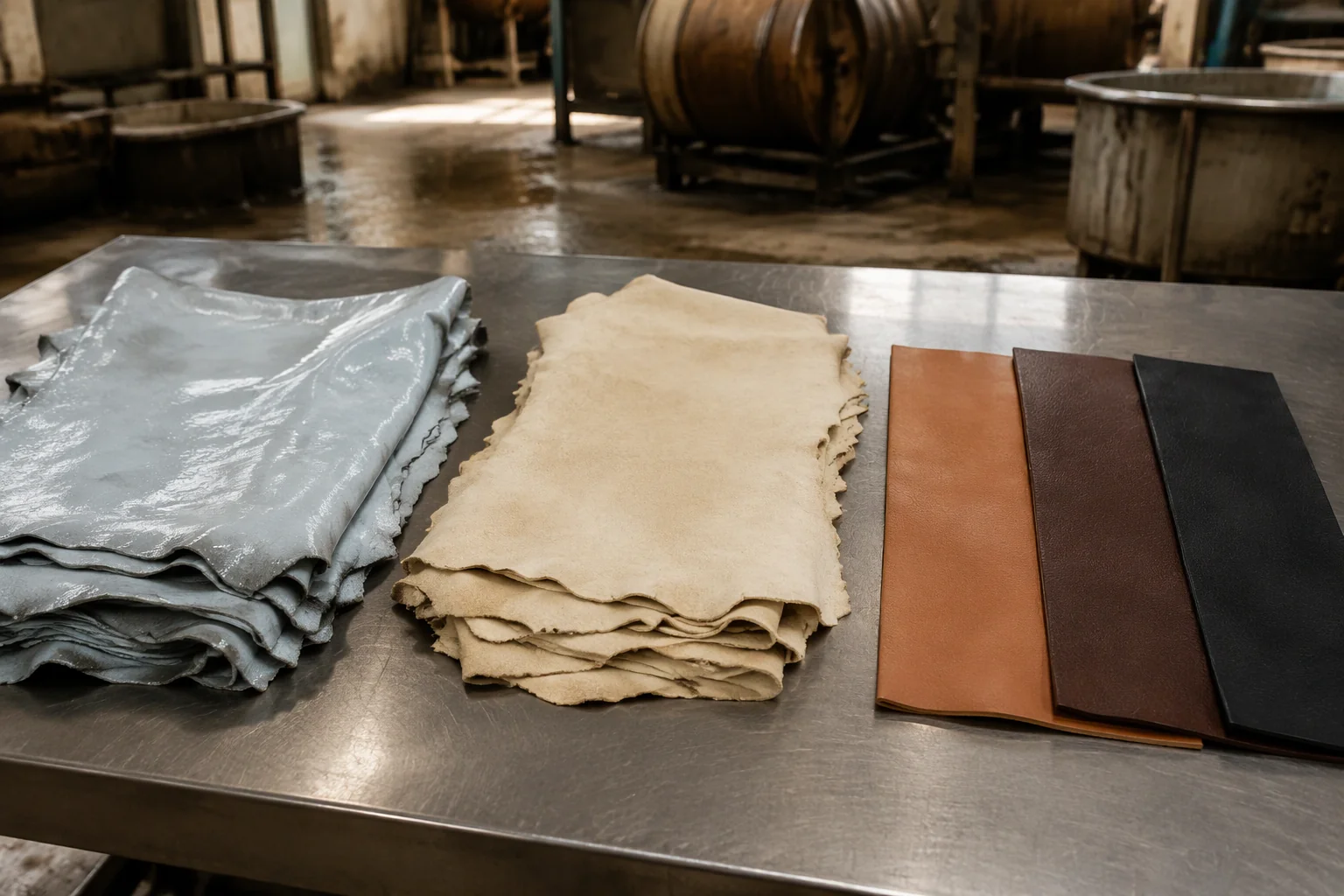
Wet-blue is hide that has been cleaned, unhaired, fleshed and tanned, but not dried. It arrives damp, typically somewhere between forty and fifty percent moisture, and it carries the pale blue-grey colour that gives the product its name when chromium salts are used. A chrome-free wet-blue is a slightly different colour, often off-white or cream, because the tanning chemistry is different.
Wet-blue is a semi-finished raw material. It is stable enough to store and ship, unlike a raw hide, but it is not usable in a bag. It still needs retanning, fatliquoring, dyeing, drying, staking and finishing. It is usually sold by weight, which is the first thing that surprises buyers, because bags are costed by area.
Crust
Crust is what you get when wet-blue has been retanned, fatliquored, dyed or left undyed, dried and mechanically softened. The name comes from the thin crust that forms on the surface during drying. It has a dry, matte, slightly fibrous face with visible grain, no protective coating, and a substance that has been brought close to its final thickness.
Crust is the stage where temper is set. Retanning chemistry, fatliquor levels, drying method and staking all decide whether the leather ends up firm enough for a structured tote or soft enough to drape in a slouchy hobo. Crust is sold by area, which makes it much easier to cost, and it is normally the earliest stage at which a bag maker can judge colour and hand feel with any confidence.
Finished Leather
Finished leather has been coated, plated, printed or otherwise surfaced, then top-coated and dried. The colour is locked, the grain is set, the surface protection is applied and the substance is usually controlled to a final tolerance. This is the product most brands mean when they say “leather”.
It is also the stage where the least flexibility remains. Once a hide is finished, a colour change means a new run, a new minimum, a new lead time, and often a new dye lot that does not match the previous delivery. That is the trade: certainty purchased with commitment.
What Actually Happens Between the Stages
The gap between raw hide and finished leather is not one process but a sequence of them, and understanding that sequence explains nearly every commercial and technical difference between the three buying options.
From Raw Hide to Wet-Blue
A salted or fresh hide goes through soaking, liming to remove hair and open the fibre structure, fleshing to remove flesh and fat, splitting to bring the hide to a workable thickness, and then tanning. Tanning is the step that makes the collagen structure resistant to bacterial attack and heat, and it is what turns a perishable by-product into a storable material.
After tanning, the hide is sammyed to reduce moisture, graded, and packed. Grading at this point is based on grain defects, parasite damage, scar tissue and the size of the usable area. What the buyer receives is a stack of hides with a stated average substance, a stated weight and a grade mix, not a set of panels.
From Wet-Blue to Crust
This is where a hide becomes a material with a personality. Retanning builds the structure the bag needs: syntans and vegetable extracts for body and fullness, fatliquors for softness and flex resistance. Dyeing sets the base colour. Drying, whether vacuum, toggle or hang, fixes the temper and can introduce shrinkage. Staking and milling break the fibre bonds that drying tightened, which is how a tannery makes a hide feel soft without making it thin.
Buffing may happen here as well, either to correct minor grain defects, to prepare a nubuck surface, or to open the fibre for a suede-effect split. Splitting and shaving to final substance, within tolerance, usually happens at crust stage too.
From Crust to Finished
Finishing is a coating operation, repeated several times: a base coat to seal and level, pigment coats to build colour and opacity, a print or emboss to set grain, and a top coat to provide the surface performance the bag needs, whether that is abrasion resistance, a matte hand, or water repellency. Each coat is dried and often plated under heat and pressure. The final product is then measured, graded and packed.
Manufacturer’s note: a purchase order that specifies only “full-grain leather, 1.4 mm, brown” tells a tannery almost nothing about which stage is being sold. State the stage explicitly, because wet-blue sold by weight and finished leather sold by area are not comparable prices even when the per-unit numbers look close.
The Three Buying Stages at a Glance
The table below is the comparison we use in a first sourcing meeting. It compares the properties that determine how a programme will actually run rather than how the quotation reads.
| Property | Wet-Blue | Crust | Finished Leather |
|---|---|---|---|
| What you receive | Tanned, undried hide | Tanned, retanned, dyed, dried | Coated, plated, colour-locked |
| Moisture content | High, typically 40–50% | Low, dry | Low, dry |
| Sold by | Weight (kg) | Area (sq ft) | Area (sq ft) |
| Substance control | Approximate | Close, needs shaving | Final, within tolerance |
| Colour visibility | None | Base shade only | Exact |
| Hand feel visibility | None | Good | Exact |
| Flexibility after purchase | Very high | Moderate | Very low |
| Process risk carried by buyer | High | Medium | Low |
| Capital tied up in stock | Medium | Medium–high | High per colour |
| Typical route to cut panels | Weeks of additional processing | Days to weeks | Immediate |
| Best suited to | Large, technical programmes | Colour-led, mid-size runs | Most branded bag programmes |
The row that decides the most is flexibility. A brand that changes colour twice a season and runs four colourways per style is not served well by buying finished leather eight months ahead, and a brand running one black style in volume is wasting money by buying crust and paying someone else to finish it in the same black every time.
Buying Wet-Blue: Flexibility and a Longer Owned Risk
Wet-blue is the power buyer’s material. It is also the material that most often ends up unloved in a warehouse, slowly developing a mould bloom because nobody planned for the fact that it is a damp organic product sitting in a humid climate.
The Commercial Case
The argument for wet-blue is straightforward. You pay for leather before finishing and before dyeing, so the per-unit cost is the lowest of the three options. You add value downstream in the way you want: your retanning recipe, your colour, your temper, your surface. If you run enough volume to justify the setup, or if you work with a tannery that will process your wet-blue to your own crust specification, the unit economics can be materially better than buying finished leather at a distributor’s price.
There is a second, subtler argument. Wet-blue lets you decide late. A brand that holds wet-blue can respond to a colour trend in the same season, because the dye has not been applied yet. A brand holding finished leather in four colours is carrying inventory that is already wrong if the market shifts.
The Hidden Costs
The visible price is not the real price, and the gap is wider than most first-time buyers expect.
- Freight on water. Wet-blue is roughly half water. You are paying to ship moisture, and you are paying duty on it too in most markets.
- Shrinkage. Processing wet-blue into crust reduces usable area. The percentage varies with the tannery, the retanning recipe and the drying method, but it is not zero, and it must be built into the cost equation.
- Yield loss at grading. Wet-blue is graded on the hide, not on the panel. The defects you can see at this stage are only part of the story; grain defects become more visible after buffing and finishing.
- Storage conditions. Wet-blue needs to be wrapped, kept out of direct light, kept cool, and rotated. Mould risk is real and uninsured in most factory relationships.
- Downstream quality dependence. Your final quality now depends on someone else’s retanning, dyeing and finishing, performed on a material you already paid for. If the finish fails, the conversation about who owns the loss becomes long.
Manufacturer’s note: when a quotation for wet-blue looks thirty percent cheaper than crust, the difference is usually smaller than it appears once shrinkage, freight weight and additional processing are loaded in. Ask for the price of the equivalent crust from the same tannery before deciding.
When Wet-Blue Makes Sense
Wet-blue is a serious option in a narrow set of circumstances:
- You run a large, repeating programme with a stable colour and can commit to substantial volume.
- You have a tannery relationship deep enough to process your wet-blue to a written crust specification with agreed tolerances.
- Your factory or your tannery has the retanning and finishing capability in-house, and you can inspect the intermediate product.
- You need a very specific temper or finish that no stock finished leather provides.
- Your cash position can absorb inventory that will not become sellable panels for weeks.
If three or more of those do not apply, the saving is likely to be consumed by the risk. For most branded bag programmes, especially in diaper bags and backpacks where colour consistency across components matters, wet-blue is a specialist tool rather than a default.
Buying Crust: The Compromise Most Programmes Underestimate
Crust occupies the middle of the chain and, in our experience, the middle of the conversation. Buyers reach for finished leather because it is simple, or for wet-blue because it looks cheap, and skip the stage that often fits best.
What Crust Lets You Control
Crust gives you the two things that decide whether a bag looks expensive: colour and hand feel. You can see the base shade, judge the temper, feel the grain, and measure the substance, all before committing to a surface finish. If the crust is right, the finishing is a technical exercise. If the crust is wrong, no finish will save it.
Crust also lets you delay the finish decision. A brand can approve a crust in a neutral shade, then run final colour at the finishing stage once the season’s palette is confirmed. That is a genuine hedge against colour risk.
There is a cost advantage too, though a smaller one than wet-blue: you avoid paying a finishing margin to a third party, and you avoid the markup a distributor applies to stock finished leather.
What Crust Does Not Guarantee
Crust is not a promise. Three things can still go wrong after you take delivery.
First, the finish can change the hand. A heavy pigment coat on a soft crust produces leather that feels like plastic, and the brand discovers this only at finish approval. Second, colour can shift during finishing, because the top coat changes the apparent depth of the base shade. Third, substance can move: finishing adds measurable thickness, and a crust at the top of tolerance can finish outside it.
Specifying Crust Properly
A crust specification for bags needs more than a colour reference. It needs substance with tolerance, temper described in behaviour rather than adjectives, grain appearance, shrinkage allowance, and the finishing route the crust was designed for.
| Crust specification field | What to state | Why it matters for bags |
|---|---|---|
| Substance | 1.2–1.4 mm at crust, finished target 1.3–1.5 mm | Finishing adds thickness; splitting later is costly |
| Tolerance | ±0.10 mm on any single point | Inconsistent substance shows as wavy seams |
| Temper | Firm, medium or soft, defined by a bending test | Determines whether the bag stands or slumps |
| Grain | Natural, corrected, or buffed for nubuck | Drives the visual grade of the finished panel |
| Dye state | Undyed, drum-dyed, or surface-dyed | Undyed crust is cheapest but limits colour depth |
| Shrinkage allowance | Agreed percentage from wet-blue to crust | Protects the yield calculation |
| Finish route | Pigmented, semi-aniline, aniline, or waxed | Some crusts only accept certain finishes |
| Area measurement | Method and tolerance for measurement | Area disputes are the most common crust complaint |
The temper field is the one most often written badly. “Soft” means nothing on its own. A tannery needs to know whether the leather should hold a standing tote body, fold into a soft hobo, or survive being turned inside out during assembly. Describe the bag, not the adjective.
Buying Finished Leather: The Default, for Good Reasons
Most bag programmes buy finished leather, and the reasons are practical rather than lazy.
What Finished Leather Gives You
You get exactly what you approved. The colour on the swatch is the colour in the shipment, within a stated dye-lot tolerance. The hand feel is the hand feel. The surface performance, whether abrasion resistance, water repellency or cleanability, has already been applied and can be tested on the sample you are holding. You can cost the bag accurately on day one, because finish loss, colour rejection and re-finishing are someone else’s problem.
For a diaper bag, this matters more than for almost any other product. A diaper bag gets wiped, spilled on and stuffed, and it is carried by a person with one hand free. Its exterior needs a surface that resists staining and cleans with a damp cloth. Buying finished leather with a documented performance finish is how that requirement gets met reliably; trying to reach it from crust, in a factory without finishing capability, is how a programme ends up with a beautiful bag that marks permanently in week one.
What You Give Up
Flexibility, mostly, and the ability to buy small.
- Colour lock-in. Finished leather is bought per colour per dye lot. A late colour addition means a new minimum and a new lead time.
- Minimum quantities. Tannery minimums for finished colours are usually higher than crust minimums for the same article.
- Upcharges for change. Anything other than a catalogue colour attracts a development charge.
- Longer sampling. Finish development cycles add weeks before the first correct swatch exists.
- Inventory risk. You are holding value in a specific colour that may not sell.
Specifying Finished Leather Well
With finished leather, the specification work moves to the surface. Ask for the coating system, not just the appearance: what base coat, how many pigment coats, what top coat chemistry, what the expected abrasion performance is, and how the finish behaves when flexed a thousand times. Ask for the finish adhesion test result, because peeling at a strap fold or a gusset crease is the most common finished-leather failure in bags.
Also ask for the dye-lot tolerance in numbers, not adjectives. A written tolerance of a Delta E value against the approved swatch, with a stated rejection rule, converts a subjective argument at goods-in into a measurement.
Cost Structure: Where the Money Actually Goes
Comparing stage prices is easy. Comparing stage costs is harder, because the cheaper product carries costs that appear in other columns of the budget.
| Cost element | Wet-Blue | Crust | Finished |
|---|---|---|---|
| Material price per unit area | Low | Medium | High |
| Freight weight penalty | High (water) | Low | Low |
| Retanning and dyeing cost | Buyer | Included | Included |
| Finishing cost | Buyer | Buyer | Included |
| Shrinkage allowance needed | High | Medium | None |
| In-house technical capability required | High | Medium | Low |
| Inventory tied up before cut date | High | Medium | Low per unit, high per colour |
| Colour change cost | Low | Medium | High |
| Rejection risk absorbed by buyer | High | Medium | Low |
| Suitability for small runs | Poor | Fair | Good |
Read across the wet-blue row and the arithmetic becomes clear. The material line is the smallest part of the total, and every other line grows. A factory can make wet-blue work because it is already set up to retan, dye, finish, inspect and store. A brand without those capabilities is not buying a cheaper material; it is buying a longer supply chain.
The Colour Change Experiment
A useful way to test which stage fits is to sketch the cost of one late colour change at each stage.
- Wet-blue: add dye to the retanning drum. Cost is chemistry and a run slot, and the material was going to be processed anyway.
- Crust: dye at the finishing stage. Cost is a dye run, finish development and a new approval cycle.
- Finished: the stock you hold is now the wrong colour. Cost is a new minimum run, a new lead time and the carrying cost of obsolete inventory.
If a programme expects two or more colour changes a season, that sketch usually settles the decision. It is why seasonal fashion programmes work in crust and long-run basics work in finished leather.
Matching the Stage to the Bag: A Decision Matrix
The bag type shapes the answer more than the budget does, because it determines which properties have to be locked and which can stay loose.
| Bag type | Recommended buying stage | Why it fits | What to watch |
|---|---|---|---|
| Diaper bag (structured, wipe-clean exterior) | Finished | Needs a proven stain-resistant, wipeable surface and exact colour matching across body, flap and trim | Finish adhesion at the flap fold; colour match between leather and coated trim |
| Diaper bag (soft, canvas-and-leather hybrid) | Finished or crust | Leather is a trim material; small areas make wet-blue uneconomic | Trim colour consistency across small panels cut from different hides |
| Backpack (technical, multi-panel) | Finished | Many small panels and close colour tolerances; abrasion resistance matters at the base and shoulder contact | Substance consistency across panels; scuff performance on the base |
| Tote (structured, open top) | Crust or finished | Temper has to hold shape; crust lets you tune stiffness at finishing | Temper creep after finishing; edge stiffness |
| Slouchy hobo or shoulder bag | Crust | Hand feel dominates; finish choice can soften or stiffen | Over-finishing turns soft crust boardy |
| Wallet and small leather goods | Finished | Small panels make defects expensive; consistent substance for skiving | Substance tolerance; grain match across fold lines |
| Sample and development rounds | Finished or crust | Speed matters more than unit price at this stage | Assuming sample leather equals production leather |
| Large-volume single-colour basics | Wet-blue or crust | Volume justifies owning the process | Shrinkage, storage and downstream QC |
The pattern is not about price tiers. It is about how much surface performance and colour precision the product needs, and how much of that the brand is equipped to create itself.

What Changes on the Cutting Table and Sewing Line
The buying stage does not just change the invoice. It changes what happens on the factory floor, and those changes show up in yield, in labour minutes and in the defect rate.
Yield and Nesting
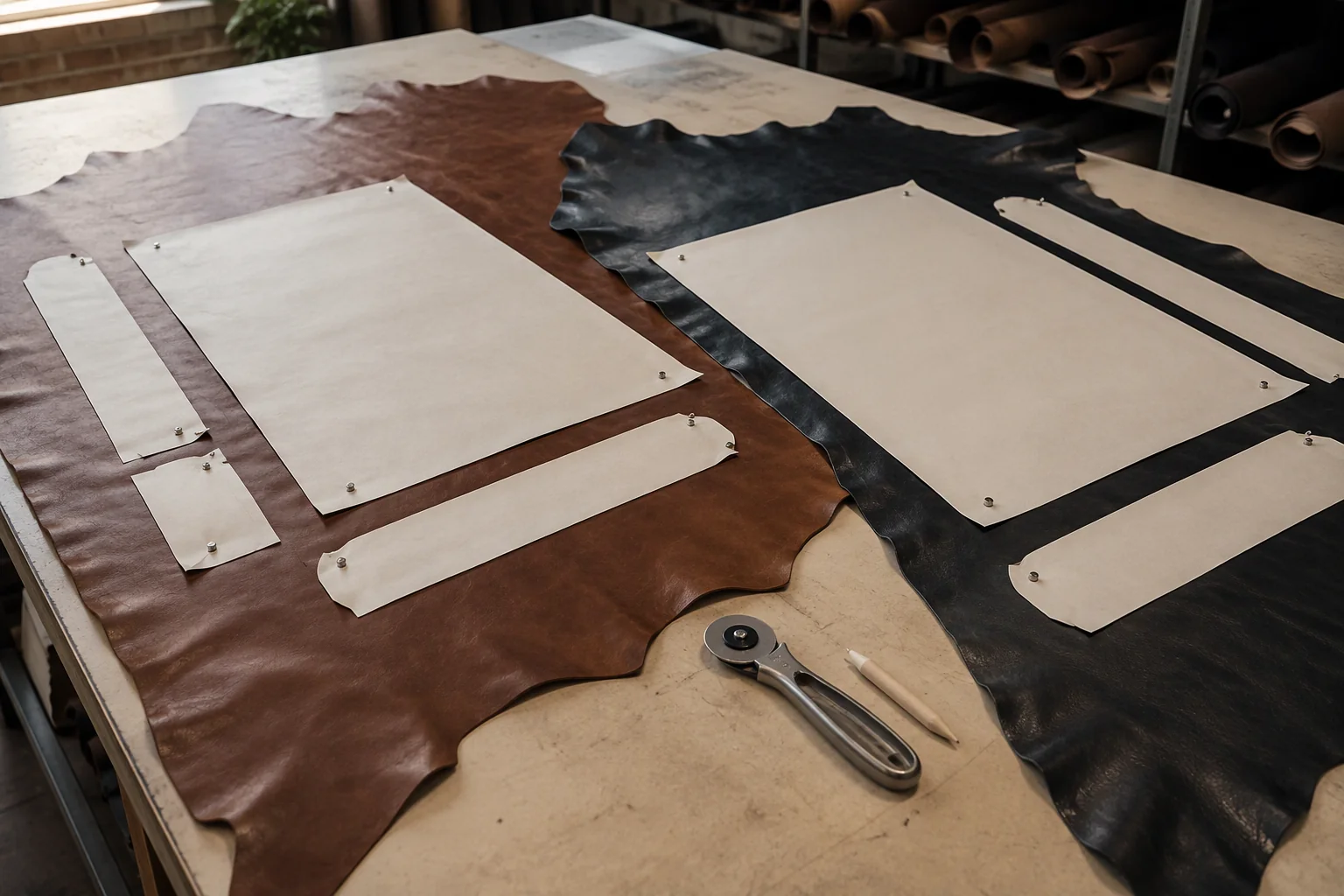
Finished leather arrives flat, consistent in substance and predictable under the knife. Nesting is straightforward, and a cutter can plan around visible defects immediately.
Crust behaves similarly but is softer and distorts more during handling. Wet-blue is a different problem: damp, heavier and dimensionally unstable until processed, so it cannot be nested reliably because the final area is not yet known. Any yield figure quoted for wet-blue sits inside a wide confidence band, and on a narrow margin that band is the margin.
Splitting, Skiving and Edge Work
Substance consistency is the quiet hero of bag construction. Skiving a strap to a specific thickness, folding a top edge, and turning a gusset all assume the leather is where you think it is. Finished leather is controlled to final substance. Crust is close but will gain thickness under coating. Wet-blue will change substance several times before it becomes a panel.
For bags with folded edges, welted seams or turned constructions, buy the latest stage you can afford. The labour saved in skiving adjustments and the defects avoided at the fold are usually worth more than the material saving.
Stitch Behaviour
Dense, firm finished leather takes a lockstitch cleanly. Soft crust can pucker at the seam because the material compresses under the presser foot, and a heavily finished soft crust can become slippery, which shows up as seam slippage under load. Thick, waxy or oiled surfaces need a different needle and thread combination and mark permanently under a hard presser foot.
None of this is a reason to avoid a stage. It is a reason to tell the factory which stage the leather is arriving at, so the line can be set up for it rather than discovering the problem at the first seam.
Reinforcement and Hardware
Bags fail at hardware anchors. A rivet or D-ring pulls against the leather, and how well the load spreads depends on fibre density and temper. Firmer, denser material needs less reinforcement; soft, stretchy material needs backing or a reinforced patch, which costs labour and adds thickness exactly where thickness is least welcome.
If your design has heavy hardware, a bag body in soft crust will need more internal engineering than the same design in a firm finished article. That difference belongs in the cost sheet, not in a post-launch complaint.
Quality Control: What You Can See at Each Stage
Inspection is not the same task at each stage, and a goods-in checklist written for finished leather will miss the things that matter on a wet-blue delivery.
Incoming Inspection by Stage
- Wet-blue: check weight against the packing list, moisture (feel and, if possible, meter reading), wrapping integrity, mould or mildew smell, salt bloom, grain damage, and the grade mix against the agreed ratio. Photograph everything on arrival.
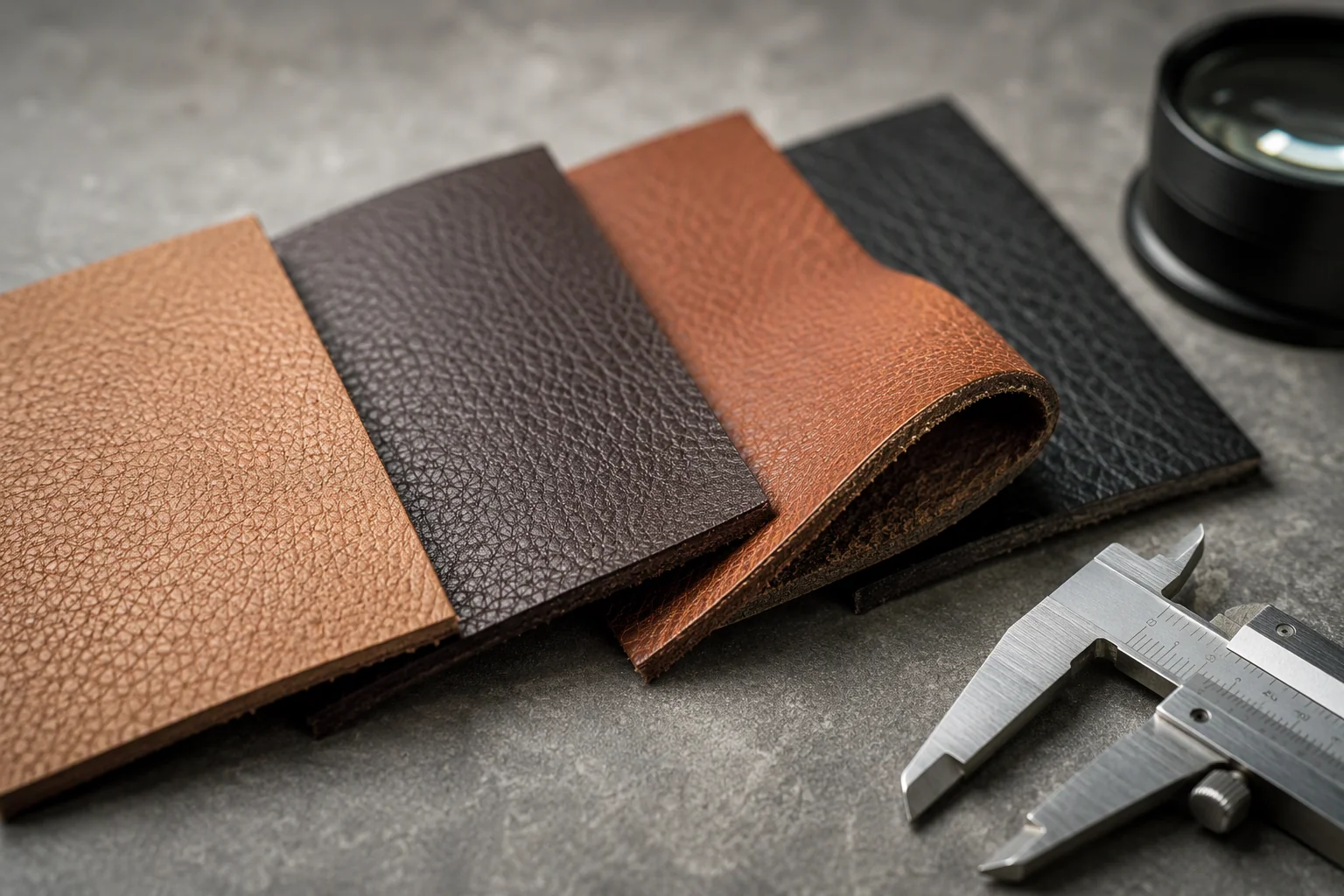
- Crust: check substance at multiple points per hide, temper by hand and by bend test, colour against the approved crust standard, grain appearance, buffing uniformity, and area measurement against the invoice.
- Finished: check colour against the approved swatch under controlled light, surface uniformity, coating adhesion by flex test, substance, grain pattern consistency, and freedom from scratches, iron marks and coating streaks.
The Defects That Only Appear After Finishing
This is the strongest argument for buying later in the chain. Several defect classes are invisible in wet-blue and crust and only become obvious once the surface is coated:
- Grain damage that buffs into a visible patch under a semi-aniline finish.
- Growth marks and veininess that disappear under heavy pigment but reappear as cracking at flex points.
- Uneven dye uptake that produces a mottled surface once the top coat seals it.
- Residual moisture pockets that cause blistering or poor adhesion during plating.
A tannery that finishes its own leather sees these before shipping. A brand buying crust and finishing elsewhere discovers them after it has already paid for the material and the finishing.
Tests Worth Running Early
Run the tests on the stage you buy, not only on the finished bag:
- Flex resistance on a coated sample, because bag failures concentrate at folds.
- Abrasion on the base and shoulder panels, where bags actually wear.
- Adhesion, by attempting to lift the finish at a cut edge.
- Colour fastness to rubbing, especially for dark linings and light exteriors.
- Substance mapping across a full hide, not a single point, to see the real tolerance range.
Traceability, Compliance and Documentation
Buying stage changes the compliance conversation, because different stages carry different restricted-substance profiles and different audit trails.
The Tannery Audit Trail
An environmental audit of a tannery, such as the Leather Working Group protocol, assesses the facility rather than a single consignment. It tells you something real about environmental management and almost nothing about whether the hide in front of you is the hide in the certificate. Traceability has to be built at order level: tannery name, article code, production date, lot number and raw material origin.
Buying wet-blue or crust usually gives a cleaner traceability chain, because you are closer to the tannery and the processing stages are fewer. Buying finished leather from a distributor adds a link, and that link has to be documented rather than assumed.
Where Restricted Substance Risk Sits
Risk is not evenly distributed across the chain.
- Wet-blue and crust: elevated risk of hexavalent chromium formation if the material is stored warm and damp, and of azo dye issues if dyeing is uncontrolled. Storage conditions matter as much as chemistry.
- Finished leather: elevated risk from coating chemistry, including solvent residues, phthalates in some coating systems and formaldehyde in some resin formulations.
- Any stage sold through a trader: elevated risk of documentation gaps, because the paperwork is one step removed from the process.
Ask for test reports that name the article code and the production period, not a generic certificate for “leather”.
What Paperwork to Demand
At minimum, a purchase specification should require:
- Tannery identity, country of origin and audit status.
- Article code, colour code and dye lot.
- Substance with tolerance and measurement method.
- Restricted substance test reports matched to the article.
- A written finish specification for finished leather, including coating system.
- Storage and shelf-life instructions, especially for wet-blue and crust.
The Failure Modes That Appear Six Months Late
Field failures are usually process decisions that were made long before the bag was assembled. These four account for a large share of the complaints we see.
Colour Migration and Crocking
Dark linings against light exteriors, or heavily dyed crust finished with a thin top coat, can transfer colour under friction or humidity. The fix belongs in the specification: fastness to rubbing requirements, a barrier layer where colours contrast, and a finishing route suited to the dye depth.
Relaxation and Sagging
Leather relaxes. A bag body cut from a soft crust with high elongation will sag under load, and a structured tote will lose its line. The specification fix is a temper requirement tied to a bending test and a maximum elongation figure, plus a construction response: reinforcement, interlining, or a firmer article in the base and gusset.
Coating Adhesion Failure at Flex Points
Peeling or cracking at strap folds, flap hinges and gusset creases is the classic finished-leather failure. It is almost always an adhesion problem, made worse by heavy pigment on a soft substrate. Specify adhesion testing and flex testing before bulk, and avoid very stiff coatings on leather destined for parts that will fold repeatedly.
Mould and Moisture
Mould is a storage and transit problem, not a tanning problem, but buying early makes it more likely. Wet-blue and crust are more vulnerable than finished leather, particularly in humid climates and in shipments that sit in a container through a seasonal change. Specify wrapping, desiccant where appropriate, humidity limits, and a shelf-life rule that forces stock rotation.
Manufacturer’s note: when a bag fails in the field, the first question is usually “who made the leather?” The more useful question is “which stage did we buy, and what did we not specify at that stage?” Roughly half of the failures we investigate trace back to a specification gap, not a bad tannery.
Writing the Purchase Specification by Stage
A specification is a risk allocation document. It should say what you are buying, how it will be measured, and what happens when it is not met.
Fields Common to All Stages
- Article name and code, with a reference sample held by both parties.
- Animal and origin, with any breed or region requirement.
- Tannage: chrome, chrome-free, vegetable or combination, with a stated minimum.
- Grade mix and acceptable defect level by area.
- Colour reference and the light source under which it will be judged.
- Restricted substance requirements and the test standard applied.
- Packing, labelling, storage and shipping conditions.
- Acceptance sampling plan and the rejection rule.
Additional Fields by Stage
| Stage | Add these fields |
|---|---|
| Wet-blue | Moisture range, weight basis, splitting thickness, preservation method, storage temperature, maximum storage period |
| Crust | Substance and tolerance, temper by bend test, dye state, grain treatment, area measurement method, shrinkage allowance from wet-blue |
| Finished | Coating system, number of coats, top coat type, finish sheen, adhesion test, abrasion test, flex test, dye-lot tolerance in Delta E, emboss plate reference |
Acceptance Criteria and Tolerances
Write tolerances as numbers with a measurement method attached. “Substance 1.4 mm” is not a specification; “1.4 mm ±0.10 mm measured at five points per hide using a dial gauge, no single reading outside 1.3–1.5 mm” is. The same applies to colour, to area, and to temper, which can be tied to a simple in-house bend test with a described result rather than an adjective.
Working With a Factory That Buys at Several Stages
Most established bag factories can work with whichever stage you choose, but not identically, and the differences deserve to be discussed before the purchase order rather than after.
Capacity and Minimums
A factory set up for finished leather has a cutting room, a skiving line and sewing lines. One that handles crust has finishing, or a relationship with a finisher, plus colour approval capability. One that handles wet-blue needs storage, climate control and either in-house retanning or a tannery partner who will process to its specification. Ask which of these the factory actually operates, and ask to see the storage area.
Who Owns the Risk
The cleanest commercial arrangement names the owner of each risk in writing. Material quality risk sits with the supplier of the stage you bought. Process risk sits with whoever performs the next step. Colour approval risk sits with whoever signs the swatch. When a programme buys wet-blue and asks the bag factory to arrange finishing, the factory is carrying process risk on material it did not buy, and that belongs in the price or the liability clause. Development timelines also stretch as you move earlier in the chain, so never approve a bag sample made from stock finished leather if production will run on crust.
Frequently Asked Questions
Is wet-blue leather cheaper than finished leather for bag production?
The material price per kilogram is lower, but the comparison is not like for like. Wet-blue is roughly half water, so you pay freight on moisture, then you pay for retanning, dyeing, finishing, shrinkage allowance, storage and inspection. Once those are loaded in, the gap often closes or reverses for small and mid-size programmes. Wet-blue wins when volume is high and the buyer already owns the downstream processing capability.
Can a bag factory buy crust leather and finish it in-house?
Some can, and many more claim they can. Finishing requires coating lines, plating equipment, colour matching capability and the technical staff to diagnose adhesion and colour problems. Ask to see the line, ask who formulates the coatings, and ask for the adhesion and flex test results from a previous programme. A factory that outsources finishing is not necessarily a bad choice, but the finishing house becomes part of your supply chain and should be named.
How much area do you lose when processing wet-blue into crust?
It varies with tannery, retanning recipe, splitting and drying method, and it is not a fixed industry number. What matters is that you agree a shrinkage allowance in writing with the tannery before the order, then measure actual output against it. A programme that assumes zero shrinkage is effectively assuming the tannery will absorb the loss, which rarely happens quietly.
Does buying stage affect the grade of leather I can get?
It affects what you can verify. Grade is determined by grain condition, parasite damage, scar tissue and usable area, and much of that is only fully visible after buffing and finishing. Buying finished leather means the supplier has already graded on the finished surface. Buying wet-blue means you are accepting a grade assessment made before the surface exists, so you should expect a wider variance band and price it in.
Which stage is best for a leather diaper bag?
Finished leather, in most cases. A diaper bag needs a surface that resists staining, wipes clean and holds colour across the body, flap, base and trim, often with a wipeable lining. Buying finished leather with documented performance finishes, plus a written test for abrasion and cleanability, is the shortest route to that result. Crust is workable for trim on a hybrid bag where the leather area is small.
How do I compare quotations from tanneries selling at different stages?
Convert everything to cost per usable square foot of cut panel. That means starting from the quoted price, adding freight including moisture weight, applying the agreed shrinkage factor, adding any processing you will pay for, then dividing by realistic yield rather than gross area. A quotation that cannot be converted this way is not a quotation yet; ask the supplier for the missing figures.
Can I change colour after approving a crust?
You can, and that is one of the main reasons to buy crust. The colour is applied at the finishing stage, so a change costs a dye run and a new approval rather than a new minimum production run of finished leather. The constraint is that the finished shade will not match a Pantone chip exactly, because coating shifts the base tone, so approvals should always be made on a finished sample.
Conclusion: Buy the Stage Your Team Can Actually Manage
The leather buying decision is not a price comparison. It is a decision about how much of the process you want to own, and how much technical capability you have to own it well.
Buy finished leather when colour precision, surface performance and speed to production matter most, which covers most branded bag programmes and almost every diaper bag and multi-panel backpack. Buy crust when hand feel and colour flexibility are the priority, and when you can control finishing to a written route. Buy wet-blue only when volume, tannery depth and downstream capability all line up, and when you have done the cost arithmetic on usable area rather than on quoted weight.
Whichever stage you choose, five habits prevent most of the expensive mistakes:
- Name the stage explicitly in every enquiry, quotation and purchase order.
- Convert all quotations to cost per usable square foot of cut panel before comparing.
- Write substance, colour and temper as numbers with a measurement method, not adjectives.
- Test adhesion, flex and abrasion on the stage you actually buy, before bulk.
- Agree in writing who owns material risk, process risk and colour approval risk.
A bag is a manufactured object, and its quality is decided long before the first stitch. The buying stage is the earliest of those decisions, and it is the one most often made by accident. Making it deliberately is the cheapest quality improvement available to most programmes.