
How Should an Open-Top Leather Tote Be Built to Hold Shape?
How Should an Open-Top Leather Tote Be Built to Hold Shape?
An open-top tote has no zip, no flap and no frame, so nothing holds its mouth closed and nothing braces its walls. The bag either stands up on a table because its materials and its construction make it stand, or it collapses into a puddle of leather the moment it is set down.
That distinction is decided before the first stitch: in the temper of the leather, in the thickness at the base, in whether the side wall is one panel or two, and in how much of the load is carried by the handle patch rather than by the panel. It is a construction problem with a material input, not a style preference.
This guide treats the tote as a structure. It covers the zones that decide shape, how to choose leather for a tote that must stand or slouch on purpose, base and gusset construction, the mouth edge, handle attachment through the panel face, lining and stiffeners, sewing order, testing, and how to write a specification a tannery and a sample room can both build to.
- Why an Open Top Changes Everything
- The Zones That Decide Shape
- Choosing Leather for Shape
- Structured Versus Slouchy Totes
- Building the Base
- Side Walls and Gussets
- The Mouth Edge
- Handle Attachment
- Lining and Stiffeners
- Sewing Order That Preserves Shape
- Edge Work on a Large Open Panel
- Load, Weight and Dividers
- Hardware, Feet and Closures
- How Totes Fail
- Testing Shape Before Production
- Specifying the Leather
- Cost Drivers in Tote Production
- Climate, Transit and Storage
- Repair and Re-shaping
- Tote Compared With Backpack and Diaper Bag
- Quality Checks on the Line
- Details That Decide Whether a Tote Feels Expensive
- Working With the Tannery on Panel Selection
- How Size Changes the Build
- Tote Construction Checklist
- Frequently Asked Questions
- Conclusion
Why an Open Top Changes Everything
No Closure to Brace the Mouth
A zip or a flap stiffens the top edge as a side effect. Remove it and the mouth becomes a free edge on a large unsupported panel, which is the first place a tote begins to fold inward under its own weight.
Load Carried by Two Points
A tote hangs from two handle attachments, and every kilogram inside is transmitted through those small areas into a panel that has no frame. Handle attachment is therefore a structural element, not a decorative one.
A Large Panel With Nothing Behind It
The side wall of a tote is often the widest single piece of leather in the bag, and it has no seam pattern to break it up. Any inconsistency in temper, thickness or backing across that panel becomes visible as a wave.
A tote is the most honest bag a factory builds: there is nowhere to hide a weak panel, and no closure to correct a soft one.
The Zones That Decide Shape
The Base
The base sets the footprint and takes the load. It is the one zone where extra thickness and a stiffener are almost always justified, because a base that sags pulls the side walls out of vertical.
The Side Walls
The side walls carry the visual surface and the handle load. Their temper decides whether the bag stands straight or slouches, and their thickness decides how the panel behaves at the top edge.
The Gusset
A gusset adds depth and folds at its crease. A well-made gusset holds a straight line down the side of the bag; a poorly made one bows outward when the bag is filled and never recovers.
The Mouth
The mouth is a free edge that receives the most handling. It needs either a binding, a facing or a folded and stitched edge, and the choice has a direct effect on how rigid the top of the bag feels.
Choosing Leather for Shape
Temper First
Temper describes how the leather stands and recovers, and it matters more than thickness for a tote. A firm, tight-tempered hide at 1.4 mm will hold a silhouette that a soft, floppy hide at 1.8 mm cannot.
Thickness Second
Thickness supports temper but does not replace it. The usual production range for a tote body is roughly 1.2 to 1.6 mm, with the base heavier, and the exact figure depends on whether the bag is meant to stand or slouch.
Grain and Finish
A tight grain with a light finish holds a crease cleanly and resists the marking that a wide panel attracts. Heavy finishes and loose grains show every knock across the surface, because there is no seam to interrupt the eye.
| Panel | Typical range | Priority |
|---|---|---|
| Body / side wall | 1.2 – 1.6 mm | Temper |
| Base | 1.6 – 2.0 mm | Rigidity |
| Gusset | 1.2 – 1.4 mm | Fold memory |
| Handle strap | 1.6 – 2.0 mm | Tensile strength |
| Mouth binding | 1.0 – 1.2 mm | Clean fold |
Structured Versus Slouchy Totes
What a Structured Tote Needs
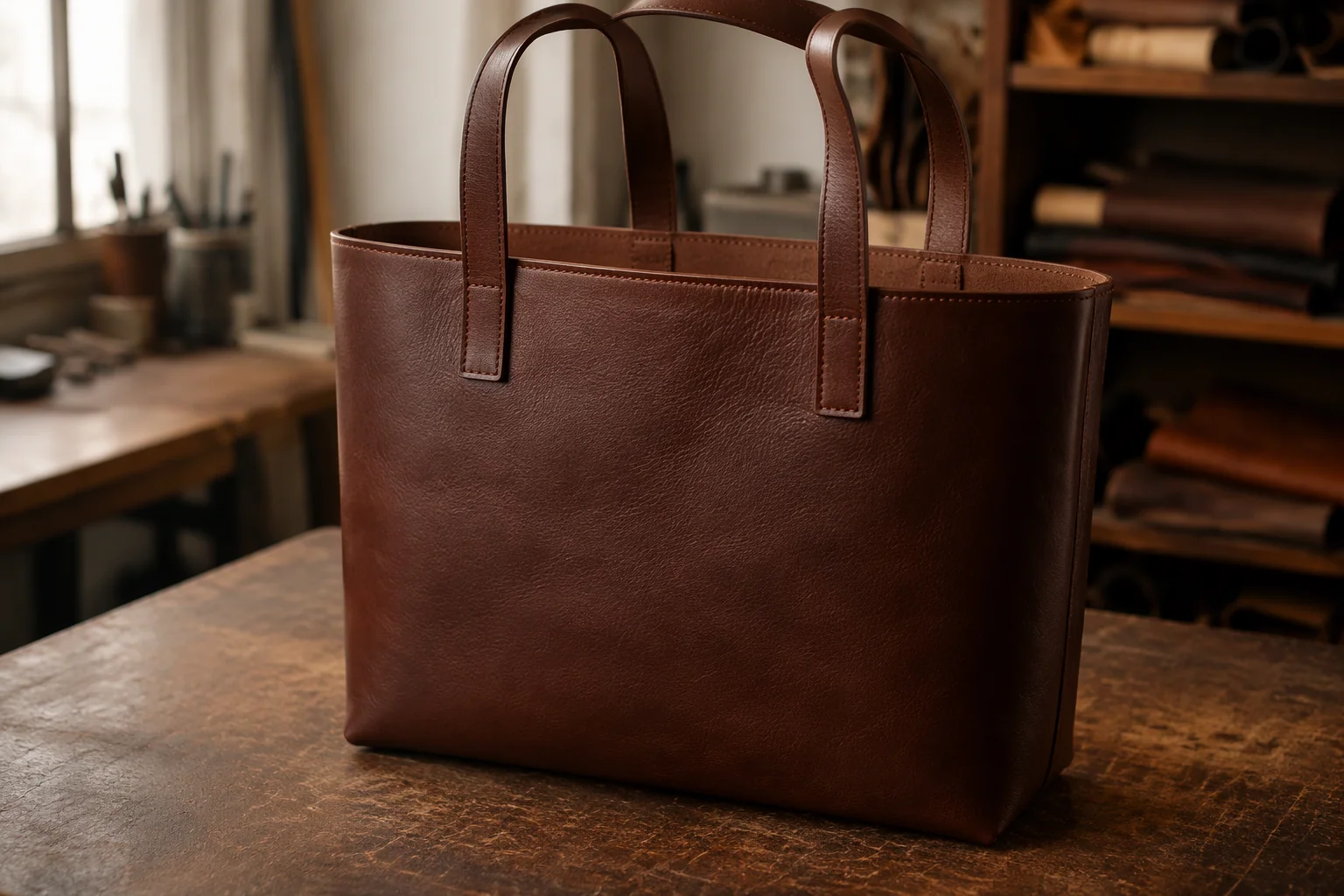
A structured tote needs firm temper, a reinforced base, a stiffened side wall or a lined construction that carries a board, and a mouth that is bound or faced to stop it collapsing inward.
What a Slouchy Tote Needs
A slouchy tote needs the opposite and more skill: a soft temper that drapes without creasing badly, a base that bends rather than breaks, and seams placed where the fold will happen naturally rather than where it fights the leather.
Deciding Before Sampling
The mistake is to order a soft hide and then ask the sample room for a bag that stands. Whether the tote stands or slouches is a decision made in the specification, and the pattern, the stiffener and the leather all follow from it.
Building the Base
Panel, Board or Both
A base can be a single thick panel, a thin panel with a stiffener inserted between layers, or both. A thick panel alone resists wear; a stiffener resists bending; a tote that must stand and take load usually wants both.
Turning and Corner Treatment
Turning a base inside out concentrates stress at the corners, so corners are clipped and the seam is placed where the finished bag will not show it. Reinforcing the corner from inside prevents the wear that appears first on any tote.
Feet and Base Protection
Metal feet lift the base off the ground and take the abrasion instead of the leather. They also need a reinforced mounting area, or they will pull through a panel that was never designed to carry a point load.
Side Walls and Gussets
One Panel or Two
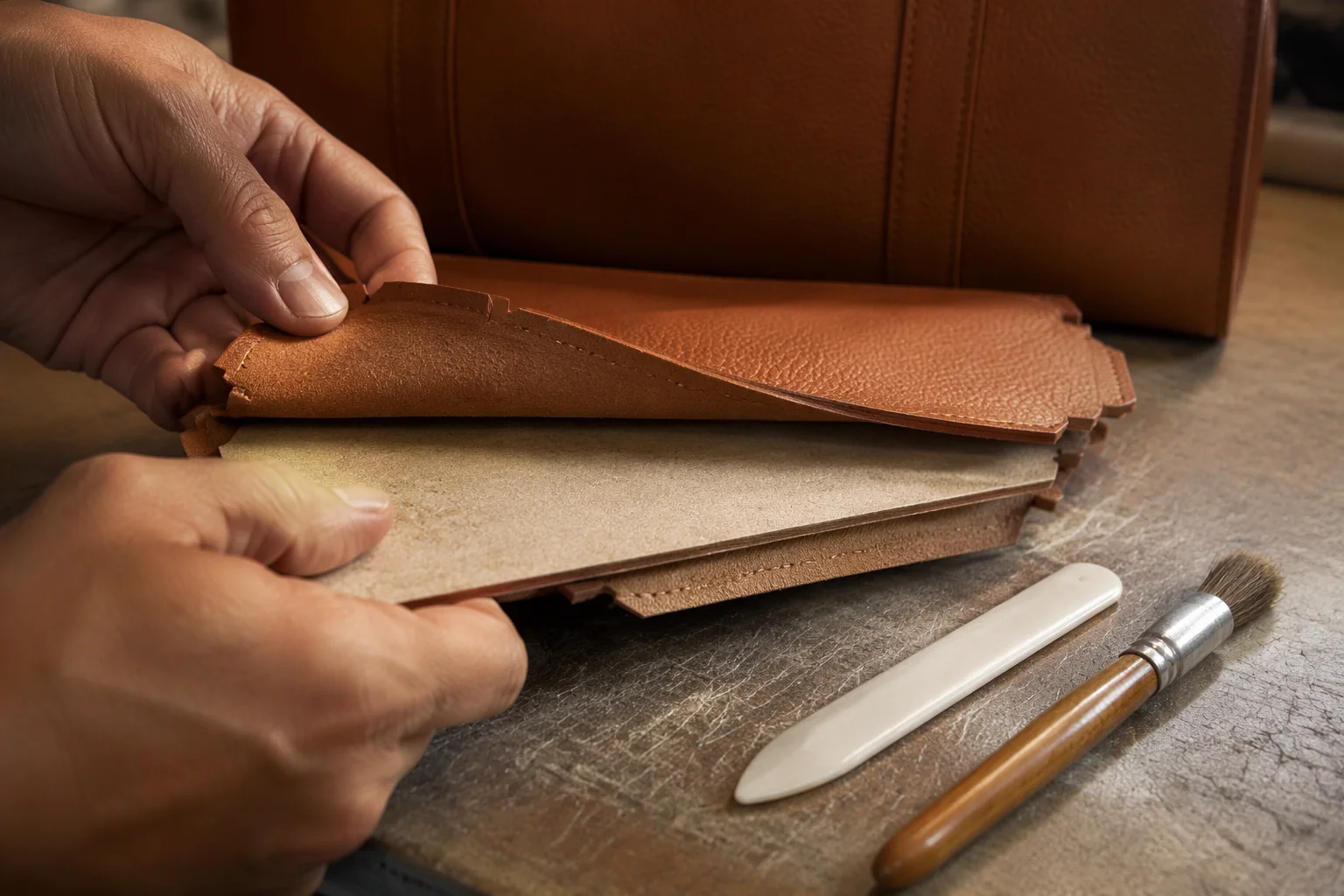
A single-panel side wall gives a cleaner surface and fewer seams to align, but it wastes more leather on a large tote. A two-panel wall saves material and allows a firmer and a softer temper to meet at a seam.
Gusset Crease Memory
A gusset must fold along the same line every time. Skiving the crease, or setting a crease before assembly, teaches the leather where to fold; without it the gusset finds its own line and the bag leans.
Keeping the Wall Vertical
Vertical walls come from a base that does not bow and a gusset that does not splay. Both are geometry: if the base is wider than the mouth, the walls will lean inward no matter how firm the leather is.
The Mouth Edge
Binding
Binding wraps the raw edge in a strip of leather and gives a clean, firm mouth. It handles a curve well and hides the lining edge, which is why it suits totes with a soft body.
Facing
A facing turns a strip of leather to the inside of the mouth, producing a flat top with a visible stitch line. It is the tidier option on a structured tote and the one that best resists the mouth folding over.
Folded and Stitched
Folding the panel over itself is the simplest mouth and the least forgiving. On a heavy panel the fold will not sit flat without skiving, and on a soft one it will soften further with handling.
Handle Attachment
Through the Panel Face
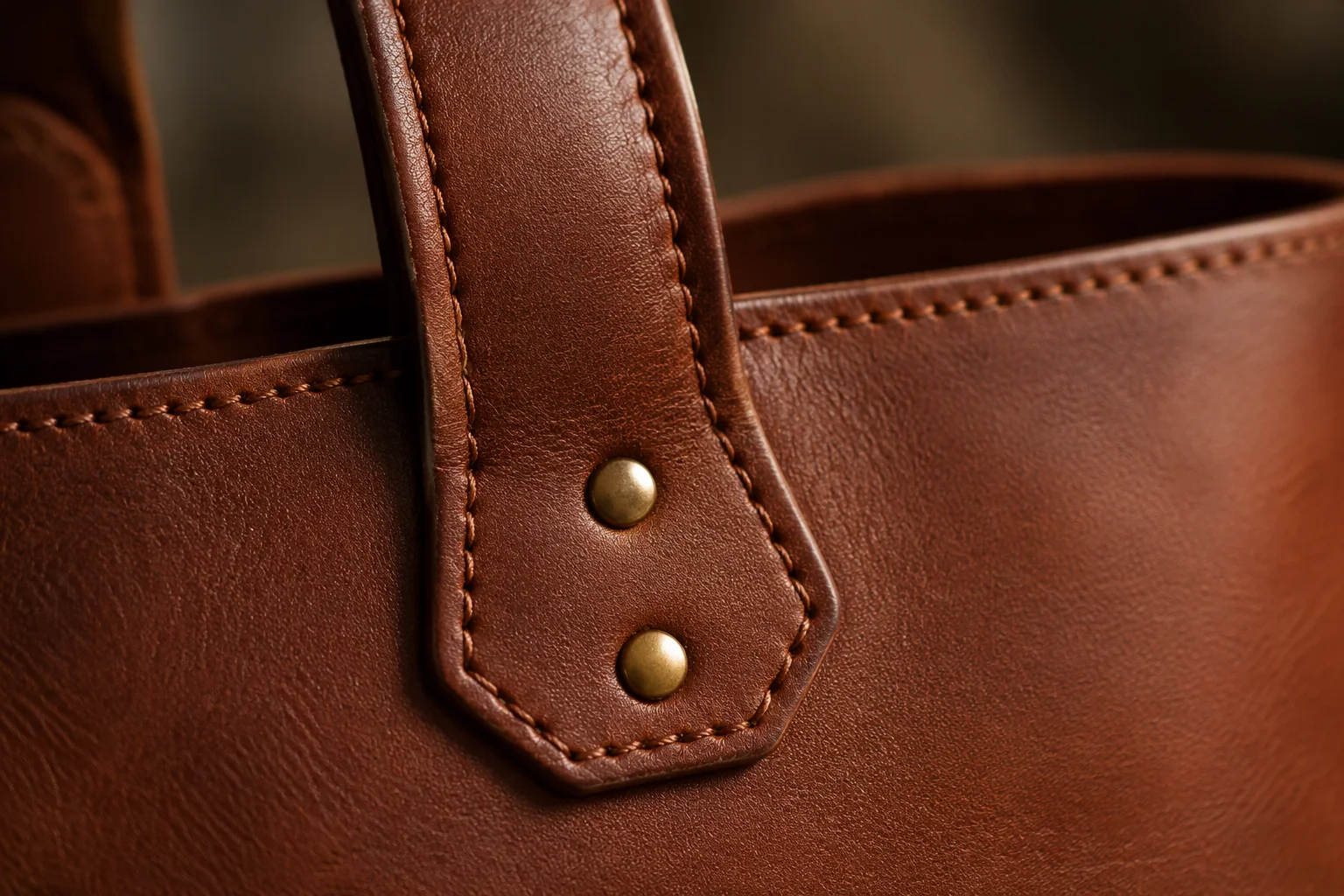
Most tote handles are stitched to the outside of the body panel, which puts the entire load on a stitched patch. The patch must be long enough to spread that load and stitched with a seam that will not act as a tear line.
Rivets and Reinforcement
Rivets add mechanical holding power at the ends of a patch but concentrate stress where they sit. A reinforcement behind the panel at each rivet, or a rivet through a folded tab rather than a single layer, keeps the fixing stable.
Testing the Attachment
Fill the bag to its rated load, hang it by one handle and leave it. Slight stretch is normal; visible distortion of the panel, elongated rivet holes or a widening stitch line means the attachment needs more spread.
Lining and Stiffeners
When a Lining Carries Structure
A lining becomes structural when it is attached at the mouth and the base and holds a stiffener between itself and the outer panel. In that arrangement the lining is a construction layer, and its weight and attachment method decide how the bag behaves.
Stiffener Materials and Placement
Stiffeners vary in flexibility, and placement matters more than the material. A base stiffener should stop short of the seam so it cannot press through, and a wall stiffener should stop below the mouth so the top edge stays soft enough to handle.
Lining That Moves Independently
A lining that is stitched only at the mouth will shift inside the bag and pull the outer panel out of shape when the bag is full. Side anchors, or a lining attached at the base seam, keep the two layers behaving as one.
Sewing Order That Preserves Shape
Assemble Flat, Then Close
Assembling gussets and walls while the panels are still flat keeps the seams straight. Closing the bag last, when the geometry is already fixed by stitching, prevents the distortion that appears when a partly built bag is handled.
Where to Start a Seam
Start every long seam at a matched reference point rather than at an end, and work outward in both directions. For a wide panel this keeps the two ends meeting the gusset at the same place, which is what prevents a leaning tote.
Handling Without Stretching
A large panel is heavy and easy to stretch by lifting it from one corner. Supporting the panel while it feeds through the machine, and avoiding pulls on a partly sewn edge, keeps the dimensions the pattern intended.
Edge Work on a Large Open Panel
Painting a Long Edge
Edge paint on a long exposed edge shows every inconsistency, so the edge must be sanded level and painted in thin coats. A single heavy coat on a wide panel will craze where the bag flexes as it is carried.
Burnishing Where It Suits
Burnishing works on the mouth of a soft tote where the edge is folded and handled. It is less durable on a painted straight edge along the base, where abrasion is constant and the finish has to be harder.
Consistent Edge Width
A visible edge line running the length of the bag is a design element, so its width must be constant. Marking the edge before turning, and checking along the length rather than at one point, is how that consistency is achieved.
Load, Weight and Dividers
Rated Load
A tote’s rated load should be defined before the handle patch is designed. A bag intended for a laptop, a bottle and a folder carries a very different load from one intended for a tablet, and the patch, rivets and base all scale with it.
Dividers and Their Effect
An internal divider or a padded sleeve stiffens a soft tote as a side effect, and that can be useful. A divider stitched to the lining alone, however, transfers its load to the lining rather than the body, which is where a sag begins.
Bottom Sag Under Load
Sag comes from a base that is too thin, a stiffener that is too small, or a base seam loaded in the wrong direction. Each of those is fixed in the pattern, and none of them can be corrected later by a heavier lining.
Hardware, Feet and Closures
Feet and Their Mounting
Feet are only as good as their mounting. A foot fixed through a single layer of a 1.4 mm panel will loosen as the leather compresses, so a reinforcement plate or a doubled panel behind each foot is standard on a bag that will be set down daily.
Magnetic Closures on an Open Top
A magnetic closure is the usual answer to an open mouth, and it needs a stiffened area behind each magnet. Without it the panel cups around the magnet, the bag will not lie flat, and the closure stops meeting cleanly.
D-rings and Detachable Straps
A D-ring is a point load on a soft panel, and a detachable strap concentrates the whole bag’s weight on it. A folded leather tab, stitched through the panel and reinforced behind, distributes that load better than a ring sewn directly to the wall.
How Totes Fail
Collapsed Mouth
The mouth folds inward because the top edge has no support and the leather is too soft for the panel size. Binding or facing the mouth, or adding a light stiffener below it, keeps the opening where the pattern placed it.
Splayed Gusset
A gusset bows outward when the bag is loaded because the base is wider than the crease allows. Correcting the base-to-mouth ratio in the pattern solves it; pressing the gusset harder does not.
Torn Handle Patch
A handle patch tears when its seam sits too close to the patch end, or when the patch is too short to spread the load. Lengthening the patch and moving the seam inward addresses both causes at once.
| Failure | Cause | Construction fix |
|---|---|---|
| Mouth collapse | Soft edge, no support | Bind or face the mouth |
| Splayed gusset | Base wider than mouth | Correct base ratio |
| Sagging base | Thin base, small board | Heavier base plus stiffener |
| Torn handle patch | Short patch, edge seam | Longer patch, inner seam |
| Cupped magnet | No stiffener behind | Add local stiffener |
| Leaning walls | Gusset crease drifts | Pre-set the crease |
Testing Shape Before Production
The Empty Stand Test
Set the empty sample on a level table and look at it from a metre away. A structured tote should stand with vertical walls and an open mouth; if it leans or sags when empty, no load will improve it, and the sample should go back to the pattern table.
The Loaded Hang Test
Fill the sample to its rated load, hang it from one handle for several hours, then measure the mouth and the base again. A mouth that has widened noticeably or a base that has bowed tells you the construction is under-built for the load.
The Repeated Carry Test
Carry the loaded sample for a distance, set it down, pick it up by the other handle, and repeat. This alternation exposes weakness at the handle patches that a static hang test will not reveal, because it loads each side in turn.
Specifying the Leather
Name Temper, Not Just Weight
Write the specification in terms of temper and thickness together, because a firm 1.2 mm and a soft 1.8 mm produce completely different totes. Ask for a temper description and a physical sample, and keep the approved sample as the reference.
State the Visible Panel
On a tote the whole side wall is a visible panel, so the specification should say that the hide must be free of scars or growth marks across the full cutting area. A hide that is acceptable for a seamed bag may be unusable for a single-panel tote wall.
Agree the Splitting Target
If the leather will be split, agree the target thickness and the tolerance, and decide which surface will remain visible. Splitting changes the hand slightly, and the approved sample must be built from split leather rather than from a stock piece of the nominal weight.
Cost Drivers in Tote Production
Panel Size and Yield
A tote consumes a large single panel per side, so yield is dominated by how well those panels nest. Selecting hides sized for the pattern, rather than splitting a large hide across several products, is usually the biggest lever on material cost.
Stiffeners and Lining
A structured tote costs more in materials and labour than a slouchy one, because it needs stiffeners, a lining attached at both ends, and more careful edge work. That cost is real and should be quoted as a construction choice, not absorbed as an assumption.
Rework on Large Panels
A mis-stitch on a large panel wastes the whole panel, where the same error on a small component wastes very little. Cutting and handling discipline on totes protects margin more than any negotiation on hide price.
Climate, Transit and Storage
Humidity and Temper
Leather softens in humid conditions, and a tote that stands in a dry workshop can arrive in a humid market with a mouth that folds. Slightly firmer temper, or a light stiffener below the mouth, protects the silhouette in transit and in use.
Transit Packing
Totes should travel with the mouth supported, either stuffed lightly or packed flat with the base protected. A tote compressed under cartons arrives with a permanent crease across the wall, and the customer sees it before anything else.
Storage in the Warehouse
Store finished totes upright or flat with nothing resting on the walls. Stacking a soft tote on its side for weeks sets a fold that stiffeners cannot correct, and the fault appears only after delivery.
Repair and Re-shaping
What Can Be Rebuilt
A torn handle patch can be replaced, a loose foot re-mounted and a stretched mouth re-bound. These repairs work because they replace a discrete component rather than trying to restore a shape the leather has lost.
What Cannot Be Restored
A wall that has taken a permanent crease or a base that has bowed under load cannot be brought back. Leather remembers deformation, and a stretched panel will return to its stretched state shortly after any attempt to press it flat.
Designing for a Second Life
A tote with stitched rather than fused construction, painted rather than sealed edges, and accessible lining seams can be repaired by a workshop. That is a selling point for a brand that offers aftercare, and it begins at the pattern stage.
Tote Compared With Backpack and Diaper Bag
Where the Tote Differs
A backpack carries load on the body and uses a structured back panel, so its shell can be softer. A diaper bag is usually closed, compartmented and wipeable. A tote carries everything from two points and relies almost entirely on its own panels for shape.
What Carries Over
The base construction, handle attachment logic and edge treatment learned on totes apply directly to the other two. A factory that can build a tote that stands can usually build a backpack that holds its shape.
| Feature | Tote | Backpack | Diaper bag |
|---|---|---|---|
| Load path | Two handle points | Shoulder straps and back | Handle plus strap |
| Shape source | Panel temper | Frame and padding | Structure plus lining |
| Closure | Open or magnet | Zip | Zip and flap |
| Base demand | High | Medium | Medium |
| Firmest zone | Base and mouth | Back panel | Base and frame |
Quality Checks on the Line
Measuring the Base and the Mouth
Measure the base width and the mouth width on every first article and at intervals through the run. If the mouth is drifting wider than the base, the gusset is splaying and the batch will lean before it reaches the customer.
Checking the Handle Patch
Pull each handle patch by hand before the bag is closed, and look at the stitches rather than the leather. A stitch line that widens under a firm pull means the seam is too close to the patch end, which is a pattern issue rather than an operator error.
Inspecting the Mouth Edge
Run a finger along the inside of the mouth for a hidden raw edge, and look along the outside for a wave. A wavy mouth is the most common cosmetic rejection on a tote, and it usually traces back to inconsistent skiving rather than to the sewing.
Details That Decide Whether a Tote Feels Expensive
The Top Edge
The mouth is what a customer touches first and sees most often. A clean, firm, evenly stitched top edge carries more perceived value than any hardware on the bag, and it is the cheapest place to add quality.
Stitch Consistency Across a Wide Panel
A long stitch line on an undivided panel leaves nowhere to hide a change in stitch length or tension. Consistent thread, needle and machine settings across the whole panel matter more here than on any seamed product.
How the Bag Sits When Empty
A tote that stands squarely when empty, with its handles falling naturally, signals control over the material. One that collapses is not necessarily badly made, but it must be a deliberate design choice rather than an accident of temper.
Working With the Tannery on Panel Selection
Hide Size for Panel Size
Tell the tannery the panel dimensions, not just the total area needed. A hide that suits a seamed bag may yield too few clean tote panels, and the resulting cost per bag can be far higher than the price per square metre suggests.
Consistency Across a Repeat Order
Ask how the article will be kept consistent between orders, and retain a physical sample of the approved temper. Tote silhouettes are sensitive to small changes in temper, so the same nominal weight from a different lot can produce a visibly different bag.
Sampling Before Committing
Build at least one sample from each candidate hide before committing a season to it. Tote construction is unforgiving enough that a hide which looks correct on a swatch can still fail once it is made into a full panel.
How Size Changes the Build
Small Totes
A small tote holds its shape almost by itself, because a short panel resists bending. It can use a softer leather and a light base, and the risk shifts from collapse to over-stiffening, which makes the bag feel like a box.
Large Totes
A large tote multiplies every weakness. Panel area grows faster than the seams that could support it, so a leather that works at 30 cm fails at 45 cm, and the handle patch has to spread its load across a much greater distance.
Scaling a Pattern Up
Scaling a pattern up without changing the leather or the stiffener is the most common cause of a collapsing large tote. Base thickness, stiffener size and patch length should all be reviewed when the width changes by more than a few centimetres.
Tote Construction Checklist
- Side wall temper named and sampled
- Thickness specified per panel with tolerance
- Base construction chosen: panel, stiffener or both
- Stiffener size set to stop short of seams
- Base-to-mouth ratio checked in the pattern
- Gusset crease pre-set or skived
- Mouth treatment chosen: binding, facing or fold
- Handle patch length set to spread rated load
- Patch seam kept clear of the patch end
- Reinforcement behind every rivet and foot
- Lining anchored at mouth and base
- Magnet backed with a local stiffener
- Edge treatment chosen per edge
- Stitch and thread settings fixed for wide panels
- Empty stand and loaded hang tests in approval
- Transit packing that supports the mouth
Frequently Asked Questions
What leather is best for an open-top tote?
A firm, tight-tempered leather around 1.2 to 1.6 mm on the body, with a heavier base. Temper matters more than weight, because a firm thin hide holds a silhouette that a soft heavy one cannot.
How do you make a leather tote stand up on its own?
Give it a base that resists bowing and a mouth that resists folding. In practice that means a heavier base with a stiffener, vertical walls set by the base-to-mouth ratio, and a bound or faced top edge.
Should a tote be lined?
A lining helps a structured tote by carrying a stiffener and holding the shape from inside. A slouchy tote can be unlined, but then the leather itself has to provide the drape and the panel edges must be finished properly.
Why does my tote collapse when I put it down?
The top edge has no support and the leather is too soft for the size of the panel. Binding or facing the mouth, or adding a light stiffener below the edge, fixes it without changing the leather.
How are tote handles attached so they do not tear out?
With a patch long enough to spread the load, a stitch line kept away from the patch ends, and reinforcement behind any rivet. The patch, not the rivet, should be doing the work.
How much weight should a leather tote carry?
Define the rated load before designing the handle attachment. A tote built for a laptop and a bottle needs a longer patch, a firmer base and stronger fixings than one built for a tablet and a wallet.
Why does the gusset of my tote bow outward?
The base is wider than the mouth allows, so the crease cannot sit where the pattern intended. Correcting the base-to-mouth ratio in the pattern is the only permanent fix; pressing harder does not hold.
Is a stiffener necessary in a tote base?
For any tote that must stand or carry weight, yes. A thick base alone resists wear but still bends, and a bag whose base bows pulls its walls out of vertical.
How should a leather tote be stored?
Upright or flat, with nothing resting on the walls, and lightly stuffed if it is soft. Compression in storage sets a crease that stiffeners cannot correct later.
Can a stretched leather tote be reshaped?
Very little. Leather remembers deformation, so a wall with a permanent crease or a base that has bowed stays that way. Repairs work on discrete parts such as a handle patch, not on overall shape.
What is the most common tote defect in production?
A wavy or collapsed mouth edge, usually traced to inconsistent skiving of the top edge rather than to the sewing. Checking the edge along its length, not at one point, catches it before the batch is finished.
Conclusion
An open-top tote holds its shape because of decisions made before assembly: a firm temper in the body, a heavier base with a stiffener, a base-to-mouth ratio that keeps the walls vertical, a mouth that is bound or faced, and a handle patch long enough to spread the load into the panel.
None of those decisions is expensive on its own, and none of them can be corrected after the bag is sewn. That is what makes the tote a useful test of a factory: the bag has no closure to brace it and no frame to hide behind, so the construction is visible in the way it stands on a table.
For a brand, the practical takeaway is to specify temper and thickness together, test the empty stand and the loaded hang before approving a sample, and treat the mouth edge as the detail that carries perceived quality. A tote built that way reads as solid from across a room, which is where most purchasing decisions start.
