
Suede vs Nubuck vs Split Leather: A Bag Manufacturer’s Guide to Choosing and Using Them
Suede vs Nubuck vs Split Leather: A Bag Manufacturer’s Guide to Choosing and Using Them
Every bag programme eventually reaches the same conversation. A designer has specified a soft, matte surface for a bag body, the sourcing team has a budget that will not stretch to full-grain, and someone suggests “suede” as a shortcut. Three different materials then arrive in the sample room under that one word, and the bag that gets approved is not the bag that ships.
That confusion is expensive, and it is avoidable. Suede, nubuck and split leather are related but not interchangeable. They differ in where the wearing surface comes from, how the fibre behaves under a needle, how they age beneath a shoulder strap, and what they cost per square foot. Each one has a legitimate place in a bag programme, including in diaper bags, backpacks and totes where softness and cleanability are usually in direct conflict.
This guide is written from the manufacturing side of the table. It explains what each material actually is, where each earns its place on a bag, how to specify it so a tannery can quote it properly, what changes on the cutting table and the sewing line, and where these materials fail in the field. The aim is not to talk a brand out of soft surfaces. It is to make sure that when a soft surface is approved, everyone knows which soft surface was approved, what it will do after a year of use, and what it costs to make it behave.
- What Suede, Nubuck and Split Leather Actually Are
- Suede, Nubuck and Split: A Comparison Table for Bag Programmes
- Where Each Material Earns Its Place in a Bag
- Decision Matrix: Matching Material to Bag Type
- How These Materials Age, and Where They Fail
- Specifying Suede, Nubuck and Split Correctly
- On the Factory Floor: Cutting, Sewing and Finishing
- Quality Control: What to Check and When
- Care Expectations and What the Label Should Say
- Cost, MOQ and Sourcing Reality
- Common Mistakes That Cost Brands Money
- FAQ
- Conclusion
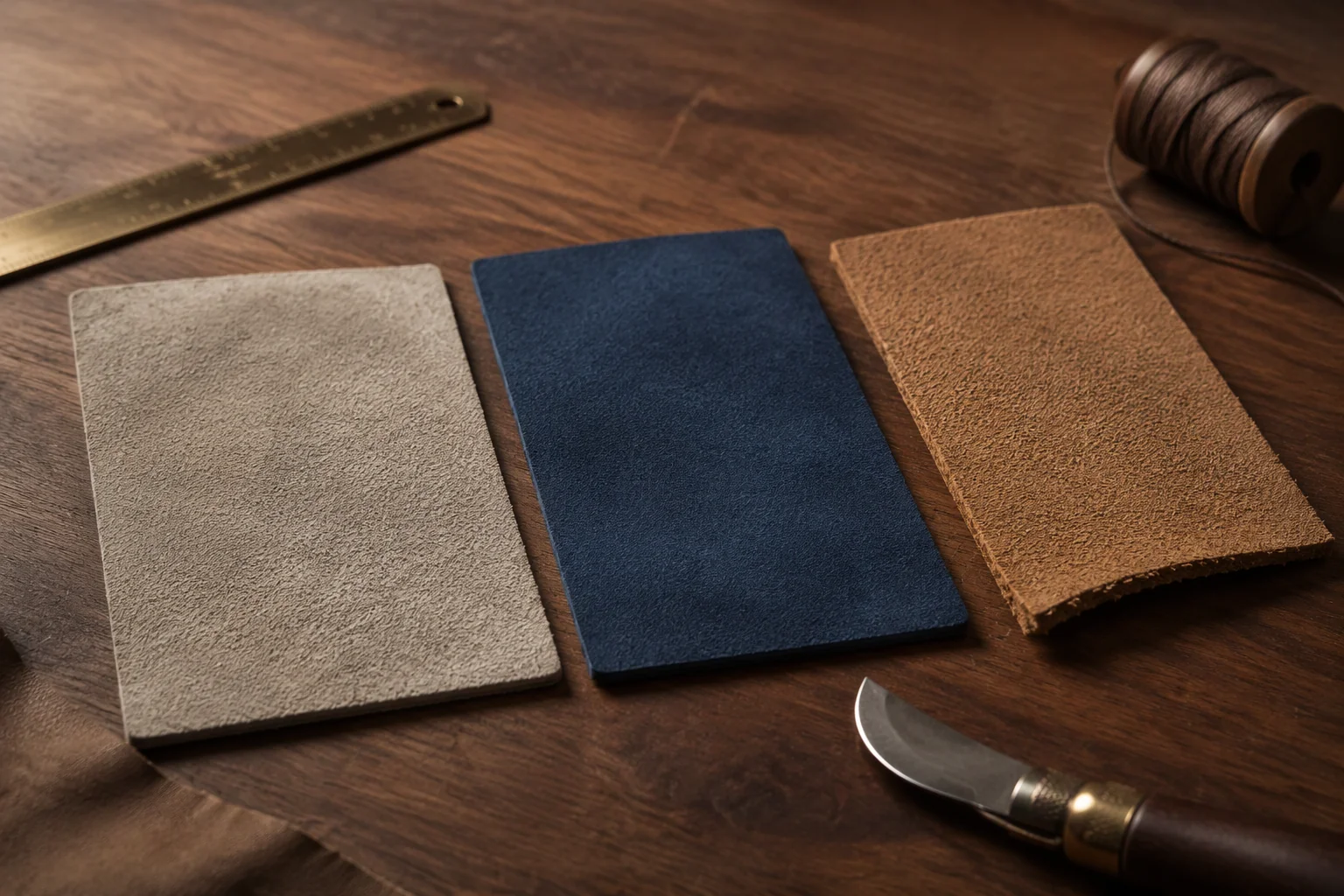
What Suede, Nubuck and Split Leather Actually Are
All three materials begin the same way: a tanned hide is run through a band knife and split horizontally into layers. What happens after that split decides everything a bag maker cares about. The top layer carries the grain, the tight fibre structure that gives leather its tensile strength and its resistance to scuffing. The lower layer, sometimes two or three slices deep, is looser, more open and less dense.
Suede and nubuck both present a raised fibre surface, which is why buyers treat them as cousins. The difference is which face of the hide was buffed to create that surface. Suede is buffed on the flesh side, the inside face of the hide. Nubuck is buffed on the grain side, the outside face, removing just enough of the top surface to raise a very fine, short nap while leaving the dense grain-layer fibre underneath largely intact.
Split leather is what is left when the grain layer has been taken off for a full-grain or top-grain programme. It has no natural grain surface at all. Depending on the tannery, a split can be sold as a raw fibre material for linings and structural work, finished with a heavy polymer coating to imitate grain, or buffed into a coarse suede-effect surface for lower-cost goods.
The Fibre Structure Behind the Surface
Fibre density is the single most useful thing to understand, because it explains almost every performance difference a brand will notice later. Grain-layer fibre in a cattle hide is tightly interwoven and oriented roughly parallel to the surface. Beneath it, the fibre bundles become progressively looser and more vertical, until the flesh side is soft, open and weak in tension.
Nubuck keeps that tight grain-layer substrate. Its nap is short and its fibres are anchored in dense material, so it resists abrasion better than its soft hand suggests. Suede is built on looser fibre and usually on a thinner split, which makes it softer, lighter and considerably more vulnerable to wear and stretch. Plain split carries the loosest structure of the three, with high elongation and low tear resistance relative to its thickness.
How Each Material Is Produced
The production route matters as much as the raw material, because two tanneries can deliver very different products under the same name. Suede is typically produced by buffing the flesh side of a split, then dyeing through the drum so the colour penetrates the fibre rather than sitting on the surface. Because the dye goes right through, suede is more resistant to surface scuffing than its delicacy implies, though the colour itself can migrate and fade.
Nubuck is normally produced from a full-grain or corrected-grain hide that is dyed through, then lightly buffed on the grain side with fine abrasive paper or brushes. Only a few hundredths of a millimetre should come off. A tannery that buffs too aggressively converts nubuck into a thin suede and destroys the property the buyer paid for.
Split leather production varies enormously. The cheapest route coats the split with polyurethane or acrylic, embosses a grain pattern and calls it finished split. A better route buffs the split into a suede-effect material, dyes it through and finishes it lightly. The structural route leaves the split unfinished or lightly retanned for use as reinforcement, pocketing and lining where nobody sees it.
Why the Three Names Get Confused in Sourcing
Three commercial habits cause most of the confusion. First, “suede” is used as a generic word for anything with a nap, including nubuck, suede-effect splits and even brushed microfibre. Second, “split” is used both for the raw intermediate layer and for the finished coated product, which are wildly different materials. Third, translations of Italian and Chinese trade terms do not map one-to-one onto English buying vocabulary.
The practical fix is procedural rather than linguistic. A purchase specification should never rely on the material name alone. It should state the fibre face, the finishing route, the substance with tolerance, the dye-through requirement and the performance tests, so that “nubuck” means one specific thing in every quotation a brand receives.
Suede, Nubuck and Split: A Comparison Table for Bag Programmes
The table below is the comparison we use when a brand asks which of the three to put on a bag. It compares the properties that actually determine whether a style survives a season of daily use.
| Property | Suede | Nubuck | Split (uncoated or suede-effect) |
|---|---|---|---|
| Wearing surface | Flesh side, buffed | Grain side, lightly buffed | No grain; buffed fibre or coated |
| Fibre density under surface | Loose to medium | Tight (grain layer intact) | Loose |
| Typical substance for bags | 0.8–1.4 mm | 1.2–1.6 mm | 1.0–1.8 mm |
| Hand feel | Soft, floppy, dry | Velvety, firm, dense | Variable; often spongy |
| Abrasion resistance | Moderate | Good | Low to moderate |
| Tear and tensile strength | Moderate | Good | Low relative to thickness |
| Stretch and recovery | Moderate, tends to relax | Low, holds shape | High, tends to sag |
| Water behaviour | Spots readily, darkens | Spots readily, beads if finished | Soaks quickly unless coated |
| Colour depth | Deep, matte, shifts with nap | Deep, slightly lustrous | Uneven; often surface-coated |
| Cost index (1 = lowest) | 3 | 4 | 1–2 |
| Cleaning tolerance | Specialist dry clean only | Specialist dry clean only | Depends entirely on coating |
| Best bag role | Linings, pockets, trim, soft bodies | Exterior panels, premium casual | Structure, backing, budget linings |
Two rows in that table carry more decision weight than the rest. The first is fibre density, because it predicts how the material will behave at the point where bags actually fail: the top edge of a pocket, the corner of a gusset, the fold behind a strap anchor. The second is stretch, because a material that relaxes under load will change the silhouette of the bag the brand approved.
From a manufacturing standpoint, “soft” is a specification with consequences. Every increment of softness in a bag body is bought with fibre density, and fibre density is what resists abrasion, sag and seam pull-out.
A common mistake is to compare the three on appearance alone, judged from a single swatch under showroom light. Appearance is the least reliable differentiator, because nap direction alone can make the same material look like two different colours. Compare on substance, fibre, backing and test data, then judge appearance on a made-up sample rather than a flat card.
Where Each Material Earns Its Place in a Bag
A bag is not one material decision; it is a set of them. The exterior body, the gusset, the pocket bags, the lining, the trim and the reinforcement each sit in a different mechanical environment, and the right answer changes from panel to panel. Treating suede, nubuck and split as a single “soft material” option wastes the strengths of all three.
The useful question is not “which is best” but “which panel, which load, which cleaning regime”. Once that is answered, the material choice usually becomes obvious, and it often turns out that the best programme uses two of the three rather than one.
Suede: Linings, Pockets and Quiet Trim
Suede’s real advantage is hand feel per gram. It gives a bag an interior that feels considered, at a fraction of the weight of a leather lining. In a tote or a shoulder bag, a suede lining or suede pocket bags turn an otherwise ordinary interior into something the customer notices every time they open the bag.
Suede also works well as exterior trim on styles where it will not take the main load: contrast panels on a flap, a base accent, a decorative band above a gusset, tassels and pulls. In these positions it delivers texture without being asked to survive abrasion at the corners or tension at the strap anchors.
Where suede should not go is any panel that will be wiped, scrubbed or repeatedly rubbed. A suede lining in the main compartment of a diaper bag is a specification that reads beautifully in a design review and fails in week two of real use. The same material used for the exterior slip pocket, a changing-pad sleeve or an internal organiser pocket is far more defensible.
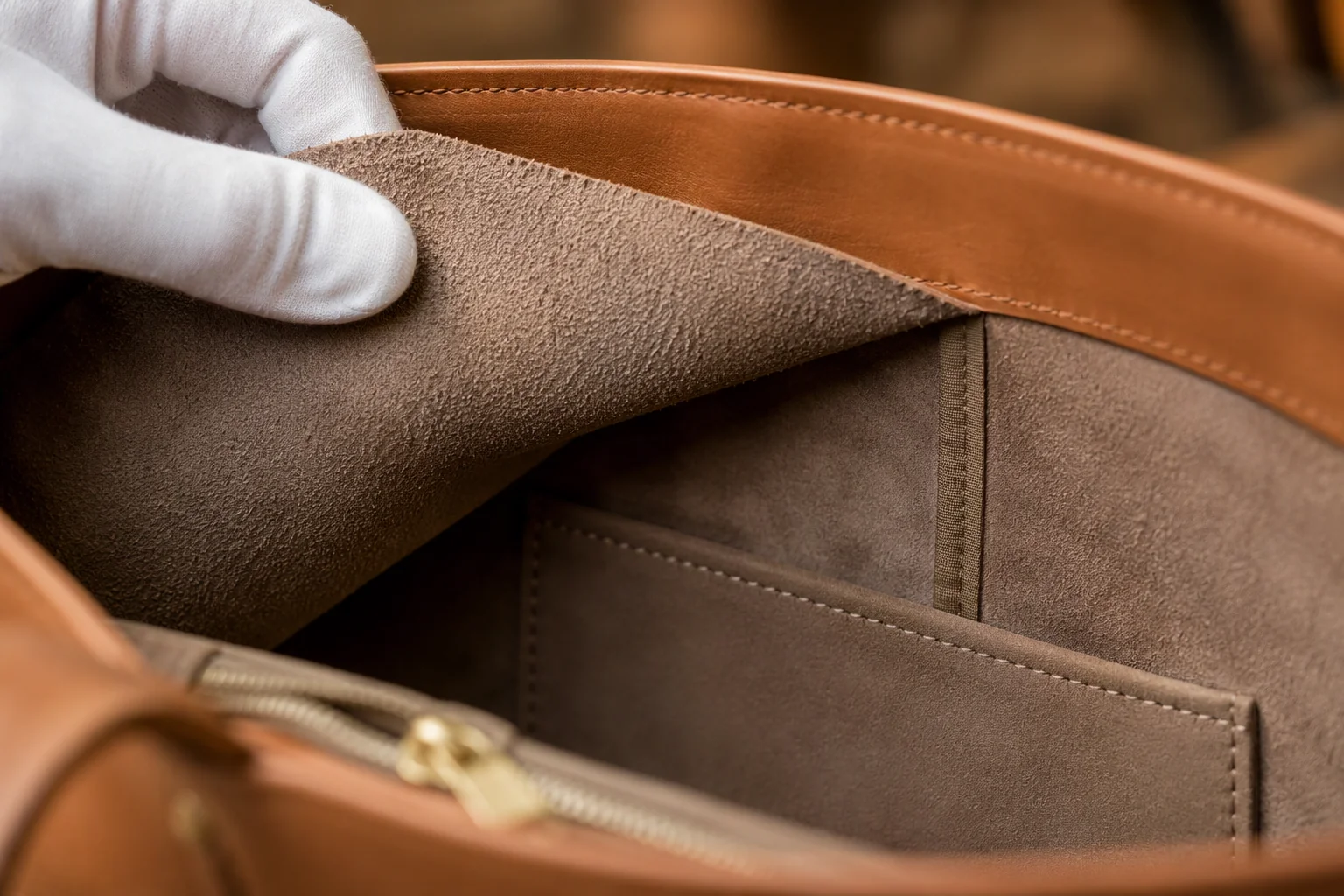
Nubuck: Exterior Panels on Premium Casual Styles
Nubuck is the best of the three for exterior use, and it is the one most often under-specified by brands that have only seen cheap imitations. Because the nap sits on an intact grain layer, a good nubuck resists scuffing, holds shape and takes a fold without collapsing. It reads as a premium casual material, softer than smooth leather and less formal than a polished finish.
Its natural home is the body of a backpack, a hobo or a soft tote, and the flap of a satchel where the panel is large and the stresses are distributed. It also pairs extremely well with smooth full-grain in the same bag: nubuck body, smooth leather trim, suede lining. That three-material construction is a familiar premium formula for good reason.
Nubuck’s weakness is staining, not abrasion. A drop of oil, a splash of coffee or a wet umbrella will mark it, and the mark cannot be washed out the way it can on a coated surface. For a diaper bag, that reality has to be designed around rather than ignored, typically by keeping nubuck on the exterior and confining it to panels away from the base.
Split: The Honest Workhorse
Uncoated split gets a poor reputation because so much of it is sold as a cheap imitation of something else. Used honestly, it is one of the most useful materials in a bag factory. It is dimensionally stable enough to back a soft panel, cheap enough to line a pocket bag, and strong enough in compression for reinforcements that nobody sees.
A suede-effect split, properly buffed and dyed through, can serve as a lower-cost visual alternative to true suede in trim positions where the customer’s hand will touch it but the bag will not load it. The trade-off is usually visible within a year: the nap flattens faster, the colour looks thinner at folds and the material creases rather than recovering.
Coated split is a different animal entirely. Once a split is given a polymer coating and an embossed grain, it is functionally a synthetic-faced material with a leather-fibre core. It can be perfectly serviceable for a price-driven programme, but it should be specified and marketed as what it is, with the coating’s performance and cleaning behaviour treated as the primary specification rather than the leather underneath.
Decision Matrix: Matching Material to Bag Type
Bag type drives the choice faster than anything else, because it fixes both the load path and the cleaning regime. A wallet is folded, sat on and handled with clean hands. A diaper bag is set down on a wet changing room floor and wiped with a disinfectant wipe. A tote carries a laptop and a water bottle and gets dragged through a commute.
The matrix below is the shortcut we use in pre-production meetings. It assumes the material will be used for the panel named, not for the whole bag.
| Bag type | Recommended material and role | Avoid | Reasoning |
|---|---|---|---|
| Diaper bag | Nubuck exterior body panels; suede trim above the gusset; coated split for interior pockets | Suede lining in the main compartment; suede on the base | Base and interior face constant wiping; nubuck gives texture where the bag is seen, not where it is scrubbed |
| Backpack | Nubuck body and flap; split as internal reinforcement; suede pocket bags | Suede on the base panel and shoulder-strap anchor | Base abrasion and strap tension demand dense fibre |
| Tote | Nubuck body for a soft look; suede lining for a premium interior | Suede exterior on a bag that will be set on the floor | Tote bases take the heaviest contact wear |
| Crossbody / shoulder | Nubuck flap; suede gusset accent; split backing | Suede on the strap itself | Straps abrade against clothing all day |
| Wallet and small goods | Suede or suede-effect split for card slots and coin-pocket linings; nubuck for exterior if the hand is fine | Plain loose split on fold lines | Folded edges need fibre that will not fray |
| Travel and duffel | Nubuck body; split reinforcement at handles and base; suede pull tabs | Suede anywhere load-bearing | High loads and rough handling expose weak fibre |
| Tech and organiser sleeves | Suede lining for device protection; nubuck exterior | Coated split against screens | Nap cushions and does not scratch |
Read the matrix as a starting point for sampling, not as a rule to defend. A brand can absolutely put suede on the exterior of a tote if the style is a special-occasion piece with a short service life and the label warns about care. What is not acceptable is doing so without telling the buyer what will happen.
The fastest way to lose money on a soft-material bag is to approve the material on a flat swatch. Approve it as a made-up panel, loaded the way the finished bag will be loaded.
There is one more variable that deserves a place in the matrix and rarely gets one: the market. Bags sold in wet climates need more stain protection and a more honest care label. Bags sold to a customer who expects to wipe everything need coated surfaces where the hand will not notice them.
How These Materials Age, and Where They Fail
Ageing is predictable, which is good news for a manufacturer. Every failure mode below has a cause in the fibre structure or the finishing, and most can be designed out or at least disclosed. A brand that understands the failure pattern can choose where to accept it and where to spend money.
Abrasion and Matting
Nap-based materials fail visibly before they fail structurally. The fibres flatten where the bag contacts the body, a seat belt or a desk edge, and the panel turns smooth and slightly shiny in patches. On suede this can happen within weeks of daily use on a high-contact panel. On good nubuck it takes far longer, because the fibres are shorter and more densely packed.
The fix is positioning, not chemistry. Keep nap materials off the panels that take repeated rubbing, or accept matting as part of the material’s character and photograph it honestly in the product imagery. Coatings that claim to lock the nap usually trade softness for durability, which defeats the reason the material was chosen.
Crocking and Colour Transfer
Crocking is the transfer of colour from the leather to whatever rubs against it. It shows up as dark marks on a pale coat or on the customer’s trousers, and it is the complaint that damages a brand fastest because it is visible in public. Deep-dyed suede and nubuck are usually better than surface-coated materials, but wet rubbing is the hard test, and dyestuff selection matters more than colour depth.
Specify colour fastness to rubbing on both dry and wet cloth, and ask for the test report from the production lot rather than from a development sample. Wet fastness is where cheap dyeing shows itself. If the bag will be sold in a humid market or worn against light clothing, this is not an optional test.
Water, Staining and Cleaning Limits
Water behaviour is the weakest point of both suede and nubuck. A light shower can leave tide marks that no domestic remedy removes, because the water carries dissolved salts and dirt into the fibre and dries unevenly. Fluorocarbon-free repellent finishes reduce spotting but do not make the material waterproof, and repellent chemistry is under increasing regulatory pressure in the EU and parts of the United States.
The practical answer is a cleaning instruction that matches the material. Suede and nubuck should never be machine washed, soaked or scrubbed with detergent. They should be brushed when dry, spot-treated with a dedicated suede cleaner and, for anything serious, sent to a leather specialist. A brand that prints “wipe with a damp cloth” on a suede bag has written a complaint.
Edge and Seam Failure
Edges are where nap materials reveal their limits. A raw suede edge cannot be painted or burnished to a clean line, because there is no grain surface for the finish to bond to and the fibre keeps wicking. Edges therefore have to be folded, bound, taped or turned, all of which add operations and add bulk at the seam.
Seams fail differently. Because suede and split have lower tear strength in the direction perpendicular to the seam, a stitch line close to an edge can pull out under load, especially at strap anchors and pocket mouths. Wider seam allowances, reinforcement tape and a slightly longer stitch length all help. So does honest load testing on the made-up bag rather than on a swatch.
Specifying Suede, Nubuck and Split Correctly
A specification is a contract, and most soft-material disputes trace back to a specification that described a look instead of a material. The following fields are the minimum we ask a brand to agree before a tannery quotation is requested.
Substance and Tolerance
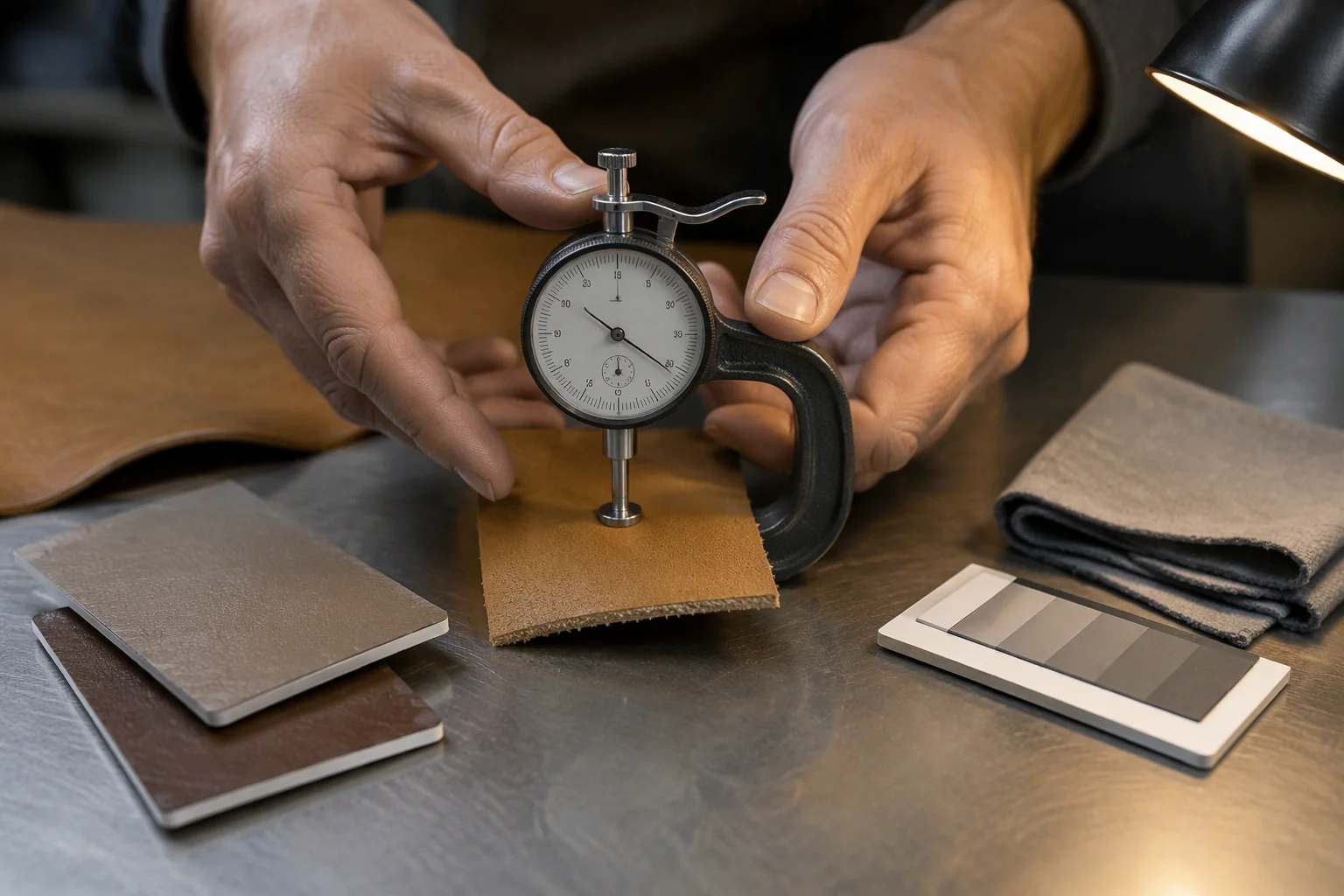
Substance, the leather industry’s term for thickness, drives hand feel, weight and cost simultaneously. A bag nubuck is normally specified in the 1.2 to 1.6 mm range, a suede lining around 0.6 to 0.9 mm, and a structural split from 1.0 mm upward depending on the panel. Tolerance matters as much as the nominal figure, because a lot that arrives at the top of the range will feel stiff and a lot at the bottom will feel floppy.
Specify substance in millimetres with an explicit tolerance, measured at defined points across the hide. Measurement location is not a detail: hide thickness varies from butt to belly, so a supplier can legitimately meet a nominal figure at the butt and miss it at the belly.
Nap Direction and Panel Layout
Nap is directional. Run your hand along the surface and then against it, and the colour will shift. Every panel in a bag must therefore be cut in the same nap direction, or the finished bag will show mismatched panels that no amount of pressing will fix.
This has a direct cost consequence that belongs in the quotation. Nap control and defect avoidance reduce usable area, so pattern nesting for nap materials typically needs a larger hide allowance than for smooth leather. Plan on a materially lower yield, and ask the factory to confirm the nesting allowance in writing.
Backing, Reinforcement and Interlining
Suede and split usually need help to hold a shape. The options are a fusible interlining, a sewn-in reinforcement such as a non-woven or a thin board, or a laminated backing applied at the tannery. Each one changes the hand, and each one changes what happens when the bag is cleaned.
Heat fusing onto nap is riskier than onto smooth leather. The adhesive must wet out through the fibre, the press temperature must stay low enough not to flatten the nap permanently, and the panel must be cooled under pressure to avoid a shiny patch. If a factory fuses at the same settings it uses for full-grain, the bag will show press marks on the exterior within a week.
What Belongs on the Specification Sheet
| Field | Why it matters | Example entry |
|---|---|---|
| Fibre face and finish route | Defines the material rather than its name | Grain-side buffed, dyed through, no surface coating |
| Substance and tolerance | Controls hand, weight and cost | 1.3 mm ±0.15 mm |
| Hide or split origin | Predicts fibre density and stretch | Cattle hide split, grain removed, suede-effect buffed |
| Nap and colour | Prevents mismatched panels | Single nap direction, colour matched to approved swatch |
| Backing or interlining | Determines shape retention | 40 g non-woven laminated, low-temperature fusible |
| Performance tests | Sets pass or fail objectively | See quality-control section |
| Cleaning instruction | Aligns label with reality | Brush dry, spot clean, specialist clean only |
| Yield allowance | Makes the quote comparable | Nesting allowance stated as square feet per bag |
The last row is the one buyers forget. Two quotations for the same bag in the same material can differ by a wide margin simply because one factory assumed a generous yield and the other assumed a realistic one. Normalising yield is how a brand compares suppliers honestly instead of comparing optimism.
On the Factory Floor: Cutting, Sewing and Finishing
Once the material is approved, the work moves to people who have to make it behave at production speed. This is where soft materials become expensive, because almost every operation has to be adjusted rather than run on the settings used for smooth leather.
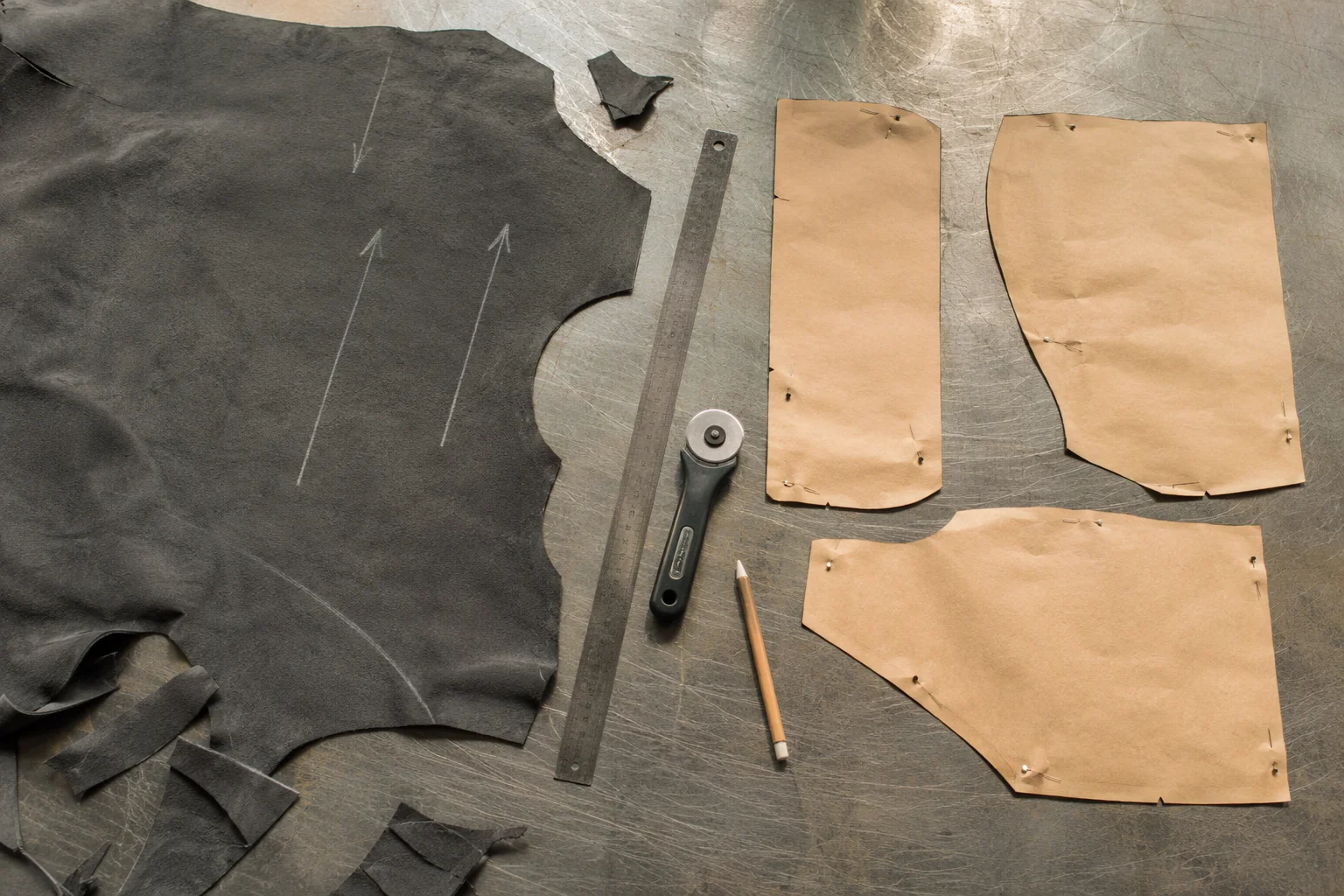
Nesting and Nap Control
Cutting a nap material is a discipline, not a layout exercise. Panels are arranged in one direction, defects are marked before nesting rather than discovered after cutting, and the cutter must not rotate a pattern to squeeze in one more piece. A rotated panel becomes a colour-mismatch claim three months later.
Small parts are where nap discipline breaks down. Pocket flaps, tabs and pulls are often cut last, from offcuts, by whoever is free. That is exactly how a bag ends up with a flap that looks a shade darker than its body. Give small parts their own cutting instruction and keep them with the parent panel through the line.
Skiving, Seam Bulk and Needle Choice
Suede and split skive willingly but fuzz at the edge, and the skived edge is mechanically weaker than the same edge in a tight-grain leather. Where a smooth leather would be skived and folded once, a nap material often needs a bound or taped edge to stop fibre shedding into the seam.
Needle choice affects the visible result. A leather-point needle separates fibre rather than cutting it, which reduces the risk of a tear line along the stitch. Stitch length on nap materials is generally longer than on smooth leather, because a tight stitch line compacts the fibre and creates a groove that later cracks. Thread should be a bonded synthetic, sized to the material’s strength rather than to the machine’s habit.
Backstitching is the other quiet failure. Reversing over a nap seam cuts the fibre beneath the top surface, and the damage only appears after the bag has been used. Lock the seam with a thread end or a short overlap instead.
Adhesives and Bonding
Nap absorbs adhesive. A coat weight that bonds two smooth leather panels will disappear into a suede surface and leave a dry joint that fails in the field. Factories that work mostly in smooth leather routinely underestimate this, and the failure shows up as a lifted lining or an opening edge rather than as an obvious production defect.
Water-based adhesives are the default for most export programmes now, but they need adequate open time and controlled humidity to develop strength. Spray application with proper extraction gives more even coverage on nap than roller application. Whatever the system, the bonded sample should be pull-tested, not simply inspected.
Edge Treatment and Finishing
Edge paint on nap is unreliable unless the edge is first consolidated. The options are a folded and stitched edge, a bound edge in a contrasting material, an edge tape, or a primer coat that seals the fibre before painting. Each adds cost and each looks different, so the choice belongs in the design review rather than on the line.
Burnishing, the wax-and-friction technique used on vegetable-tanned edges, does not work on suede. The fibre simply lifts. Brands sometimes ask for it because a reference bag had it, without realising that the reference bag was made from a different material entirely.
Pressing, Packing and Protection
Pressing a nap bag is a controlled operation. Steam collapses the nap, direct heat glazes it, and a hot press plate leaves a permanent shine. Use low temperature, a protective cloth and short dwell, and let the panel cool before it is folded or packed.
Packing deserves the same attention. Nap materials mark against cardboard, absorb plasticiser from cheap bags and pick up dye from anything pressed against them. Individual tissue wrapping and a clean, dry carton are not luxuries here; they are the difference between a bag that arrives as approved and one that arrives with a pattern transfer from its own dust bag.
Quality Control: What to Check and When
Soft materials need their own inspection routine, because the defects that matter are not the defects an inspector trained on smooth leather looks for. The following checks are the ones that catch problems before they become claims.
Incoming inspection, on receipt of each lot:
- Confirm fibre face and finishing route against the approved standard, by hand and by eye under raking light.
- Measure substance with a dial gauge at multiple points, including belly and shoulder areas.
- Check nap direction consistency across the lot and against the sealed reference.
- Run a dry and wet rub test on a hidden area and compare against the reference card.
- Check for grain damage, buffing burn-through, coating cracks and uneven dye penetration at cut edges.
- Verify the lot matches the approved colour under daylight, not only under factory lighting.
Inline checks, during cutting and assembly:
- Confirm every panel in a bag was cut in the same nap direction.
- Check skived edges for fibre shedding and seam thickness at joins.
- Pull-test bonded edges and linings at the start of each shift.
- Inspect stitch lines for fibre cutting, skipped stitches and over-compression.
- Check that fused reinforcement has not glazed the exterior surface.
Final inspection, before packing:
- Surface appearance under raking light, from both directions, on every unit.
- Edge finish integrity at high-flex points.
- Colour consistency between body, flap, trim and lining.
- Cleanliness: nap materials show handling marks, so gloves and clean benches matter.
- Packing protection against transfer and compression.
Testing belongs on the specification sheet with named methods. Tensile strength and elongation are commonly assessed under ISO 3376, tear load under ISO 3377-2, thickness under ISO 2589, colour fastness to rubbing under ISO 11640, and abrasion under taber-type methods such as ISO 17076-1. Ask for reports from the production lot, dated, and keep them with the shipment record.
Care Expectations and What the Label Should Say
The care instruction is part of the product, not paperwork. A bag made from nap material that is labelled as if it were a coated bag will generate returns no matter how well it was manufactured.
For suede and nubuck, the honest message is short. Brush the surface when dry to lift the nap, treat fresh marks promptly with a cleaner formulated for suede, keep the bag away from prolonged rain, and use a specialist for anything more serious. Store it stuffed and dust-bagged rather than folded, because a crease in nap material becomes permanent.
For split, the instruction depends entirely on the finish. An uncoated or suede-effect split follows the same rules as suede. A coated split can usually be wiped, but the coating has its own limits: solvents, alcohol-based sanitisers and abrasive cloths will dull or lift it, and once a coating is damaged it cannot be repaired locally.
If the factory and the brand cannot agree on a care instruction in the development stage, that is a signal the material choice is not settled yet. Care labels written at packing time are written too late.
Cost, MOQ and Sourcing Reality
Cost comparisons between these materials are only meaningful when they are made per finished bag rather than per square foot. A cheaper material with a lower yield and three extra edge operations can easily cost more than the material it replaced.
Three cost drivers dominate. The first is raw material price per square foot, where split sits lowest, suede in the middle and good nubuck closer to full-grain. The second is yield, where nap direction and defect avoidance can consume a significant share of the hide. The third is operations, where folded or bound edges, extra reinforcement and slower sewing add labour that does not appear on the leather invoice.
Minimum order quantities follow the tannery, not the bag factory. Nubuck and good suede are usually dyed in drum lots, so a small colour run may be impractical or may carry a surcharge. Split is more forgiving because it is often stocked and because a coated split can be produced in smaller batches.
The most reliable sourcing arrangement for these materials is a direct relationship with a tannery that specialises in them, plus a factory that has made the material before. A factory learning nap handling on a brand’s first order is a hidden cost that shows up as rework, delay and a slightly different bag at the end of the run.
Common Mistakes That Cost Brands Money
- Specifying “suede” without stating the fibre face, so quotations arrive for three different materials.
- Approving a material from a flat swatch instead of a made-up panel under load.
- Using suede in a diaper bag interior that will be wiped with sanitiser daily.
- Cutting small parts from offcuts without nap control, producing visible shade differences.
- Applying smooth-leather press settings to a nap surface and glazing the exterior.
- Assuming edge paint will hold on a raw suede edge without consolidation.
- Comparing quotes without a stated yield allowance, which makes the cheapest quote look best.
- Writing a care label that promises wiping on a material that cannot be wiped.
Each of these is cheap to prevent at the specification stage and expensive to fix after shipping. None of them requires new technology, only a clearer agreement about what is being made.
FAQ
Is nubuck more durable than suede for a bag?
Yes, generally. Nubuck’s nap sits on an intact grain layer, so the fibre beneath it is denser and better able to resist abrasion, stretch and seam pull-out. Suede is built on a thinner, looser split. Nubuck is therefore the better choice for exterior body panels, while suede is better suited to linings, pocket bags and trim.
Can a diaper bag use suede or nubuck at all?
It can, with placement rules. Keep nap materials on the exterior and away from the base, which takes the most contact wear and wiping. Use coated or wipeable material for the main compartment lining and interior pockets. A suede lining in a compartment that will be disinfected daily is a specification that will fail in use.
What is the difference between split leather and genuine leather?
Split leather is a specific layer of the hide, taken below the grain. “Genuine leather” is a marketing term rather than a technical grade, and it is often applied to finished splits, coated splits or lower-grade top grain. For production purposes, ask for the fibre face, the finishing route and the substance rather than relying on either term.
How thick should nubuck be for a bag?
Most bag bodies work well between 1.2 mm and 1.6 mm, with the lower end for soft slouchy styles and the upper end for structured backpacks and totes. Specify a tolerance as well as a nominal figure, and state where on the hide the measurement is taken, because thickness varies from butt to belly.
Why do suede and nubuck change colour when you brush them?
The nap is directional. Fibres lean one way and reflect light differently depending on the angle, so the same panel can look several shades apart when brushed in opposite directions. This is normal and is why all panels in a bag must be cut in one nap direction.
Can suede edges be painted like other leather edges?
Not reliably. Edge paint needs a consolidated surface to bond to, and a raw suede edge keeps wicking and shedding fibre. The practical options are folding, binding, edge tape or a primer system, each of which changes the look and the cost. Burnishing does not work on suede either.
Does a water-repellent finish make suede waterproof?
No. A repellent finish reduces spotting and slows absorption, but suede and nubuck remain permeable and will still mark in sustained rain. Repellent chemistry is also under increasing regulatory pressure, so confirm which finish is being used and whether it meets the destination market’s requirements.
How much does nap direction affect material yield?
It reduces usable area, because panels must all run one way and defects must be avoided within that constraint. The exact penalty depends on the style’s panel shapes, but it is large enough that quotations without a stated yield allowance are not comparable. Ask the factory to state the nesting allowance in square feet per bag.
Which of the three is best for a premium-looking bag on a tight budget?
Usually a good suede-effect split in trim positions combined with a denser material where the bag takes load, rather than a low-grade nubuck everywhere. The perception of quality comes mostly from the interior and the edges, so spending there while keeping cost out of hidden structure is the more effective trade.
Conclusion
Suede, nubuck and split are three answers to the same design request, and the difference between them is the difference between a bag that ages well and one that generates complaints. The material name on a purchase order does not control that outcome. The fibre face, the substance, the nap control, the edge construction and the care instruction do.
For a brand, the working method is straightforward. Decide per panel rather than per bag, match the material to the load and the cleaning regime, specify substance and tests in writing, and approve a made-up sample instead of a swatch. For a factory, the discipline is nap control, adjusted sewing and pressing settings, and edge constructions that respect what the fibre will actually do.
Get those five things right and nap materials stop being a risk category. They become what they should be: a way to give a bag a softer surface, a warmer interior and a texture that smooth leather cannot offer at any price.
