
Full-Grain vs Top-Grain vs Genuine vs Bonded Leather: How Each Grade Behaves on a Bag Factory Line
# Full-Grain vs Top-Grain vs Genuine vs Bonded Leather: How Each Grade Behaves on a Bag Factory Line
Most buyers choose a leather grade from a sample card and a price per square foot. Then they find out during production that the grade they picked does not skive cleanly, does not hold an edge paint, frays at every seam end, or delaminates six months after the bag ships. The sample card never mentions any of that, because the sample card was made to be looked at, not cut.
This article looks at the four grades buyers argue about most — full-grain, top-grain, genuine, and bonded leather — from the only angle that decides whether a bag programme succeeds: how each one behaves once it reaches the cutting room, the sewing room, the edge-finishing bench, and the warranty desk. We build leather bags and diaper bags for brands that specify all four grades, and we track the same data on every one of them: yield per hide, rejects per thousand panels, rework hours, and claims per thousand units.
The grades are not a simple quality ladder. They are four different materials with different fibre structures, and each one asks something different from the factory. A top-grain body panel and a bonded leather trim can both be correct choices in the same bag. What is not correct is writing “genuine leather” on a purchase order and assuming the factory knows what you mean, or budgeting for full-grain and receiving a hide with a corrected grain that will not patina the way the sample did.
Manufacturer’s note: Grade is a statement about fibre structure, not about animal species, thickness, or country of origin. Two panels from the same cowhide can end up as full-grain and as split leather. Any specification that does not describe the fibre structure is not a specification — it is a hope.
- What “Grade” Actually Describes, and Why It Decides Your Production Risk
- The Four Grades, Defined Without Marketing Language
- At-a-Glance Comparison: All Four Grades Side by Side
- Cutting Room: Where Grade Becomes Yield, and Yield Becomes Cost
- Sewing Room: Needle, Thread, and Seam Behaviour by Grade
- Edge Finishing: The Step That Separates a Premium Bag From a Cheap One
- Reinforcement and Structure: Each Grade Needs a Different Backbone
- Temper, Break-In, and How Each Grade Ages in the Owner’s Hands
- Process Behaviour Matrix: What Each Grade Asks of the Factory
- Where Each Grade Belongs: A Component-Level Decision Matrix
- Cost: Why Price per Square Foot Is the Wrong Number to Compare
- Incoming Inspection: Four Tests That Catch a Grade Substitution
- Writing Grade Into the Purchase Order
- FAQ
- Conclusion: Specify the Structure, Not the Adjective
What “Grade” Actually Describes, and Why It Decides Your Production Risk
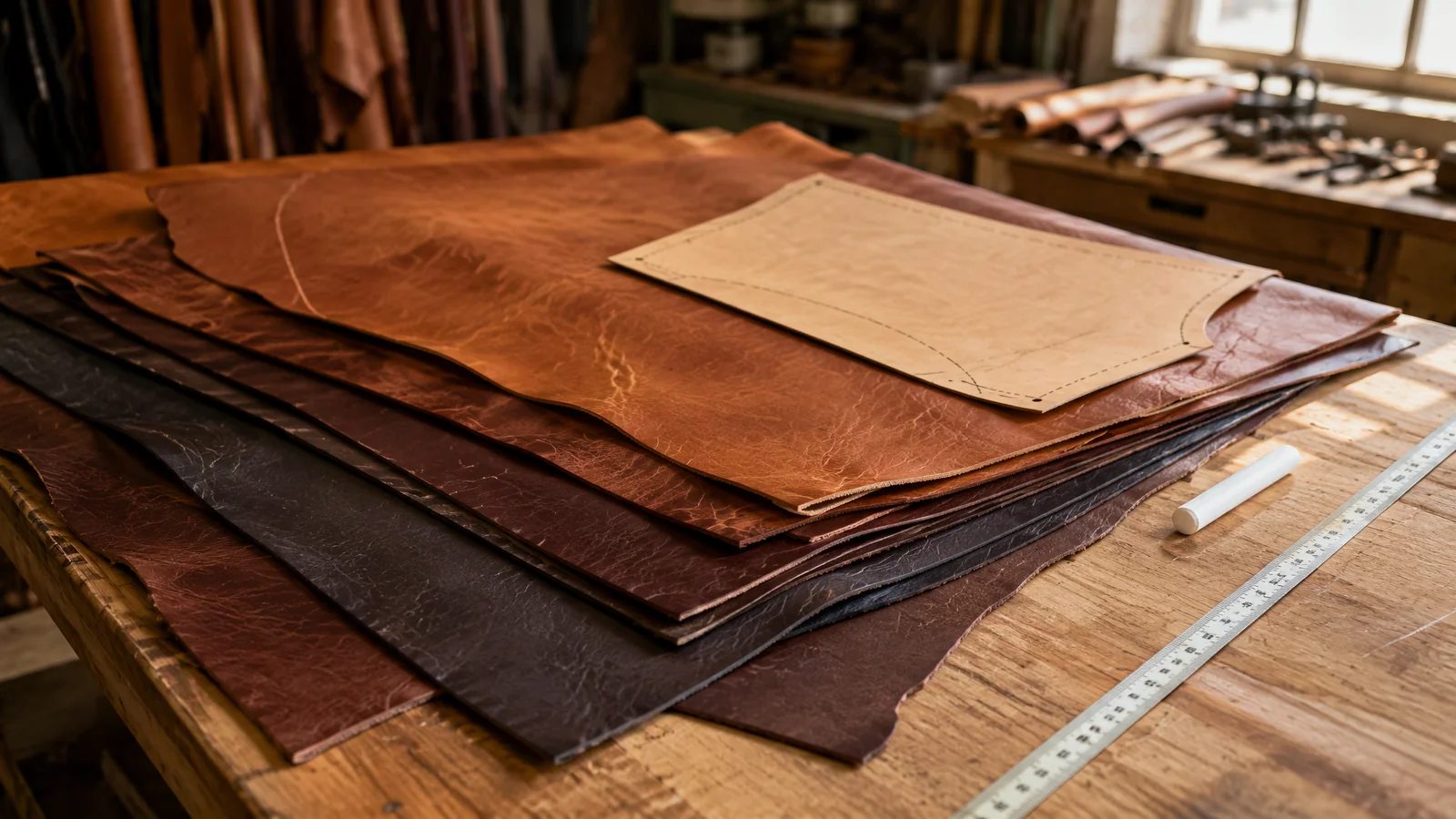
A hide is a three-dimensional structure, not a flat sheet. The top layer — the grain — is dense, tight, and made of small interlocking fibre bundles. Below it, the corium becomes progressively looser and more open until it reaches the flesh side. Everything the industry calls “grade” is a description of how much of that structure survives into the finished panel, and how much of the grain surface is still the animal’s own.
That single fact explains almost every production difference between the four grades:
- Full-grain keeps the entire grain layer, unaltered, with its original topography and pore structure.
- Top-grain keeps the upper portion of the hide but has the grain surface lightly removed or corrected, then finished.
- Genuine leather (the trade term for split leather finished as a surface) starts below the grain, so the surface you see is applied, not grown.
- Bonded leather has no continuous fibre structure at all; it is leather fibre reconstituted with a binder and rolled into a sheet.
Each step down that list removes structure and adds a manufacturing process. Removed structure cannot be sewn back in, and added process creates failure modes that the factory has to inspect for. When a brand tells us a bag “failed in the field,” we can usually predict the failure mode from the grade alone before we see the returned unit.
The commercial consequence is that grade sets your cost structure in three places at once: the price per square foot, the yield you actually achieve per hide, and the labour and rework content per bag. Buyers usually compare only the first number. The other two are frequently larger.
The Four Grades, Defined Without Marketing Language
Full-Grain Leather: The Intact Grain Layer
Full-grain leather is the outer surface of the hide, hair removed, tanned, and finished without sanding or correcting the grain. What remains is the animal’s own surface: pores, healed scars, neck wrinkles, stretch marks, and the natural variation that comes from an animal living outdoors. Nothing is applied to imitate grain, and nothing is removed to hide a defect.
Mechanically, this is the strongest sheet of leather you can buy per unit of thickness. The grain layer carries the highest fibre density in the hide, so it resists abrasion, holds shape, and takes a bend without cracking. It also has the best tear strength at the same ounce weight, which is why full-grain straps can be made thinner than split-leather straps and still pass a pull test.
The cost of that strength is variability. Full-grain hides carry the animal’s history, and a buyer who wants 500 identical panels from 500 hides is asking the tannery for something full-grain leather does not provide. Factories handle this with defect mapping, tighter nesting, and a grade rule written into the purchase order: how many scars per panel are acceptable, on which parts of the bag, and at what size.
Manufacturer’s note: A full-grain programme without a written defect-tolerance rule will always end in an argument. Decide before sampling whether a healed scar on the front panel is character or a reject. Both answers are legitimate; having no answer is what costs money.
Top-Grain Leather: Grain Retained at the Surface, Corrected Above It
Top-grain leather is cut from the upper part of the hide, and the very top of the grain is lightly sanded or buffed away before a finish is applied. The result is a surface that is still leather, still dense, and far more uniform than full-grain — but the outermost, tightest layer of the fibre structure is gone.
In the factory, top-grain is the easiest of the four real-leather grades to run. Panels match, thickness is consistent, the surface accepts edge paint and adhesive predictably, and defect density is low enough that nesting waste drops noticeably. For a brand building a uniform-colour collection across several styles, top-grain removes an entire category of buyer complaints about panel mismatch.
The trade-off appears over time rather than on the line. A corrected top-grain has less ability to develop patina, because the surface is a finish rather than bare grain. Where a full-grain bag darkens and polishes with use, a corrected top-grain tends to wear through its finish at the highest-abrasion points — top corners, handle edges, the base — and show a lighter substrate before a full-grain bag shows anything at all. Both are durable; they age differently, and the difference is visible in year two, not month two.
Genuine Leather: A Split With a Manufactured Surface
In the trade, “genuine leather” describes split leather — the lower layer of the hide, below the grain — that has been finished with an applied surface to look like grain. It is genuinely leather in the legal sense in most markets. It is not a grain-bearing material, and that distinction is what matters on the line.
A split has an open, fibrous structure. Its surface is a coating, and the bond between that coating and the fibrous substrate is the weakest interface in the material. Cutting a split generates a fuzzy edge that must be sealed, not just painted. Skiving it produces a friable, dust-generating edge. Seam ends fray, so every stitch line needs backstitching or a bar tack, and every raw edge needs either a folded construction or a sealed finish.
Genuine leather’s real strength is economics and uniformity. It is inexpensive, consistent, available in large matched runs, and can be embossed or printed to a consistent pattern at scale. For a lining-side pocket, a hidden reinforcement panel, or a mid-price bag where the surface will be seen but not stressed, it does a job. For a high-stress part — a handle root, a strap anchor, a base panel — it is the wrong material, and no amount of finishing changes the fibre structure underneath.
Bonded Leather: Reconstituted Fibre, Not a Hide
Bonded leather is made from leather fibre — shavings, trimmings, and buffing dust — mixed with a polyurethane or latex binder, then rolled or pressed onto a backing and embossed with a grain pattern. It contains leather, which is why the word appears on the label, but it has no continuous fibre network and therefore no directional strength.
On a factory line, bonded leather behaves more like a coated paper board than like leather. It cuts cleanly and cheaply, it needs no skiving skill, and it holds a crease well. It also has poor tear strength in thin sections, almost no elasticity, and a hard limit on flex cycles: repeated folding at the same line — a flap hinge, a wallet fold, a zip gusset — will crack the binder, and once the binder cracks the material separates. Its edges cannot be burnished into a leather edge, only painted or folded.
Used honestly, bonded leather has a legitimate place in low-cost structured goods, rigid box components, and decorative panels that never flex. Used as a substitute for the material shown in a sample, it is the single most common cause of a brand’s first-year warranty problem — and the failure is predictable enough that our incoming inspection rejects bonded sheet presented as split or top-grain on sight, every time.
At-a-Glance Comparison: All Four Grades Side by Side
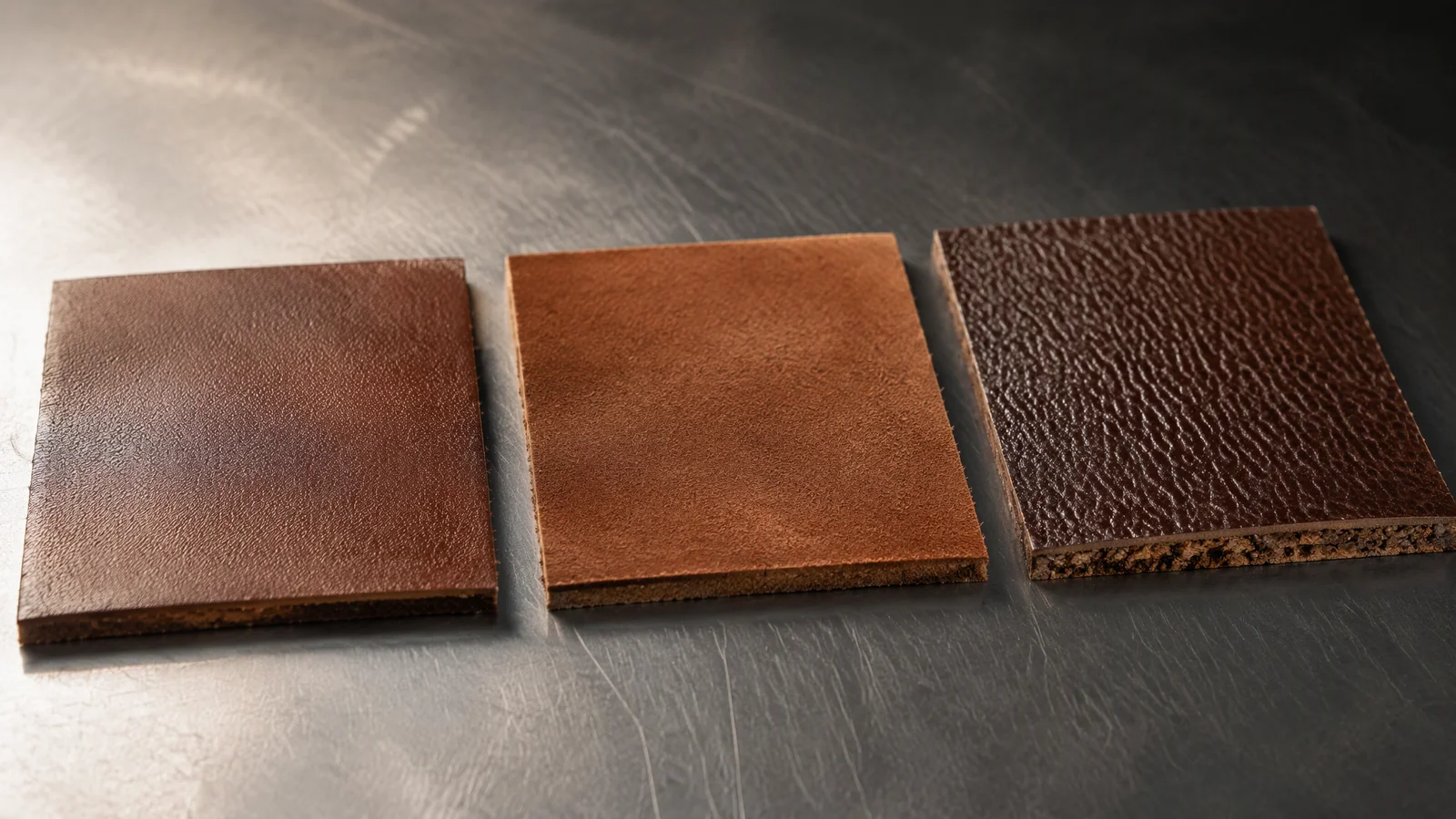
The table below is the summary we use when a buyer needs one page to take to a product meeting. The figures are typical ranges from our own incoming inspection and production records across cowhide and buffalo programmes; they are not laboratory absolutes, and any specific tannery lot must be verified on its own test report.
| Attribute | Full-Grain | Top-Grain | Genuine (Split) | Bonded |
|---|---|---|---|---|
| Fibre structure | Intact, dense grain through upper corium | Intact upper corium, grain surface removed | Open corium, no grain layer | Reconstituted fibre, no network |
| Surface | Natural, untreated topography | Corrected and finished | Applied coating or emboss | Embossed film on fibre sheet |
| Typical thickness range | 1.0–2.0 mm (2.5–5 oz) | 1.0–1.8 mm (2.5–4.5 oz) | 1.0–1.6 mm (2.5–4 oz) | 0.6–1.2 mm (1.5–3 oz) |
| Abrasion resistance | High to very high | High | Moderate, coating-dependent | Low to moderate |
| Tear strength at equal thickness | Highest | High | Moderate | Lowest |
| Flex endurance at a fold line | Excellent | Good | Fair | Poor |
| Panel-to-panel uniformity | Low, natural variation | High | High | Very high |
| Patina development | Yes, over years | Limited | None | None |
| Cutting yield per hide | Lowest, defect-driven | Moderate | High | Highest |
| Skiving behaviour | Clean, holds a skived edge | Clean | Fuzzy, dust, edge sealing required | Crumbles in thin skives |
| Edge finishing | Burnish, paint, or fold | Paint or burnish | Sealed and painted, or folded | Paint or folded only |
| Repairability | High, can be refinished | Moderate | Low | Very low |
| Relative material cost | Highest | Mid to high | Low to mid | Lowest |
| Typical service life in a bag | 10+ years with care | 5–8 years | 2–4 years | 1–2 years |
Reading the table across rows rather than down columns is what makes it useful. A brand that wants a 10-year bag but budgets bonded leather is not making a compromise; it is specifying two contradictory requirements in the same document. A brand that wants uniform colour across five styles and specifies full-grain without a colour-matching protocol is doing the same thing from the other direction.
Cutting Room: Where Grade Becomes Yield, and Yield Becomes Cost
The cutting room is where the grade decision is first tested against reality, because this is the only department that sees every square inch of the hide. A buyer sees a 30 cm swatch. A cutter sees 4.5 square metres of material, and knows within a minute how much of it will become bag and how much will become offcut.
Defect Mapping and Nesting Waste
Full-grain hides carry natural defects: scars, tick marks, veininess, growth marks, and areas of loose structure near the belly and shoulder. A cutter working full-grain builds a mental defect map and nests pattern pieces around it, placing the cleanest panels on visible front and flap surfaces and pushing marked material towards gussets, bases, and interior parts. That skill is real, and it costs money — a trained cutter on a full-grain programme typically needs 15–25% more time per hide than on a uniform split.
The measurable result is yield. On comparable styles, we see roughly 78–85% usable yield on good full-grain lots, 85–90% on top-grain, and 90–95% on split and bonded. Translated into material cost per finished bag, a hide priced 20% higher can end up 30–35% more expensive per bag once yield is applied. Buyers who compare only price per square foot systematically underestimate full-grain by a wide margin.
The trade-off is consistent across all four grades: the more structure a material retains, the more the cutter must work around, and the higher the skill requirement on that hide. Bonded sheet nests like a textile and almost never needs a decision.
Manufacturer’s note: Ask for yield, not just price. A quote that states “$X per square foot” without a yield assumption for your specific style is not a cost — it is a starting position for a later conversation about who absorbs the shortfall.
Skiving, Splitting, and Thickness Tolerance
Most bag construction requires skiving: thinning the leather at seam allowances, folded edges, and where panels overlap. Full-grain and top-grain skive cleanly, and a competent operator can hold ±0.1 mm on a well-maintained skiving machine. Splits skive with more resistance and produce a fuzzy, dusty edge that will not hold a fold neatly without adhesive and reinforcement.
Bonded leather is the problem case. Below roughly 0.6 mm, the skived edge begins to crumble, and the material can delaminate from its backing during the operation itself. If your design calls for thin, folded edges, bonded leather cannot deliver them reliably regardless of operator skill.
Thickness tolerance matters just as much as thickness itself. A tannery lot specified at 1.4 mm that arrives between 1.2 and 1.6 mm will produce bags that feel different from one another even when every panel is within tolerance. That is tolerable on a slouchy hobo. It is not tolerable on a structured tote with a sewn-in base board, where a 0.2 mm variance changes whether the base sits flat.
Sewing Room: Needle, Thread, and Seam Behaviour by Grade
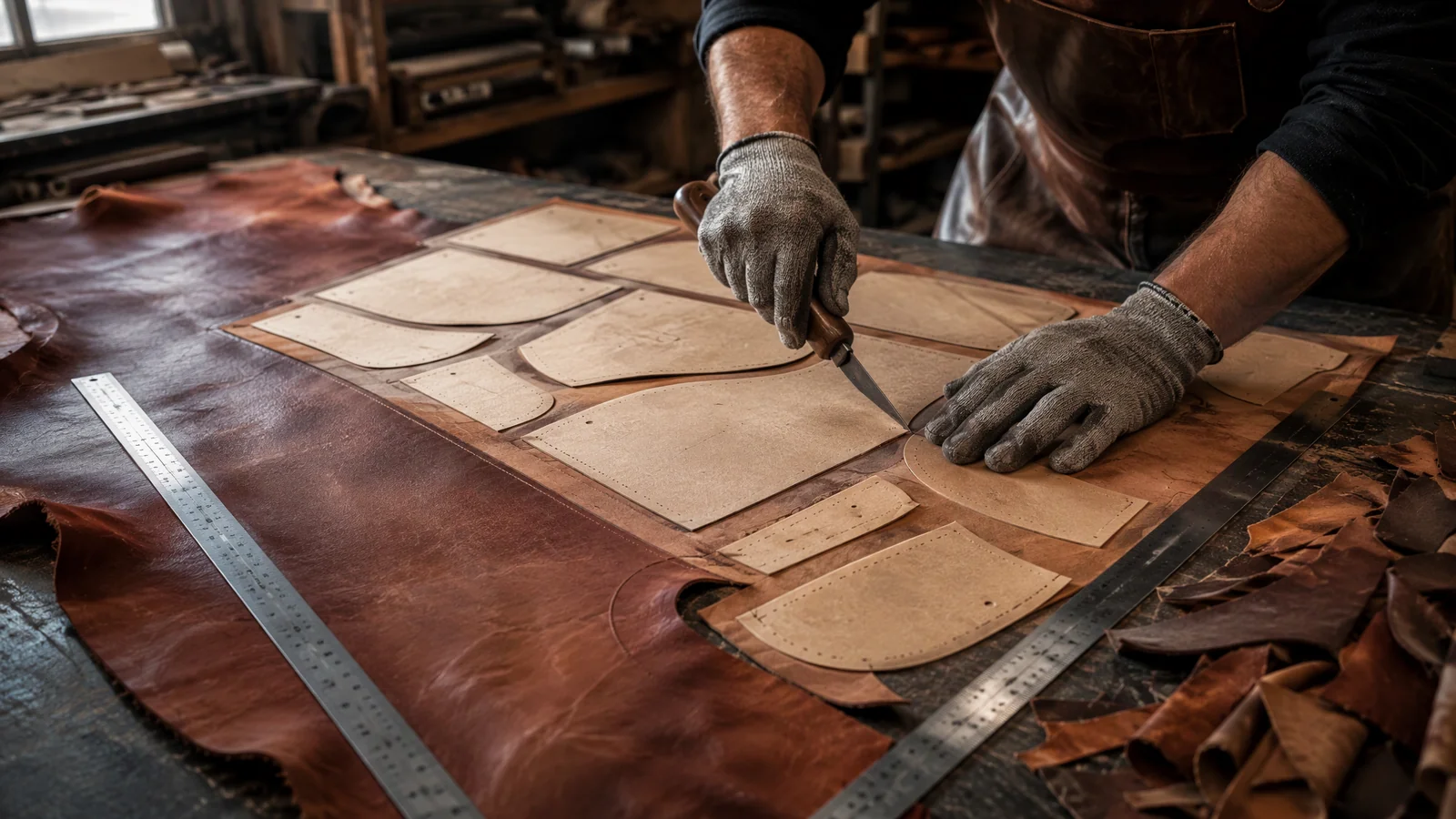
Sewing is where the difference between a grain-bearing material and a coated one becomes audible. Experienced operators can hear a split being sewn; the machine note changes, and so does the defect rate.
Needle and Thread Selection
Leather is sewn with a cutting-point needle, usually a wedge or diamond point, which separates fibres rather than punching through them. The correct size follows the material and the thread:
- Full-grain at 1.2–1.8 mm with 138 bonded nylon: 130/21 needle, 7–8 stitches per inch, seam allowance 8–10 mm.
- Top-grain at 1.0–1.4 mm with 92–138 thread: 120/19 to 130/21 needle, 8 stitches per inch.
- Genuine split at 1.0–1.4 mm: 110/18 to 120/19 needle, with sealed seam ends and backstitching at every termination.
- Bonded leather at 0.6–1.0 mm: 100/16 to 110/18 needle, shorter stitch length, and a reinforced backing strip wherever the seam carries load.
Using a leather-point needle on bonded leather is a common error. The cutting point slices the thin fibre sheet, and the seam pulls through under load. A light round point with a backing reinforcement performs better on reconstituted material, even though it contradicts the habit of “leather gets a leather needle.”
Stitch Density and Seam Failures
Full-grain tolerates a wide stitch range because the fibre structure holds the thread. Splits and bonded leather do not: too long a stitch leaves an unsupported span that tears out; too short a stitch perforates the material into a tear line. On splits, we cap stitch length at 3.2 mm and require a backstitch of at least four stitches at every seam end.
The characteristic failures are grade-specific, which is what makes them useful as a QC signal:
- Full-grain: rarely fails at the seam. When it does, the cause is a cut nick at the seam allowance or a strap anchor pulled without a reinforcement.
- Top-grain: finish wear at the seam edge and, occasionally, finish cracking along a tight curve where the panel was stretched during assembly.
- Genuine split: fraying at seam ends, coating separation along stitch lines, and edge paint peeling where the fuzzy edge was not sealed first.
- Bonded: seam pull-through, hinge-line cracking, and delamination of the embossed film from the fibre sheet.
Manufacturer’s note: A single returned bag tells you what failed. A pattern of returns by material grade tells you what to change in the specification. We report warranty claims split by grade and by component, because pooling them hides the signal.
Edge Finishing: The Step That Separates a Premium Bag From a Cheap One
Edge treatment is the most visible finishing decision in a leather bag, and it is almost entirely determined by grade. There is no finishing trick that turns a split edge into a full-grain edge; there is only the right finish for the material you actually bought.
Burnishing. Full-grain and top-grain edges can be slicked, gummed, waxed, and burnished to a sealed, rounded edge that is part of the leather rather than a coating on it. This is the most durable edge treatment available and the one that survives years of handling. It requires edges cut square, consistently skived, and correctly bevelled first.
Edge paint. Splits and bonded leather are painted, usually with a two-coat polyurethane system plus a primer. The paint sits on a fibrous or coated substrate rather than on dense grain, so adhesion is the limiting factor. On splits, the edge must be sealed — typically with a diluted primer or a thin edge filler — before paint, or the first coat sinks into the fuzz and the second coat sits on top of a weak layer.
Folded and bound edges. Where a split or bonded edge will be heavily handled, we fold it over a reinforcement and stitch it rather than paint it. This removes the exposed edge from the wear path entirely.
The failure signature follows: a burnished full-grain edge wears gradually and can be re-burnished by the owner, while a painted split edge chips at the highest contact point first and cannot be repaired invisibly. If a brand’s marketing depends on visible edge quality, the grade has already made that decision for them.
Reinforcement and Structure: Each Grade Needs a Different Backbone
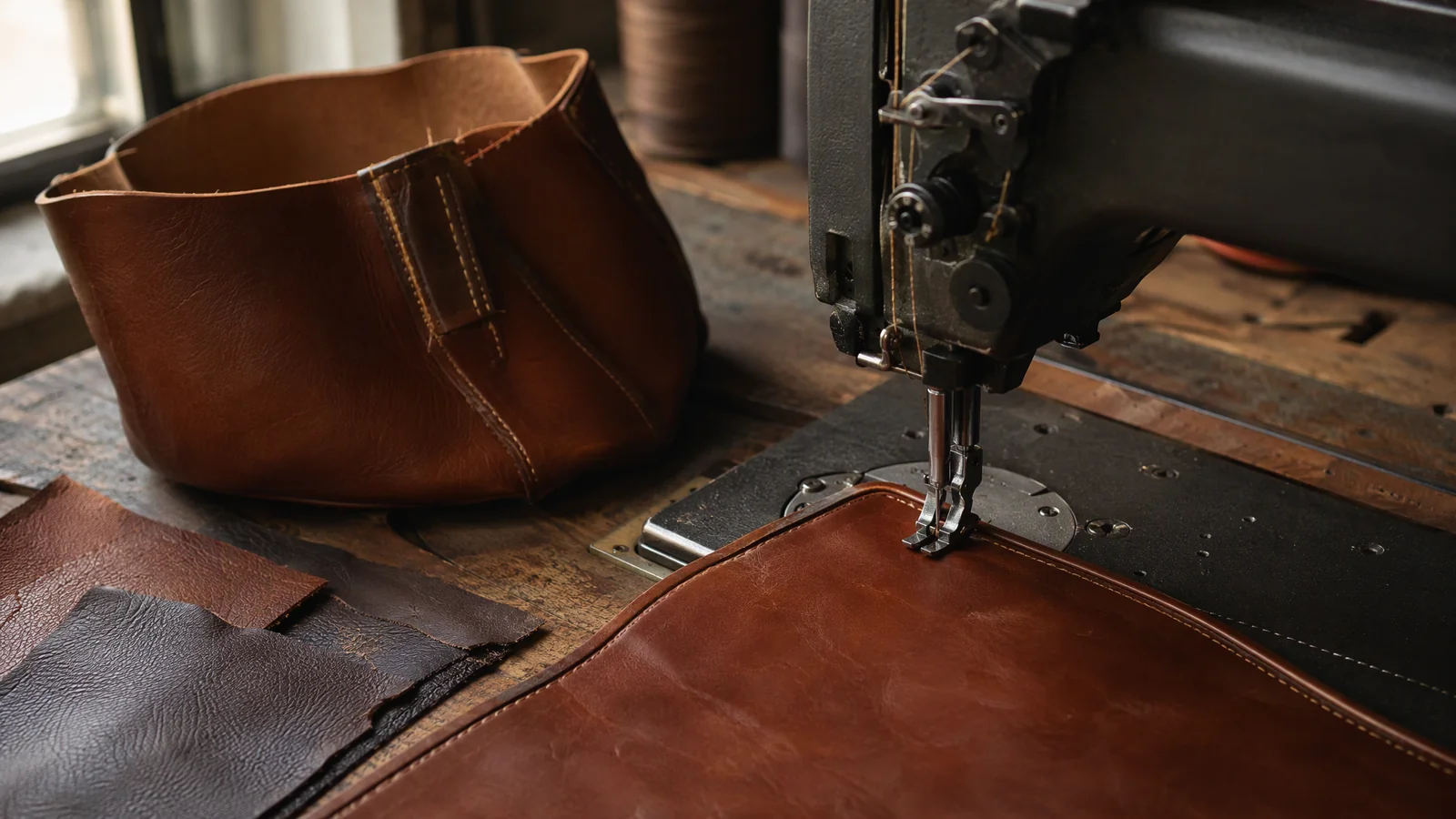
No leather bag holds its shape on leather alone. Structure comes from interlinings, backings, and reinforcement panels, and the grade dictates how much of that support the material needs.
Full-grain at 1.4 mm and above is structurally self-supporting for most tote and backpack bodies. It needs interlining mainly for shape definition — a light fusible to keep a panel flat, a stiffener in a base — rather than for strength. This is why full-grain bags can be built with fewer layers, thinner seams, and cleaner interiors.
Top-grain benefits from a light backing on large flat panels, because a corrected surface telegraphs an interlining edge more readily than natural grain does.
Splits and bonded leather require structural backing in almost every load-bearing application. A split gusset without a backing will stretch and sag; a bonded panel without a stiffener will cup. The reinforcement has to be bonded with adhesive across its full area, not spot-glued, or the assembly will bubble in humid conditions. That adhesive work is a real cost, and it is the cost most often left out of a bonded or split quote.
Manufacturer’s note: If a quote for a split-leather bag comes in close to a full-grain quote, check the bill of materials for reinforcement and adhesive content. Either the full-grain price is high or the split bag is under-built. Both matter before you sign.
Temper, Break-In, and How Each Grade Ages in the Owner’s Hands
Temper is the hand of the leather — how it flexes, folds, and recovers. It is set at the tannery and cannot be fixed in the sewing room, and it interacts with grade in ways buyers rarely plan for.
Full-grain with a firm temper holds a structured silhouette but takes months to relax at stress points. Full-grain with a soft temper drapes immediately and shows every fold, including the ones the pattern did not intend. Top-grain sits in a narrower band because the finishing process partially standardises the hand, which is one reason it is easier to match across a collection.
Splits and bonded leather have limited temper range. A split can be softened with fatliquor at the tannery, but it will not develop the supple, polished hand that full-grain reaches after a year of use. Bonded leather’s hand is essentially fixed at manufacture and changes only by degrading.
Then there is patina. Full-grain vegetable-tanned leather darkens and polishes; the grain compresses where it is handled and the surface takes on a sheen that is specific to the owner’s habits. Chrome-tanned full-grain patinas more slowly and more evenly. Top-grain develops a limited sheen. Splits and bonded leather do not patina at all; they only show wear, and wear on an applied surface reads as deterioration rather than character.
For a brand selling on longevity, this is the argument that closes the sale, and it is worth stating plainly on the product page. For a brand selling on colour consistency and price, full-grain patina is a liability, because two bags from the same run will look different after a year. Neither is wrong. Choosing without knowing which you are selling is.
Process Behaviour Matrix: What Each Grade Asks of the Factory
The matrix below is the internal reference we use when a new style is being costed. Each row is a production decision, and the grade determines how much attention it needs.
| Production decision | Full-Grain | Top-Grain | Genuine (Split) | Bonded |
|---|---|---|---|---|
| Cutter skill level required | High | Medium | Medium | Low |
| Defect inspection before cutting | Mandatory, per hide | Light | Minimal | None |
| Nesting flexibility | Low | Medium | High | High |
| Skiving reliability | Excellent | Excellent | Fair | Poor |
| Seam-end treatment | Standard backstitch | Standard backstitch | Seal plus backstitch | Reinforcement strip required |
| Edge finishing route | Burnish, fold, or paint | Burnish or paint | Seal then paint, or fold | Paint or fold only |
| Interlining / backing need | Light, shape only | Light to medium | Medium to heavy | Heavy, full-area bond |
| Colour matching difficulty | High | Low | Low | Very low |
| Rework rate per 1,000 panels | 12–20 | 8–14 | 15–25 | 20–35 |
| Inline QC focus | Shade and defect on visible panels | Finish uniformity | Coating adhesion, edge seal | Delamination, hinge cracking |
| Sample rounds typically needed | 2–3 | 1–2 | 2 | 2–3 |
Two numbers in that table deserve attention. The first is rework rate. Full-grain carries a moderate rework load not because it is weak but because it is variable: shade and defect selection drive rework on a programme with tight visual standards. Bonded leather carries the highest rework load of the four, which surprises buyers who chose it to save money — the material is cheap, but the corrective work is not.
Sample rounds tell the same story: a cheap material that adds two extra rounds and a hinge redesign is not cheap.
Where Each Grade Belongs: A Component-Level Decision Matrix
Grade does not have to be uniform across a bag. In fact, the best-cost bags rarely are. The useful question is not “which grade for this bag” but “which grade for this component, given the load it carries and how visible it is.”
| Component | Recommended grade | Why | Avoid |
|---|---|---|---|
| Front and back body panels | Full-grain or top-grain | Highest visibility, needs structure and abrasion resistance | Bonded |
| Handle and strap roots | Full-grain, 1.6 mm+ | Carries the full load; tear strength is critical | Split, bonded |
| Shoulder straps | Full-grain or firm top-grain | Flexes constantly and rubs against clothing | Bonded |
| Base panel | Full-grain or top-grain, reinforced | Abrasion and moisture contact | Split |
| Gussets | Top-grain or firm split with backing | Needs to hold a straight fold without sagging | Bonded |
| Flap hinge | Full-grain, soft temper | Flexes thousands of times | Bonded, thin split |
| Interior pockets | Split or top-grain | Low load, low visibility | None, this is a valid use |
| Lining panels | Textile or split | Cost-efficient, protected from abrasion | Bonded, which can shed fibre |
| Decorative trim, piping | Split or bonded, folded | Short runs, no load | None, if folded and sealed |
| Zip gusset | Top-grain or split with reinforcement | Constant flex at the coil | Bonded |
The pattern in the right-hand column is consistent: any component that carries load or flexes repeatedly must have continuous fibre structure. Any component that is decorative, hidden, or lightly loaded can use a lower grade without a real penalty. A bag that mixes full-grain body and handles with split interior pockets is not a compromise bag — it is a well-specified one.
Manufacturer’s note: The most common specification error we see is not choosing a cheap grade; it is choosing a cheap grade in the one place where the bag’s entire load path runs through it. A bonded leather handle root on an otherwise good bag will fail before the body shows any wear, and the customer will blame the whole bag.
Cost: Why Price per Square Foot Is the Wrong Number to Compare
Every buyer asks for price per square foot, and every factory quotes it, because it is the only number both sides can agree on quickly. It is also the number that most often misleads. Material cost per shipped bag is a function of four things, and price per square foot is only the first.
The other three are usable yield from the actual hide lot, labour content in cutting and edge work, and rework plus claim cost — which appears months later instead of on the quote.
Run the numbers on a mid-size tote that consumes 1.6 square metres of leather per unit before waste. At a typical 82% usable yield on full-grain and 92% on split, effective material per bag becomes 1.95 and 1.74 square metres — a 12% gap that consumes much of the raw price difference before reinforcement, edge sealing, and claims are counted.
The point is not that full-grain is cheaper. It is that the gap between the two programmes is narrower than the raw price difference suggests, because split leather pays back part of its saving in yield, reinforcement, edge work, and claims. Run the same comparison against bonded leather and the gap narrows further, or reverses, once two extra sampling rounds and a hinge redesign are included.
Manufacturer’s note: Ask each supplier for the same three numbers on the same style: material cost per bag, labour minutes per bag, and expected claim rate. Suppliers who can answer all three are quoting a programme. Suppliers who can answer only the first are quoting a material.
Incoming Inspection: Four Tests That Catch a Grade Substitution
Grade substitution is the most expensive quality problem in bag production, because it is invisible in a finished bag until the bag is used. These four checks are quick, require no laboratory, and catch the vast majority of substitutions at goods-in.
1. Cut-edge examination. Cut a clean cross-section and look at it with a 10× loupe. Full-grain and top-grain show a continuous, dense upper layer transitioning into looser corium. A split shows a uniform open fibre structure with a distinct coating line on top. Bonded leather shows a fibrous core with visible backing and a film on the surface, and often a straight, machine-like boundary between layers.
2. The fold-and-rub test. Fold the panel face-to-face and rub the fold firmly, then unfold and inspect. Full-grain recovers with surface creasing; splits show coating separation or fine cracking at the fold line; bonded leather shows a hard crease that whitens and, with repeated cycles, cracks through.
3. Grain continuity across a large area. Natural grain changes across a hide: pore size, direction, and density all shift. A surface whose pattern repeats identically across two square metres is embossed, which means it is a corrected or reconstituted surface regardless of what the label says.
4. Adhesion and burnish response. Try to burnish a cut edge with gum and a slicker. Full-grain and top-grain take a sealed, glossy edge. A split will not consolidate, and the edge stays fuzzy. Bonded leather will not burnish at all.
Run these on every new lot, not only on the first. Substitution usually appears mid-programme, when a tannery runs short of a colour and ships “equivalent” material to keep a delivery date. A two-minute cut-edge check at goods-in is the cheapest insurance in the whole process.
Writing Grade Into the Purchase Order
The specification is the contract’s memory. If the grade is described loosely, the factory will interpret it in the way that keeps the delivery date, and the interpretation will be defensible. The fix is a short, unambiguous block on every purchase order.
| Specification field | What to write | Why it matters |
|---|---|---|
| Grade | Full-grain, top-grain, split (finished), or bonded — one term only | Removes the ambiguity of “genuine leather” |
| Fibre structure statement | “Intact grain layer, not corrected, not embossed” | Distinguishes top-grain from embossed split |
| Thickness and tolerance | e.g. 1.4 mm ±0.15 mm, measured at three points per panel | Controls hand, seam bulk, and base flatness |
| Temper | Firm, medium, or soft, with a reference sample number | Temper is not visible in a colour swatch |
| Grain and defect rule | Maximum scar size and count per visible panel | Turns “character” into a pass/fail criterion |
| Finish type | Aniline, semi-aniline, pigmented, waxed, or printed | Determines care instructions and claim exposure |
| Colour reference | Physical approved sample plus light source for matching | Prevents metamerism disputes under retail lighting |
| Test requirements | Tear strength, flex endurance, colourfast to rubbing | Makes durability measurable before production |
| Traceability | Tannery name, lot number, and LWG or equivalent status | Supports claims you intend to publish |
| Sample retention | Two sealed panels per lot, retained 24 months | Settles claims with evidence rather than opinion |
Two fields in that list are routinely left out and cause most disputes. The first is temper: buyers approve a swatch for colour and never specify hand, then reject the bulk for feeling different. The second is the defect rule: a full-grain programme without a written tolerance means every scar is arguable, and arguable becomes negotiable at the worst possible moment.
Manufacturer’s note: Language on the label and language on the purchase order should agree. If the bag will be marketed as full-grain, the purchase order must say full-grain and the retained sample must prove it. Marketing claims that outrun the specification are the fastest route to a compliance complaint in markets that regulate leather descriptions.
FAQ
Is top-grain leather lower quality than full-grain?
It is a different material, not a lower grade of the same thing. Top-grain has the outermost grain surface removed and finished, which makes it more uniform and easier to match, but it develops less patina and its finish wears at high-abrasion points before the leather itself does. For a uniform-colour collection it is often the better production choice; for a bag sold on ageing and character, full-grain is.
Is “genuine leather” a good grade?
In the trade it usually means split leather with an applied surface. It is real leather, but it has no grain layer, so it has lower tear strength, needs edge sealing, and its coating can separate along stitch lines over time. It is a reasonable material for interior pockets or lightly loaded parts, and a poor one for handles, strap roots, and bases.
Can bonded leather be used anywhere in a bag without risking returns?
Yes, in components that never flex and carry no load, such as decorative piping that is folded and sealed, or rigid panel inserts. It should never be used at a hinge, a strap anchor, a zip gusset, or any thin skived edge, because the binder cracks under repeated flex and the material then separates.
How can I tell full-grain from top-grain without a laboratory?
Cut a cross-section and look at it with a loupe. Full-grain has an intact, dense upper layer with the animal’s natural pore pattern changing across the panel. Top-grain shows a thin, uniform finished layer over dense corium, with the original surface removed. A pattern that repeats identically over a large area indicates an embossed surface, which means the grain is not natural.
Does a higher leather grade always mean a longer-lasting bag?
No. Grade sets the ceiling on durability, but construction decides whether the bag reaches it. A full-grain bag with an unreinforced strap anchor or a cut seam allowance will fail before a well-built top-grain bag. Grade and construction have to be specified together; improving one while ignoring the other produces an expensive bag rather than a durable one.
Should a bag use the same grade on every component?
Usually not. Putting full-grain where load and abrasion are highest — body, handles, strap roots, base — and split or top-grain in interior pockets and linings gives a better cost-to-durability result than a uniform specification. What must never vary is the load path: every component in the chain that carries the bag’s weight needs continuous fibre structure.
How much does grade change the sampling timeline?
Full-grain usually needs two to three sample rounds because colour and defect selection must be agreed before bulk. Top-grain closes in one or two. Split leather needs two, mainly to settle edge sealing and reinforcement. Bonded frequently needs three, because round one exposes flex cracking and adhesion problems the material card never mentioned.
Conclusion: Specify the Structure, Not the Adjective
The four grades are not a ranking to be won or lost. They are four materials with different fibre structures, and every production consequence in this article — yield, skiving behaviour, seam durability, edge finishing, reinforcement need, patina, claim rate — follows from that structure rather than from marketing language.
The practical rule for a bag programme is short enough to put on one line: put continuous fibre where the load runs, use applied-surface materials only where nothing flexes, and write the structure into the purchase order in words a factory and a laboratory would both accept.
That approach also protects the brand’s claims. A bag described as full-grain, built from full-grain, and supported by a retained lot sample is defensible in any market. A bag described as full-grain and built from a corrected top-grain is a compliance problem waiting for the first informed customer — and the informed customer always arrives.
If you are specifying a leather programme and want a second opinion on grade selection by component, send us the tech pack and the target price. We will come back with the grade matrix, the yield assumption behind each number, and the failure modes to inspect for at goods-in.
