
Saffiano Leather for Diaper Bags: Durability, Cleanability and How to Specify It
Saffiano Leather for Diaper Bags: Durability, Cleanability and How to Specify It
Every bag manufacturer eventually gets the same brief from a parent-focused brand: the bag has to look like a serious leather bag, survive a toddler, and be wipeable in a supermarket car park at seven in the evening. Those three demands pull in different directions, and the material that resolves them most often on our production floor is cross-hatch embossed finished leather, the family of materials the market sells as saffiano.
Saffiano is not a hide, not a tannage and not a grade. It is a finished surface: a fine diagonal hatch pressed into a piece of leather that has already been dyed and coated, usually sealed under a thin film that closes the pores and gives the panel a dry, slightly crisp hand. That definition matters commercially, because two suppliers can quote “saffiano leather” and deliver panels with completely different durability, different colour behaviour and a price difference of forty percent.
This guide is written from the manufacturing side of the table. It covers what the material actually is, how the hatch is produced, where it beats other wipe-clean options for diaper bags and changing bags, where it fails, how to write a specification that a tannery can actually meet, and which quality tests tell you before shipment whether the panels will still look right after a year of daily family use.
If you are sourcing leather diaper bags, the useful question is not “is saffiano good” but “which saffiano, on which base, at which thickness, with which finish chemistry, tested to which standard”. The sections below answer that in the order a factory would ask it.
- What Saffiano Leather Actually Is
- How the Cross-Hatch Finish Is Made
- Saffiano Compared with Other Wipe-Clean Options
- Why Saffiano Suits Diaper Bags Specifically
- The Trade-offs You Should Be Honest About
- How to Specify Saffiano Leather in a Purchase Order
- Construction Notes for Sewing and Assembling Saffiano Bags
- Quality Control Tests That Actually Predict Failure
- Care and After-Sales Guidance
- Cost, Sourcing and Lead Time Reality
- When Saffiano Is the Wrong Choice
- FAQ
- Conclusion
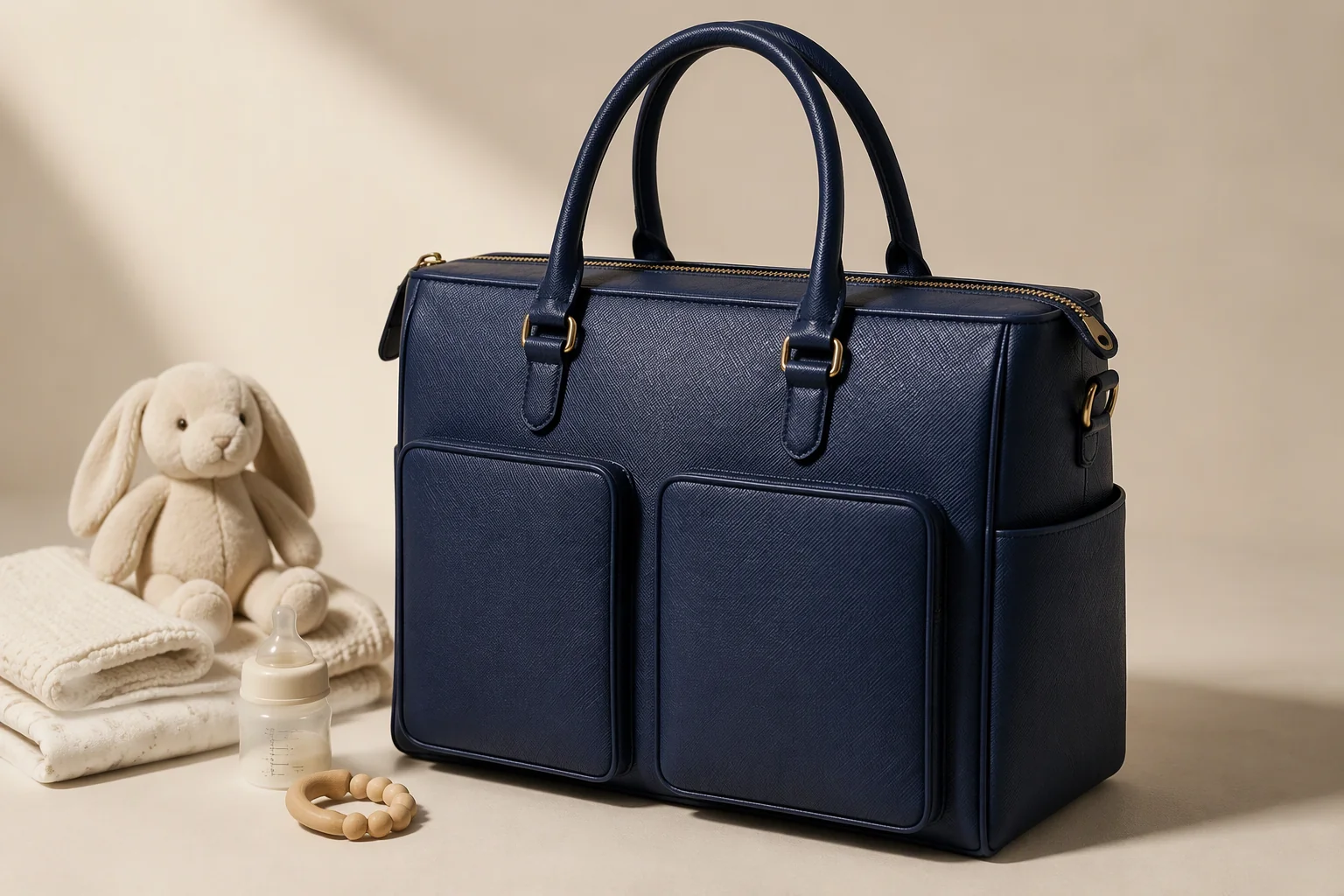
What Saffiano Leather Actually Is
The name comes from the Italian fashion house that popularised the cross-hatch finish in the late twentieth century, and like many fashion-origin material names it has no protected technical definition. Any tannery or coating plant can call a cross-hatch embossed finished leather “saffiano”, and many do. What varies enormously is what sits underneath the hatch.
Structurally, a saffiano panel is a finished leather with three layers of work on top of the raw material: a base colour applied through the leather, a polymer film or finish coat that closes the grain, and a fine diagonal hatch embossed through that film before it fully cures. The hatch is shallow, typically well under half a millimetre deep, and its purpose is not decoration alone. The pattern breaks up the surface into many small planes, so light scatters and minor scuffs read as texture rather than damage.
The name is a finish, not a grade
In our sampling library we hold “saffiano” panels made from full-grain calf, from corrected-grain top-grain, from split leather with an applied grain, and from offcuts reassembled into a bonded sheet. All four can carry the same hatch and, at arm’s length, look similar. None of them behaves the same after two years.
- Full-grain base: the strongest option, with intact fibre structure, the best flex life and the highest cost.
- Corrected-grain top-grain: the volume choice for mid-market diaper bags, where the grain is buffed and rebuilt before finishing; more uniform, slightly lower flex life.
- Split with applied grain: cheapest leather version; adequate for low-stress panels such as pocket facing, weak at fold lines.
- Bonded or reconstituted sheet: not leather in the structural sense; avoid it on any load-bearing panel of a bag that will be cleaned weekly.
Manufacturer’s note: a quotation that says only “saffiano leather” tells you nothing about durability. Ask for the base grade, the finished thickness, the finish system and the test results on the actual production lot, not on a lab swatch from last season.
Hatch patterns are not all identical
Buyers often assume every cross-hatch surface is the same pattern. In practice the hatch is specified by two numbers that change both the look and the wear behaviour: pitch, meaning how many hatch lines fall within a given distance, and depth, meaning how far the pattern is pressed into the film.
- Fine pitch: reads as a dense, almost fabric-like texture from a distance and photographs very evenly, but the shallow pattern does less to disguise a heavy scuff.
- Coarse pitch: looks bolder in the hand and scatters light more aggressively, though at very coarse settings it can look synthetic next to a smooth trim.
- Deep impression: hides marks best, but thins the film at the base of each groove and can become the starting point for cracking at a fold.
- Shallow impression: keeps film integrity and flex life, at the cost of a flatter, less textured read under direct light.
Because pitch and depth are tooling decisions, changing them mid-programme usually means new plates or new release paper. Approve the pattern on a full panel under both daylight and shop lighting, and record the reference in the tech pack so a later reorder does not quietly arrive with a coarser hatch.
Why the surface reads as premium
The hatch does something useful for perceived quality on a bag that is bought online. A smooth pigmented leather photographed under flat studio light shows every handling mark and reflects light in one broad sheen. A hatched surface breaks the highlight into many small points, so the panel photographs evenly, hides transit scuffs and looks deliberately engineered rather than merely plastic-coated.
This is also why the material dominates structured silhouettes. A tote or a boxy changing bag with sharp folds and flat front panels needs a leather that stays flat and holds an edge. Saffiano does that without the sagging that soft milled leathers show on an unsupported front panel.
How the Cross-Hatch Finish Is Made
Understanding the process is the fastest way to predict failure. The finish is a stack of thin layers, and most field complaints trace back to one layer being under-cured, too thick, or incompatible with the one below it.
From crust to finished panel
The sequence on a typical line runs as follows.
- Crust selection. The tannery starts from a dyed crust, already tanned and dried. Grain quality and thickness uniformity are checked here, because the hatch amplifies any unevenness.
- Base coat. A pigmented base coat is sprayed or roller-applied to level the colour and seal the grain. Thickness control matters: too thin and the grain telegraphs through the hatch; too thick and the film becomes stiff and prone to cracking.
- Print or release-paper embossing. The diagonal hatch is applied either by a heated plate press or by casting the film against an embossed release paper. Plate embossing gives a crisper hatch and a slightly harder hand; release paper gives a softer hand and finer registration.
- Top coat. A clear or lightly tinted top coat provides the actual performance layer: abrasion resistance, water repellency, and the anti-soiling behaviour buyers describe as “wipe clean”.
- Curing and plating. Controlled oven curing cross-links the film. Under-cured film feels tacky in warm weather, blocks when stacked, and fails rub tests; over-cured film becomes brittle and crazes at folds.
- Cooling, conditioning and inspection. Panels are conditioned to a stable moisture content, then graded for hatch definition, colour consistency and coating defects.
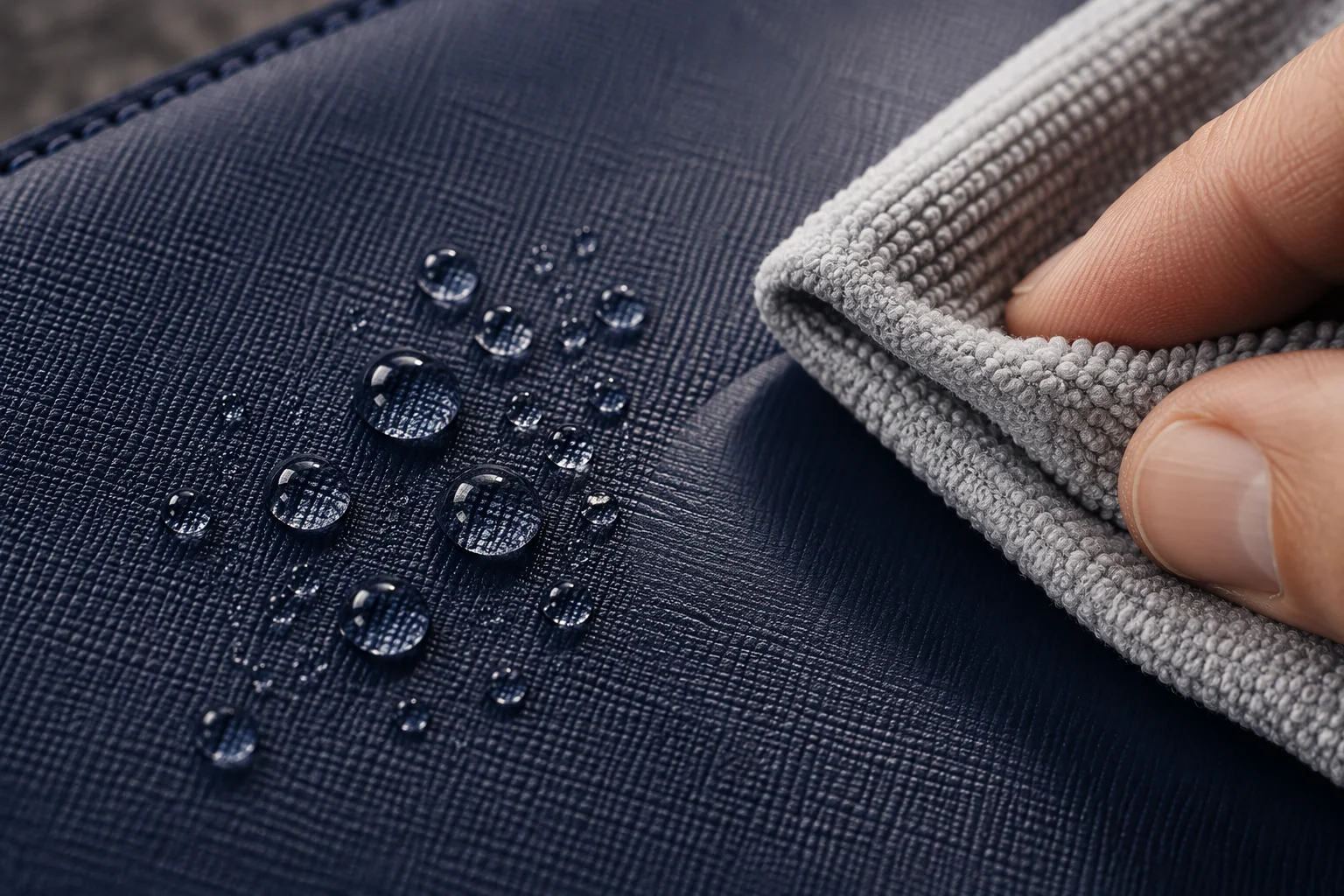
Finish chemistry decides performance
The single most consequential choice in a saffiano specification is what the top coat is made of. Three families dominate bag production.
- Polyurethane dispersion top coats: the default for flexible bag leathers. Good abrasion and flex performance, softer hand, sensitive to hydrolysis if the film is poor quality or stored damp.
- Acrylic top coats: cheaper and harder, with excellent initial scuff resistance, but lower flex life and a tendency to feel “plasticky” and to craze at tight folds.
- Cross-linked polyurethane or hybrid systems: the premium option for diaper bags. Better resistance to oils, sunscreen and baby wipes, at a higher cost and with tighter process windows.
Manufacturer’s note: for a bag that will be wiped with alcohol-free baby wipes several times a week, specify a cross-linked polyurethane top coat and ask for the wet rub and chemical resistance results. Acrylic systems can look identical on day one and fail visibly by month eight.
Saffiano Compared with Other Wipe-Clean Options
Parents do not care about material taxonomy; they care whether a puree pouch explosion comes off with one wipe. That question is best answered by comparing the realistic alternatives on the same criteria a factory uses when building a costing sheet.
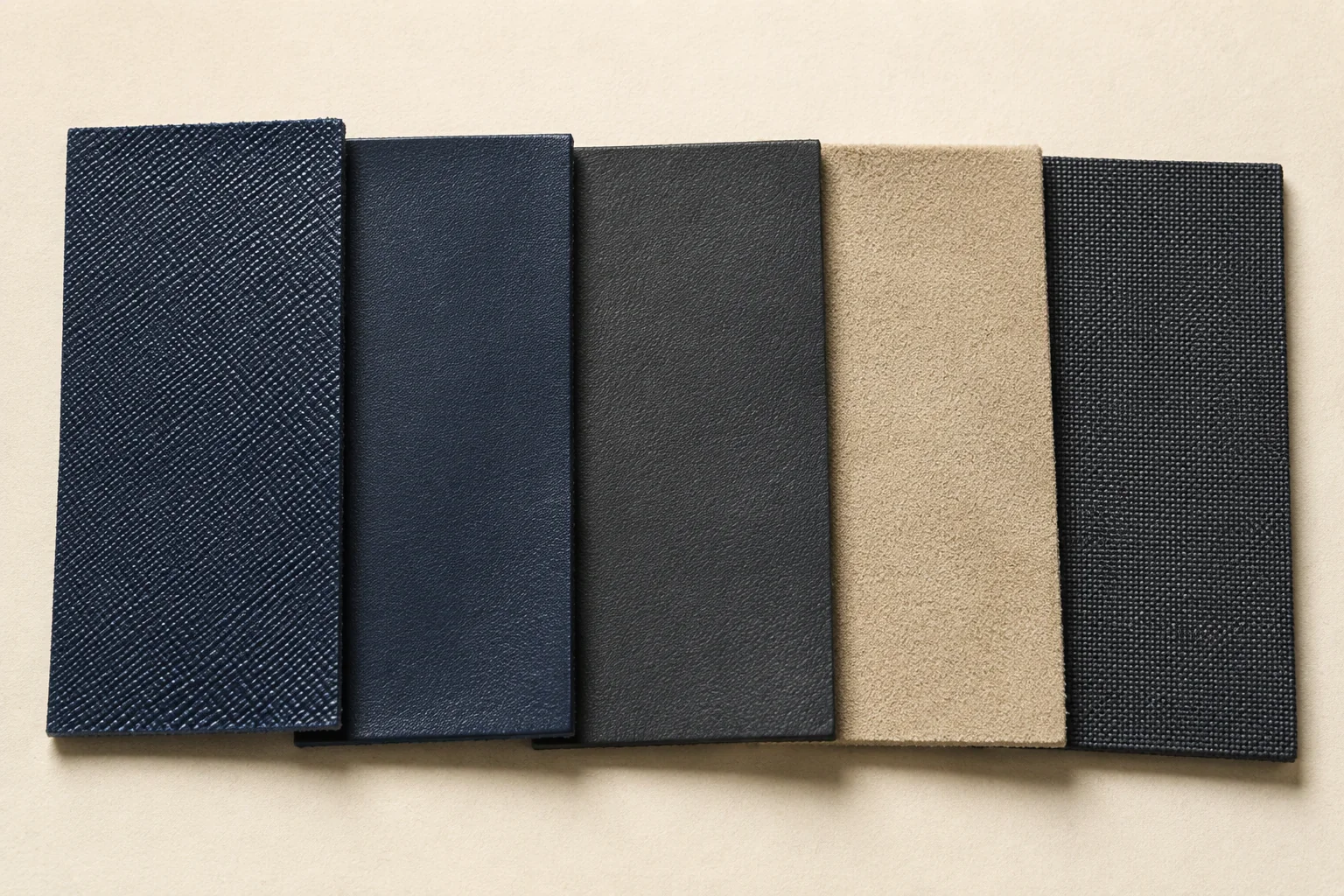
The comparison table
| Material | Surface behaviour | Abrasion and scuff resistance | Flex and crack risk at folds | Relative material cost | Best use in a diaper bag |
|---|---|---|---|---|---|
| Saffiano on full-grain base | Closed, dry, hatch hides marks | High | Low | $$$$ | Whole shell of a premium structured bag |
| Saffiano on corrected-grain base | Closed, uniform, slightly flatter look | High | Low to moderate | $$$ | Main body, front panels, flap |
| Smooth pigmented leather | Closed, satin sheen, shows handling marks | Moderate to high | Moderate | $$$ | Trim, piping, handle wraps |
| PU-coated leather | Closed, rubbery to dry hand | Moderate | Moderate | $$ | Interior pockets, base reinforcement |
| Microfibre leather | Soft, suede-like or filmed | Low to moderate | Low | $$ | Lining, soft pouches, changing mats |
| PVC-free coated textile | Closed, woven emboss | Moderate | High | $ | Expandable gussets, wipe-clean lining |
What the comparison means in practice
The table explains why most of our diaper bag programmes end up hybrid rather than single-material. A full saffiano shell with pigmented leather trim gives the brand the wipe-clean front panel and the softer, more luxurious handle wrap in one bag, and it keeps the cost sensible by reserving the expensive base for the panels that are actually seen and touched.
- Front and back panels: saffiano, because they take the most abrasion from car seats, restaurant floors and buggy frames.
- Gussets and expansion panels: often a softer coated material, because a stiff hatch leather fights the fold and cracks when the bag is opened wide.
- Handles and shoulder pads: smooth pigmented leather or a softer temper, so the grip does not feel like sandpaper after an hour.
- Base: reinforced saffiano or coated textile with a footed structure; the base sees the worst of the wear.
Why Saffiano Suits Diaper Bags Specifically
Diaper bags are abused in a very particular way. They are set down on wet ground, loaded past their designed capacity, wiped with whatever is in the parent’s hand, and left in hot cars. The failure modes we see on returned bags are consistent, and the hatch finish addresses most of them.
The stain set is different from a handbag
A fashion handbag mostly meets hand oils and rain. A changing bag meets nappy cream, formula, fruit puree, sunscreen, and the occasional leak from a bottle that was not closed properly. These are oily and particulate rather than watery, and they behave differently on different surfaces.
- Nappy cream and sunscreen: oily, and they migrate into open-pore leather permanently. A closed film stops migration at the surface.
- Formula and puree: water-based but protein-rich; they stain aniline and lightly finished leather quickly and wipe off a sealed film.
- Bottle leaks: repeated wetting swells untreated fibre and can lift a poorly bonded film at the seam edges.
- Friction marks: buggy frames and car seat buckles abrade a soft leather in weeks; a hatched, filmed surface distributes the contact.
Manufacturer’s note: the wipe-clean claim only holds if the seams are sealed too. Stitch holes through an unsealed edge are the most common route for liquid to reach the fibre core, and they are the reason we specify edge paint or folded-and-sealed seams on every saffiano changing bag.
Structure, weight and shape retention
A diaper bag has to stand open on a changing table while a parent uses both hands. That requires a shell that does not collapse, and saffiano’s crisp hand makes the structure much easier to achieve without heavy internal board.
- Panels stay flat, so a wide zip opening stays wide instead of folding shut.
- The material takes a heat-fused interlining cleanly, which lets us build a semi-rigid body at a lower total weight.
- Because the surface is already sealed, we can skip the extra protective top finish that softer leathers need, saving a process step.
Weight, temperature and one-hand handling
Diaper bags are carried one-handed more often than any other bag category, usually with a child on the opposite hip, so the relationship between material weight and structure matters more than the gram count on a spec sheet.
- A hatched, filmed leather panel is stiffer per unit weight than a soft milled leather, so a lighter total bag can hold the same silhouette.
- Less internal board and padding means less weight high up in the bag, which changes how it hangs from a shoulder strap over an hour.
- The sealed surface does not absorb humidity the way an open-grain leather does, so the bag’s weight and shape stay stable in wet weather and in a hot car.
- In cold weather the film stays dimensionally stable, but a low-grade film specified without a cold crack requirement can become brittle, which is why that test line exists in the specification.
Manufacturer’s note: when a brand asks us to reduce bag weight, the first lever is not thinner leather on the shell. It is the lining, the internal board and the hardware, in that order — thinning the shell is what produces the sagging front panel that generates returns.
The Trade-offs You Should Be Honest About
No material wins everywhere, and a manufacturer who claims otherwise is either inexperienced or selling. Saffiano has real limits, and buyers should hear them before the sampling stage rather than after the first container.
Edge and fold behaviour
The hatch is a pressed film, and pressed films do not like being folded back on themselves. At a tight radius the top coat is under tension and will eventually craze, so construction has to respect the material.
- Keep fold radii generous; specify a minimum radius in the tech pack rather than leaving it to the sample room.
- Skive and turn rather than pressing a hard crease on a visible panel edge.
- On expansion gussets, use a softer material or a bellows construction that shares the fold across several panels.
- Seal every cut edge; an unsealed hatch edge looks unfinished and wicks moisture.
Repair and ageing limits
Saffiano ages cleanly but not romantically. It does not develop the patina that sells vegetable-tanned leather, and a deep scratch that breaks the film cannot be blended out with conditioner the way an aniline surface can.
Manufacturer’s note: if the brand’s marketing leans on heritage and ageing, saffiano is the wrong hero material. If it leans on practicality, easy cleaning and a bag that still looks new at eighteen months, it is the right one. Match the material to the promise.
The specification risk
Because the name is unregulated, the biggest trade-off is commercial rather than physical: a competitor can offer “the same saffiano” at a lower price by changing the base grade, thinning the film, or skipping the cross-linker. Without a written specification and lot testing, the two bags are indistinguishable on a purchase order and very distinguishable in the field.
How to Specify Saffiano Leather in a Purchase Order
A workable specification is short, measurable and testable. The version below is the one we hand to tanneries for diaper bag programmes, and it is deliberately written so that a buyer without a leather background can still check a quotation against it.
| Specification item | What to write | Why it matters |
|---|---|---|
| Base grade | Corrected-grain top-grain, or full-grain where specified | Determines flex life and cost more than any other line |
| Finished thickness | 1.2–1.4 mm body, 1.4–1.6 mm base and handles | Thin panels collapse; thick panels fight the seam |
| Hatch definition | Diagonal cross-hatch, pitch and depth per approved swatch | The main visual identity of the material |
| Finish system | Cross-linked polyurethane top coat | Wipe-clean and chemical resistance in real use |
| Colour fastness | Dry rub grade 4 minimum, wet rub grade 3–4 minimum | Prevents marking pale interiors and clothing |
| Abrasion | 500 cycles minimum on a standard abrasion tester, no film breakthrough | Predicts scuff life on high-contact panels |
| Flex resistance | No cracking after the agreed cycle count at the specified radius | Catches brittle films before bulk production |
| Adhesion | Finish must not lift on a tape pull test | Catches under-cured or poorly bonded film |
| Cold crack | No cracking at the agreed low temperature | Relevant for winter shipping and storage |
| Light fastness | Blue wool scale per the brand’s market requirement | Prevents visible fading in shop windows |
| Restricted substances | Compliance statement per the destination market | Legal gate for the EU, UK and US |
Reading a tannery quotation against the spec
When quotes come back, compare them line by line rather than on price alone. In our experience the three most common silent downgrades are base grade, film thickness and top-coat chemistry, in that order. A quotation that omits the base grade is not a quotation for the same material.
- Ask for the lot test report, not the seasonal swatch report.
- Ask which abrasion and flex method was used, since results are not comparable across methods.
- Ask for a retained sample sealed and dated, so a later dispute has a reference.
Construction Notes for Sewing and Assembling Saffiano Bags
Saffiano behaves well in assembly if the line is set up for it, and badly if the line treats it like soft milled leather. The differences are small but they show up immediately in the finished bag.
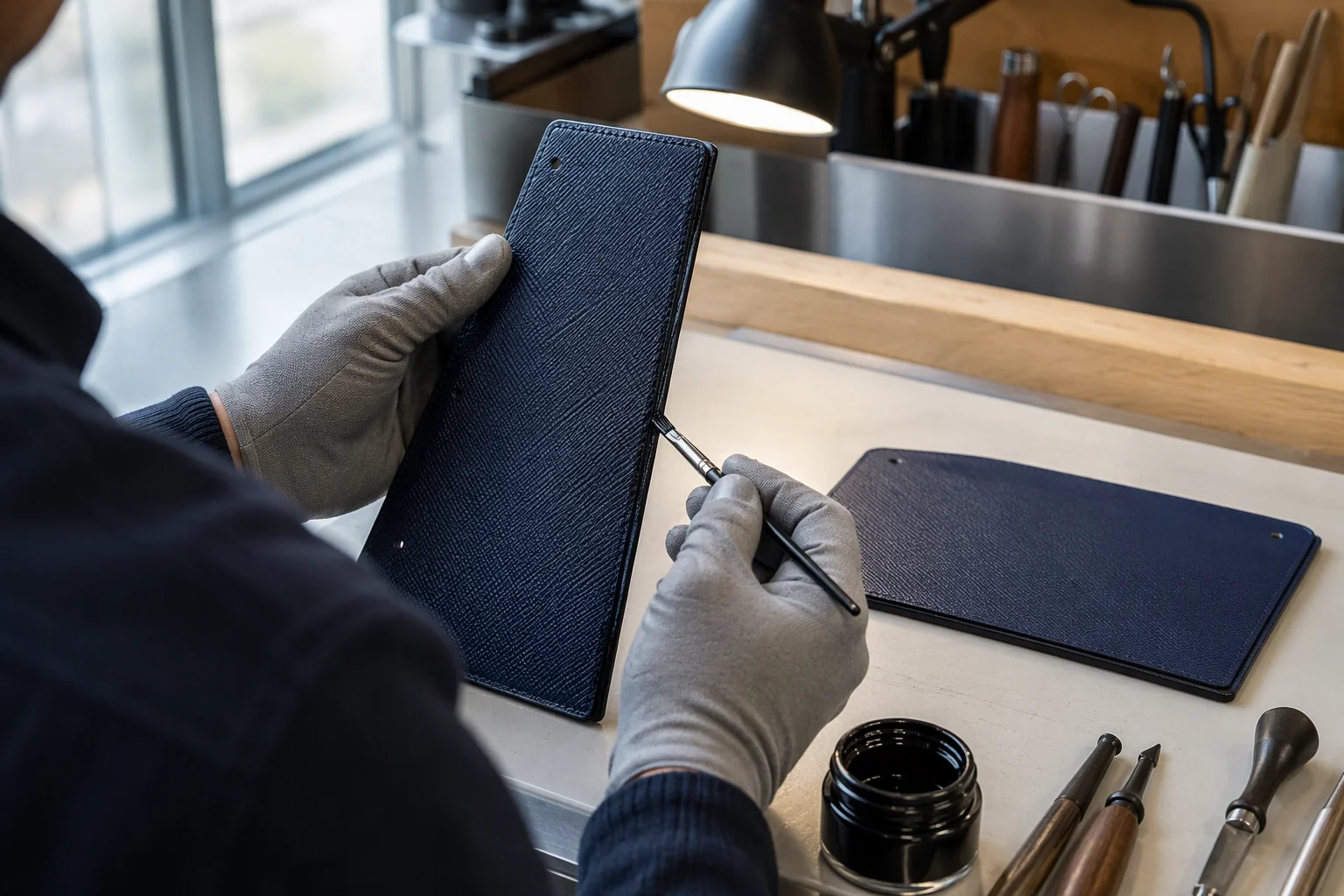
Cutting and preparation
- Cut with a sharp die and a clean bed; a dull die crushes the film and leaves a white halo on the cut edge.
- Mark on the back or with a removable marker; some solvent markers stain finished films permanently.
- Store cut panels flat and covered. Stacked panels with weight on them can take a print from the panel below in warm conditions.
- Check direction of the hatch on every panel before sewing; mismatched hatch direction is visible under shop lighting and is a common rejection reason.
Sewing parameters
- Use a needle sized for the leather, with a cutting point, and change it on a fixed schedule rather than when it feels dull.
- Set stitch length so the seam does not perforate a narrow margin; tear-out at the seam line is a film-and-fibre failure, not a thread failure.
- Reduce presser foot pressure; too much pressure leaves a track along the seam that will not recover.
- Avoid back-stitching on visible seams; lock the seam by other means and keep the visible line clean.
Manufacturer’s note: the most expensive defect we see on hatched leather is needle tracking along a top-stitched panel. It cannot be pressed out. Set the machine properly before the first panel, not after the fiftieth.
Edges, linings and hardware
- Seal cut edges with edge paint in a colour matched to the finish, applied in two thin coats rather than one thick one.
- Fold and seal the top edge of open pockets; a raw hatched edge is the first place a changing bag looks cheap.
- Line the interior with a wipeable woven or coated textile, not a porous fabric, or the practical advantage of the outer shell is wasted.
- Back every hardware attachment with a reinforcement patch; the film resists abrasion but the leather around a rivet still tears under load.
- Test the zip run on the finished bag; a stiff shell transmits more load into the zip tape than a soft one.
Interior build and lining choice
The outer shell gets the marketing attention, but on a changing bag the interior decides whether the wipe-clean promise survives contact with a leaking bottle. A sealed outer surface with a porous cotton lining simply moves the problem inside.
- Use a wipeable woven or lightly coated textile for the main interior, and seam it so liquid cannot run straight into the bag’s base.
- Provide at least one washable, removable pouch for the items that leak regardless of design, such as a half-used bottle.
- Avoid raw hatched leather inside the bag; cut edges that are never sealed will mark clothing and absorb spills.
- Specify thermal pockets as separate assemblies, so insulation and lining can be built and inspected before the shell is closed.
- Keep hardware backing plates inside the lining so a rivet never sits directly against a bottle or a spare outfit.
Manufacturer’s note: a diaper bag is judged in two moments — how it looks on the shelf and how it looks after the first spill. The exterior hatch wins the first moment; the interior build is what prevents the return.
Quality Control Tests That Actually Predict Failure
Lab tests are only useful if they map to field complaints. The five below cover the failures we most often see on returned saffiano changing bags, and each one has a clear pass condition to write into the inspection standard.
| Test | What it predicts | Typical method | Pass condition for diaper bags |
|---|---|---|---|
| Wet and dry rub fastness | Colour transfer onto clothing and pale linings | Crockmeter, felt rub | Dry grade 4, wet grade 3–4 or better |
| Abrasion | Scuff breakthrough on front panels and base | Rotary platform abrasion | 500 cycles, no film breakthrough |
| Flex endurance | Crazing along gussets and pocket folds | Flexometer at agreed radius | No cracking at the agreed count |
| Finish adhesion | Peeling or lifting at seam edges after wiping | Tape pull on a cross-hatched area | No measurable transfer |
| Hydrolysis resistance | Sticky or crumbling film after humid storage | Accelerated humidity ageing | No tackiness, no loss of adhesion |
Running the tests on production lots
Testing a lab swatch proves the recipe works; testing the production lot proves the tannery still follows it. For ongoing programmes we test the first lot, then every third lot, then any lot after a chemistry or base-supplier change, and we keep retained panels for the life of the style.
- Combine the lab result with an in-line visual check at goods-in for hatch consistency and colour match.
- Cut test pieces from the actual shipment wherever possible, not from a matching swatch sent ahead.
- Record the result against the lot number so a field complaint can be traced back to a specific delivery.
Care and After-Sales Guidance
The care advice you publish is part of the product specification. Vague instructions cause warranty disputes, and wrong instructions cause real damage, so it is worth writing the leaflet before the sampling round rather than after.
What to tell the customer
- Wipe with a soft damp cloth or an alcohol-free baby wipe, then dry with a dry cloth.
- Do not use solvent cleaners, acetone, bleach or abrasive cream on the finished surface.
- Do not machine wash, soak or tumble dry; water can reach the fibre through stitch holes.
- Store stuffed and dry, away from direct sun and radiators, in the dust bag supplied.
- Treat a scuff by wiping first; polishing creams are unnecessary on a sealed film and can dull it unevenly.
Manufacturer’s note: the two claims that generate most returns are “waterproof” and “scratch-proof”. Saffiano is water-resistant and highly scuff-resistant, and neither of those means indestructible. Write the limitation into the marketing copy and the return rate drops.
Warranty language that holds up
Define what counts as a manufacturing defect and what counts as wear. Film lifting at a seam, hatch loss across a whole panel, and colour transfer to clothing are defects. A scuff from a buggy frame or a scratch from a car key is wear. Clear language protects both the brand and the factory.
Cost, Sourcing and Lead Time Reality
Saffiano sits in the middle of the leather price range, above smooth corrected-grain and below full-grain aniline, and the spread within the category is wider than the spread between categories.
What drives the price
- Base grade: the largest single factor, and the one most easily hidden in a quote.
- Finish system: cross-linked polyurethane adds cost but is what makes the wipe-clean claim defensible.
- Hatch tooling: plate or release-paper registration costs money to set up, so small orders often reuse an existing pattern.
- Colour: deep saturated colours and bright whites require better base selection and more finish coats than black or brown.
- Order size: tanneries price by lot; below a few hundred square metres, expect to choose from a colour card rather than develop a shade.
Planning the calendar
A new colour on an existing hatch typically needs several weeks for lab dip, approval and bulk. A new hatch pattern needs tooling time on top of that, so it belongs in the development calendar rather than the production calendar. Plan the leather approval before the hardware approval, because the hardware finish has to be signed off against the leather colour it will sit on.
- Confirm hatch direction and colour under daylight, not only under factory lighting.
- Approve a full panel, not a small swatch, for any structured bag.
- Build a second approved tannery into the plan for continuity.
Negotiating without downgrading the material
Price pressure on a leather changing bag almost always lands on the leather, because it is the largest single material line in the costing sheet. There are better places to recover margin, and a factory that understands the material can usually find them.
- Simplify the interior: fewer pockets and a single lining quality save more than a thinner shell, and they do not affect the outer appearance.
- Standardise hardware finishes across the range so plating lots are larger and unit cost falls.
- Reuse an existing hatch tooling and colour card instead of developing a new pattern for a first order.
- Reduce panel count by redesigning a detail rather than reducing leather thickness; the second shows in the field, the first usually does not.
- Keep the cross-linked top coat even when other lines are trimmed; it is the cheapest insurance against a wipe-clean claim that fails.
When Saffiano Is the Wrong Choice
Saffiano is a strong default for structured, wipe-clean changing bags, and a poor choice for several other briefs. Being clear about that up front saves a sampling round.
- Soft slouchy silhouettes: the material resists the drape that makes a hobo or a soft bucket bag work.
- Heritage and patina positioning: it will not age into anything, and the marketing story collapses.
- Very tight fold radii: a bellows gusset or a rolled top in a stiff hatch will craze; use a softer temper instead.
- Repairability-first programmes: a broken film cannot be refinished the way an aniline surface can.
- Low-cost volume programmes: a credible cross-linked saffiano costs more than the coated textiles that usually win at the entry price point.
Manufacturer’s note: the honest test is to hold the finished sample bag open with one hand and let it hang. If the silhouette is what the brand wants in that moment, saffiano is the right material for it.
FAQ
Is saffiano leather real leather?
It can be, and usually is in mid-market and premium bags, but the name describes a finish rather than a material. A saffiano panel can be built on full-grain, corrected-grain top-grain, split leather or even a reconstituted sheet. The base grade, not the hatch, determines how long the bag will last. Always ask the tannery or factory which base the panels are made from.
Is saffiano leather good for a diaper bag?
It is one of the best available choices for a structured changing bag, because the sealed cross-hatch surface wipes clean, resists scuffing and holds a shape without heavy internal board. It is less suitable if the design depends on soft drape or tight folded gussets. The material performs best when paired with a wipeable lining and sealed seam edges.
Is saffiano leather waterproof?
No. It is water-resistant. The finish film slows absorption and lets you wipe spills off the surface, but water can still enter through stitch holes, unsealed cut edges and open seams. Never describe a saffiano bag as waterproof in product copy; describe it as wipe-clean and water-resistant, and specify sealed edges to support the claim.
How do you clean a saffiano leather diaper bag?
Wipe with a soft damp cloth or an alcohol-free baby wipe, then dry immediately with a dry cloth. Do not use solvents, acetone, bleach, abrasive cream or conditioning oil on the finished surface, and never machine wash or soak the bag. For a stubborn mark, wipe gently and let it dry before trying again rather than scrubbing, which can dull the film.
Does saffiano leather scratch easily?
It is one of the most scratch-resistant leather finishes used in bag production, because the hatch breaks up the light and the film protects the grain. Light surface marks usually wipe away. A deep scratch that cuts through the film cannot be blended out, which is why a hatched finish suits high-contact panels better than a smooth aniline surface.
Does saffiano leather peel?
Good saffiano does not peel in normal use; peeling indicates a manufacturing problem, usually poor finish adhesion, under-curing or hydrolysis in a low-grade film. Peeling typically starts at cut edges and fold lines, which is why adhesion and flex tests on the production lot matter more than tests on a lab swatch. A bag that peels within the first year should be treated as a defect.
How thick should saffiano leather be for a diaper bag?
Most structured changing bags work well with 1.2 to 1.4 mm on the main body and 1.4 to 1.6 mm on the base, handles and any panel that carries load. Going thinner saves weight and cost but loses shape retention; going thicker makes seams bulky and increases the risk of film cracking at folds. Specify thickness by panel rather than one number for the whole bag.
What is the difference between saffiano and PU leather?
Saffiano is a finish applied to leather, while PU leather is a synthetic coating on a textile or split backing. Both can look similar and both wipe clean, but they age differently: leather develops creases and holds structure, while PU tends to delaminate or crack with age and heat. For a bag expected to last several years of daily family use, leather on a defined base grade is the more durable choice.
Can saffiano leather be repaired?
Cosmetic marks can often be wiped away, and edge paint can be reapplied by a repairer. A damaged finish film cannot be invisibly restored, and a torn panel requires replacement rather than repair. If repairability is central to the brand’s positioning, combine saffiano on high-wear panels with repairable smooth leather on handles and trims.
Why does saffiano leather cost more than smooth leather?
The extra cost comes from additional process steps: a levelled base coat, hatch embossing through a plate or release paper, a performance top coat and controlled curing. Within the category, price differences of forty percent or more usually reflect the base grade and the top-coat chemistry rather than the hatch itself, so compare quotations line by line against a written specification.
Conclusion
Saffiano is the material most diaper bag programmes arrive at once they accept that the bag will be cleaned far more often than it will be admired. The cross-hatch finish gives a structured shell that holds its shape, hides the scuffs that come with buggy frames and car seats, and wipes down after the spills that define family use.
The catch is that “saffiano” is a marketing name rather than a technical standard, so the material is only as good as the specification behind it. Base grade, finished thickness per panel, top-coat chemistry, edge sealing, and lot-level tests for rub fastness, abrasion, flex and adhesion are what separate a bag that still looks new at eighteen months from one that peels at the gusset in the first season.
Written properly, the specification takes a page and the tests take a day. That is a small price for a material claim a brand can defend in a review thread two years later, and it is the difference between selling a wipe-clean bag and being trusted for one.
