
Incoming Leather Inspection: A Goods-In Checklist
Incoming Leather Inspection: A Goods-In Checklist
Approving a leather sample and receiving five hundred square feet of it are two different events. Between the swatch on the meeting room table and the bundles that arrive at the loading bay, colour drifts, thickness wanders, temper changes, moisture moves and defects appear in places the sample never showed.
As a bag manufacturer, we treat goods-in inspection as the last point at which a problem is still cheap. This guide sets out what changes between approval and delivery, what to check on every lot, which tools and conditions the check requires, how results should be recorded and what should happen when a delivery fails.
An inspection that finds nothing is not a wasted hour. It is the cheapest hour in the whole order.
- Why Goods-In Inspection Decides the Order
- What Changes Between Approval and Delivery
- Building an Inspection Routine
- Tools, Conditions and the Inspection Area
- What to Check on Every Delivery
- Thickness, Area and Count Checks
- Colour and Panel Matching at Goods-In
- Temper, Hand and Drape
- Surface and Defect Screening
- Moisture, Smell and Storage Condition
- Recording Results and Dispositions
- When to Reject a Lot
- Talking to the Supplier About a Rejection
- Traceability and Re-inspection
- Repeat Problems and Escalation
- Common Mistakes at Goods-In
- Frequently Asked Questions
- The Bottom Line
Why Goods-In Inspection Decides the Order
Quality is decided before cutting begins.
The Last Cheap Moment
Problems cost least here.
A deviation found at goods-in can be raised with the supplier, sorted, re-selected or replaced. The same deviation discovered in the cutting room has already consumed labour, and the same deviation discovered at final inspection has consumed the whole order.
What Inspection Is Not
It is not a replacement for specification.
Inspection confirms that a delivery matches an agreed specification; it cannot create one. A factory checking leather against nothing in particular is collecting opinions, not measurements.
The Cost Balance
Inspection should be proportional, not exhaustive.
Checking 100 percent of a delivery is usually unnecessary and slow, while checking nothing is indefensible. The practical answer is a defined sample plan that concentrates on the properties that will cause the most damage if they are wrong.
What Changes Between Approval and Delivery
Most failures are ordinary rather than dramatic.
Lot-to-Lot Variation
Leather is a natural material.
Hide-to-hide variation, seasonal differences in raw material and small changes in process all move colour, grain and temper between lots. Approved samples set the target, and the delivery is what has to be measured against it.
Process and Recipe Drift
Tanneries adjust as they work.
Coating weights, dye strengths and finishing passes can shift slightly between batches, and a supplier working from a different stock lot may deliver leather that is technically the same article but visibly different from the approved sample.
Handling and Storage
Damage often happens in transit.
Crushing, folding under load, moisture, heat in a container and long storage all affect leather before it reaches the factory. Some of what goods-in inspection finds was perfect when it left the tannery.
Mixed Lots and Deliveries
One delivery is not always one lot.
Where a supplier consolidates several production lots into a single shipment, the bundles can differ from each other even though the paperwork describes one article. Goods-in inspection should therefore check whether the delivery is homogeneous and, where it is not, treat the differing bundles as separate lots with their own records.
Keeping bundles identified by their original lot number, rather than relabelling the whole delivery under one internal number, is what preserves the ability to trace a problem back to the tannery batch that caused it.
Substitution Risk
The wrong article can arrive by mistake.
Similar articles, similar colours and similar names make mix-ups possible, and a delivery that is the right colour but the wrong finish or thickness will only be discovered during construction if it is not checked.
Building an Inspection Routine
A routine is a written procedure, not a habit.
Writing the Goods-In Procedure
A procedure is what makes inspection repeatable.
The document should state which properties are checked, the method for each, the sampling basis, the light and temperature conditions, the acceptance criteria and the disposition options. Written once and used daily, it removes the question of what to check from the person at the bench.
It should also name who inspects and who authorises each disposition. An inspection procedure without named responsibility tends to produce records that nobody owns and decisions that wait for whoever is senior enough to make them.
Define the Sample Plan
Decide how much to check and where from.
Checking bundles, not only the top layer, and taking samples from across the delivery rather than from the most accessible corner is what makes the result representative. The plan should state the sampling basis and be applied consistently to every lot.
Fix the Conditions
Comparison needs a stable environment.
Colour and gloss should be assessed under the same lighting every time, and thickness and temper should be measured at a consistent temperature and moisture state. Changing conditions between deliveries makes results incomparable.
Keep the Reference
The approved standard must be present.
Inspection without the approved sample, stored reference panel and specification sheet is guesswork. These should live together in the inspection area so that a delivery can be compared without searching for the standard.
Tools, Conditions and the Inspection Area
A modest kit covers almost everything.
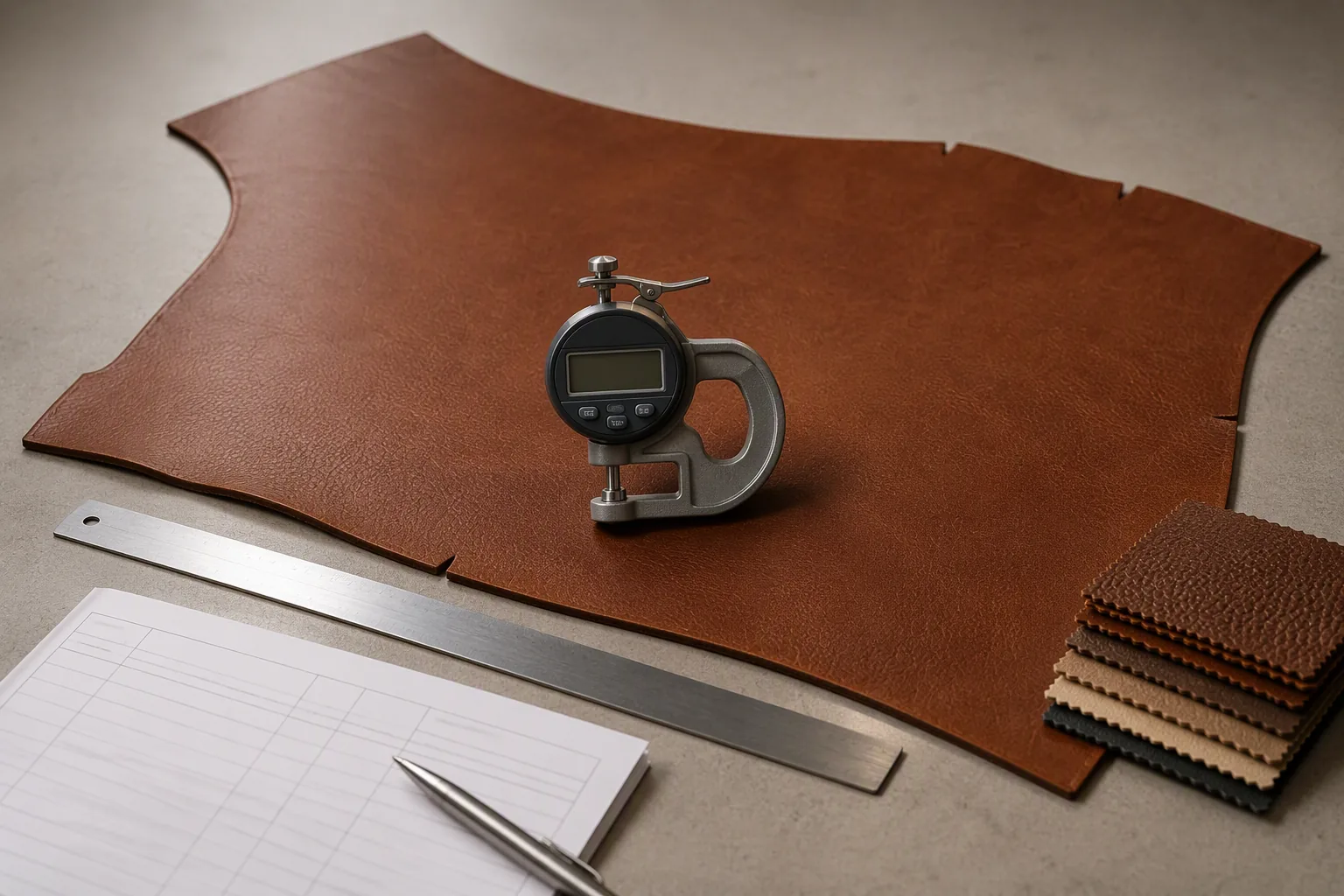
The Tools
- A thickness gauge suitable for leather, with a flat foot
- A steel rule or tape for measuring panels and piece sizes
- A moisture meter or, at minimum, a documented feel-and-record method
- The stored reference panel and colour swatches
- A light source with consistent colour characteristics
- A clean, smooth bench, chalk and a record form
The Area
Conditions should be repeatable.
A dedicated area with stable lighting and a clean surface prevents accidental marking and makes comparison meaningful. Inspecting under mixed lighting, on a cluttered bench, is how good leather gets rejected and poor leather gets accepted.
The Record Form
The form should follow the check list.
Each property on the checklist should have a place on the form for the measured value or assessment, plus room for the disposition. Recording results in the same structure every time is what turns inspection into data.
Who Inspects
Separate the person who checks from the person who ordered.
Where possible, the person performing goods-in inspection should not be under pressure to accept a late delivery, because that pressure is what converts a hold into a concession. A neutral inspector protects the factory and the supplier relationship.
What to Check on Every Delivery
The checklist should be short enough to be used.
The Master Checklist
| Check | Method | What a failure looks like |
|---|---|---|
| Article identity | Compare bundle labels and article codes against the purchase order | Wrong finish, wrong grain or wrong tannage delivered |
| Colour | Compare against the stored reference under fixed light | Visible tone or shade difference, or a strong batch shift |
| Gloss and surface | Compare surface reflection against the reference | Too glossy, too matte or a different surface hand |
| Thickness | Measure with a gauge at points across the panel | Thickness outside the agreed range, or uneven within a panel |
| Temper and hand | Assess by hand against the reference | Too soft, too firm or a different drape |
| Grain and surface uniformity | Visual check across the delivery | Corrected grain where natural was approved, or uneven grain |
| Defects | Visual screening by area | Holes, scars, deep marks or pipe in areas that must be clean |
| Moisture | Meter reading, or a documented assessment | Damp leather that risks mould or movement after cutting |
| Smell | Smell the leather after opening the bundle | Chemical, musty or otherwise unusual odour |
| Area and count | Measure panels and count pieces against documents | Short measure or missing pieces |
| Handling damage | Visual check of folds and edges | Creases, crushed grain, edge damage from transit |
| Storage condition | Check the bundle and its wrapping | Wet wrapping, condensation or heat damage |
Frequency and Depth by Risk
Not every property needs the same attention.
Colour, thickness and temper are checked on every delivery because a deviation affects every panel of the order, while slow tests such as flex and adhesion are run on retained samples in parallel. Where a supplier has a history of one particular deviation, that check is deepened rather than the whole routine being lengthened.
The same logic applies to value. A delivery that will become the most visible part of a premium bag justifies a fuller inspection than one destined for interior linings and pockets, and the procedure can state that difference explicitly instead of leaving it to judgement.
Checks for Cut Parts and Components
Cut parts need their own check.
Where the supplier delivers cut panels rather than full hides, the check shifts toward dimensions, symmetry and the location of defects relative to the panel shape, because a small defect in the wrong place ruins a cut part that is otherwise perfect.
Checks That Take Longer
Some properties cannot be judged on arrival.
Flex, adhesion and fastness tests need preparation and time, so they are usually run on a retained sample in parallel with the arrival check rather than holding the delivery. The retained sample is what allows those results to be connected to the lot later.
Thickness, Area and Count Checks
Measurements are where arguments are avoided.
Measuring Thickness Properly
Method matters as much as the value.
Thickness varies across a hide, so measuring at a few fixed points and recording them, rather than quoting a single number, is the honest approach. Measurement points should be consistent between deliveries and noted on the form.
Where to Measure
Measure where the leather will be used.
A thickness reading from the belly of a hide says little about the back panels that will carry load. Where specific areas are reserved for specific parts, thickness should be checked in those areas.
Area and Count
Count what was paid for.
Measuring panel sizes and counting pieces against the delivery documents catches short measure early, when it can still be corrected. This check is mechanical, fast and frequently skipped.
When to Take Area Off
Some deviation is expected.
Allowing for the agreed tolerance and for the natural shape of a hide, rather than expecting mathematically exact sizes, keeps the check fair. What matters is that the tolerance is written down before the delivery arrives.
Colour and Panel Matching at Goods-In
Colour is the most common complaint and the easiest to prevent.
Comparing Against the Standard
Comparison needs the reference, not memory.
The stored reference panel, kept away from light and handling, is the only reliable standard. Comparing deliveries against each other, rather than against the reference, allows colour to drift in one direction order after order.
Light Condition
Lighting decides what you see.
Assessing colour in the same light every time, ideally under a controlled source rather than mixed daylight and workshop lamps, is what makes the comparison meaningful. Two people agreeing under the same light is verification; two people disagreeing under different lights is noise.

Panel Matching Groups
Colour variation must be managed, not only measured.
Where a delivery shows variation between bundles, panels should be grouped so that each bag is made from leather of the same tone, and the grouping should be recorded. Mixing bundles within one bag is how visible two-tone bags are produced.
Recording Colour Results
Record the verdict, not the adjective.
Noting the measured result, the reference used and the disposition is more useful than writing “slightly darker”. A recorded comparison can be repeated by someone else; an adjective cannot.
Temper, Hand and Drape
Temper decides how the leather behaves in the cutting room.
Assessing Temper
It is a comparison, not a measurement.
Temper is assessed by handling the leather against the reference: how it folds, how it springs, whether it holds a curve and how it feels in the hand. It should be judged by someone who handles leather daily, against the approved standard.
Where Temper Causes Problems
Wrong temper breaks constructions.
Too soft and the bag sags; too firm and the gusset resists opening and the edge finish cracks at the fold. Because temper interacts with thickness and reinforcement, a temper deviation should be assessed against the parts the lot will be used for.
Documenting a Temper Judgement
Write the reference and the verdict.
Recording which reference panel the judgement was made against, and whether the deviation was accepted, is what allows a repeat problem to be identified rather than re-argued.
Surface and Defect Screening
Defects are graded by where they fall.
Screening by Area
The same defect is serious in one place and irrelevant in another.
A scar in the middle of a panel that will become the front of a bag is a serious defect, while the same scar in an area destined for an interior pocket is acceptable. Screening therefore depends on knowing the cutting plan.
Defect Types to Record
- Holes, tears and cuts
- Scars, tick marks and healed surface damage
- Deep wrinkles and growth marks
- Grain damage, including pipe and loose breaks
- Finish faults such as coating blisters, streaks or unevenness
- Stains that will not lift
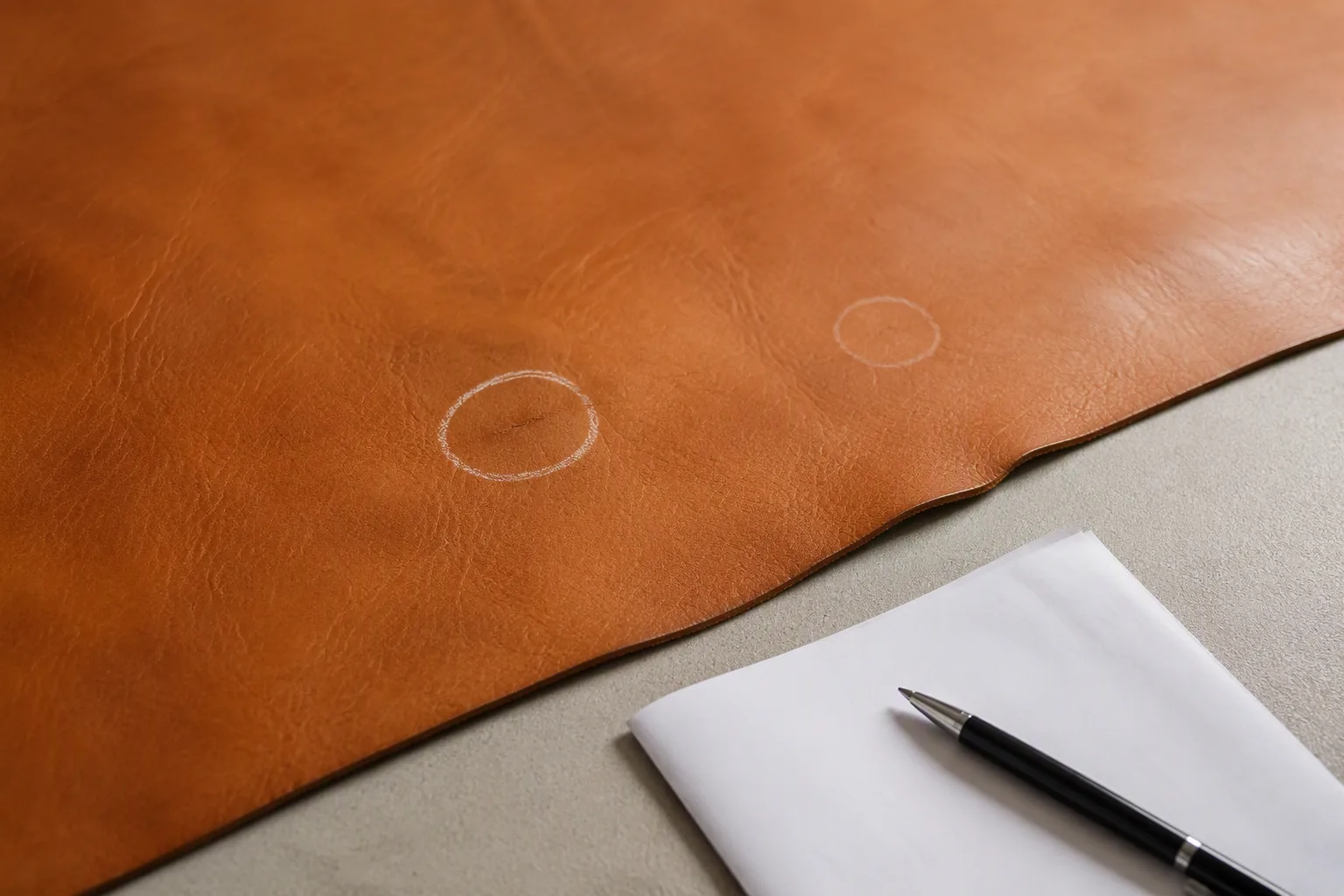
Recording Defect Locations
Map rather than describe.
Marking the defect positions on the delivery form, or on a retained sketch, tells the cutting room where the leather can safely be used and documents the extent of the problem if a claim is raised later.
Defects Found Later
Some appear during cutting.
Cutting reveals hidden damage, and when that happens the finding should be logged against the delivery rather than treated as an isolated annoyance. Repeated hidden defects are a supplier issue, not a cutting room issue.
Moisture, Smell and Storage Condition
Two checks that are cheap and often skipped.
Moisture
Damp leather causes delayed damage.
Leather arriving damp can develop mould in storage and can move dimensionally after it is cut, which produces panels that no longer match. A meter reading, or at minimum a documented hand assessment, allows damp deliveries to be identified and dried under controlled conditions before use.
Smell
Odour reveals process problems.
An unusual chemical or musty smell can indicate a process deviation or a storage problem, and odour is difficult to remove once it is inside a finished bag. Smelling the leather when the bundle is opened costs nothing and should be on the checklist.
Storage After Inspection
Acceptance is not the end of the check.
Accepted leather should be stored under conditions that keep it dry, flat and out of direct light, with bundles identified by lot so that any problem can be traced back. Inspection followed by poor storage simply moves the failure later.
Small Components and Consumables
Not only the main leather needs checking.
Thread, zips, reinforcement materials and edge finishes arriving in the same delivery should be checked against their own references, because a zip of the wrong finish or a reinforcement of the wrong weight causes just as much rework as a leather deviation. Small components are often waved through simply because they are small.
Where components are supplied pre-coated or pre-treated, the check should also confirm the coating behaves as approved, since an adhesive or coating change can pass a visual check and still fail during fusing.
Recording Results and Dispositions
Every check should end in a decision.
The Four Dispositions
| Disposition | When to use it | What to do next |
|---|---|---|
| Accept | Delivery meets the specification | Release to production and record the result |
| Accept with deviation | Deviation is within agreed tolerance or usable for a defined part | Restrict the lot to specific parts and record the restriction |
| Hold | Decision needs a test, a second opinion or supplier comment | Store separately and quarantine from production |
| Reject | Deviation is outside tolerance or unusable | Raise with the supplier and keep the lot segregated |
Why Hold Is Not a Delay Tactic
The middle option should be used deliberately.
Hold exists for deliveries that need a flex test or a supplier explanation before a decision is possible. Using it to postpone uncomfortable decisions turns the inspection area into a warehouse and hides the problem until it becomes urgent.
Recording Against the Lot
Records should be traceable.
Lot number, delivery date, quantity, measured results, disposition and the name of the inspector should be recorded together, so that a later complaint can be connected to a specific delivery without relying on anyone’s memory.
When to Reject a Lot
Rejection is a decision with a written basis.
Rejection Triggers
- Colour outside the agreed tolerance against the reference
- Thickness outside the agreed range, or uneven beyond tolerance
- Wrong article, finish, grain or tannage delivered
- Defects in areas reserved for visible panels
- Damp leather that cannot be safely dried
- Odour that cannot be removed
- Short measure beyond the agreed tolerance
Before Rejecting
Check that the standard is the problem.
Confirm the reference used is the current approved one, the measurement method matched the specification, and the conditions were consistent. A rejection based on a superseded reference damages the relationship and wastes a delivery.
Time Limits for Raising a Claim
A claim raised late is a claim weakened.
Most suppliers expect problems to be reported within a defined period after delivery, and a deviation discovered when the lot has already been cut and partly assembled invites a discussion about who caused it. This is the practical reason the formal arrival check matters: it establishes the condition of the leather before the factory has touched it.
Where hidden defects only appear during cutting, the retained sample and the lot records are what allow the claim to be made at all. Without them, the factory is asserting a fact it cannot demonstrate.
While a Decision Is Pending
Keep the lot separate.
Rejected or held leather should be physically separated and clearly identified so that it cannot drift into production while the discussion continues. The most expensive outcome is a rejected lot that is used anyway.
Talking to the Supplier About a Rejection
The conversation should be about data.
What to Send
Send the measurement, not the complaint.
The lot number, the measured values, the reference used, photographs of the marked defects and the disposition give the supplier something to act on. Vague statements about quality make a resolution slower and more expensive for both sides.
What to Ask
Ask about cause, not only remedy.
Understanding whether the deviation came from a stock change, a process adjustment or a handling problem prevents the same thing from arriving with the next delivery. A replacement that arrives with the same deviation has solved nothing.
Agreeing the Outcome
The remedy should be specific.
Replacement, credit, re-selection at the supplier’s cost or acceptance at a reduced price are all legitimate outcomes, and the choice should be recorded so that both sides know what was agreed and what will be checked on the re-delivery.
Traceability and Re-inspection
Traceability makes later problems solvable.
Keeping the Link
Every panel should be traceable to a lot.
Where a defect is found weeks later in a finished bag, the lot record is what connects the bag to the leather delivery and to the supplier’s production. Without it, every complaint is investigated from nothing.
Re-inspection After a Problem
Re-inspection should be heavier, not identical.
When a lot has been rejected or a deviating lot accepted for restricted use, the replacement or the next delivery should be inspected more thoroughly, with the specific failure as the focus. Escalating inspection after a failure is how a supplier is brought back to specification.
Retained Samples
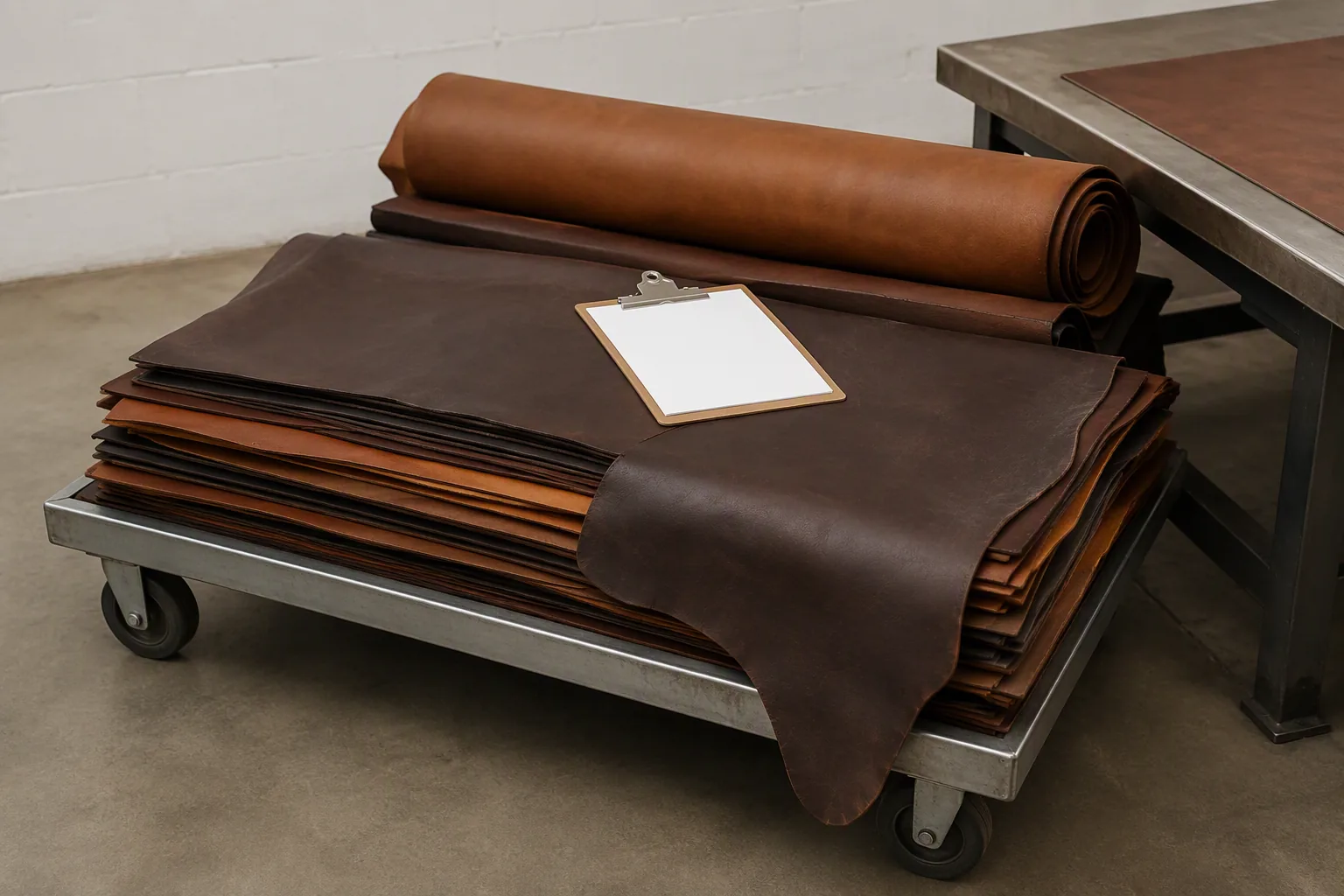
Keep a sample from every accepted lot.
A retained sample, stored with the lot record, allows a later dispute to be settled by measurement rather than memory, and allows flex or adhesion tests to be run on the actual leather if a problem appears in service.
Repeat Problems and Escalation
A repeated deviation is a process problem.
Identifying Repetition
Track results by supplier and by property.
Looking at goods-in results over several months shows whether a supplier’s deviations cluster around colour, thickness or temper, which is far more actionable than reacting to each delivery separately.
Escalation Steps
- Raise the specific deviation with evidence from the lot records
- Ask for the cause and for what has changed in the process
- Increase inspection on the following deliveries
- Request a re-submitted sample where the article itself has changed
- Review the commercial terms where the deviation repeats without correction
When to Change Supplier
Change only with evidence.
A decision to move to another supplier should rest on a documented pattern of deviations that the supplier has not corrected, not on a single poor delivery. The same standard should apply when a new supplier is being qualified.
Judging Whether It Is Improving
Escalation should be measured, not assumed.
Reviewing the goods-in results after the following deliveries shows whether the deviation has actually reduced, and that review is what decides whether normal inspection can resume. Escalation that continues indefinitely stops being a signal and becomes a habit.
Where results do improve, the finding is worth recording on both sides. A supplier who corrects a problem has demonstrated something a supplier who only apologises has not, and the record of correction is more useful in future sourcing decisions than the original rejection.
Common Mistakes at Goods-In
| Mistake | Consequence | Prevention |
|---|---|---|
| Inspecting only the top bundle | Hidden deviations pass into production | Sample across the delivery and through the stack |
| Comparing against another delivery rather than the reference | Colour drifts gradually in one direction | Keep and use the stored reference panel |
| Assessing colour under mixed lighting | Good leather rejected, poor leather accepted | Fix the light source for every assessment |
| Recording adjectives instead of values | Results cannot be repeated or defended | Record measured values and the reference used |
| Skipping moisture and smell | Mould and odour appear weeks later | Add both to the routine checklist |
| No disposition recorded | Deviating lots drift into production | End every check with a written disposition |
| Holding a lot without a decision date | Inspection area becomes a warehouse | Set a decision date when a lot is held |
| No retained sample | Later disputes become arguments about memory | Retain a sample from every accepted lot |
Frequently Asked Questions
What should be checked when leather arrives at a factory?
Article identity, colour and gloss against the stored reference, thickness, temper, grain uniformity, defects, moisture, smell, area and count, handling damage and the condition of the packaging. The check should be written down as a routine so that every delivery is assessed the same way.
How much of a delivery needs to be inspected?
A defined sample taken across the delivery and through the stack, rather than the accessible top layer, is normally sufficient. The sampling basis should be written into the procedure and applied consistently, with heavier inspection after a rejected or deviating lot.
How is leather colour checked properly?
By comparing the delivery against the stored approved reference panel under the same light source every time. Comparing deliveries against each other allows colour to drift order after order, and mixed lighting makes the result depend on the weather rather than the leather.
Why does approved leather arrive a different colour?
Because leather is a natural material and because tannery process and stock lots change between orders. Hide variation, dye strength and finishing passes all move colour slightly, which is why a written tolerance and a stored reference are needed rather than an expectation of an exact match.
What if the delivery is slightly outside tolerance?
It can often be accepted for specific parts, provided the deviation is recorded and the lot is restricted to parts where it does not matter. The restriction must be written into the record, otherwise the lot quietly becomes general stock.
When should a leather delivery be rejected?
When it falls outside the agreed tolerance, when the wrong article, finish or tannage was delivered, when defects fall in areas reserved for visible panels, when the leather is damp beyond recovery or carries odour, or when the measure is short beyond tolerance.
How should damp leather be handled?
Identify it at goods-in, keep it out of production, and dry it under controlled conditions before use. Cutting damp leather is how panels move after assembly, and storing it damp is how mould appears inside a delivered bag weeks later.
What records should be kept for each delivery?
Lot number, delivery date, quantity, the measured results for each checklist item, the disposition, the inspector’s name and a retained sample. Together these allow a later complaint to be traced to a specific delivery rather than investigated from nothing.
What should be sent to a supplier when rejecting a lot?
The lot number, the measured values, the reference used, photographs of marked defects and the requested remedy. Data makes the discussion short and factual, while a general complaint about quality usually produces a replacement with the same problem.
How can a factory stop the same deviation arriving repeatedly?
By tracking goods-in results by supplier and by property over several months, raising the specific pattern with evidence, asking for the cause rather than only the remedy, and increasing inspection on the following deliveries until the results are stable.
Should goods-in inspection replace supplier qualification?
No. Supplier qualification and tannery auditing decide who is capable of meeting the specification, while goods-in inspection confirms that each delivery did. Inspection cannot fix a supplier who is unable to hold the standard in the first place.
The Bottom Line
Goods-in inspection is where a specification becomes real.
The routine does not need to be elaborate: a stored reference, a consistent light source, a thickness gauge, a written checklist that ends in a disposition, and a retained sample from every accepted lot. What matters is that every delivery is measured against the same standard and that the result is recorded.
For buyers, the practical questions are short. Ask whether the factory inspects each delivery against a stored reference and under fixed lighting, and how thickness, temper, moisture and defects are recorded.
Then ask what dispositions exist and who makes the call, and whether a retained sample is kept for every lot. A factory that can answer those questions is controlling its material; one that cannot is accepting whatever arrives and discovering the consequences during assembly.
