
Leather Dual Sourcing: Managing Supply Risk in Bags
Leather Dual Sourcing: Managing Supply Risk in Bags
A bag programme that depends on one tannery for its main leather is exposed to everything that tannery does: a process change, an unexpected shortage, a price revision, a delivery delay or a quality drift that only appears after two thousand square feet have been cut. Dual sourcing exists to reduce that exposure, and it is one of the few supply decisions that is much easier to make deliberately than in a hurry.
As a bag manufacturer, we qualify and run second sources for most programmes, and we also see how badly dual sourcing is done when it is treated as simply buying the same colour elsewhere. This guide explains what has to match, how a second tannery is qualified, how production is split, and what goes wrong when two sources are managed as though they were one.
A second source is not a spare supplier. It is a second version of the material, and it has to be proven equal before it is treated as one.
- Why a Single Source Is a Risk
- What Dual Sourcing Really Means
- When to Qualify a Second Source
- What Must Match Between Two Sources
- Colour and Hand Matching Across Tanneries
- Thickness, Temper and Substitution Limits
- Qualifying a Second Tannery
- Splitting Production Between Sources
- Cutting, Batching and Traceability Rules
- Stock, Continuity and Buffer Planning
- Documentation and Claims With Two Sources
- Cost and Commercial Considerations
- Risks and Downsides of Dual Sourcing
- Testing and Approval Protocol
- Managing Two Suppliers at Once
- Knowing When to Drop or Replace a Source
- Common Mistakes in Dual Sourcing
- Frequently Asked Questions
- The Bottom Line
Why a Single Source Is a Risk
Tanneries are businesses with their own constraints.
The Risks You Are Accepting
Depending on one tannery means accepting its downtime, its stock decisions and its commercial priorities. If it stops production for maintenance, loses a consignment in transit, changes a coating supplier or decides to raise its price, the bag programme absorbs the consequences directly.
Why the Risk Is Asymmetric
Losses are rarely gradual.
Single-source problems tend to arrive as disruptions rather than slow drifts: a delivery is late by six weeks, or a lot arrives in a shade that cannot be used, and the production plan has to be rebuilt around whatever remains in the warehouse.
The Cost of Preparing Late
Qualifying a source under pressure is expensive.
A second tannery approached during a crisis is being asked to match a colour, a temper and a finish under time pressure, with no room to run trials or to reject an imperfect match. Qualifying the same source calmly, months earlier, costs a fraction of that.
What Dual Sourcing Really Means
It is material equivalence, not supplier multiplication.
The Definition
Two qualified sources for one specification.
Dual sourcing means two tanneries have each been approved against the same specification, have each delivered production quantities that passed the same checks, and can each supply the programme without the bag changing in any way the customer would notice.
What It Is Not
It is not simply buying elsewhere.
Buying the same article description or the same colour name from a second tannery is not dual sourcing until the delivered material has been proven to match, because leather articles are defined locally: the same name can describe different thickness, temper, grain and finish depending on who is making it.
Full, Partial and Emergency Dual Sourcing
There are three levels, and they should be labelled.
- Full: both sources are approved for the specification and either can be used for any order
- Partial: the second source is approved for defined parts or colours only
- Emergency: the second source is a contingency that has been sampled but not yet run in production
Labelling which level applies prevents the common mistake of assuming a sampled source is a production-ready one.
Where Dual Sourcing Does Not Help
It does not solve design problems.
If the specification is vague, two sources will interpret it differently and the variations will multiply. Dual sourcing works best where thickness, temper, colour reference, finish family and defect limits are all written down.
When to Qualify a Second Source
Timing is a commercial decision.
Programme Characteristics
The case is strongest where the programme is large.
Long-running programmes, seasonal peaks, programmes with several colours and programmes tied to a single launch date are the ones where a single-source disruption is most expensive, and therefore where qualification effort pays back fastest.
Signals That the Time Has Come
- The programme accounts for a large share of the factory’s leather volume
- Lead times have lengthened, or the source is near capacity
- The tannery is consolidating, changing ownership or moving plant
- Prices have risen more than the market explains
- Quality has begun to drift between lots
Who Owns the Qualification
Someone has to be accountable.
Qualification involves sampling, testing, cutting trials and a decision, and where no one owns it the process stalls after the first swatch comparison. Naming an owner and a target date turns an intention into a project.
That owner is usually the person responsible for leather sourcing or development, supported by whoever runs incoming inspection and whoever assembles the samples. The decision to approve a source, however, should sit with the party accountable for the finished product, because approval is a promise about what will be delivered.
Beginning Earlier Than It Feels Necessary
Comfortable qualification is the whole point.
Qualification should start when nothing is wrong, because that is the only time the process can be run properly: sampling over several rounds, comparing lots, adjusting and rejecting, without a production plan hanging on the outcome.
What Must Match Between Two Sources
Two sources only work if the bag does not change.
The Attributes That Matter
| Attribute | What has to match | How it is confirmed |
|---|---|---|
| Colour | Agreed reference under fixed light | Visual comparison against the stored reference |
| Gloss and surface | Same finish family and level of sheen | Visual and handling comparison |
| Thickness | Same range and uniformity | Gauge measurement across panels |
| Temper and hand | Same feel, fold and spring | Handling comparison by an experienced assessor |
| Grain character | Same grain type and level of correction | Visual comparison on panels and cut parts |
| Finish performance | Comparable water, rub and flex behaviour | Comparative tests on both sources |
| Flesh side and backing | Same treatment, suitable for bonding | Handling check and fusing trial |
| Cut and area | Comparable usable area for the patterns | Cutting trial against the same nesting |
| Moisture and smell | Within the same limits | Meter reading and odour check |
| Weight per area | Comparable panel weight | Panel weighing during sampling |
Which Differences Are Tolerable
Small variation can be managed.
Two sources will never be identical, and the question is not whether a difference exists but whether it affects the finished bag. A slight difference in the flesh side may be irrelevant where panels are lined; a slight difference in temper is not, because it changes how the bag folds.
Where Difference Becomes Visible
The customer sees the outside.
Differences in colour, gloss and grain are the ones that reach the buyer, while differences in backing, moisture and flesh structure rarely do. Prioritising the visible attributes protects the product even where the technical match is imperfect.

Writing the Match Criteria Down
Tolerance should be explicit.
The comparison is only repeatable if the criteria, the light condition and the reference are recorded. A qualification decision described as “close enough” cannot be re-checked by anyone else, including the same people a year later.
Colour and Hand Matching Across Tanneries
This is where most qualifications succeed or fail.
Why Colour Is Harder Than It Looks
Colour comes from chemistry and process.
Dye selection, penetration, coating opacity and finishing passes all influence the final tone, and two tanneries working from the same nominal colour will land in slightly different places. The difference is often small on a swatch and obvious once a bag-sized panel is viewed against the reference.
Matching Hand as Carefully as Colour
Hand is what the customer feels.
Temper, surface friction and flexibility are assessed by handling, and a source that matches on colour while feeling firmer or softer will produce a bag that behaves differently even if it looks the same. Hand should be assessed against the reference panel, not against the other source.
The Reference Discipline
One reference, used by both sources.
Both tanneries should be working to the same stored reference panel, and the factory should compare each delivery against that panel rather than against the other supplier’s most recent lot. Reference drift is what turns a good match into a slow divergence.

Managing an Imperfect Match
Sometimes the reference itself is the problem.
Where a second source cannot reach the reference at an acceptable cost, the practical options are to restrict that source to parts where the difference does not show, to accept a defined tolerance for interior parts, or to re-approve the reference with the customer on the basis of the two achievable tones.
Thickness, Temper and Substitution Limits
Some differences cannot be absorbed by supervision.
Thickness Ranges
Write a range, not a number.
A second source should be qualified against the same thickness range with the same measurement method. A source that runs consistently at the top of the range can still pass, but it must be assessed against the parts it will supply, because a thicker panel changes folds and edge work.
Temper as a Hard Limit
Temper is the least forgiving attribute.
Bags are built around the way a panel folds, holds and springs back, so a temper difference that exceeds the agreed tolerance may require a separate set of patterns or a different reinforcement approach. Where that is unacceptable, temper becomes a qualifying criterion in its own right.
Where Substitution Is Not Permitted
Some parts should never be mixed.
Panels that sit directly beside each other, visible exterior panels within one bag, and the parts of a single visible assembly must come from one source. Where two sources are in use, the bags themselves have to be kept single-source rather than the panels inside them.
Substitution Reference
| Part | Can two sources be mixed? | Reason |
|---|---|---|
| Visible exterior panels of one bag | No | Colour and grain difference becomes obvious |
| Straps and body of one bag | No | Hand differences show in use |
| Interior pockets and linings of one bag | Sometimes | Rarely compared side by side in use |
| Reinforcement and support layers | Often | Usually hidden and far less visible |
| Small trim pieces | With care | Visible, so only where the match is confirmed |
| Different bags in one order | Yes, if declared | Customers may compare bags from the same batch |
Qualifying a Second Tannery
A structured process beats an opportunistic one.
The Steps
- Confirm the specification is written and complete before approaching any source
- Send the reference panel, the specification and the samples required
- Obtain swatches and small panels for a first comparison
- Compare colour, gloss, grain, thickness, temper and finish behaviour against the reference
- Run a fusing or bonding trial if reinforcement is part of the construction
- Order a pilot quantity and cut it into the real patterns
- Assemble sample bags from the new source and review them against bags from the existing source
- Test the assembled bags where the programme requires it
- Agree tolerances, inspection criteria and delivery requirements
- Approve for a defined scope, and review after the first production run
Why the Pilot Cut Matters
Cutting reveals what swatches hide.
A panel that looks acceptable as a swatch can behave differently once nested: yield changes, defects appear in different places, and the leather may handle differently at the skiving machine. Cutting a pilot quantity in the real patterns is the step that exposes all of it.
Recording the Qualification
Approval should be traceable.
The approved reference, the tolerance agreed, the tests performed, the pilot lot number and the scope of approval should be recorded together, so that a later delivery can be checked against the basis on which the source was approved.
Splitting Production Between Sources
Allocation is a policy, not an accident.
Why Splitting Matters
Two sources must remain alive.
A second source that is qualified and then never used will lose familiarity with the article, let its tooling or stock lapse and deliver inconsistently when it is finally needed. Keeping a share of real production with the second source is what keeps it capable.
How to Split Sensibly
- Keep each individual bag, and each colourway, single-source
- Allocate by order, by delivery window or by colour rather than by panel
- Keep the split reasonably stable so both sources retain the article in production
- Give the second source enough volume to be commercially motivated
- Review the split whenever quality or delivery performance changes
Handling the Changeover Between Sources
Changeovers need a clean line.
Where a production run moves from one source to the other, the changeover should coincide with a break in the run: a new order, a new colour or a defined batch boundary. Mixing sources within a continuous run is how two slightly different tones end up in the same delivery.

Informing the Customer
Some buyers want to know.
Where the customer has approved a source, adding a second one may require notification or approval, particularly for own-brand programmes. This should be clarified before the second source is used in production rather than after the delivery has shipped.
Cutting, Batching and Traceability Rules
Two sources demand better records.
Batch Identification
Every bundle should say where it came from.
Bundles should carry the tannery, the lot and the article code, and the internal production record should link the cut panels to those bundles. Without that link, a problem discovered after assembly cannot be attributed to a source.
Keeping Sources Apart in Storage
Physical separation prevents mixing.
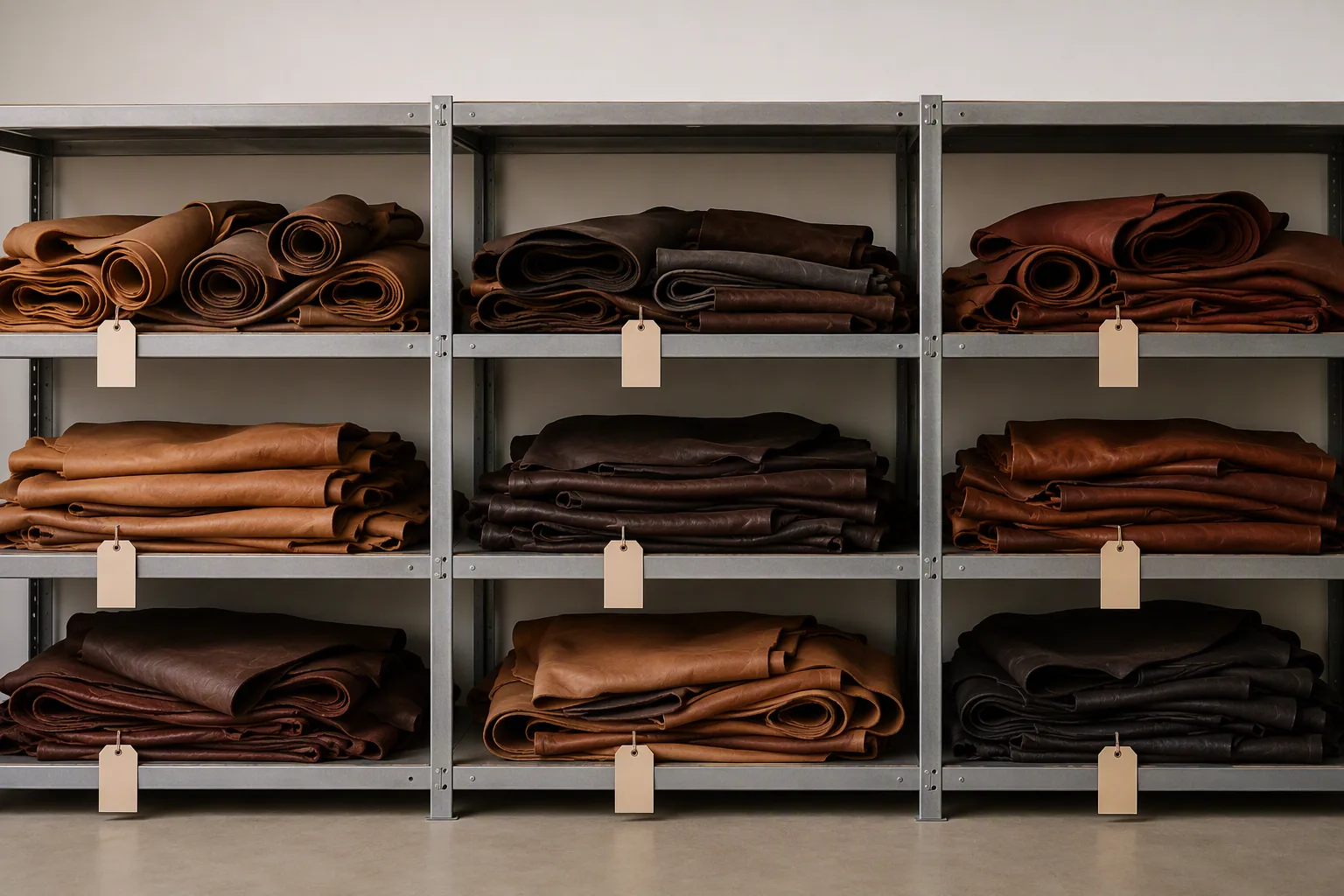
Leather from two sources should be stored in identified bays or on identified shelves, and cut parts should carry the source through to the assembly line. Where bays are unlabelled, the safest assumption is that mixing has already happened.
Traceability Through Assembly
Every bag should be traceable to one source.
Recording which source supplied the panels for a production batch allows a complaint to be investigated precisely and allows the affected deliveries to be identified if a source is later found to be out of specification.
Records Worth Keeping
- The approved reference panel for each source
- Qualification records, including the pilot lot and the test results
- Allocation for each order, by source and colour
- Incoming inspection results per source
- Retained samples for each accepted lot of both sources
Stock, Continuity and Buffer Planning
Continuity is built before it is needed.
Buffer Stock
A buffer should have a purpose.
Holding a defined quantity of approved leather from each source smooths over a short interruption, and the buffer should be sized against the lead time and the likely disruption rather than to whatever fits in the store.
Rotation and Shelf Life
Buffers go stale.
Leather held for a long time can change in moisture and colour, and a buffer that is never rotated becomes a stock of material that does not match the current reference. Buffer stock should be rotated through production, with the oldest lots used first.
When the Buffer Is Used
Using the buffer should trigger action.
Drawing down a buffer is a signal that the primary source has a problem, and the response should be to investigate and to replenish rather than to treat the buffer as ordinary stock.
Planning Reference
| Planning element | What to define | Why it matters |
|---|---|---|
| Buffer quantity | Amount per source, in area terms | Covers a short interruption |
| Reorder trigger | The level at which new orders are placed | Prevents the buffer being used as stock |
| Maximum holding | The limit before colour and moisture drift | Protects matching to the reference |
| Rotation rule | Oldest first, with recorded dates | Keeps buffers current and usable |
| Allocation policy | How orders are split between sources | Keeps both sources active |
| Review frequency | How often the split and performance are reviewed | Catches drift early |
Documentation and Claims With Two Sources
Two sources means two sets of paperwork.
What Should Be Held
- Approved specification, common to both sources
- Qualification record for each source
- Compliance and material documentation for each source
- Incoming inspection records, per source and per lot
- Allocation records linking orders to sources
Claims and Complaints
Attribute the problem before contacting anyone.
Where a defect appears, the lot records identify which source supplied the panels, and only that supplier should be approached. Raising a claim with both sources at once wastes goodwill and usually delays the resolution.
Keeping the Customer Informed
Disclosure depends on the agreement.
Some buyers require notification of a second source, others require approval of it, and others only require that the delivered product meets the specification. The requirement should be established in writing before the second source is used.
Cost and Commercial Considerations
Dual sourcing has a price.
Where the Value Comes From
Risk reduction is the return.
The benefit is not usually a lower unit price but a programme that survives a disruption. Where a second source is also cheaper, that is a bonus rather than the reason to qualify one.
Costs to Expect
- Qualification effort, including samples, tests and pilot runs
- Dual reference panels and separate inspection routines
- Additional storage and traceability administration
- A possible small price concession to keep the second source interested
- Training and documentation for both sources
Negotiating With Two Sources
Do not use one against the other carelessly.
Competitive pressure can reduce prices, but applying it aggressively tends to reduce the attention a source gives to a small programme. Where the second source is kept alive for risk reasons, it should be given enough volume and stability to remain genuinely willing.
Risks and Downsides of Dual Sourcing
The approach has its own failure modes.
| Risk | How it appears | Mitigation |
|---|---|---|
| Two sources drift apart over time | Colour develops in different directions | Compare both against the stored reference, not against each other |
| One bag made from two sources | Visible mismatch in the finished product | Keep each bag and each colourway single-source |
| The second source loses capability | Poor delivery when it is finally needed | Keep a defined share of real production with it |
| Records fail to attribute | Claims go to the wrong supplier | Carry the source through batching to assembly |
| Buffer stock goes stale | Material no longer matches the reference | Rotate buffers and cap maximum holding |
| Costs creep without benefit | Qualified source never used | Review the split and the economics annually |
| Customer approval assumed, not obtained | Delivered goods rejected | Clarify the requirement in writing before use |
Testing and Approval Protocol
Comparisons should be measured, not asserted.
| Test | Purpose | Applied to |
|---|---|---|
| Colour comparison under fixed light | Confirm match to the reference | Reference panel and both sources |
| Gloss and surface assessment | Confirm finish family matches | Reference panel and both sources |
| Thickness measurement across panels | Confirm range and uniformity | Each lot of both sources |
| Temper and hand assessment | Confirm behaviour in folding and use | Reference panel and both sources |
| Fusing or bonding trial | Confirm backing behaves with reinforcement | Both sources, on the real construction |
| Water and rub resistance | Confirm finish performance is comparable | Both sources |
| Flex test, including cold flex | Confirm finish survives movement | Both sources |
| Pilot cutting and assembly | Confirm yield and behaviour in the real patterns | Both sources |
Approving on Evidence
Approval should follow results.
Each test should produce a recorded result and a decision, and the approval scope should state which parts, colours and orders each source may supply. Approval without a scope is what allows a partially qualified source to be used everywhere.
Managing Two Suppliers at Once
Two relationships need two disciplines.
Communicating Clearly
Each source should know its role.
Where one source is primary and the other secondary, both should understand the split, the expectation and the review cycle, so that neither is surprised by a change in allocation.
Measuring Both
Performance should be comparable.
Delivery reliability, incoming inspection results and responsiveness should be tracked for both sources on the same basis, which allows the split to be reviewed on evidence rather than on familiarity.
Escalation With Two Sources
Problems should be handled per source.
Where one source drifts, the response should be aimed at that source alone, with the other continuing normally. Treating both as a single relationship usually means penalising the source that was performing.
Knowing When to Drop or Replace a Source
Sources need reviewing like designs.
Grounds for Dropping
- Repeated drift in colour, temper or thickness that is not corrected
- Delivery reliability that consistently fails the programme
- Unresolved compliance or documentation gaps
- Commercial terms that no longer work for the volume involved
Grounds for Replacement
Replacement is a qualification project.
Where a source is to be replaced, the replacement should be qualified before the existing source is released, otherwise the programme is left single-sourced with a new and unproven supplier.
Reviewing Sources on a Cycle
Reviews should be routine.
A short review at a fixed interval, comparing incoming inspection results, delivery reliability and price movement for each source, keeps the arrangement honest and gives both suppliers a reason to maintain performance. Reviews triggered only by a failure tend to happen too late.
The review should also confirm that the stored reference panels are still the current approved ones, and that both sources are still working to them. References age out of date quietly, and a review is the natural moment to re-approve them.
Retiring a Source Cleanly
Run it out through a batch boundary.
A source should be retired at the end of an order or colourway rather than mid-run, so that no bag contains mixed material and the records stay clean.
Common Mistakes in Dual Sourcing
| Mistake | Consequence | Prevention |
|---|---|---|
| Treating a sampled source as approved | Production risk without the benefit | Label the qualification level explicitly |
| Comparing sources against each other | Both drift away from the reference | Compare each source against the stored reference |
| Mixing panels within one bag | Visible mismatch | Keep each bag and colourway single-source |
| Qualifying on swatches only | Behaviour differences appear in production | Include pilot cutting and assembly |
| Never using the second source | Capability decays | Keep a defined share of production |
| No source recorded through batching | Claims cannot be attributed | Carry the source from bundle to assembly |
| Buffer stock not rotated | Material no longer matches | Rotate and cap holding |
| Assumed customer approval | Rejected deliveries | Confirm the requirement in writing |
Frequently Asked Questions
What is dual sourcing for leather in bag production?
It means two tanneries have each been approved against the same specification and can each supply the programme, so that the finished bag does not change and neither source can halt production on its own. Approval means sampled, cut, assembled and tested, not simply having the same colour name.
Why is dual sourcing worth the effort?
Because single-source disruptions arrive as events rather than drifts. A maintenance shutdown, a quality drift or a price change at one tannery can stop a bag programme, and qualifying an alternative calmly in advance costs far less than qualifying one during a crisis.
Can two tanneries really match the same colour?
They can get close, and how close they get depends on the coating system and the finishing passes rather than the dye name. What matters is whether the achievable difference is visible in the finished product and whether a tolerance against the stored reference has been agreed.
Which properties must match between two leather sources?
Colour, gloss, grain character, thickness range, temper and hand, finish performance, backing suitability and usable area. The visible properties matter most to the customer, while temper and backing affect how the bag behaves during production.
Can panels from two sources be used in the same bag?
Generally no. Visible exterior panels, straps and body parts should come from one source, because even a small difference in tone or hand shows when the parts sit beside each other. Interior and hidden layers are more tolerant where the specification allows.
How long does it take to qualify a second tannery?
It depends on sampling rounds, testing and pilot cutting, but the work should be planned in months rather than weeks. The qualification includes swatch comparison, panel comparison, a fusing trial where relevant, a pilot quantity cut in the real patterns and bags assembled and tested.
Should the customer be told about a second source?
It depends on the agreement. Some buyers require notification, some require approval of the source, and others only require that the delivered product meets the specification. The requirement should be established in writing before the second source is used.
How should orders be split between two sources?
By order, by colourway or by delivery window, with each bag and each colourway kept single-source. The split should be stable enough that both sources stay familiar with the article and commercially motivated to keep it in production.
What happens if the second source is never used?
Its capability decays. It loses familiarity with the article, may let stock or tooling lapse and tends to deliver inconsistently when it is finally needed, which is why a defined share of real production should be kept with the second source.
How should complaints be handled with two sources?
Attribute the problem first. The lot records link the cut panels to the source that supplied them, and only that supplier should be approached, which keeps the claim precise and avoids penalising the source that performed correctly.
Does dual sourcing always reduce cost?
Not necessarily. The return is continuity rather than price, and qualification, dual references and extra administration all cost something. Where a second source is also cheaper that is useful, but it should not be the reason to qualify one.
The Bottom Line
Dual sourcing is a qualification project, not a purchasing habit.
It works when the specification is written, both sources are proven equal against the same reference, production is split so that each bag stays single-source, and records carry the source from bundle to assembly. Doing it while nothing is wrong is what makes it cheap.
For buyers, the practical questions are short. Ask whether a second source has been qualified and to what scope, how each source is compared against the reference rather than against each other, whether each bag is guaranteed single-source, how the split is kept alive, and whether the requirement to notify or approve the source applies. A factory that can answer those questions is managing supply risk; one that cannot is hoping the tannery stays available.
