
Leather Lead Times and MOQ: Planning Bag Production
Leather Lead Times and MOQ: Planning Bag Production
Leather arrives on a schedule that was set by the tannery, not by the bag factory. Between the moment a colour is confirmed and the moment finished panels are ready to cut, there is a sequence of production stages that cannot be compressed by asking nicely, and a minimum quantity below which a tannery will not start a dye lot at all.
As a bag manufacturer, we plan leather around these two constraints every week, and we see how often they are treated as surprises. This guide explains what actually determines lead time, why minimum order quantities exist, how they shape what a bag programme can realistically offer, and how to plan orders so that neither becomes a crisis.
Lead time and minimum order quantity are not obstacles to negotiate away. They are the shape of the industry, and a programme that ignores them will eventually be rescheduled by them.
- Why Lead Time Belongs in the Specification
- What Actually Determines Leather Lead Time
- Standard, Seasonal and Peak Lead Times
- Why Minimum Order Quantities Exist
- MOQ by Colour, Article and Lot
- How MOQ Shapes a Bag Programme
- Colour Continuity Across Repeat Orders
- The Ordering Rhythm
- Samples, Pilots and Small Orders
- Transit, Customs and Buffer Time
- What Delays Leather
- The Cost of Expediting
- Agreeing Dates With a Tannery
- Holding Stock or Ordering Fresh
- Reviewing Performance Over Time
- Common Mistakes in Lead Time and MOQ Planning
- Frequently Asked Questions
- The Bottom Line
Why Lead Time Belongs in the Specification
A colour without a date is only half a requirement.
Lead Time as a Constraint
It sets what is possible.
The date a bag can ship depends on when the leather can be cut, which depends on when it was ordered, which depends on the tannery’s schedule. Treating lead time as a purchasing detail rather than a programme constraint is how delivery promises get made before they are checked.
Lead Time and Colour Availability
Some colours take longer than others.
A colour already in the tannery’s routine runs to one schedule; a new colour, a special finish or a shade that must be matched to a reference runs to another, because it needs sampling, approval and a dedicated dye lot. The colour decision and the calendar decision are the same decision.
Planning Backwards
Start from the ship date.
Working backwards from the delivery date through assembly, cutting, leather lead time and approval is the only reliable way to see whether a programme is achievable. If the dates do not fit, that is discovered months before the problem, which is when it is still cheap to fix.
What Actually Determines Leather Lead Time
Lead time is a process, not a queue.
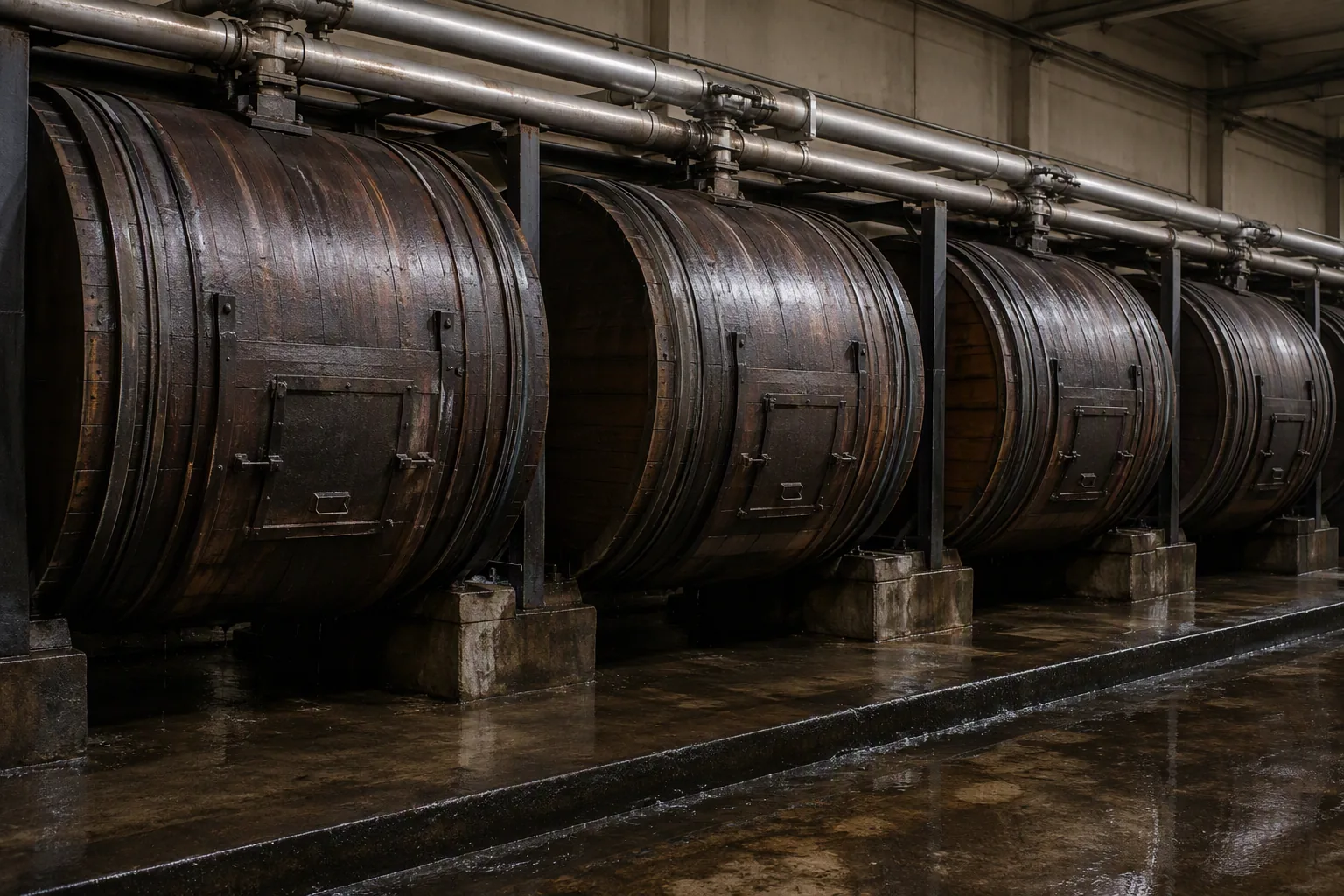
The Production Stages
Each stage has its own duration.
| Stage | What happens | What affects the duration |
|---|---|---|
| Order confirmation and scheduling | The order enters the tannery’s plan | Current workload, size of the order |
| Colour matching and approval | A dye or coating trial is approved against the reference | Whether the colour is new or existing |
| Raw material selection | Hides are allocated from stock | Availability of suitable hides for the article |
| Wet-end processing | Soaking, liming, tanning and related stages | Drum capacity and batch scheduling |
| Retanning, dyeing and finishing | The article is dyed and finished to specification | Number of finishing passes, coating system |
| Drying and conditioning | Moisture is stabilised before dispatch | Weather, drying capacity |
| Inspection, measuring and packing | The lot is checked, measured and bundled | Queue at inspection, order size |
| Dispatch and transit | The shipment moves to the factory | Destination, mode of transport, customs |
What Makes It Longer
Some orders need more stages.
A repeat of an established article with an existing colour moves through the plan at one pace. A new colour, a new finish, a different raw material grade or a new thickness requires sampling and approval before production, and every approval round adds time.
What Makes It Shorter
Very little shortens it.
Where the tannery already holds a suitable lot of the exact article and colour, delivery can be quick. Otherwise, the only real lever is to order earlier, or to accept the schedule and build the programme around it.
Why Rushing Is Not a Plan
Pressure does not create capacity.
Asking a tannery to shorten a schedule usually means asking it to displace another customer’s order or to shorten a stage such as drying or conditioning. The first is not always possible and the second affects the material, which is why expediting is a decision with a quality cost rather than a free service.
Standard, Seasonal and Peak Lead Times
The calendar has its own pattern.
Standard Conditions
A steady plan is the cheapest plan.
Where the order is placed with normal notice and the article is established, the schedule runs at the tannery’s standard pace and the risk of quality compromise is lowest.
Seasonal Pressure
Demand clusters.
Leather demand follows the bag industry’s own seasonality, and periods before major selling seasons are when tanneries are most heavily booked. Programmes that must ship into those windows need to be scheduled earlier than the arithmetic appears to require.
Peak and Holiday Effects
Capacity disappears at predictable times.
Long public holidays and year-end periods interrupt tannery schedules and, just as importantly, the logistics that follow them. Congestion after a holiday can be as disruptive as the holiday itself.
Planning Around the Pattern
Book capacity rather than hope for it.
Where a programme has a fixed launch date, the leather order should be placed against a confirmed slot in the tannery’s plan rather than a hoped-for one, with the colour approved before the slot is confirmed.
Why Minimum Order Quantities Exist
An MOQ is a production reality.
The Technical Reason
Colour needs volume.
Dyeing and finishing a small quantity is not simply a scaled-down version of a large run: the drum must be filled to work properly, the coating equipment has a minimum pass, and the resulting lot has to be consistent within itself. Below a certain quantity the tannery cannot hold the colour reliably.
The Commercial Reason
Small runs cost attention.
Sampling, colour approval, machine setup, cleaning between colours and inspection all take time that does not shrink in proportion to the quantity. A small order consumes nearly the same attention as a large one, which is why the price per square metre rises sharply below the MOQ.
Why It Cannot Simply Be Waived
Waiving it moves the risk.
Where a tannery does accept a small order, it is usually by adding it to another run, which creates a colour that may not repeat later, or by charging a surcharge that reflects the disruption. Either way, the constraint has not disappeared; it has been converted into a different risk.
MOQ by Colour, Article and Lot
There is rarely a single number.
Colour Drives the Minimum
Every colour is its own minimum.
A tannery may set one minimum for a standard colour it runs regularly and a higher one for a new or special colour, because the special colour requires a dedicated lot. A programme offering many colours therefore multiplies its minimums, not just its stock.
Article and Finish Effects
Some constructions need volume.
Certain articles, finishes and thicknesses run on specific equipment with its own minimum. Where a bag uses an unusual finish, the minimum may be higher than the tannery’s general figure, and it should be asked for explicitly rather than assumed.
Lot Structure
Minimums can sometimes be combined.
Where two colours share the same base article and the same drum cycle, a tannery may be able to schedule them together and apply its minimum to the combined quantity. This is worth asking about at the planning stage, because it changes what a small programme can offer.
What to Confirm With the Tannery
| Question | Why it matters |
|---|---|
| What is the minimum for this article and thickness? | Establishes the baseline |
| Does the minimum differ for a new colour? | New colours require a dedicated lot |
| Is there a minimum per colour or per order? | Determines how many colours are affordable |
| Can colours be combined into one run? | May allow a smaller programme |
| What is the minimum for a repeat order? | Repeats may be treated differently |
| Is there a surcharge below the minimum? | Turns a refusal into a price decision |
The Honest Answer
Minimums should be confirmed, not assumed.
Figures differ between tanneries, articles and seasons, and the only reliable source is the tannery’s own confirmation for the specific article. Planning on an assumed figure is how a programme discovers, late, that its colour range is not viable.
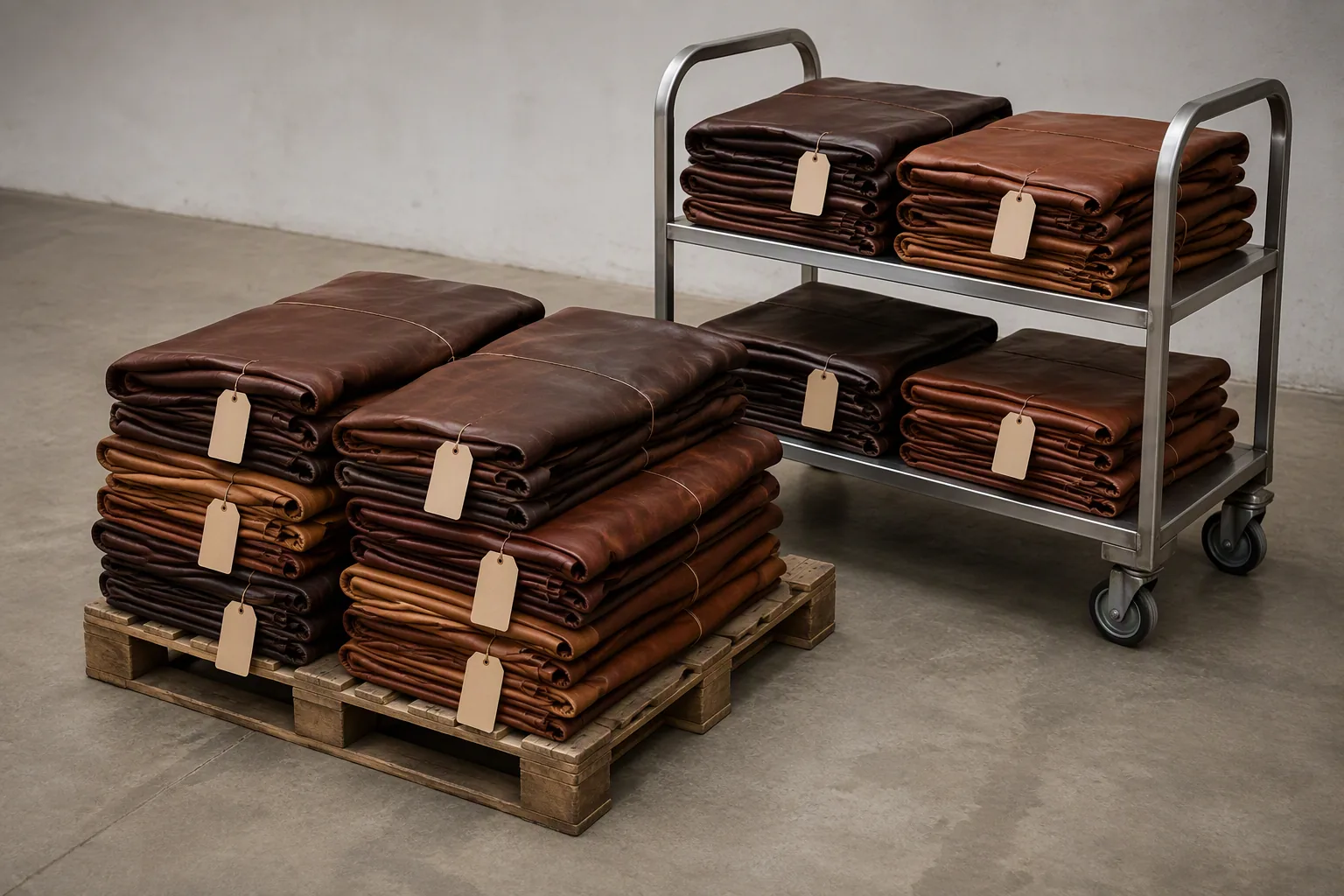
MOQ Against Programme Size
| Programme characteristic | Effect on MOQ planning |
|---|---|
| Single colour, single article | Easiest to reach the minimum |
| Several colours in one article | Each colour must reach its own minimum |
| Special finishes | Minimums may be higher than standard |
| Small launch order | May need to buy leather ahead of demand |
| Repeat programme | Established colours are easier to reorder |
| Seasonal peak | Availability may matter more than minimum |
How MOQ Shapes a Bag Programme
The minimum becomes a product decision.
Fewer Colours, Better Availability
A narrow palette is easier to keep.
A programme offering two or three well-chosen colours can order to the minimum, repeat reliably and hold a small buffer. A programme offering eight colours spreads the same demand across eight minimums and risks having some colours unavailable when they are needed.
Colour Selection With the Minimum in Mind
Choose colours that can be produced.
Colours that sit within the tannery’s existing range, or that share a base with an existing colour, are easier to run and cheaper to repeat than a colour invented for the season. Where a distinctive colour is essential, it should be the one the programme commits its volume to.
Stock Implications
Small orders become stock.
Where a programme cannot reach the minimum from a single order, the difference has to be bought ahead and held. That stock is a cost, and it should be planned deliberately rather than discovered as an unplanned inventory.
Working With the Factory
The factory can help.
Because a bag factory buys leather continuously, it can often combine requirements across programmes to reach a minimum, or hold a shared buffer of a common colour. This is one of the practical reasons to work with a manufacturer that has other production running.
Colour Continuity Across Repeat Orders
The second order is the hard one.
Why Repeats Drift
Colour is reproduced, not stored.
A repeat order of the same colour is a new production lot, and small differences in dye, coating or finishing conditions can shift the tone slightly. The risk is greatest when the repeat is separated by a long interval or produced under different conditions.
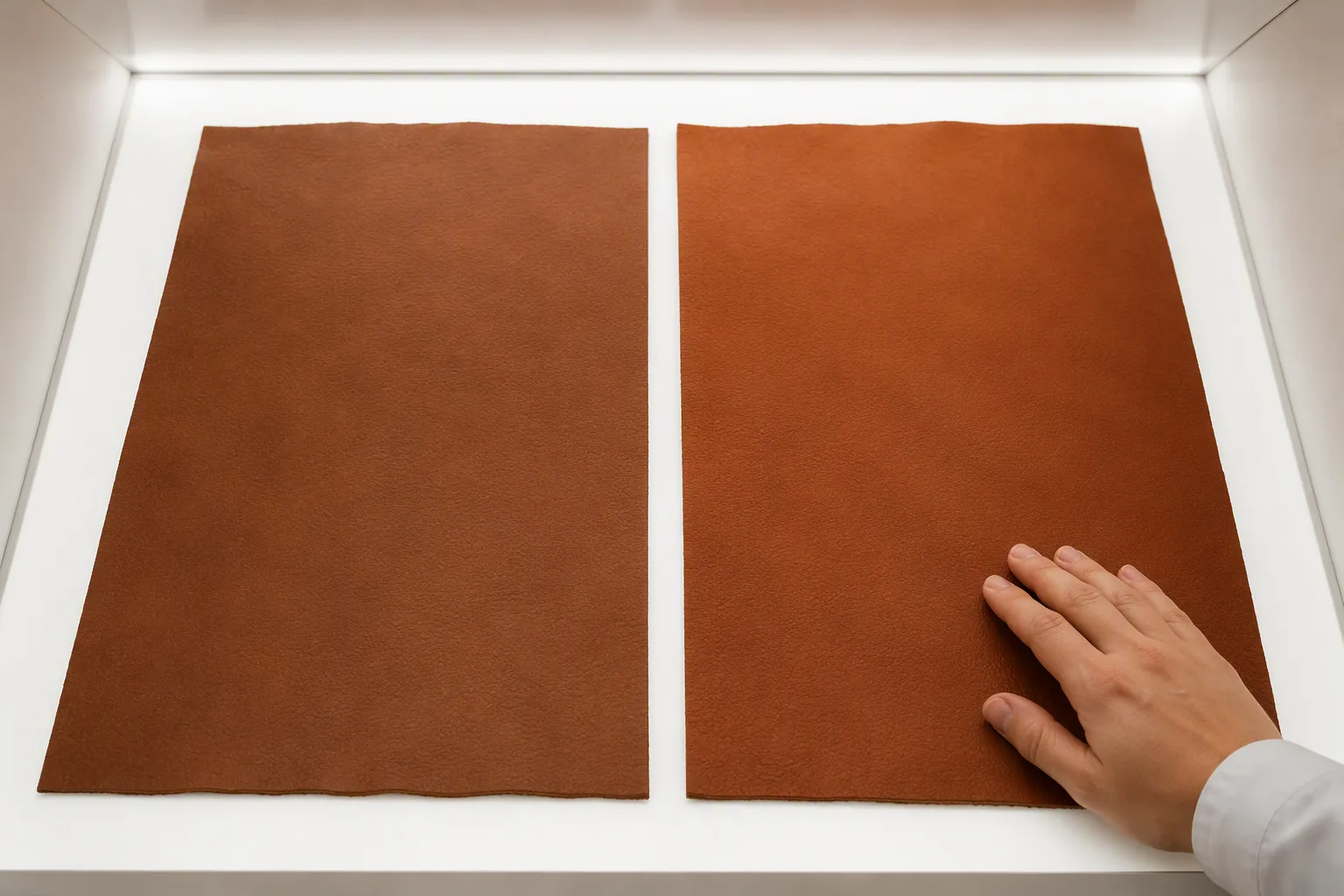
Using the Reference Properly
Compare against the reference, not the last lot.
Where each new lot is compared against the most recent delivery rather than the approved reference, small differences accumulate in one direction and the colour drifts away from what was originally approved. The stored reference is the only fixed point.
Keeping Continuity Over Time
- Retain an approved reference panel, stored away from light and handling
- Record the article, colour and approval date alongside it
- Compare every new lot against that reference under fixed light
- Re-approve the reference deliberately if the material must change
- Consider a small buffer of the colour where a launch depends on it
When Continuity Cannot Be Held
Say so early.
Where a colour genuinely cannot be reproduced to the required tolerance, that is a programme decision rather than a factory problem: the colour may need to be retired, the tolerance widened with the customer’s agreement, or the design changed to make the difference irrelevant. Discovering it at the second order is the worst option.
The Ordering Rhythm
Orders should follow a pattern.
Working From the Ship Date
Every date derives from one.
The ship date sets assembly, cutting and leather delivery, and leather delivery sets the order date. Writing that chain down for each colour turns a programme into a calendar, and a calendar is something a tannery can commit to.
Reordering Before It Is Urgent
The reorder point is a plan.
Where a colour sells steadily, the reorder should be placed while stock remains, not when it runs out. The reorder point depends on lead time, consumption rate and the risk of a delay, which is why it is best set once and reviewed periodically.
Rhythm Against Custom
A repeating rhythm gets better treatment.
Tanneries plan around predictable orders. A programme that orders the same article and colours on a regular cycle is easier to schedule than one that appears irregularly with urgent requests, and that reliability translates into better dates and often better attention to quality.
Planning Reference
| Planning element | What it decides | Input it needs |
|---|---|---|
| Ship date | The date everything else is measured against | Customer commitment |
| Leather delivery date | When leather must be at the factory | Cutting and assembly schedule |
| Order date | When the tannery must receive the order | Confirmed lead time |
| Colour approval date | When the colour must be signed off | Sampling lead time |
| Reorder point | When a repeat order is placed | Consumption rate and lead time |
| Buffer quantity | How much protection the programme carries | Risk tolerance and storage |
Samples, Pilots and Small Orders
Early stages have their own rules.
Sampling Quantities
Samples are not production.
Tanneries usually supply swatches and small panels for approval outside the normal ordering process, but the material supplied for a swatch is not always produced on the same equipment as the bulk lot. Approval based on a swatch should therefore be confirmed with a production sample before the order is placed.
Pilot Runs
A pilot run tests the article in production.
Where a programme is new, a small pilot quantity cut in the real patterns reveals defects, yield and handling behaviour that swatches cannot show. Pilot quantities may fall below the minimum, and the difference should be planned rather than discovered.
Planning the First Order
A first order should be planned as two decisions.
The first is the quantity of leather, which should be sized for the pilot plus the launch rather than for the pilot alone, because a second order placed shortly afterwards starts the lead time again. The second is the colour, which should be chosen with its repeatability in mind, not only its appearance on a swatch.
Both decisions are cheaper to make together. Splitting them tends to produce a launch that is either delayed by a reorder or committed to a colour that cannot be reproduced at the volumes the programme later needs.
Bridging the Gap
Small programmes need a strategy.
Where a launch order is below the minimum, the usual options are to buy to the minimum and hold the surplus, to combine colours into one run, to use an existing colour from the tannery’s range, or to accept a surcharge for a short run. Each of these is a defensible choice; leaving the gap unplanned is not.
Transit, Customs and Buffer Time
Lead time does not end at the tannery gate.
The Hidden Part of the Schedule
Transit is part of the lead time.
Time in transit, time spent clearing documentation and time lost to congestion all sit between the tannery’s dispatch and the factory’s cutting table. A production plan that stops at dispatch is short by exactly that interval.
Buffer Time
Some slack should be deliberate.
A buffer absorbs the difference between the schedule and reality, and it should be sized against the length of the chain rather than set at a round number. Programmes with multi-stage logistics and long transit need more slack than programmes buying locally.
Documentation Timing
Papers take time to prepare.
Certificates, test reports and shipping documents all need to be produced before dispatch, and they depend on the lot being finished and inspected. Where a customer requires specific documents, that requirement should be communicated with the order rather than after the goods are packed.

Buffer Planning Reference
| Element | Purpose | Typical treatment |
|---|---|---|
| Production buffer | Absorbs small schedule slippage | Added to the leather order date |
| Transit buffer | Covers shipping variability | Based on the route and mode |
| Customs buffer | Covers clearance time | Based on the destination |
| Quality hold | Allows inspection before use | Between delivery and cutting |
| Colour rework | Allows a lot to be replaced | Needed only for critical colours |
What Delays Leather
Delays have causes, and most are predictable.
| Cause | How it appears | How to reduce it |
|---|---|---|
| Colour approval rounds | Sampling is repeated | Provide a clear reference and decide quickly |
| New article or finish | Sampling and equipment setup needed | Allow extra time for a first order |
| Peak season booking | The tannery is fully committed | Place orders earlier or reserve capacity |
| Raw material shortages | Hides for the article are unavailable | Confirm availability before committing dates |
| Weather-dependent drying | Finishing slows in wet conditions | Expect seasonal variation |
| Quality hold at inspection | The lot is rejected or reworked | Agree criteria and keep the reference current |
| Documentation delays | Papers are not ready at dispatch | Clarify document requirements with the order |
| Transit and customs congestion | Goods wait at ports or borders | Build a transit buffer and avoid peak periods |
The Cost of Expediting
Speed is bought with something.
What Expediting Costs
- A surcharge for disrupting the tannery’s schedule
- Reduced drying or conditioning time, which affects the material
- Higher risk of a colour that does not repeat
- Less time for inspection, which shifts risk to the factory and to the customer
When It Is Worth It
Rarely, and deliberately.
Expediting makes sense where a small quantity is needed to protect a launch, and where the material affected is not the visible surface of the product. It makes much less sense as a routine habit, because the cost is paid in quality rather than in money.
The Alternative to Expediting
Order earlier.
Planning further ahead is the only method that reliably improves dates without affecting quality, and it costs nothing but attention.
Agreeing Dates With a Tannery
A date is only useful if it is committed.
What a Useful Commitment Contains
- The article, colour and thickness it applies to
- The quantity and the units it is measured in
- The dispatch date, not only the order confirmation
- The documentation to be provided
- What happens if the date slips
Confirming in Writing
Agreements should be recorded.
A confirmed order with a dated dispatch commitment, recorded in writing, is what allows a factory to plan cutting and to tell a customer something reliable. Verbal reassurances are not a schedule.
Escalation When Dates Slip
Act early.
Where a date is at risk, the earlier it is raised, the more options exist: reallocating to another colour, using a buffer, using a qualified second source, or adjusting the delivery to the customer. Every one of those options narrows as the date approaches.
What to Write in an Order Agreement
| Item | Why it belongs in the agreement |
|---|---|
| Article and colour reference | Defines what is being bought |
| Quantity and unit | Prevents measurement misunderstandings |
| Thickness and tolerance | Avoids substitution |
| Dispatch date and destination | Anchors the schedule |
| Inspection and acceptance criteria | Defines what counts as conforming |
| Documentation required | Prevents dispatch delays |
| Handling of delays and shortfalls | Gives both sides a defined response |
| Review point | Forces an early conversation if dates slip |
Holding Stock or Ordering Fresh
Both approaches have a cost.
The Case for Stock
Stock protects the schedule.
Holding approved leather of a colour that the programme depends on removes lead time from the critical path, at the cost of capital, storage and the risk that the stored material drifts in moisture or colour.
The Case for Fresh Orders
Fresh material matches the reference.
Ordering to demand avoids holding stale material and keeps the delivered lot close to the approved reference. It leaves the programme exposed to lead time, which is why it works best where the selling window is flexible.
Where Stock Is Held
Placement affects how well it keeps.
Leather held at the factory can be conditioned, inspected and cut in the normal flow, while leather held at the tannery is effectively a reservation rather than a possession. Where a colour is critical, holding it at the point of use — flat, in stable conditions and away from light — is usually the more reliable arrangement.
The Practical Balance
Most programmes use both.
Fast-moving colours are usually held in a small buffer while slower colours are ordered to demand, and launch quantities are often bought ahead to protect the first delivery. The balance should be set deliberately and reviewed as the programme’s sales pattern becomes clear.
Reviewing Performance Over Time
Dates should be measured, not remembered.
What to Track
- Order date against the committed dispatch date
- Actual receipt date against the planned delivery date
- Colour acceptance on first presentation
- Quantity delivered against quantity ordered
- Delays by cause, so that patterns become visible
Why the Review Matters
Patterns repeat.
A tannery that is consistently late in one season will be late again in the same season, and a colour that needed two approval rounds will need them again on a repeat. Reviewing performance allows the programme to be planned around those patterns rather than surprised by them.
Using the Review
It should change behaviour.
The output of the review is a decision: order earlier, raise the buffer, narrow the colour range, move a colour to a second source, or change the delivery promise to the customer. A review that produces no change is only a record.
Common Mistakes in Lead Time and MOQ Planning
| Mistake | Consequence | Prevention |
|---|---|---|
| Treating lead time as a purchasing detail | Delivery promises made before checking | Build the date chain from the ship date |
| Assuming one MOQ figure | Colour range planned on the wrong basis | Confirm minimums per article and colour |
| Offering many colours without checking minimums | Some colours cannot be produced | Check each colour against its minimum |
| Comparing a new lot against the last lot | Colour drifts away from the reference | Compare against the stored reference |
| Approving production on a swatch | Bulk material behaves differently | Confirm with a production sample |
| Leaving the sub-minimum gap unplanned | An unexpected stock purchase | Decide the bridging approach in advance |
| Rushing to recover a late date | Quality paid for speed | Order earlier, or use a buffer |
| Not recording delays by cause | The same delay repeats | Track causes and plan around them |
Frequently Asked Questions
What determines leather lead time?
The sequence of stages rather than a single queue: order scheduling, colour matching and approval, raw material selection, wet-end processing, dyeing and finishing, drying and conditioning, inspection and packing, then dispatch and transit. A new colour or finish adds sampling and approval rounds before production begins.
Can leather lead time be shortened if we pay more?
Usually only slightly, and with a quality cost. Expediting typically means displacing another order or reducing drying and conditioning time, which affects the material. The reliable way to improve a date is to order earlier.
Why is there a minimum order quantity at all?
Because colouring and finishing leather requires a filled drum and a minimum equipment pass to achieve a consistent lot, and because sampling, setup, cleaning and inspection take nearly the same attention regardless of quantity. Below the minimum the colour cannot be held reliably and the cost per square metre rises sharply.
Is the minimum per order or per colour?
It is usually per colour, because each colour needs its own dye lot. Some tanneries can combine colours that share the same base article and drum cycle, but this should be confirmed with the tannery rather than assumed.
How should a small programme handle minimum order quantities?
By choosing one of the defined options: buy to the minimum and hold the surplus, combine colours into one run, use a colour from the tannery’s existing range, or accept a surcharge for a short run. What matters is choosing deliberately rather than discovering the gap.
Why does the same colour look slightly different on a repeat order?
Because colour is reproduced rather than stored. A repeat is a new production lot, and small differences in dye, coating or finishing conditions shift the tone slightly. Comparing every lot against the stored reference, rather than against the previous delivery, is what keeps the colour anchored.
How much buffer time should a leather order carry?
Enough to absorb the variability of the whole chain, including transit and customs, rather than a round number chosen by habit. Longer routes and multi-stage logistics need more slack, and the buffer should be reviewed as actual performance data accumulates.
Does ordering in a repeating cycle help?
Yes. Tanneries plan around predictable orders, so a programme that orders the same article and colours on a regular rhythm is easier to schedule than one that appears irregularly with urgent requests, and that reliability tends to produce better dates and better attention.
What should be confirmed with the tannery before committing dates to a customer?
The article, colour and thickness, the quantity, the confirmed dispatch date, the documentation to be provided and the inspection criteria. A date that has been confirmed in writing for a specific article and colour is what a production plan can be built on.
Is it better to hold leather stock or order to demand?
Both are used. Stock removes lead time from the critical path but costs capital and risks the material drifting in storage, while ordering fresh keeps the lot close to the reference but leaves the programme exposed to lead time. Most programmes hold a small buffer for their fastest colours and order the rest to demand.
What should a factory track to improve future planning?
Order dates against committed dispatch dates, actual receipt against plan, first-presentation colour acceptance, delivered against ordered quantity, and delays by cause. Reviewing those figures is what allows the next programme to be planned around known patterns.
The Bottom Line
Lead time and minimum order quantity are constraints to plan around.
Both come from how leather is actually made: a sequence of stages that cannot be compressed much, and dye lots that need a minimum quantity to hold their colour. A programme that works backwards from its ship date, confirms minimums per colour, keeps a stored reference for continuity and orders on a steady rhythm will rarely be surprised.
For buyers, the practical questions are short. Ask what the confirmed lead time is for this article and colour, what the minimum is per colour and whether colours can be combined, how the reference will be kept for repeat orders, what buffer the factory recommends, and what documentation will accompany dispatch. A factory that can answer those questions is planning production; one that cannot is reacting to it.
