
How Should You Inspect Finished Leather Bags Before Shipping?
How Should You Inspect Finished Leather Bags Before Shipping?
By the time a leather bag is finished, most of the money has already been spent. The leather is cut, the hardware is set, the lining is sewn in and the edges are finished, so the only useful question left is whether the bags about to be packed actually meet the specification — and whether the answer is known before the container is loaded rather than after the customer opens it.
As a bag manufacturer, we run final inspection as a sampling exercise with defined rules, and we see how often it is treated as a formality performed by whoever is free that afternoon. This guide explains what AQL sampling means in practice, what is checked on a finished bag, how defects are classified, what happens when a lot fails, and what a buyer should require before production starts.
Final inspection does not improve a bag. It decides whether the bags you already have are good enough to ship, and that decision has to be made on evidence rather than on hope.
- Why Final Inspection Is Its Own Stage
- What AQL Sampling Actually Means
- Choosing a Sampling Plan
- Classifying Defects: Critical, Major, Minor
- What a Finished Bag Inspection Covers
- Workmanship: Stitching, Edges and Symmetry
- Materials: Leather, Lining and Reinforcement
- Function: Zips, Closures, Straps and Load
- Measurement Against the Specification
- Colour and Appearance Across the Lot
- Hardware Finish and Metal Quality
- Packaging, Labelling and Carton Checks
- Recording Results and Deciding Dispositions
- Handling Failures: Rework, Sort and Reject
- The Inspection Report
- In-House or Third-Party Inspection
- What to Agree Before Production Starts
- Common Mistakes at Final Inspection
- Frequently Asked Questions
- The Bottom Line
Why Final Inspection Is Its Own Stage
It answers a different question.
A Different Question From Incoming Inspection
Incoming inspection asks whether the material can be used; final inspection asks whether the product can be sold. The first looks at leather, lining and hardware in isolation, while the second looks at the assembled bag as the customer will receive it, including everything that only becomes visible once the parts are together.
Why It Cannot Be Replaced by Process Control
Process control prevents, inspection verifies.
Good process control reduces defects; it does not prove that a specific lot is acceptable. Where a customer needs an objective statement about a delivery, only inspection of the finished goods produces one.
Where the Cost Sits
Defects get more expensive with every stage.
A fault found at cutting costs a panel; the same fault found after assembly costs the whole bag, and the same fault found by the customer costs the bag, the freight and the relationship. Final inspection exists to catch the faults that survived the earlier stages.
What AQL Sampling Actually Means
AQL is a sampling rule, not a quality level.
The Idea Behind It
You cannot inspect everything.
Sampling standards define, for a given lot size, how many units must be inspected and how many defects are permitted before the lot is rejected. The acceptance quality limit is the defect level that the plan is designed to accept, not a promise that every unit is perfect.
What the Numbers Mean
Three numbers drive the decision.
The lot size determines the sample size; the chosen AQL level determines the maximum number of defects allowed; and the number of defects found determines whether the lot passes, fails or needs a closer look. Reading a sampling plan as a simple threshold is how it gets misused.
Why the Levels Are Usually Split
Different defects get different limits.
Most programmes run tighter limits for critical defects and wider limits for minor ones, because the consequence of a broken strap is not comparable to the consequence of a loose thread end. Applying a single limit to everything is the most common error in setting up an inspection plan.
Choosing a Sampling Plan
The plan should be agreed, not improvised.
What Has to Be Decided
- The lot size and how a lot is defined for this programme
- The inspection level and the AQL values to be used
- Which defects are classified critical, major or minor
- Whether inspection happens at the factory, at a third party, or both
- What happens when a lot fails
- Who pays for sorting, rework and re-inspection
Sampling Structure
| Decision | What it controls | Practical guidance |
|---|---|---|
| Lot definition | What a single inspection covers | One shipment, one article, one work order |
| Sample size | How many bags are examined | Derived from lot size by the chosen standard |
| Critical AQL | Zero-tolerance characteristics | Normally no critical defect is accepted |
| Major AQL | Visible, functional or durability faults | Set tightly for visible areas |
| Minor AQL | Cosmetic issues with limited impact | Wider limit, but still counted |
| Inspection location | Where the decision is made | Finished goods before packing |
Agreeing Before Production
Mid-run changes are expensive.
Where the plan, the defect definitions or the AQL levels are agreed before the first bag is made, failures can be resolved inside the factory. Where they are agreed after a failed inspection, both sides are negotiating from a position where the goods already exist.
Classifying Defects: Critical, Major, Minor
Classification turns an opinion into a decision.
The Three Categories
- Critical: unsafe or unusable, or a defect that would cause a return regardless of price
- Major: clearly visible or functional fault that a customer would reject
- Minor: cosmetic imperfection that does not affect use and is usually tolerated
Why Classification Matters Most
It is the argument that never happens.
Nearly every dispute about a failed lot is really a dispute about whether a given fault is major or minor. Defining the categories in advance, with examples from the actual product, removes most of that argument.
Reference Table
| Defect example | Usual classification | Reason |
|---|---|---|
| Sharp or protruding metal part | Critical | Safety and return risk |
| Broken stitch line on a load-bearing seam | Critical | Structural failure |
| Zip that jams or does not close | Major | Function fails |
| Hardware that detaches under normal load | Major | Function and return risk |
| Visible colour difference between panels | Major | Clearly visible to the customer |
| Wavy or puckered seam on a visible panel | Major | Appearance and workmanship |
| Loose thread ends on the interior | Minor | Cosmetic, easily trimmed |
| Slight variation in edge paint thickness | Minor | Not visible in normal use |
Defining With the Product in View
Examples should come from the bag.
Generic defect lists are easy to copy and hard to apply. A classification list built from the actual design, with photographs of accepted and rejected examples, is what makes the categories usable at the inspection table.
What a Finished Bag Inspection Covers
A finished bag has to be examined as a product.
The Areas of the Check
| Area | What is examined |
|---|---|
| Workmanship | Stitching, edges, symmetry, cleanliness |
| Materials | Leather appearance, lining, reinforcement behaviour |
| Function | Zips, closures, straps, handles, load points |
| Measurement | Dimensions against the specification |
| Consistency | Colour, gloss and appearance across the lot |
| Hardware | Finish, function, attachment, security |
| Presentation | Cleaning, packing, labelling, carton condition |
The Order of the Check
A fixed sequence prevents omissions.
Inspecting in the same order every time — exterior, interior, function, measurement, then presentation — is what keeps a routine inspection from becoming a partial one. Inspection sheets should follow the same order as the physical check.
How Much Is Reasonable
The check should match the product.
A bag with several hidden compartments and a complex closure needs a longer check than a simple tote, and the inspection sheet should reflect the design rather than a generic template. Where the sheet has not changed since a much simpler product, the check is usually being done from memory.
Workmanship: Stitching, Edges and Symmetry
Most visible defects are workmanship defects.
Stitching
The stitch line is the most examined feature.
Stitch density, tension, alignment with the edge and locking at the ends should each be checked, along with the condition of the thread itself. A stitch line that is wavy, inconsistently spaced or that pulls the leather is visible from across a room.
Edges
Edges show every shortcut.
Edge paint thickness, smoothness, coverage into the corners and freedom from cracking when the panel flexes should be examined, together with the burnished or folded alternatives where the design uses them. Edges are where a rushed finishing station is easiest to detect.
Symmetry and Alignment
The eye finds asymmetry quickly.
Panels, pockets, straps and hardware should be checked for alignment against each other, including the symmetry of the bag when viewed from the front and the alignment of the top opening. A bag that hangs unevenly is usually a symmetric checking failure rather than a design fault.
Cleanliness and Finishing
Small marks carry weight.
Adhesive residue, chalk marks, oil from the machine, stray thread ends and powder from the finishing area should all be looked for, because they are the marks that make a new bag look handled before it arrives.
Materials: Leather, Lining and Reinforcement
The bag is judged on the material it was made from.
Leather Appearance
Grain, gloss and consistency matter.
The grain character, the level of sheen and the visible variation between panels should be checked against the approved sample. Natural variation is expected; a panel that reads as a different colour or a different finish is not.
Lining
The interior is inspected too.
Lining seams, alignment of internal pockets, freedom from puckering and the general impression of the interior all count, because buyers open a bag before they judge it. Lining failures are also a common cause of returns in bags with many compartments.
Reinforcement Behaviour
Support shows in the finished shape.
Where reinforcement is used, the finished bag should be checked for stray stiffness, visible board edges, bubbling behind the leather and localised softening. Reinforcement problems rarely appear as single defects; they appear as an area that does not behave like the rest of the bag.
Where Material and Workmanship Meet
The boundary is where defects hide.
Fusing lines, adhesive bleed, reinforcement edges and lining attachment points sit between material and workmanship, and they are the places where an inspector should slow down rather than speed up.
Function: Zips, Closures, Straps and Load
Function is what the customer will test first.
Zips and Closures
They are operated immediately.
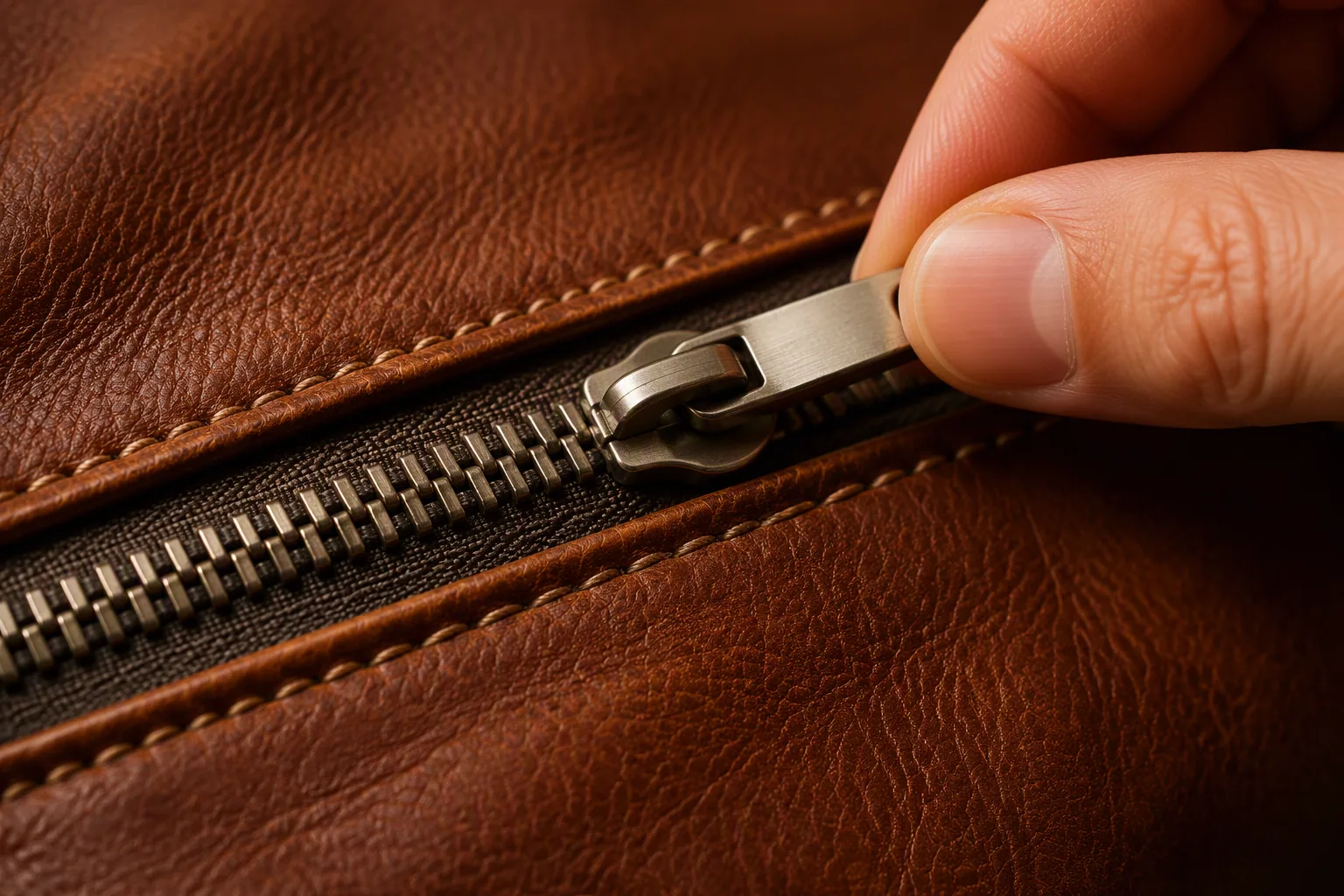
Every zip should be cycled through its full travel, in both directions, including any that pass around a curve. Sliders, pullers, magnets, snaps and buckles should be operated as the customer would, and any tendency to catch, stick or release unexpectedly is a function defect.
Straps and Handles
Load points get extra attention.
The attachment of straps and handles should be inspected visually and loaded by hand, checking stitch and rivet integrity, the behaviour of the leather at the anchor and whether the strap hangs straight when the bag is empty.
Load Testing by Hand
A practical check with a real bag.
Filling a sample bag to its intended load and lifting it by each carrying option reveals problems that visual inspection misses: hardware that bends, anchors that crease and stitching that strains. Where the programme warrants it, this check should be repeated after a period under load.
Opening and Closing One-Handed
Usability counts as function.
A bag intended to be opened with one hand should be tested that way, because a closure that is easy with two hands can be unusable with a baby in the other arm. This is a functional requirement, not a preference.
Measurement Against the Specification
Numbers settle what opinion cannot.
What Is Measured
The dimensions that matter.
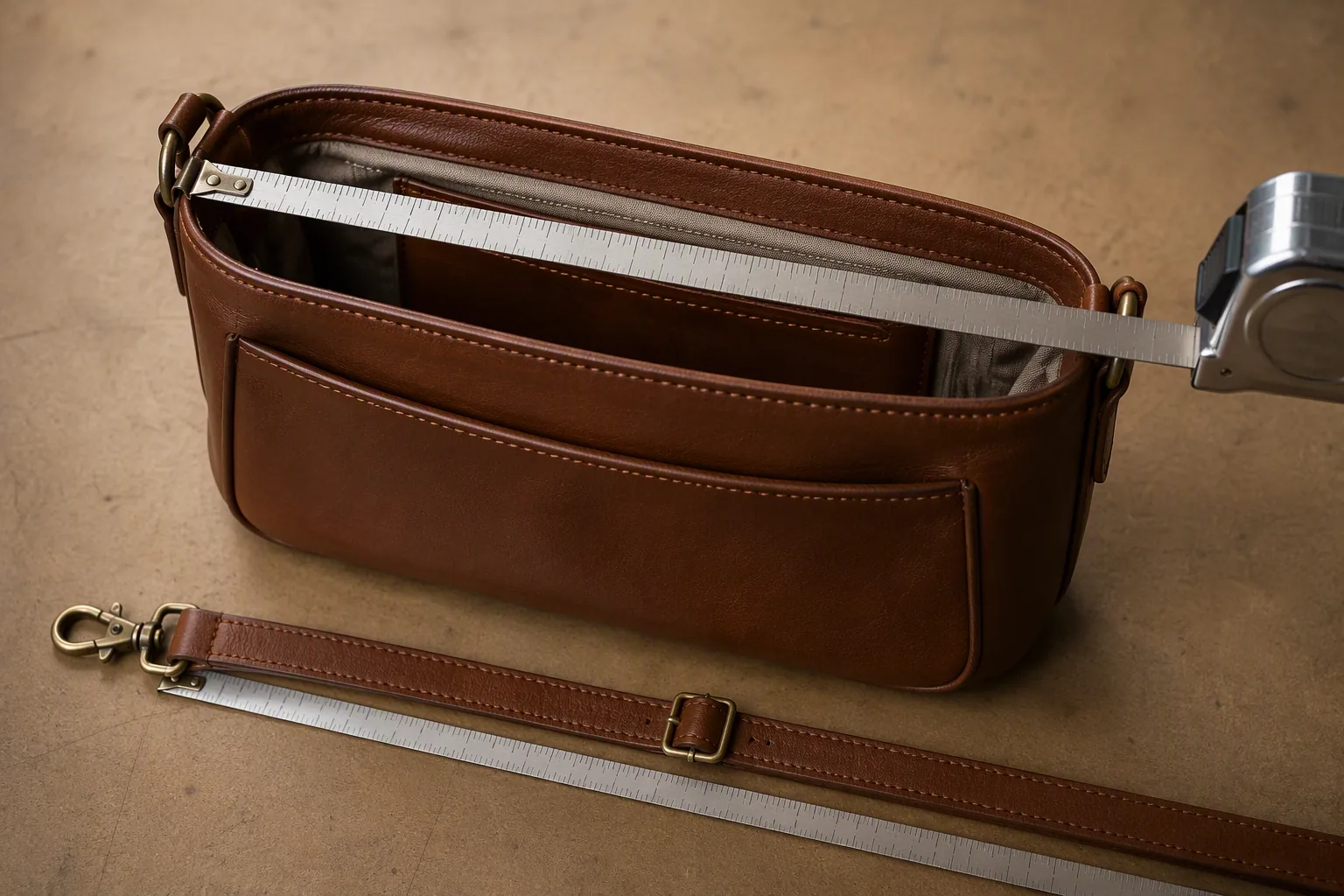
Overall width, height and depth, strap length and drop, the positions of pockets and hardware and the length of any adjustable strap should all be measured against the specification, on the finished bag rather than on the pattern.
Tolerance Discipline
Every measurement needs a tolerance.
A dimension without a tolerance cannot be judged, because leather bags are partly hand-built and normal variation has to be allowed. Tolerances should be written into the specification, and they should be tight enough to matter and wide enough to be achievable.
The Measurements That Matter Most
| Measurement | Why it is checked | Failure it prevents |
|---|---|---|
| Overall dimensions | The bag must match its description | Customer rejection on size |
| Strap length and drop | Carrying position must match the design | Unusable carry height |
| Strap adjustment range | Adjustability must work as promised | Returns from fit problems |
| Pocket positions | Function and appearance | Functional mismatch |
| Hardware positions | Alignment and balance | Visible asymmetry |
| Zip lengths | Opening must match the design | Incomplete openings, gaps |
| Handle drop | Hand and forearm clearance | Uncomfortable or unusable handle |
Colour and Appearance Across the Lot
Consistency is a lot-level property.
Why Lot-Level Checks Differ
One bag hides what ten bags reveal.
A single bag can look acceptable while the lot as a whole shows a drift: several bags slightly darker, several slightly warmer. Colour and appearance should therefore be assessed across the inspected sample, arranged together, rather than one bag at a time.
The Reference
Compare against the approved sample.
The lot should be compared against the approved sample or reference panel under fixed light, not against the previous shipment and not against the bag that happens to be nearest. Where the sample itself has aged, it should be replaced deliberately rather than quietly ignored.
Appearance Under Different Light
Light changes appearance.
A lot that reads correctly under factory lighting can look different under daylight or under the warm light of a shop. Where the programme is colour-critical, the lot should be assessed under more than one light condition.
Hardware Finish and Metal Quality
Hardware is a common source of returns.
What to Check
- Plating colour and consistency across the lot
- Freedom from scratches, bubbles, discolouration and sharp edges
- Smooth operation of every moving part
- Security of each attachment, including rivets and screws
- Behaviour under load at the points that carry weight
- Protection during packing, so that hardware does not mark the leather
Consistency Across the Lot
Hardware lots can differ.
Plating batches can vary slightly, and the difference becomes visible when many bags are displayed together. Where hardware arrives in several batches, the bags should be checked for consistency across the whole delivery.
Packaging, Labelling and Carton Checks
The last mile of quality.
Individual Presentation
How a bag looks when opened.
Wrapping, protective material, tissue and any inserts should be inspected for consistency, and the bag should be free of the marks that packing can add: creases from tight packing, impressions from hardware pressed against leather and dust from the packing area.
Labelling
Labels are a compliance document.
Care labels, composition labels, origin marking and any customer-specific labelling should be checked against the requirements for the destination market, and the placement and legibility of each label should be verified on the finished product rather than on a sample label.
Carton Checks
Packing defects are shipping defects.
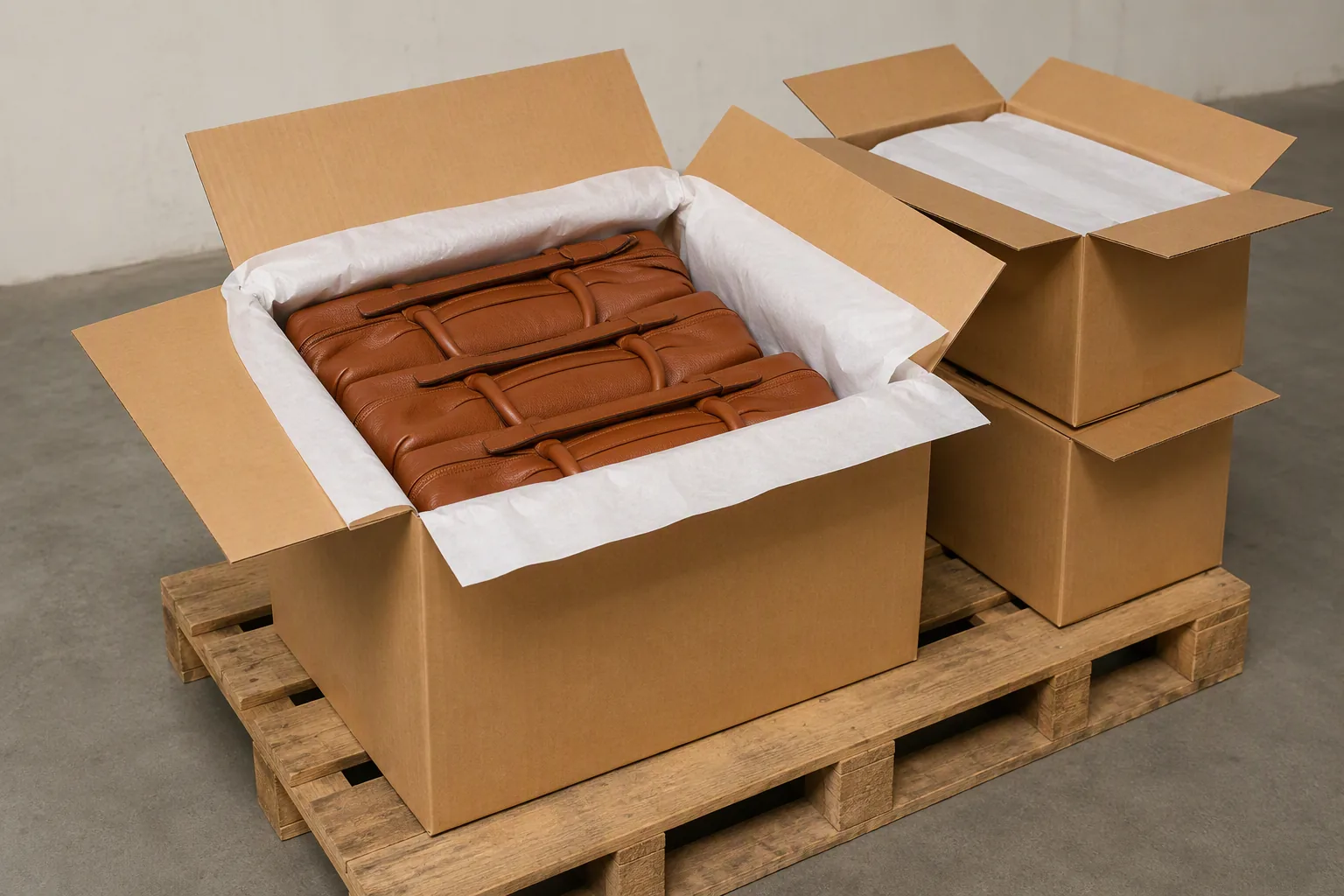
Carton strength, stacking, the fit of bags inside the carton, the presence of protective material and the closing of the carton should all be inspected on the packed goods. Where cartons are marked with shipping information, the marks should be checked for accuracy before the container is loaded.
Reasons This Stage Matters
| Check | Consequence if missed |
|---|---|
| Protective wrapping | Surface marks and abrasion in transit |
| Hardware protection | Impressions and scratches on leather |
| Label accuracy | Customs delays or compliance problems |
| Carton closure | Goods damaged or lost in transit |
| Carton marking | Misdirected shipments |
| Stacking behaviour | Crushed cartons and deformed bags |
Recording Results and Deciding Dispositions
Findings only matter if they lead somewhere.
What the Record Contains
- The lot, work order and quantity inspected
- The sample size and the standard used
- Every defect found, with its classification
- Photographs of representative defects
- The measurements taken against their tolerances
- The disposition and who authorised it
The Dispositions
| Disposition | When it applies | What follows |
|---|---|---|
| Accept | Defects within the agreed limits | Proceed to packing |
| Accept with concession | Minor deviation, customer informed | Documented approval recorded |
| Sort the lot | Defects concentrated but not universal | 100% inspection or screening |
| Rework then re-inspect | Correctable defects | Repair, then inspection again |
| Reject the lot | Defects exceed the limits | Rework, replacement or cancellation |
Why the Disposition Needs a Name
Decisions should be attributable.
Recording who authorised a concession is what prevents a deviation from being discovered later by a customer with no explanation available. It also makes the following delivery easier, because the reason for the concession is on file.
Handling Failures: Rework, Sort and Reject
The response should be proportional.
Sorting Before Rework
Not every defect needs the same response.
Where a lot fails on a small number of characteristics, sorting the lot to separate conforming from non-conforming bags is usually cheaper than reworking everything, provided the process is controlled and re-inspection covers the sorted goods.
Rework Limits
Some defects should not be reworked.
Rework that involves opening a seam, replacing a panel or resetting hardware can leave traces, and a reworked bag is not automatically equal to a new one. Defects that cannot be corrected cleanly should be treated as rejected rather than sent for repair.
Re-Inspection After Rework
The correction has to be verified.
Reworked bags should be re-inspected on the corrected characteristics, and any rework that affects a visible area should also be checked for appearance. Returning reworked goods to the packing line without verification is how the same failure reaches the customer with an extra mark on it.
Communicating a Failure
Bad news travels best early.
Where a lot fails and the shipment date is at risk, the customer should hear it from the factory before the container is due, with the findings, the proposed response and a revised date. A failure disclosed early is a schedule problem; the same failure discovered at destination is a trust problem.
The message should also state what has been done about the cause, because the useful part of a failure report is what will prevent the next one from being identical.
Escalation and Cause
Fix the cause, not only the lot.
Where a lot fails, the immediate task is to protect the shipment; the more valuable task is to identify which stage produced the defect. A lot that is sorted and shipped without addressing the cause will fail again on the next order.
The Inspection Report
The report is the deliverable.
What It Should Contain
- Date, lot, article codes and quantities
- Sampling plan and standard used
- Defects found, classified and illustrated
- Measurements and their results
- Line items that passed, so the report is a record of the whole check
- The disposition and the signatories
Who Reads It
Different readers, different needs.
The factory uses the report to correct the process, the customer uses it to decide whether to accept the goods, and a manager uses it to see trends across orders. A report built only for the customer tends to omit the detail the factory needs.
Keeping Reports Comparable
Structure should not change.
Where each report is formatted differently, comparing one order with the last becomes a project. A stable template with stable defect names is what turns a filing cabinet of reports into usable history.
In-House or Third-Party Inspection
The choice changes who signs.
In-House Inspection
Faster and closer to production.
In-house inspection can happen continuously, catch problems while the line is still running and avoid scheduling delays. Its weakness is independence, which matters most where a lot is borderline and the shipment is urgent.
Third-Party Inspection
Useful where independence is required.
Third-party inspection provides an external signature on the lot, usually against a defined standard and often required by buyers who do not visit the factory themselves. Its weakness is timing: an inspector booked for a fixed date can arrive to find the goods not quite ready, and a rebooking costs days.
Using Both
Common and reasonable.
Many programmes run in-house inspection through the run and arrange third-party inspection on the packed goods, so that internal findings are already corrected before the external check takes place. This reduces the chance of an external failure and keeps the external report as a confirmation rather than a discovery.
What to Agree Before Production Starts
Most inspection disputes are specification disputes.
The Items to Fix in Advance
- The standard and sampling level to be used
- Defect classification with examples from this product
- Measurement points and tolerances
- Colour and appearance criteria with a stored reference
- The inspection stage and location
- The documents required for the destination market
- What happens when a lot fails, including who bears the cost
Who Performs the Inspection
The person changes the result.
An inspector who also assembles the bags will tend to see the work as normal, while an inspector drawn from a different line is more likely to notice what a customer would. Where the programme allows it, the final check should be done by someone who did not build the goods being checked.
That person also needs the authority to stop a shipment. An inspection routine without the power to hold goods is a reporting exercise, and it tends to resolve itself in favour of whatever the delivery schedule requires.
Why the Timing Matters
After production is too late.
Every one of these items can be decided calmly before the first bag exists and becomes a negotiation once a failed lot is sitting in the warehouse. Agreeing them is usually the difference between a short conversation and a stalled shipment.
Writing It Into the Order
Agreements belong with the order.
The agreed inspection plan should be attached to the purchase order rather than held in correspondence, so that it applies to every delivery under that order and does not depend on anyone remembering the conversation.
Common Mistakes at Final Inspection
| Mistake | Consequence | Prevention |
|---|---|---|
| Inspecting after packing | Packing defects and marks are hidden | Inspect finished goods before packing |
| A single AQL for all defects | Critical faults accepted with cosmetic ones | Split limits by classification |
| Undefined defect categories | Disputes over every borderline fault | Classify with product examples |
| No stored reference for colour | The lot is judged against the nearest bag | Use the approved sample under fixed light |
| Checking bags one at a time | Lot-level drift is missed | Assess the sample assembled together |
| Skipping function tests | Zips and closures fail at the customer | Operate every closure as a customer would |
| Measuring without tolerances | Measurements cannot be judged | Write tolerances into the specification |
| Not recording who conceded | Deviations surface later unexplained | Name the authoriser on the record |
Frequently Asked Questions
What does AQL mean in a bag inspection?
It is a sampling rule that defines how many units must be inspected for a given lot size and how many defects are permitted before the lot is rejected. It is an acceptance limit rather than a statement that every unit is perfect, and it works with defect classifications rather than as a single threshold.
How is a finished bag inspection different from incoming material inspection?
They answer different questions. Incoming inspection decides whether leather, lining and hardware can be used, while final inspection decides whether the assembled product can be sold, examining workmanship, function, measurement, consistency and presentation as the customer will receive them.
Which defects should be treated as critical?
Those that make the bag unsafe or unusable, or that would cause a return regardless of price — a sharp or protruding metal part and a broken load-bearing stitch line are the usual examples. Critical characteristics are normally given no acceptance at all.
What should be measured on a finished bag?
Overall width, height and depth, strap length and drop, the adjustment range, hardware and pocket positions and zip lengths, each with a written tolerance. Measuring the finished product rather than the pattern is what confirms that assembly has not changed the dimensions.
Should bags be inspected before or after packing?
Before packing, with a separate check of the packed goods. Inspecting after packing hides marks caused by packing itself, so the finished-goods check is normally done on unpacked bags and the cartons are inspected separately before loading.
How is lot-level colour consistency checked?
By arranging the sample together and comparing it against the approved sample or reference panel under fixed light, rather than checking bags one at a time. Checking individual bags against whichever one is nearest allows a gradual drift to pass unnoticed.
What happens when a lot fails inspection?
One of the defined dispositions applies: accept with a recorded concession, sort the lot, rework and re-inspect, or reject it. The response should be proportional and recorded, and the cause should be investigated so that the following delivery does not fail the same way.
Can reworked bags be shipped as normal?
Only after re-inspection on the corrected characteristic and, where the rework touches a visible area, after an appearance check. Rework that opens seams or changes panels can leave traces, so defects that cannot be corrected cleanly are better treated as rejected than repaired.
Should inspection be done in-house or by a third party?
Both are common. In-house inspection is faster and can run continuously, while third-party inspection provides an independent signature that buyers who do not visit the factory often require. Many programmes run in-house checks through the run and arrange a third-party check on the packed goods.
What should be agreed with the factory before production?
The standard and sampling level, defect classification with product examples, measurement points and tolerances, colour criteria with a stored reference, the inspection stage, required documents and the handling of a failed lot. Bringing those decisions forward removes most inspection disputes.
What should a final inspection report contain?
The lot and quantity, the sampling plan, every defect with its classification, photographs, measurement results, the characteristics that passed, and the disposition with the names of those who authorised it. A stable template makes reports comparable across orders.
The Bottom Line
Final inspection is a decision, not a formality.
It answers one question — are these bags good enough to ship — and it answers it on a defined sample, a defined classification of defects, a defined measurement list and a stored colour reference. Where those are agreed before production, a failure is a manageable event inside the factory rather than a dispute at the port.
For buyers, the practical questions are short. Ask what standard and sampling level will be used, how defects are classified and what examples apply to this product, what is measured and with which tolerances, which sample the colour will be checked against, when the inspection happens relative to packing, and what the plan is if a lot fails. A factory that can answer those questions is inspecting; one that cannot is hoping.
