
Where Do Leather Offcuts and Cutting Waste Go in a Bag Factory?
Where Do Leather Offcuts and Cutting Waste Go in a Bag Factory?
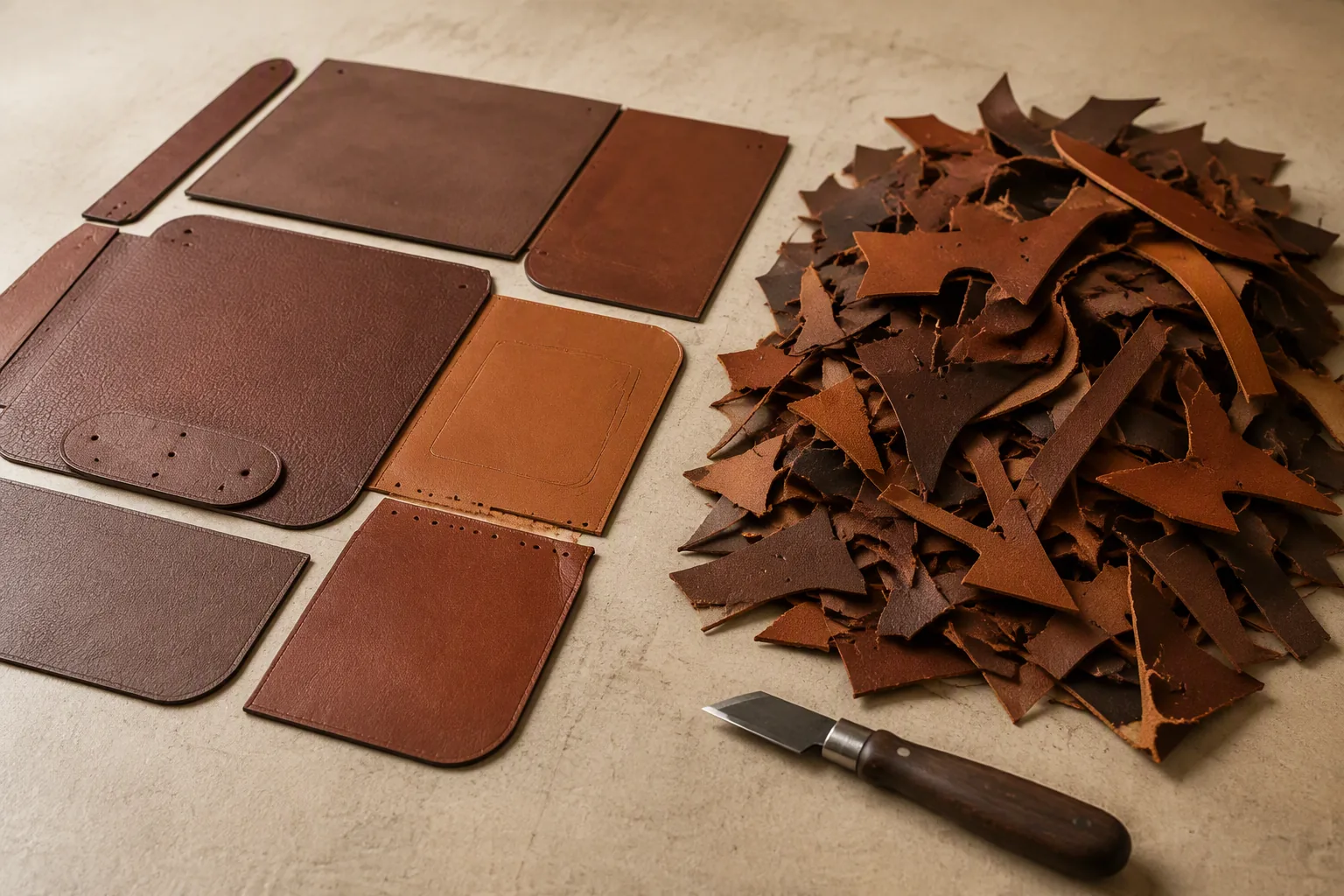
Every leather bag leaves a pile behind it. Once the panels for a tote or a diaper bag have been cut from a hide, the remainder — irregular pieces, narrow bands, and material around holes, scars and belly areas — has to go somewhere, and what a factory does with that pile says a great deal about how well the whole hide is being used.
As a bag manufacturer, we treat offcuts as a material stream with its own logic rather than as rubbish. This guide explains how offcuts are created, what the pile actually contains, which parts can be reused inside the product, which can become small goods, what cannot be recovered and why, how the economics work, and what a buyer should ask about material utilisation before accepting a sustainability claim.
Cutting waste is decided long before the cutting table: by the pattern, the hide size and the grade the programme was willing to pay for.
- Why Offcuts Are a Design Outcome
- How Offcuts Are Created in a Bag Factory
- What the Offcut Pile Actually Contains
- Sorting at the Cutting Table
- Reusing Offcuts Inside the Bag
- Small Goods and Accessories From Offcuts
- Passing Offcuts On: Sales and Partnerships
- Shavings, Dust and Trimmings
- What Cannot Be Reused
- The Economics of Offcut Reuse
- Designing to Reduce Waste
- What You Can and Cannot Claim
- Working With the Tannery on Hide Utilisation
- Records and Traceability
- Setting Up an Offcut Programme
- Common Mistakes in Offcut Management
- Frequently Asked Questions
- The Bottom Line
Why Offcuts Are a Design Outcome
Waste starts as a drawing decision.
Patterns Decide the Pile
Cutting is a layout problem.
The shapes a bag requires, their quantity and their orientation across the hide determine how much material is left over. A design with many large rectangular panels nests efficiently; a design built from curved, oddly proportioned pieces leaves much more behind, regardless of how carefully the hide is cut.
Hide Shape Limits Everything
A hide is not a rectangle.
Because a hide has a natural outline, thinner areas at the belly and neck, and a spine that behaves differently from the flanks, even an idealised layout cannot use the whole surface. Some of what remains is a consequence of the hide’s shape rather than of the design.
Where the Waste Really Sits
Most loss is not visible at the table.
The material that ends up unusable includes areas rejected for defects, areas too thin or too stretchy for a load-bearing panel, and the margins left for cutting tolerance and edge trimming. The pile of offcuts on the floor is the visible remainder of a much larger set of decisions.
How Offcuts Are Created in a Bag Factory
The pile is built in stages.
Primary Cutting
The largest pieces are produced here.
When panels are cut from a hide, the gaps between them and the material around the hide’s outline become the first and largest group of offcuts. These pieces are often big enough to make something else, which is why they are the most valuable part of the pile.
Trimming and Shaping
Secondary cutting produces narrow pieces.
Trimming panels to their final shape, cutting straps, tabs and reinforcements, and squaring edges all produce narrow strips and small blocks. These are less useful because their shape is dictated by the component they came from.
Skiving and Edge Work
Thinning produces shavings rather than pieces.
The material removed when panels are skived or split comes away as shavings and dust, which cannot be reassembled into leather and behave differently from offcuts in any recovery route.
The Cutting Order
Sequence changes what is left.
Cutting the largest panels first from the strongest areas concentrates the remaining material into predictable shapes, while cutting small parts first scatters the layout and leaves awkward remnants behind. The order in which components are allocated across a hide therefore changes both yield and what the offcut pile looks like.
That order belongs in the cutting instruction rather than in the cutter’s judgement, because a change of cutter should not change the shape of the material left over.
Faults and Rework
Some waste comes from defects.
Panels rejected for surface faults, colour mismatch within a panel group, or damage during handling add to the pile, and this portion is the one most directly influenced by incoming inspection and process control.
What the Offcut Pile Actually Contains
Not all offcuts are equal.
Reading the Pile
Value depends on size and shape.
| Offcut type | Where it comes from | Practical reuse |
|---|---|---|
| Large panels and blocks | Gaps between main panels | Small bags, pouches, straps |
| Medium rectangles | Areas around pockets and gussets | Card holders, key fobs, tabs |
| Narrow strips | Trimming, straps, edge squaring | Piping, small loops, binding |
| Small fragments | Tight areas and corners | Very limited; usually waste |
| Shavings and dust | Skiving and splitting | Not reusable as leather |
| Defective material | Surface faults and rejects | Not reusable; often a quality signal |
Why Size Matters More Than Quantity
A pile is not a resource until it is sorted.
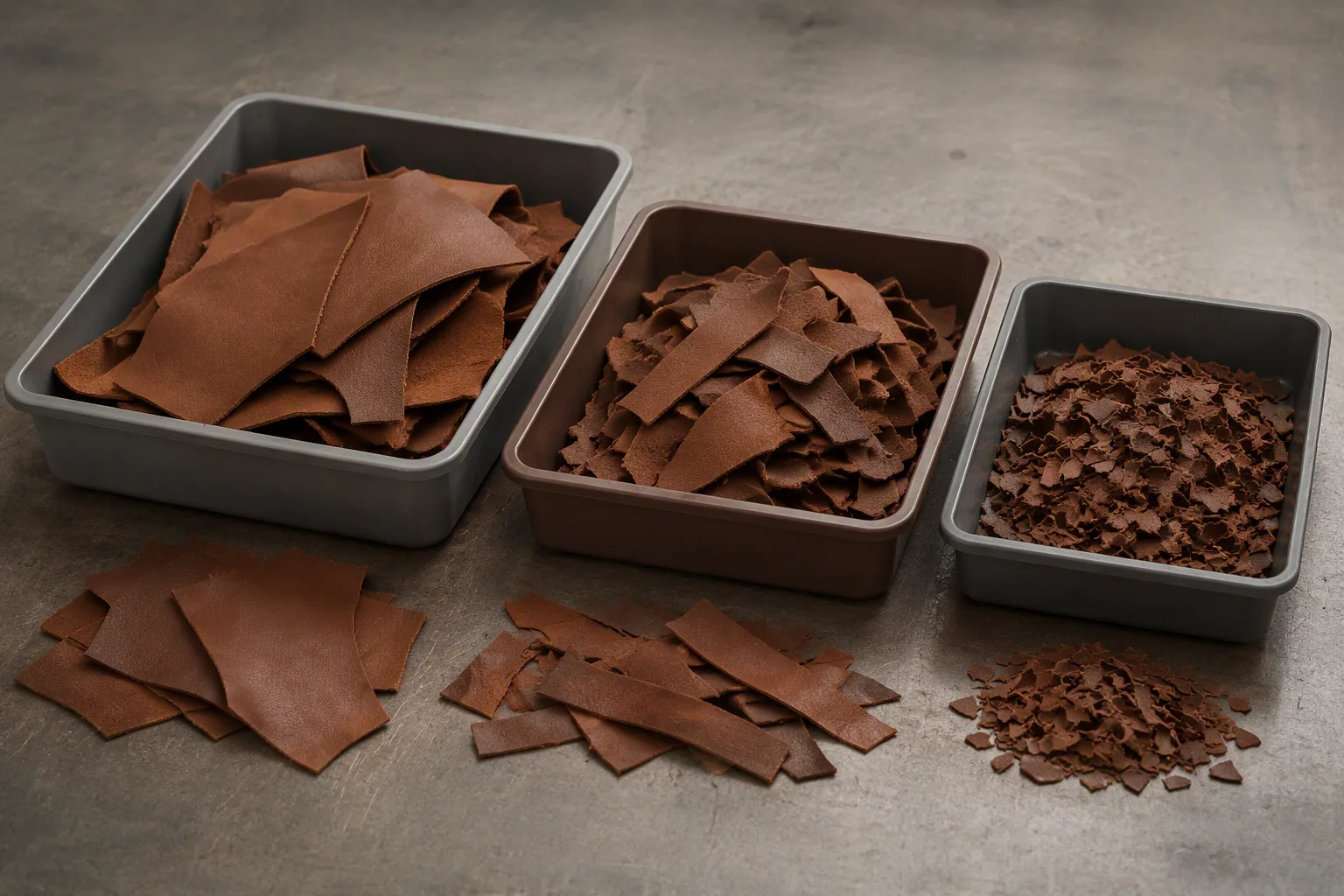
A large pile of mixed offcuts is difficult to use because each piece has to be assessed before it can be allocated to anything. Sorting by size and grade at the point of cutting is what converts a pile into material.
The Quality Question
Offcuts inherit the hide’s condition.
Material cut from a strong area with no defects behaves like the leather it came from, while material from around a scar or from a loose belly area carries the same weakness it had in the hide. Reuse decisions should follow the same material logic as the original cutting plan.
Where the Pile Is Generated
| Stage | Type of waste | Best intervention |
|---|---|---|
| Pattern design | Layout inefficiency | Redesign or re-nest the pattern |
| Primary cutting | Large offcuts | Sort for reuse immediately |
| Trimming and shaping | Narrow strips | Collect by width for piping and binding |
| Skiving and splitting | Shavings and dust | Segregate for its own disposal route |
| Quality rejection | Defective panels | Improve inspection and process control |
| Handling and storage | Marks and creases | Improve storage and handling rules |
Sorting at the Cutting Table
Sorting later costs more.
Why Sorting at Source Works
The person cutting knows the piece.
The cutter knows which hide a piece came from, whether it was a strong area and whether the surface is sound, and that knowledge disappears as soon as the offcuts are tipped into a common bin. Sorting at the table preserves information that cannot be recovered later.
Sorting Rules
- Keep large pieces separate from narrow strips
- Separate material by thickness, so reuse matches the original article
- Set aside clean pieces from strong hide areas for visible components
- Remove defective and weak pieces before they contaminate a reuse bin
- Keep shavings and dust in a separate container from the start
Containers and Labelling
A sorted pile needs somewhere to live.
Shallow open containers allow pieces to be seen and selected, and each container should be identified with the material it holds: article, thickness, colour and the hide area it came from. Bags or boxes of mixed offcuts defeat the sorting effort almost immediately.
Frequency
Sorting should be continuous.
Where sorting happens at the end of a shift, the pile has usually been mixed by then. Continuous sorting at the table is what keeps the categories clean enough to use.
Reusing Offcuts Inside the Bag
The best reuse is invisible.
Where Offcuts Fit in the Product
Small internal components suit them.
| Component | Why offcuts suit it | What to watch |
|---|---|---|
| Interior pocket panels | Small, seldom seen | Consistency of thickness |
| Reinforcement patches | Hidden and shaped to fit | Bonding behaviour |
| Strap tabs and loops | Small and load-bearing | Grain direction and strength |
| Piping and binding | Narrow strips are ideal | Colour match to the main leather |
| Zip pulls and small details | Very small pieces | Uniform appearance |
| Protective pads | Hidden inside the bag | Thickness consistency |
Matching the Original Article
Reuse should not change the product.
Material used internally should come from the same article and thickness as the bag it goes into, because a patch of different temper or finish can telegraph through a panel or behave differently at a seam. Reuse that changes how the product feels has stopped being reuse.
Grain Direction
Direction matters in small parts too.
Tabs, loops and straps cut from offcuts should be cut in the same direction as the main straps, or they will stretch differently from the components they sit beside. This is the most common technical failure in offcut reuse.
Approvals
Reuse inside a product should be approved.
Where a customer has approved a specification, substituting an offcut for a component changes the material used in the bag. Internal reuse should therefore be agreed in advance rather than introduced quietly, because the customer may have opinions about both quality and consistency.
Small Goods and Accessories From Offcuts
The visible second life of the pile.
What Suits Offcut Production
Small items tolerate small pieces.
Card holders, key fobs, coasters, small pouches, luggage tags, bookmarks and simple cable organisers can all be produced from pieces that would never make a bag panel. Because these items are small, they can also be made from material that the main production cannot use for reasons of size rather than quality.

Working With the Main Programme
The accessory line should follow the leather.
Where small goods are made from the same articles as the bags, they can share colour, hardware and edge finishing, which makes them a coherent extension of the range rather than a separate product line. Items made from whatever happened to be in the pile tend to look like what they are.
Quality Standards
Small does not mean unregulated.
Accessories made from offcuts should meet the same material standards for defects, thickness and finish as the rest of the range, because they carry the brand’s name. Reusing material that was rejected for the main product without disclosing it is how an accessory line damages a reputation.
Volume Limits
Offcut supply is unpredictable.
Production from offcuts cannot be planned like production from a hide order, because the quantity and shape of the material depends on what the main programme cut that month. Accessory lines built on offcuts should therefore be positioned as limited or flexible rather than as a fixed catalogue item.
Passing Offcuts On: Sales and Partnerships
Offcuts have a market.
Who Buys Offcuts
There is a range of buyers.
Small-goods makers, craft businesses, repair workshops and trainers all use offcut material, and some factories sell sorted offcuts as a secondary product. The value depends almost entirely on how well the material has been sorted and how consistent it is.
Selling Sorted Material
Sorted offcuts are worth more.
Mixed offcuts are usually sold by weight at a low price, while material sorted by size, thickness and colour can be sold as a usable input to another maker. The sorting effort is what creates the value difference.
Partnerships and Local Use
Some reuse is not a sale.
Local craft workshops, vocational training programmes and repair services can be practical recipients for material a bag factory cannot use. Arrangements like these require clear expectations about quality, because material that is described as freely given can still generate complaints if it is unusable.
Documentation
Passing material on should be recorded.
Where offcuts leave the factory, a simple record of date, quantity, article and recipient keeps the material traceable and prevents unsorted or defective stock from being described as usable leather.
Shavings, Dust and Trimmings
Not everything can be a piece.
What Skiving Produces
Thin material with no structure.
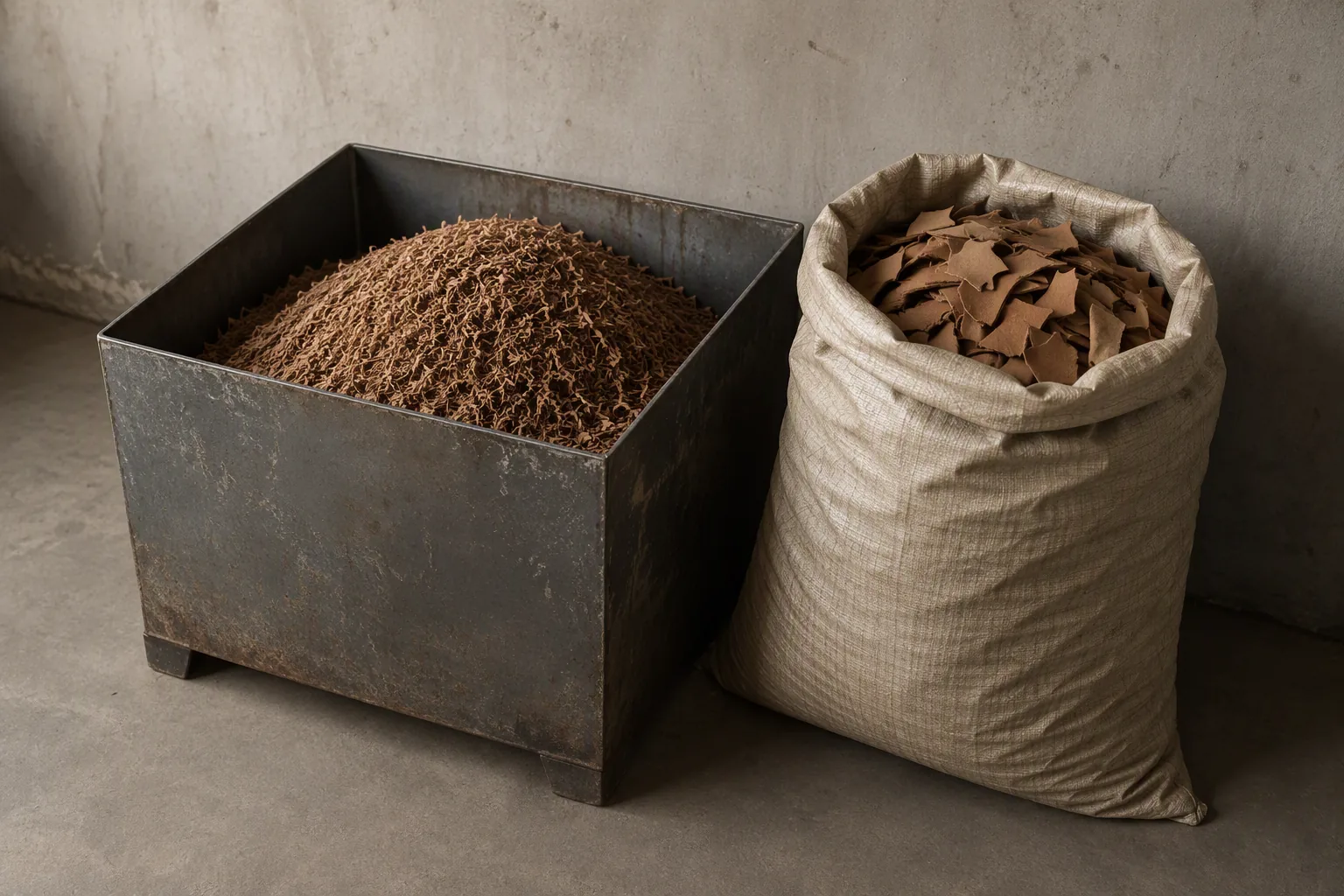
Shavings and dust from skiving and splitting have no fibre structure left in a usable form, so they cannot be reconstructed into panels. Their routes are limited to the waste streams a factory already operates for its general production.
Mixed and Contaminated Waste
Mixing closes options.
Once shavings are mixed with general workshop waste, any possibility of a separate, cleaner route disappears. Keeping them segregated at the point of production costs nothing and keeps the factory’s options open.
What Cannot Be Recovered
Be honest about the tail.
A proportion of any hide becomes material with no further use, and the amount depends on the hide’s condition, the design and the grade bought. A factory that claims to use everything is usually describing unmeasured waste rather than eliminated waste.
The Practical Position
Reduce first, then reuse, then pass on.
The order matters, because it reflects the cost of each step. Reducing waste through design is free at the drawing stage, reusing it inside the product costs a little organisation, and passing it on costs less organisation but returns less value.
What Cannot Be Reused
Some material is finished.
Defective and Weak Areas
Quality limits reuse.
Material cut from around a scar, from a loose belly area or from a region with a surface fault carries that fault with it, and using it in a small item simply relocates the defect into a smaller product. Weak material can be acceptable in a hidden, lightly loaded role and unacceptable anywhere a customer will inspect.
Very Small Fragments
Below a size, value disappears.
Once a piece is smaller than the smallest component a programme makes, turning it into anything requires disproportionate labour, and the practical answer is that the piece becomes waste. Defining that minimum size in advance stops the pile from growing indefinitely while nobody decides.
Mixed and Contaminated Material
Contamination ends options.
Pieces that have picked up adhesive, edge paint, oil or dust are usually not recoverable for visible use, and where they are mixed with clean offcuts they reduce the value of everything around them.
Material That Should Simply Be Bought
Design should not chase waste.
Where a bag requires a component in a size or quantity that the offcut pile cannot supply reliably, the right answer is to buy that material rather than to design the product around whatever is left over. A programme that depends on offcuts for a visible component has accepted an unpredictable supply of a visible part.
The Economics of Offcut Reuse
Reuse has a cost, and it should be counted.
What Reuse Costs
- Sorting time at the cutting table
- Storage space and containers for sorted material
- Labour to cut small components from irregular pieces
- Increasing layout difficulty, because small parts must be found a home in the remaining material
- Quality risk where material is used without full assessment
What Reuse Returns
- Reduced purchases of small components that can be cut from offcuts
- Value recovered from material that would otherwise be waste
- Reduced waste handling and disposal volume
- A possible accessory line with its own revenue
- A credible utilisation story with records behind it
When Reuse Is Not Worthwhile
Some piles do not pay.
Where the material is small, mixed, contaminated or of uncertain grade, the labour of sorting and cutting it can exceed the value of what could be made. Recognising that openly is more useful than maintaining a reuse programme that quietly costs money.
The Utilisation Figure
It has to be measured.
Material utilisation is only meaningful when it compares the area of the hide bought with the area of the material actually used in products and recoverable offcuts. A figure calculated without measurement, or quoted without defining what counts as used, is not a performance measure.
Designing to Reduce Waste
The cheapest gain is at the drawing stage.
Pattern Efficiency
Layout is the largest lever.
Nesting panels to share edges, avoiding unnecessary curves and keeping component sizes compatible with the material left between larger panels all reduce waste without changing the product. Efficiency should be reviewed when a pattern changes, not only when a new bag is designed.
Reviewing Efficiency When Patterns Change
Every change should be rechecked.
A pattern is often revised for fit, reinforcement or construction reasons, and each revision alters the layout even when the outer dimensions are unchanged. Checking utilisation whenever a pattern is revised catches the waste that quietly arrives with a design improvement.
The check does not need to be elaborate: cutting a full set from a representative hide and comparing the usable area against the previous version is enough to show whether the change has cost material.
Working With Hide Sizes
Materials have to fit.
A pattern designed around a hide size the tannery does not supply in that grade will waste material however carefully it is nested. Where a large panel is only just within the hide’s usable width, the programme is relying on the best hides in every lot.
Designing for the Pile
Small parts can be planned for offcuts.
Where a design includes small components, deciding in advance that some of them will be cut from sorted offcuts turns leftover material into planned input rather than an afterthought. The design of those components should avoid long thin shapes that only fit large offcuts.
What Design Cannot Fix
Some waste is inherent.
Curved bags, tight radii, hidden interiors and small decorative parts all consume material in shapes that cannot be avoided, and a hide’s outline cannot be squared off. The target should be a well-understood, measured waste rate rather than an implausible one.
What You Can and Cannot Claim
Material claims need evidence.
Claims That Are Defensible
- A stated proportion of components produced from reused material, with records
- A described process: sorting at cutting, reuse in named components, transfer to named partners
- A measured utilisation figure with its definition stated
Claims That Are Not
- Unsupported statements about waste elimination
- Percentages with no measured basis
- Descriptions of defective material as reusable leather
- Claims that ignore the shavings and fragments that genuinely have no further use
Keeping the Claim Honest
Say what happens to the remainder.
The most credible position is one that describes reuse accurately and also states how the remaining material is handled. A claim that omits the tail invites a question the factory cannot answer.
Working With the Tannery on Hide Utilisation
The hide sets the ceiling.
Questions Worth Asking
- Which hide grades and sizes are being supplied for this article
- How much of a hide is typically usable for the specified panels
- Whether the grade can be changed to improve usable area without harming the product
- How defects are described and how frequently they appear in this grade
Grade and Waste Trade Off
Better grades reduce waste.
A higher grade of hide usually reduces the proportion lost to defects, which changes the waste picture as much as any layout improvement. That trade should be assessed with real numbers, because the extra material cost may be offset by usable area.
Documenting the Discussion
Utilisation is a joint figure.
Where a factory reports utilisation to a customer, the underlying assumptions about the hide and its defects should be recorded and agreed, so that the number is understood as belonging to a particular article and grade rather than to leather in general.
Records and Traceability
A reuse programme runs on paper.
What to Record
| Record | Purpose |
|---|---|
| Offcut quantities by category | Shows whether the sorting effort is working |
| Reuse destinations | Links material to the components it became |
| Transfers out of the factory | Keeps passed-on material traceable |
| Waste quantities by type | Separates reusable from non-reusable material |
| Utilisation figures with assumptions | Makes the performance claim defensible |
| Defect-related waste | Connects waste to incoming quality |
Why the Record Matters
It is the only evidence.
Where a customer asks how much material is reused, or a claim is reviewed, the record is what separates a described practice from an assertion. It also shows the factory where its own waste is concentrated, which is where improvement is worth attempting.
Who Owns the Material Stream
Someone should be responsible.
Sorting, storage, reuse and transfer all happen at different points, and unless one person is accountable for the whole stream, each stage assumes another is looking after it. Naming an owner is what turns a series of good intentions into a routine with results.
That owner is usually in production rather than in purchasing, because the decisions that create and sort offcuts are made on the factory floor.
Keeping It Simple
Complex records are abandoned.
A one-page log by cutting station, completed during the shift, is more durable than a detailed system that only works when someone has time. Simplicity is what keeps the records alive.
Setting Up an Offcut Programme
Start small and specific.
A Practical Sequence
- Measure what is currently being thrown away, by category
- Choose two or three components that could use offcut material
- Introduce sorting containers at the cutting tables, labelled by article and thickness
- Trial reuse on those components and check the product result
- Add small goods where the offcut supply supports them
- Identify an external route for material that cannot be used in-house
- Record quantities and review whether the effort returns more than it costs
What Makes Programmes Fail
Effort without a destination.
Most failed reuse programmes begin with enthusiasm and containers, and end when nobody has defined what the material will become. Deciding the destination first, and the required sorting second, is what produces a programme that survives a busy month.
Scaling
Scale follows demand.
A programme grows when there is a component or product that needs the material, and it tends to stall when the next step is more sorting rather than more use.
Common Mistakes in Offcut Management
| Mistake | Consequence | Prevention |
|---|---|---|
| Sorting at the end of the shift | Material is mixed and unusable | Sort continuously at the cutting table |
| One bin for all offcuts | The pile has no defined use | Separate by size, thickness and colour |
| Using offcuts for visible components without approval | Unapproved substitution | Agree reuse with the customer in advance |
| Cutting small parts across the grain | Components stretch differently | Apply the same direction rules as main parts |
| Ignoring shavings and fragments | Options are closed by mixing | Segregate at the point of production |
| Claiming reuse without records | The claim cannot be supported | Log quantities and destinations |
| Designing around the pile | Unpredictable supply of a visible part | Buy material where reliability matters |
| Chasing reuse before reduction | Expensive effort for modest return | Fix layout and grade before sorting harder |
Frequently Asked Questions
Where do leather offcuts come from in a bag factory?
Mainly from the gaps between cut panels and the material outside the hide outline, from trimming straps, tabs and reinforcements, from fault-rejected areas, and from handling damage. Skiving and splitting produce shavings and dust rather than usable pieces.
Are all offcuts reusable?
No. Reuse depends on size, thickness, surface condition and the hide area the piece came from. Large and medium pieces from strong areas can become small components or accessories, while fragments, contaminated material, defective areas and shavings have no practical leather reuse.
What is the best use of offcuts inside the bag?
Small internal components that are seldom inspected: interior pocket panels, reinforcement patches, strap tabs, piping and binding, small zip details and hidden pads. They should come from the same article and thickness as the bag and be cut in the same direction as comparable components.
Can offcuts be used for visible components?
Technically yes, where the material is sound and large enough, but it should be agreed with the customer in advance because it changes the material specified for the product. Substituting offcut material quietly is how a spec change becomes a quality dispute.
Why does sorting offcuts at the cutting table matter?
Because only the cutter knows which hide a piece came from and whether it was a strong area. Once offcuts are tipped into a common bin that information is lost, and mixed material is difficult to allocate to anything.
What can be done with skiving shavings and dust?
They have no usable fibre structure and cannot be reconstructed into leather panels. Segregating them at the point of production keeps them out of the reusable stream and keeps the factory’s handling options open.
Is selling offcuts worthwhile?
It can be, and the value comes from sorting. Mixed offcuts usually sell by weight at a low price, while material sorted by size, thickness and colour can be sold as a usable input to small-goods makers, craft businesses or repair workshops.
How should material utilisation be reported?
As a measured figure that states its definition: the hide area bought compared with the area used in products plus recoverable offcuts, for a specific article and grade. A percentage quoted without measurement or definition is not a performance measure.
How does hide grade affect waste?
Directly. A higher grade with fewer surface defects reduces the proportion of material lost to rejection, which can improve usable area enough to offset part of the higher material cost. The trade is worth assessing with real figures for a specific article.
What makes an offcut programme fail?
Cutting corners on intent rather than effort — typically starting with containers and sorting but never deciding what the material will become. Settling the destination first and the sorting rules second is what produces a programme that survives a busy month.
What should a buyer ask about offcuts and waste?
How material utilisation is measured and for which article, which components are made from reused material and whether that was approved, how offcuts are sorted at the cutting table, what happens to material that cannot be reused, and what records support the description.
The Bottom Line
Offcuts are a predictable part of bag making, not an accident.
How much material is left over is decided by the pattern, the hide grade and the hide’s own shape, and what happens to it afterwards is decided by whether anybody sorted it at the cutting table. Reducing waste at the design stage, reusing what fits inside the product, turning appropriate material into small goods and passing the remainder to a defined route is a sequence that can be described, measured and defended.
For buyers, the practical questions are short. Ask how utilisation is defined and measured for this article, which components use reused material and whether that substitution was approved, how offcuts are sorted and stored, what happens to shavings and unusable fragments, and what records exist. A factory that can answer those questions is managing material; one that cannot is describing it.
