
Diaper Bag Leather: A Manufacturer’s Specification Guide
Diaper Bag Leather: A Manufacturer’s Specification Guide
A diaper bag is asked to do more than almost any other bag. It carries several kilograms of changing kit, gets put down on floors, hung from a stroller, rained on, wiped with whatever is to hand, and opened one-handed while someone is holding a baby. The leather that survives that routine is not the most beautiful leather available; it is the leather chosen for the job.
As a bag manufacturer, we treat diaper bags as a specification problem rather than a styling problem. This guide explains what a baby bag actually endures, which leather properties matter most, how finish, tannage, thickness and support should be chosen, what to write into a specification, and how to test a leather before a programme is committed.
A diaper bag is used by tired people in a hurry. Every specification decision should be judged against that reality.
- Why Diaper Bags Are a Harder Leather Problem
- What a Diaper Bag Actually Endures
- Functional Requirements First
- Leather Type and Grain for Diaper Bags
- Finish Choice for a Baby Bag
- Tannage, Odour and Chemical Questions
- Thickness, Temper and Support
- Colour and Stain Management
- Interior Lining and Wipe-Clean Surfaces
- Hardware, Straps and Attachment Points
- What to Avoid
- Specification Sheet: What to Write
- Testing Before You Commit
- Sampling, Bulk and Change Control
- Care Instructions for a Baby Bag
- Common Mistakes and How to Avoid Them
- Frequently Asked Questions
- The Bottom Line
Why Diaper Bags Are a Harder Leather Problem
Most bags are carried; a diaper bag is used.
The Usage Pattern Is Different
Frequency and handling are extreme.
A diaper bag is opened dozens of times a day, loaded and emptied several times, and handled by adults who are holding something else. That frequency of contact, flexing and cleaning wears surfaces faster than occasional use of a comparable handbag.
The Operating Environment Is Hostile
Floors, cars, strollers and weather.
The bag spends time on the ground, on car seats, on stroller frames and in the open air. Abrasion from hard surfaces and exposure to rain and sun are normal rather than exceptional, which pushes the specification toward more protective surfaces than a fashion bag would use.
Cleaning Happens Often and Quickly
Cleaning is frequent, improvised and sometimes harsh.
Wipes, damp cloths and household products are used on the surface without much thought, and any leather that cannot tolerate that treatment will fail early. Cleanability is therefore a primary property, not a secondary convenience.
Two Users, One Bag
The bag serves the adult and the baby at the same time.
Everything inside belongs to a child, while everything about using it belongs to an adult who is often carrying that child. That split is why the specification has to satisfy two very different demands at once: materials that are safe and easy to keep clean around a baby, and hardware and openings that work quickly for an adult.
What a Diaper Bag Actually Endures
Requirements become clearer when the failure modes are listed.
Load and Load Points
The load is concentrated, not spread.
Changing mats, bottles, spare clothes and wipes add up, and the weight sits in a few places: strap anchors, handle attachments, the base and the top edge of the main compartment. These are the areas where stitching and reinforcement matter most.
Moisture and Spills
Wet wipes, bottles and weather all bring water.
Bottles leak, wipes stay damp, and rain arrives without warning. Water resistance at the surface and a lining that does not soak through protect both the bag and everything inside it.
Abrasion and Contact
The bag meets the world constantly.
Floors, car seats, stroller frames, doors and zippers all abrade the surface. Corners and lower panels take the most contact, while areas handled daily develop gloss changes and darkening.
Staining and Odour
Some soiling is not removable by design.
Milk, food and sunscreen can stain leather, and the interior of a bag that carries used items can take on odour. Choosing a surface that resists staining and a lining that can be wiped and aired reduces both problems.
Cold and Heat
Leather behaviour changes with temperature.
A bag left in a car or carried in winter sees temperature extremes, and finishes that become brittle when cold can crack along fold lines. Cold flex behaviour is worth testing for any market with real winters.
Functional Requirements First
Write the requirements before choosing the leather.
The Requirement List
The following properties decide the specification:
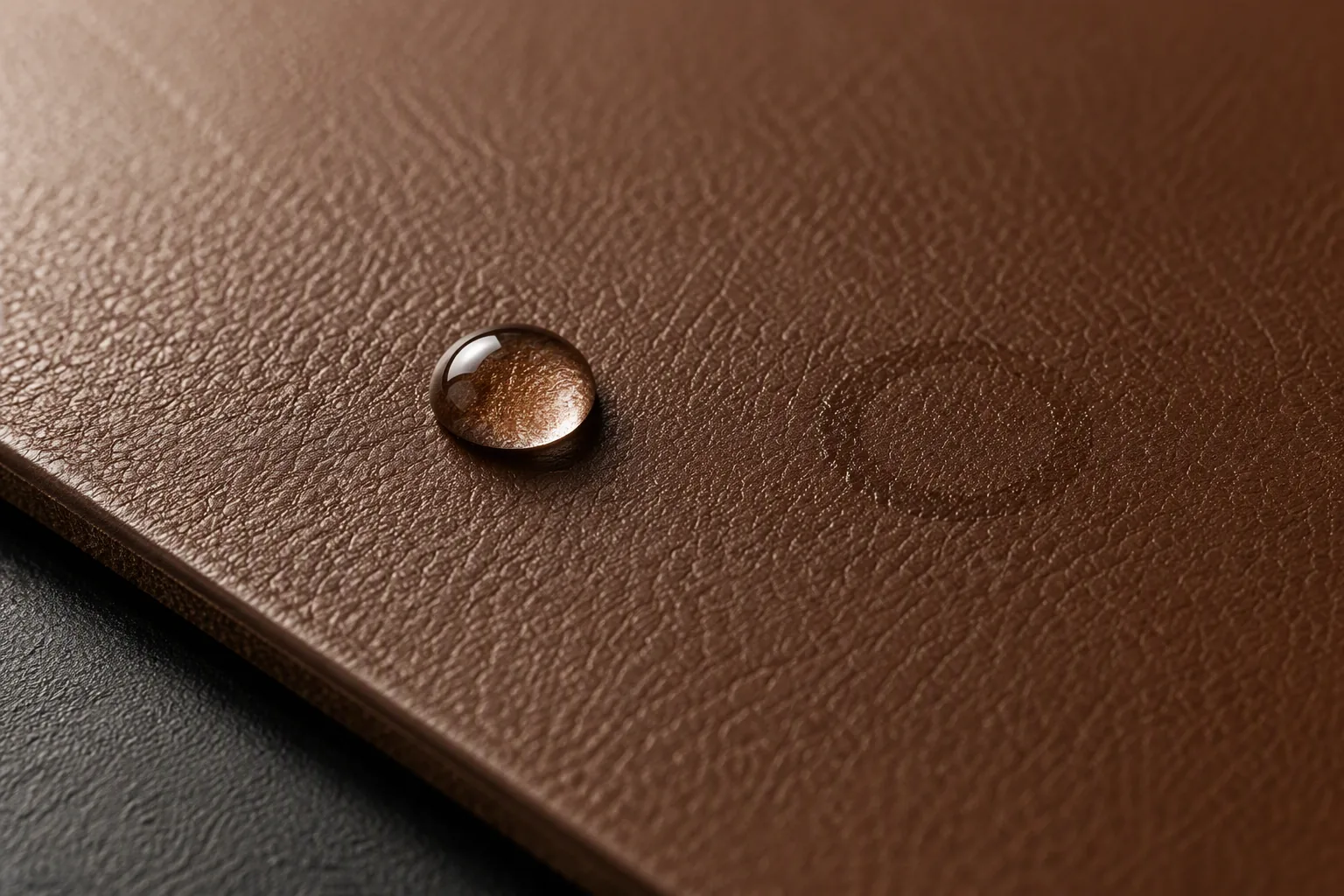
- Water resistance at the surface, measured by how the leather behaves when a spill sits on it
- Abrasion resistance on corners, base and lower panels
- Cleanability with mild products and a damp cloth
- Colour fastness under rubbing, so the leather does not mark clothing
- Flex resistance along folds at the bag mouth and around the gussets
- Cold flex behaviour for winter use
- Stain resistance to oils, milk and sunscreen
- Dimensional stability so the bag keeps its shape when loaded
Turning Requirements into a Leather Choice
Each requirement maps to a decision.
Water and stain resistance point to a coated finish; abrasion resistance points to a finish with a protective top coat; flex and cold flex point to a coating weight appropriate to the leather’s thickness. The requirement list is what keeps those decisions consistent.
Requirements That Work Against Each Other
Not every good property can be maximised.
The most natural-looking leather is the least protective, and the most protective coating is the least natural-looking and the most prone to cracking if it is too heavy for the leather. The specification is a set of deliberate trade-offs, and they should be written down so that everyone knows what was chosen and why.
Leather Type and Grain for Diaper Bags
Grain character affects how the surface behaves.
Grains That Suit Daily Use
Even, closed grain is easier to protect.
Full-grain and top-grain leathers with a reasonably even, closed surface take a coating well, resist soiling better than open or heavily marked surfaces, and are easier to keep clean. Very natural, open grains are attractive but show every mark.
Corrected and Embossed Grain
A corrected surface buys consistency.
Where a programme needs many identical bags, a corrected or lightly embossed grain gives an even surface, consistent colour and better soil resistance. The trade-off is a less natural look, which for this product category is usually acceptable.
Suede and Nubuck
Poorly suited to this product.
Suede and nubuck mark from water and oil, cannot be wiped clean and need brushing, which conflicts with almost every requirement a diaper bag has. They work as trims at most.
Grain Character and Hide Area
Different panels come from different parts of the hide.
The back and shoulder areas of a hide are denser and more uniform, which suits the panels that carry load and take abrasion, while belly and neck areas are looser and stretch more. That difference is one reason a bag can look consistent while behaving inconsistently, and it is worth specifying which areas feed which panels.
Grain and Surface Comparison
| Grain character | Cleanability | Water behaviour | Appearance | Suitability for baby bags |
|---|---|---|---|---|
| Full-grain with light finish | Moderate | Moderate | Very natural | Limited to light-use designs |
| Full-grain with protective finish | Good | Good | Natural with sheen | Good all-round choice |
| Top-grain, coated | Very good | Very good | Even, slightly covered | Strong choice for hard use |
| Corrected or lightly embossed | Very good | Very good | Uniform, less natural | Best for large repeat orders |
| Deeply embossed | Very good | Very good | Textured | Good where texture hides marks |
| Suede or nubuck | Poor | Poor | Soft, matte | Not recommended for main panels |
Finish Choice for a Baby Bag
The finish does most of the protective work.
Why the Finish Leads
Protection lives in the coating.
Because soiling and water meet the surface first, the finish family is the single most important choice for this product. A well-chosen finish makes the bag easy to live with; a poorly chosen one makes every spill a permanent record.
Finishes That Work
Coated families are the practical answer.
A pigmented or corrected-grain finish resists water and abrasion, cleans with a damp cloth and tolerates the improvised cleaning this product attracts. A semi-aniline finish is acceptable where a more natural appearance is wanted and the user will treat the bag carefully.
Finishes That Do Not
Natural and delicate surfaces struggle.
Aniline marks from water and oil, patent shows every fingerprint and scuff, and metallic or pearlised finishes are difficult to keep uniform in use. These belong on occasion bags rather than on a bag that will be hung from a stroller.
Finish and Cleaning Products
Instructions must match the finish.
Whichever family is chosen, the care advice that goes out with the bag should name the finish type and the products to use, because a product made for a different family can strip or darken the surface. Care guidance is part of the specification, not an afterthought.
Tannage, Odour and Chemical Questions
Materials questions deserve direct answers.
Tannage and Behaviour
Tannage affects how the leather behaves in use.
The tannage system influences softness, colour range, moisture behaviour and how the leather ages, and it also affects how the finished surface takes a coating. Tannage should be part of the specification, not left to the tannery’s default.
Odour
Odour matters more in this product than in most.
A bag that stays closed and carries damp items will hold any odour the material brings with it, so leather and lining should be assessed for smell before approval rather than after complaints. Airing a sample in a closed environment is a simple and revealing test.
Chemical Requirements and Documentation
Requirements should be stated as requirements.
Where a market imposes restrictions on substances in leather goods, the specification should name the requirement and ask the supplier for documentation that demonstrates compliance, rather than assuming that a general claim of quality covers it. Buyers should confirm the applicable requirements and the accepted evidence for each destination market with their supplier and, where needed, a testing provider.
Thickness, Temper and Support
A diaper bag needs structure, but not stiffness everywhere.
Thickness by Area
One bag, several thicknesses.
The base and the main body need enough substance to hold shape under load, while the gusset and the bag mouth need to flex as they open. Using the same thickness everywhere either makes the bag heavy and rigid or leaves the base too weak.
Temper
Temper should follow the part.
A structured base wants a firmer temper, while a gusset that folds repeatedly wants a softer one. Temper is a specification field, and it should be recorded per part rather than as a single value for the leather.
Support and Reinforcement
Hidden structure carries the load.
A thin leather over a suitable support layer can deliver the stiffness a base needs without the weight of a heavy hide, and support in the strap anchors spreads load away from stitching. The reinforcement belongs in the specification alongside the leather.
Thickness and Support Reference
| Part | Thickness direction | Support | Reason |
|---|---|---|---|
| Base | Heavier | Firm board or combined layer | Carries the loaded bag on hard surfaces |
| Main body panels | Medium to heavy | Light board or combined layer | Shape without excess weight |
| Gusset and sides | Medium | Woven support | Must flex as the bag opens |
| Bag mouth and flap | Medium | Woven support | Repeated opening and closing |
| Handles | Medium | Foam plus woven support | Padding and load stability |
| Stroller straps | Medium, firm | Firm reinforcement | Concentrated load at hardware |
| Interior pockets | Light | Light interlining or none | Little load, easy access |
| Trim and piping | Light | None | Follows the panel |
Colour and Stain Management
Colour is a maintenance decision.
Light and Dark
Each choice has a cost.
Dark colours hide everyday soiling but show scuffs and wear as lighter marks, while light colours look clean until they are not, and then show every stain. Mid-tones and textured or embossed surfaces are usually the most forgiving in daily use.
Colour Fastness
Transfer onto clothing is the failure to avoid.
Leather that releases colour when rubbed can mark light clothing and car seats, which is a serious complaint in this product category. Rubbing fastness should be tested and recorded before a colour is approved.
Trim, Piping and Panel Matching
Small parts still have to match.
Piping, trim and the panels that sit beside each other should come from the same lot and be matched for colour and gloss, because a visible difference in a narrow strip is more noticeable than a difference across a large panel. This matters more in a product bought as a gift and inspected closely.
Surface Texture as Camouflage
Texture hides more than colour.
A lightly embossed or grained surface breaks up the appearance of small scuffs and marks, which is why textured finishes hold up better in daily use than perfectly smooth ones in the same colour.
Interior Lining and Wipe-Clean Surfaces
Most of the cleaning happens inside the bag.
Lining Requirements
The lining is the working surface.
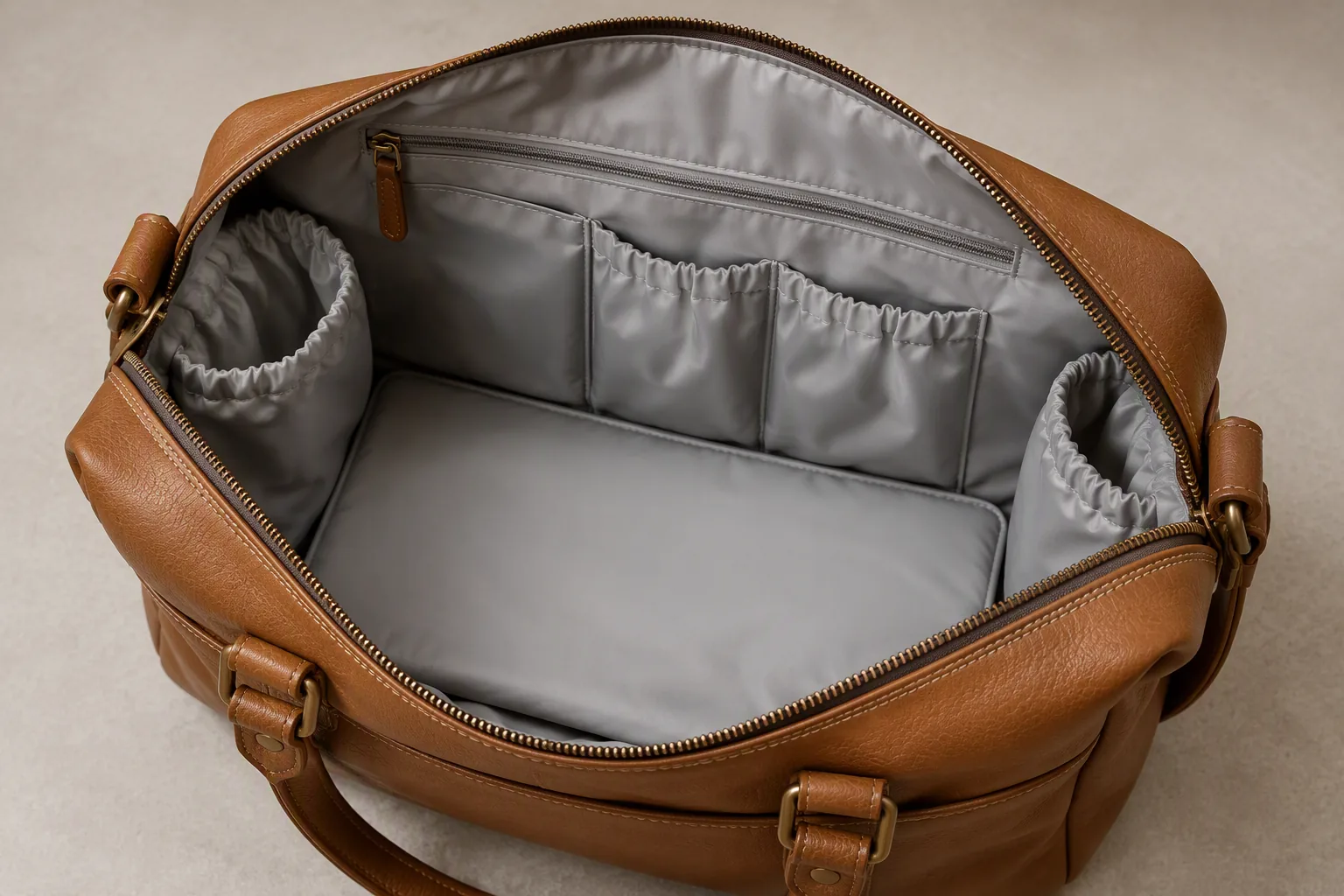
An interior lining should be wipe-clean, resistant to moisture, and dimensionally stable enough that it does not sag as the bag is loaded. A smooth, tightly woven or coated lining is easier to wipe out than a soft fabric.
Pockets, Pads and Compartments
Interior features need cleanability too.
Bottle pockets, wet compartments and changing mats are the areas most likely to become soiled, and each should be made from a material that can be wiped or removed for washing. Removability is a practical advantage.
Interior and Exterior Together
The bag should dry as one system.
A moisture-resistant lining protects the leather from inside, while a protective exterior finish handles the outside. Specifying only one of the two leaves the bag vulnerable from the other direction.
Hardware, Straps and Attachment Points
The functional parts are where bags fail first.
Hardware for One-Handed Use
Closures must open without help.
Zippers, magnetic closures and clips are operated while the user is holding a baby, so they need to be easy to work with one hand and unlikely to jam. Zipper quality and the smoothness of the pull are functional requirements rather than details.
Strap Anchors
Load concentrates at the attachment.
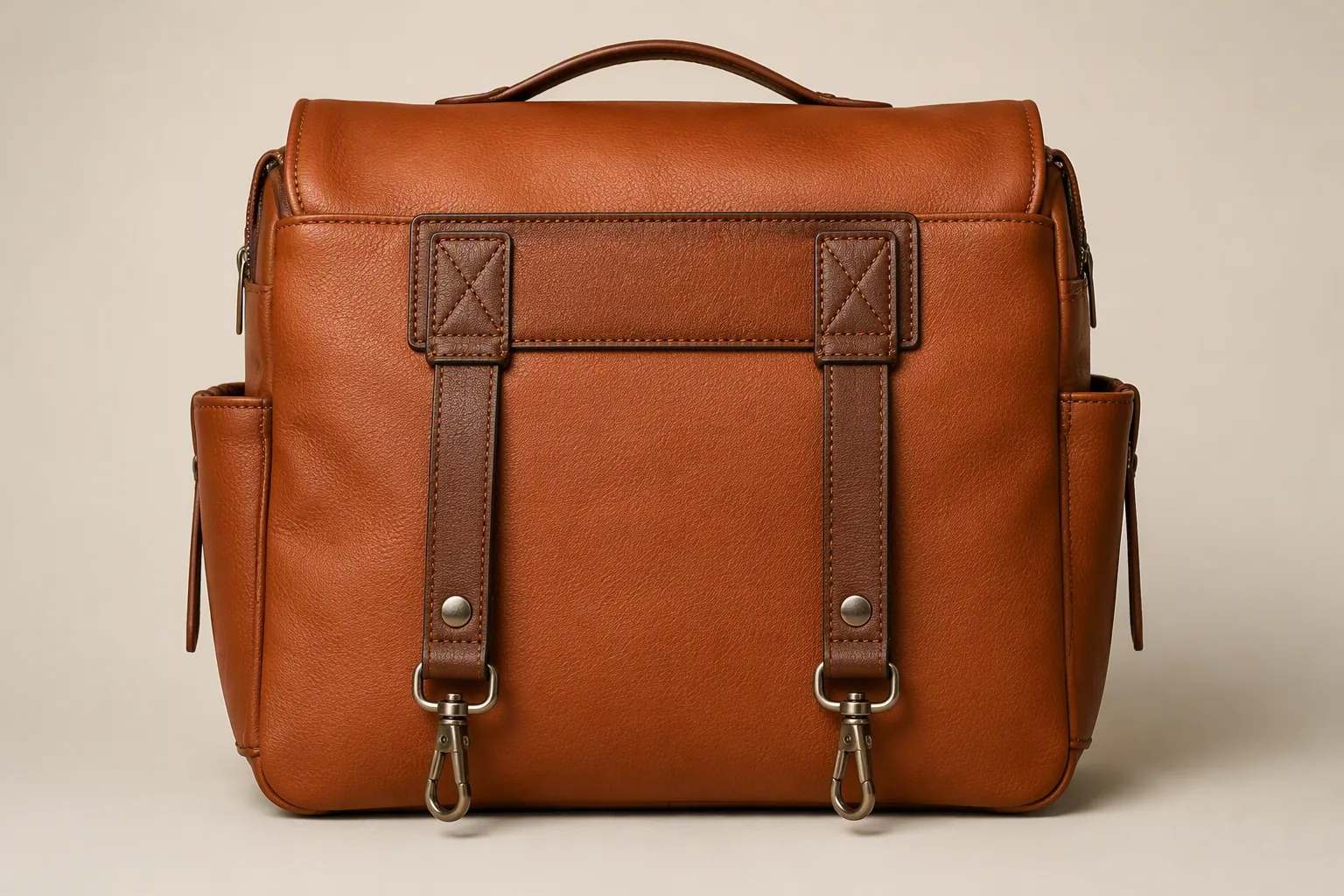
Stroller straps and handles carry the greatest load in the smallest area, so the leather, the reinforcement and the stitching at those points should be specified together. Anchors should always be reinforced.
Attachments and Wear
Stroller straps live on a metal frame.
Straps that hang on a stroller frame rub against metal and take repeated abrasion, so a firmer, more protective leather and a secure attachment are worth the extra material.
Hardware Reference
| Component | Requirement | Why it matters here |
|---|---|---|
| Main zipper | Smooth, one-hand operation | Used while holding a child |
| Stroller clips | Secure, easy to attach and release | Frequent attachment and removal |
| Strap anchors | Reinforced leather and stitching | Highest load in the smallest area |
| Handle attachment | Reinforced, comfortable when loaded | Carried for long periods |
| Base studs or panel | Protective layer at the contact point | Bag is put down on rough surfaces |
| Interior zips | Smooth and light | Accessed while the bag is held |
Wear Protection
Some parts should be designed for wear.
A protective base panel, studs or a reinforced lower corner costs little and delays the most visible wear. Designing for the contact points is more effective than choosing a heavier leather for the whole bag.
What to Avoid
Some choices are reliably poor for this product.
Materials to Avoid
- Uncoated aniline surfaces on panels that will be wiped frequently
- Suede and nubuck on main panels or handles
- Very light leather with no support on the base
- Deeply open grains that trap soiling and are hard to clean
Constructions to Avoid
- Single-layer leather straps without reinforcement at the anchors
- Unsupported bases that sag once the bag is loaded
- Linings that soak and hold moisture against the leather
- Edge finishes that crack when the bag mouth flexes open
Finishes to Avoid
- Heavy glossy coatings that show every scuff on a bag that meets floors and frames
- Effect finishes whose appearance changes with viewing direction
- Finishes whose care requirements contradict how the bag will really be treated
Questions That Reveal the Wrong Choice
Three questions expose most unsuitable materials.
Ask how the surface behaves when a spill is left to dry on it, how the colour behaves when rubbed with a damp white cloth, and what happens to the finish when it is flexed in the cold. A material that struggles with any of the three is wrong for a bag that will be used the way this one is.
Specification Sheet: What to Write
A short document prevents most disputes.
Required Fields
Each field should be filled in, not assumed.
- Tannage system and article reference
- Grain character, and whether the grain is corrected or embossed
- Finish family, coating weight and gloss level
- Colour reference, with a stored reference panel
- Thickness and temper per part
- Support material per part, and its position
- Lining material and its cleanability
- Performance tests required, with acceptance criteria
- Care instructions that will be published with the product
Questions to Ask a Supplier
| Question | What a good answer looks like |
|---|---|
| Which finish family is this leather, and how does it behave when wiped? | A named family with a described cleaning method |
| How does the finish perform on a cold flex test? | A test result, not an assurance |
| Does the colour transfer when rubbed with a damp white cloth? | Results from a rubbing test on the actual lot |
| Which tests were run on this article, and what were the results? | Named tests with figures and conditions |
| How consistent will the colour be across a large order? | A stated tolerance and a reference panel |
| What documentation is available for restricted substances? | Named documents that can be issued per lot |
| What care instructions suit this finish? | Guidance matching the finish actually supplied |
Testing Before You Commit
Order-level mistakes are expensive; tests are not.
The Test Set
A small set of tests covers the real risks.
Water spotting, rubbing fastness, flex and cold flex, abrasion, cleanability and odour assessment address the ways a diaper bag actually fails. Each test should be run on the actual article, using the finish that will be supplied.
Running the Tests
Tests should resemble use.
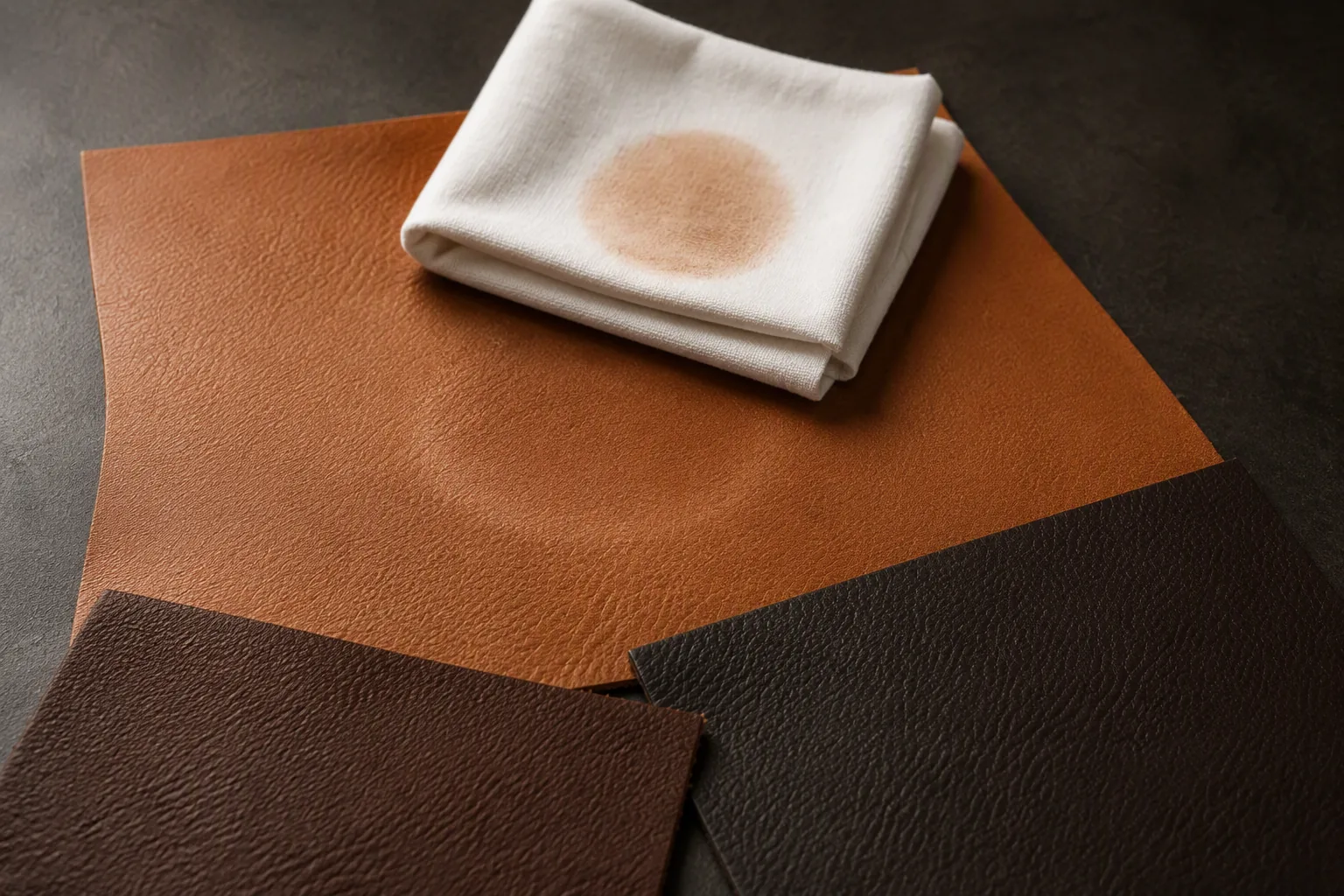
Wiping a sample with a damp cloth, letting a spill dry on it, flexing the bag mouth repeatedly and leaving a sample in a closed bag for a day are all simple, cheap and revealing. Testing on a finished sample is more informative than testing a flat swatch.
Test Reference
| Test | Method | What it protects against |
|---|---|---|
| Water spot test | Leave a drop to dry on the surface | Permanent spotting after spills |
| Rubbing fastness | Rub with a damp white cloth | Colour transfer onto clothing |
| Flex test on folds | Flex the bag mouth repeatedly | Coating cracks at the opening |
| Cold flex test | Flex at low temperature | Winter cracking |
| Abrasion test | Rub with a standard abrasive | Wear at corners, base and straps |
| Cleanability test | Wipe with a mild product and a damp cloth | Stains that cannot be removed |
| Odour check | Store a sample closed for a day | Odour held inside the bag |
| Load test at anchors | Hang the loaded bag from its anchors | Strap and handle failure |
Accepting a Result
Acceptance criteria should be agreed in advance.
Deciding in advance what counts as acceptable prevents a later argument about whether a mark or a gloss change is normal. The criteria belong in the specification alongside the tests.
Sampling, Bulk and Change Control
Sampling is where a programme is won or lost.
What a Sample Must Show
The sample should be used, not admired.
Loading it, wiping it, hanging it on a stroller and carrying it for a week reveals more than any inspection. Programmes that approve samples on appearance alone tend to discover the functional problems in customer hands.
Incoming and In-Process Checks
Checks should compare against the reference.
Incoming inspection should compare the delivered lot against the stored reference panel for colour, gloss, grain and feel, and in-process checks should confirm the parts that carry load received their reinforcement.
Change Control
Change the material, change the test.
A change of finish, grain, colour or thickness alters how the bag behaves, so each change should be re-sampled and the published care advice updated. Keeping the approved specification on file is what makes a repeat order repeatable.
Care Instructions for a Baby Bag
Care advice is part of the product.
What to Tell the Customer
Instructions should be specific and short.
Name the finish family, recommend a product type, and state clearly what not to use. Advice such as “wipe with a damp cloth and dry naturally” is far more useful than a general instruction to clean with leather cleaner.
What to Warn Against
Most damage is caused by good intentions.
- Solvent cleaners and abrasive pads
- Soaking the leather or leaving the bag wet
- Drying leather with direct heat
- Overloading the bag beyond the design load
- Storing the bag damp, with used items inside
Interior Maintenance
The inside needs care too.
Wiping the lining after use and allowing the bag to air before it is closed prevents most odour problems, and removable interior elements should be washed separately as their own instructions specify.
Common Mistakes and How to Avoid Them
| Mistake | Consequence | Prevention |
|---|---|---|
| Choosing an uncoated finish for a bag that is wiped daily | Permanent marks and water spots | Match the finish to the cleaning it will receive |
| Using suede or nubuck on main panels | Stains that cannot be cleaned | Reserve these materials for trims, if used at all |
| One leather thickness for the whole bag | Rigid mouth and a sagging base | Specify thickness and support per part |
| No reinforcement at strap anchors | Strap failure under load | Specify reinforcement at every load point |
| Colour approved without a rubbing test | Colour transfer onto light clothing | Test rubbing fastness on the actual lot |
| No cold flex test for winter markets | Coating cracks in cold weather | Test flex at low temperature |
| Moulded or effect finishes without cutting control | Visible panel-to-panel difference | Control cutting direction and panel matching |
| Care instructions written generically | Customers use the wrong product | Publish care advice for the specific finish |
Frequently Asked Questions
What is the best leather for a diaper bag?
A coated leather with an even, closed grain and a protective finish is the most practical choice, because it resists water and abrasion, wipes clean and holds its shape. Suede, nubuck and uncoated natural finishes look attractive but do not tolerate the daily wiping this product receives.
Is genuine leather good enough for a diaper bag?
It depends on the finish rather than the name. A coated top-grain or corrected-grain leather with a protective finish performs well, while an uncoated natural leather of the same grade will mark from water and oils. Ask which finish family the leather carries, not only which grade.
How thick should diaper bag leather be?
Thickness should be specified per part rather than for the whole bag. Bases and main body panels need enough substance to hold shape under load, while gussets and the bag mouth need to flex, so a medium thickness with suitable support usually outperforms one heavy thickness throughout.
How should a leather diaper bag be cleaned?
With a soft damp cloth and a mild product made for the finish family actually used. Avoid solvent cleaners, abrasive pads and soaking, and let the bag dry naturally away from direct heat. Care advice should name the finish, because the wrong product can strip or darken the surface.
Why do diaper bags wear out at the handles and straps?
Because load concentrates there. Straps and handles carry the whole bag through a small attachment area, so they need reinforcement in the leather, enough thickness and secure stitching. Unreinforced anchors are the most common point of failure.
Does leather transfer colour onto clothing?
It can, particularly with strongly dyed colours on light clothing or in humid conditions. Rubbing fastness should be tested with a damp white cloth on the actual lot before a colour is approved, especially for dark colours used against light clothing.
Is a heavier leather always more durable for a baby bag?
No. Durability in this product comes mostly from the finish, the support layers and how load is managed, while weight makes the bag tiring to carry. A medium leather over suitable support with a protective finish usually outlasts a heavier leather with a poor finish.
Should a diaper bag have a wipe-clean lining?
Yes, in most designs. Most of the cleaning happens inside the bag, and a lining that resists moisture and can be wiped protects both the contents and the leather from the inside, which an exterior finish cannot do.
Which colours hide wear best on a diaper bag?
Mid-tones with a lightly textured or embossed surface are usually the most forgiving, because they hide both light scuffs and dark marks. Very dark colours show scuffing clearly, and very light colours show stains.
What tests should be run before approving leather for a diaper bag?
Water spotting, rubbing fastness, flex and cold flex, abrasion, cleanability, odour and a load test at the anchors. These correspond to the ways this product actually fails, and they are quick enough to run on the article that will be supplied.
What documentation should accompany the leather?
The buyer should state the requirement for their destination market and ask the supplier for documentation that demonstrates it, rather than relying on a general quality claim. The accepted evidence and the applicable requirements should be confirmed with the supplier and, where needed, a testing provider.
The Bottom Line
A diaper bag is specified, not styled into durability.
The leather that works is the one chosen for water, abrasion, cleaning and load: an even grain, a protective coated finish, a thickness and support that vary by part, reinforcement at every load point, a wipe-clean lining, and care advice that matches the finish. Appearance choices follow those decisions rather than leading them.
For buyers, the practical questions are few. Ask which finish family the leather carries and what cleaning it tolerates, what happens to it when flexed cold, whether the colour transfers when rubbed, how thickness and reinforcement differ by part, and which tests were run with what results. A supplier that answers those questions is delivering a specified bag; one that cannot is delivering a sample that looked good in the meeting room.
