
Leather Defects and Grading: A Manufacturer’s Guide
Leather Defects and Grading: A Manufacturer’s Guide
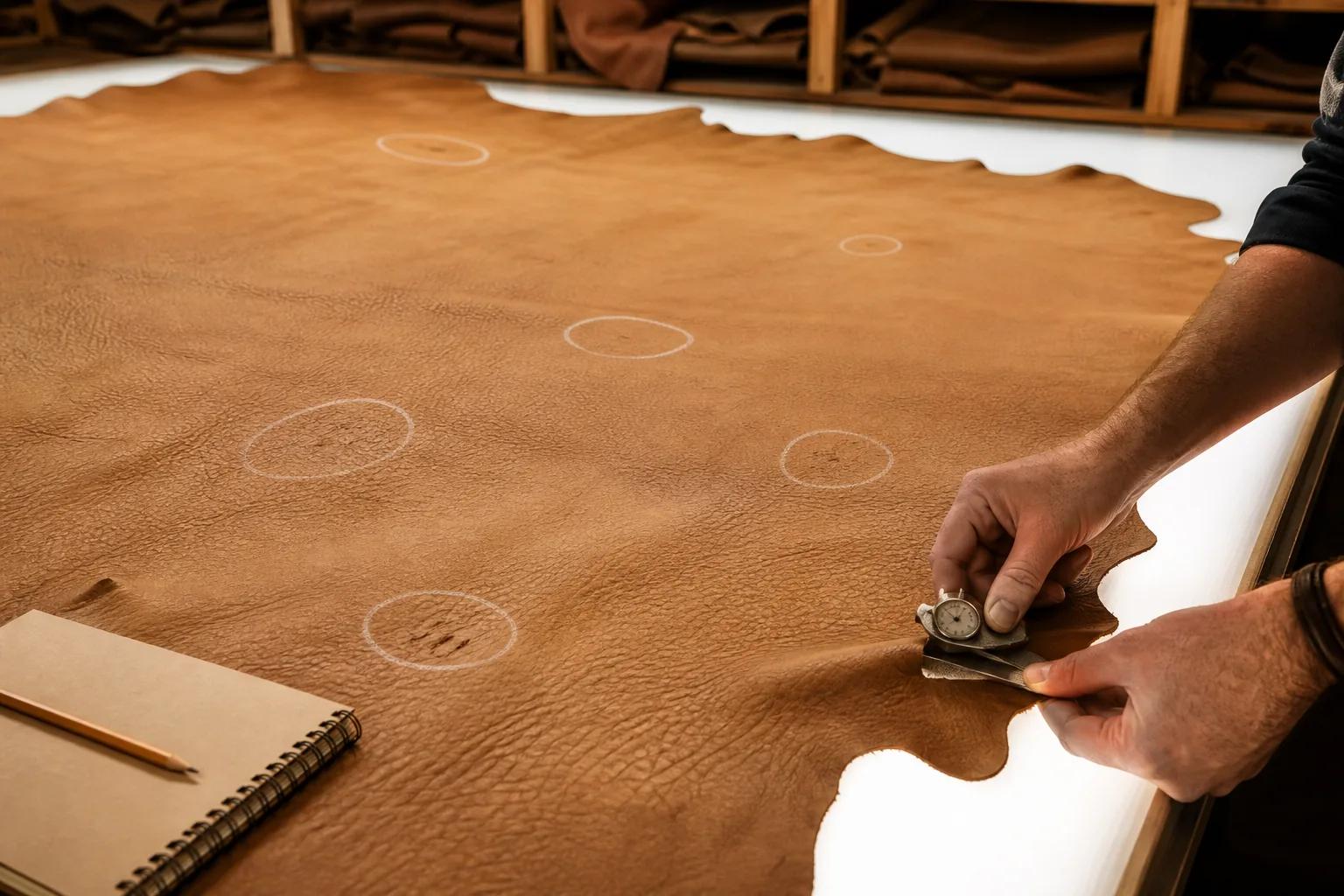
No hide is flawless. Every one arrives with scars, growth marks, insect bites, or brand marks somewhere on its surface. The manufacturer’s job is not to find a perfect hide — it is to know exactly where each flaw sits and to decide whether it becomes a bag or a return.
This guide is the defect reference we use on the factory floor: what each defect is, where it matters, how hides are graded, and how to write defect tolerances into a purchasing specification.
- Why Defects Decide Everything
- The Defect Catalogue
- Where Defects Come From
- How Tanners Grade Hides
- Placement Rules: Where a Defect Is Acceptable
- Inspection on the Factory Floor
- Defects That Appear Later
- Writing Defect Tolerances Into a Spec
- Cost Impact of Defect Management
- Natural Variation Versus Damage
- Defect Vocabulary Buyers Should Know
- Seasonal and Regional Defect Patterns
- Frequently Asked Questions
- The Bottom Line
Why Defects Decide Everything
Before discussing types, it is worth understanding why defects dominate so many manufacturing decisions.
A Hide Is Not a Uniform Sheet
A hide is an irregular organic surface, and its quality varies dramatically from one area to another.
The back and butt are dense, tight-grained, and strong. The belly and shoulder are looser, stretchier, and more prone to showing wrinkles. The neck carries deep creases. Therefore a hide is not one material — it is a map of areas with very different suitability.
How Defects Drive Price
Two hides of identical size and weight can differ by several times in price, based entirely on usable area.
A hide with defects concentrated on the belly might yield 85 percent usable leather. The same hide with defects spread across the back might yield 55 percent. Since yield determines how many bags a hide can produce, defect location translates directly into cost per bag.
The Difference Between Defect and Character
Not every mark is a defect, and the distinction matters commercially as well as technically.
A healed scar on the back of a leather bag is a defect for a structured fashion tote and a feature for a heritage work bag. Grain variation is a defect in a uniform-volume line and the entire appeal of a full-grain collection. The manufacturer’s job is to know both, and to place material accordingly rather than rejecting half a hide.
What Buyers Actually See
Customers do not inspect the whole bag; they inspect the front panel, the handle, and the flap.
Roughly 80 percent of perceived quality comes from a small fraction of the bag’s surface area. This is why placement rules matter more than total defect counts: a bag with six defects hidden inside pockets looks better than a bag with one defect on the front panel.
The Defect Catalogue
Below are the defects we check for on every incoming hide, grouped by cause and typical impact.
Scars and Healed Wounds
Scars come from scratches, barbed wire, and healed injuries, appearing as raised lines or areas with a different grain direction.
Healed scars are structurally sound and rarely weaken the leather, but they take dye and finish differently, so they stay visible. On the back, small scars are usually acceptable for most bags. On a front panel, they are almost always rejected.
Grain Damage and Abrasion
Grain damage includes surface abrasion, rubbed areas, and mechanical damage to the top layer of the hide.
This defect matters more than a scar, because the grain is the leather’s protective surface. Damaged grain wears faster, absorbs moisture unevenly, and can flake or crack later. Serious grain damage is a reject even in hidden areas if it sits at a flex point.
Insect and Tick Marks
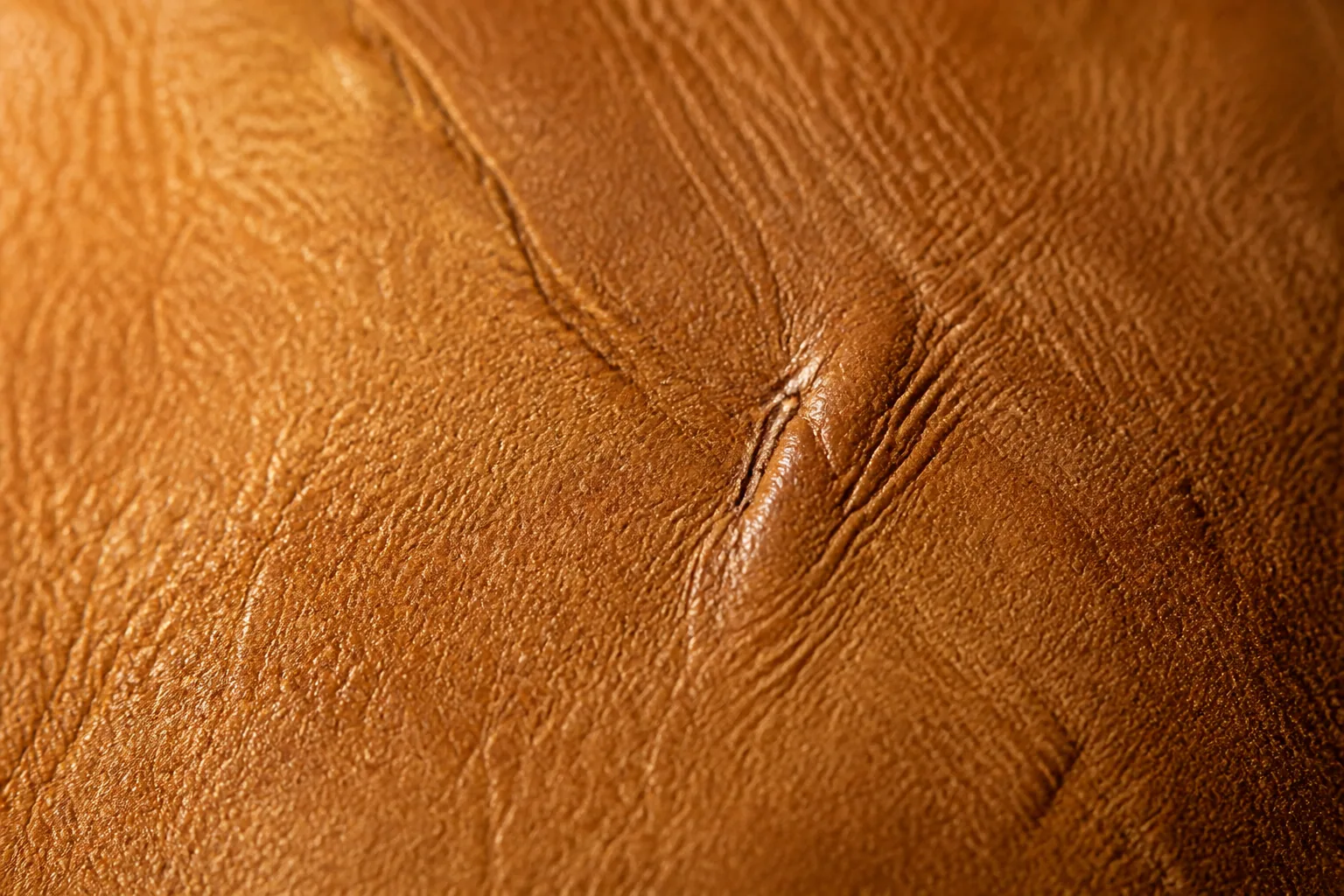
Tick bites and insect damage appear as small pitted holes or clustered marks, often on the belly and legs.
These are punctures through the grain, and they can enlarge during stretching. Small isolated marks are usable in hidden panels. Clustered damage means the whole area must be avoided, which is why inspectors map it rather than judging marks individually.
Brand Marks and Fire Brands
Farm brands leave large, hard areas with compressed grain and distorted dye absorption.
Brand marks are always rejected for visible panels because they cannot be finished consistently, and they cannot be skived away without weakening the leather. Hides with brands are typically cut around, which reduces yield noticeably.
Growth Marks, Veins and Fat Wrinkles
Growth marks are natural creases from the animal’s movement, and fat wrinkles are the deeper folds across the shoulder and belly.
Growth marks are a normal characteristic of natural leather, and most are cosmetic. Deep fat wrinkles, however, contain looser fiber and stretch more than surrounding material, so they should never be used for panels that must hold shape.
Holes, Cuts and Scores
Holes come from the slaughter and processing stages, while cuts and scores come from handling and flaying.
Any through-hole is a structural defect and forces the panel to be cut around it. Deep scores on the flesh side weaken the leather even if the grain looks intact, and they often only reveal themselves after the bag has been used.
Color and Dye Defects
Dye defects include uneven color, patchiness, dye streaks, and shade variation between hides of the same lot.
Shade variation is the most commercially damaging defect category, because customers compare two bags of the same model side by side. Factories manage it by grouping panels by shade rather than by rejecting whole hides.
Storage and Mold Damage
Mold, mildew, and moisture damage appear as dark patches, musty smell, and surface dullness.
Mold damage is generally a reject because it can reactivate in humid climates and can transfer to surrounding material in storage. Damp storage also causes dry rot at the hide edges, and those edges are frequently the very areas used for straps.
Loose Grain and Stretch Marks
Loose grain is an area where the surface layer has separated from the fiber structure below, feeling spongy rather than firm.
This is the most dangerous defect in the catalogue, because it often looks normal at inspection and fails months into use, producing wrinkles and flaking at the very places where load concentrates. Any suspicion of loose grain is a reject for load-bearing panels.
Defect Impact by Type
| Defect | Structural risk | Visible risk | Typical handling |
|---|---|---|---|
| Healed scar | Low | Moderate | Hidden panels acceptable |
| Grain abrasion | Moderate | High | Reject on visible grain |
| Tick marks | Low to moderate | Moderate | Avoid clustered areas |
| Brand mark | Low | Very high | Cut around always |
| Growth mark | Low | Low to moderate | Accept as character |
| Fat wrinkle | High (stretch) | Moderate | Not for structured panels |
| Hole or cut | High | High | Cut around |
| Dye shade variation | None | Very high | Sort and group |
| Mold damage | Moderate | High | Reject |
| Loose grain | Very high | Delayed | Reject for load areas |
Where Defects Come From
Knowing the origin of a defect determines both the remedy and who pays for it.
Hide-Origin Defects
Hide-origin defects occur on the animal: scars, brands, tick marks, growth marks, and insect damage.
These cannot be prevented by the tannery, only managed by grading and cutting. Buyers who demand near-perfect leather should expect to pay for hides where defects were cut away upstream, which is precisely what higher grades represent.
Tannery-Origin Defects
Tannery-origin defects arise during processing: uneven dyeing, grain damage from handling, chemical spots, and poor drying.
These are quality-control failures at the tannery, and they should trigger a claim rather than being absorbed into production. A batch with a specific, repeating tannery defect almost always indicates a process problem rather than bad luck.
Transport and Storage Defects
Moisture, heat, and pressure during shipping cause mold, stains, and compressed areas.
Leather shipped in humid conditions without moisture barriers frequently arrives with mold along the folds. This is why incoming inspection should always include smell and edge checks, not just visual surface examination.
Production-Induced Defects
Some defects appear during manufacturing: cutting scores, stitch holes, glue marks, and oven or drying damage.
These are factory errors and should be treated as reworkable rather than acceptable deviation. Tracking them by production stage is the fastest way to improve overall yield.
Why Origin Determines Remedy
The origin of a defect tells you whether to change the material, the process, or the supplier.
Hide-origin defects require better grading and smarter nesting. Tannery-origin defects require a supplier conversation and possibly a claim. Production defects require training and process control. Treating all three the same way wastes both money and goodwill.
How Tanners Grade Hides
Tanneries all grade, but they grade by their own definitions, which is why buyers must ask what a grade actually means.
Grading by Usable Area
Most grading systems measure the percentage of a hide free from significant defects, not the number of defects.
A hide graded as first grade typically offers a large continuous clean area suitable for large panels. Second grade offers smaller clean areas suitable for medium panels. Third grade is usable mainly for small components. The practical question is which panel sizes a grade can support.
The Letter Grades
Letter or numeric grades vary by tannery and by country, and they are rarely comparable across suppliers.
Some tanneries grade A through C, others use numbers, and some use descriptive tiers such as full-grain select. Because naming is inconsistent, buyers should request the defect criteria behind a grade in writing rather than relying on the label.
| Grade | Typical clean area | Supports | Typical bag use |
|---|---|---|---|
| First / A | 80–90% usable | Large single panels | Front panels, structured bodies |
| Second / B | 60–80% usable | Medium panels | Back panels, gussets |
| Third / C | 40–60% usable | Small components | Straps, pockets, trims |
| Utility | Below 40% usable | Fragments | Interior parts, samples |
Trimming and Splitting Decisions
Tanneries and factories both trim hides, and each trim consumes material in exchange for consistency.
Trimming the belly and neck removes the loosest areas but reduces area. Splitting adjusts thickness but may expose a weaker fiber layer. Both decisions should be documented, because a hide that was heavily trimmed to reach a grade is not equivalent to one that arrived clean.
What First Grade Does Not Mean
First grade does not mean defect-free, and treating it as such causes constant disputes.
It means the hide contains an area large enough for large panels with a defined tolerance for minor marks. Buyers who expect visual perfection at first grade will reject most shipments forever, while buyers who define placement rules receive workable leather at a fair price.
Placement Rules: Where a Defect Is Acceptable
Placement rules are the most practical tool in defect management, and they replace blanket rejection with intelligent sorting.
The Four Visibility Zones
We divide every bag design into four zones and apply different tolerances to each.
- Zone 1 — Primary visible: front panel, flap, and handle
- Zone 2 — Secondary visible: side gussets, back panel, exterior pockets
- Zone 3 — Occasionally visible: interior pockets, lining attachment areas
- Zone 4 — Never visible: internal reinforcement, hidden stiffeners, sample material
Front Panel Versus Back Panel
The same defect that disqualifies a front panel is often acceptable on the back.
A two-centimeter shade variation is a reject on the front, tolerable on the back. A minor surface scar may be acceptable on the back of a casual backpack and unacceptable on the front of a formal briefcase. This asymmetry is why sorting, not rejection, protects both quality and margin.
Hidden Zones and Utility Panels
Hidden areas absorb a surprising share of imperfect material, and using them well is a mark of a mature factory.
Internal reinforcement panels, pocket backs, and lining support areas can take material that no visible surface would accept. Documenting these zones in the specification turns waste into usable inventory without affecting what customers see.
Placement Allowance Matrix
| Defect | Zone 1 visible | Zone 2 secondary | Zone 3 occasional | Zone 4 hidden |
|---|---|---|---|---|
| Minor growth mark | Accept if subtle | Accept | Accept | Accept |
| Healed scar, small | Reject | Accept if small | Accept | Accept |
| Grain abrasion | Reject | Limit to one small area | Accept | Accept |
| Tick marks | Reject | Reject if clustered | Accept if isolated | Accept |
| Brand mark | Reject | Reject | Accept if covered | Accept |
| Shade variation | Reject if visible at seam | Accept within tolerance | Accept | Accept |
| Loose grain | Reject | Reject | Reject at flex points | Accept if not load-bearing |
Inspection on the Factory Floor
Inspection is a discipline with defined steps, not a glance at the leather.
Light Table Inspection
The primary inspection happens on a backlit table, which reveals holes, thin areas, and grain defects invisible to the naked eye.
Inspectors examine the hide systematically in overlapping strips, marking each defect with chalk and recording its zone. Light table inspection catches structural problems that surface inspection misses, which is why it is the first quality gate in the factory.
Thickness and Gauge Checks
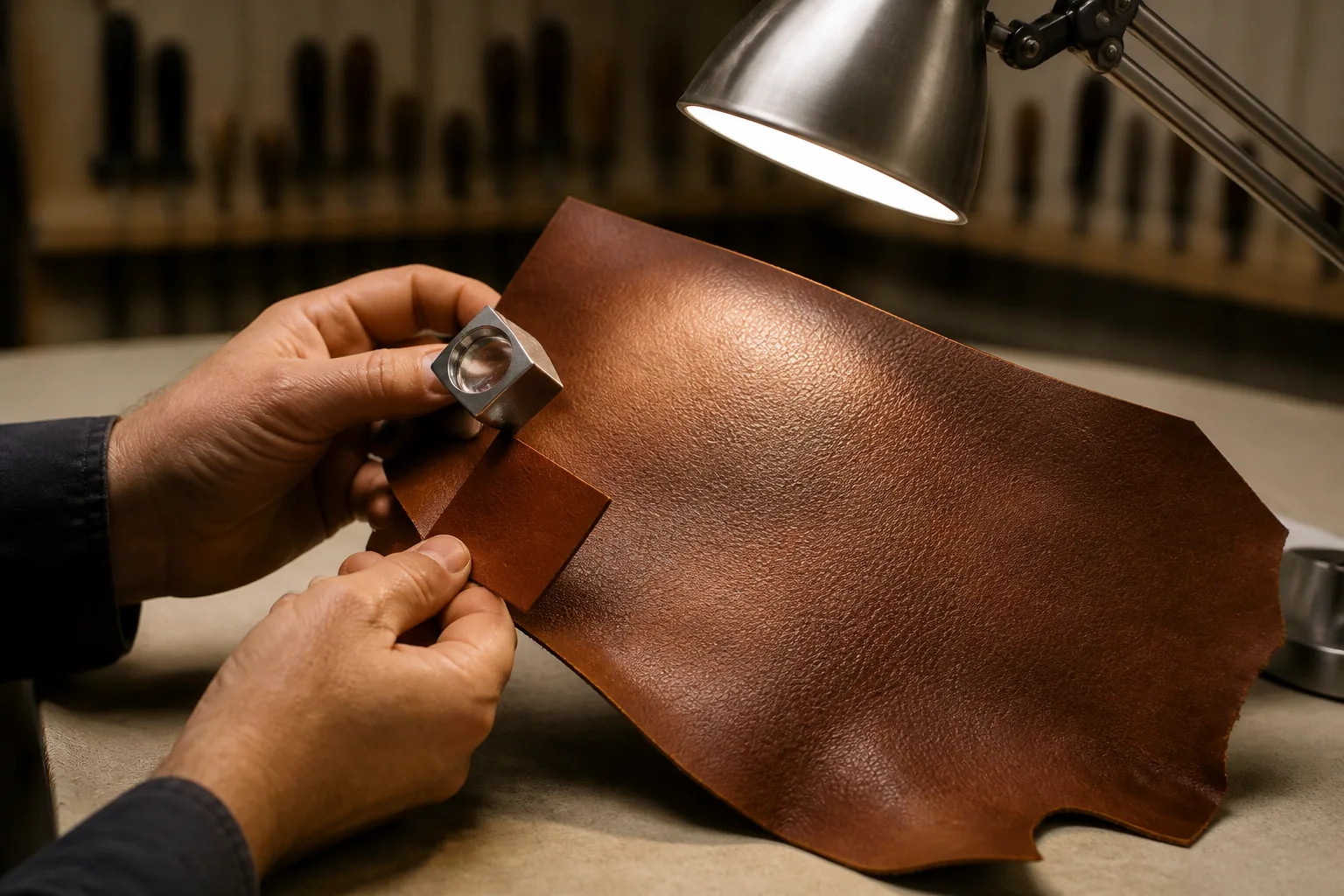
Thickness is measured at multiple points, because a single hide varies by area and a single measurement is meaningless.
We gauge near the back, the belly, the shoulder, and the neck to confirm the hide’s range, then verify that the panels for a given bag come from a consistent thickness band. Mismatched thickness within one bag produces visible distortion in assembly.
Shade Matching Across Panels
Shade is checked under both daylight and retail lighting, because colors shift between the two.
Panels for one bag are laid out together and compared before sewing, and panels for one production run are grouped by shade band. Grouping by shade rather than by hide is what prevents a customer from receiving a bag whose front and back do not match.
Documenting and Tagging
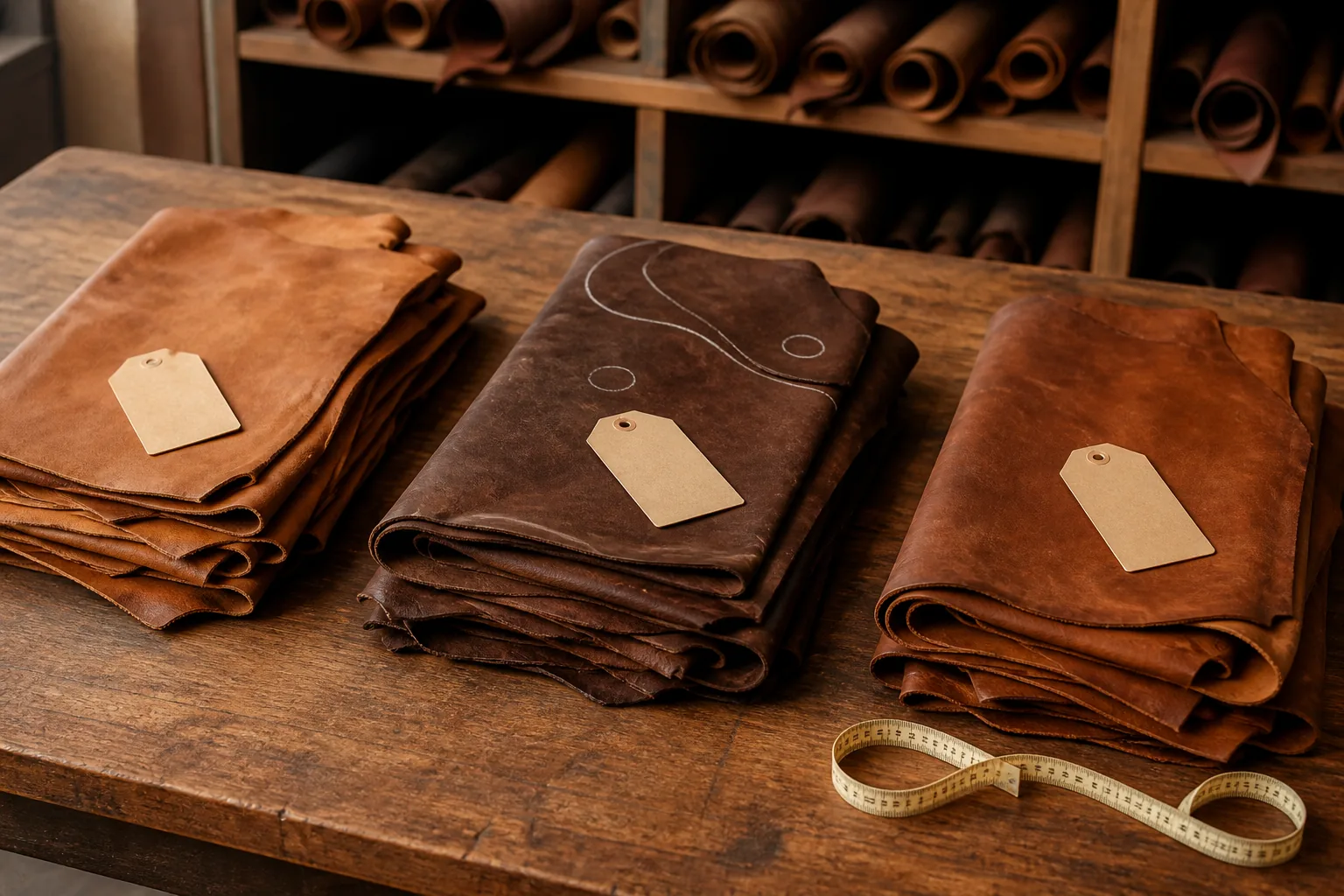
Every hide receives a record: lot number, grade, measured thickness range, and marked defect map.
Documentation turns a subjective argument into a traceable fact. When a customer raises a quality question three months later, the hide record shows whether the material met the agreed specification on the day it was received.
The Rejection Workflow
Rejected material follows a defined path: segregated, labelled, photographed, and reported with a disposition decision.
Options are return to supplier, downgrade to a different zone, or scrap. What never happens is returning defective material to general stock, because that guarantees the defect will reappear in production with no traceable history.
Defects That Appear Later
Some defects pass inspection and emerge during use, and these cause the most damaging customer disputes.
Loose Grain Failures
Loose grain fails slowly, producing ripples, sagging, and eventual surface separation at stress points.
By the time it is visible to a customer, the bag may already be weeks into use and the hide lot may be long consumed. Prevention relies on hand-feel testing during inspection, since loose grain is detectable by pressing the surface before cutting.
Finish Delamination
Finish delamination shows as peeling or flaking of the top coat, usually starting at edges and folds.
It is often a coverage or adhesion problem, and it can appear only after flexing. Testing finish adhesion at the sampling stage — bending a sample repeatedly and inspecting for lifting — is far cheaper than handling claims later.
Cracking at Folds
Cracking appears where leather folds repeatedly, particularly at flap hinges and corner folds.
The cause is usually a combination of insufficient skiving, overly dry leather, or a leather grade too firm for the design. It is a design-and-specification defect more than a material defect, and it is best prevented by matching leather to the construction.
Color Migration and Crocking
Color migration moves dye from leather onto lining or clothing, while crocking transfers color through rubbing.
Both are aggravated by humidity and by aggressive dye loads, and both are commercially serious because they damage the customer’s other possessions. Testing in a humid chamber is the standard prevention step for colored linings.
Why Some Defects Are Claimed, Not Seen
Many defect claims are about material behavior the buyer did not specify, rather than material failure.
If a specification never states that a panel must be free of fat wrinkles, a bag made with one is technically compliant and commercially disappointing. Clear specifications convert these disputes into predictable, testable requirements.
Writing Defect Tolerances Into a Spec
A specification with defect tolerances is the single most effective tool for preventing quality disputes.
Defining Acceptable and Rejectable
Every specification should pair each defect type with a zone, a size limit, and a count limit.
Instead of “no defects,” write “no healed scars larger than five millimeters in Zone 1; up to two scars below five millimeters in Zone 2.” This gives inspectors a decision they can make without escalating, and gives the supplier an unambiguous target.
AQL Sampling Explained
AQL sampling defines how many defectives in a lot are acceptable, based on lot size and inspection level.
Rather than inspecting 100 percent of production, AQL sets a statistically grounded threshold that protects both parties. It works only when “defective” is defined precisely — which is why AQL and defect definitions belong in the same document.
Photographic Standards
Photographs of acceptable and rejectable examples remove most remaining ambiguity.
A reference board with numbered samples showing each defect at each zone tolerance lets an inspector compare rather than interpret. Factories that maintain photo standards resolve disputes in minutes instead of weeks.
Dispute Resolution Clause
Disputes should be resolved by comparing the shipment to the approved standard, not by opinion.
The clause should state the reference sample, the measurement method, the evidence required, and the remedy for each outcome. Remedies typically include replacement, credit, or rework, and specifying them in advance removes most of the friction from claims.
Tolerance Table Example
| Parameter | Zone 1 | Zone 2 | Zone 3 |
|---|---|---|---|
| Scar length | None allowed | Up to 5 mm, max 1 | Up to 10 mm |
| Thickness variation | Within 0.2 mm | Within 0.3 mm | Within 0.5 mm |
| Shade difference | Not visible at seam | Slight, within band | Any |
| Grain abrasion | None | Up to 1 small area | Acceptable |
| Tick marks | None | None if clustered | Isolated acceptable |
Cost Impact of Defect Management
Defect management looks like a cost center until you compare it against the alternatives.
Yield and Sorting Labor
Better sorting raises yield, but it consumes labor, and both numbers belong in the costing model.
A factory that sorts thoroughly may gain several percentage points of yield from the same hide, which for leather often outweighs the added labor. Factories that skip sorting get faster cutting and pay for it in rejected finished goods.
The Price of Ignoring Defects
Ignoring defects transfers cost downstream, where it multiplies.
A defect caught at inspection costs the price of a panel. The same defect caught at final assembly costs the panel plus the labor. Caught by the customer, it costs the full product, the shipping, the handling, and part of the brand’s reputation.
When Upgrading Grade Pays
Upgrading leather grade is sometimes cheaper than managing a lower grade carefully.
For bags with large visible front panels, the labor and rejection cost of using second-grade leather can exceed the price difference of first grade. The calculation changes for bags built mostly from small components, where lower grades perform well.
Natural Variation Versus Damage
The final judgment in defect management is commercial: knowing when to explain and when to replace.
Understanding Grain
Natural grain varies in pore size, pattern, and texture across a single hide — this is not a defect.
Educating customers about natural variation prevents returns of perfectly sound bags. Product pages, care cards, and packaging copy are all legitimate places to explain how natural leather behaves.
When to Educate
Educate when the variation is inherent, expected, and clearly described in advance.
Growth marks, grain variation, and gradual patina are all characteristics a well-informed customer will accept and often prefer. The key is disclosure before purchase, so that variation reads as authenticity rather than surprise.
When to Replace
Replace when the issue is damage rather than variation, or when it affects function.
A loose-grain ripple, a delaminated finish, a shade mismatch between the two sides of one bag, or a brand mark on a front panel are all replaceable issues. Deciding this quickly and generously protects the brand far more than winning the argument does.
Defect Vocabulary Buyers Should Know
Industry terms carry precise meanings, and using them correctly speeds up every conversation with a tannery or factory.
Grain and Surface Terms
- Loose grain: surface layer separated from the fiber structure beneath
- Shrunken grain: surface tightened by heat or processing, producing an unnatural pattern
- Spue or spew: waxy bloom rising to the surface, often from fats or stearic acid
- Crocking: transfer of dye through rubbing or moisture
- Pipping: small raised blisters in the finish
Hide Area Terms
- Butt: the rear area, densest and strongest
- Belly: the loosest and most stretch-prone area
- Shoulder: firm but marked by fat wrinkles
- Neck: heavy natural creasing
- Bend: the hide’s overall flexibility measured by folding
Why Vocabulary Matters
Using the correct term turns a vague complaint into an actionable specification.
When a buyer says “the leather feels wrong,” a factory must guess. When a buyer says “loose grain in Zone 1 at the handle anchor,” the factory knows exactly what to inspect, what to reject, and what to change. Vocabulary is not pedantry — it is the difference between a claim that can be resolved and one that cannot.
Seasonal and Regional Defect Patterns
Defect frequency is not constant, and experienced buyers plan around its natural rhythm.
Seasonal Hide Quality
Hide quality varies with season because it reflects the animal’s living conditions.
In regions with harsh winters, hides often carry more insect damage and healing marks from summer months, while animals raised with better shelter and feed produce cleaner hides. Tanneries see these patterns annually, which is why experienced buyers place orders with seasonal tolerance in mind rather than assuming constant quality.
Regional Differences
Hide characteristics differ by climate, breed, and husbandry practices across producing regions.
Tropical regions often show more insect-related defects and looser structure, while colder regions tend toward denser grain and fewer parasite marks. Neither is inherently superior; they suit different bag types, and a specification that ignores regional reality will generate constant disputes.
Climate Effects During Production
Humidity and temperature affect both the leather and the processes applied to it.
High humidity loosens fiber, slows drying, and increases mold risk, while very dry conditions make leather brittle during skiving and folding. Factories in humid climates run dehumidified storage and shorter open-air handling windows for exactly this reason.
Frequently Asked Questions
Are leather defects normal?
Yes. Every hide has natural marks because it comes from an animal. What matters is defect type, size, and location. Manufacturers manage defects through grading and placement rules rather than expecting flawless hides, which do not exist at commercial scale.
What is the most serious leather defect?
Loose grain is the most serious, because it looks acceptable at inspection and fails months later at stress points. Structural defects such as holes and deep scores are also serious but are usually visible during inspection, so they can be cut around before production.
What does A-grade leather mean?
It usually means the hide contains a large continuous area free from significant defects, suitable for large panels. Grade naming is not standardized between tanneries, so buyers should ask for the defect criteria behind the grade and confirm the panel sizes it can support.
Should a leather bag have zero defects?
Visible panels should be free from notable defects, but entirely defect-free hides are not commercially realistic. The practical standard is that defects allowed anywhere are limited in size and confined to zones that customers rarely examine.
What is the difference between a scar and grain damage?
A healed scar is surface discoloration and grain irregularity with intact fiber structure, so it is structurally sound. Grain damage removes or weakens the protective surface layer, so it wears faster, absorbs moisture unevenly, and can deteriorate with use.
How do factories handle shade variation between hides?
Factories group panels by shade band before cutting and ensure that each finished bag is assembled from panels within one band. Variation is inherent in natural leather, so tolerance should be agreed with the buyer rather than treated as a defect on every hide.
What is a hide’s usable area?
Usable area is the portion of a hide free from defects significant enough for the intended panels. Because defects cluster on the belly and neck, a hide’s usable area determines how many bags it can produce, and therefore its real material cost.
Can leather defects be repaired?
Surface marks can sometimes be filled, dyed, or burnished, but structural defects such as holes, deep scores, and loose grain cannot be repaired reliably. Repairing a structural defect usually transfers the failure to a later date rather than eliminating it.
What is AQL in leather goods inspection?
AQL stands for Acceptable Quality Limit, a sampling standard that defines how many defective units in a lot are acceptable. It works only when acceptable and rejectable defects are defined precisely, so AQL and defect tolerances should be written into the same specification.
Why do some bags develop wrinkles after a few months?
Wrinkles that appear after use usually indicate loose grain, insufficient reinforcement, or a leather grade too soft for the load. Loose grain is the most common cause, and it is detectable at inspection by pressing the leather surface to feel for spongy areas.
How should defect tolerances be written in a purchase order?
Specify each defect type by zone, maximum size, and maximum count, and attach photographic reference standards. Add the measurement method, the inspection level, and the remedy for each outcome. Precise tolerances reduce disputes far more than demanding zero defects.
The Bottom Line
Leather defects are not an occasional problem to be solved; they are a permanent condition to be managed.
Hides arrive with a map of marks, and every mark has a location, a severity, and a best possible use. Manufacturers who grade carefully and place intelligently produce consistently good bags from the same material that would generate returns under blanket rejection.
For buyers, the practical lesson is to specify rather than hope. Define defect tolerances by zone, agree photographic standards, and treat natural variation as a characteristic to disclose. Do that, and the conversation shifts from arguing about flaws to choosing where each piece of leather belongs.
