
Leather Bag Materials: Canvas, Nylon and Hardware Pairing
Leather Bag Materials: Canvas, Nylon and Hardware Pairing
Most commercial bags are not made from one material. A bag labelled “leather” often pairs leather panels with a canvas body, a nylon lining, and a set of metal fittings, and each of those choices changes how the bag carries, wears, and ages.
As a bag manufacturer, we assemble mixed-material bags every week. This guide explains how leather behaves alongside canvas, nylon, and hardware — what each pairing does well, where the joins fail, and how to specify materials so they work together instead of against each other.
- Why Mixing Materials Is Standard Practice
- Leather and Canvas
- Leather and Nylon
- Leather and Hardware
- Material Combination Matrix
- The Join: Where Materials Meet
- Design Rules for Mixed-Material Bags
- Leather and Textile Linings
- Zippers, Webbing and Trims
- Cost and Pricing Implications
- Care and Cleaning for Mixed Bags
- Sustainability in Mixed Construction
- Common Mistakes We See
- Frequently Asked Questions
- The Bottom Line
Why Mixing Materials Is Standard Practice
Before examining each pairing, it is worth understanding why manufacturers rarely use one material throughout.
No Single Material Does Everything
Every material has a profile: cost, weight, water behavior, abrasion resistance, and appearance. None is strongest in all five.
Leather offers durability, structure, and prestige, but it is the heaviest and most expensive option. Canvas offers strength per unit weight and a softer look at lower cost. Nylon offers lightness, water resistance, and resilience. Mixing them lets a designer place each material where its strengths matter most.
The Cost and Weight Equation
Material choice is usually driven by a simple calculation: what does the customer touch, and what must survive load?
Visible and handled surfaces justify leather because it is what the buyer sees and feels. Hidden structural areas, linings, and volume-heavy sections often suit textile better. Done well, this mixing reduces weight and cost while keeping the perceived quality of a leather bag.
Where Mixing Goes Wrong
Mixed-material bags fail at the joins, not in the materials themselves.
A leather panel and a canvas panel behave differently under load, moisture, and time: one stretches, the other does not; one absorbs water, the other repels it. When those differences are ignored, seams pucker, edges curl, and panels tear. Successful mixing is therefore a story about joints and allowances.
Manufacturer’s point: When a brand asks us to cut cost on a leather bag, we look at three things in order: hardware specification, lining material, and how much of the body truly needs leather. Reducing leather on hidden panels is invisible to customers. Reducing it on the handle is immediately obvious.
Leather and Canvas
Leather and canvas is the oldest mixed construction in bag making, and it remains the most commercially useful.
Why the Pairing Works
The two materials complement each other structurally rather than competing.
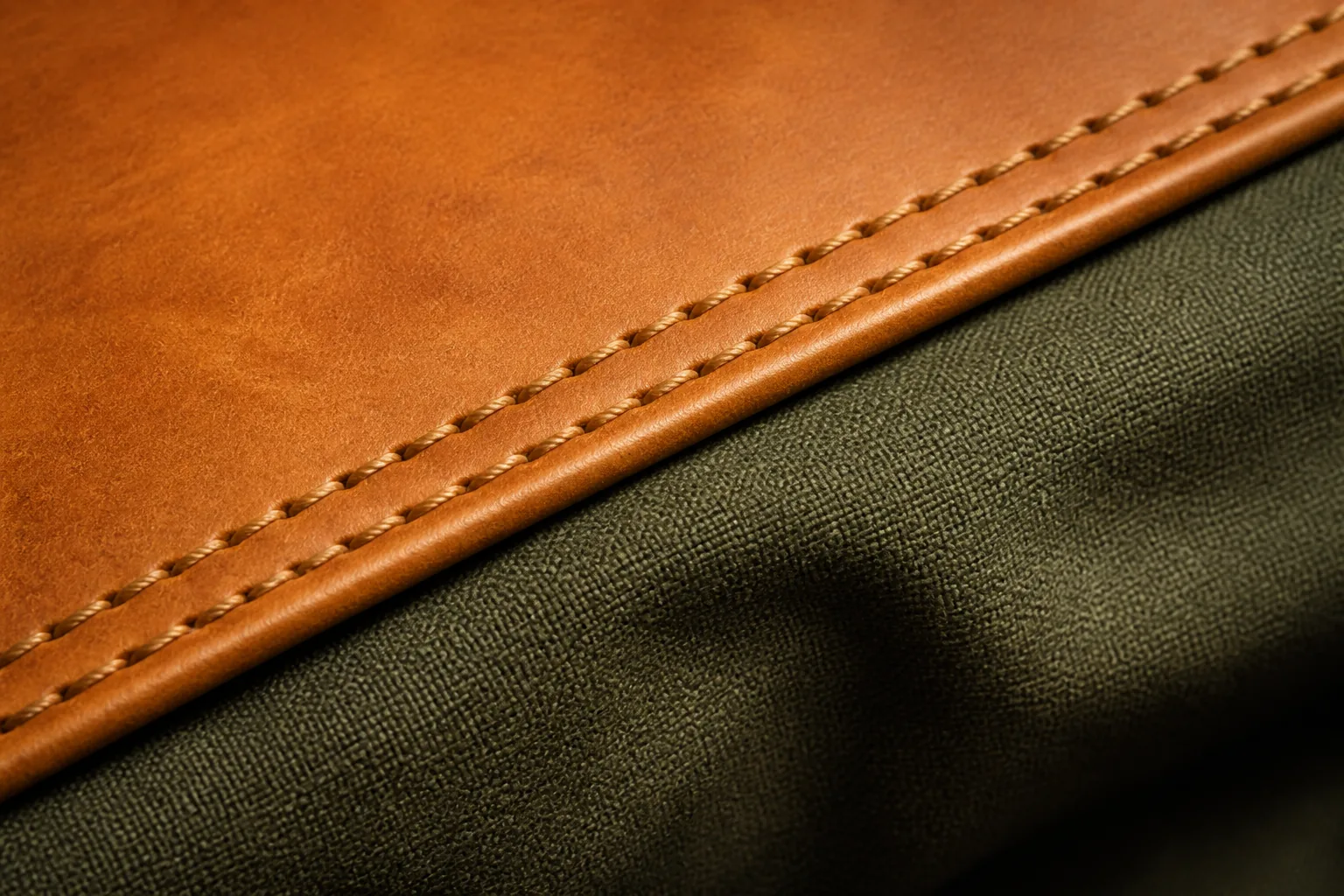
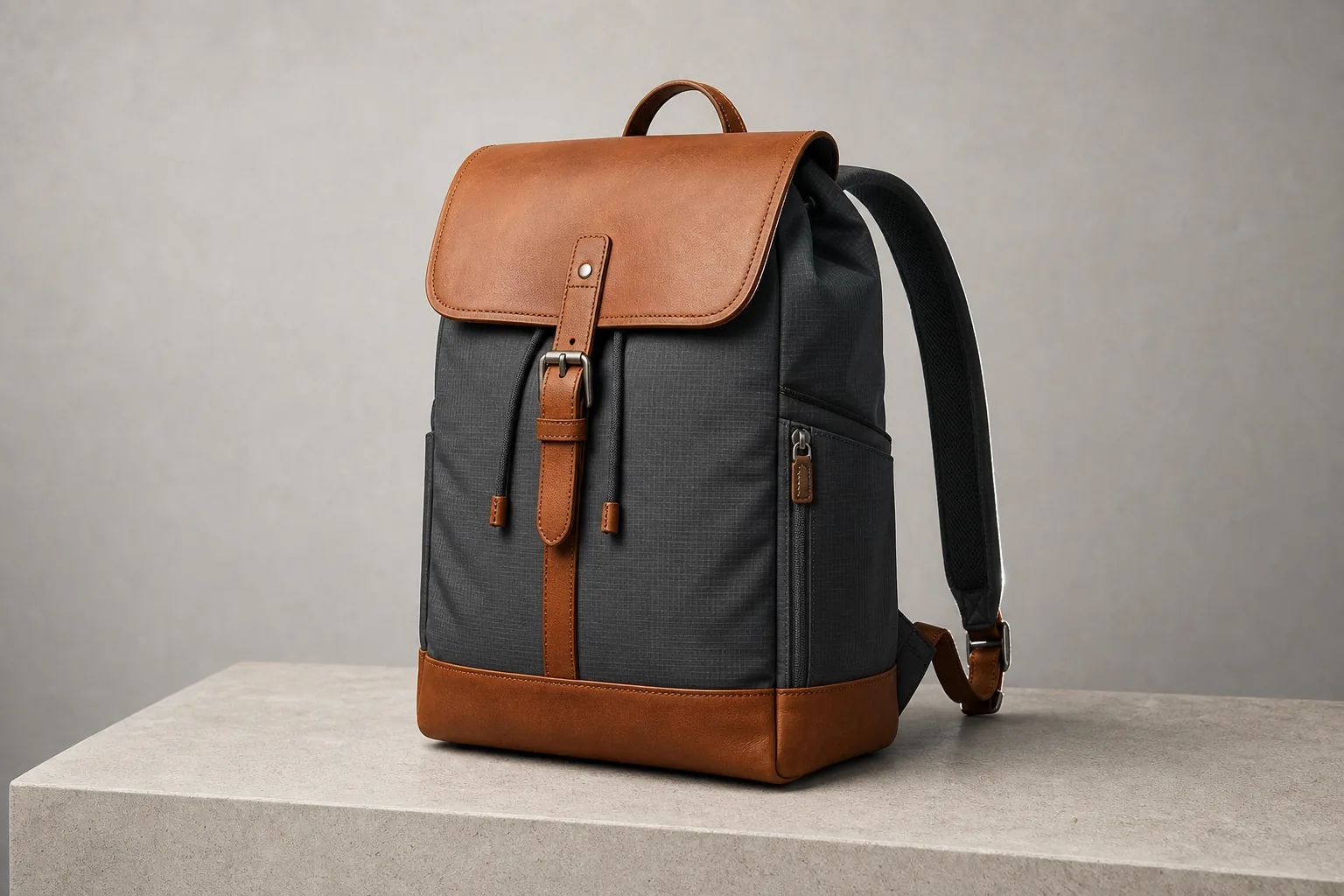
Canvas provides a lightweight, high-strength body with a matte, tactile surface. Leather provides structure at the base, abrasion resistance at the corners, and a premium visual anchor. Together they read as heritage and utility, which is precisely why the combination dominates work bags, totes, and backpacks.
Choosing the Right Canvas Weight
Canvas weight is measured in ounces per square yard, and the choice affects both structure and join behavior.
For bag bodies, 12 to 18 oz canvas is typical, with 18 oz giving a firm stand-up body and 12 oz a softer, foldable one. Lighter canvas requires interfacing or lining to hold shape, while heavier canvas puts more stress on any leather trim attached to it.
Waxed Canvas Versus Plain Canvas
Waxed canvas adds water resistance and a distinctive sheen, but it behaves differently at the join.
Waxed canvas resists moisture but can transfer wax to adjacent leather, darkening it unevenly and softening the leather edge over time. Plain canvas is more predictable but needs a separate water-repellent finish. Both are workable; the mistake is treating them as interchangeable in a specification.
Construction Details at the Join
The leather-canvas join is the most important 15 millimeters in the entire bag.
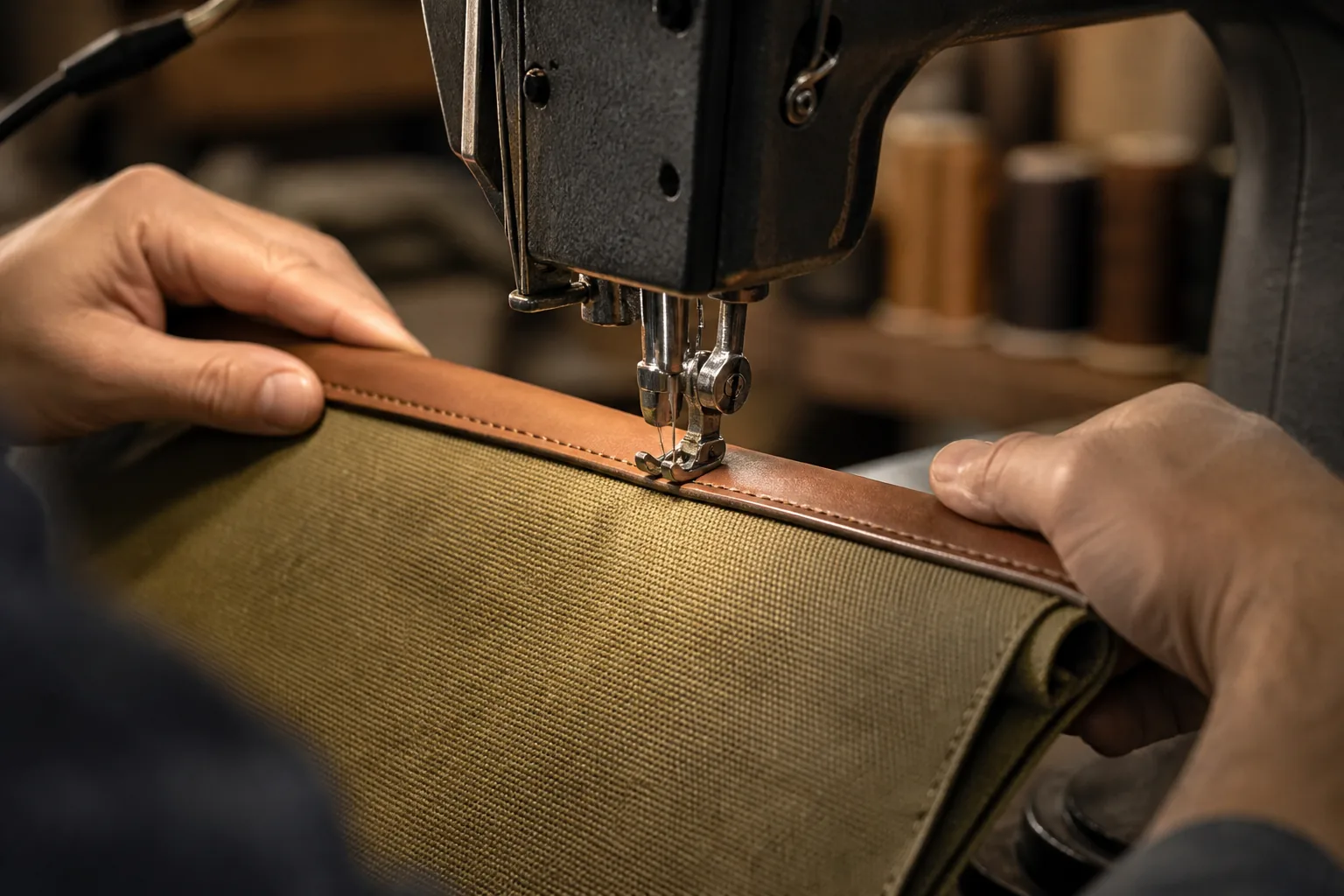
Best practice is to reinforce the canvas side with a facing or interfacing so it cannot stretch, and to skive the leather edge so the seam does not become a hard ridge. Stitch density should suit both materials, and the seam should be designed so that load is carried by the stronger material rather than by whichever is thinner.
Best Bag Types for Leather and Canvas
- Tote bags with a leather base and canvas body
- Work and laptop bags with leather handles and canvas panels
- Backpacks with canvas bodies and leather flaps or straps
- Weekend and duffel bags where weight matters
- Heritage and utility lines built around a rugged visual story
Leather and Nylon
Nylon is the most technical material in common bag use, and pairing it with leather solves specific performance problems.
What Nylon Brings
Nylon contributes lightness, water resistance, and high tensile strength per unit of weight.
A nylon body can be dramatically lighter than leather while resisting rain and abrasion better than untreated canvas. For commuter bags, travel bags, and diaper bags where the user carries a load all day, this weight difference is the single most valuable property in the design.
Weight and Weather Advantages
The practical benefit is easy to quantify: swapping a leather body for nylon frequently removes several hundred grams from a bag of the same volume.
That weight saving changes how the bag carries, especially when loaded. Nylon also dries quickly, which matters for bags exposed to spills, rain, and repeated cleaning — the exact conditions family and commuter bags face.
Joining Leather to Nylon
The difficulty with nylon is not strength but stretch and slipperiness.
Nylon fabric stretches under load and has a slick surface, so a leather piece stitched directly onto it may distort or pull away. Factories manage this with a stable backing layer behind the nylon, with heavier seam allowances, and by attaching leather at reinforced points rather than across large unsupported areas.
Where Nylon Undermines a Leather Bag
Nylon can also undercut the value story if it is used carelessly in visible places.
A leather bag with nylon handles, nylon pocket edges, or nylon trim reads as a cheap bag regardless of how good the leather is, because the customer’s hand learns the truth immediately. Nylon belongs in linings, hidden panels, and internal structures — not where it directly substitutes for a premium surface.
Leather and Hardware
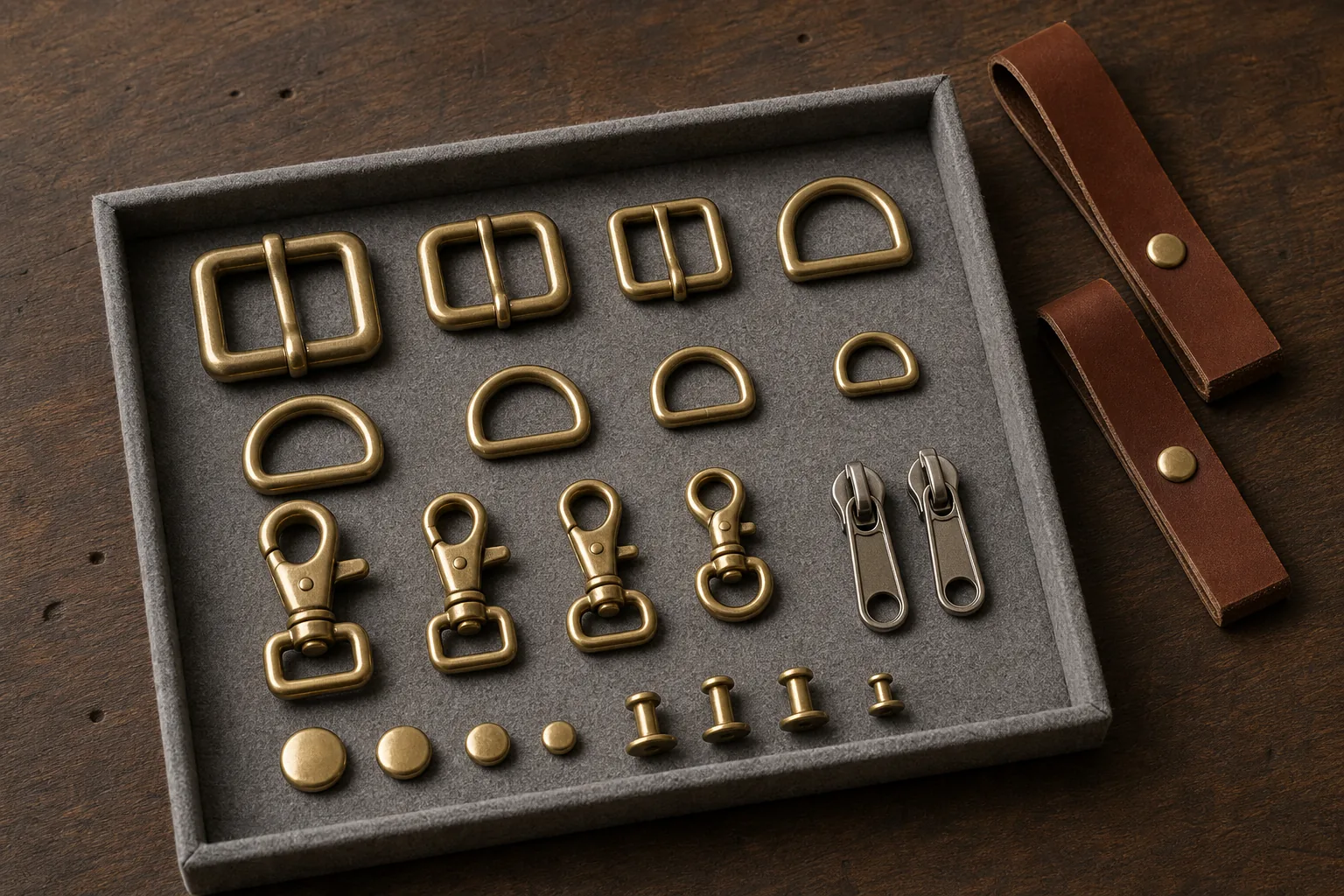
Hardware is the part buyers notice last and evaluate unconsciously, and it is where leather bags most often fail.
Metals That Suit Leather
Solid brass, nickel-plated brass, and stainless steel are the durable choices, while zinc alloy suits lighter-duty applications.
Solid brass develops a patina and holds strength over decades, which complements a leather bag that is also aging. Plated metals look identical when new but can flake at wear points. Zinc alloy is common in mid-market bags and is acceptable when it is thick and well finished.
Finishes and Wear
Finish determines how hardware ages, and it should be chosen alongside the leather’s finish rather than independently.
Antique and matte finishes hide scratches well, which suits soft or naturally marked leathers. Polished finishes reveal every scuff and look best against smooth, uniform leather. For a bag intended to develop patina, unplated brass is often the most honest pairing.
Attachment Methods and Reinforcement
Every hardware attachment should distribute load into a reinforced area rather than into the leather alone.
Rivets hold well in firm leather but can tear through soft or thin material unless backed. Screw fittings allow replacement and repair, which matters for premium bags. D-rings should attach to a reinforced strap or a leather tab with multiple stitches, not to a single layer of soft leather.
Hardware Weight Balance
Hardware that is too heavy for its attachment point harms the bag even if it is well made.
Oversized buckles and heavy clasps load the leather around them, stretching holes and distorting panels. The correct approach is to match hardware mass to leather thickness and to the load the fitting will carry, which is why bag hardware is specified in sizes rather than chosen by appearance alone.
A Hardware Compatibility Table
| Material | Best metal pairing | Attachment method | Notes |
|---|---|---|---|
| Full-grain firm leather | Solid brass, stainless | Rivet or screw | Holds shape, ages well together |
| Soft leather, sheepskin | Light nickel or brass | Screw with backing | Avoid heavy clasps and rivets |
| Waxed canvas | Antique brass, matte metal | Rivet through tabs | Wax darkens metal edges over time |
| Heavy nylon | Stainless, matte metal | Screw with plastic backing | Backing prevents pull-through |
| Lined textile | Light zinc alloy | Sewn tabs | Load is carried by the tab, not fabric |
Material Combination Matrix
The table below summarizes how each common pairing performs across the properties that matter most.
| Combination | Weight | Weather resistance | Durability | Perceived value | Best use |
|---|---|---|---|---|---|
| Leather + canvas | Medium | Moderate to good | High | High | Totes, work bags, backpacks |
| Leather + nylon | Light | High | High | Moderate | Commuter and diaper bags |
| Leather + leather lining | Heavy | Good | Highest | Highest | Premium structured bags |
| Canvas + nylon lining | Light | Moderate | Moderate | Moderate | Volume utility bags |
| Leather trim + cotton lining | Medium | Moderate | High exterior | High | Mid-market handbags |
| All-synthetic body + leather trim | Lightest | High | Moderate | Moderate | Budget travel and sport bags |
Reading the Matrix
The pattern across the table is that mixing materials trades perceived value for weight and weather performance.
Leather-heavy constructions score highest on value perception and durability but weigh the most. Textile-heavy constructions win on weight and weather resistance while depending entirely on the leather trim to carry the premium signal. A well-designed bag chooses its mix based on who carries it and where.
The Join: Where Materials Meet
The majority of field failures in mixed bags happen at material transitions, so construction details deserve more attention than material names.
Stitching Through Mixed Materials
Different materials need different stitch lengths, tensions, and needle types, and the compromise is rarely neutral.
Stitching thin nylon with the heavy thread used for leather can perforate and weaken the fabric, while stitching heavy leather with fine thread creates a weak seam. Factories resolve this with separate operations and, when necessary, separate needles — never one setting for the whole bag.
Edge Treatment Across Materials
Edges cannot be finished the same way on both sides of a join, so the transition must be designed.
A burnished leather edge against a folded canvas edge looks intentional and wears predictably. A burnished leather edge against a raw-cut canvas edge frays within months. Where materials differ, the safest approach is to fold or bind the textile edge and keep the leather edge as the visible reveal.
Adhesives and Interfacings
Adhesive and interfacing choices determine whether a join stays flat or develops ripples.
Leather and textile respond differently to moisture and heat, so an adhesive that works on one may stiffen or fail on the other. Reputable factories test the bond for bond strength, then follow with stitching that carries the structural load regardless of adhesive performance.
Flex Points and Differential Wear
Every join should anticipate which side will move and which will stay rigid.
At a flex point, the more flexible material should be allowed to move through the seam rather than fight a rigid partner. This means slightly longer seam allowances on the flexible side, and reinforcements that prevent the stiffer material from cutting into the softer one over time.
Design Rules for Mixed-Material Bags
A few practical rules prevent most problems before sampling begins.
Assign Roles by Load
Decide which material carries load and which carries appearance, then build accordingly.
Handles, straps, and bases carry load, so they belong to the strongest material available. Flaps, trims, and pockets carry appearance, so they belong to the most attractive material. When a designer reverses these roles to save cost, the bag fails at the handle or the base rather than in the trim, and customers notice immediately.
Keep Water Behavior Consistent
Materials with different water behavior should never sit unprotected against each other.
If one panel absorbs water and its neighbor repels it, moisture accumulates at the seam and damages the absorbing side. Matching finishes, adding a barrier layer, or placing the absorbent material where it can dry are all valid solutions. Ignoring the question is not.
Weight Distribution
Balance matters as much as total weight, especially in bags carried for hours.
Leather concentrated on one side of a bag creates asymmetry when loaded, which pulls on handles unequally. Distributing leather where it also serves structure — base and handle anchors rather than a single decorative panel — improves both feel and durability.
Color and Texture Balance
Mixed materials should contrast deliberately rather than accidentally.
A tonal pairing of tan leather with olive canvas reads as designed; a mismatched brown leather with a slightly different brown synthetic looks like a materials shortage. Contrast in texture — smooth leather against textured weave — usually reads better than contrast in color alone.
Leather and Textile Linings
The lining is the material customers touch most often and think about least, which makes it a quiet driver of perceived quality.
Cotton, Twill and Synthetic Linings
Lining choice affects feel, weight, durability, and how the bag handles moisture.
Cotton and twill linings feel soft and premium but stain easily and hold moisture. Synthetic linings such as nylon or polyester are durable, dry fast, and resist stains, but can feel thin in a premium bag. Many manufacturers use a woven synthetic blend that balances both, or place cotton in pockets where hands reach most.
Suede and Microfiber Linings
Suede and microfiber linings are used where scratch protection and a premium feel matter.
Suede resists slipping and protects screens and delicate contents, which is why laptop compartments often use it. Microfiber offers similar protection at lower cost and is easier to maintain. In both cases the lining must be stitched into a stable base, or it will pull at pocket seams under use.
Lining Color and Dye Transfer
Dark linings hide marks but risk color transfer, while light linings show wear but flatter the contents.
We test linings for crocking, because a saturated dark lining in a humid climate can transfer dye onto pale leather or clothing. When a brand insists on a strong dark color, the specification should include a crocking test rather than trusting the swatch.
Why Lining Choice Affects the Leather
The lining determines how the leather bag holds shape from the inside.
A stiff lining can make a soft leather bag feel rigid and unnatural, while a slack lining lets a structured bag collapse at the base. Matching lining weight and body to the leather’s own character is a small decision with a large effect on how the finished bag carries.
Zippers, Webbing and Trims
Small components carry a disproportionate share of quality perception, and they deserve the same specification discipline as the panels.
Metal Versus Coil Zippers
Metal zippers bring weight, durability, and a traditional feel; coil zippers bring flexibility, lightness, and smooth operation.
On leather bags, metal zippers read as premium and suit structured designs, but they are heavier and can scratch hardware or leather if the tape is not set cleanly. Coil zippers suit soft, lightweight, or sporty constructions. Both require a properly stabilized zipper tape, because the tape — not the teeth — is what fails first.
Webbing Straps Versus Leather Straps
Webbing is lighter, cheaper, and adjustable with hardware; leather is stronger visually and more durable at the point of contact.
A common hybrid uses leather at the shoulder area and webbing through the adjustment run, capturing the feel of leather with the practicality of textile. What must not happen is a leather strap joined to webbing with an unreinforced seam, which is a recognized failure point under load.
Edge Binding and Piping
Binding and piping conceal raw edges and define the bag’s outline, so their material matters.
Leather piping gives a crisp, premium edge but demands precise skiving. Textile binding is more forgiving and lighter, and it suits rounded, softer silhouettes. Mixing the two on one bag is possible but should be deliberate — a leather-piped front with textile-bound interior is a common, well-resolved combination.
Pullers and Small Parts
Zipper pullers, cord ends, and small tabs are the parts customers touch hundreds of times.
Leather pullers feel substantial and align with the bag’s material story, while metal or cord pullers are lighter and more weather-resistant. Whichever is chosen, the attachment should be replaceable, since a broken puller should never mean a broken bag.
Cost and Pricing Implications
Mixed construction is also a pricing strategy, and understanding the cost structure helps buyers negotiate accurately.
Where the Money Goes
| Component | Typical share of material cost | Cost driver |
|---|---|---|
| Leather (body panels) | Highest single item | Hide grade, size, yield |
| Hardware | Moderate to high | Metal type, finish, thickness |
| Textile body | Low to moderate | Fabric weight, coating |
| Lining | Low | Fiber type, print |
| Interfacing and reinforcement | Low | Number of layers |
How Mixing Reduces Cost Without Reducing Quality
Cost reduction is legitimate when it removes material from places customers cannot see or feel.
Replacing an interior panel with a lighter textile, using a synthetic lining instead of leather, or reducing leather to the visible surfaces lowers cost without lowering perceived quality. These are engineering decisions, and good factories document them rather than hiding them.
Where Cheap Mixing Is Obvious
Cheap mixing hides in the details buyers check instinctively: handles, zipper pulls, and pocket edges.
When those parts use thin synthetic substitutes, the bag feels inexpensive regardless of the exterior. Buyers evaluating samples should hold the handle first, open and close the zipper second, and examine the interior third — the order in which quality becomes visible.
Care and Cleaning for Mixed Bags
Care advice has to respect all materials in the bag at once, which is why generic leather advice often causes damage.
Cleaning Leather and Canvas
Leather and canvas need different cleaning agents, applied separately.
Wipe the leather with a lightly damp cloth and condition it occasionally, while cleaning canvas with mild soap and water. The critical rule is to keep the cleaning agent on its own material: soap that cleans canvas can strip finishes from adjacent leather, and leather conditioner can stain raw canvas.
Cleaning Leather and Nylon
Nylon tolerates washing better than almost any bag material, which creates its own risk.
A nylon-lined leather bag should never be machine washed, because the agitation damages the leather even though the nylon would survive. Hand cleaning with a damp cloth on the nylon and a dry method on the leather is the safe routine.
Hardware Care
Hardware care is mostly prevention: keeping fittings dry and free of abrasive grit.
Wiping metal fittings after exposure to rain or salt prevents the corrosion that discolors leather around them. Plated hardware should be dried immediately, since standing moisture lifts plating at edges and accelerates flaking.
A Care Table by Material
| Task | Leather | Canvas | Nylon | Hardware |
|---|---|---|---|---|
| Routine cleaning | Damp cloth | Mild soap | Mild soap | Dry cloth |
| Conditioning | 1–2× per year | Not needed | Not needed | Not applicable |
| Water exposure | Dry away from heat | Air dry | Air dry | Dry immediately |
| Abrasive cleaners | Never | Avoid | Occasionally | Never |
| Storage | Dust bag, stuffed | Dry, aired | Dry, aired | Dry, covered |
Sustainability in Mixed Construction
Mixed-material bags raise specific sustainability questions, and honest answers matter more than slogans.
Material Efficiency
Mixing is often the most material-efficient option, because it uses premium material only where it performs.
A bag that uses leather on panels and textile elsewhere can reduce total material impact while keeping the durability that prevents early replacement. Longevity is the dominant sustainability variable in bags, and mixed construction can serve it.
Repairability
Repairability is where mixed bags can excel or fail, depending on assembly choices.
Screw-set hardware, stitched rather than glued joins, and standard components all make repair practical. Fully bonded or fused assemblies make it impossible, which is why we favor stitched construction even when adhesives would be faster.
Recycling Challenges
Mixed materials are harder to recycle than single-material products, and this should be acknowledged.
Separating leather from textile and metal at end of life is labor-intensive, so most mixed bags are not recycled today. The realistic strategy is designing for long service life and repair rather than promising recyclability the material stream cannot deliver.
Common Mistakes We See
These are the errors that generate the most rework in mixed-material production.
- Skipping reinforcement at the leather-textile join, which causes the textile to stretch first
- Using one stitch setting for the whole bag, weakening either the leather or the fabric
- Putting cheap synthetic on the handle to save leather, which customers notice instantly
- Mixing water behaviors at a seam without a barrier or finish
- Oversizing hardware on soft leather, which distorts panels under load
- Treating waxed canvas as plain canvas in a specification
- Specifying color by name rather than by swatch, which produces mismatched batches
- Ignoring differential stretch so that one panel grows and the seam ripples
Frequently Asked Questions
Is a leather and canvas bag as durable as an all-leather bag?
It can be, provided the joins are reinforced and leather is used on the load-bearing parts. Canvas bodies are strong and lighter than leather, but they can stretch at attachment points, so reinforcement behind the join determines durability far more than the material names do.
Why do bag makers mix leather with canvas or nylon?
To place each material where its strengths matter. Leather provides durability, structure, and premium appearance on visible and handled surfaces, while canvas or nylon provides a lighter, more weather-resistant body at lower cost. Mixing also reduces total weight, which matters most in bags carried all day.
Is nylon lining a sign of a cheap bag?
Not necessarily. Nylon is a practical lining material: light, durable, and water resistant. It becomes a problem when it appears on visible or handled surfaces such as handles, trim, or pocket edges, where customers expect the material they can see and touch.
Which hardware is best for a leather bag?
Solid brass, nickel-plated brass, and stainless steel are the durable choices. Solid brass develops a patina that suits aging leather, while plating can flake at wear points. Match hardware mass to leather thickness, and make sure every fitting attaches to a reinforced area rather than directly to soft leather.
Can a canvas and leather bag get wet?
It can get wet, but the two materials dry differently, so the bag should be dried away from heat and direct sun. Waxed canvas repels water while leather absorbs some, and prolonged soaking damages both. Water-repellent finishes and conditioning reduce risk but do not make the bag waterproof.
How should I clean a bag that mixes leather and fabric?
Clean each material with what suits it, and keep the agents separate. Use mild soap and water on canvas or nylon, and a damp cloth plus occasional conditioner on leather. Never machine wash a leather-trimmed bag even if the textile part is washable.
What causes wrinkling along a leather and canvas seam?
Differential stretch. Fabric stretches under load while leather does not, so an unreinforced seam can ripple. The usual fix is interfacing or a facing behind the textile at the join, longer seam allowances on the stretchy side, and stitching that lets the flexible material move.
Does waxed canvas damage leather?
Wax can transfer from the canvas to adjacent leather, darkening it unevenly and softening the leather edge over time. The transfer is manageable with a barrier layer or a designed gap between materials, but waxed canvas and leather should never be specified as if wax transfer does not happen.
Are mixed-material bags harder to repair?
They can be harder, but stitched construction, screw-set hardware, and standard components keep repair practical. The main obstacle is bonded or fused assembly, where disassembly destroys the materials. Ask how a bag is assembled before assuming it can be repaired.
Can mixed-material bags be recycled?
Recycling is difficult because leather, textile, and metal must be separated, which is labor-intensive. The more realistic sustainability strategy for mixed bags is a long service life, repairable construction, and durable components — keeping the bag in use rather than promising recyclability.
How do I specify a mixed-material bag to a factory?
Specify each material separately with grade, weight, color swatch, and finish, then define the joins: reinforcement type, stitch specification, edge treatment, and hardware attachment. Most mixed-material disputes trace back to an undefined join rather than an undefined material.
The Bottom Line
Leather, canvas, nylon, and hardware are not competitors in bag design; they are roles in a structure.
Canvas and nylon supply the lightweight, weather-resistant volume that leather cannot provide economically, while leather supplies the structure, abrasion resistance, and perceived quality that textiles cannot imitate. Hardware then determines whether the assembly holds together over years of use.
Design the joins before choosing the materials, place the load on the strongest component available, and let the customer’s hand meet leather wherever it rests. A mixed-material bag built on those rules outperforms an all-leather bag built without them — and it costs less to make.
