
Leather Bag Hardware: Selection and Failure Analysis
Leather Bag Hardware: Selection and Failure Analysis
Hardware is the smallest component of a leather bag by weight and one of the largest by influence. Buckles, rings, zippers and rivets are what the customer’s hands touch every day, and they are the parts most likely to fail first.
As a bag manufacturer, we specify, inspect and test hardware constantly. This guide covers how to choose it, how to specify it, and how it actually fails in service — from a factory bench rather than a catalogue.
- Why Hardware Decides Perceived Quality
- The Metals: What Each One Does
- Plating and Finish
- Load Ratings and Where Hardware Fails
- Testing Hardware Before Production
- Hardware and Leather Interaction
- Common Failures and Their Real Causes
- Specifying Hardware Correctly
- Cost and Value of Hardware Choices
- Quality Control for Hardware
- Maintenance and Advice for Customers
- Hardware Sourcing and Lead Times
- Repair, Replacement and Long-Term Service
- The Bottom Line
Why Hardware Decides Perceived Quality
Hardware is a quality proxy, and buyers read it quickly.
The First Touch Point
Customers open, close, clip and adjust hardware before they notice stitching.
A zip that runs roughly or a snap hook that feels light communicates more about perceived quality than an exquisite edge finish, because the hands make that judgement in seconds. Hardware is where cheap construction becomes obvious without close inspection.
Where Bags Actually Fail
Service failures cluster at hardware and its attachment points.
Straps tear out, rings open, plating flakes, rivets loosen, zippers split. Most of these failures are not material failures of the leather at all — they are load, wear, or corrosion problems concentrated at a small metal part and the seam holding it.
Why Hardware Gets Specified Badly
Hardware is often specified by appearance instead of by properties.
A specification that says “antique brass ring” describes a look, not a load capacity, a base metal, a plating thickness or an attachment method. That leaves the decision to whoever supplies the cheapest part matching the description, and that is how failures are designed in.
The Metals: What Each One Does
Base metal determines strength, weight, corrosion behavior and cost.
Zinc Alloy
Zinc alloy is the most common base metal in mass-produced bag hardware.
It can be cast into complex shapes cheaply and takes plating well, which is why it dominates fashion hardware. Its weaknesses are mechanical: it is softer than brass or steel, it can crack at thin cast edges under high load, and its strength depends heavily on the quality of the alloy and the casting process.
Solid Brass
Solid brass is the traditional choice for quality hardware.
It machines and polishes well, has a warm tone, withstands repeated opening and closing, and develops a patina instead of peeling. It is heavier and more expensive than zinc alloy, which is exactly why it appears on higher-priced bags. Solid brass also tolerates wear gracefully: worn brass looks aged, while worn plating looks damaged.
Stainless Steel
Stainless steel brings strength and corrosion resistance together.
It is significantly stronger than zinc alloy and does not rely on plating for corrosion protection, which makes it a practical choice for load-bearing rings, hooks and adjustment hardware on outdoor and travel bags. Its limitations are aesthetic and practical: it is harder to form into intricate shapes, and it has a cooler, more technical appearance than brass.
Aluminium and Other Options
Aluminium is used where weight matters most.
It is light and corrosion resistant but softer than steel and prone to scratching, so it suits hooks and adjusters on lightweight bags rather than load-critical rings. Iron and steel parts appear occasionally, usually as cores under plating, and require careful corrosion protection.
Metal Selection Reference
| Base metal | Strength | Corrosion behavior | Weight | Typical use |
|---|---|---|---|---|
| Zinc alloy | Moderate, depends on casting | Relies on plating | Light | Fashion buckles, decorative rings |
| Solid brass | Good, durable under cycles | Develops patina, does not peel | Heavy | Quality buckles, rings, hooks |
| Stainless steel | High | Inherent, no plating needed | Moderate to heavy | Load rings, hooks, adjusters |
| Aluminium | Low to moderate | Good | Light | Lightweight hooks, adjusters |
| Plated steel | High | Depends entirely on plating | Moderate | Structural parts, some hooks |
Plating and Finish
Finish determines how hardware looks on day one and on day five hundred.
Common Plating Types
Plating decisions trade cost against wear life and appearance.
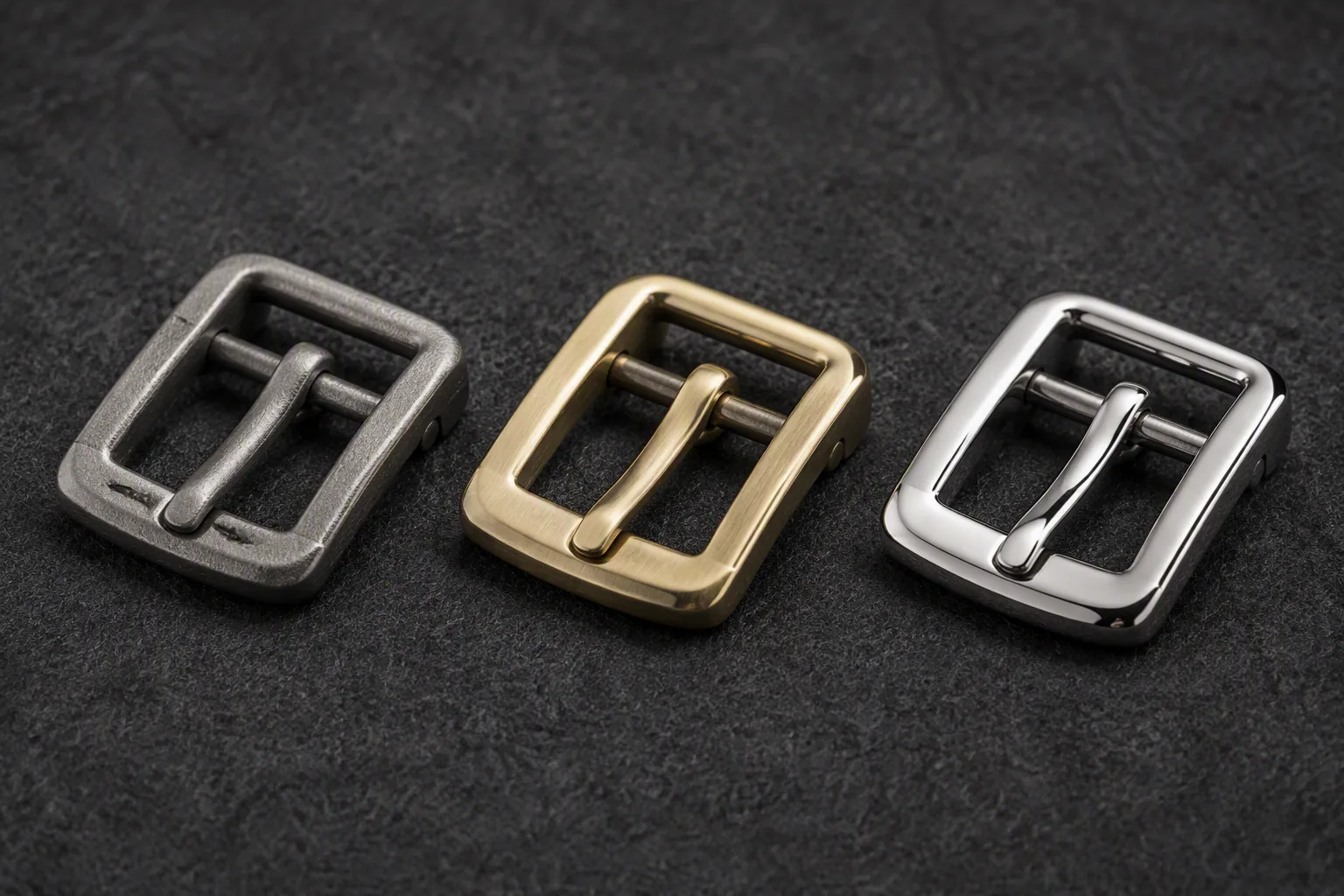
- Nickel plating — bright silver appearance, widely used, moderate wear resistance
- Chrome plating — harder and more wear resistant than nickel, brighter finish
- Brass plating — warm gold tone over a base metal, wears through relatively quickly
- Antique finishes — darkened plating with a patina effect, hides wear better than bright finishes
- Powder coating and paint — color flexibility for fashion hardware, weakest against edge wear
- PVD coatings — hard, thin coatings with good wear and color stability, at higher cost
Plating Thickness and Wear Life
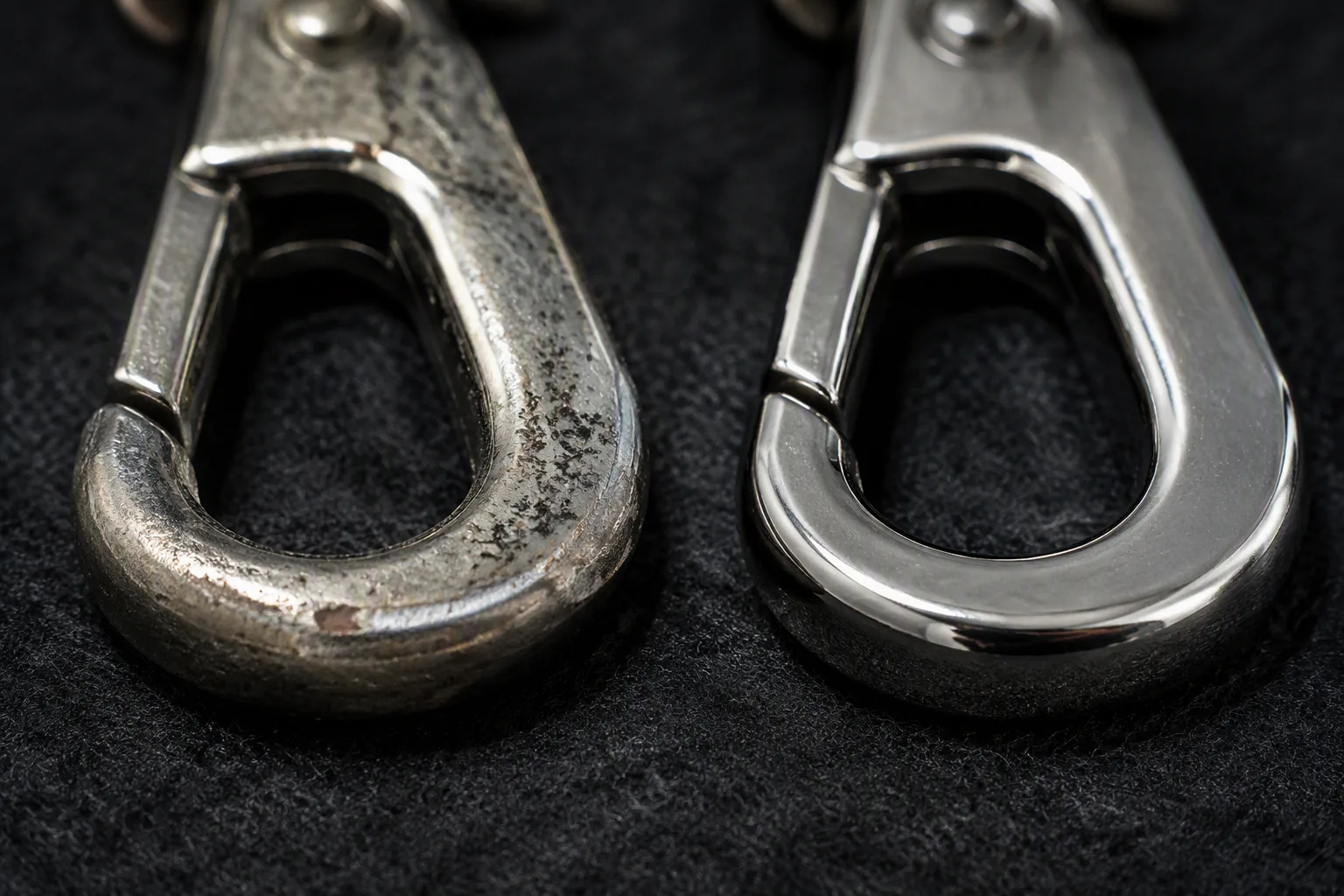
Plating thickness is the single most useful number in a hardware specification.
Thin plating looks correct on delivery and wears through at the first contact points, exposing base metal that is often a very different color. Thicker plating and harder coating processes extend the period before wear becomes visible, which matters most on parts the hand contacts constantly.
Antique and Matte Finishes
Antique finishes are less demanding to live with than bright ones.
Because they are intentionally uneven, the first scratches and wear marks blend rather than announce themselves. Bright polished finishes are the harshest test: any wear, fingerprint or scratch is immediately visible, which is why they suit display pieces more than daily-use hardware.
Color Matching Across a Set
A hardware set must match as a set, not as individual parts.
Buckles, rings, hooks, rivets and zipper pulls are usually produced in different batches or by different suppliers. Small tone differences between the ring and the zipper pull are among the most common visible defects on a bag, and they are prevented by requiring the whole set from one finish reference.
Load Ratings and Where Hardware Fails
Load failures concentrate in a small number of predictable places.
Attachment Points Are the Weak Link
The fitting is rarely what fails first; the connection is.
A ring strong enough for several hundred kilograms fails at the leather loop or seam holding it, because leather stretches, stitch density varies, and the reinforcement behind the fitting may be inadequate. Designing for load means designing the attachment, not just choosing a heavier ring.
Rivets, Screws and Press Studs
Small fasteners carry real load and deserve real specifications.
Rivets depend on the correct grip length for the material stack, the right barrel diameter, and proper setting force. Screws depend on thread engagement and can loosen with movement unless secured. Press studs depend on spring quality and plate thickness. Each has a working load far below what the visual size suggests.
Zipper Hardware
Zippers fail at the tape, slider and pull far more often than at the teeth.
The tape strength, the stitch holding the tape, the slider body material and the pull attachment are the components that decide zipper life. Metal teeth do not save a zipper whose tape tears out at the top stop or whose pull breaks at the joint.
Snap Hooks, D-Rings and Buckles
Each fitting type has its own failure tendency.
- Snap hooks — spring fatigue and gate wear after repeated cycling
- D-rings — joint failure at welded or cast seams under lateral load
- Side-release buckles — prong breakage and release-button wear
- Magnetic closures — loss of holding force and interference with cards
- Lobster clasps — lever fatigue and plating wear at the pivot
Failure Mode Reference
| Failure mode | Typical cause | Practical prevention |
|---|---|---|
| Plating flaking or wearing through | Thin plating on high-contact parts | Specify plating thickness and hardness |
| Cracking at a cast edge | Thin zinc alloy casting, poor alloy quality | Move load-bearing parts to brass or steel |
| Spring fatigue in a hook | Repeated cycling, weak spring material | Choose cycling-tested fittings |
| Rivet or screw loosening | Wrong grip length, no thread locking | Match fastener to material stack |
| Zipper tape tear-out | Weak tape or insufficient stitching | Specify tape strength and stitch pattern |
| Deformation under load | Base metal too soft for the load | Size the fitting to tested working load |
| Sudden color mismatch | Mixed batches or suppliers | Require one finish reference per set |
Testing Hardware Before Production
Hardware testing is cheap, fast, and it prevents the most expensive kind of failure.
Pull and Load Testing
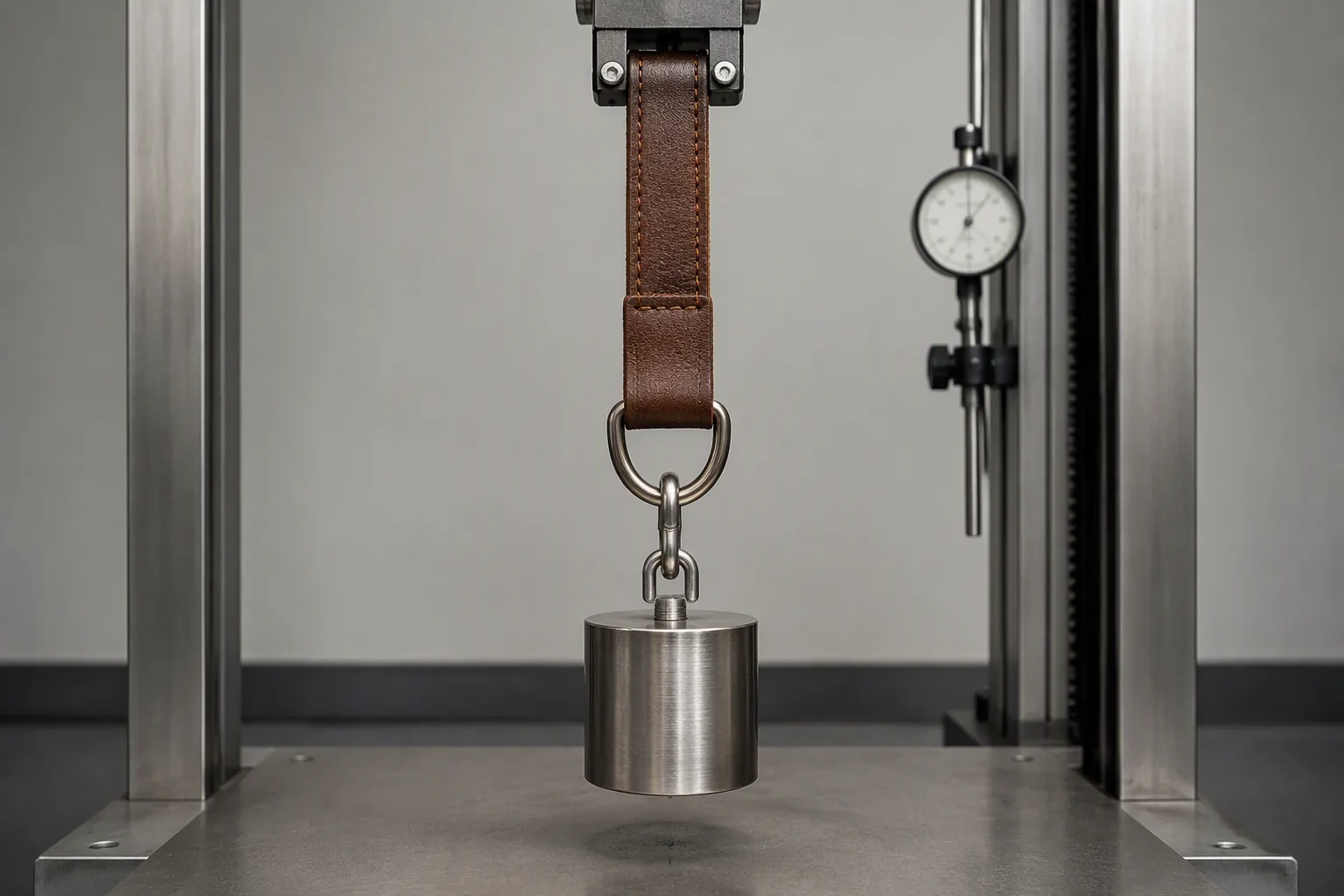
Pull testing answers the only question that matters: what load breaks it.
Fittings and their attachments should be tested in the assembled state, because a ring that survives alone may fail once the leather loop stretches. Testing to a defined multiple of the expected working load — rather than to the point of destruction only — produces comparable data order to order.
Cycle Testing
Cycle testing simulates months of use in hours.
Opening and closing a snap hook, operating a zipper, or flexing a buckle repeatedly reveals spring fatigue, wear at contact points, and loosening at pivots. Products used many times daily, such as diaper bags and commuter backpacks, benefit most from cycling data.
Corrosion Testing
Corrosion testing matters most for humid and coastal markets.
Salt spray testing is the standard approach and produces a defined number of hours before visible corrosion. It is a comparative measure rather than a life prediction, but it separates fittings that will survive a rainy season from those that will spot within weeks.
Abrasion Against Leather
Hardware damages leather as well as itself.
Sharp cast edges, burrs, and rough plating act as abrasives against the leather loop holding them, and the damage usually appears after the bag has been carried for a while. Polished edges, rounded radii and correct surface finishing are the prevention.
Hardware and Leather Interaction
Hardware and leather affect each other continuously, and both directions matter.
Weight Balance
Hardware weight must match the bag’s structure and material.
Oversized metal on soft leather drags the bag out of shape and pulls at stress points. Very light hardware on a heavy structured bag feels toy-like. The balance point is where the hardware feels solid in the hand without deforming light leather.
Tarnish Transfer and Staining
Metal and leather can stain each other.
Plated parts can transfer oxides to the leather around them, especially in humid conditions, producing dark marks that are difficult to remove. Contact between dissimilar metals in a damp environment can also accelerate corrosion on one of them. Protective lacquer, correct wrapping in storage, and avoiding leather-metal contact in transit all reduce the problem.
Reinforcement Behind the Hardware
Every fitting needs something behind it.
Reinforcement panels, extra layers of leather, or a structural plate distribute load from a small metal part into the surrounding material. A well-designed reinforcement is invisible from outside and is the difference between a strap that lasts and one that tears out.
Edges, Radii and Sharp Corners
Small geometry decisions create large wear problems.
Sharp internal corners on a ring or buckle concentrate stress on the leather loop, while generous radii spread it. In our own hardware reviews, rounding an internal edge is often a more effective durability improvement than increasing metal thickness.
Common Failures and Their Real Causes
Failure analysis is mostly pattern recognition, and the patterns repeat.
Plating Wear That Appears Too Early
Early plating wear is nearly always a specification problem rather than a use problem.
When plating wears through within months on a part that only touches hands and fabric, the plating was too thin, the wrong process was used for the wear pattern, or the finish was specified as a bright mirror polish with no hardness behind it. The fix belongs in the specification, not in customer care advice.
Cracking at Cast Edges
Cracks at thin cast sections point to the base metal choice.
Zinc alloy castings crack where walls are thin and load is high, particularly on rings and hooks that see lateral force. The permanent fix is to move the load-bearing part to a stronger base metal, or to redesign the section thickness and radius, rather than to keep replacing failed units.
Spring and Pivot Failures
Moving parts fail from fatigue, which is a function of design and material.
A hook spring that weakens after repeated cycling, or a lever that loosens at its pivot, indicates insufficient spring material quality or a design that allows too much play. Cycle testing before production is the cheapest way to discover this.
Deformation Under Load
Permanent bending means the fitting was undersized for the application.
This failure is common on lightweight fashion hardware used on bags that are genuinely loaded — a snack-laden diaper bag, a commuter bag with a laptop, a travel bag at an airport. Matching the fitting’s tested capacity to the realistic maximum load of the bag prevents it.
Corrosion in Humid Conditions
Corrosion is an environment problem solved by material choice.
Markets with high humidity, coastal air, or heavy seasonal rain make corrosion the dominant failure mode. In those markets, stainless steel and thick, hard coatings outperform thin decorative plating regardless of how good the plating looks at delivery.
Color Mismatch Across a Set
Mismatched tone is a supply-chain problem, not a plating problem.
It occurs when the ring, buckle, rivet and zipper pull come from different batches or suppliers with slightly different finish references. Fixing it means treating the hardware set as one purchased unit with one finish reference, controlled by a physical approved sample.
Specifying Hardware Correctly
A good hardware specification is short, specific and testable.
The Fields That Must Be Specified
Every hardware item should be specified on properties rather than appearance.
| Field | Why it matters |
|---|---|
| Base metal | Determines strength, weight and corrosion behavior |
| Finish process and color reference | Determines appearance and how wear shows |
| Plating or coating thickness | Directly controls time to visible wear |
| Tested load capacity | Prevents deformation and pull-out failures |
| Dimensions and tolerances | Controls fit, leather loop size and assembly |
| Edge finishing | Prevents abrasion damage to the leather |
| Corrosion performance | Sets the humidity and coastal suitability |
| Approved physical sample | Removes ambiguity between words and product |
Avoiding Ambiguous Descriptions
Words like “premium”, “heavy duty” and “antique gold” specify nothing testable.
A specification should allow a supplier to be measured against it: a named base metal, a coating process, a thickness, a load figure and an approved sample. When a description cannot be tested, the outcome is decided by whoever supplies the part.
Controlling Substitutions
Substitutions are the main way good specifications fail in practice.
Suppliers may substitute a lighter casting, a thinner plating or a different spring to hold a price. Control means requiring written approval for any change, verifying incoming lots against the approved sample, and re-testing when a batch changes. Documentation of an approved sample is the anchor for all of it.
Cost and Value of Hardware Choices
Hardware is a small cost line with an outsized effect.
Where the Money Goes
The cost difference between adequate and excellent hardware is often modest in absolute terms.
Upgrading a load-bearing ring from zinc alloy to solid brass or stainless steel changes unit cost by a small amount, while materially changing durability and perceived quality. Because hardware is a small share of total bag cost, these upgrades usually deliver more perceived value per unit of cost than almost any other change.
When Cheap Hardware Is the Right Choice
Cheap hardware is appropriate when it is chosen honestly for a light-duty product.
A cosmetic bag that holds tissues does not need a scale-rated ring. The engineering error is not using inexpensive hardware; it is using it where load, cycles or humidity will exceed what it can survive, and describing the product as if it were more robust than it is.
Value Perceived by Customers
Customers perceive hardware value through feel, sound and movement.
A solid buckle clicks decisively, a heavy ring feels reassuring, and a smooth zipper implies care in manufacturing. These are real signals, and they are the reason premium brands often invest in hardware well beyond its structural requirement.
Quality Control for Hardware
Hardware quality is controlled at three points: incoming, in-line, and final.
Incoming Inspection
Incoming inspection catches problems before they enter production.
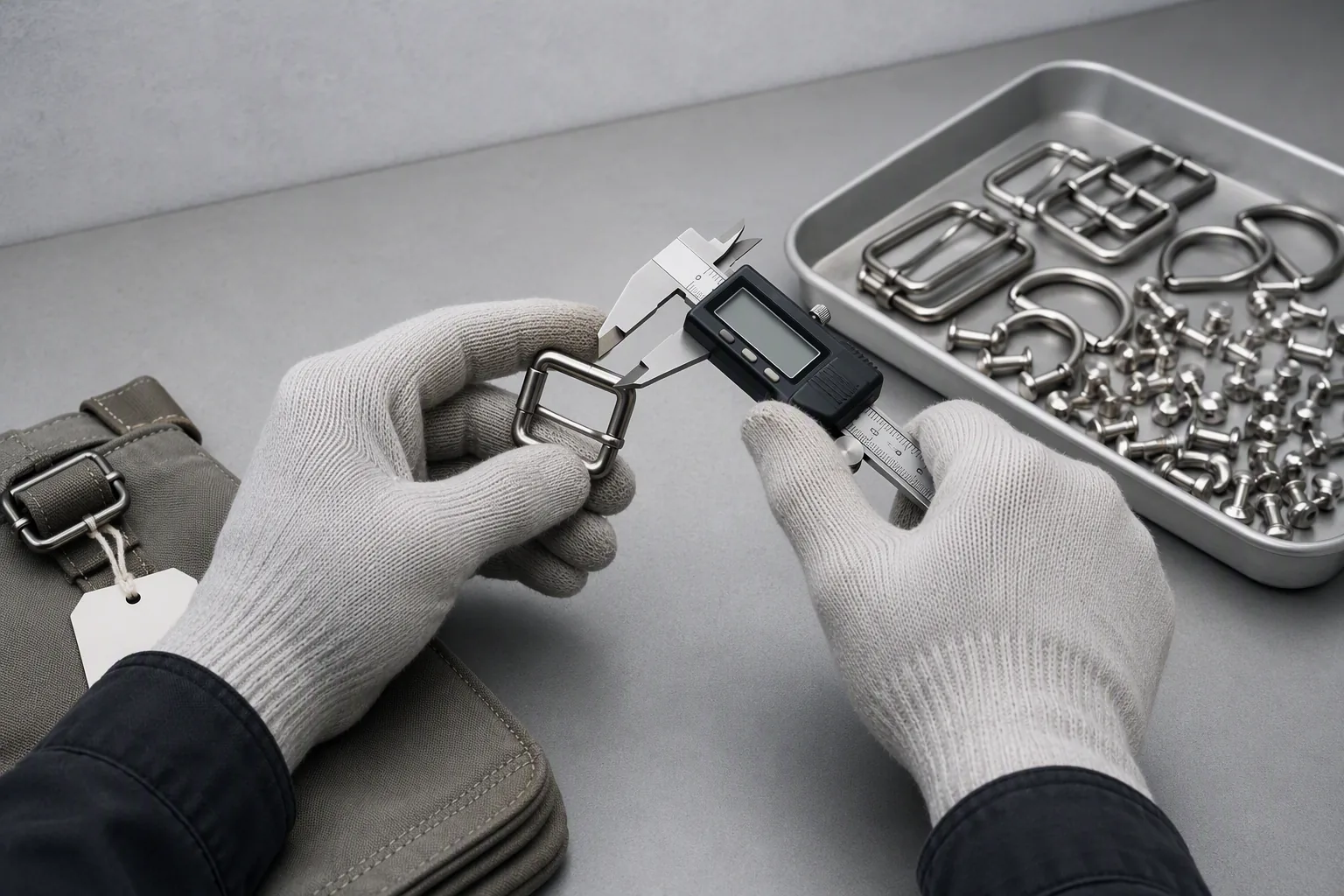
Checking base metal and finish against the approved sample, measuring plating-relevant dimensions, confirming load ratings from the supplier, and testing a sample lot for corrosion are all practical steps. Rejecting a bad lot at this stage costs a delay; discovering it in finished goods costs a shipment.
In-Line Checks
In-line checks catch assembly problems, which are the most common.
Rivets set with insufficient force, screws without locking, fittings attached without reinforcement, and leather loops sized too large for the ring are all assembly failures. A short checklist at each hardware station prevents most of them.
Final Inspection and Testing
Final inspection should include function, not just appearance.
The practical checks are:
- Operate every zipper through its full length
- Open and close every buckle, hook and clasp
- Confirm the hardware set matches in tone
- Check that fittings are secure with a firm hand pull
- Verify no sharp edges or burrs contact the leather
- Confirm reinforcement is present behind load-bearing fittings
Documenting Hardware Standards
Hardware standards should live with the golden sample.
A retained approved hardware set, with its specification sheet and test results, makes future orders reproducible and turns hardware disputes into comparisons instead of arguments. When a supplier or component changes, the physical reference is what allows a fair re-evaluation.
Maintenance and Advice for Customers
A little guidance extends hardware life considerably.
Everyday Care
Simple habits protect metal fittings.
- Wipe hardware with a soft dry cloth after exposure to rain or sweat
- Avoid leaving bags in humid environments for long periods
- Keep metal away from prolonged contact with moisture-retaining materials
- Do not use abrasive polishes on plated parts, which accelerate wear
Why Some Wear Is Normal
Plating wear at contact points is normal on plated hardware.
Explaining this honestly at the point of sale prevents it from being perceived as a defect. What is not normal is plating failure in weeks, cracking, spring collapse, or corrosion in dry conditions — those are manufacturing issues, and they should be treated as such rather than as customer misuse.
Hardware Sourcing and Lead Times
Hardware is sourced on its own schedule, and it often gates production.
Where Hardware Comes From
Bag hardware usually comes from specialist hardware factories rather than the bag factory itself.
Those suppliers may hold stock moulds for common buckles and rings, or produce custom moulds for a specific design. Stock items are fast and economical; custom items allow a distinctive look but bring tooling cost and minimum order quantities. Deciding early which parts can be stock and which must be custom is a schedule decision as much as a design one.
Lead Times and Minimum Order Quantities
Hardware lead times are frequently longer than leather lead times.
Custom moulds need design, sampling, mould making and plating before bulk production, and plating is often the slowest step because finishes are applied in batches. Minimum order quantities apply per finish, so adding a second colorway can double the order rather than split it. Development schedules that treat hardware as an afterthought slip most often at this stage.
Sample Plating Versus Production Plating
Sample hardware and production hardware rarely come from the same plating run.
Samples are often plated quickly in small batches, while production runs in larger batches with slightly different results. This is why an approved hardware sample should be retained and compared against the first production delivery, and why tone checks belong in incoming inspection rather than only at final packing.
Qualifying a Hardware Supplier
Hardware suppliers should be evaluated on capability, not just price.
The useful questions are whether they control their own plating, what thickness they achieve and how they verify it, whether they test load and corrosion performance, and whether they can hold an approved finish reference across repeat orders. A supplier who cannot answer those questions cannot be held to a specification.
Repair, Replacement and Long-Term Service
Hardware is the most repairable part of a leather bag, which is a real advantage.
Designing for Repair
Repairability is a design decision made long before a bag fails.
Screwed fittings can be replaced by a repair technician, while riveted fittings generally cannot without damaging the leather. Leather loops sized to standard ring dimensions, and zippers that can be replaced by opening one seam, turn a write-off into a repair. Brands that value longevity design hardware for serviceability.
Spare Parts Strategy
Spare parts are cheap insurance against returns.
Holding a small stock of the fittings used on current styles allows a repair rather than a replacement when a single component fails. For long-lived designs, keeping the hardware set available for several years is a genuine customer-service benefit and a differentiator in premium segments.
Warranty Handling
Clear hardware warranty terms prevent disputes.
Plating wear at contact points, spring fatigue after long use, and cosmetic patina are normal. Cracking, spring collapse within a short period, corrosion in dry conditions and premature plating failure are defects. Defining where that line sits, and documenting it for customer service, makes claims consistent and fair.
What Repair Data Tells You
Repair records are the best field data a factory can have.
Tracking which components fail, on which styles, in which markets, turns anecdotal complaints into a list of specification improvements. A repeated zipper failure on one style or a repeated plating complaint from one humid market is specific, actionable information — and the cheapest possible route to better hardware.
What is the best metal for bag hardware?
It depends on the application. Solid brass and stainless steel offer the best combination of strength and long-term appearance for load-bearing parts. Zinc alloy is appropriate for decorative and light-duty fittings where complex shapes and lower cost matter more than load capacity.
Why does bag hardware plating wear off so quickly?
Usually because the plating is too thin for the wear it receives, or the wrong coating process was chosen for a high-contact part. Thicker plating and harder coating processes extend wear life significantly, and the plating thickness should be stated in the specification.
How do I test bag hardware strength before production?
Test the assembled connection — the fitting plus the leather loop and stitching — rather than the metal part alone. Apply a defined multiple of the expected working load, record the results, and repeat the test for each production batch to keep results comparable.
What causes hardware to break on a leather bag?
Most breakages happen at the attachment point rather than at the metal itself. Leather stretching, insufficient reinforcement, poor rivet setting, and undersized fittings are the usual causes. Cracking, spring fatigue, and plating failure account for most of the rest.
Is solid brass hardware better than plated zinc alloy?
For load-bearing parts, generally yes. Solid brass is stronger, does not rely on plating for appearance, and wears gracefully by developing a patina rather than peeling. Zinc alloy remains a reasonable choice for light-duty and decorative fittings.
Which hardware suits humid or coastal markets?
Stainless steel and thick, hard coatings perform best in high-humidity and coastal environments. Thin decorative plating on a corrodible base metal is the worst choice there, because corrosion appears quickly and cannot be hidden by surface treatments.
Do bag hardware sets need to match exactly?
Yes for tone consistency. Rings, buckles, rivets and zipper pulls usually come from different batches, so tone differences are common. Specifying the set against one approved physical finish reference prevents visible mismatches on the finished bag.
Why do zippers fail before the teeth wear out?
Because the tape, slider and pull fail first. Tape tear-out at the top stop, a worn slider body, and a broken pull connection are far more common than worn teeth. Zipper specification should therefore cover tape strength and stitching as well as the teeth.
How do I prevent hardware from damaging the leather?
Ensure internal edges and radii are rounded and polished, avoid burrs and rough plating, and add reinforcement behind the fitting. Sharp cast edges act as abrasives against the leather loop even when the fitting itself is strong.
Should screws or rivets be used for bag hardware?
Rivets are simpler and tamper-resistant, and they need the correct grip length for the material stack. Screws allow replacement and repair but can loosen with movement unless thread locking is used. The choice depends on whether the product is designed to be repairable.
How much should hardware cost in a leather bag?
Hardware is typically a small share of total bag cost, even at good quality levels. Because it drives perceived quality and failure rates so strongly, upgrading load-bearing fittings is usually one of the most cost-effective improvements available in a bag design.
The Bottom Line
Hardware is small, cheap relative to the bag, and disproportionately responsible for how a bag is judged and how long it lasts.
Choose the base metal by load, cycles and climate rather than by appearance. Specify plating thickness, tested capacity, edge finishing and corrosion performance instead of descriptive words. Test the assembled attachment, not just the fitting. Control substitutions with an approved physical sample, inspect what arrives, and check every closure on the finished bag.
Do that, and hardware stops being the part that fails first. It becomes what a customer notices when they pick the bag up — solid, quiet, and correct.
