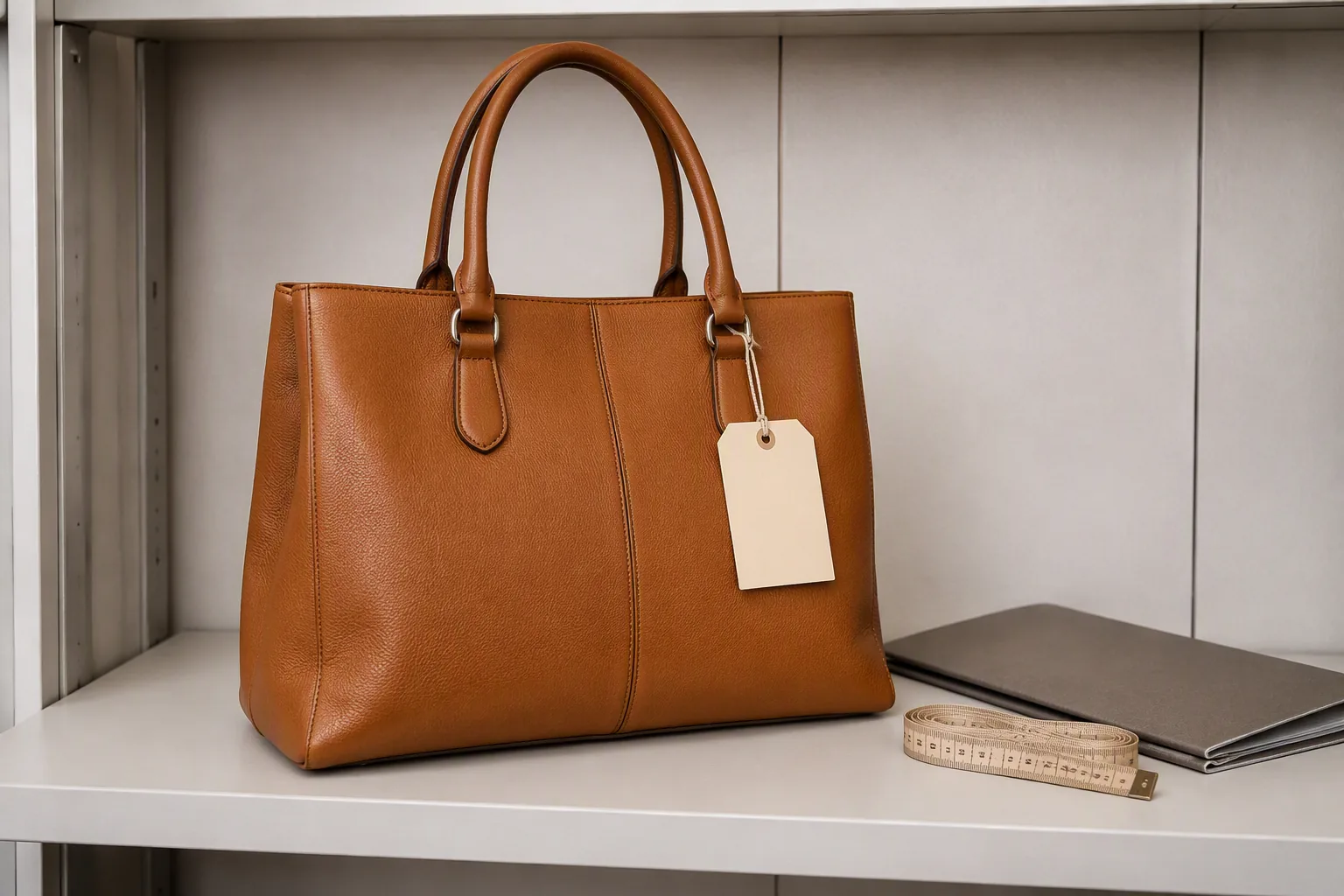
How Leather Bag Samples Are Made: A Development Guide
How Leather Bag Samples Are Made: A Development Guide
Every production bag begins life as a sample, and most production problems can be traced back to a sampling stage that was rushed. Sampling is where a drawing becomes a physical object, where assumptions about leather meet the reality of thickness and stretch, and where the cost of the product is finally known.
As a bag manufacturer, we build samples weekly. This guide walks through the development process from brief to approved sample — what happens at each round, what it costs, and what separates a smooth development from an expensive one.
- Why Sampling Decides Everything
- The Development Timeline
- Starting Point: The Brief and Tech Pack
- Pattern Making and Prototype Construction
- Material Selection and Sourcing for Samples
- Sample Rounds: Proto, Sizes, Pre-Production
- Testing the Sample
- Sample Cost, Tooling and Ownership
- The Golden Sample and Approval
- From Sample to Production
- Sampling Priorities by Bag Type
- Common Sampling Failures
- Working Well With a Factory During Development
- Development Deliverables Reference
- Frequently Asked Questions
- The Bottom Line
Why Sampling Decides Everything
Sampling is not a formality before production; it is the stage where the product is actually designed.
A Drawing Is Not a Product
A design drawing specifies appearance, not behavior.
It shows what a bag looks like but not how the leather behaves at a tight curve, how the handle sits when loaded, whether the base holds its shape, or how the lining sits when the bag is opened. Those are physical properties, and they are discovered only by making the bag.
What Sampling Resolves
Each sample round answers a specific set of questions.
- Proportion and scale — does the silhouette read as intended at real size
- Material behavior — how this leather, thickness and finish behave in this construction
- Structure — whether the bag stands, holds, and returns to shape
- Construction sequence — the order of assembly that produces the cleanest result
- Cost reality — actual material consumption and labor minutes
- Wear behavior — how the bag looks after being carried and loaded
The Cost of Skipping Rounds
Skipping development rounds moves cost into production, where it multiplies.
A change made at the sample stage costs a sample. The same change made after cutting production leather costs material already cut, labor already spent, and often a delayed shipment. Factories and brands that argue about sample budgets are usually arguing about the cheapest place to solve a problem.
The Development Timeline
Development has a predictable shape, and knowing it prevents unrealistic schedules.
Stages at a Glance
A typical leather bag development moves through the stages below.
- Brief and specification assembly
- Pattern making and mock-up
- First prototype
- Review and revision rounds
- Pre-production sample in production-intent materials
- Wear and load testing
- Golden sample approval
- Pilot run and production
Who Is Involved
Development is a multi-party process, and each party owns different decisions.
The brand owns the commercial intent: positioning, price target, and features. The designer owns appearance. The factory’s sample maker and pattern technician own construction, and the merchandiser owns timing, cost, and material sourcing. Most delays trace to unclear ownership rather than slow work.
Typical Durations
Timelines vary with complexity, but the structure is stable.
Simple styles with known materials can reach an approved sample in a few weeks. Styles with new hardware, new construction, or custom tooling take longer, and international sample shipping adds days per round. Planning for three rounds is realistic; planning for one is optimistic.
Development Stage Reference
| Stage | Main output | Typical dependency |
|---|---|---|
| Brief and spec | Written requirement set | Brand decisions and target price |
| Pattern and mock-up | Paper or mock-up model | Design approval |
| First prototype | Physical bag in sample materials | Pattern completion |
| Revision rounds | Adjusted prototypes | Feedback quality and speed |
| Pre-production sample | Bag in production-intent materials | Material confirmation |
| Testing | Wear, load and finish results | Sample availability |
| Golden sample | Signed reference unit | All approvals complete |
| Pilot run | Small production batch | Golden sample approval |
Starting Point: The Brief and Tech Pack
The quality of the brief determines the number of sample rounds.
What a Brief Must Contain
A useful brief describes the product in terms a factory can build from.
- Intended use, user, and price positioning
- Dimensions with tolerances rather than single figures
- Material direction: leather type, grade, thickness range, and finish
- Hardware specification by metal and finish, not appearance alone
- Structural intent: structured, semi-structured, or soft
- Capacity requirements: what the bag must hold in everyday use
- Weight target, if the product will be marketed on weight
- Target market and any compliance requirements
Tech Pack Essentials
A tech pack translates design into buildable instruction.
Construction drawings, panel dimensions, seam allowances, stitching specifications, hardware placement, lining structure, and edge finish method all belong in the pack. So do the reference points that are hard to describe in words: which panel overlaps which, where reinforcement sits, and how the handle is attached.
Reference Samples and Physical Targets
Physical references resolve disputes that drawings cannot.
A competitor bag or an earlier product can establish handle drop, opening stiffness, edge thickness, and hardware weight in a way that no dimension list achieves. When a brand provides a reference, we measure it rather than approximating from images.
Common Brief Gaps
Most development delays come from the same short list of omissions.
- Thickness specified as a word rather than an ounce range
- Hardware described by appearance with no metal named
- No tolerance on dimensions, so every measurement becomes a negotiation
- No priority stated among features, so trade-offs cannot be made
- No decision owner on the brand side, so feedback arrives slowly and changes
- No target weight, so structure creeps heavier through revisions
Pattern Making and Prototype Construction
Pattern making is the bridge between design intent and physical behavior.
From Design to Pattern Pieces
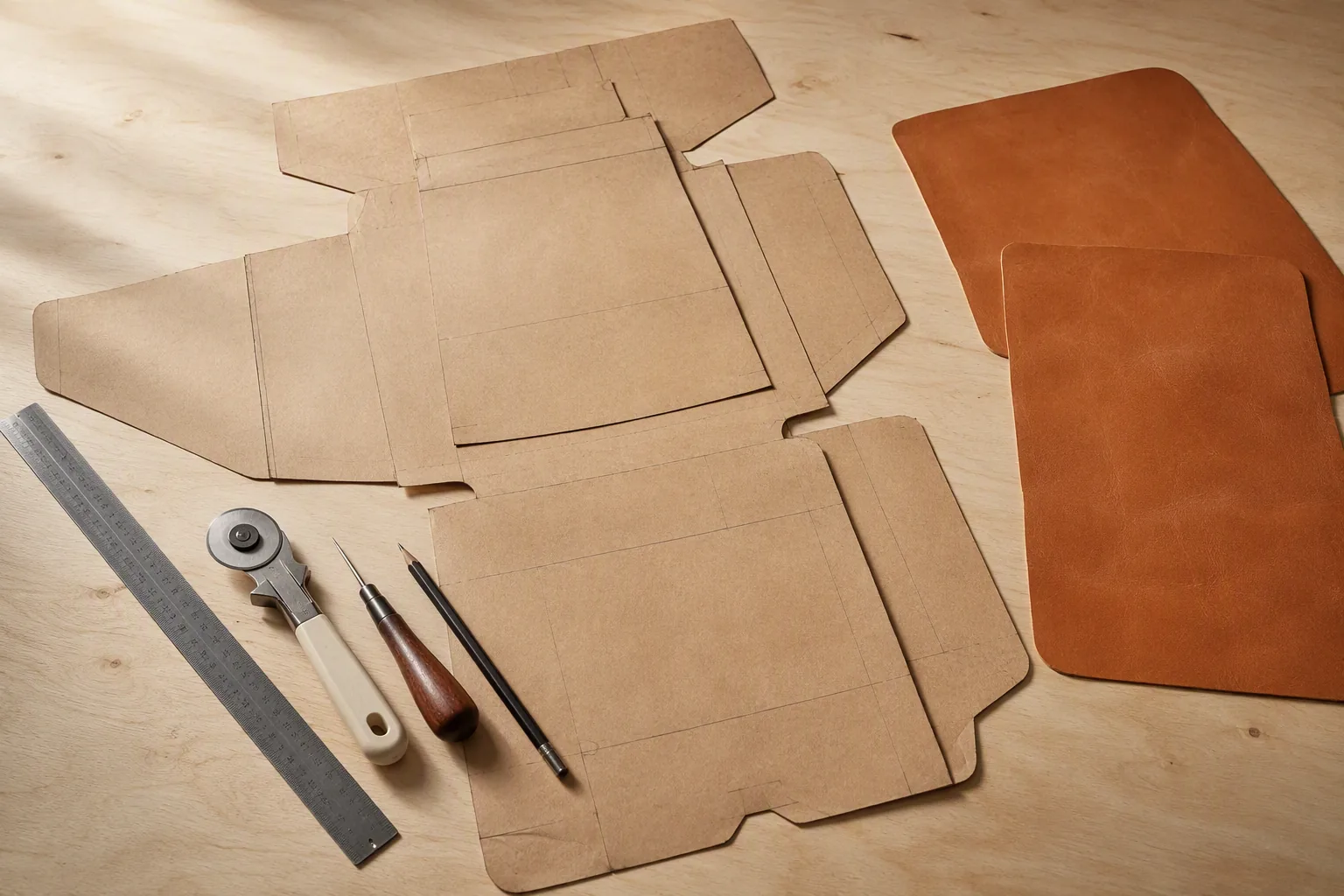
Patterns convert a 3D object into flat pieces that assemble into it.
The technician accounts for leather thickness, stretch direction, seam allowance, and the way the material behaves when folded and stitched. Two-dimensional drawings rarely translate cleanly; pattern making is where proportion errors surface, usually as a bag that looks right in a sketch and wrong in the hand.
Mock-Ups and Paper Trials
Cheap mock-ups prevent expensive samples.
Building a version in paper or inexpensive material confirms proportions, opening size, and handle placement before leather is cut. It is the least glamorous and most cost-effective step in development, and skipping it is a reliable way to spend leather on problems that paper would have caught.
The First Prototype
The first prototype is a construction test, not a finished product.
It is usually built in available sample leather rather than the final material, because the goal is to validate construction, proportion, and assembly sequence. Judging a first prototype on color or finish is a category error, and it generates the wrong feedback.
What We Learn From Proto One
The first prototype answers the questions that matter most for cost and quality.
- Whether the bag holds its intended shape when empty and loaded
- Whether the opening is usable in practice
- Where the leather wants to wrinkle, and whether that is acceptable
- Which operations take longer than estimated
- Whether hardware placement is comfortable and functional
- Whether the panel count can be reduced without losing the design
Material Selection and Sourcing for Samples
Samples use real leather, and sourcing it in small quantities is its own challenge.
Sourcing Leather in Small Quantities
Sample quantities are small, and tanneries sell by the hide or by the lot.
Factories generally draw samples from stock already held for other customers, request cut pieces from a tannery, or buy single hides locally. Each route has trade-offs: stock is fast but may not match the final specification, tannery cut pieces are specification-accurate but slow, and local purchases are fast but inconsistent batch to batch.
Why Sample Leather Rarely Matches Production
Sample material and production material often differ, and the reason matters.
Samples are frequently made in the closest available match so development can proceed while final material is confirmed. When production leather arrives, its hand, color depth, and thickness may differ enough to change how the bag behaves. This is why a pre-production sample in production-intent material is not optional for anything shipping at volume.
Hardware and Lining Sampling
Small components cause disproportionate delays.
Hardware may need to be sourced from a specialist supplier, plated in a specific finish, or produced as a custom mold, and each of those has its own minimum and lead time. Linings and reinforcement materials have similar issues. A development schedule that assumes hardware is available on demand is a schedule that will slip.
Substitution Rules and Disclosure
Substitutions are normal; undisclosed substitutions are not.
When a sample must use an alternative material, the difference should be recorded with the sample so that later comparisons are honest. A sample approved in one leather and produced in another is the single most common source of quality disputes, and it is entirely avoidable with documentation.
Sample Rounds: Proto, Sizes, Pre-Production
Development proceeds through a ladder of samples, each with a different purpose.
The Iteration Ladder
Each round should have a defined goal and a defined approval gate.
| Round | Purpose | Judged on | Do not judge on |
|---|---|---|---|
| Mock-up | Proportion and layout | Shape, opening, handle position | Material, finish |
| Proto 1 | Construction and assembly | Structure, sequence, usability | Color, hardware finish |
| Proto 2 | Refinement | Proportion changes, comfort, clean edges | Final material behavior |
| Size set | Grading accuracy | Each size holds proportion | Styling changes |
| Pre-production | Production-intent build | Materials, finish, tolerances, cost | New design ideas |
| Golden sample | Frozen reference | Everything, as signed | Nothing after approval |
What Changes Between Rounds
Productive rounds change a few things decisively rather than everything slightly.
Good development feedback names the specific issue, the direction of the fix, and the priority. Feedback that lists twenty impressions without priorities produces a bag that is better in twenty small ways and still wrong in proportion. Fewer, larger corrections reach an approvable product faster.
When to Stop Iterating
Iteration should stop when the product meets the brief, not when it becomes perfect.
Beyond a certain point, further rounds produce diminishing improvements while consuming schedule and sample budget. The practical test is whether the remaining issues are visible to customers or only to the development team. Issues in the second category can usually be recorded as known characteristics.
Cost of Extra Rounds
Every round costs material, labor, shipping, and time.
Sample material is expensive per unit because it is bought in small quantities, and each round adds shipping and review cycles. Two extra rounds on a small style can be affordable; on a complex style with custom hardware, the same two rounds can delay a season.
Testing the Sample
A sample that looks right still needs to be tested in use.
Fit and Wear Testing
Wear testing reveals what inspection cannot.
Carrying a loaded sample for days shows whether the handle digs, whether the bag swings awkwardly, whether the opening frustrates access, and where the leather begins to crease. Brands that wear-test early catch comfort problems before tooling and production commitments.
Load and Durability Testing
Load testing targets the weakest points, which are almost always the connections.
Handles, strap attachments, hardware anchors, and base seams carry the load, so those are where testing focuses. Observations should be recorded as failures rather than pass or fail, because a stretched attachment point that has not yet failed is still a finding.
Color and Consistency Checks
Color must be checked under the light where the product will be sold.
Leather shade shifts between daylight, retail lighting, and photography lighting. Reviewing samples under only one condition produces frequent mismatches in production. Comparing the sample against the approved reference under the same conditions, every round, keeps consistency measurable.
Field Trials and Care Testing
Longer trials answer the questions customers will ask.
A bag carried for weeks in real conditions shows how the finish ages, how edges wear, how hardware patinas, and how the lining behaves. If the product will be marketed on care claims, those claims should be tested rather than assumed.
Sample Cost, Tooling and Ownership
Development has real costs, and hiding them in unit price helps nobody.
Why Samples Are Charged
Sample charges cover real inputs, not profit.
Leather, hardware, skilled labor, machine time, and shipping are genuine costs, and sample makers are among the most skilled people in a factory. A supplier charging nothing for samples is either absorbing cost into production pricing or intending to recover it another way.
Tooling and Dies
Tooling is a one-time investment that is usually bought by the brand.
Cutting dies, embossing plates, logo molds, and printing plates are specific to a design. On low volumes, tooling cost per unit can exceed the material cost, which is why tooling-heavy designs need volume to make economic sense.
Who Owns Patterns and Tooling
Ownership should be agreed in writing before development starts, not after a dispute.
Best practice is that the brand owns designs, patterns, and tooling it has paid for, while the factory retains its own process knowledge and standard components. Whether patterns transfer to another factory is the most contested question in sourcing, and the answer should exist in the development agreement.
Sample Credits
Credits are a commercial arrangement, not a discount.
Many factories credit sample charges against the first production order once it reaches a defined quantity. This aligns both sides: the brand recovers development cost, and the factory secures the order it developed the product for.
The Golden Sample and Approval
The golden sample is the contract between design intent and production reality.
What a Golden Sample Is
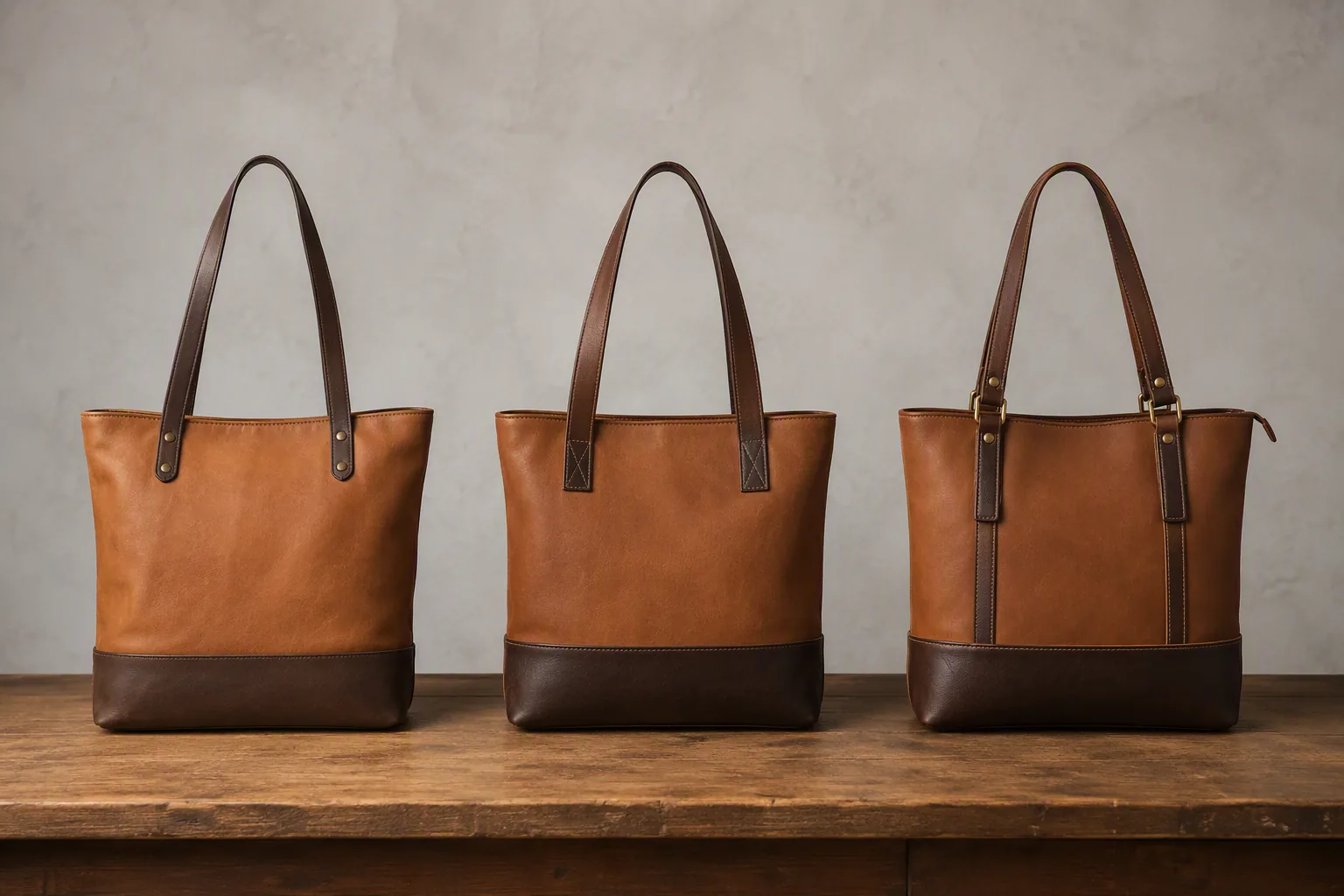
A golden sample is the frozen reference unit that production must match.
It is built in production-intent materials with production tooling and methods, then signed off by both sides. From that point, the golden sample is the definition of acceptable: color, hand, dimensions, hardware, stitching density, and edge finish are all judged against it rather than against a description.
Approval Documentation
Approval should produce a document, not a verbal agreement.
The record should include the sample identity, the approved specification, the tolerance ranges, reference photography, and the date and names of approvers. Verbal approvals are the origin of most “this is not what we agreed” conversations six weeks later.
Reference Photography and Conditions
Photographs are useful only if they are comparable.
Reference photos should be taken in consistent lighting with a color reference in frame, from a fixed set of angles, and stored with the sample number. Photographs taken casually under different lights create false disagreements rather than resolving them.
Changes After Approval
Changes after golden sample approval are possible, and they are production changes.
Any modification after approval invalidates the reference, so it requires a new sample and a new approval if it affects materials, dimensions, or construction. Treating post-approval changes as minor details is how a production run ends up matching neither the original specification nor the revised intent.
From Sample to Production
Approval closes development; production transfers the knowledge.
The Pilot Run
A pilot run validates the line, not the design.
It confirms that production teams can build the bag to the approved standard at the required rate, and it surfaces the tooling, sequencing, and training problems that sample makers quietly absorbed. Pilots are the cheapest place to discover that a design is harder to make at volume than it was to make once.
Scale-Up Variations
Small-scale and large-scale production do not behave identically.
Cutting changes from hand cutting to die or machine cutting, which can shift edge behavior. Assembly moves from one skilled maker to a line with several operators. Adhesives, fusing, and pressing run in different equipment. Each of these can introduce a variation that never appeared in sampling.
Line Setup and Training
Production quality depends on operators knowing what good looks like.
The golden sample should be present at the line, with clear photographs at each station and specific standards for stitching, edge finishing, and hardware setting. Training against a physical reference outperforms training against a written specification every time.
First-Order Inspection Intensity
The first production order deserves heavier inspection than later orders.
Inspection at a higher sampling rate during the first run catches systematic problems while they are still correctable, and produces the data to tighten tolerances for subsequent orders. Reducing first-order inspection to save time usually costs more in sorting and replacements.
Sampling Priorities by Bag Type
Different products fail in different ways, so sampling priorities shift with the bag type.
Diaper Bags and Family Bags
Family bags are judged on access, load, and stability under pressure.
Sampling should concentrate on the opening geometry, whether pockets remain usable when the bag is full, how the base behaves with heavy contents, and whether the bag stays upright when set down while loaded. These are the properties parents notice immediately and the ones most often assumed rather than tested.
Backpacks
Backpacks live or die on strap geometry and panel balance.
The sample stage should verify strap attachment strength, how the bag sits against the back when loaded, where the base contacts the ground, and whether the opening can be used while the bag is worn. Backpacks are also where load testing matters most, because the load is carried for longer periods than with other bag types.
Totes and Handbags
Tote development focuses on structure and handle behaviour.
Key questions are whether the bag stands when empty, how the opening holds its shape over time, whether handles remain comfortable under a realistic load, and whether the base needs reinforcement to prevent sagging. Small changes in structure produce large differences in how premium a tote feels.
Wallets and Small Goods
Small leather goods demand precision because every millimetre is visible.
Sampling should confirm folding behaviour at card and currency thicknesses, edge finishing quality on narrow components, and whether the construction stays flat when closed. In small goods, tolerance problems that would be invisible in a bag become obvious defects.
Common Sampling Failures
Development problems repeat in recognizable patterns.
Failure Modes and Fixes
| Failure | What it looks like | Practical fix |
|---|---|---|
| Vague brief | Endless revisions, no approval | Write dimensions, tolerances and materials before sampling |
| Undisclosed substitution | Production differs from approved sample | Document every material deviation on the sample itself |
| Over-iteration | Schedule slides, budget exhausted | Prioritise feedback; stop when customer-visible issues are solved |
| No pre-production sample | Material surprises at mass production | Require a production-intent sample before cutting |
| Verbal approval | Disputes about what was agreed | Signed approval sheet with photographs and tolerances |
| Missing tooling ownership | Conflict when changing suppliers | Agree ownership in writing at development start |
| Skipped pilot run | Line problems discovered in full production | Run a pilot batch at production method and rate |
Material Surprises
Most late-stage surprises are material surprises.
Thickness variation, hand difference, color depth, and finish behavior all change between sample lots and production lots. Committing production leather early, and approving a sample made from it, removes most of this risk.
Construction Surprises
Construction issues appear when a design meets manufacturing reality.
A design that is easy to sample by hand may be difficult to produce on a line, and a structure that works in a prototype may behave differently once interfacing and linings are applied at production standards. Pilots exist to find these before volume.
Communication Surprises
Communication failures cost more schedule than technical failures.
Feedback that arrives late, contradicts earlier feedback, or lacks a priority order forces rework. A single decision owner on the brand side with a predictable feedback window solves more development delay than any technical improvement.
Working Well With a Factory During Development
Development is a collaboration, and it rewards specific habits.
Honest Feedback Loops
Useful feedback is specific, prioritised, and consistent.
Naming the panel, the measurement, and the direction of the change produces actionable revisions. General impressions produce guesses. Factories respond well to clear priorities, because they allow the sample maker to solve the important problem instead of optimising everything at once.
Communication Cadence
A predictable rhythm beats constant contact.
Agreeing a review window per round — for example, feedback within a set number of days — lets the sample room plan work and keeps rounds from stalling. Ad hoc feedback that arrives in fragments is the most common cause of a development that technically started but never finished.
Documentation Habits
Documentation is what makes development repeatable.
Sample numbers, material references, approval sheets, and photographs create a record that survives staff changes and allows later orders to reproduce the approved product. Factories that document development well produce more consistent production, and brands that document well get fewer surprises.
Development Deliverables Reference
Development should produce a defined set of outputs, not just finished bags.
| Deliverable | Purpose | Owner |
|---|---|---|
| Approved specification sheet | Freezes materials, dimensions and tolerances | Brand and factory |
| Pattern set | Enables accurate reproduction | Factory, ownership per agreement |
| Golden sample | Physical reference for production | Brand approval |
| Reference photography | Comparable visual standard | Factory with brand approval |
| Tooling list | Records dies, molds and plates | Factory, ownership per agreement |
| Cost sheet | Confirms material consumption and labor | Factory |
| Pilot run report | Documents production readiness | Factory |
| Approval records | Resolves later disputes | Brand and factory |
Frequently Asked Questions
How long does it take to develop a leather bag sample?
Simple styles using known materials can reach an approved sample in a few weeks. Designs with new hardware, custom tooling, or unfamiliar construction take longer, and international sample shipping adds days per round. Planning for three rounds is realistic; planning for one usually leads to schedule pressure later.
How many sample rounds does a leather bag usually need?
Most products need a mock-up, one or two prototypes, and a pre-production sample in production-intent materials. Complex designs with grading across sizes or custom hardware can need more. Each round should resolve specific issues rather than reopen settled ones.
Why are samples charged separately from production?
Sample charges cover genuine costs: leather purchased in small quantities, skilled labor, machine time, and shipping. Factories typically credit sample charges against the first production order once it reaches an agreed quantity, which keeps development affordable for both sides.
What should a bag tech pack include?
Construction drawings, panel dimensions with tolerances, seam allowances, stitching specifications, hardware placement by metal and finish, lining and reinforcement details, edge finish method, and any compliance requirements. Measurement points and priorities should be explicit so trade-offs can be decided.
Why is the production bag sometimes different from the approved sample?
Usually because sample leather differed from production leather, or because a substitution was made without documentation. Materials, thickness, and finish can shift between lots, which is why a pre-production sample built in production-intent material is required before mass production.
What is a golden sample and why does it matter?
A golden sample is the approved reference unit built with production materials and methods. Production is judged against it for color, dimensions, hardware, stitching and edge finish. It removes ambiguity from inspection and makes quality measurable rather than subjective.
Who owns the patterns and tooling paid for during development?
This should be agreed in writing before development begins. Common practice is that the brand owns designs, patterns and tooling it has paid for, while the factory retains its process knowledge and standard components. Settling ownership upfront avoids disputes later.
Why do factories ask for a pilot run before mass production?
Because sampling proves a design works, while a pilot proves the production line can build it to standard at rate. Pilots expose tooling, sequencing and training issues that sample makers absorb quietly, and they are far cheaper to fix than problems discovered in full production.
How should feedback be given during sampling?
Specific, prioritised and in one consolidated pass per round. Name the panel, the measurement, and the direction of the change, and rank issues so the sample room solves the important ones first. Fragmented or contradictory feedback is the main cause of stalled development.
What testing should a sample go through before approval?
Wear testing with realistic loads, load testing at handles and attachment points, color comparison against the reference under consistent lighting, and field trials for finish and edge wear. If the product will carry care or durability claims, those claims should be tested rather than assumed.
Can a design change after the golden sample is approved?
Yes, but it becomes a production change. Any modification affecting materials, dimensions or construction invalidates the reference and requires a new sample and a new approval. Treating post-approval changes as minor details usually results in production matching neither the original nor the revised specification.
The Bottom Line
Sampling is where a bag is designed in reality, and where its cost becomes knowable.
A tight brief reduces rounds. Mock-ups catch proportion problems before leather is cut. Prototypes validate structure and assembly, not color. A pre-production sample in production-intent material removes the most common source of production divergence. Load and wear testing finds the failures that inspection cannot see. A signed golden sample makes quality measurable, and a pilot run proves the line before volume.
None of these steps is optional in a serious development programme, and every one of them is cheaper than the production problem it prevents. Do development properly once, and production becomes a matter of repetition rather than repair.