
How Does Tannery Water Use Affect Leather Bag Sourcing and Cost?
How Does Tannery Water Use Affect Leather Bag Sourcing and Cost?
A hide passes through more water than almost anyone outside the tannery imagines. Soaking, liming, bating, pickling, tanning, washing and finishing all happen in water, and the wet end of the process carries the largest share of a tannery’s water use.
That matters to a bag brand for two reasons. Water quality influences how the leather dyes, how evenly it tans and how well finishes adhere, so an upstream water decision can resurface months later as a complaint about colour, hand or coating. Water management also drives operating cost and compliance exposure, and both eventually appear in the price and the paperwork behind a leather order.
It is also easy to misread. A tannery that uses a large volume of water may simply be producing a large volume of leather. The useful figure is water per unit of output, not water in total.
Water is not a background utility in leather production. It is a process input that touches quality, cost and the records a tannery can produce.
- Why Water Belongs in a Sourcing Conversation
- What the Wet End Actually Is
- What Water Quality Does to Leather
- Two Process Routes and Their Water Profiles
- What Ends Up in the Wastewater
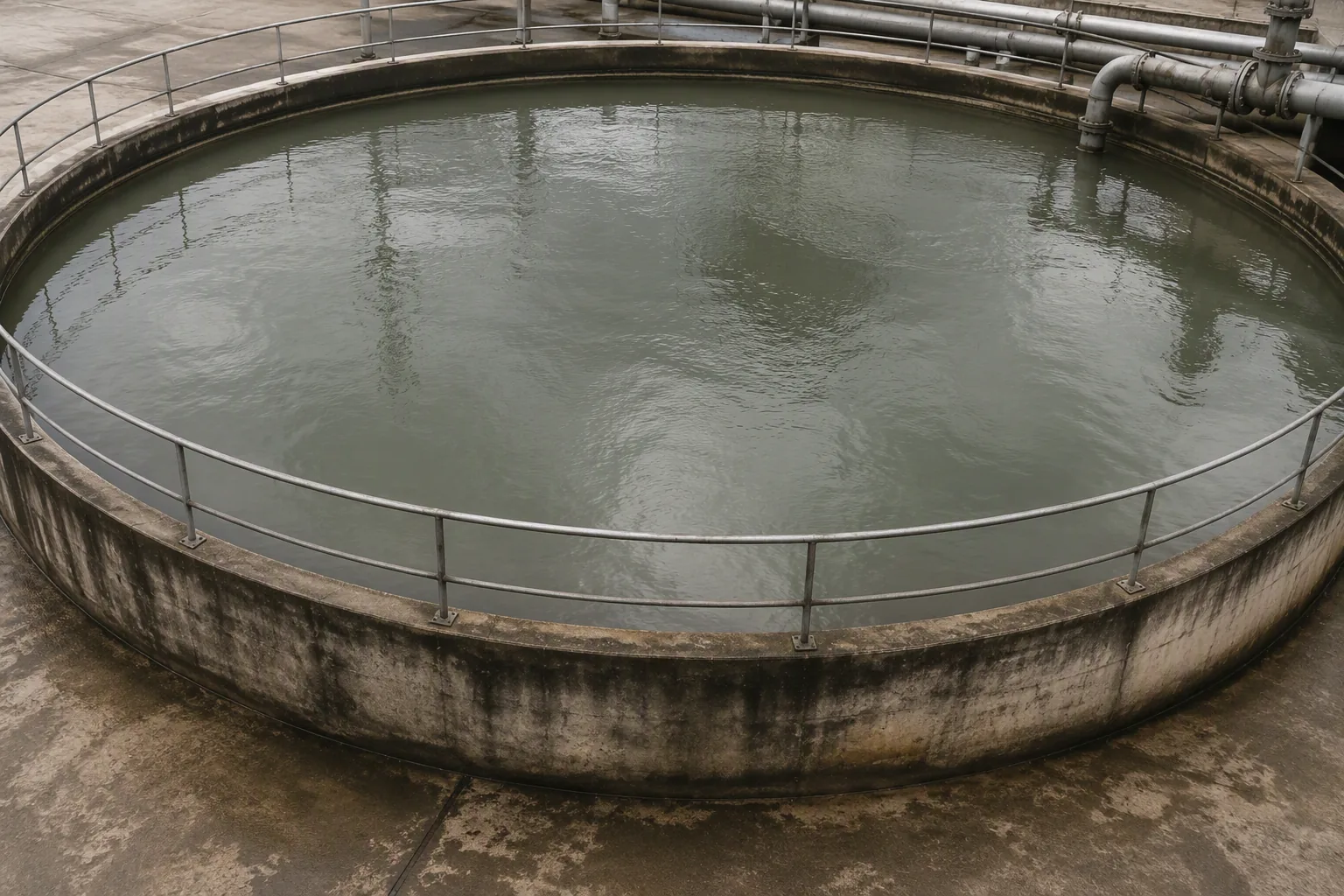
- How Treatment Works in Principle
- How Tanneries Reduce Water Use
- Reading Water Data Without Being Misled
- Where Local Water Context Matters
- What Records and Audits Can Show
- Questions Worth Asking a Tannery
- Turning Water Into a Sourcing Action
- Common Mistakes Brands Make
- Frequently Asked Questions
- The Bottom Line
Why Water Belongs in a Sourcing Conversation
Water is usually treated as a tannery’s private business. It is not.
Quality Follows Water
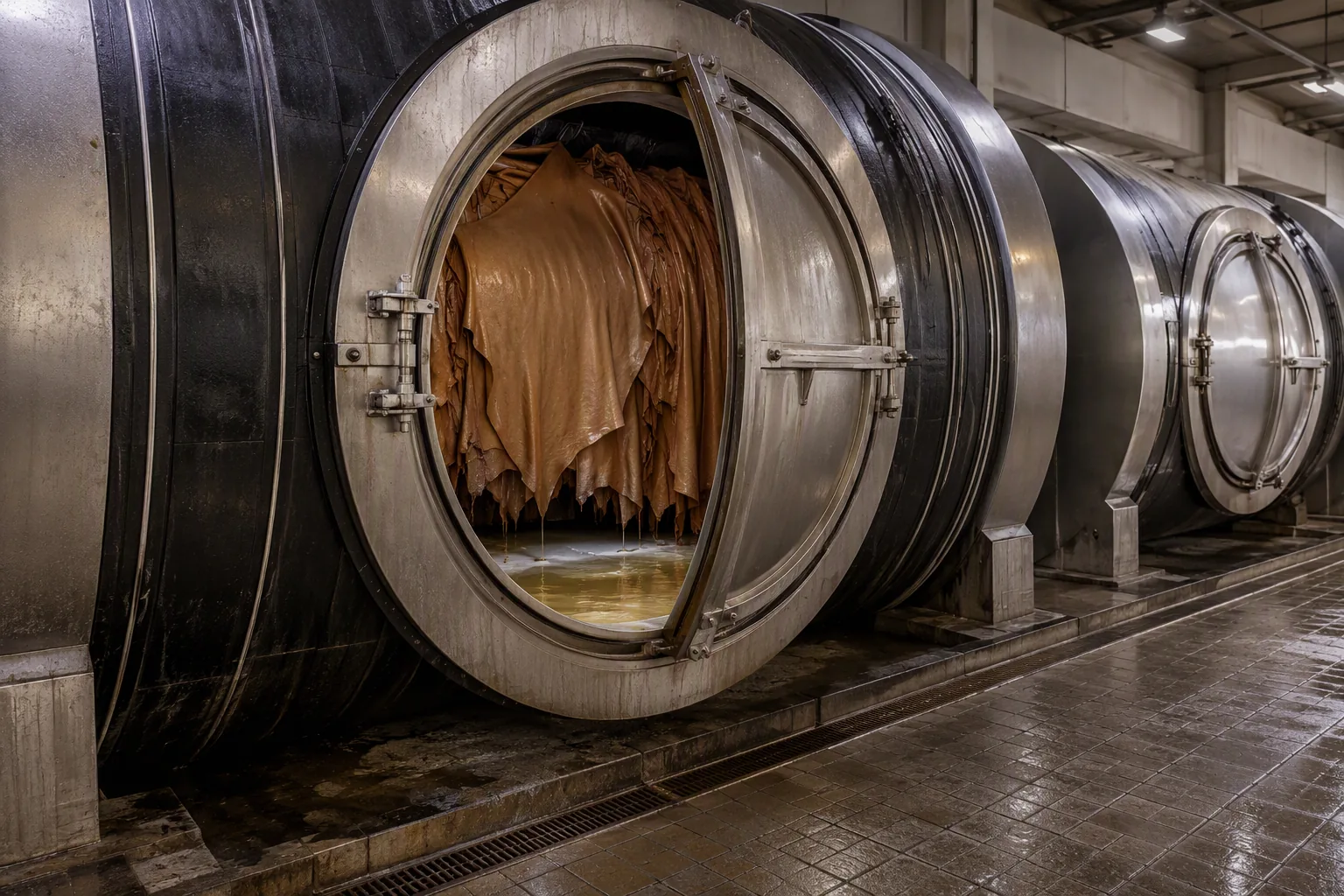
Leather is dyed, tanned and finished in water-based systems.
Where process water carries the wrong mineral profile, dye uptake becomes uneven, tannage can be less complete and finish adhesion can suffer. Those effects are quiet at the tannery and loud at the customer, which is why water control is a quality topic before it is an environmental one.
Cost Follows Water
Water has to be bought, heated, moved and treated.
Every additional step in intake, heating, pumping and effluent treatment carries cost, and a tannery recovering those costs has to price them into the leather. Water efficiency and cost efficiency are therefore the same project viewed from two directions.
Compliance Exposure Follows Water
Discharge is regulated in every tanning region.
Where effluent limits are tightened or local water availability declines, a tannery has to invest or reduce output, and both outcomes reach the brands it supplies. Knowing which tanneries sit in water-constrained areas is part of understanding supply risk.
Why It Rarely Appears in a Specification
The leather specification is silent about water.
Water use is normally invisible in a technical specification because it is one step removed from the article itself. It appears only when a buyer asks, which is why asking early is more useful than investigating after a problem.
What Water Cannot Tell You About Leather
Water data describes a process, not an article.
A tannery with excellent water management can still produce leather that fails a colour standard, and a tannery with modest published data can produce leather a brand is perfectly content with. Water is one input among several, so it should inform supplier assessment rather than replace testing of the leather itself.
What the Wet End Actually Is
Water use concentrates in a specific part of the tannery.
The Sequence of Water-Intensive Stages
- Soaking, to rehydrate preserved hides
- Liming and unhairing, where the largest volumes are used
- Deliming and bating, preparing the hide for tannage
- Pickling, adjusting the hide for tanning chemistry
- Tanning, in the drum
- Washing between stages
- Dyeing and fatliquoring later in the process
- Finishing, where water-based coatings may be applied
Where the Volume Sits
The beamhouse dominates.
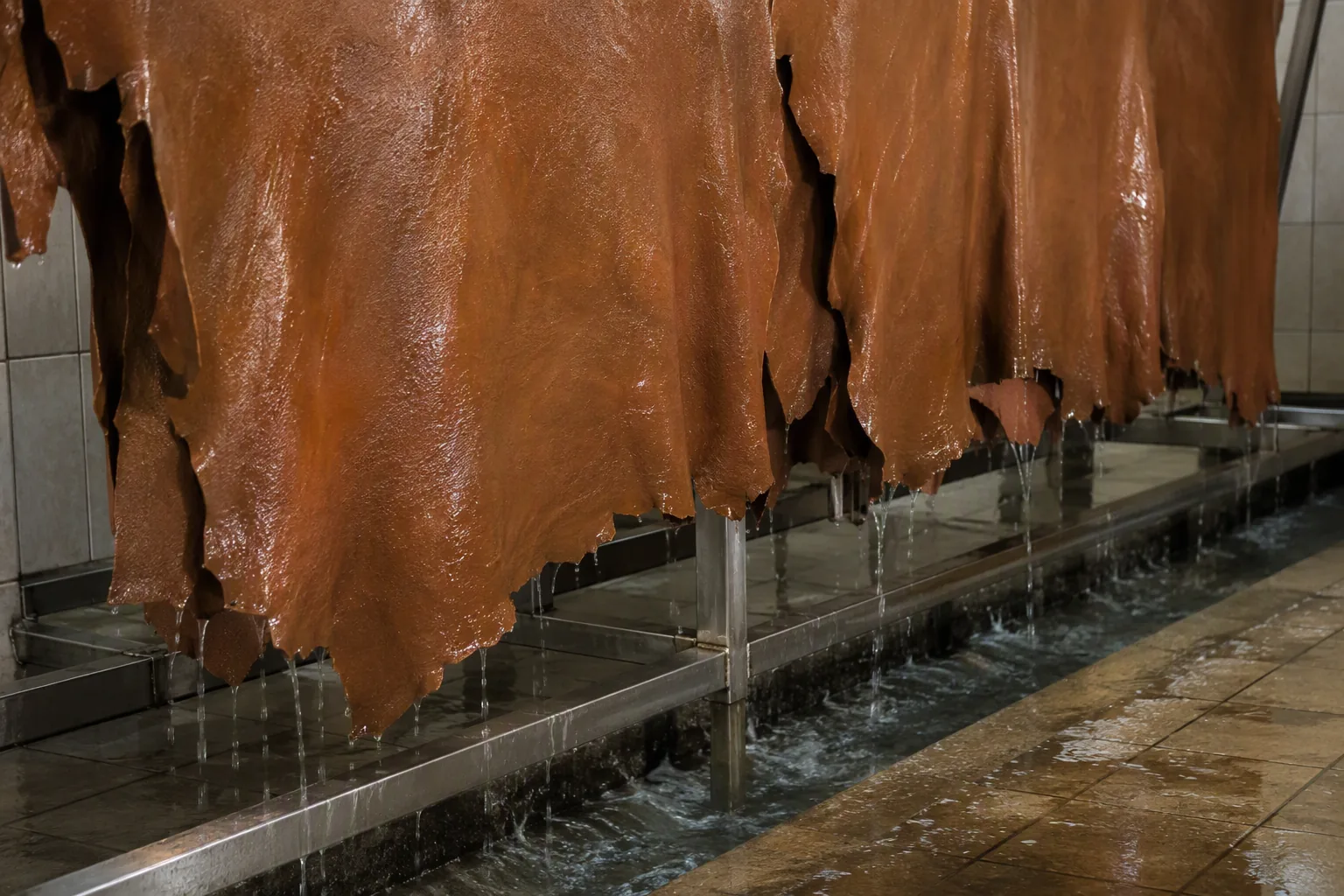
Soaking, liming, deliming and washing are the stages where the greatest volumes move through the process and where the strongest effluent load is generated. The tanning and finishing stages matter for chemistry and for the composition of the wastewater, but the heavy volume sits earlier.
Why the Stages Cannot Simply Be Skipped
Each stage prepares the next.
Water is not used as a solvent that could be replaced at will; it carries the chemistry that changes the hide at each step, and it removes what the previous step left behind. Reducing water without understanding the sequence risks leaving residues that interfere with tanning or finishing.
| Stage | Why water is used | What it leaves behind |
|---|---|---|
| Soaking | Rehydration and dirt removal | Salt, dirt, soluble proteins |
| Liming and unhairing | Swelling, hair and epidermis removal | Alkaline liquor, hair, lime sludge |
| Deliming and bating | Neutralising and softening | Ammonium salts, enzymes, organic load |
| Pickling | Acidifying before tannage | Salt, acid |
| Tanning | Carrying the tanning agent into the hide | Residual tanning chemistry |
| Washing | Removing residual process liquors | Dilute mixed liquor |
| Dyeing and fatliquoring | Colour and softness | Dye and oil residues |
| Finishing | Coating application and cleaning | Coating residues, cleaning water |
Why Volume Varies Between Tanneries
The same process, different numbers.
Two tanneries running comparable chemistry on comparable raw material will still differ in water use. The gap comes from equipment age, drum control, how often washes are repeated, whether soaking is done in stages and how carefully the line is operated. Volume alone therefore says less about intent than about equipment and habit.
Why Segregation Matters Upstream
Not every stream is the same.
Some streams carry a heavy organic or salt load, others carry tanning chemistry, and some are relatively clean wash water. Segregating streams at the source is what makes treatment and reuse possible; once streams are mixed, the cheapest treatment options usually disappear.
What Water Quality Does to Leather
Water is an ingredient, not just a medium.
Mineral Content and Dye Uptake
Hardness and dissolved minerals interfere.
Water carrying a high mineral load can react with dyes and auxiliaries, producing uneven shade, duller colour and inconsistent penetration. The effect is often visible as variation between lots rather than as an obvious defect in a single hide.
Iron and Discolouration
Small amounts of iron can mark leather.
Leather exposed to iron-bearing process water can develop staining and colour shifts, particularly on lighter and vegetable-tanned articles where a change in tone is easy to see. This is one reason tanneries monitor process water rather than only discharge.
pH Stability
Small shifts change outcomes.
Tanning and dyeing chemistry depends on staying within a controlled pH range, and water that pulls the process out of that range can leave a hide under-tanned or unevenly coloured. Stability matters more than any single reading.
Effects on Finish Adhesion
The coating has to bond.
Finishes adhere to a surface prepared in water-based systems. Where water quality varies, the preparation varies, and the coating can later show poor adhesion, cracking or patchy gloss. A finish failure at the customer is often a wet-end story.
| Water factor | Effect on leather | Where it shows up |
|---|---|---|
| High hardness | Interference with dyes and auxiliaries | Uneven shade between lots |
| Dissolved minerals | Reduced penetration and colour clarity | Dull, patchy colour |
| Iron content | Staining and tone shift | Visible marks on light articles |
| Unstable pH | Incomplete or uneven tannage | Soft or over-tight areas |
| Microbiological load | Odour and surface defects | Complaints after storage |
| Temperature variation | Slower or uneven reactions | Inconsistent hand and shade |
Matching Water Scrutiny to the Article
Not every article needs the same depth.
Where a leather carries a tight colour standard or a light, easily marked surface, water quality variation shows up quickly. Where it is dark and heavily finished, the same variation may never become visible to a customer. Matching the depth of water questioning to the sensitivity of the article keeps the effort proportionate to the risk.
Two Process Routes and Their Water Profiles
The tannage choice changes the water story as well as the leather.
Chrome Tanning and Water
Speed, temperature and salinity.
Chrome tanning is fast and works across a wide temperature range, which suits high-volume production, but it brings salt load and a chrome-bearing stream that has to be segregated and handled separately. The water profile of chrome tanning is dominated by salinity and by the need to keep that stream out of the general effluent.
Vegetable Tanning and Water
Longer, slower, different load.
Vegetable tanning takes longer and typically uses more process stages, and its effluent carries a heavy organic and tannin load rather than a metal-bearing stream. The volumes and the treatment challenges are different, but the dependency on water is not smaller.
Why the Route Affects Sourcing
Both have to be managed.
A brand choosing between routes is choosing between two water profiles, not between a clean option and a dirty one. The relevant question is whether the tannery in question manages its particular profile properly and can show records.
| Route | Water profile | Main treatment focus |
|---|---|---|
| Chrome tanning | High salinity, metal-bearing stream | Stream segregation and salinity control |
| Vegetable tanning | High organic and tannin load | Biological load reduction |
| Combination tannage | Mixed profile | Load balancing across streams |
| Wet-white alternatives | Reduced metal-bearing stream | Salinity and organic load |
Where the Brand Actually Sits
The brand’s leverage is upstream.
A bag factory uses very little water compared with a tannery. The brand’s ability to influence water outcomes sits almost entirely in supplier selection and in the questions asked at the point of tannery approval.
What Ends Up in the Wastewater
Understanding the load explains the treatment bill.
Organic Load
Flesh, hair, proteins and fats.
Beamhouse streams carry material removed from the hide itself, which produces a high organic load. This is what a biological treatment stage is primarily dealing with, and it is why the beamhouse stages dominate both volume and treatment cost.
Salts
A load that water alone will not remove.
Preservation salt, pickling salt and process chemistry leave a dissolved salt load that conventional treatment does not remove. Salinity is usually the hardest part of a tannery’s water problem, because it cannot be settled out or biologically consumed.
Metal-Bearing Streams
Segregation is the first control.
Where chromium is used, the chrome-bearing stream is normally separated, treated and, where the tannery is equipped, recovered. Recovery is a technical capability rather than a given, and it is one of the concrete questions worth asking.
Why Load Matters to the Brand
Effluent shapes what a tannery can accept.
A brand buys leather rather than effluent, but the load in a tannery’s wastewater determines what that tannery can take on in future orders. Where treatment capacity is the binding constraint, a tannery may turn down metal-bearing work, change its chemical programme or narrow the finishes it offers, and those decisions reach the articles a brand is able to order.
Residual Chemistry
Dyes, oils and coatings.
Dyeing, fatliquoring and finishing contribute smaller volumes but a chemistry that can be difficult to treat. Their presence is one reason mixed effluent is harder to manage than segregated streams.
How Treatment Works in Principle
Treatment is a sequence, not a single step.
Primary Treatment
Removing what will settle.
Primary treatment removes solids and gross material through screening, settling and, where used, chemical assistance. It reduces the load reaching later stages rather than producing a compliant discharge on its own.
Secondary Treatment
Removing what biology can consume.
Secondary treatment uses biological processes to break down the organic load. Its performance depends on the load arriving from primary treatment, which is why balancing stages matters more than optimising any single one.
Tertiary and Salinity Management
The difficult remainder.
Tertiary steps polish colour, solids and specific parameters, and salinity management may require separation or evaporation techniques that are capital-intensive. This is the part of the system where investment decisions are hardest and most consequential.
Sludge and Residues
Treatment produces its own waste.
Every stage that removes material creates a residue that has to be managed, which is why a tannery’s environmental performance cannot be judged by discharge quality alone.
How Tanneries Reduce Water Use
Efficiency comes from process control.
Low-Float and Drum Retrofit
Less water in the drum.
Running drums with less float, and retrofitting drums with better control of fill and drain, reduces consumption without changing the chemistry. It is usually the first place a tannery looks because the saving is immediate and the technical risk is low.
Counter-Current Washing
Clean water meets the cleanest stage.
Washing in a counter-current arrangement, so that the cleanest water meets the final stage and the dirtiest water meets the first, reduces total volume while maintaining rinsing performance.
Reuse and Recycling Loops
Reuse has limits.
Some streams can be reused within the process, and some can be recycled after treatment. Reuse is constrained by salinity build-up and by the risk of carrying contamination into a stage that needs clean water, which is why reuse is designed rather than improvised.
Process Discipline
The cheapest saving is control.
Avoiding overfills, stopping unnecessary rinses, fixing leaks and controlling temperature all reduce use without capital spending. Most of these depend on operators rather than equipment, which is why they need to be written into the way the tannery works.
Why Improvements Arrive in a Certain Order
Sequence reflects cost and risk.
Low-float processing needs no capital and carries little technical risk, so it tends to be done first. Reuse loops need treatment capacity and careful design, so they come later. Reading a tannery’s improvement plan in that order shows whether the plan is a programme with stages or a list of intentions.
Monitoring and Targets
What gets measured gets managed.
Metering per stage, tracking water per unit of output and setting reduction targets turn water from an unmeasured overhead into a managed input. A tannery that cannot report water per unit of output is not managing it, whatever its intentions.
| Reduction route | How it works | Main constraint |
|---|---|---|
| Low-float processing | Less water carried in the drum | Chemistry range limits |
| Drum retrofit | Controlled fill and drain | Capital cost |
| Counter-current washing | Cleaner water meets later stages | Layout of the line |
| Stream segregation | Keeps hard streams separate | Additional pipework |
| Treated-water reuse | Displaces fresh intake | Salinity build-up |
| Process discipline | Removes waste and overfills | Depends on operators |
| Stage-level metering | Makes use visible | Investment in monitoring |
Reading Water Data Without Being Misled
Numbers need a denominator.
Normalise Before Comparing
Per hide, per square metre, per kilogram.
Comparing two tanneries on total water use tells you which is bigger, not which is more efficient. The comparison only becomes meaningful when intake is related to output, and the same normalisation should be used for both parties.
Intake Versus Discharge
Two different measurements.
Intake measures what the tannery takes in. Discharge measures what leaves the site after treatment. The gap between them is what the process consumed, evaporated, or lost within the plant, and reading only one of the two can hide a problem.
Load Versus Volume
Clean water is not the same as low load.
A tannery can reduce water volume while concentrating its effluent, which raises the load per cubic metre and can make treatment harder. Volume targets should therefore be read together with load data rather than on their own.
Why One Good Year Proves Little
A trend needs more than a data point.
A single favourable year can reflect a wet season, an unusual production mix or a shutdown rather than a durable improvement. Water performance should be read across several years and alongside output, so that a genuine trend can be separated from a coincidence and a programme from a favourable set of circumstances.
Why Absolute Figures Are Hard to Verify
Verification needs the site.
Water data is difficult to verify from a distance because it depends on metering, on where meters sit, and on how output is counted. For anything material, the figures should be traceable to measurement at the site rather than to a summary in a report.
Where Local Water Context Matters
The same process in a different place is a different risk.
Water Availability
Scarcity changes the calculation.
A tannery operating where water is scarce faces a different set of constraints from one in a wet region, regardless of how efficient its process is. Local availability is a supply-risk input, not only an environmental one.
Regulation and Enforcement
Rules matter as much as text.
Two regions may have comparable standards on paper and very different enforcement, and investment follows enforcement. Knowing which regime a supplier operates under tells you how durable their environmental position is.
Community and Reputation Pressure
Local relationships affect continuity.
Where a tannery’s water use or discharge becomes a local issue, the consequence can be interruptions, licence conditions or reputational pressure that reaches the brands it supplies. This is a supplier-continuity question as much as a values question.
Planning for Tightening Limits
Discharge limits tend to move in one direction.
A tannery that can describe how it would respond to a tighter limit — which stage it would change, what investment it would need and how long that would take — is easier to plan around than one that has not considered the question. The answer also tells a brand how much of its supply is exposed to the change.
Why Geography Belongs in Supplier Approval
Location is a supplier attribute.
Because local water context shapes both risk and cost, it belongs alongside capacity, capability and price in supplier approval rather than in a separate sustainability file.
What Records and Audits Can Show
Evidence is the point of asking.
Audits Verify Practice
A recognised tannery audit scheme examines process control, chemical management, effluent handling and record keeping at the site and produces a report against a defined standard. The value lies in the fact that someone has looked at the line, not in the logo on the certificate.
Certificates Are a Starting Point
A certificate tells you an assessment happened.
A certificate confirms that an assessment took place at a point in time against a specific scope. It does not by itself tell you what the tannery’s water performance is today, and it should always be read together with the scope and the date.
Declarations Versus Measurements
Understand what a document covers.
A supplier declaration states something the supplier asserts, while a measurement records something observed. Both have a place, and a brand that understands the difference will ask for the right one when a claim matters.
Site Visits and What They Reveal
Some questions are answered by looking.
A visit shows where meters sit, whether segregation pipework is genuinely connected, whether treatment stages are running at the time and whether operators can explain their own process without referring to a file. Even a short visit separates a tannery managing water from one reporting it.
Traceability to the Lot
Records should connect to the order.
Where a water or chemical claim needs to be defended, it has to be linked to the material supplied rather than to the supplier in general. Lot-linked documentation is what makes a claim checkable after the leather has shipped.
Questions Worth Asking a Tannery
A short list does most of the work.
Water Use and Efficiency
- How is water use measured, and at which stages?
- What is the trend in water use per unit of output over the last few years?
- Which stages have been targeted, and what was the result?
Treatment and Discharge
- How are streams segregated, and which streams are kept separate?
- What treatment stages are in place, and who operates them?
- Is any treated water reused, and where?
Chemical Management
- How are tanning chemicals selected and controlled?
- Is the chrome-bearing stream treated, and is chromium recovered?
Records and Verification
- What can you provide per lot, and what only at site level?
- Which audits have been carried out, against which scope, and when?
- Who should a brand contact when it needs a specific figure?
Limitations and Honesty
- What are the current constraints on further reduction?
- Which improvements are planned, and which are not technically feasible yet?
| Question area | What a useful answer looks like | What to watch for |
|---|---|---|
| Measurement | Stage-level metering with a defined denominator | Totals with no output figure |
| Trend | Direction over several years | A single favourable year |
| Segregation | Named separate streams | A general claim of treatment |
| Treatment | Named stages and operator | “Fully treated” with no detail |
| Reuse | Named reuse points | Reuse claimed without constraints |
| Records | Lot-linked documentation | Only a company-level summary |
| Constraints | Acknowledged limits | No limits admitted |
Turning Water Into a Sourcing Action
The information only helps if it changes a decision.
Put Water in the Supplier Questionnaire
Start at the point of approval.
Water questions belong in the tannery approval questionnaire rather than in a separate sustainability exercise, so that the answers arrive with the same weight as capacity, lead time and price.
Ask for the Denominator
One question changes the conversation.
Asking for water use per unit of output separates tanneries that understand their process from those that only know their total intake. The answer, and the speed with which it arrives, is informative in itself.
Weight the Answers by Product
Not every article carries the same exposure.
An article with a demanding colour standard or a light, easily stained surface is more exposed to water quality variation than a dark, heavily finished one. Questions should be weighted accordingly.
Revisit at Reorder
A supplier’s position changes.
Water constraints, investment and local regulation all move over time, so water questions should be revisited when an order is repeated rather than being settled once at approval.
Work With What an Answer Cannot Cover
Accept the boundary.
Some water performance cannot be verified without a site visit, and some cannot be verified at all by a buyer. Deciding in advance which claims will be accepted, which will require documentation and which will be treated as unverified is what keeps a sourcing programme honest.
Common Mistakes Brands Make
| Mistake | Consequence | Prevention |
|---|---|---|
| Comparing tanneries on total water use | Bigger capacity looks inefficient | Normalise per unit of output |
| Reading volume without load | Efficiency gains mask harder effluent | Read the two together |
| Treating a certificate as current performance | Decisions rest on a stale assessment | Check scope and date |
| Accepting a company-level claim for a lot | The claim cannot be defended | Ask for lot-linked records |
| Ignoring where the tannery operates | Water risk is underestimated | Include location in approval |
| Leaving water out of specifications | Water quality issues appear as defects | Link water to appearance standards |
| Asking once at approval | A changed supplier goes unnoticed | Revisit at every reorder |
| Assuming one route is clean | The real question is management | Compare managed profiles |
Frequently Asked Questions
Why does tannery water use matter to a bag brand at all?
For two reasons. Water quality affects how leather dyes, tans and accepts finish, so upstream water problems can appear later as colour, hand or coating complaints. Water management also affects cost and compliance exposure, both of which feed into the price and reliability of leather supply.
Which part of a tannery uses the most water?
The beamhouse. Soaking, liming, deliming and bating, together with the washing between them, carry the largest volumes and generate the strongest effluent load. Tanning and finishing matter for chemistry and for what ends up in the wastewater, but the heavy volume sits earlier.
Can a tannery simply use less water?
Only within limits. Water carries the chemistry at each stage and removes what the previous stage left behind, so reducing it carelessly leaves residues that interfere with tanning or finishing. Practical reductions come from low-float processing, counter-current washing, reuse and process discipline rather than from cutting water at random.
Does vegetable tanning use less water than chrome tanning?
The profile is different rather than simply smaller. Vegetable tanning typically runs longer with more stages and produces a heavy organic and tannin load, while chrome tanning brings salinity and a metal-bearing stream that must be segregated. Both depend on water and both have to be managed.
What is the hardest thing to remove from tannery wastewater?
Salinity. Organic load can be reduced biologically and solids can be settled, but dissolved salt is not removed by those stages, so salinity management needs separation or evaporation techniques that are capital-intensive. It is usually the decisive constraint on further water improvement.
How should water use be compared between two tanneries?
Per unit of output — per hide, per square metre or per kilogram — never on totals. Total intake mostly reflects plant size. The same denominator must be used for both parties, and volume should be read together with effluent load.
Does a tannery certificate prove good water management?
It proves that an assessment happened at a point in time against a defined scope. It does not by itself describe current performance, so the scope and date should be checked and the certificate read alongside measurements and lot-linked records.
What records can a brand realistically obtain?
Stage-level metering and water use per unit of output are reasonable to request at approval. Lot-linked documentation becomes harder where a claim concerns the whole site rather than the material supplied. A supplier that distinguishes clearly between the two is easier to work with than one that does not.
Why does the tannery’s location matter?
Because local water availability, regulation and enforcement shape both cost and continuity. A tannery in a water-constrained area faces constraints that an efficient process does not remove, and tightening limits there can lead to investment, capacity reduction or interruption.
How much water does the bag factory itself use?
Very little compared with a tannery. Bag making consumes water mainly in cleaning and in some finishing operations, so a brand’s water leverage sits almost entirely upstream in supplier selection and in the questions asked at tannery approval.
What is the single most useful question to ask?
What is your water use per unit of output, and how is it measured? It is a question that a tannery managing water can answer quickly and specifically, and one that a tannery not managing it can only answer vaguely.
The Bottom Line
Water sits at the point where leather quality, operating cost and compliance exposure meet, which is why it deserves a place in sourcing rather than in a separate environmental file.
The practical position for a brand is straightforward. Ask for water use per unit of output and how it is measured. Ask how streams are segregated and what treatment stages exist. Ask what can be provided per lot and what only at site level. Ask where the tannery operates and what local water constraints apply. Then revisit those answers when the order repeats, because a supplier’s water position is a moving target rather than a fixed attribute.
For buyers, the value is not in holding a certificate but in understanding the process behind it. A tannery that can explain its wet end, name its constraints and produce figures with a denominator is managing water. One that answers only in generalities is not, and that difference will eventually show up in the leather a brand receives.
