
How Do You Prevent Mould on Leather Bags in Transit and Storage?
How Do You Prevent Mould on Leather Bags in Transit and Storage?
A leather bag can pass every inspection at the factory and still arrive with pale speckled patches on its surface. Nothing was wrong with the leather when it left, and nothing was wrong with the bag when it was packed. What changed was the moisture and temperature history of the journey.
Mould is one of the few defects that is created almost entirely by conditions rather than by materials. The leather is the same at both ends; the storage and transit environment is not. That is why prevention is a specification and packing problem rather than a cleaning problem.
This article deals specifically with mould. General storage and packaging practice is covered elsewhere on this site; here the focus is the conditions that allow growth, the points where they are created, and the controls a brand can write into an order.
Mould is rarely caused by a single failure. It appears where a marginal moisture level meets a warm period and a sealed package, and nobody was measuring either.
- Why Mould Is a Manufacturing Risk, Not a Housekeeping Problem
- What Mould Needs to Grow
- Where the Moisture Comes From
- Why Transit Is the Highest-Risk Stage
- Setting a Moisture Content Requirement
- Production Controls Before Packing
- Packaging as Moisture Control
- Detection: What to Look For at Inspection
- Responding When Mould Is Found
- Records, Claims and Traceability
- Shipping and Route Planning
- Storage After Delivery
- Working With Suppliers on Requirements
- A Pre-Packing Checklist
- Common Mistakes Brands Make
- Frequently Asked Questions
- The Bottom Line
Why Mould Is a Manufacturing Risk, Not a Housekeeping Problem
It is created upstream and discovered downstream.
Where the Risk Actually Begins
The conditions are set before packing.
Mould needs moisture, warmth, a nutrient source and time. Three of those four are decided in the factory and during packing, long before the goods reach a customer. Treating mould as a warehouse or retail problem misses where the risk is actually created.
Why It Shows Up After Delivery
Time is part of the recipe.
Growth needs time as well as conditions, and ocean transit supplies plenty of both. A bag packed at a marginal moisture content may be visually perfect at the loading dock and affected on arrival, which is why inspection at the factory cannot fully rule the risk out.
Why It Attracts Claims
The damage is visible and hard to argue with.
Mould marks appear on the surface customers see first, and they are difficult to remove without changing the leather. Claims are frequent, expensive and hard to defend when no moisture or humidity records exist for the shipment.
Who Owns the Problem
It sits across three parties.
The tannery or finishing supplier controls the moisture content of the material, the bag factory controls the production environment and packing, and the brand controls the specification and the shipping route. Prevention only works when all three are addressed in one requirement.
Why the Problem Appears in Waves
Seasons and shipments cluster.
Mould complaints rarely arrive evenly through the year. They cluster around humid periods, long routes and shipments that spent extra time waiting. That pattern is useful evidence, because it points to conditions and timing rather than to a change in the leather itself.
What Mould Needs to Grow
Four conditions, and it needs them together.
The Conditions That Have to Coincide
- Moisture above the level the material can safely hold
- Warmth within a moderate range
- A nutrient source on or in the material
- Enough time for growth to become visible
Why Leather Can Support Growth
Leather is not inert.
Leather contains substances that can serve as nutrients, and finishes, adhesives and linings may add more. This is why mould is a leather problem rather than only a packaging problem: the material itself can supply part of what growth needs.
Why Dry-Looking Leather Is Not Automatically Safe
Residual moisture is invisible.
Leather that feels dry at the surface may still carry moisture internally, particularly after finishing, and that hidden moisture becomes available once the bag is packed and the surrounding air becomes warm. Safe packing depends on measurement rather than on touch.
Why Temperature Alone Is Rarely Enough
Warmth without moisture stays quiet.
A hot, dry environment can be far safer for leather than a mild, damp one, which is why shipments to hot climates do not automatically carry higher risk. The condition to control is moisture; temperature mainly influences how quickly the other conditions act.
What This Means in Practice
Control the conditions you can.
Nobody can eliminate warmth or time from a supply chain. What can be controlled is moisture content before packing, the humidity of the packing environment, the breathability of the package and the routing of the shipment.
Where the Moisture Comes From
There are several doors, and they all have to be closed.
Residual Moisture in the Material
Finishing and conditioning leave water behind.
After tanning, dyeing and finishing, leather passes through drying and conditioning stages, and if it is packed before it has re-equilibrated, it carries moisture into the package. This is the single most common origin of the problem.
Humidity in Production and Packing Areas
The room is part of the process.
Leather and finished bags equilibrate with the air around them. Where a packing area is warm and humid, or where bags stand overnight in a damp space, the material takes up moisture before it is boxed.
Moisture Sealed In by Packaging
A sealed package is a closed system.
Once a bag is enclosed in a plastic bag inside a sealed carton, the moisture present at packing has nowhere to go. Packaging that prevents water from entering also prevents it from leaving, which is why breathability has to be a deliberate decision.
Condensation in Transit
Water can be created on the way.
A container moving between climates cycles through warm days and cool nights. Moisture in the air condenses on cooler surfaces, and the resulting water can be absorbed by cartons and their contents even though nothing was wet when loading began.
| Moisture source | Where it enters | Typical control |
|---|---|---|
| Residual moisture in leather | Tannery and finishing stages | Moisture specification and measurement |
| Packing-room humidity | Bag factory | Ventilation and humidity control |
| Prolonged standing before packing | Storage between finishing and packing | Shorter exposure, airflow |
| Sealed packaging | Packing station | Material choice and desiccants |
| Condensation in transit | Container | Routing, ventilation, stowage |
| Storage after delivery | Brand or retailer warehouse | Airflow and off-floor storage |
Which Sources Are Controllable
Most of them are.
Five of the six sources sit inside the supply chain, which means they can be specified and audited. Only condensation is substantially a function of route and season, and even that can be influenced by container selection and stowage.
Why Transit Is the Highest-Risk Stage
The least visible link carries the greatest exposure.
Temperature Swings and Condensation
Warm air holds more moisture.
As a container warms, the air takes up water; as it cools, that water is released onto cooler surfaces. Over a long journey the cycle repeats daily, and cartons act as a slow accumulator. This is why shipments can be affected even when both the origin and destination are dry.
Long Sea Transit and Seasonal Routes
Duration and season multiply the risk.
A longer route provides more time, and a route that crosses humid seasons provides more opportunity. The same shipment can be low risk in one part of the year and high risk in another, which makes routing a seasonal decision rather than a fixed one.
Container Ventilation and Stowage
Air movement matters.
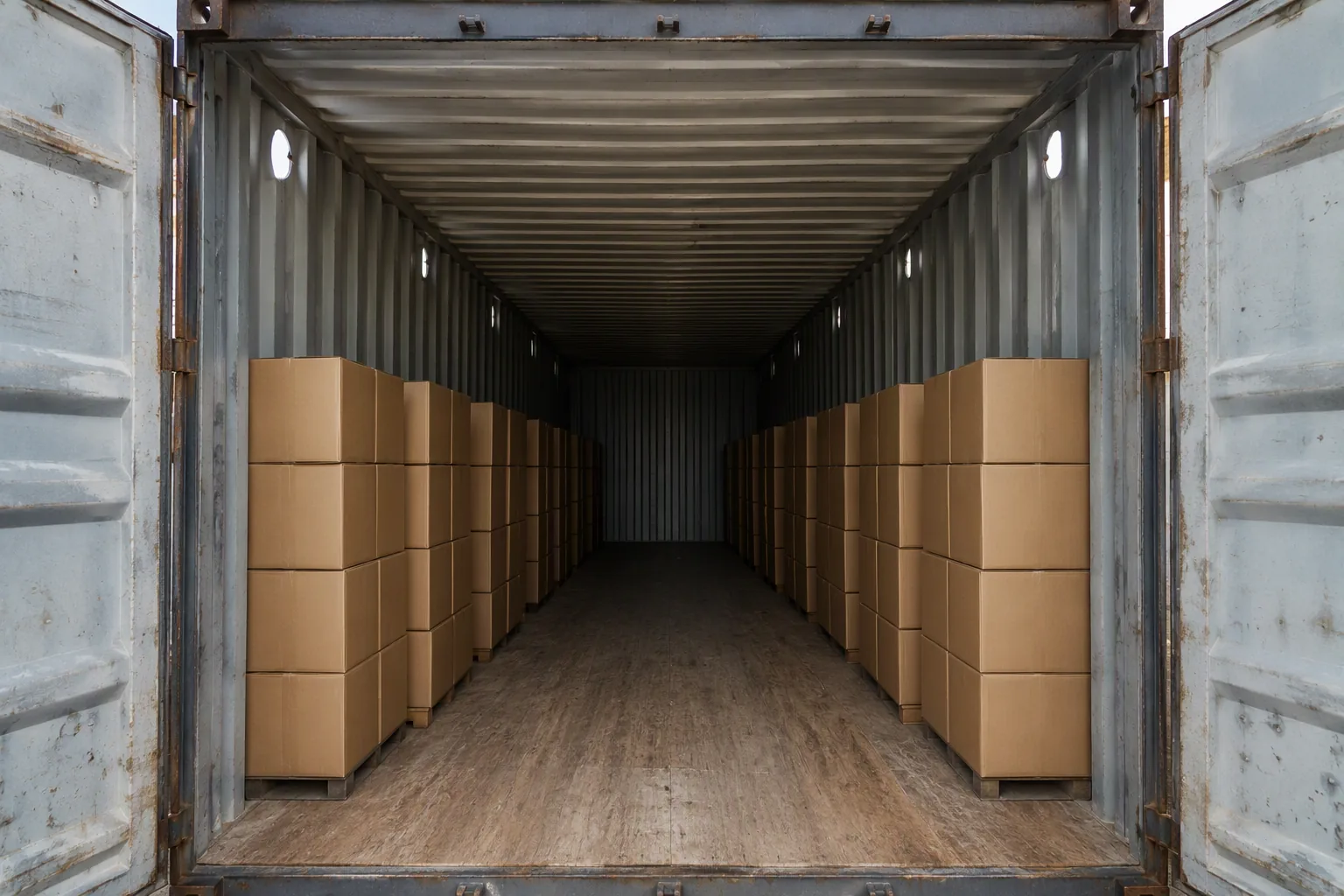
Containers vary in how much ventilation they provide, and where cartons are stacked tightly against walls or against the door, air cannot circulate. Stowage that leaves breathing room reduces the concentration of moisture around the goods.
Why Transit Risk Is Hard to See in Advance
The evidence arrives after the fact.
Nothing in a normal pre-shipment inspection shows how a container will behave across an ocean. The practical answer is to control what can be measured before loading and to plan the route with the season in mind.
Setting a Moisture Content Requirement
The number is the control.
Why Dryness Has to Be a Number
“Dry” is not a specification.
A requirement that leather or finished bags be dry cannot be verified, disputed or improved. A moisture content requirement expressed as a measured value with an acceptable range can be checked at the point of packing and becomes something a supplier can manage against.
What to Specify and What to Leave to the Supplier
Set the outcome, not the method.
The brand’s interest is the moisture condition of the material at packing and its condition on arrival. How a supplier reaches that condition is its own business, and prescribing methods usually produces compliance on paper rather than a change on the floor.
How Measurement Is Done in Principle
Measurement is quick and repeatable.
Moisture content is normally checked with a meter applied to the material, with readings taken at several positions because a hide or a finished bag is not uniform. The equipment is inexpensive, and the discipline lies in taking readings and recording them rather than in the instrument itself.
Verifying Without Overstepping
Records first, visits second.
Asking for recorded readings at packing is a reasonable requirement at any order size. Where the risk justifies it, a visit during packing shows whether readings are actually taken and whether the environment supports them.
Production Controls Before Packing
Control the material before it is enclosed.
Drying and Conditioning Time
Rushing the last stage creates the problem.
Where production pressure shortens drying or conditioning, material is packed while still carrying moisture that will later become available inside the carton. Protecting that time is one of the cheapest forms of mould prevention available.
Acclimatising Before Packing
Let the material reach the room.
Material brought from a cooler or damper area into a packing room should be allowed to equilibrate before it is boxed. Packing immediately after a move traps the difference between the two environments inside the package.
Ventilation in the Packing Area
Moving air is a control, not a comfort.
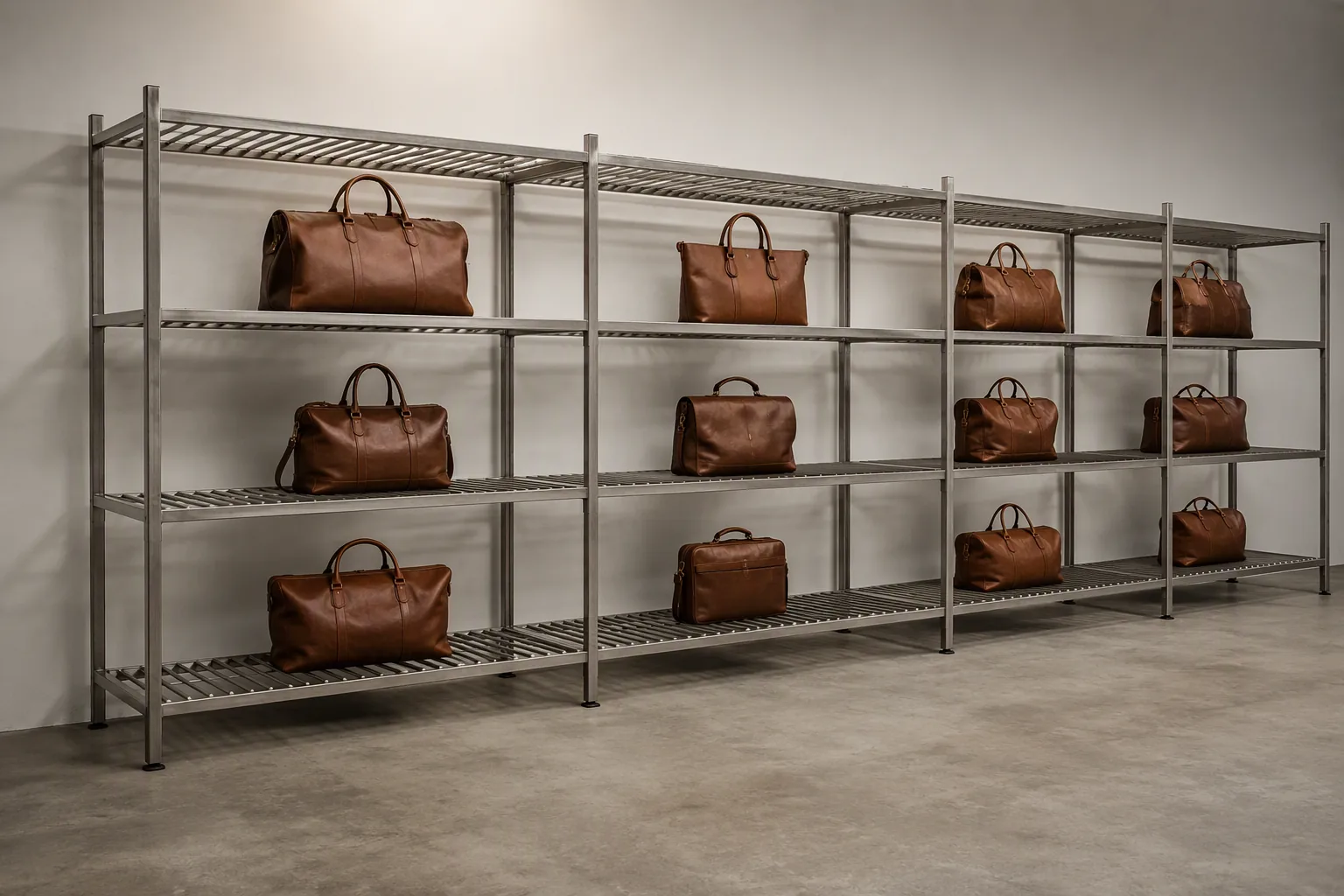
Air movement keeps local humidity from building around stored goods. A packing area with adequate ventilation reduces the rate at which bags take up moisture while they wait.
Rules About Standing Time
Waiting is not neutral.
Finished bags standing in an open area still interact with the air around them. Long waits in a humid period are as much a risk as a wet process, so a limit on how long finished goods may stand before packing is a practical control.
| Control | What it protects against | How it is verified |
|---|---|---|
| Protected drying time | Moisture sealed into the material | Production records |
| Acclimatisation before packing | Temperature and humidity difference | Packing procedure |
| Ventilated packing area | Local humidity build-up | Observation at site |
| Standing-time limits | Gradual take-up while waiting | Packing records |
| Meter readings at packing | Unverified “dry” claims | Recorded values |
| Segregation of suspect goods | Spreading contamination | Quarantine procedure |
Packaging as Moisture Control
Packaging decides whether moisture can leave.
What Desiccants Can and Cannot Do
A small buffer, not a solution.
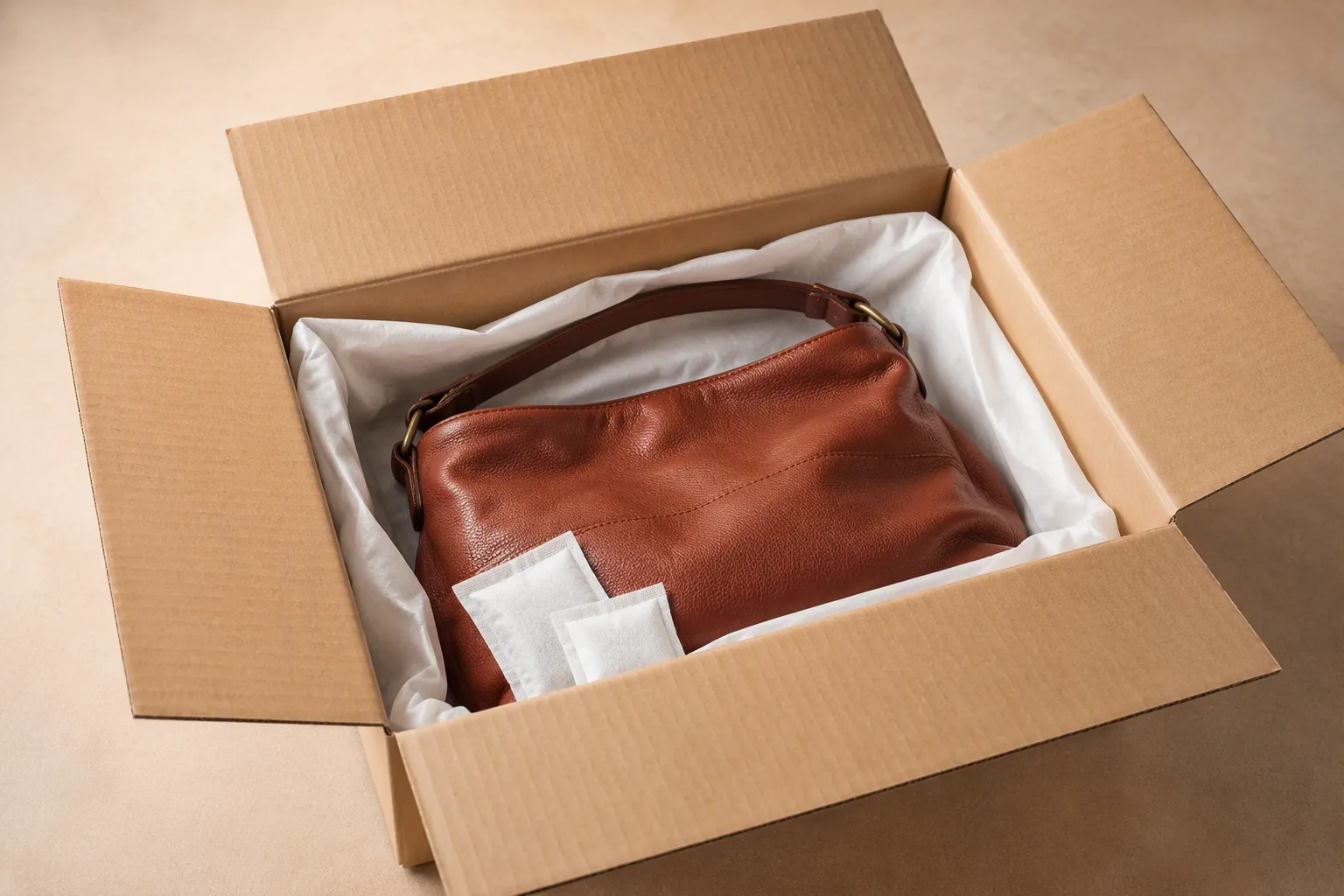
Desiccants absorb a limited amount of moisture and are sized for a package volume. They can absorb what is released by a correctly dried product but cannot compensate for material packed wet, and their capacity is finite over a long transit.
Breathable Versus Sealed Packaging
Two different philosophies.
Sealed packaging keeps external water out but holds internal moisture in. Breathable packaging allows moisture to leave but offers less protection from a wet environment. The right choice depends on how dry the product is at packing and what the journey looks like.
Liners, Tissue and Barriers
Materials interact with moisture.
Some lining and barrier materials slow the movement of moisture, and some can hold it against the surface. Choosing materials that do not trap water against the leather, and avoiding direct contact between plastic and finished surfaces, reduces the risk of localised marking.
Protecting Metal and Lining
Damage does not stay in one place.
Where moisture collects, hardware can corrode and linings can stain, and those effects are often noticed before any growth itself. Protecting fittings and lining areas is therefore part of the same control.
Detection: What to Look For at Inspection
Finding it early limits the damage.
The Visible Signs
Look under the right light.
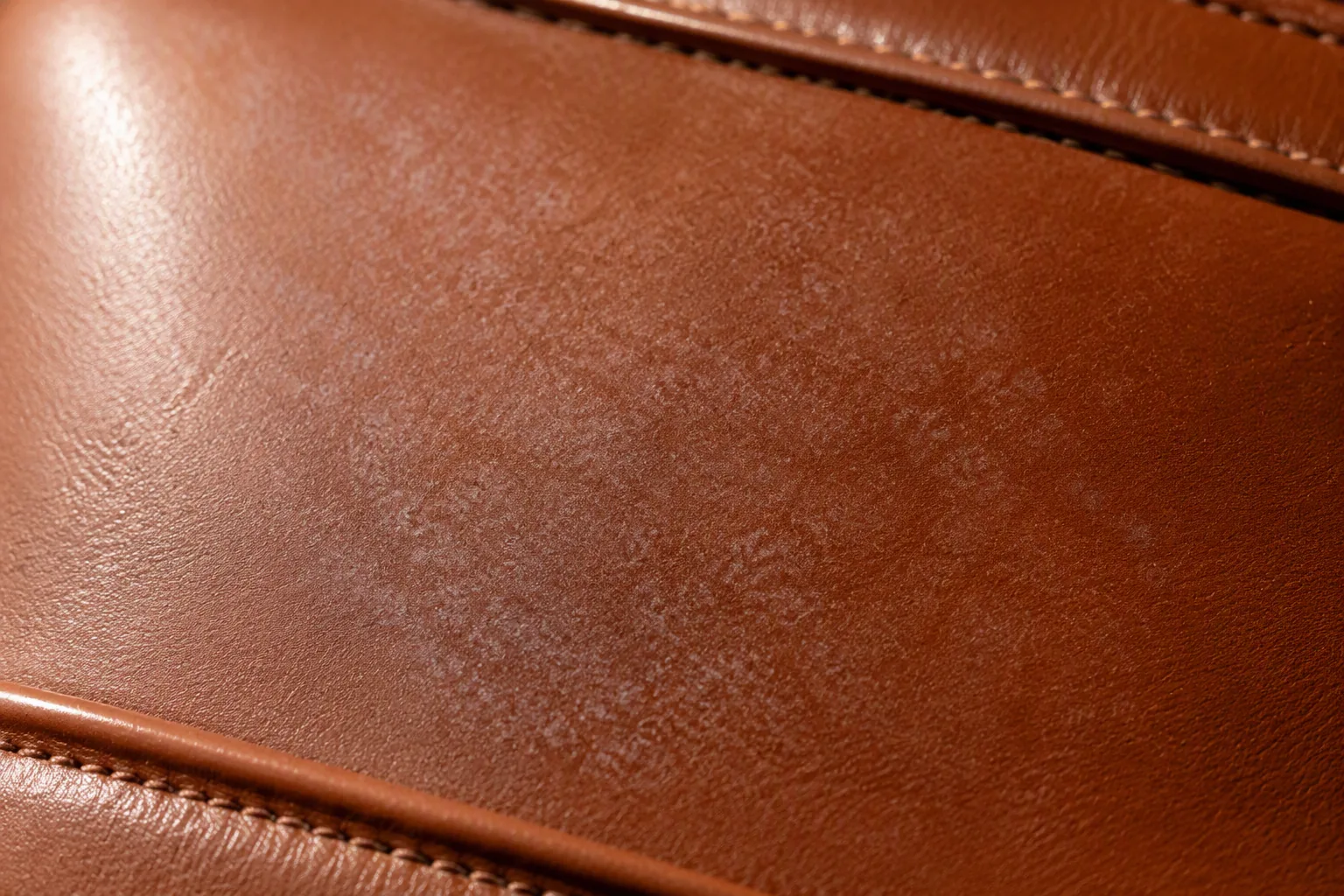
Early mould appears as a faint pale speckling, a dulling of the surface or a slight mustiness. It is easiest to see under low-angle light on a dark surface, and very easy to miss under flat, bright, top-down lighting.
Where Mould Starts on a Bag
The places that stay damp.
Interior linings, folds, gussets, the underside of flaps and areas in contact with packaging tend to show it first, because those are the places where air does not move and moisture lingers.
Distinguishing Mould From Other Surface Conditions
Not every pale mark is growth.
Bloom from fats and oils, tannin migration, dried water marks and finish defects can all produce marks that resemble early mould. The distinction matters because the treatments and the claim consequences are different, and a misdiagnosis can lead to unnecessary cleaning of a sound bag.
Documenting What You Find
Records decide the outcome.
Photographs in consistent lighting, with the location on the bag noted and the reading conditions stated, turn an observation into evidence. Without that, a claim becomes a difference of opinion between parties.
| Observation | Likely cause | What to do |
|---|---|---|
| Pale speckles, dulled surface, musty smell | Mould growth | Quarantine and assess |
| Even waxy haze, no smell | Fat or oil bloom | Treat as surface finish condition |
| Brownish patches near edges or folds | Tannin migration | Assess against leather type |
| Irregular tide marks | Dried water marks | Check packing and handling |
| Corrosion on hardware only | Local moisture contact | Inspect adjacent material |
| Musty smell, no visible marks | Early growth or packaging odour | Investigate before shipping |
Responding When Mould Is Found
The first decision is containment.
Isolate Before You Decide
Stop the spread.
Affected goods should be separated immediately, with the packaging removed so that air can reach the material, and quarantined away from clean stock. Moving further into the chain before the extent is known is what turns a contained problem into a shipment-wide claim.
Assessing the Extent
Surface or structural.
The useful question is whether the marks are on the surface or whether growth has reached linings, adhesives and the interior structure. Surface-level marks are far more recoverable than growth that has spread into absorbent materials and bonded layers.
Cleaning Versus Rejecting
Not every affected bag is recoverable.
Where the surface has been marked but the structure is sound, cleaning under a defined procedure may restore the goods. Where linings or bonded areas are affected, or where the finish has been changed, rejection is usually the more honest outcome than a repaired bag shipped as new.
Re-Checking Before Release
The re-check is not optional.
Any item that has been cleaned should be examined again in controlled conditions before release, because a bag that looks clean can carry residual moisture and a modified surface. Releasing it without a re-check simply moves the claim closer to the customer.
Who Should Do the Work
Competence matters.
Cleaning of this kind should be done by people who understand the material and the finish, using products intended for the purpose and following the supplier’s instructions. Improvised treatment often produces a second, less fixable problem.
Records, Claims and Traceability
Prevention is a paper exercise as much as a physical one.
What Evidence a Claim Needs
Facts, positions and timing.
A credible claim requires readings from the material, the humidity and temperature history of the journey where available, photographs of the affected area in consistent light, and a clear statement of when the goods were examined and by whom.
Humidity and Temperature Records
Data turns opinion into fact.
Where a shipment carries recorded humidity and temperature data, the discussion moves quickly from blame to cause. Where it does not, both parties argue from memory, and the brand usually carries the cost.
Why the Cause Changes the Outcome
Responsibility follows the conditions.
If moisture was sealed in at packing, the issue sits with production. If condensation occurred in transit, it sits with routing and stowage. If the goods stood in a damp warehouse after arrival, it sits with the receiving operation, and the claim will not succeed upstream.
Building the Record Before the Problem
Records are cheap in advance.
Readings taken at packing, together with the shipment’s route and dates, cost very little and settle most disputes. Assembled after the event, the same information is often unavailable.
Shipping and Route Planning
The journey is part of the specification.
Route, Season and Duration
Time in transit is exposure.
Longer routes and routes crossing humid seasons carry more risk, and the same shipment can be low risk at one time of year and high risk at another. Planning around the season is a decision a brand can make.
Container Choice and Ventilation
Not all containers behave alike.
Containers differ in ventilation, and some shipments benefit from a container type that manages internal moisture. The choice should follow the risk, not convenience.
Stowage Position
Where goods sit changes what they meet.
Cartons placed against the container wall or packed hard against the doors are more exposed to condensation and have less air movement around them than cartons stowed with clearance.
Documenting the Shipping Decision
Note why, not only what.
Recording the reasoning behind a route and stowage choice means that a later review can tell whether the decision was sound at the time, rather than judging it only on the outcome.
| Risk factor | Why it matters | Practical option |
|---|---|---|
| Long transit time | More time for growth | Prefer shorter routes when risk is high |
| Humid season at origin or destination | More moisture available | Schedule within a drier window |
| Large temperature swing on route | More condensation cycling | Manage container internal moisture |
| Tight stowage | Less air movement | Leave clearance at walls and doors |
| Delayed clearance at destination | Extra uncontrolled storage | Plan release timelines in advance |
Storage After Delivery
The risk does not end when the goods arrive.
Air Movement and Off-Floor Storage
Two simple rules.
Goods should sit on pallets or shelving rather than directly on floors, and air should be able to move around them. Both measures reduce the moisture that collects around cartons in a still room.
Sealed Packaging in a Damp Room
Plastic keeps water both ways.
Cartons wrapped in plastic in a humid warehouse hold moisture against the goods. Where long storage is expected, either the storage environment or the packaging has to be controlled, and preferably both.
Rotation and Inspection
Older stock needs attention.
Where goods are stored for extended periods, rotating stock and inspecting older cartons for signs of damp prevents a problem discovered only when an order is picked.
Why Retail Environments Behave Differently
Shop conditions are not warehouse conditions.
Retail spaces can be warm, brightly lit and humid, with goods displayed for months in a sealed bag, and stockrooms are often the dampest part of a building. A bag that survived the ocean can still be affected in the last few metres of its journey, which is why retailer handling matters as much as factory packing.
What to Tell the Customer
A few lines prevent many problems.
Simple consumer guidance — keep the bag dry, keep it ventilated, avoid sealed plastic storage and avoid damp rooms — costs nothing and removes the most common cause of mould appearing after purchase.
Working With Suppliers on Requirements
Put the controls in the documents that govern the order.
What Belongs in the Purchase Requirement
Measurable conditions only.
The order should state the moisture condition required at packing, how it will be evidenced, the packing materials agreed, and the environment expectations for the packing area. Requirements that cannot be evidenced cannot be enforced.
Asking for Readings, Not Assurances
Evidence over adjectives.
A supplier should be able to provide recorded readings taken at packing rather than an assurance that the goods are dry. The request is small, and the response tells you whether the control exists.
Agreeing Packing Materials
The packaging is part of the specification.
Desiccant use, the choice between breathable and sealed packaging, and the materials that touch the finished surface should all be agreed rather than left to local practice, because the same product packed two different ways carries two different risks.
Reviewing After Every Shipment
Feedback closes the loop.
Comparing what arrived against what was specified at packing, shipment by shipment, is what turns a requirement into a working control. A requirement that is never reviewed drifts back to whatever the floor finds convenient.
A Pre-Packing Checklist
A short list covers most of the risk.
- Readings taken from the material and recorded
- Bags fully acclimatised to the packing area
- Packing area ventilated and free from standing damp
- Agreed packing materials used as specified
- Desiccants, where used, correctly sized and placed
- No plastic in direct contact with finished surfaces
- Cartons not sealed while the material is warm
- Standing time before packing within the agreed limit
- Route and season reviewed against the risk profile
- Stowage planned to leave clearance for air movement
- Records stored so they can be produced after arrival
Common Mistakes Brands Make
| Mistake | Consequence | Prevention |
|---|---|---|
| Specifying “dry” without a value | Nothing can be verified or improved | Set a measurable moisture requirement |
| Relying on touch at the factory | Hidden moisture passes inspection | Take and record readings |
| Sealing cartons without considering breathability | Moisture is trapped with the goods | Choose packaging deliberately |
| Using desiccants as a substitute for drying | Capacity is exceeded in transit | Dry correctly, then buffer |
| Ignoring the season when routing | A safe route becomes a risky one | Plan shipping by season |
| Stowing cartons tight against walls | Condensation collects with no airflow | Leave clearance |
| No humidity or temperature records | Claims become arguments | Record shipment conditions |
| Releasing cleaned goods without a re-check | A repaired claim reaches the customer | Re-examine before release |
Frequently Asked Questions
Why does mould appear on leather bags that were perfect at the factory?
Because growth depends on conditions as much as on the material. A bag packed with marginal internal moisture and then exposed to warm, humid conditions and a sealed package can develop mould during transit or storage, even though nothing was visibly wrong when it was loaded.
Can leather that feels dry still develop mould?
Yes. Surface feel says nothing about internal moisture, which is why the material may be visibly dry at packing and still release moisture once enclosed. Safe packing depends on measurement rather than on touch.
What are the conditions mould needs?
Moisture above what the material can safely hold, warmth within a moderate range, a nutrient source and enough time. Leather can supply part of the nutrient requirement, so removing the other conditions is what prevention depends on.
Why is transit the riskiest stage?
Because a container cycles through warm days and cool nights, releasing moisture onto cooler surfaces, and the journey provides the time growth needs. The stage is also the least visible, so a shipment can look perfect at loading and be affected on arrival.
Do desiccants prevent mould?
They help within limits. A desiccant absorbs a set amount of moisture sized to a package volume, which can handle what a correctly dried product releases, but it cannot compensate for material packed wet. Desiccants are a buffer, not a substitute for drying.
Is breathable packaging better than sealed packaging?
They solve different problems. Sealed packaging keeps external water out but holds internal moisture in; breathable packaging lets moisture escape while offering less protection from a wet environment. The right choice depends on how dry the goods are at packing and what the journey involves.
How do you tell mould apart from other marks?
Early mould usually shows as faint pale speckling, a dulled surface and often a musty smell, while fat bloom appears as an even waxy haze without odour and tannin migration appears as brownish patches near folds and edges. The distinction matters because treatments and claim outcomes differ.
Where does mould appear first on a bag?
In the places that stay damp and still — interior linings, folds and gussets, the underside of flaps and areas touching packaging. These are the areas to examine first, and they are easy to miss under flat, bright lighting.
Should cleaned bags be shipped as new?
Only after a controlled re-check. Cleaning can restore the surface while leaving residual moisture or a changed finish, and goods affected in linings or bonded areas are generally better rejected than repaired. Releasing without a re-check moves the claim closer to the customer.
What records make a mould claim defensible?
Readings taken from the material at packing, the humidity and temperature history of the journey where available, photographs of the affected area in consistent lighting, and a note of when and by whom the goods were examined. Records assembled in advance settle most disputes.
What should be written into the purchase order?
A measurable moisture condition at packing, how it will be evidenced, the agreed packing materials including any desiccant, the environment expectations for the packing area, and a limit on how long finished goods may stand before packing. Requirements that cannot be evidenced cannot be enforced.
The Bottom Line
Mould is one of the few bag defects that is almost entirely created by conditions, which makes it unusually controllable. The material does not change between the factory and the customer; the moisture, warmth, packaging and time around it do.
The practical programme is short. Set a measurable moisture requirement instead of asking for dryness. Record readings at packing rather than relying on touch. Choose packing materials deliberately, understanding that a sealed package holds moisture in as well as out.
Then plan the route with the season in mind and stow cartons with clearance for air. Keep simple shipment records so that a problem can be diagnosed rather than argued about. And tell the customer the few storage habits that prevent the problem recurring at home.
For buyers, the test is whether the requirement is measurable and evidenced. A supplier that can show readings, name its packing materials and describe its packing environment is controlling the risk. One that answers that the leather is always dry is not, and the difference will be visible only after the container is opened.
