
Leather Supplier Evaluation: A Bag Manufacturer’s Guide
Leather Supplier Evaluation: A Bag Manufacturer’s Guide
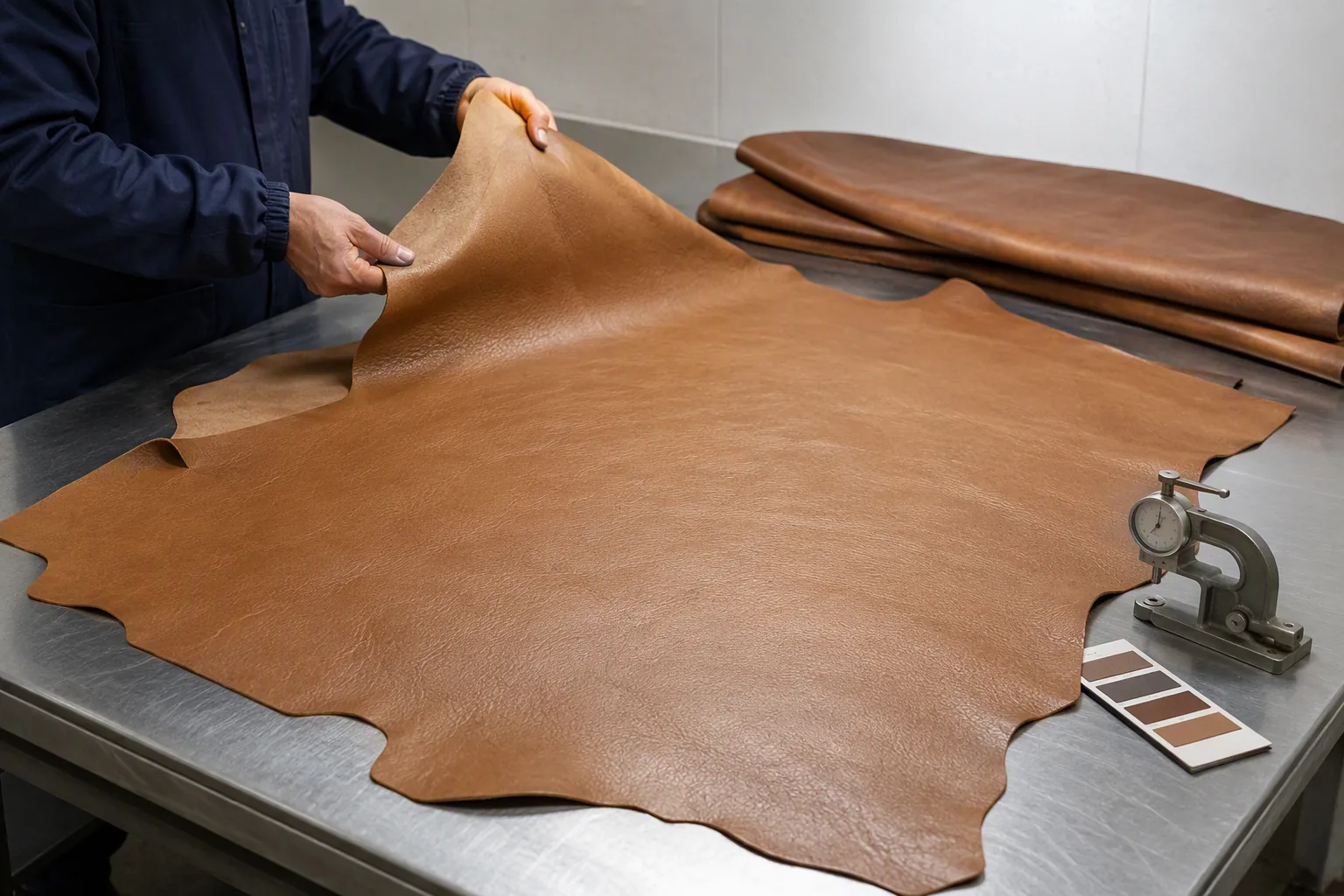
Leather is usually the largest single material line in a bag’s cost, and the one with the most variability. Two bags built from the same pattern and the same process can feel completely different because the hides behind them came from different suppliers.
As a bag manufacturer, we evaluate tanneries and leather traders continuously, because supplier quality sets the ceiling on everything downstream. This guide covers what to evaluate, how to test it, how to audit a tannery, and how to score suppliers so the decision is evidence-based rather than conversational.
A bag factory cannot inspect quality into leather that arrives wrong. Supplier selection is the only control that operates before the defects exist.
- Why Leather Suppliers Decide Your Quality Ceiling
- What You Are Actually Evaluating
- The Evaluation Process, Step by Step
- Sample and Swatch Approval
- Testing Leather Before Bulk Production
- The Factory Audit Checklist
- Scoring Suppliers: A Practical Model
- Incoming Inspection of Leather
- Managing Supplier Risk
- Commercial Terms and Negotiation
- Supplier Priorities by Product
- Common Evaluation Mistakes
- Frequently Asked Questions
- The Bottom Line
Why Leather Suppliers Decide Your Quality Ceiling
Supplier choice determines the range of results your factory can achieve.
Leather Is the Largest Variable
Unlike hardware, thread or lining, leather arrives with inherent variation.
Every hide is a different part of an animal, with its own grain tightness, stretch behaviour, thickness and scarring. A supplier with disciplined selection and grading narrows that variation to what a production line can absorb. A supplier who ships whatever the lot produced pushes the problem into cutting, and cutting cannot fix grain that is too loose or stretch that is too high.
What Consistency Really Means
Consistency is not the same as quality.
A supplier can deliver an average quality that is adequate while the spread between the best and worst hides in the lot destroys yield. What production actually needs is repeatability: thickness within tolerance, colour matching an approved reference, temper and hand stable from lot to lot. Consistency is the property that makes a manufacturing plan possible.
The Cost of a Bad Lot
A bad lot is far more expensive than its own price.
Hides that cut badly reduce yield, and yield loss is measured in the most expensive part of the hide. Loose grain produces stretch and sagging in finished bags, discovered only after assembly. Colour variation creates returns. Each of these failure modes costs several times the material itself, which is why supplier evaluation is a financial control rather than a procurement formality.
What You Are Actually Evaluating
The supplier’s role in the chain matters as much as the material.
Tanneries, Traders and Agents
You may be buying from a tannery directly or through a trader.
Tanneries control selection, tannage and finishing, and they can answer technical questions about the process. Traders and agents provide flexibility, smaller quantities and access to multiple tanneries, but their control over the source is limited. Knowing which one you are dealing with determines which questions are meaningful and where the risks sit.
Capability Before Price
Capability questions should be answered before price is discussed.
The useful questions are what leathers the supplier actually produces in volume, what their yield and thickness tolerances are, how they control finishing, whether they operate their own wet-end or buy crust, and what their rejection rate looks like. A supplier who cannot answer these cannot be managed by specification.
Traceability and Documentation
Traceability is a functional requirement, not paperwork.
Retail customers and regulators increasingly require knowing where leather came from, how it was tanned, and what chemicals were used. Suppliers who can tie a shipment to a production lot, and who hold current audit and test documentation, protect a brand from problems it cannot otherwise fix after the fact. Where documentation is weak, so is legal protection.
The Evaluation Process, Step by Step
A structured process prevents both bad suppliers and good ones being judged on a single sample.
1. Questionnaire and Screening
Screening should eliminate clear mismatches before anyone travels.
A written questionnaire covering product range, capacity, equipment, staffing, certifications and current customer types filters out suppliers who cannot serve the product category. The goal is not to approve anyone yet, but to decide who is worth a sample request.
2. Sample Submission and Swatch Approval
Samples are checked against the specification, not admired.
Swatches are measured for thickness, assessed for grain and temper, tested for colour against a reference, and checked for the defects that would matter in cutting. Approval should be recorded physically with retained swatches, because the sample is the reference all later shipments are compared against.
3. Trial Order and Lot Testing
A trial order tests the production lot, not the sample table.
This is where real variation appears: how consistent the colour is across a whole shipment, how much unusable area is included, how accurate the thickness is at volume. Trial quantity should be large enough to expose variation, and every hide in it should be inspected rather than sampled.
4. Audit Visit
An audit confirms what documents claim and reveals what they omit.
Visiting the tannery shows the condition of the drums and finishing lines, the state of the chemical store, how hides are sorted and graded, and whether the quality organization has real authority. Photographs and notes should be recorded in a consistent format so visits can be compared over time.
5. Scorecard and Decision
The decision should be reproducible.
Scoring each supplier against the same criteria allows comparison between candidates and, more importantly, gives an approved supplier a baseline against which later performance can be measured. A supplier approved without a scorecard cannot be improved, because there is no record of what was agreed.

Sample and Swatch Approval
Approval is a measurement exercise, and the record it produces governs everything afterwards.
What a Swatch Must Prove
A swatch has to answer questions the eye cannot.
It should show the thickness at the specification, the grain tightness expected in the finished product, the temper or stiffness the pattern requires, and the surface finish that will be visible on the bag. Where a leather is expected to be used across large panels, the swatch should come from a comparable area of the hide, because shoulder grain behaves differently from belly grain.
Colour and Tone Consistency
Colour is the most common cause of rejected shipments.
A single swatch approved under one light source tells you very little, so approval should include several pieces from the same lot and, ideally, from more than one lot. Retaining these references allows later shipments to be compared objectively rather than argued about, and shifting light sources is one of the most common ways colour disputes appear.
Thickness and Area Tolerance
Thickness should be specified as a range with a stated measurement method.
Hides vary naturally across the surface, so a supplier needs to know where measurement is taken and what tolerance is acceptable. Area or yield expectations should also be agreed, including the maximum share of unusable area: a cheap hide with heavy scarring can cost more per usable square foot than an expensive clean one.
Hand, Temper and Finish
Hand feel is a specification, even though it is described in words.
Temper is the resistance of the leather to bending, and it decides whether a structured tote holds its shape or a soft bag slouches. It should be recorded with a reference sample and a short written description, because it is one of the first properties to drift when a tannery changes process or raw material source.
Approval Records That Survive
The approval record must outlive the people who made it.
Retaining physical swatches, the measured specification, the test results and the date of approval creates a durable reference. When machinery, staff or ownership at the tannery changes, that file is the only reliable way to re-establish what was agreed.
Testing Leather Before Bulk Production
Tests convert opinions into comparable numbers.
Physical Tests That Matter for Bags
Not every laboratory test predicts bag performance, so selection matters.
| Test | What it indicates | Why it matters for bags |
|---|---|---|
| Thickness measurement | Material consistency | Cuts, folds, skiving and edge build |
| Tear strength | Resistance to tearing at stress points | Handle attachments, strap ends |
| Tensile strength | Load capacity of the material | Straps, panels under load |
| Grain crack and flex resistance | Behaviour under repeated bending | Flaps, gussets, wallets |
| Colourfastness to rubbing | Surface colour stability | Handled edges, light-coloured bags |
| Water and stain resistance | Surface protection level | Diaper bags, outdoor use |
| Fogging and volatile release | Chemical emissions | Interior contact surfaces |
| Adhesion of finish | Coating bond strength | Appearance durability |
Chemical and Compliance Testing
Chemical testing protects against market access failures rather than performance failures.
Restricted substance testing, azo dye checks and heavy metal screening are the standard requirements for most markets, and they must be current. The practical point for a bag manufacturer is that a supplier’s previous reports are not evidence about a new lot, so testing should be tied to specific production and refreshed on a defined cycle.
Test Reports and Lab Choice
A test report is only as useful as the laboratory behind it.
Reports should come from recognized laboratories, name the specific material and production lot, state the test method and version, and include the actual measured values rather than a pass mark alone. Reports that name a generic material without a lot reference cannot be tied to anything in production, which makes them commercially worthless in a dispute.
Interpreting Results Honestly
Results should be read as distributions rather than as verdicts.
A pass result tells you the sample passed; it says nothing about the spread across the shipment. When a result sits close to a limit, the practical response is to widen the sampling rather than to celebrate, because the next lot is likely to cross the line.
The Factory Audit Checklist
The audit visit should follow a fixed structure so results are comparable.
Process Control in the Tannery
Process control is the difference between a reliable supplier and a lucky one.
Look for documented recipes per article, recording of temperatures and times, calibrated measuring equipment, and a defined reaction when a batch deviates. Tanneries that adjust by feel rather than by record can produce excellent leather, but they cannot reproduce it on demand, which is a risk no production plan can absorb.
Chemical Management and Effluent
Chemical handling is both a compliance and a quality issue.
The audit should cover segregation and labelling of chemicals, storage conditions, dosing accuracy, and effluent treatment. Poor chemical management produces inconsistent tannage and creates legal exposure for every customer further down the chain, including the brand whose name is on the bag.
Capacity and Planning Discipline
Capacity claims should be checked against observable reality.
Ask what the monthly output is, how many drums and finishing lines are running, how long the order book extends, and what happens in peak season. A supplier who is already oversold will deliver late or substitute, and substitution is far more damaging than delay because it is discovered after assembly.
Quality Organization
Quality needs independence and authority to be meaningful.
The audit should establish whether quality staff report separately from production, whether they can hold a lot, and whether rejection data is recorded and reviewed. In tanneries where the production manager decides what ships, quality problems surface at the customer instead of inside the building.

Audit Checklist Reference
| Area | What to verify | Warning sign |
|---|---|---|
| Process control | Documented recipes, calibrated instruments, deviation records | Adjustments made by feel alone |
| Raw material | Source consistency, selection and grading discipline | Untraceable or mixed sources |
| Chemical management | Labelling, segregation, dosing accuracy, records | Unlabelled drums and loose documentation |
| Effluent treatment | Working treatment plant, discharge records | Bypass or unmonitored discharge |
| Capacity | Drums and lines actually running, order book length | Capacity claimed exceeds equipment |
| Quality organization | Independent authority, lot holding, rejection data | Quality reports to production |
| Finishing control | Colour and thickness control, grading standards | Grading rules undocumented |
| Traceability | Lot-to-shipment linkage, retained records | Reports not tied to lots |
| Working conditions | Safety, ventilation, protective equipment | Visible neglect of basic safety |
Scoring Suppliers: A Practical Model
A scorecard converts a scattered impression into a comparable number.
Choosing the Weightings
Weightings should reflect what your product actually fails on.
A structured bag programme cares most about thickness consistency and temper; a soft leather programme cares about grain and hand; a family-bag programme cares about colourfastness and water resistance. The weightings should be set before scoring begins, or they will be reverse-engineered to justify a preferred supplier.
The Scorecard Reference
| Criterion | What it measures | Typical weight |
|---|---|---|
| Material consistency | Thickness, colour and temper variation across lots | High |
| Defect and yield | Usable area, scarring, grain tightness | High |
| Process control | Documentation, calibration, deviation handling | High |
| Compliance and traceability | Current testing, lot linkage, audit standing | High |
| Capacity and lead time | Realistic output, on-time record | Medium |
| Technical support | Response quality, development capability | Medium |
| Commercial terms | Price, payment, claims handling, flexibility | Medium |
| Responsiveness | Communication speed, issue closure | Low to medium |
Interpreting Scores and Setting Thresholds
Thresholds should be defined before the first supplier is scored.
A practical approach is to require a minimum score in each high-weight criterion rather than only an overall average, because a supplier who is excellent commercially but inconsistent in material cannot be rescued by other strengths. Suppliers below the material threshold should be treated as unsuitable for primary supply regardless of price.
Weighting by Product Type
Different products justify different scorecards.
| Product focus | Highest-priority criteria | Can tolerate |
|---|---|---|
| Structured totes and briefcases | Thickness consistency, temper, defect rate | Wider colour tolerance |
| Soft and slouchy bags | Grain, hand, tear strength | Slightly wider thickness tolerance |
| Diaper and family bags | Colourfastness, water resistance, cleaning durability | Moderate temper variation |
| Small leather goods | Thin-gauge accuracy, surface uniformity, finish adhesion | Smaller lot sizes, higher cost |
Incoming Inspection of Leather
Even an approved supplier needs incoming control, because lots differ.
Planning the Inspection
The inspection plan should state what is checked and how often.
A practical structure is to inspect every hide in a trial or first shipment, then move to sampled inspection once the supplier demonstrates stability, while keeping a defined trigger for returning to full inspection. Triggers should include a new tannery source, a new article, a process change at the supplier, or any customer complaint tied to material.
Thickness, Colour and Hand Checks
Three measurements catch most material problems.
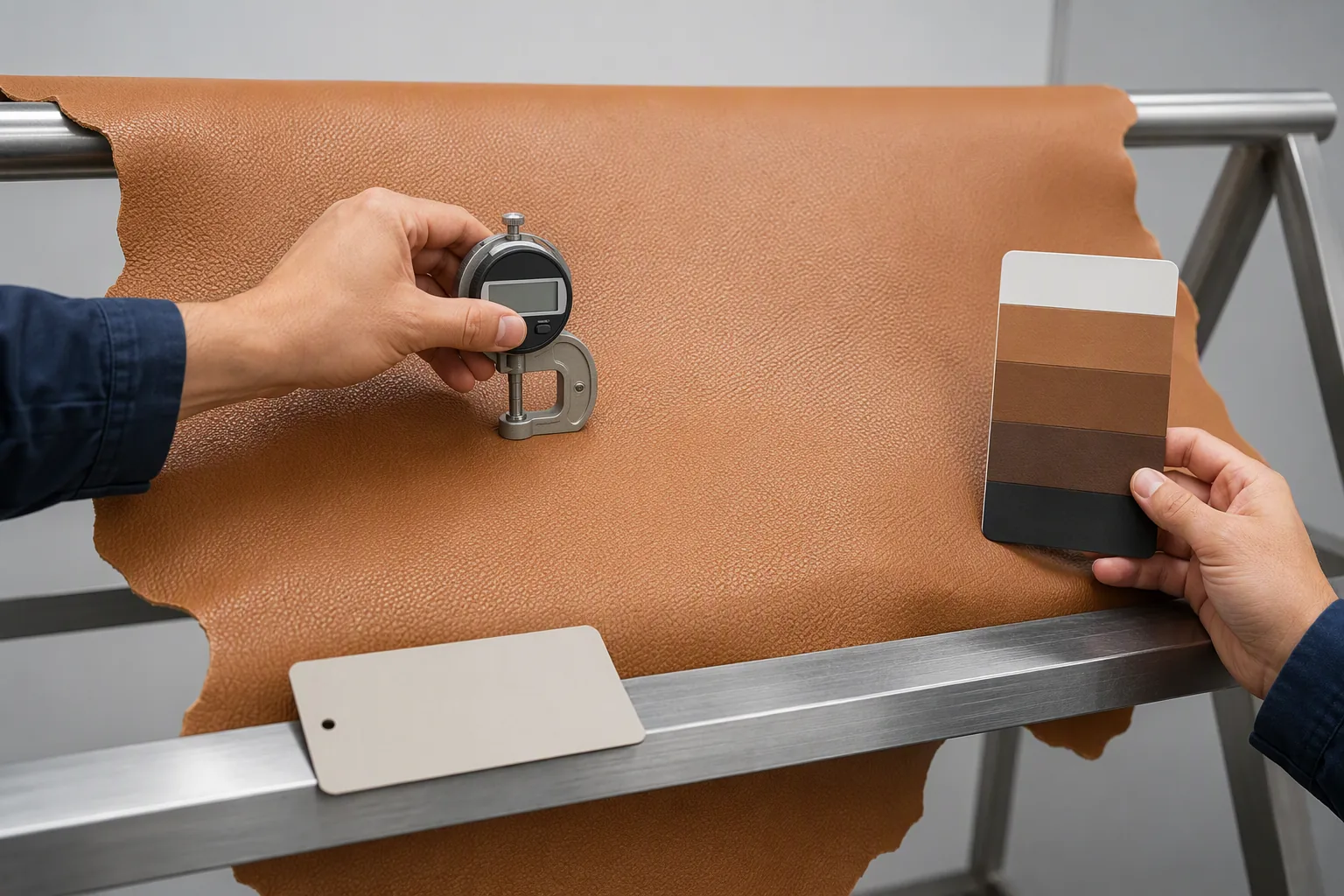
Thickness should be measured at defined points and compared against tolerance, not to a remembered feel. Colour should be assessed against the retained approved swatch under consistent lighting rather than in whatever light the warehouse happens to have. Hand and temper should be compared against the reference sample by the same person where possible, because it is the most subjective of the three.
Defect and Area Mapping
Inspecting hides is about usable area, not about counting defects.
The relevant output of an inspection is how much of the hide can be used for the panels that need it, which is why inspection should be tied to the cutting plan. A hide with a large scar in the area needed for a main panel is a larger loss than the same scar sitting where only small parts are cut.
Documentation and Traceability Records
Inspection results should be recorded per lot and linked to the shipment.
Recording measurements, colour assessment and usable area by lot builds the history that makes later disputes factual. It also makes supplier performance measurable over time, which is the only way to tell improvement from fluctuation.
Managing Supplier Risk
Approved does not mean finished. Supplier management is continuous.
Dual Sourcing and Allocation Split
A single source is a single point of failure.
Running a primary and a secondary supplier for the same article, with a defined allocation split, keeps the secondary supplier active and their material proven. The split should be large enough to be meaningful to both, because a supplier who receives almost nothing has no incentive to hold the standard or the capacity.
Hidden Risks in Substitution
Substitution is the most common way a good specification fails.
It happens gradually: a different crust source, a slightly thinner substance, a finishing step shortened under time pressure. Because each change is small, the result still looks acceptable in isolation, and the problems appear in finished goods. Requiring written approval for any change to material, process or source, and re-testing after a change, converts substitution from a silent risk into a managed event.
Relationship Management and Improvement
Supplier improvement requires a shared, specific target.
Sharing rejection data, yield measurements and customer feedback with the supplier turns a commercial relationship into a technical one. The most productive version of this is a small number of measurable targets per quarter — a thickness tolerance to tighten, a defect category to reduce — rather than a general request to improve quality.
When to Walk Away
Some suppliers cannot be developed into reliable ones, and the decision to leave should be made early.
Persistent substitution without disclosure, falsified or untraceable documentation, refusal to allow audits, or repeated colour failures after corrective action all point to a supplier whose behaviour is structural. Continuing with them converts a material problem into a brand problem, and brand problems are not recoverable through price.
Commercial Terms and Negotiation
Commercial structure determines what happens when something goes wrong.
Price Is a Function of Specification
Leather price is meaningless until the specification is fixed.
Grain grade, thickness tolerance, usable-area expectation, colour tolerance and testing requirements all move the price of the same nominal article. Comparing quotations across suppliers therefore requires comparing specifications first; a cheaper quote usually reflects a looser specification rather than a better deal, and the difference reappears as yield loss or returns.
What to Negotiate Besides Price
Several terms matter more than a small price movement.
- Thickness and colour tolerance held to the approved specification
- Maximum share of unusable area stated as a written figure
- Written approval required for any material, process or source change
- Lead time measured from order confirmation, with a stated peak-season policy
- Claims procedure with a defined response window and inspection method
- Retention of approval swatches and test records for the life of the article
- Right to audit, stated as a routine rather than an exception
Payment, Delivery and Claims
Payment and delivery terms should be structured around risk rather than habit.
Paying against inspection rather than against shipment notice keeps the inspection meaningful. Delivery terms should specify where risk and cost transfer, because a favourable price with unfavourable terms is often more expensive in practice. Claims terms matter most: they should define what evidence is required, who inspects, and how long compensation takes, before a dispute exists.
Building a Claim That Stands
A claim succeeds or fails on documentation.
Retained approval swatches, lot-linked inspection records, measured values and photographs taken at receipt make a claim factual. Claims based on an impression of quality are usually settled by whoever has more leverage, which is rarely the party assembling the bags.
Supplier Priorities by Product
Different bags stress leather differently, so supplier priorities shift with the product.
Diaper Bags and Family Bags
Family bags demand surface durability and cleanability above all.
Colourfastness to rubbing, water and stain resistance, and finish adhesion matter more here than grain character, because the material is wiped, packed and exposed to food and moisture. Suppliers should be selected on their finishing control and their ability to hold colourfastness consistently, not on the beauty of a single sample.
Backpacks
Backpacks put load, abrasion and weather on the same panels.
Tear strength, thickness consistency and water resistance rank highest, along with the ability to supply leathers that hold shape under load without becoming brittle. A supplier whose thickness tolerance drifts creates strap and base problems that appear only in the finished, loaded product.
Totes and Handbags
Totes and handbags are judged on appearance and structure together.
Grain tightness, temper stability and colour consistency carry the most weight, with defect rate close behind because large visible panels expose every flaw. These products also justify the tightest colour tolerance, since a visible tone shift between panels is the first thing a customer notices.
Small Leather Goods
Small leather goods need thin-gauge accuracy and surface uniformity.
Precision in substance matters more than in any other category, surface uniformity is visible at reading distance, and finish adhesion decides how the product looks after a year in a pocket. Small lot sizes and higher unit cost are usually acceptable trade-offs for that precision.
Common Evaluation Mistakes
Most supplier failures can be traced back to a shortcut taken during evaluation.
Judging on a Single Sample
One beautiful sample says nothing about lot consistency.
A sample is usually produced with extra care, from selected raw material, and inspected before it is sent. Approving a supplier on that basis measures their marketing rather than their production. The trial order exists precisely because the sample table is not representative.
Comparing Quotations Without Specifications
Quotations are only comparable when they describe the same thing.
Two suppliers quoting the same nominal article may be quoting different grain grades, thickness tolerances and usable-area expectations. Ranking them by price alone reliably selects the looser specification, and the difference returns as yield loss, rework or returns rather than as a saving.
Accepting Documents Without Lot Linkage
Generic certificates feel reassuring and prove very little.
A test report that names a material without identifying the production lot cannot be tied to the leather in your warehouse. Documentation becomes useful only when it identifies the specific lot and can be matched against the shipment it accompanied.
Skipping the Audit Because the Price Is Good
The commercial case for skipping an audit is always persuasive and usually wrong.
Not every supplier needs a full audit, but a new source with no visit is an unmeasured risk. Where travel is impractical, the alternatives are a third-party audit, a documented self-assessment verified by lot data, or restricting the supplier to secondary allocation until they are proven.
Frequently Asked Questions
How do I evaluate a new leather supplier?
Use a fixed process: a screening questionnaire, a sample submission measured against the specification, a trial order large enough to expose lot variation, an audit visit, and a scorecard that records the evaluation. Approving a supplier without a scorecard leaves nothing against which to measure later performance.
What should a leather swatch approval include?
It should include several pieces from the same lot and ideally more than one lot, with the measured thickness, a written description of hand and temper, the surface finish, and the retained physical swatches. Colour assessed under a single light source is not sufficient.
Which laboratory tests matter most for bag leather?
Thickness measurement, tear strength, grain crack and flex resistance, colourfastness to rubbing, and finish adhesion cover most bag performance risks. Water and stain resistance matter for family and outdoor products, and chemical testing protects market access rather than performance.
What causes colour variation between leather shipments?
Variation comes from differences in raw material, tannage and finishing across production lots. It is controlled by approving colour against retained physical swatches, measuring under consistent lighting, and requiring the supplier to hold the approved reference across repeat orders.
How do I check a tannery’s process control during an audit?
Look for documented recipes per article, recorded temperatures and times, calibrated measuring equipment, and a defined response when a batch deviates. Tanneries that adjust by feel can produce excellent leather but cannot reproduce it on demand.
Should I buy leather from a tannery or a trader?
Tanneries give more technical control and direct process answers; traders give flexibility, smaller quantities and access to multiple sources. The key is knowing which you are dealing with, because the questions that matter and the risks involved are different for each.
What is a reasonable allocation split between two leather suppliers?
The split must be large enough that both suppliers have a commercial reason to hold the standard and reserve capacity. A secondary supplier receiving negligible volume has no incentive to stay compliant, which removes the redundancy the second source was meant to provide.
How do I prevent supplier substitution without disclosure?
Require written approval for any change to material, process or source; verify incoming lots against retained approved swatches and measured tolerances; and re-test after any change. Substitution usually appears as small, individually plausible changes rather than one obvious swap.
What documentation should a leather supplier provide?
Current test reports from recognized laboratories that name the material and production lot, traceability linking shipment to tannery lot, audit standing where relevant, and retained approval records. Reports that cannot be tied to a specific lot have little value in a dispute.
How often should leather suppliers be re-evaluated?
Annually at a minimum, and immediately after any change to source, process or ownership, after a significant quality incident, or when customer complaints point to material. Re-evaluation should use the same scorecard so results remain comparable over time.
When should a bag manufacturer stop using a supplier?
Persistent undisclosed substitution, falsified or untraceable documentation, refusal to permit audits, or repeated colour and thickness failures after corrective action. These indicate behaviour that will not change, and continuing converts a material problem into a brand problem.
The Bottom Line
Leather supplier evaluation is a control system, not a purchase decision.
Screen before sampling, measure rather than admire, test the production lot rather than the sample, and visit the tannery to confirm what documents claim. Fix the specification so quotations are comparable, hold approval swatches so colour is a measurement, and score suppliers so improvement is visible.
Then manage the relationship: split allocation, require written approval for change, share rejection data, and walk away from suppliers whose behaviour is structural rather than temporary. Hides arrive with variation built in — supplier discipline is what keeps that variation inside the range your production can absorb.
