
Leather Colour Matching in Bag Production: A Factory Guide
Leather Colour Matching in Bag Production: A Factory Guide
Colour is the defect customers notice first and forgive last. A bag can be perfectly stitched, correctly reinforced and beautifully edged, and still be rejected because the front panel and the flap read as two different browns under shop lighting.
As a bag manufacturer, we manage colour as a production process rather than as an incoming inspection result. This guide covers where leather colour variation comes from, how a colour standard is set and recorded, how panels are selected and cut for consistency, and how factories catch mismatches before assembly rather than after.
Colour consistency is not achieved by buying better leather. It is achieved by deciding which panels must match, cutting them from the same material, and proving the match under controlled light.
- Why Colour Is a Production Problem
- Where Colour Variation Comes From
- Setting a Colour Standard
- Panel Selection and Cutting for Consistency
- Production Practices That Reduce Mismatch
- Incoming Colour Checks in Practice
- Common Colour Problems and Their Causes
- Managing Colour Across a Product Range
- Customer Expectations and Claims
- Colour Priorities by Bag Type
- Cost and Yield Implications
- Working with the Tannery on Colour
- Training and Documentation on the Line
- Frequently Asked Questions
- The Bottom Line
Why Colour Is a Production Problem
Colour matching fails in assembly, not in the warehouse.
Leather Varies by Nature
Leather is a natural material, and colour varies within a single hide.
A hide is not one tone. It shifts from the back to the belly, changes where the grain is tight or open, and responds differently to dye and finishing across its surface. Even a perfectly executed dye lot has internal variation, which is why colour control is about allocation and matching rather than about demanding uniformity that does not exist.
What Customers Actually See
Customers compare adjacent surfaces, not absolute colours.
Nobody holds a bag against a colour chart. They see a flap next to a front panel, a strap against a body, a pocket against its backing, and they judge the relationship between those surfaces. This is why the practical standard is not “all panels identical” but “adjacent and simultaneously visible panels match”.
The Cost of a Mismatched Bag
A colour mismatch is expensive because it is usually found late.
Mismatches appear after assembly, when the panels finally sit next to each other, by which point the material is cut, edged, stitched and often reinforced. The bag cannot be repaired upward into a correct colour; it is scrapped or sold as a second. The cost is the whole assembled bag rather than the leather it contains.
Where Colour Variation Comes From
Variation has several distinct sources, and each is controlled differently.
Hide Position and Raw Material
Position within the hide is the most predictable source of variation.
Back and butt areas generally dye and finish more uniformly, while belly and shoulder areas show more variation, looser grain and more pronounced texture. A cutting plan that assigns back-area panels to simultaneously visible surfaces and belly-area panels to internal or single-layer parts removes much of the problem before it exists.
Tannage and Dyeing
Dyeing method determines how much variation the leather carries into finishing.
Drum-dyed leathers absorb dye irregularly around the hide, which produces depth and character but also wider variation. Spray-dyed or finished leathers can be levelled more consistently on the surface but may show underlying tone differences as the finish wears or where the surface is stretched.
Finishing and Surface Treatment
Finishing is where a tannery can correct or hide variation, and also where it can create it.
Pigmented finishes cover the surface and offer the tightest colour hold, aniline finishes leave the natural grain exposed and vary the most, and semi-aniline sits between them. Water-based and solvent-based finishes also behave differently under abrasion and cleaning, which decides whether a colour holds its appearance in use.
Light Source and Perception
The same leather can match in one light and fail in another.
Different light sources have different spectral output, so a pair of panels can appear identical under daylight and visibly different under warm indoor lighting. This effect is common with leathers finished with different dyes or processes, and it is the reason colour approval has to happen under a stated light source rather than in whatever light the room happens to have.
Variation Sources and Controls
| Source of variation | Where it appears | Practical control |
|---|---|---|
| Hide position | Back to belly tonal shift | Assign panels by position in the cutting plan |
| Drum dyeing | Irregular absorption around the hide | Select and batch-match at the tannery |
| Spray finishing | Surface levelling with hidden variation | Specify finish type and levelling standard |
| Light source | Panels match in one light, not another | Approve under a defined light source |
| Batch and lot | Tone shift between production runs | Retain references and test each lot |
| Handling and soiling | Localised darkening and sheen changes | Handling discipline and protective storage |
Setting a Colour Standard
A colour standard must be written, measured and physically retained.
Physical References Over Descriptions
Words cannot define a colour, and photographs cannot either.
An approved physical swatch is the only reliable reference, because colour descriptions in text are interpreted differently by every reader and product photographs shift with lighting, camera and screen. The reference should be large enough to assess under different light sources and retained in a way that protects it from light and contamination.
Master, Limit and Production Samples
Mature colour control uses more than one reference.
A master sample defines the target, limit samples define what is still acceptable at each edge of the tolerance, and production samples record what each batch actually looked like. Together they allow a lot to be located within the tolerance band instead of being judged as acceptable or not.
Measurement and Visual Assessment Together
Instrumental measurement and human assessment answer different questions.
A spectrophotometer produces a numerical difference against a reference, which is consistent, repeatable and independent of mood. The eye detects relationships and contexts that instruments miss, such as how a flap sits against a panel. Good practice uses the instrument to flag lots for attention and the eye to make the final production decision under controlled light.
Colour Standard Record
| Field | Purpose |
|---|---|
| Colour name and code | Identifies the standard in documents and orders |
| Physical master and limit samples | Defines target and acceptance band |
| Specification of finish type | Explains how the colour will behave in use |
| Measurement method and instrument | Makes results comparable between lots |
| Approval light source | Fixes the conditions for visual decisions |
| Approved date and approver | Records who accepted what, and when |
| Panel matching requirement | States which panels must match on the bag |
Panel Selection and Cutting for Consistency
Most colour mismatches are decided at the cutting table.
The Cutting Plan Sets the Matching Rules
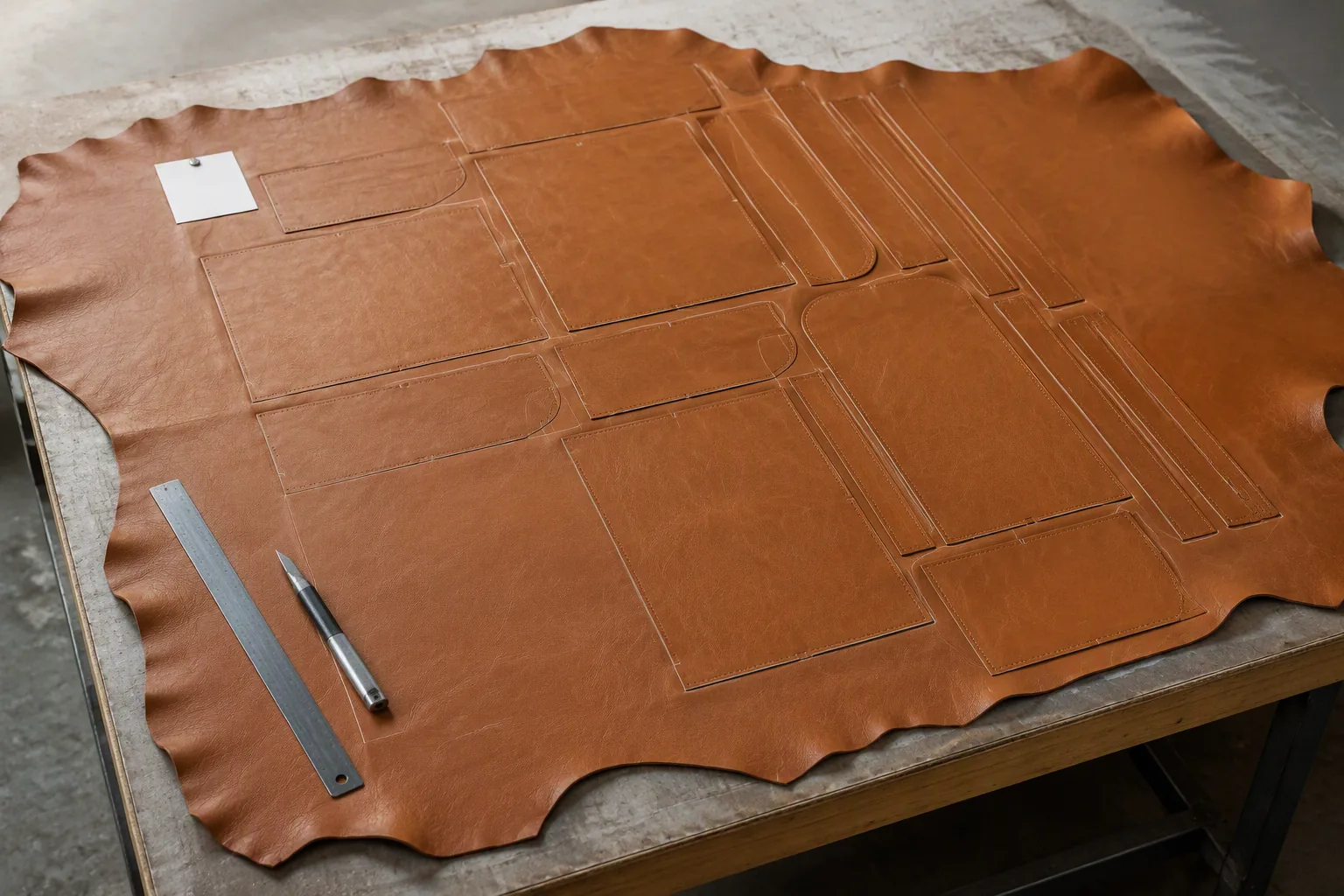
The cutting plan should state which panels must match and which may differ.
Front panel, flap, strap, gusset and pocket faces are usually visible together and belong to a matching group. Internal pocketing, interlinings, reinforcements and hidden linings do not, and treating them as if they did wastes material and inflates cost without improving how the bag looks.
Cutting Matching Groups from the Same Material
Panels in the same matching group should come from the same hide or the same controlled lot.
Cutting them from adjacent areas of one hide gives the closest natural match, because the tone gradient across the hide is gradual. When volume makes that impossible, the next best approach is cutting each matching group from a single lot and keeping those cut panels physically together through the rest of production.
Grain and Nap Direction
Colour is not the only visible property that must be consistent.
Grain tightness, hair cell direction and the sheen of certain finishes all read as tone differences when panels are cut in different directions. Marking direction on the pattern and keeping every panel in a matching group oriented the same way prevents a mismatch that no colour measurement would detect.
Panel Matching in Practice
| Panel group | Matching requirement | Typical source |
|---|---|---|
| Front panel, flap, strap | Strict match, same hide where possible | Back area of a single hide |
| Side panels and gusset | Match within the lot, adjacent cutting preferred | Shoulder area, same hide |
| Pocket faces | Match to the panel they sit on | Offcuts from the same hide |
| Internal pockets and linings | Loose match or contrasting by design | Belly area or separate lot |
| Reinforcement and stiffeners | No colour requirement | Lowest usable area |
Production Practices That Reduce Mismatch
Control depends on keeping matched material together and traceable.
Lot Segregation and Tracking
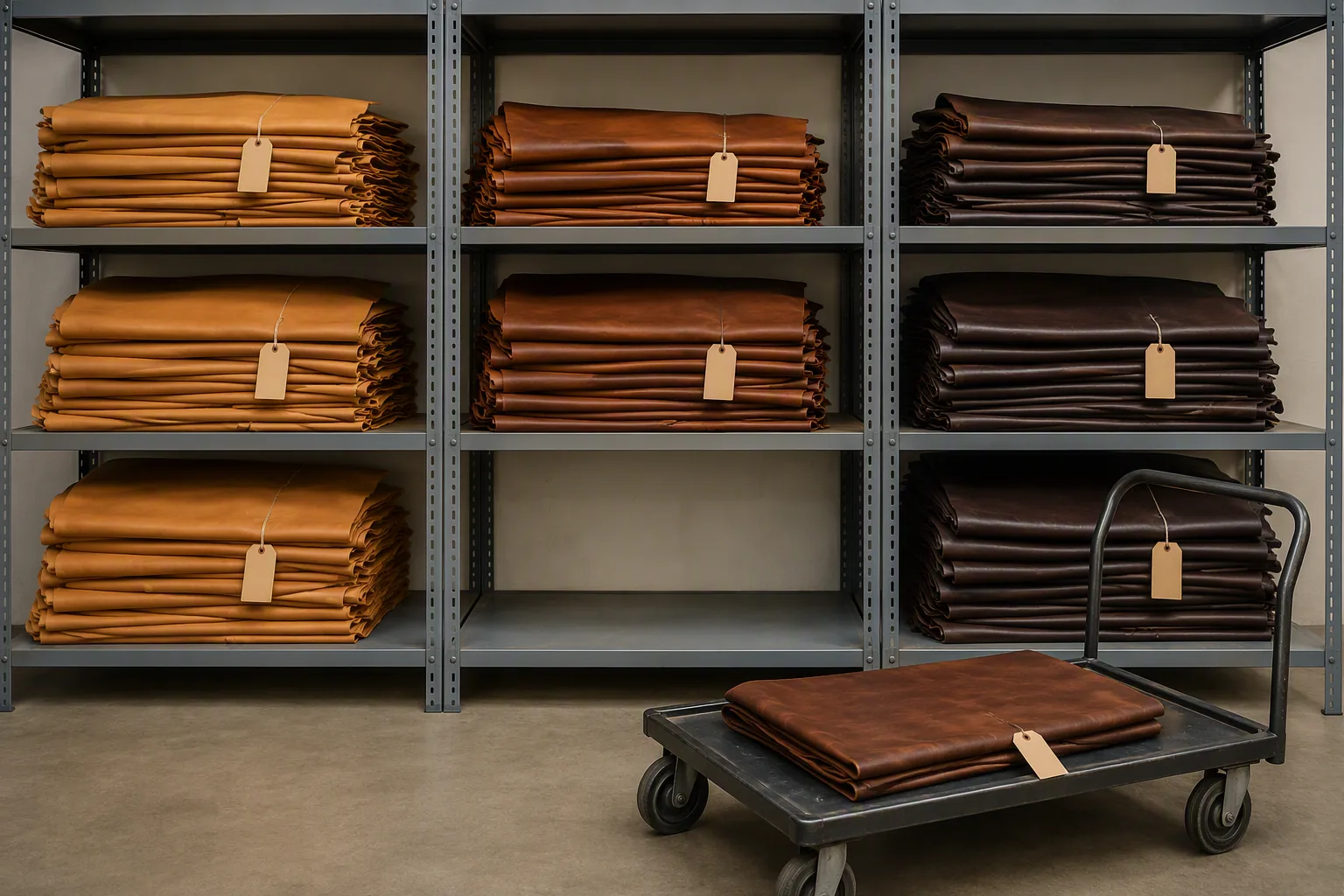
Lots should be stored and tracked separately from the moment they arrive.
Mixing two lots in one bin makes them indistinguishable at the cutting table, and by then the only possible outcome is a mismatch discovered late. Keeping lots separated, with lot identity carried on the cut panels themselves, makes correct matching the default rather than a matter of operator memory.
Sequencing Assembly by Matching Group
Cut panels should move through production as matched sets.
When panels of one matching group are cut together and issued to assembly together, the bag is assembled from material that was already proven compatible. When they are separated across work orders, the pairing is re-created by chance, and chance is not a production control.
Thread, Edge Paint and Lining Coordination
Non-leather components decide whether a correct match looks correct.
Thread shade, edge paint colour and lining tone all interact with the leather tone. A leather match can be lost visually by a thread that is a shade too light or an edge paint that is cooler than the leather. These components should be approved against the same physical reference as the leather, under the same light.
Handling and Soiling Discipline
Handling changes apparent colour before it changes colour.
Oils from hands darken leather locally, dust settles into grain and dulls it, and abrasion adds sheen that reads as a lighter tone. Clean handling, covered storage between operations and protection during transport all preserve the colour that was approved.
Incoming Colour Checks in Practice
The check is quick, but only if the conditions are controlled.
Sampling Colour by Lot
Colour sampling is about detecting lot-level shifts, not inspecting every hide.
A practical approach is to compare a small number of hides from each lot against the reference under controlled light, and to escalate to fuller inspection when a lot sits close to the tolerance limits. Sampling should be repeated at the start of cutting, when the lot is opened in volume, rather than only at goods-in.
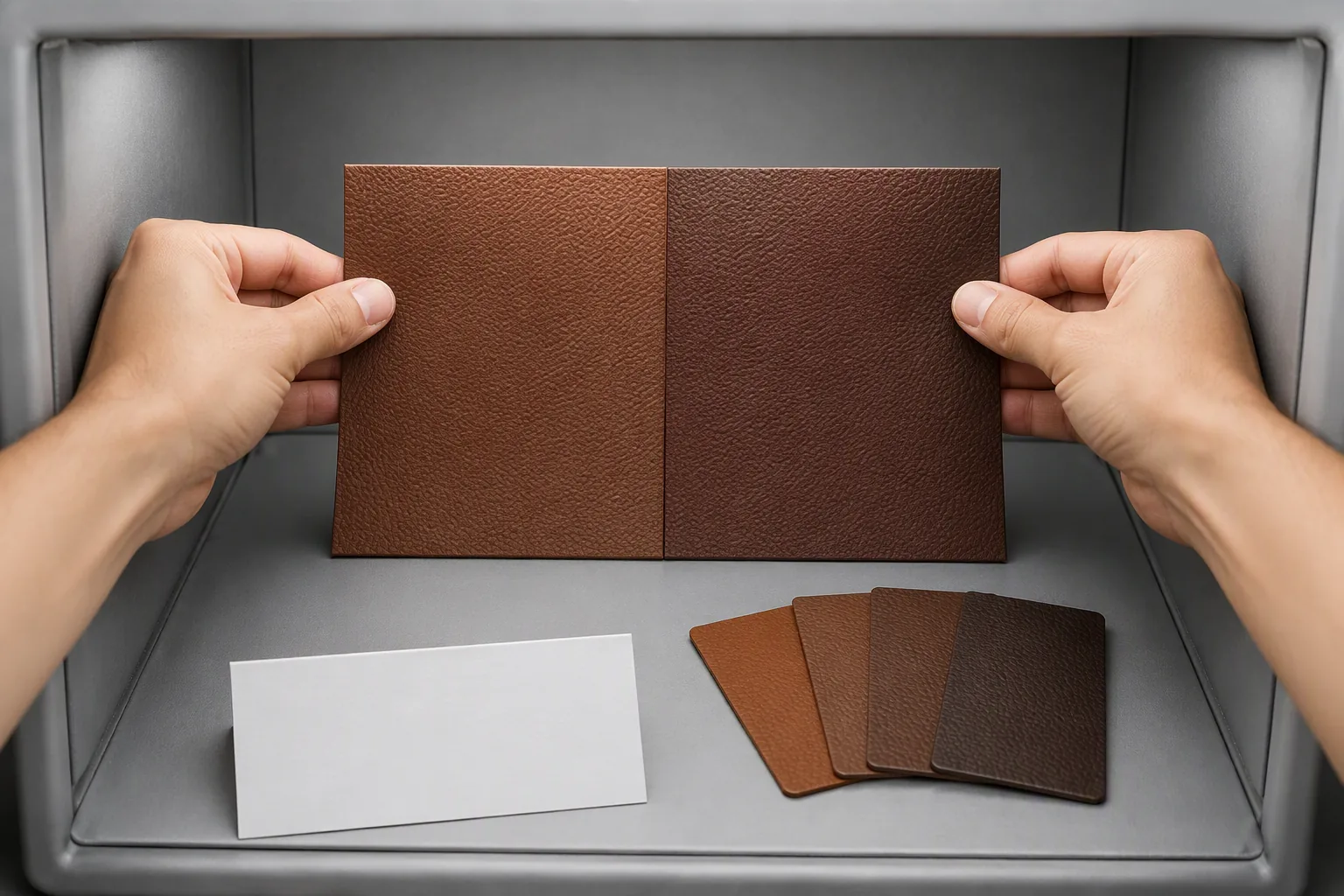
A Workable Light Box Procedure
A repeatable procedure matters more than expensive equipment.
- Place the reference swatch and the sample panel side by side, touching, on the light box floor.
- View from directly above at the same distance for each sample.
- Assess under the approved light source, then confirm under at least one second source.
- Rotate the sample to compare both grain directions and sheens.
- Record the result against the lot number, not against the operator’s impression.
- Clean the light box interior, since contamination affects the judgement.
Accept, Hold or Reject
Three outcomes are more useful than a pass or fail.
A lot that matches the reference within the band is accepted. A lot that sits near the limit but could be used for non-matching parts is held and re-allocated rather than rejected, which recovers value. A lot that is outside the band on simultaneously visible surfaces is rejected for those parts. Recording which decision was taken, and why, is what makes the next lot easier to judge.
Common Colour Problems and Their Causes
Colour complaints form a small number of repeating patterns.
Panel-to-Panel Mismatch on One Bag
This is the most common complaint and almost always a cutting decision.
It happens when matching-group panels are cut from different hides or different lots, when grain direction differs across panels, or when a patch from a separate offcut is used to complete a large panel. The fix belongs in the cutting plan and in keeping matching groups together, not in additional inspection.
Tone Shift Between Production Batches
Batch shifts appear when a reorder is produced from a new lot without comparison.
The first units of a new batch are compared with the previous batch rather than with the master reference, or not compared at all, and the shift is discovered by the customer who bought both. Comparing every new lot against the retained physical reference, under the same light, catches the shift while the material is still in the warehouse.
Colour Change After Assembly
Some colour problems do not exist until the bag is finished.
Adhesive bleed at edges, heat from fusing operations, pressing marks, and handling during assembly can all alter the surface. These effects should be checked on a fully assembled sample, because an inspection of flat panels will not reveal them.
Fading and Change in Use
Colour change in use is a finish performance question.
Light exposure, rubbing against clothing, cleaning agents and moisture all affect leather colour over time, and the rate depends on the dye and finish type rather than on the colour chosen. This is where specification of finish type and appropriate care advice protects the brand long after the sale.
Defect Reference
| Symptom | Likely cause | Where to fix it |
|---|---|---|
| Flap darker than front panel | Matching group cut from different hides | Cutting plan and hide allocation |
| Strap lighter than body | Grain or sheen direction differs | Direction marking on patterns |
| Visible shift at a batch change | New lot not compared with reference | Lot comparison at goods-in |
| Uneven tone across one panel | Panel cut across a hide gradient | Panel placement within the hide |
| Colour dulls after pressing | Heat and pressure on the finish | Process settings, trial assembly check |
| Localised darkening in use | Handling oils and abrasion | Handling discipline and care advice |
Managing Colour Across a Product Range
Range management is a planning problem as much as a production one.
Core Colours and Seasonal Colours
Core colours need continuity; seasonal colours need flexibility.
Core colours that stay in the range for years should be held against the same master reference indefinitely, because customers compare a new bag with the one they bought earlier. Seasonal colours can accept a wider band and shorter reference life, which allows the range to move faster without weakening the standard where it matters.
Multiple Tannery Sources
Using two suppliers for one colour requires an extra control step.
Two tanneries will not produce identical colour, even against the same nominal specification, so the practical approach is to treat each source as its own shade and to keep panels from different sources out of the same matching group. Where a colour is split across suppliers, the switchover needs to be planned so that a bag is never assembled from both.
Reorders and Continuity References
Reorders are where colour standards are usually lost.
The retained reference should be protected from light and handling, and it should be replaced only when a deliberate range decision is made. When a reference has faded or been lost, the new “reference” is whatever arrives next, which quietly redefines the standard downward.
Customer Expectations and Claims
Managing expectations is cheaper than managing complaints.
What to Explain Upfront
A short, honest explanation prevents most colour complaints.
Leather is a natural material whose tone varies slightly within and between hides, and this is a characteristic rather than a fault. The distinction worth stating clearly is that variation within a matching group on the same bag is a defect, while gentle variation between separate bags is normal.
Handling Colour Claims Fairly
Claims should be assessed under consistent conditions.
The practical approach is to ask for photographs taken in daylight, to compare the returned product against the retained reference and the approved light source, and to judge whether the mismatch is between simultaneously visible panels. That standard makes decisions consistent and defensible, instead of depending on who is negotiating.
Care Advice That Preserves Colour
Care guidance should be specific to the finish, not generic.
- Keep leather out of prolonged direct sun, which changes tone over time
- Wipe with a dry or barely damp soft cloth rather than solvent cleaners
- Avoid abrasive products, which alter sheen and read as tone change
- Store filled or lightly padded so panels are not compressed against each other
- Expect gentle darkening on handled areas as normal ageing
Colour Priorities by Bag Type
Different products expose colour problems in different ways.
Diaper Bags and Family Bags
Family bags have many panels in close proximity, which raises the matching requirement.
Front, flap, side pockets and straps are often visible at once, and the bag is handled by several people in different lighting, including outdoors. Defining several small matching groups rather than one large one keeps the standard achievable, and it prevents the common failure where a pocket face is cut from a convenient offcut that reads a shade off.
Backpacks
Backpacks are usually judged in daylight, where light-source problems are most visible.
Panels wrap around curved surfaces and meet at angles, so the same colour can read differently on a top panel and a side panel purely through light direction. Keeping the lid, front and side panels in one matching group, and checking the assembled bag outdoors at least once during development, catches mismatches that a light box alone will not.
Totes and Handbags
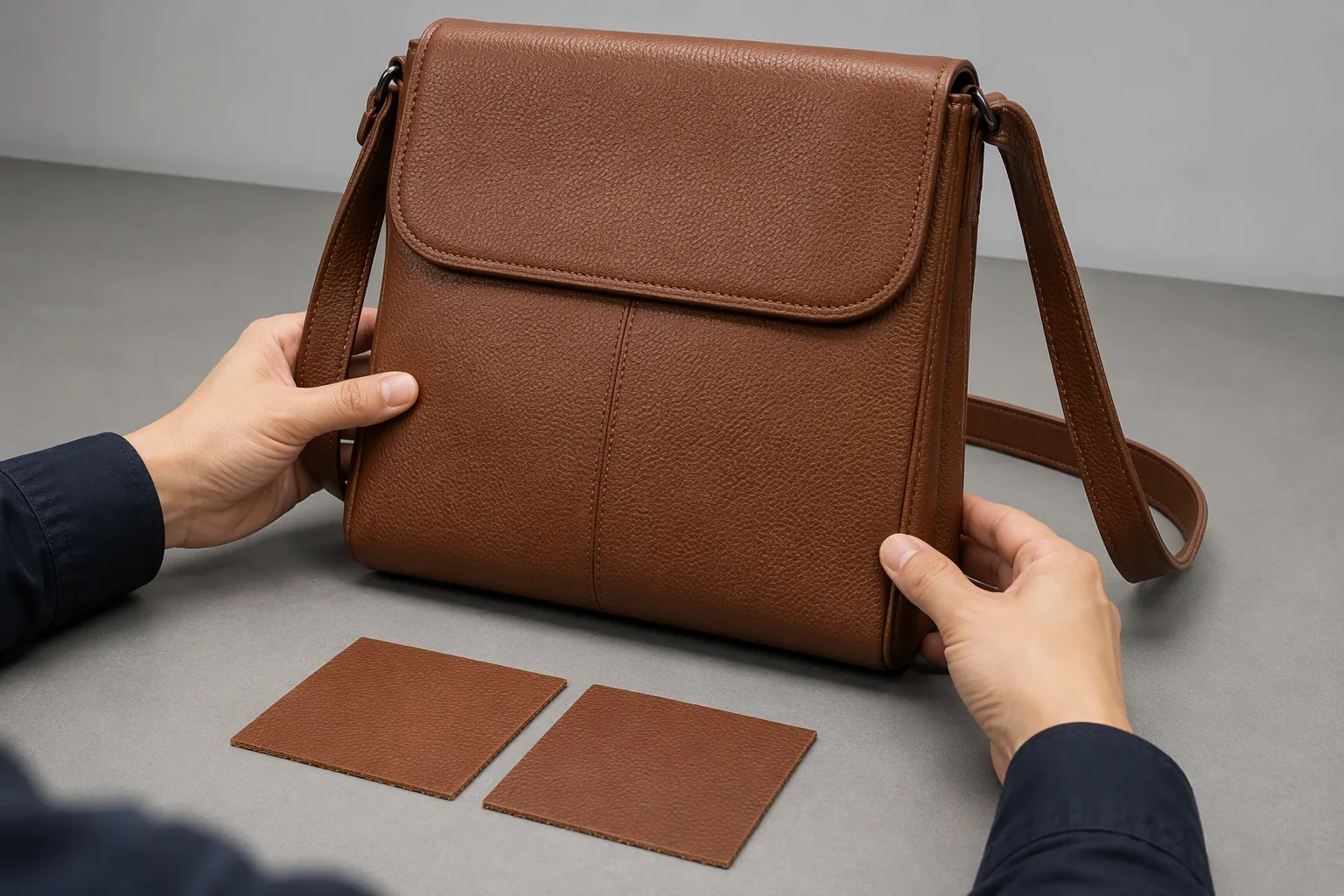
Totes and handbags carry the strictest requirements because large flat panels dominate the view.
A single visible panel shows the full tone gradient of the hide, so panel placement within the hide matters as much as lot selection. Cutting the largest visible panels from back area and keeping them adjacent in the hide gives the tightest match and the most even appearance across the bag.
Small Leather Goods
Small leather goods expose small panels to close inspection.
Because the customer looks at the product from a short distance, small shifts that would be invisible on a large tote become noticeable. Cutting all visible exterior components from one small section of a single hide is practical here, and it is the most reliable way to keep a wallet or card case internally consistent.
Cost and Yield Implications
Tighter colour control has a real material cost, and it should be decided deliberately.
Yield Cost of Matching
Matching panels from the same hide costs yield.
Restricting a matching group to one hide or one contiguous area means accepting the defects present in that area, and it can mean leaving usable material unused because it belongs to a different tone. Estimating that yield cost during development allows the standard to be set with the cost visible, rather than discovered in the first production run.
Where to Spend and Where to Save
Colour control should be concentrated where the customer is looking.
Paying for strict matching on internal pockets and linings is waste, while economising on a flap or strap is visible on every bag. The practical rule is to spend matching effort on simultaneously visible exterior surfaces and to allow looser control everywhere else, including hidden reinforcement and internal structure.
Balancing Inspection Against Prevention
Prevention is cheaper than inspection in colour control.
Inspecting every hide against a reference consumes labour and still cannot fix material that was allocated to the wrong panels. Defining matching groups, segregating lots and keeping matched panels together through assembly removes the cause, and the inspection that remains is smaller, faster and more meaningful.
Working with the Tannery on Colour
Colour is a shared problem, and most of it is solved before the leather ships.
Writing a Colour Requirement That Can Be Met
A requirement should state the colour, the tolerance and the conditions.
Specifying a colour name alone gives the tannery nothing to control against. A workable requirement names the reference sample, the acceptable band, the light source for visual assessment, the finish type, and the panels the colour will be used on. Suppliers can meet a measurable requirement; they cannot meet an adjective.
Batch Size and Colour Stability
Batch size affects how consistent a colour can be.
Larger dye and finishing batches generally produce more uniform colour within themselves, because the equipment and recipe stay constant across the run. This creates a practical trade-off: ordering larger lots for a core colour improves consistency but ties up material and cash, while ordering small quantities frequently increases the number of lots in circulation and the number of comparisons that must be made.
If a Shade Is Discontinued
Discontinuation should be planned rather than discovered.
Tanneries change raw material sources, dyes and processes, and a shade can drift or disappear. Where a core colour is important to a range, agreeing advance notice, retaining a reference and pre-approving a replacement shade avoid a situation where continuity is decided by whichever material arrives next.
Training and Documentation on the Line
Colour control only works if the people at the table can apply it.
Training Cutters and Inspectors
Operators need the standard, the light and the authority.
Training should cover how to read the cutting plan’s matching groups, how to use the light box, how to record a lot number, and what to do when a panel is outside the band. Without the authority to hold a lot, even a well-trained operator will pass material through under schedule pressure.
Keeping the Records Usable
Records are only useful if they can be read later.
Recording lot numbers, measurement results and accept or hold decisions against the work order makes it possible to trace a complaint back to a lot, and to identify whether a recurring problem is one supplier or one production period. Records that live only in an operator’s notebook cannot do either.
Reviewing Colour Complaints as Data
Complaints should be reviewed as patterns rather than as incidents.
Grouping complaints by colour, panel group and lot shows whether the cause lies in a specific supplier, a specific hide position or a specific assembly station. That pattern is what turns a series of customer emails into a change in the cutting plan.
Frequently Asked Questions
Why does leather colour vary between bags of the same style?
Leather is a natural material, and colour varies within a hide, between hides and between production lots. Variation between separate bags is normal. Variation between panels that are visible together on the same bag is a production defect and should be treated as one.
Which panels on a bag need to match in colour?
Those that are seen together: the front panel, flap, strap and gusset on most styles, with pocket faces matching the panel they sit on. Internal pockets, linings, reinforcements and stiffeners normally do not need to match, and treating them as if they did inflates cost without improving appearance.
How should colour be approved for leather bags?
Against a retained physical swatch, under a defined light source, with the acceptable tolerance stated. Text descriptions and photographs are not reliable colour references, because they are interpreted differently and shift with lighting, cameras and screens.
What causes two leather panels to match indoors but not outdoors?
Different light sources have different spectral output, so panels finished with different dyes or processes can appear identical under one source and visibly different under another. This is why approval happens under a stated light source and is confirmed under a second one.
Should I use a spectrophotometer to control leather colour?
It is useful alongside visual assessment rather than instead of it. Measurement is consistent and repeatable for flagging lots, while the eye judges relationships between adjacent panels and how they read on the finished bag. Most factories use measurement to prioritise and the eye to decide.
How do I prevent colour mismatch on a reorder?
Compare every new lot against the retained physical master reference under the approved light before cutting, and keep core colour references protected from light and handling. A faded or lost reference silently redefines the standard to whatever arrives next.
Can two leather suppliers deliver the same colour?
Not identically, even against the same nominal specification. Each source should be treated as its own shade, and panels from different sources should not be placed in the same matching group on one bag. Switchovers should be planned so no bag is assembled from both.
What is a matching group in bag cutting?
A matching group is the set of panels on one bag that will be visible together and therefore must be cut from compatible material, ideally from the same hide or at least the same lot. Defining matching groups in the cutting plan is the single most effective colour control in production.
Does grain direction affect apparent colour?
Yes. Grain tightness, hair cell direction and the sheen of the finish all change how light reflects from a panel, which reads as a tone difference even when the colour is identical. Marking direction on the pattern and cutting every panel in a group the same way prevents it.
When should a leather lot be rejected for colour?
When it falls outside the accepted tolerance on panels that will be visible together. A lot sitting near the limit but usable for internal or non-matching parts can be held and re-allocated instead of rejected, which recovers value without putting a mismatch on the finished bag.
How can colour problems be reduced without changing suppliers?
Define matching groups in the cutting plan, cut within one hide where possible, keep lots segregated with lot identity carried onto cut panels, assemble in matched sets, and check under controlled light. Most mismatches are caused by material allocation, not by the leather itself.
The Bottom Line
Colour control is an allocation discipline, and it is won or lost at the cutting table.
Define which panels must match, cut those groups from the same hide or lot, mark grain direction, and keep matched panels together through assembly. Set the standard on a retained physical reference, approve it under a stated light source, and record every decision against a lot number.
Then treat colour complaints as data rather than as incidents. Patterns point to a cutting decision, a supplier or a hide position — all of which can be fixed. Chasing individual complaints cannot fix any of them.
