
Leather Storage and Packaging: A Manufacturer’s Guide
Leather Storage and Packaging: A Manufacturer’s Guide
A leather bag can survive ten years of daily use and still be ruined in three weeks of bad storage. Moisture, light, heat, compression, and chemical contact do more damage in a warehouse than most bags suffer in a customer’s hands.
As a bag manufacturer, we treat storage as a production stage rather than a waiting room. This guide covers how leather and finished bags should be stored, packed, and shipped — and what goes wrong when they are not.
- Why Storage Is a Manufacturing Stage
- Leather Storage at the Factory
- Moisture: The Main Enemy
- Leather Age and Shelf Life
- Chemicals, Pests and Contamination
- Warehouse Layout and Handling
- Packaging the Finished Bag
- Transit Packaging
- Retail Packaging Versus Transit Packaging
- E-commerce Packaging for Leather Goods
- Long-Term Storage for Brands and Retailers
- Consumer Storage: What to Tell Customers
- Diagnosing Storage Problems
- Packaging and Compliance
- The Cost of Poor Storage
- Frequently Asked Questions
- The Bottom Line
Why Storage Is a Manufacturing Stage
Storage changes material; it is not a neutral pause between operations.
What Happens to Leather in Storage
Leather is a hygroscopic material, which means it exchanges moisture with the air around it.
When humidity rises, leather absorbs water and becomes softer, heavier, and vulnerable to mold. When humidity falls, it releases moisture and can stiffen, crack at folds, or lose flexibility. Temperature drives the speed of these changes, and light drives fading and surface degradation.
The Cost of Storage Failures
Storage failures are expensive because they are discovered late.
A mold outbreak found at packing time affects finished goods, not raw materials, so the loss includes labor and hardware already invested. Deformed bags found at the warehouse are discovered after inspection has already passed them. Both are avoidable costs that appear as unexplained margin loss.
Why Buyers Should Care
Storage discipline at the factory is one of the clearest signals of operational quality.
A supplier that controls storage conditions usually controls process discipline elsewhere. A supplier that stores leather in a damp corner and stacks finished bags under heavy cartons will show the same casualness in stitching and inspection.
Leather Storage at the Factory
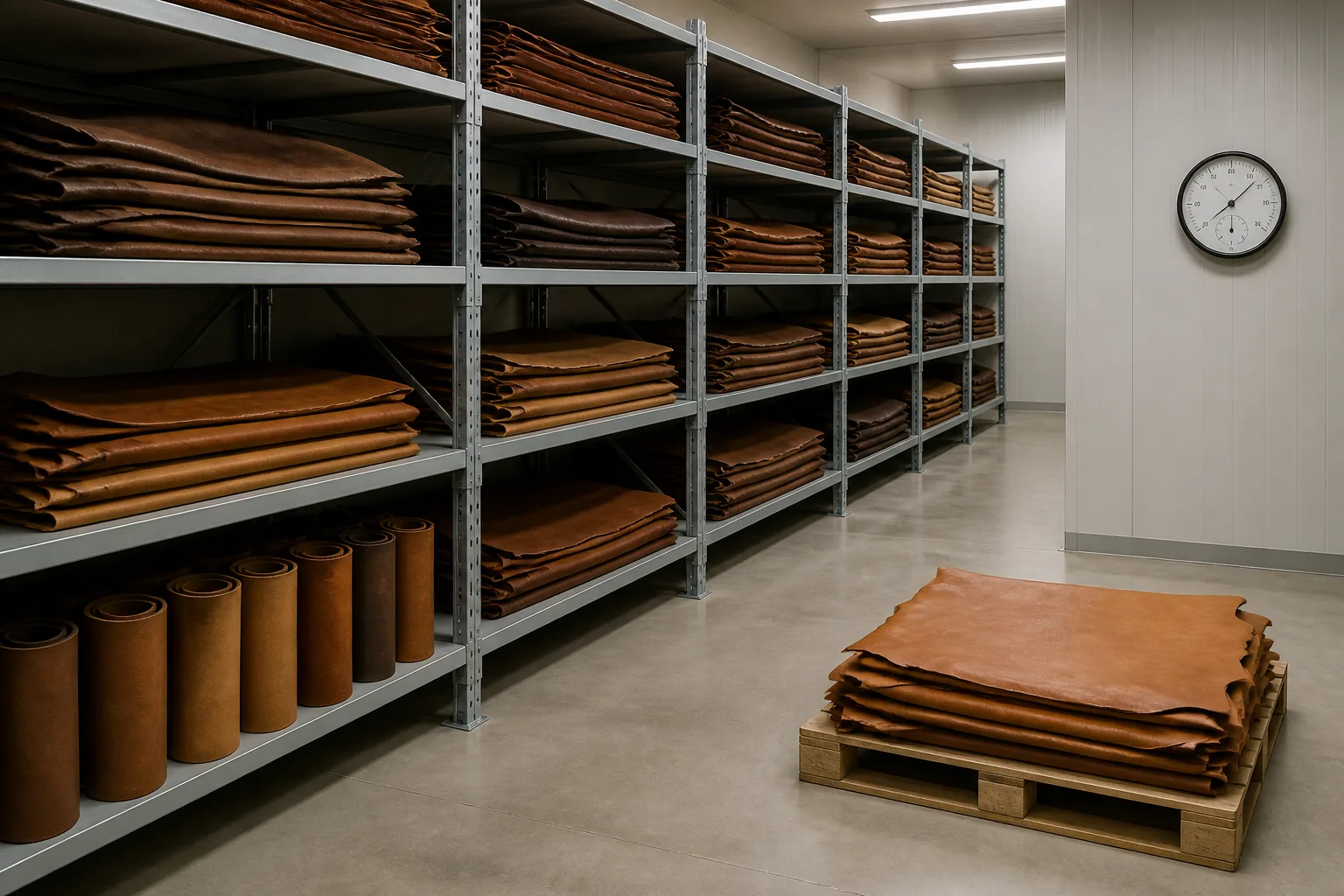
Raw leather storage has specific requirements that are easy to state and often ignored.
Ideal Conditions
The conditions below are the working targets we use for leather storage.
- Temperature: stable, moderate, away from direct sun and heat sources
- Humidity: controlled within a moderate band, avoiding both damp and very dry extremes
- Airflow: gentle circulation, never direct drafts on stored material
- Light: dark or dim storage, protected from daylight and strong artificial light
- Cleanliness: dust-free surfaces, nothing stored directly on bare floor
Manufacturer’s point: Stability matters more than any single number. Leather tolerates a consistent moderate environment far better than an environment that swings between damp and dry every week.
Stacking, Rolling and Hanging
How leather is physically stored affects its condition as much as the climate does.
Flat stacking is suitable for hides that will be cut soon, provided the stack is not so high that the lower layers compress permanently. Rolling prevents creases on material stored longer, but rolls must be supported so they do not flatten on one side. Hanging works for smaller pieces and allows airflow, but only if the hanging method does not mark the surface.
Light and Heat Exposure
Light damage is cumulative and permanent, which is why storage should be dark.
Ultraviolet light fades dyes and degrades finishes, and the change is gradual enough to be missed until a batch is compared against an untouched reference. Heat accelerates drying, promotes migration of oils and waxes, and can soften finishes until they bond to packaging materials.
Rotation and Age Limits
Leather does not spoil on a schedule, but it does change, so rotation matters.
First-in-first-out handling keeps older material moving into production before it has spent a long time in storage. Long-stored hides should be inspected before use rather than assumed good, especially around edges where drying shows first.
Storage Conditions Summary
| Factor | Preferred condition | What goes wrong otherwise |
|---|---|---|
| Temperature | Stable and moderate | Heat dries, softens finishes, speeds aging |
| Humidity | Controlled moderate band | Damp causes mold, dry causes cracking |
| Light | Dark or dim storage | Cumulative fading and surface degradation |
| Airflow | Gentle circulation | Stagnant air traps moisture |
| Stacking | Limited stack height | Permanent compression marks |
| Floor contact | Never direct | Wicking, damp, staining |
| Rotation | First in, first out | Older stock degrades unnoticed |
Moisture: The Main Enemy
If one factor deserves the most attention in leather storage, it is water.
How Moisture Enters Leather
Moisture arrives through the air, through contact, and through packaging.
Humid air is the usual route, but leather also picks up water from damp floors, wet pallets, condensation on cold surfaces, and packaging materials that trap moisture against the surface. A bag that feels dry can still be carrying enough moisture to grow mold in a sealed carton.
Mold and Mildew in Storage
Mold is the most common and most visible storage failure.
Mold needs moisture, warmth, and still air, and it feeds on the organic material of the hide and on finishing products. Early growth appears as a pale bloom or a musty smell; later stages leave stains that may not be removable. Prevention is environmental, and remediation is difficult, which is why storage conditions are cheaper than cleaning.
Condensation in Transit
Condensation is the failure mode that surprises shippers most.
Goods packed in warm, humid conditions and then moved into cooler air can condense moisture inside packaging. The same happens in reverse during seasonal transitions, and in containers crossing climate zones. Moisture barriers and desiccants exist specifically to manage this transition, and both are inexpensive relative to a mold claim.
Drying Leather Correctly
When leather does get damp, the recovery method matters.
Slow drying at moderate temperature with airflow is correct. Heat, direct sun, and forced hot air dry the surface faster than the interior, which produces stiff, cracked material. Leather that has been soaked should be dried in shape, with support to prevent collapse as it stiffens.
Leather Age and Shelf Life
Buyers often ask whether leather expires; the honest answer is that it changes.
Does Leather Expire?
Leather has no fixed expiry date, but it has a condition curve.
Stored in good conditions, leather remains usable for a long time, often years. Stored badly, it can become unusable in months through mold, staining, excessive drying, or finish migration. The variable is the environment, not the calendar.
Storage Effects by Tanning Type
Different tannages respond differently to storage conditions.
| Leather type | Storage behaviour | Main risk |
|---|---|---|
| Chrome-tanned | Generally stable, tolerates moderate variation | Mold in damp conditions, finish migration |
| Vegetable-tanned | Responds more visibly to humidity and light | Color change, drying, surface marking |
| Oil and wax pull-up | Oils migrate with heat and pressure | Uneven appearance, marks from packaging |
| Aniline and unfinished | Absorbs moisture and oils readily | Water marks, staining, handling marks |
| Coated and finished | Surface resists water but can bond to packaging | Sticking, finish lifting, print transfer |
| Suede and nubuck | Picks up moisture and dust easily | Matting, staining, difficult recovery |
Vegetable-Tanned Leather in Storage
Vegetable-tanned leather is the most rewarding to store well and the most punishing to store badly.
It continues to change color with light and time, which is part of its appeal to customers but complicates batch consistency. It also responds to humidity more visibly than chrome-tanned material, becoming softer in damp air and firmer as it dries. Storing it flat with even support prevents the creases that later show as permanent lines.
Chrome-Tanned Leather in Storage
Chrome-tanned leather is more forgiving, with two specific weaknesses.
It handles moderate humidity variation better, which is why it dominates production. Its weaknesses are mold in persistently damp conditions and finish migration when stored warm under pressure, where coatings and prints can transfer to adjacent surfaces or packaging.
Chemicals, Pests and Contamination
Storage damage is not always environmental; some of it comes from what is stored nearby.
Storage Near Chemicals
Leather should never share space with solvents, oils, cleaning agents, or strong-smelling materials.
Leather absorbs odors and chemicals from the surrounding air, and the effect can be irreversible. Solvent vapors can dull finishes, and oils can migrate into the surface. A separate, sealed store for leather is one of the cheapest quality measures available to a factory.
Insects and Rodents
Pests damage leather directly and indirectly.
Insects feed on hide and on finishing residues, and rodents chew edges and nest in stacked material. Prevention is routine inspection, sealed storage, and keeping food and waste far from the leather store. Damage discovered late usually means the whole stack needs inspection, not just the visibly affected pieces.
Metal Contact and Tarnishing
Contact with metal leaves marks on leather and damage on the metal.
Storing leather against bare steel shelving or uncoated metal frames can transfer staining, particularly in damp conditions. Similarly, stored hardware and finished bags with metal fittings should not touch each other or bare metal surfaces, because tarnishing and galvanic effects follow contact and moisture.
Cross-Contamination Between Colors
Dark and light leather should not be stored in direct contact.
Dyes can migrate between materials, especially in warm or damp conditions and under pressure, leaving light leather with dark stains that cannot be removed. Finished bags in contrasting colors and materials also benefit from individual wrapping rather than direct stacking.
Warehouse Layout and Handling
Layout decisions determine whether storage discipline survives daily production pressure.
Zoning by Material Type
Separate zones prevent the contamination problems described above.
A practical layout separates raw hides, cut panels, work in progress, finished goods, packaging materials, and hardware. Each zone gets its own environmental needs: leather needs stable humidity and darkness, hardware needs dry conditions to resist tarnishing, and packaging needs to stay clean and flat.
Racking and Floor Rules
Nothing leather should sit on the bare floor.
Floor contact wicks moisture, invites pests, and exposes material to cleaning chemicals and foot traffic. Racking with solid or coated shelves, pallets set on flat dry surfaces, and a clear physical gap between stored goods and walls all reduce risk at minimal cost.
Handling and Damage Prevention
Most storage marks come from handling rather than from the environment.
Dragging stacks, dropping hides onto edges, stacking heavy cartons on finished goods, and handling leather with soiled hands all leave permanent damage. Written handling rules and gloves are unglamorous measures that pay for themselves in reduced claims.
Inventory Accuracy
Storage discipline depends on knowing what is stored and for how long.
Lot marking at receiving, age tracking, and periodic stock checks prevent the accumulation of forgotten material that surfaces years later in poor condition. Inventory accuracy is also a compliance benefit, because traceability depends on the same records.
Packaging the Finished Bag
Packaging has two jobs: protect the bag and present it.
Stuffing and Shape Retention
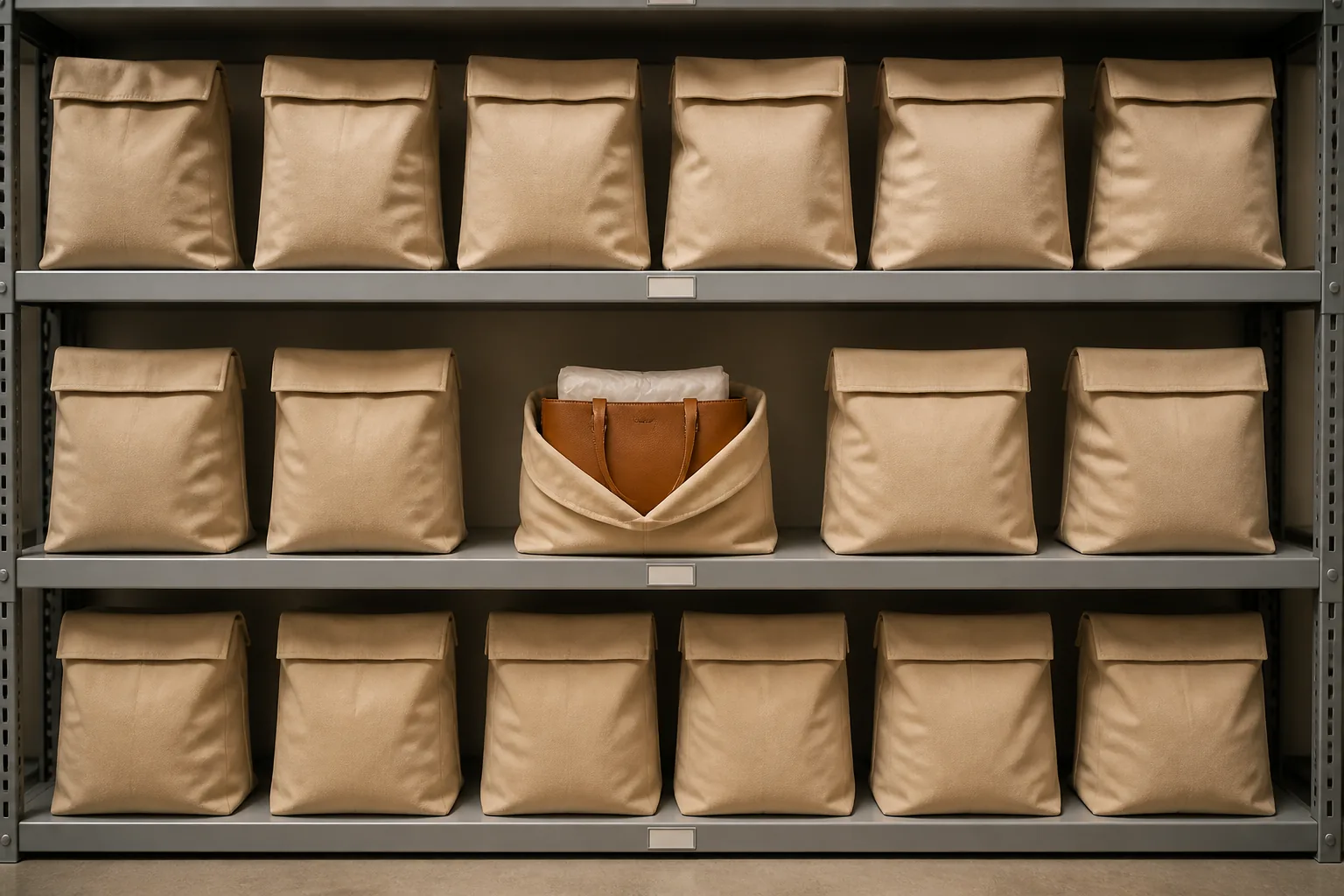
Bags should be packed in the shape they are meant to hold.
Stuffing with acid-free paper or shaped inserts prevents collapse during storage and transit, and supports handles so they do not crease at the attachment points. Soft or unstructured bags benefit most, and the extra minute of packing time is far cheaper than a deformed bag.
Dust Bags and Tissue
Dust bags protect against dust, light, and abrasion, and they are part of the product experience.
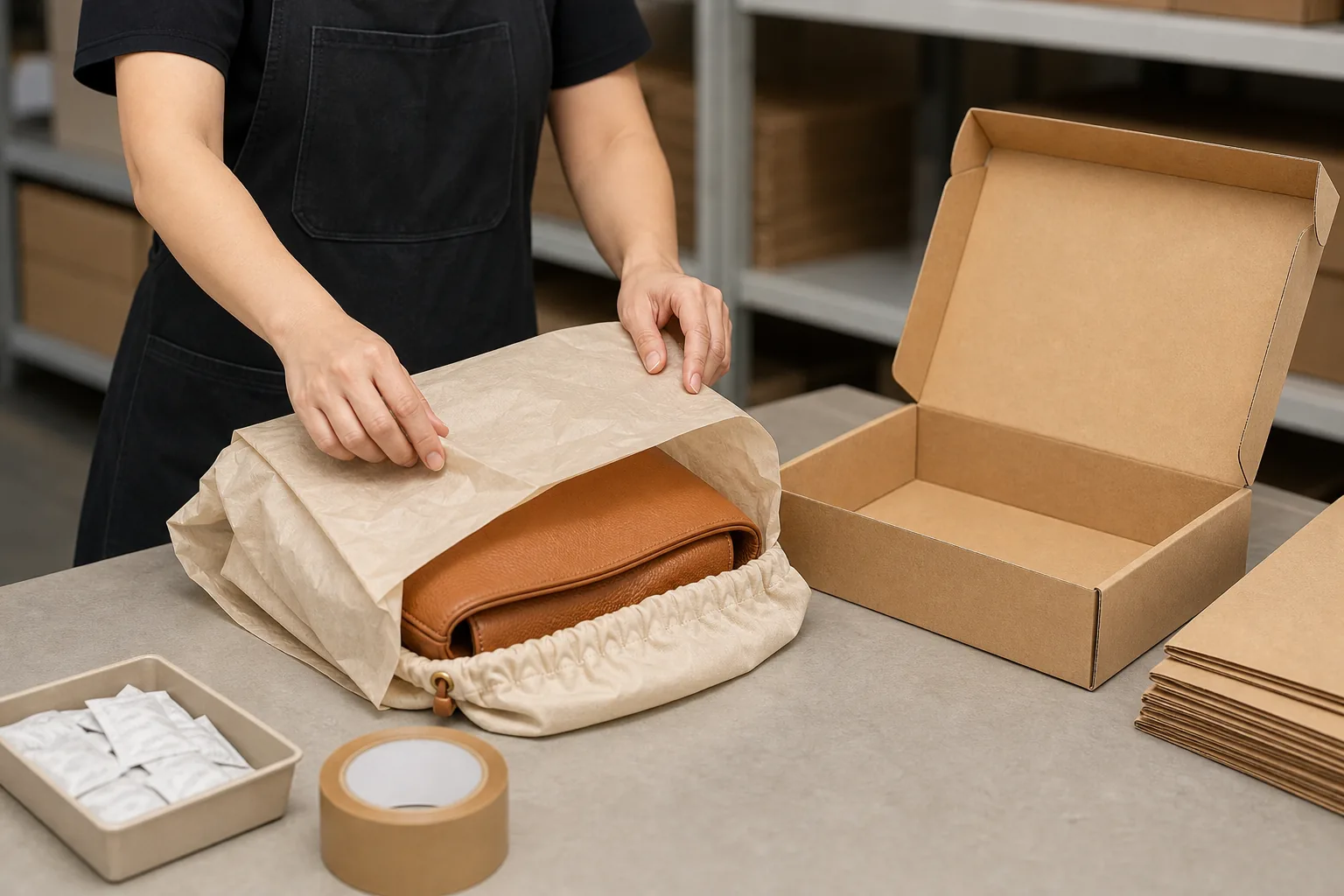
Acid-free tissue wrapped around metal fittings prevents contact marks and tarnish transfer. Non-woven dust bags are economical and effective in transit; cotton or heavier fabric dust bags are more durable and read as premium in retail. In both cases, the bag should be able to breathe rather than being sealed airtight while still carrying ambient moisture.
Hardware Protection
Hardware is the part most likely to damage the bag it is attached to.
Wrapping buckles, rings, and zipper pulls in tissue or protective film prevents them from pressing into the leather during transit. Metal components should also be protected from each other, because plated finishes can abrade or transfer marks under vibration.
Hanging Versus Boxing
The choice depends on the bag and the journey.
Hanging suits structured bags displayed in stores and avoids fold marks, but hanging leather long-term can distort handles and stretch attachment points. Boxing suits transit and dense storage, provided the bag is supported inside the box. For long-term storage, a boxed bag with internal support is generally safer than a hung one.
Transit Packaging
Transit is the harshest environment a leather bag will experience before it reaches a customer.
Cartons and Load Planning
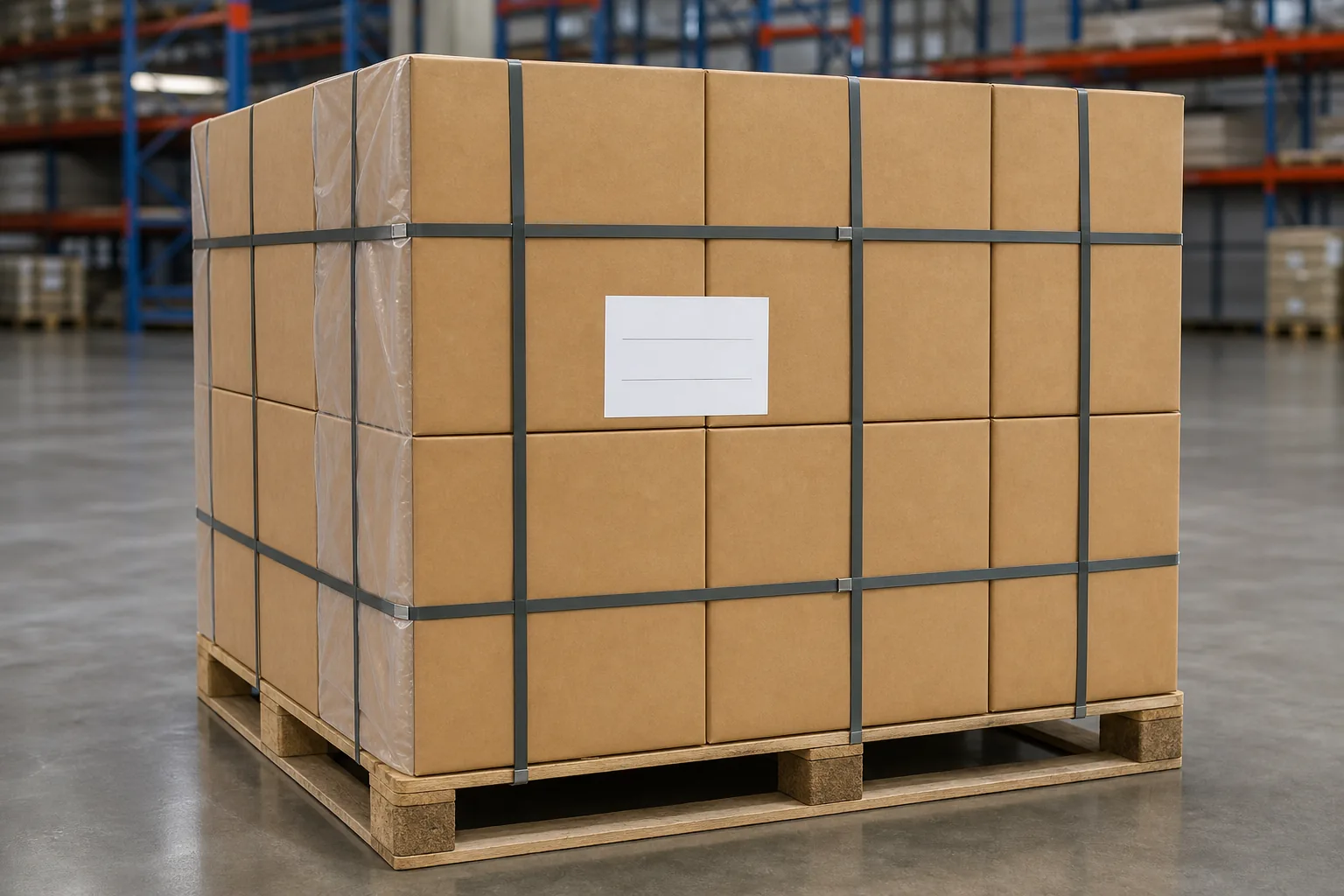
Cartons must match the weight and volume of what they carry.
Undersized cartons compress bags; oversized cartons allow movement that abrades surfaces. Load planning matters too, since a pallet stacked unevenly puts point loads on the cartons at the bottom, and those loads transfer directly to the bags inside.
Moisture Barriers and Desiccants
Moisture management in transit is cheap insurance.
A sealed liner or moisture barrier bag inside the carton, combined with desiccant sachets, manages condensation during climate transitions. Desiccants must be sized to the volume and journey, and they must never be placed in direct contact with leather, because localized over-drying can stiffen the surface.
Compression and Crushing Risks
Compression damage appears at the destination, not at packing.
Stack height limits, corner protection, and internal support structures all reduce crushing. Structured bags with a defined silhouette need most of the attention, since they hold their shape until they do not, and the damage is then visible to the customer immediately.
Labeling and Traceability
Transit packaging carries the information that makes claims manageable.
Carton labels should reference the order, style, colour, and lot, so an issue at the destination can be traced to specific production and specific material. Marking requirements for the destination market should be confirmed before the cartons are printed rather than after they are packed.
Transit Packaging Reference
| Requirement | Purpose | Common failure |
|---|---|---|
| Moisture barrier liner | Manage condensation across climate zones | Omitted on short shipments, then reused on long ones |
| Sized desiccants | Absorb residual moisture in the carton | Under-sized, or in direct contact with leather |
| Internal support | Hold bag shape under stacking | Assumed from the bag’s own structure |
| Stack height limit | Prevent crushing of lower cartons | Ignored when loading for volume efficiency |
| Individual wrapping | Prevent abrasion between bags | Skipped to save packing time |
| Traceable carton labels | Enable claims investigation | Labels listing style only, no lot |
Retail Packaging Versus Transit Packaging
The same bag often needs two different packaging specifications.
When Retail and Transit Diverge
Retail packaging sells; transit packaging protects.
A printed rigid box with foam insert is excellent on a shelf and awkward inside a shipping carton, where its volume raises freight cost and its corners are the first to crush. The practical approach is a retail unit inside a protective shipper, with the retail box specified only for channels that display it.
Matching Packaging to Channel
Channel determines the packaging specification more than product value does.
Wholesale shipments to retailers often need only dust bags and cartons, because the retailer controls presentation. Direct-to-consumer shipments need packaging that survives parcel handling and still looks considered on arrival. Marketplaces with their own fulfilment and labeling rules impose additional constraints that are easier to design for than to retrofit.
When Retail Packaging Costs More Than It Protects
Some packaging adds cost without adding protection or perception.
Heavy rigid boxes inside another carton, printed inner boxes never shown to buyers, and multiple layers of branded tissue often add cost and volume with no measurable benefit. The test is simple: name the customer who will see each layer, and remove the layers that have no audience.
E-commerce Packaging for Leather Goods
Direct-to-consumer shipping is where packaging earns or loses reviews.
Surviving Parcel Networks
Parcel networks apply forces that retail logistics do not.
Bags should be protected against compression, abrasion, and moisture, with enough internal structure to hold shape through sorting equipment. A dust bag alone is not transit protection; it is presentation plus light protection.
Presentation on Arrival
Unboxing is part of the product for direct-to-consumer leather goods.
Orderly wrapping, protected hardware, and a bag that holds its shape create confidence before the customer has inspected a single stitch. Conversely, a crushed bag with tissue marks creates doubt about quality that no material upgrade can repair.
Returns and Repacking
Returns are a packaging event that brands often ignore.
A returned bag must be repacked to resale standard or it becomes scrap. Planning for returns means specifying packaging that can be reopened without destroying it, and training fulfilment staff to inspect and repack rather than stacking returns in a corner where they will deform.
Long-Term Storage for Brands and Retailers
Brands and retailers store finished bags for months, which is where slow damage accumulates.
Climate and Light in a Stockroom
Retail stockrooms are often the worst storage environment in the chain.
Uninsulated back rooms swing in temperature and humidity, and shelf lighting runs for long hours directly above displayed bags. Storing inventory in the back in proper wrapping, with the display samples rotated on a schedule, prevents the common pattern of a perfect front bag and a faded replacement pulled from the stockroom.
Rotating Stock
Rotation prevents the oldest goods from becoming the least sellable.
First-in-first-out applies to finished goods as much as to leather. A simple rule of shipping the oldest stock with each order keeps inventory moving and prevents the discovery of a forgotten pallet from two seasons ago in poor condition.
Seasonal Storage
End-of-season inventory needs deliberate packing, not shelf time.
Bags stored for months should be cleaned, conditioned where appropriate, stuffed to shape, wrapped, and stored away from light and heat. Stacking seasonal inventory under heavy cartons is the most common and most damaging shortcut, and its effects appear when the stock is reopened for the next season.
Consumer Storage: What to Tell Customers
Customers store their bags the way they store everything else, which is why care guidance matters.
Everyday Storage
Simple habits prevent most damage.
- Keep the bag out of direct sun when not in use
- Avoid hanging a loaded bag by a single handle for long periods
- Do not store leather in plastic bags, which trap moisture
- Keep the bag away from radiators, heaters, and damp walls
- Use the dust bag for protection rather than for permanent sealing
Seasonal Storage
Long gaps between uses need a little preparation.
Empty the bag completely, remove any food or organic material, clean the surface, condition where the leather type allows, stuff the bag to hold shape, and store it in a dust bag in a dry, dark, ventilated place. Bags with chain straps should have the chain wrapped so it does not press into the leather.
Travel Storage
Travel compresses and abrades.
Packing a leather bag inside luggage without support is the fastest way to produce fold marks and crushed corners. Protection during travel is mostly about internal support and separating the bag from hard objects, and it costs nothing beyond a minute of packing.
Diagnosing Storage Problems
Most storage failures are identifiable by their symptoms, and the fix usually starts upstream.
Matching Symptom to Cause
| Symptom | Likely cause | Corrective action |
|---|---|---|
| White or grey bloom, musty smell | Mold from damp conditions and still air | Improve ventilation and humidity control, isolate affected lots |
| Stiff, cracking leather at folds | Over-drying, heat, or long storage unrolled | Moderate humidity, store rolled or flat without folding |
| Uneven darkening or marks | Light exposure, dye migration, or pressure marks | Dark storage, separate colors, reduce stack height |
| Finish transfer to packaging | Warm storage under pressure | Reduce temperature and stacking, use acid-free interleaving |
| Dull or spotted hardware | Humidity, contact with leather or bare metal | Dry storage, individual wrapping for fittings |
| Persistent creases in handles | Hanging loaded, or tight packing | Support handles, avoid hanging heavy bags |
| Dust embedded in suede | Open storage, no dust bag | Dust bags, routine cleaning per material type |
Root Cause Versus Symptom
Cleaning mold does not fix a damp store, and reshaping a bag does not fix a stacking rule.
The productive response to a storage problem is to change the condition that produced it. Recurring problems in the same location usually indicate a fixed cause: a damp wall, a hot ceiling zone, a shelf under a skylight, or a carton stack that grows too tall whenever volume rises.
When Leather Cannot Be Recovered
Some damage is permanent, and honest assessment saves more money than attempted repair.
Heavy mold staining, deep water marks on unfinished leather, brittle surface cracking, and large areas of finish lifting generally cannot be restored to saleable condition. Sorting these early prevents them from entering finished goods or reaching customers.
Packaging and Compliance
Packaging is regulated, and specifications should reflect that.
Materials and Restricted Substances
Packaging components fall within chemical regulations, including inks, coatings, and adhesives.
A compliant leather bag can still be held for a non-compliant carton or printed insert. When specifying packaging, ask for material declarations in the same way you would for leather, and keep them with the product records.
Labeling and Marking
Destination markets impose their own marking requirements.
Origin marking, material identification, recycling symbols, and language requirements vary, and they apply to packaging as well as to the product. Confirming requirements before printing avoids the expensive situation of correct bags sitting in incorrect cartons.
Recycling and Waste Rules
Packaging waste rules increasingly affect what packaging is acceptable.
Several markets tax or restrict specific packaging materials, and blended-material packaging is harder to recycle. Since packaging is often the most visible sustainability claim a brand makes, the specification should be chosen deliberately rather than inherited from an old product line.
The Cost of Poor Storage
Storage discipline is cheap; storage failure is not.
Where the Money Goes
Poor storage produces costs in several places at once.
- Material written off after mold or staining
- Finished goods downgraded or scrapped at packing
- Labor spent cleaning, reshaping, or repacking
- Replacement production and expedited freight
- Claims and returns from customers who received damaged goods
- Reputation damage in reviews that mention condition on arrival
Relative Cost of Prevention
Prevention is inexpensive compared with any of those outcomes.
Humidity control, shelving, dust bags, acid-free tissue, desiccants, and handling rules are all modest investments. The comparison that matters is between a small recurring cost and an occasional large loss with a schedule impact, and in most factories the arithmetic favors prevention clearly.
Measuring Storage Performance
What gets measured improves.
Tracking mold incidents, packing rejections, deformation claims, and damaged-on-arrival rates by location turns storage from a vague concern into a manageable process. Even a simple monthly count by storage zone identifies the problem areas faster than any inspection round.
Frequently Asked Questions
How should leather be stored in a factory?
Store leather flat or rolled in a dark, clean, well-ventilated space with stable moderate temperature and controlled humidity. Keep it off the floor and away from sunlight, heat sources, chemicals, and strong odors. Avoid tall stacks that compress lower layers, and rotate stock on a first-in-first-out basis.
Does leather expire?
Leather has no fixed expiry date, but it changes with time and conditions. Stored in a stable environment it remains usable for years. Stored in damp, hot, or brightly lit conditions it can become unusable within months through mold, staining, drying, or finish migration. The environment, not the calendar, determines shelf life.
How do I prevent mold on leather in storage?
Control moisture and airflow. Keep humidity within a moderate band, provide gentle air circulation, keep leather off damp floors and away from walls, and avoid sealing leather in plastic. Mold needs moisture, warmth, and still air, so removing any one of those conditions prevents growth.
Can moldy leather be cleaned and sold?
Light surface bloom can sometimes be cleaned professionally, but heavy mold staining is usually permanent, particularly on unfinished or suede leather. Mold also weakens the surface over time. Any affected lot should be isolated, assessed by a specialist, and kept out of finished goods unless clearly recoverable.
Is it better to store leather bags hanging or boxed?
For long-term storage, boxed with internal support is generally safer, because hanging leather bags for months can distort handles and stretch attachment points. Hanging is useful for short-term display of structured bags. In both cases the bag should be stuffed to hold shape and protected from light and dust.
What causes condensation inside shipping cartons?
Temperature differences between packing conditions and transit conditions, combined with moisture in the air and inside the goods. When warm humid air inside a carton cools, moisture condenses on cooler surfaces. Moisture barrier liners and correctly sized desiccants manage this transition.
Should desiccant sachets touch the leather?
No. Desiccants should be placed in the carton around the packed goods, never in direct contact with leather. Localized over-drying can stiffen the surface near the sachet and leave a visible difference in feel or finish.
How should a leather bag be packed for shipping?
Stuff the bag to hold its shape, protect hardware with acid-free tissue, place it in a dust bag, and pack it into a carton sized to prevent movement. Add internal support to prevent compression, use a moisture barrier and desiccants for long or climate-crossing shipments, and label cartons with order, style, colour, and lot references.
Why do leather bags arrive with creases or dents?
Almost always from compression or from unsupported packing. Undersized cartons, tall pallet stacking, insufficient internal support, and bags packed loosely together all transfer pressure onto the leather. Prevention means matching carton size to the bag, limiting stack height, and supporting the bag internally.
How should customers store leather bags at home?
Empty the bag, clean and condition it as the leather type allows, stuff it to hold shape, and store it in its dust bag in a dry, dark, ventilated place away from radiators and direct sunlight. Never store leather in plastic, and avoid hanging a heavy bag by one handle for long periods.
Does packaging have to meet compliance requirements?
Yes. Packaging components such as inks, coatings, and adhesives fall within chemical regulations, and destination markets impose labeling, origin marking, and recycling requirements on packaging. Packaging waste rules in some markets also restrict or tax specific materials, so packaging should be specified as deliberately as the leather.
The Bottom Line
Storage and packaging are where a good bag is either protected or quietly damaged.
Leather needs stability: moderate temperature, controlled humidity, darkness, airflow, and clean separation from chemicals and bare metal. Finished bags need support, individual wrapping, and packaging sized to the journey they will actually take. Transit needs moisture management and realistic stack height limits rather than optimistic ones.
None of this is complicated, and none of it is expensive compared with the losses it prevents. Treat storage as a production stage, measure the failures that occur, and fix the conditions that produced them. That is how leather reaches a customer in the condition the factory intended, and how a bag’s quality survives the last and least glamorous part of the supply chain.
