
How Should Leather Be Chosen and Specified for a Backpack?
How Should Leather Be Chosen and Specified for a Backpack?
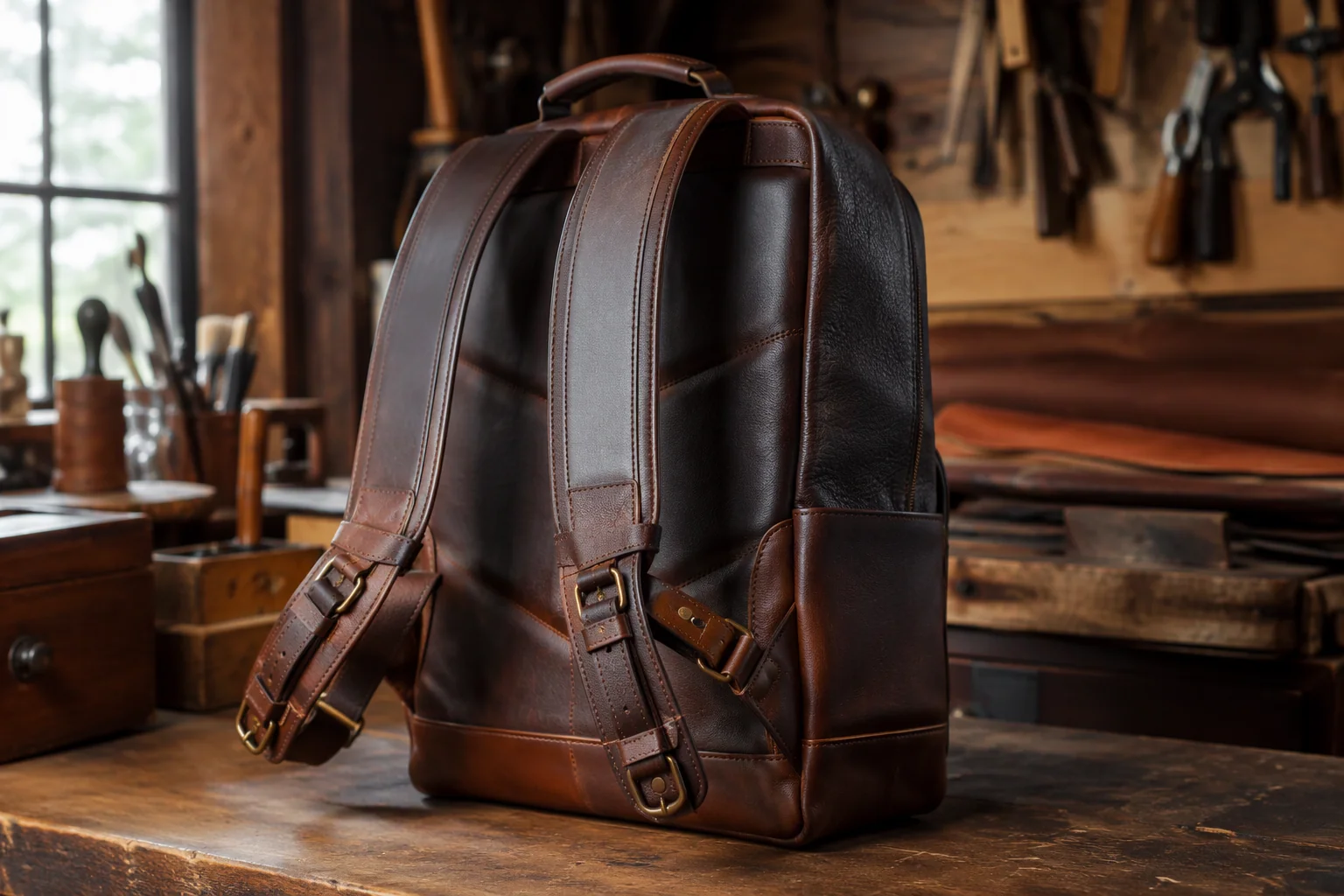
A backpack is the least forgiving bag a leather workshop can build. A tote carries weight from two handles near the body’s centre; a backpack hangs the same weight from four attachment points and a padded panel, and every one of those points is a place where a soft material can fail.
That is why leather chosen for a backpack cannot simply be “nice leather at a good price”. The straps need a material that does not stretch, the base needs one that does not scuff through, the back panel needs one that tolerates sweat, and the body needs something light enough that the bag is still worth carrying empty.
This guide deals with a single bag type, in the same way a specification sheet does. It sets out what each zone of a backpack demands from leather, how to assign thickness and temper by zone, where builders commonly get it wrong, and how to write the requirement so a factory can quote and inspect it. General comparisons between bag types, and the basic ounce system, are covered in separate articles on this site.
- Why a Backpack Asks More of Its Leather
- Mapping the Load Path
- The Zone Table in Practice
- Choosing Leather for the Straps
- Choosing Leather for the Body
- Choosing Leather for the Base
- The Back Panel and Contact Comfort
- Water Exposure and Weather
- Assigning Thickness by Zone
- Temper and Structure
- Lining and Interior
- Hardware and Attachment
- Assembly Sequence That Suits the Material
- Weight: The Cost of Overbuilding
- Common Failures and Their Causes
- Specifying a Backpack to a Factory
- Quality Checks Before Shipment
- Care and Longevity
- Backpack Types and Leather Choices
- Repair and Resale
- Working With a Buyer on the Specification
- Specification Checklist
- Leather Types That Suit a Pack Body
- Where the Specification Often Stops Short
- Packaging and Transit
- Frequently Asked Questions
- Conclusion
Why a Backpack Asks More of Its Leather
The Load Is Different
Weight in a backpack is suspended rather than carried in the hand. Every kilogram passes through two strap anchors and a small number of stitch lines, and a material with any stretch will show it within weeks rather than seasons.
The Contact Is Different
The bag rests against a moving body for hours. Contact areas see sweat, friction and pressure rather than simple abrasion, and they need a surface that tolerates all three without degrading or transferring colour.
The Abuse Is Different
Backpacks are set on floors, hung on hooks, dropped at gates and loaded past their design intent. The zones that meet the world, the base and the lower corners, take damage that a tote’s body never sees.
Mapping the Load Path
Straps and Anchors
This is the highest-stress area of the bag. Strap leather should be dense, low-stretch and firm enough to hold shape under load, and the anchor should be reinforced rather than relying on a seam through a single layer.
The Back Panel
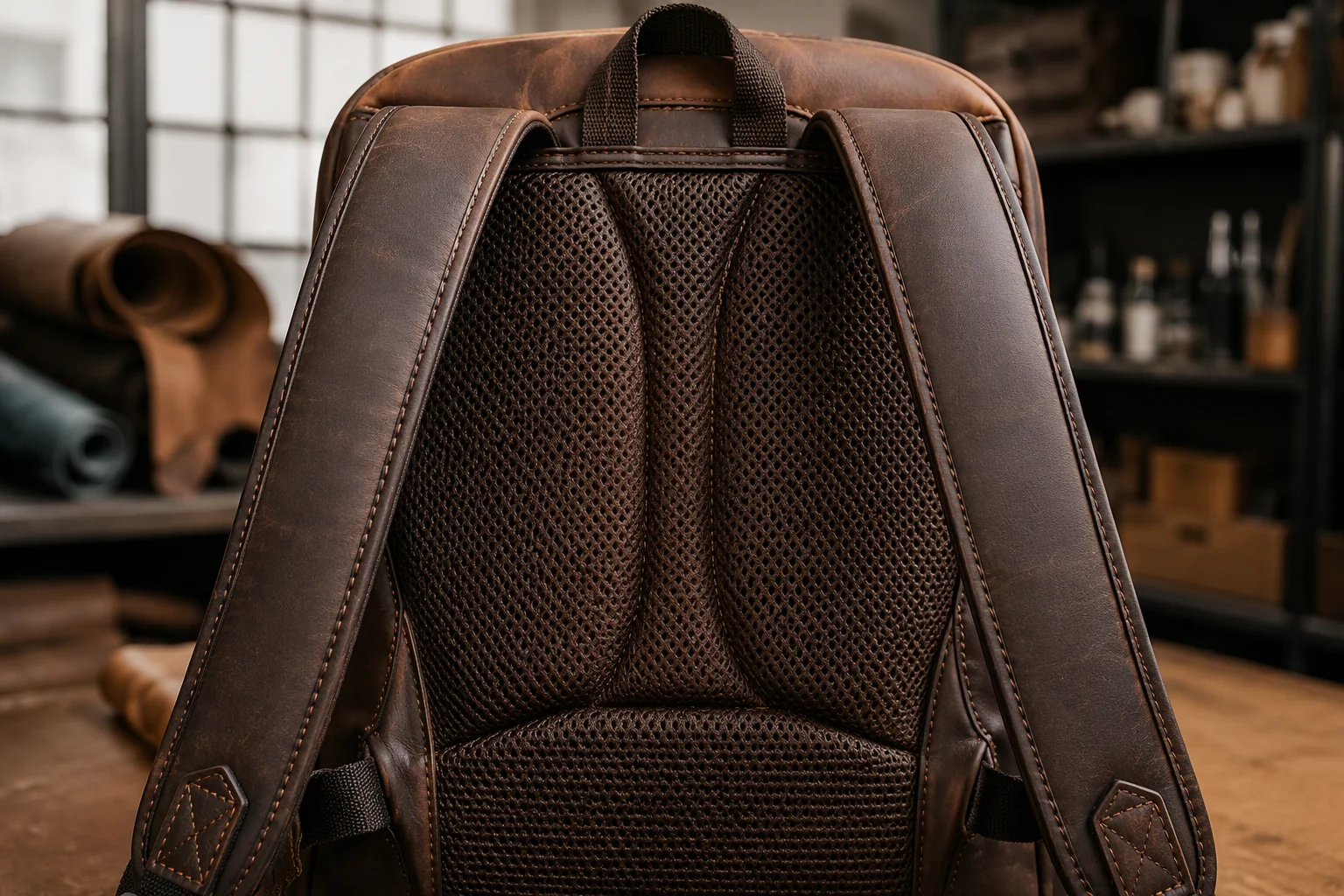
The panel carries pressure rather than tension. It needs a surface that does not polish, crack or stain from perspiration, with padding behind it and a structure that keeps the bag from folding into the wearer’s spine.
The Base
The base meets every surface the bag is set on. It needs the densest, most abrasion-resistant leather in the build, or a deliberate alternative such as a reinforced panel, a coated material or a metal foot arrangement.
A Working Zone Chart
| Zone | Main demand | Leather property to specify | Typical failure |
|---|---|---|---|
| Shoulder straps | Tension, low stretch | Dense fibre, firm temper, full grain | Stretch, edge crack |
| Strap anchors | Point load | Thick, backed, bar-tacked | Tear-out at stitches |
| Back panel | Pressure, sweat | Smooth, sealed surface | Polishing, staining |
| Body panels | Shape, light weight | Medium weight, matched temper | Sagging, creasing |
| Base | Abrasion, water | Densest available, tight finish | Scuff-through, water entry |
| Lower corners | Impact, abrasion | Reinforced or thicker | Burst seam, hole |
The Zone Table in Practice
Reading It Down the Bag
The table is not a suggestion to use six leathers. Most builds use two or three, chosen so that the hardest-working zones get the densest material and the visible zones get the most consistent one.
Where Cheap Builds Fail
A budget backpack usually applies one mid-weight leather everywhere. It survives the first year and then fails at the anchors and base, precisely the two zones the chart marks as highest risk.
Where Overbuilt Bags Fail Commercially
The opposite error is a bag built like luggage: dense leather throughout, heavy reinforcement everywhere, and a weight that makes an empty pack tiring. Leather selection has to respect the weight budget as much as the strength one.
Choosing Leather for the Straps
Why Strap Leather Is Not Body Leather
Strap leather works in tension along its length, so fibre density and low stretch matter more than surface appearance. A beautiful soft hide can make a strap that lengthens by a visible amount under a loaded bag.
Width, Thickness and Stretch
Width distributes pressure on the shoulder; thickness resists elongation. A narrow strap in thick leather can be comfortable and stable, while a wide strap in soft thin leather will still stretch and will also curl at the edges.
Lining and Padding Interaction
Straps are usually leather over padding over a lining or webbing core. The core takes the load, and the leather is the visible skin; specifying the core is as important as specifying the hide, and omitting it invites stretch.
Choosing Leather for the Body
Structured or Soft
A commuter pack wants a body that holds a rectangle; a travel or casual pack can drape. That decision sets temper first and thickness second, and it is made before any leather is ordered.
Panel Size Against Hide Size
Backpack panels are large. A hide that is too small forces joins into the front face, and a join on a smooth finished panel is visible from a metre away. Check panel dimensions against typical hide size before committing to a design.
The Weight Budget
Every increment of thickness adds weight across a large surface area. A backpack has more leather in it than a tote of the same capacity, so the body is usually the zone where a lighter, well-reinforced leather pays for itself.
Choosing Leather for the Base
Abrasion
The base is where abrasion is concentrated, and a smooth finished leather will show scuffing quickly. Dense fibre, a tighter grain or a deliberately textured surface all resist better than a soft aniline hide.
Water
Ground water enters through seams and stitch holes more often than through the surface. A water-resistant finish helps, but the seam treatment and the lining behind it decide whether the contents stay dry.
Reinforcement Options
A base can be reinforced with a separate panel, a heavier leather, a coated material or feet. Each option changes the bag’s weight and look, and the cheapest is usually the one that fails first.
The Back Panel and Contact Comfort
Sweat and Breathability
A leather back panel in direct contact with a moving back will collect moisture. Perforation, a mesh section, a contoured shape or a padded channel all help, and the choice belongs in the specification rather than in a late sample fix.
Padding and Its Covering
Padding behind a thin leather shows its edges. The covering leather needs enough body to spread the padding’s shape, and the padding needs to stop short of seams so it does not create a ridge.
Hardware Placement
Any hardware on the back panel, a luggage strap, a D-ring or a logo plate, sits against the wearer. Recessing it, covering the back of the fixing or moving it to a side panel prevents the most common comfort complaint.
Water Exposure and Weather
Rain
A backpack worn in rain has a horizontal top surface and a vertical body, and both collect water. A water-repellent finish slows absorption, and a flap, a covered zip or a storm welt does more for the contents than any coating.
Wet Ground
Setting a bag down on wet pavement is a daily event. The base’s finish and its seam sealing decide the outcome, and a bag that pools water along the bottom seam will wick it upward through the lining.
Finish Choices
Waxed, oiled and tightly finished leathers resist water better than soft aniline surfaces, at the cost of some grain character. For a pack that will see weather, that trade is usually the correct one.
Assigning Thickness by Zone
What Each Zone Needs
Thickness is the working lever, and it should vary by zone. Straps and anchors need substance, the body needs a balance of weight and shape, and the base needs density more than thickness.
| Zone | Thickness approach | Temper | Note |
|---|---|---|---|
| Straps | Heavier than body | Firm | Specify core webbing as well |
| Anchors | Same as straps, doubled | Firm | Always backed |
| Body | Mid-weight | Medium to firm | Varies with structure |
| Gusset and sides | Body weight | Slightly softer | Folds under load |
| Base | Body weight or heavier | Firm | Density matters more than thickness |
| Trim and binding | Thin | Soft | Appearance only |
Tolerances
Thin leather in a high-load zone fails early, so the tolerance matters as much as the nominal figure. Specify measurement points and a rejection band, and inspect at goods-in rather than at final assembly.
Why One Thickness Fails
A single thickness across a backpack is always a compromise: too soft at the anchors, too heavy in the body, too light at the base. Zone-based specification costs a little more in planning and saves the failures.
Temper and Structure
Firm Versus Soft Backpacks
Temper decides silhouette. Firm leather gives clean edges and a rectangular profile; soft leather gives a casual pack that collapses when set down. Neither is better, and both need different reinforcement.
Internal Frames and Sheets
A sheet in the back panel spreads load and stops the bag from folding into the wearer. When leather is soft, the sheet does more work; when it is firm, the sheet can be lighter and narrower.
Where Temper Shows
Temper shows at the seam edge, the strap’s curve memory and the way a loaded bag stands. Sampling is the only reliable test, because two hides sold as the same temper can behave differently once cut.
Lining and Interior
Laptop Sleeves
A padded sleeve needs a stable outer wall, or the padding migrates and the corner protection disappears. The sleeve’s leather should match the body’s temper, not be softer than it.
Interior Panels
Interior pockets, dividers and organiser panels add bulk behind the front face. Lighter linings and flat-seamed pockets keep the outside surface clean.
Lining Weight Against Shell
On a backpack the lining carries real load where the sleeve sits, so a very light lining will pull out at the seams. Choose a lining that can take the pocket’s load without adding weight everywhere else.
Hardware and Attachment
Strap Anchors
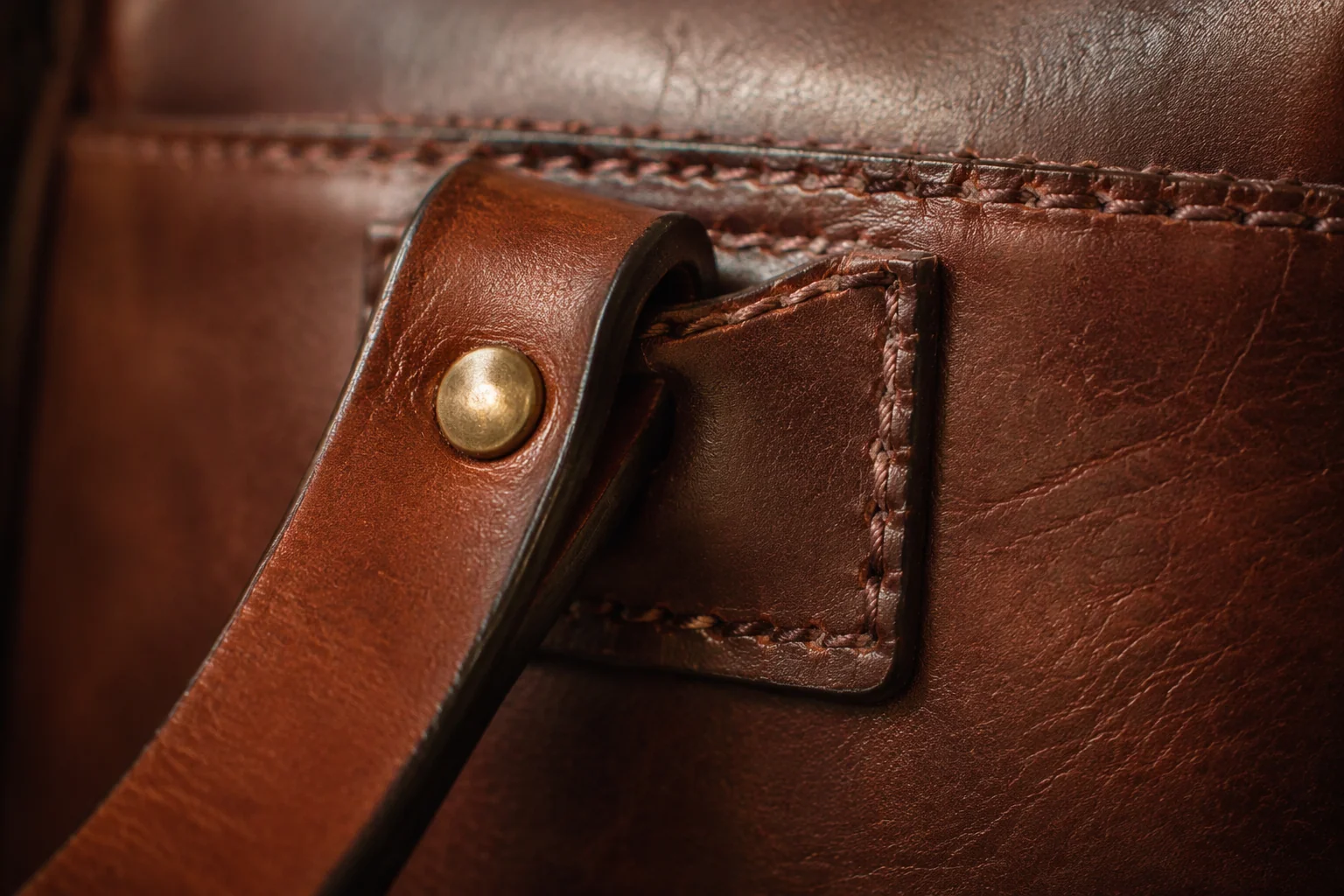
The anchor is a design decision, not a detail. A folded tab, a plate, a bar-tack through a reinforced patch or a riveted bar all behave differently, and the choice should be made against the expected load rather than by habit.
Buckles and Sliders
Ladder locks and sliders on leather straps need a strap thickness they can grip. A strap that is too thin slips; one that is too thick will not thread, and both problems appear after production.
Zips and Their Tapes
Zip tapes should be matched to the leather’s colour and weight, and the zip should be positioned so the leather does not pull against the teeth when the bag is full. Curved zips need a tape that follows the seam without puckering.
Assembly Sequence That Suits the Material
Prep and Skiving
Anchors, folds and strap ends are skived before assembly. On a heavy strap leather the skive must be gradual, or the transition becomes a step that shows through the surface.
Sewing Order
Back panel and straps usually go together first, then the body, then the gusset and finally the base. Joining the base last keeps the bag open for sewing and reduces the strain on the machine at the corners.
Turning and Topstitch
Where a pack is turned through an opening, the leather must tolerate folding at the corners without cracking. A topstitch after turning locks the shape and hides the seam allowance, and it should be planned in the pattern.
Weight: The Cost of Overbuilding
What an Empty Bag Weighs
Every zone that receives denser leather adds grams across a large surface. A pack built with strap-grade leather on the body can weigh close to double a well-specified one, and the customer notices that before noticing any difference in durability.
Where Weight Is Wasted
Weight is wasted in the body panels, the lining, the padding and any reinforcement that is thicker than the load requires. The straps and base, which do real work, are the last place to economise.
The Comfort Threshold
A pack that is tiring empty will be judged as heavy no matter how well it is made. Set a target weight at design stage, weigh the first sample with a full load, and treat any excess as a specification problem rather than a shipping detail.
Common Failures and Their Causes
- Strap stretch. Strap leather with too much stretch, or no webbing core, lengthens under load and the bag hangs low.
- Anchor tear-out. A single seam through one layer of leather fails at the stitch line; a backed, bar-tacked anchor spreads the load.
- Base scuff-through. A smooth soft base on a bag that is set down daily wears through at the corners within a season.
- Corner burst. A seam allowance too narrow at the lower corners splits when the bag is packed and dropped.
- Back panel polishing. A soft aniline surface in constant contact with a moving back polishes and stains, and cannot be repaired.
- Zip pull-out. A zip sewn into an unreinforced curve pulls away when the bag is overfilled.
- Edge cracking at straps. Edges that were painted without skiving crack at the curve where the strap enters the anchor.
- Water wicking at the base seam. Ground water enters through stitch holes and travels up the lining.
- Padding ridges. Padding that extends into a seam creates a hard line that shows through the leather.
Specifying a Backpack to a Factory
A Part-by-Part Bill of Materials
List each zone separately: straps, anchors, back panel, body, gusset, base, trim, lining, padding, zip and hardware. Each line carries leather type, thickness with tolerance, temper, finish and colour reference.
Samples and Load Trials
Ask for a sample loaded to the bag’s stated capacity and hung for a period before approval. Stretch and anchor behaviour appear under sustained load, not on a bench.
What to Ask the Factory
Ask which zone they would upgrade first and which they would leave alone. A factory that answers with the anchors and the base understands the bag; one that answers with the body is quoting from habit.
Quality Checks Before Shipment
Load and Strap Pull
Hang the finished bag with its rated load and inspect the anchors, the stitch tension and the strap length. Any visible elongation or stitch distortion is a rejection, not a note for next time.
Abrasion at the Base
Rub the base corners against a controlled abrasive surface for a fixed number of cycles and compare with the approved sample. The check is comparative rather than absolute, and it catches soft bases quickly.
Hardware Cycle
Open and close every zip, buckle and slider repeatedly, and check that the strap thickness allows smooth operation when the bag is full. Hardware that works empty and jams loaded is a design fault, not a supplier fault.
Care and Longevity
Cleaning
Wipe with a damp cloth and a mild soap solution, then dry away from heat. Avoid soaking the back panel, where padding holds moisture against the leather and the lining.
Straps and Edges
Check strap edges and anchors periodically. Edge paint at a strap curve is the first finish to fail, and touching it up early prevents the leather from drying at the same point.
Storage
Store empty, loosely filled to hold shape, away from heat and sunlight. A pack stored compressed under other luggage takes a permanent crease across the back panel.
Backpack Types and Leather Choices
Commuter Packs
Structured body, firm straps, sealed back panel, laptop sleeve with a stable wall. The priority is shape retention and clean edges, since the bag is seen in offices and on trains.
Travel and Weekender Packs
Softer body, denser base, generous straps, and hardware that survives being overfilled. The priority is volume and abrasion resistance rather than a crisp silhouette.
School and Everyday Packs
Light weight matters most, with a durable base and simple anchors. Dense leather everywhere makes the bag tiring for a daily carry, so reinforcement is targeted rather than general.
Diaper Backpacks
Wipeable interior, stable base, straps that stay comfortable when the bag is heavy, and a back panel that tolerates frequent handling. Leather belongs on the outside, with coated or washable materials inside.
| Pack type | Body | Straps | Base | Back panel |
|---|---|---|---|---|
| Commuter | Firm, mid-weight | Dense, cored | Reinforced | Sealed, structured |
| Travel | Soft to medium | Dense, wide | Densest available | Padded, breathable |
| School | Light, medium | Medium, cored | Reinforced | Simple, padded |
| Diaper backpack | Medium, wipeable inside | Dense, padded | Reinforced | Breathable, easy-clean |
Repair and Resale
What Can Be Repaired
Straps, zip pulls, edge paint, linings and base panels can all be replaced, and strap replacement is the most common repair on a good pack. A bag designed with accessible anchor stitching costs less to repair than one built as a sealed unit.
What Cannot
A polished or stained back panel cannot be restored, and neither can a base that has worn through the surface. Both failures are cheap to prevent at specification stage and impossible to correct afterwards.
Why It Matters Commercially
A pack that can be repaired keeps its owner and supports a resale price. Brands selling on longevity should specify parts that can be replaced, and keep the leather for those parts available for several seasons.
Working With a Buyer on the Specification
Start From the Load
Ask what the bag will carry before discussing leather. A commute with a laptop and a lunch is a different requirement from a weekend with clothing, and the answer sets strap and base specification immediately.
Agree the Zones Visible to the Customer
Some buyers want a single leather look across the whole bag; others accept a visible base or strap difference. Deciding that early avoids a sample that meets the engineering brief and fails the design one.
Put the Load Trial in the Contract
Sustained-load testing is the cheapest way to prove a pack, and it should be a stated acceptance criterion rather than a favour. A bag that passes on a bench and stretches on a shoulder has not been tested.
A backpack is the one bag where the specification is visible in use: strap length, back panel and base tell the customer within a month whether the leather was chosen or merely ordered.
Specification Checklist
- Load rating stated for the bag, in kilograms and litres
- Zone-by-zone leather list with type, thickness and temper
- Thickness tolerances and measurement points defined
- Strap core material and width specified alongside the leather
- Anchor construction named: tab, plate, bar-tack or rivet
- Back panel surface and ventilation method defined
- Base material and finish specified, with the reinforcement option
- Seam treatment at the base stated
- Lining weight matched to the sleeve and pocket loads
- Zip type, tape colour and curve handling specified
- Hardware sized for the strap thickness and tested loaded
- Padding extent and stop points marked on the pattern
- Edge treatment per edge, with an approved sample
- Retention sample per delivery, labelled by zone
- Load trial as an acceptance criterion, not a suggestion
- Target empty weight stated and checked on the first sample
Leather Types That Suit a Pack Body
Full Grain
Full grain gives the best combination of abrasion resistance and ageing for a pack body, provided the temper is right. It shows variation, which suits brands selling material honesty and unsettles buyers expecting uniformity.
Top Grain and Corrected Surfaces
A corrected or lightly pigmented top grain gives an even surface across large panels and hides the marks that a big bag would otherwise collect. For commuting packs sold in several colours, that consistency is often worth the loss of grain character.
Waxed, Oiled and Pull-Up
These finishes resist water and scuffing well, which suits travel and outdoor-leaning packs. They also mark and lighten where the bag is handled, so they suit a design that accepts visible wear rather than one sold on a flawless surface.
What Not to Put on a Pack Body
Very soft garment-weight leathers collapse under load, heavily coated splits crack at fold lines, and bonded materials fail at the zip and anchor stress points. Each of these looks acceptable in a flat sample and fails in a carried bag.
Where the Specification Often Stops Short
The Strap Core
Most specifications describe the leather and forget the webbing or padding inside it. Stretch, comfort and repair life are decided by that core, and it is the cheapest line in the document to add.
The Seam at the Base
The base material gets attention; the seam that joins it does not. A water-resistant base with an untreated seam still lets water in, and the fix belongs in the specification rather than in a later complaint.
The Weight Target
Few briefs state what the empty bag should weigh. Without a figure, reinforcement accumulates during development and nobody notices until the first sample feels heavy in the hand.
Packaging and Transit
Protecting Structured Panels
A structured pack can be deformed by its own carton if it is packed under compression. Corner protection, individual wrapping and a carton sized for the bag prevent the creases that appear after a long sea freight.
Humidity in Containers
Leather packs travelling through humid conditions can develop surface bloom or a musty smell. Desiccant, a dry container and sealed inner packaging are cheaper than the returns that follow.
Documentation in the Carton
Packing lists that identify the approved sample, the leather lots and the inspection result make a difference at the destination warehouse, where a disputed batch is otherwise judged without a reference.
Frequently Asked Questions
What leather is best for a backpack?
There is no single answer, because a backpack uses several zones with different demands. Dense, low-stretch leather for straps and anchors, a mid-weight leather for the body, and the densest available for the base is the working pattern.
How thick should backpack leather be?
Thicker in the straps and at the anchors, mid-weight in the body, dense rather than thick at the base. Thickness should be assigned by zone with tolerances, not chosen as one figure for the whole bag.
Can a backpack be made from soft leather?
Yes, and it will look casual and drape when set down. Soft bodies need more internal structure, and the straps still need a low-stretch core, otherwise the bag sags under load.
Why do leather backpack straps stretch?
Because strap leather is loaded in tension along its length, and soft or loosely fibred leather elongates. A webbing core inside the strap limits stretch, and it should be specified with the leather.
Is full-grain leather necessary for a backpack?
It is the best choice for straps and for the visible body where durability and ageing matter. On the base, a denser or reinforced material may serve better than full-grain, and on the lining it is unnecessary.
How do I stop the back panel from getting shiny?
Choose a sealed or textured surface rather than a soft aniline one, add ventilation or a mesh section, and avoid hardware that presses into the wearer. Polishing cannot be reversed once it develops.
What causes a backpack base to wear through?
A soft, smooth leather in constant contact with rough ground. Dense fibre, a textured finish, a separate base panel or feet all extend life, and the seam treatment decides whether water enters as well.
Should the base be a different leather from the body?
Often yes. The base works harder and is seen less, so a denser or darker material is a sensible allocation. Where the brand wants one uniform look, reinforcement behind the same leather is the compromise.
How is a backpack leather bag tested before shipment?
By hanging it with its rated load and inspecting strap length, anchors and stitch tension, by rubbing the base corners against a control sample, and by cycling every zip and buckle while the bag is full.
Does leather make a backpack too heavy?
Leather is heavier than nylon, so the body weight and the reinforcement have to be managed. Setting a target empty weight and checking it on the first sample prevents a pack that is tiring to carry empty.
Which leather suits a diaper backpack?
A medium-weight, wipeable body with dense straps and a reinforced base. The interior should be a coated or washable material rather than leather, since cleaning requirements are the deciding factor.
Conclusion
A backpack is specified zone by zone, and that is the whole discipline. Straps need dense, low-stretch leather over a core. Anchors need backing and a construction that spreads load. The base needs density rather than thickness. The body needs enough temper to hold a shape without turning the bag into luggage.
Get those four decisions right and the bag survives its first year of real use: the straps stay the length they were cut at, the base resists the pavement, and the back panel does not polish. Get them wrong and the failures appear in predictable order, at the anchors first and the base second.
The specification is not paperwork. On a backpack it is the difference between a bag that is judged by its leather and a bag that is judged by its repairs.
