
Is Calf Leather Worth the Extra Cost in Bag Manufacturing?
Is Calf Leather Worth the Extra Cost in Bag Manufacturing?
Calf leather sits at the top of the price list for a reason that has nothing to do with marketing. The hide is small, the animal is young, and the surface has had less time to acquire scars, insect damage and the coarser grain that comes with age. What arrives at the cutting table is smoother, finer and more consistent than almost anything else in the workshop.
It is also thinner, softer and less forgiving of a badly built bag. Calf rewards precision and exposes shortcuts: a seam that would disappear into a thick cowhide shows as a ridge, an edge that was never skived shows as a bulge, a lining that is too heavy drags the shape out of line.
This article looks at calf leather the way a factory does: what the hide actually is, why it costs what it costs, how it behaves in cutting, skiving, sewing and edge work, where it belongs on a bag and where it does not, how to specify and inspect it, and how to care for it. It is a single-material guide, not a comparison between hide types, which is covered elsewhere on this site.
- What Calf Leather Actually Is
- Why It Costs More
- The Hand and Weight of Calf
- Where Calf Excels on a Bag
- Where Calf Is a Poor Choice
- Cutting and Skiving Thin Panels
- Sewing Fine Calf
- Edge Work on Thin Leather
- Structure: Making a Thin Hide Hold a Shape
- Linings and Interiors
- Hardware on a Delicate Material
- Finishing Options
- Durability: What to Expect
- Care for Calf Leather
- Specifying Calf Leather
- Goods-In Checks
- Cost and Yield
- Calf by Bag Type
- Calf and Cowhide: The Hand Difference
- What Buyers Ask About Calf Bags
- Working With a Tannery on Calf
- Common Mistakes
- Specification Checklist
- Repair and After-Sales for Calf
- Frequently Asked Questions
- Conclusion
What Calf Leather Actually Is
Age, Not Breed
Calf leather comes from young cattle, typically within the first year. The animal is the same species as the cowhide used for heavier bags; what changes is the age, and with it the size of the hide and the character of the grain.
Why the Grain Is Finer
Young hides have tighter, smaller grain and thinner fibre structure. The surface has fewer healed scars and less of the deep, open pore pattern that older hides develop, which is why calf reads as smooth and even rather than rugged.
Hide Size and Its Consequences
A calf hide is smaller, which limits how large a panel can be cut in one piece and raises the number of hides needed for a given order. That single fact drives much of the cost difference, before any consideration of quality.
What the Word Does Not Guarantee
“Calf” describes an age range, not a grade. A calf hide can still be full-grain or corrected, vegetable-tanned or chrome-tanned, aniline-finished or heavily coated, and a cheap calf is often the least interesting leather in the room.
Why It Costs More
Fewer Square Feet per Hide
Small hides mean more cutting, more joins and more hides consumed per bag. The material cost per bag rises even when the price per square foot looks reasonable, because yield per hide is limited by panel size.
Slower Finishing
Fine grain shows everything, so the tannery spends more time on selection and finishing. Hides that would be acceptable for a corrected cowhide are rejected for calf, and that rejection is carried in the price.
Lower Tolerance in the Cutting Room
Scars, growth marks and colour variation that a heavier hide could absorb become visible defects here. The usable area falls, and the panels that remain must be matched more carefully.
The Market Position
Calf sits in the premium tier alongside the best cowhide and above most goat and sheep leathers. It is bought for how it looks and feels in the hand rather than for abrasion resistance, and it should be specified on that basis.
The Hand and Weight of Calf
Softness With Body
Good calf is soft without being floppy. It has enough substance to hold a panel flat and enough suppleness to fold cleanly, which is the combination that makes a well-made calf bag feel expensive in the hand.
Lightness in the Finished Bag
Thinner hides produce lighter bags, and a calf tote or shoulder bag weighs noticeably less than the same design in cowhide. For bags carried against the body for hours, that difference is part of the product.
Surface Response to Light
The fine grain reflects light evenly, which is why calf photographs well and why colour looks deeper and more saturated on it. The same evenness means a repair or a patch will never blend invisibly.
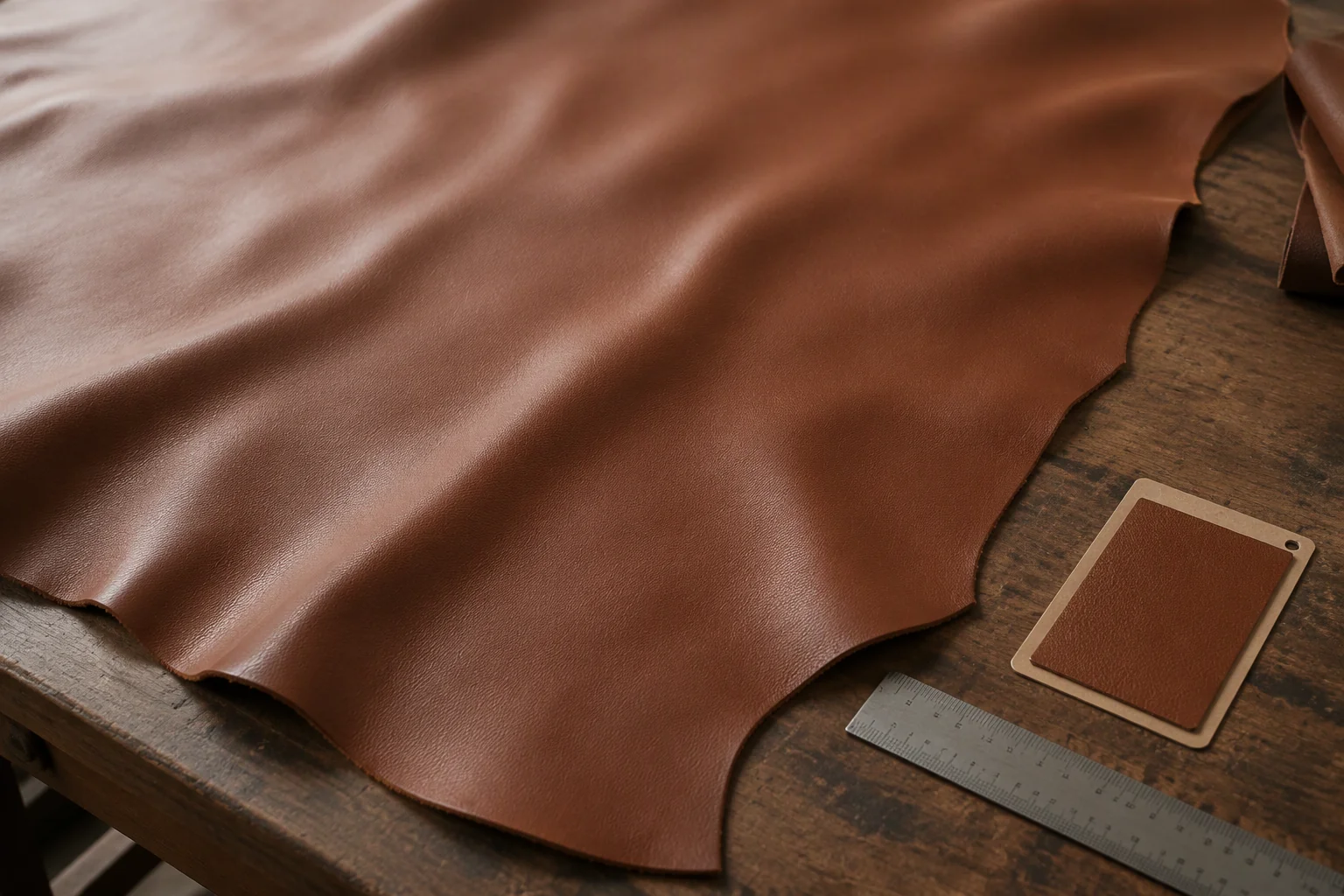
Temper Variation
Calf temper ranges from soft and drapey to firm and structured depending on tannage and finishing. Two hides sold under the same name can behave differently, so temper must be specified and checked, not assumed.
Where Calf Excels on a Bag
Structured and Semi-Structured Bodies
A firm calf holds a clean line without heavy reinforcement, which suits top-handle bags, shoulder bags and small structured totes. The panel stays flat and the silhouette survives daily use.
Fine Small Goods
Wallets, card holders, pouches and organisers are where calf is most at home. Thin panels, tight folds and visible edges are exactly the operations the material is made for.
Linings and Interior Panels
Thin calf can be used as a luxurious interior surface where a synthetic lining would feel cheap. It adds cost, and it is one of the few places where a thin hide earns its price inside the bag.
Detail Work
Piping, binding, handle wraps and small trims cut from calf give a refined edge that heavier leathers cannot match at the same thickness.
Where Calf Is a Poor Choice
Load-Bearing Straps on Heavy Bags
Thin leather stretches under sustained load. A calf strap on a bag that carries a laptop, a bottle and a day’s shopping will elongate, and the bag will hang lower every month.
Abrasion-Heavy Bases
A calf base on a bag that is set down on concrete will scuff through the surface rather than polish. Where a base must take punishment, a denser leather belongs underneath.
Outdoor and Utility Designs
Workwear shapes, bike bags and anything built for weather need a material that resists water and abrasion. Calf is the wrong tool, however good it looks in the sample room.
Large Single-Panel Designs
Hide size limits panel dimensions, so a design that needs a large uninterrupted panel will require joins. A join in the middle of a calf body is visible in a way it never is on a grained hide.
Cutting and Skiving Thin Panels
Blade and Pressure Control
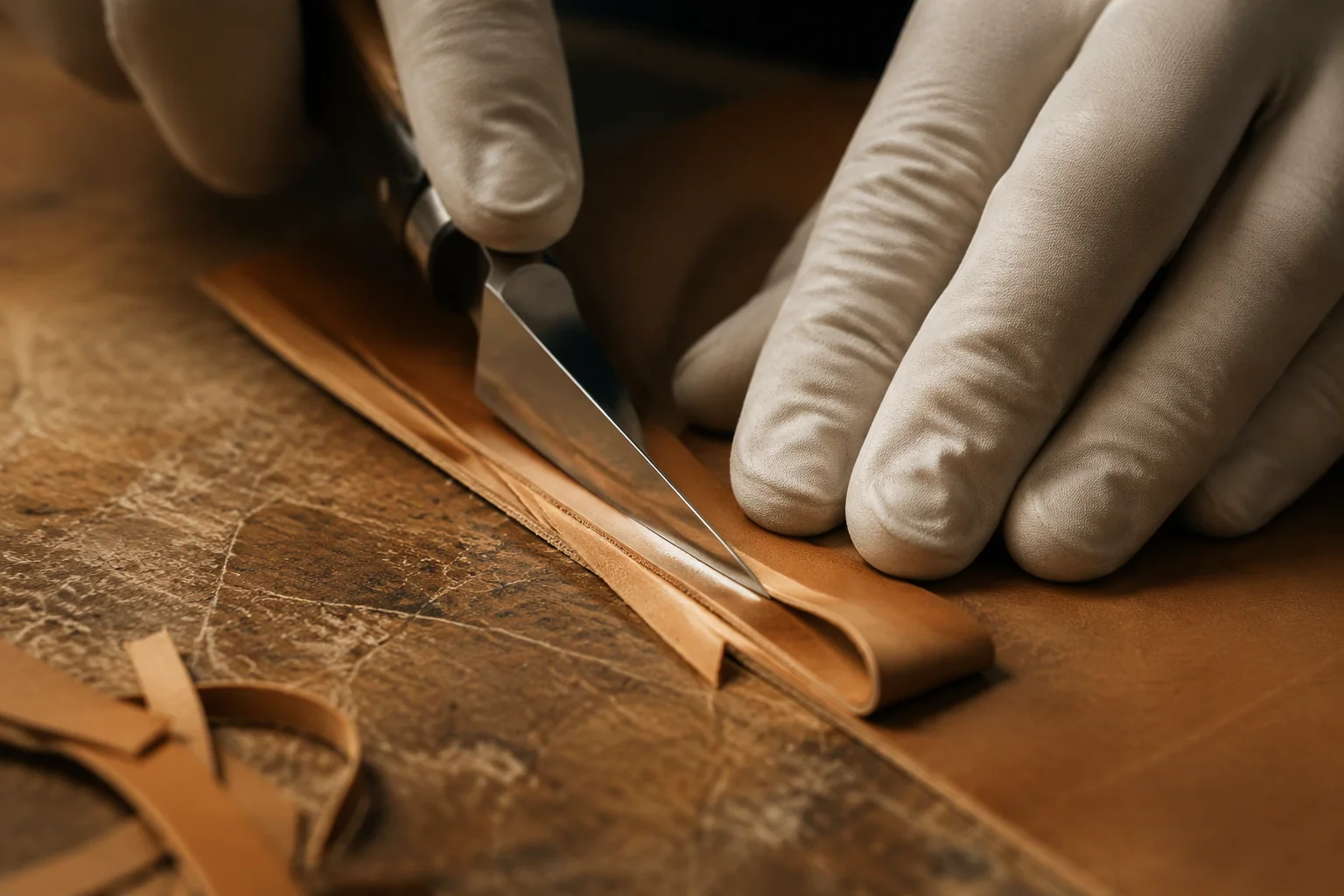
Thin leather cuts easily, which is the problem: too much pressure stretches the panel and leaves a wavy edge. Cutters need sharp blades, light passes and a surface that lets the material stay flat.
Skiving Accuracy
Skiving on calf is where quality is decided. A taper that is uneven by a fraction shows as a ridge along the finished edge, and the thin material gives no room to sand it away afterwards.
Matching Across Panels
Because the surface is even, mismatched panels are obvious. Cut adjacent panels from adjacent areas of the same hide where possible, and record which hide each panel came from.
Handling and Storage
Cut calf panels mark if they are stacked under weight or left in a humid room. Interleaved boards, flat storage and a dry environment prevent the creases that no finishing step can remove.
Sewing Fine Calf
Needle and Thread Scale
The thread must be fine enough not to overpower the leather and strong enough for the seam’s job. A heavy thread on thin calf pulls the panel into a wave, and a light thread on a stressed seam fails early; the balance is set on the actual hide.
Stitch Length and Appearance
Shorter stitches suit fine leather because the seam reads as a continuous line rather than as a series of marks. Too short, and the leather perforates into a tear line where the bag flexes.
Avoiding Feed Marks
Light presser-foot pressure and a roller foot reduce marking. On a smooth calf surface, a feed dog track along a seam cannot be repaired without replacing the panel.
Seam Bulk at Folded Edges
Thin panels fold tightly, which concentrates four layers into a small space. Skive before folding, plan the crossings, and check at sampling that the machine can pass them without skipping.
Edge Work on Thin Leather
Painted Edges
Thin calf takes edge paint well because the edge is narrow and can be sanded flat and smooth. Two or three thin coats, dried properly, give a clean line that suits the material.
Burnishing
Burnishing is possible but less forgiving, since there is little fibre to lay down. Where a natural edge is wanted, it must be sanded finely and sealed deliberately rather than worked by friction alone.
Folded and Bound Edges
Folding an edge over and stitching it gives a soft, refined finish that suits calf. The fold must be skived thinly, otherwise the edge becomes a visible ridge along the whole bag.
Consistency Across the Bag
Because calf edges are narrow and visible, slight variations in width or paint thickness read as errors. A single operator should finish all edges of a given bag wherever the volume allows.
Structure: Making a Thin Hide Hold a Shape
Reinforcement Where It Counts
Thin leather needs support at the base, the front panel and any point that holds a closure. Fusible interlining, board or a stitched-in stiffener all work, and the choice depends on how much stiffness the design needs.
Keeping the Surface Clean
Reinforcement has to stay invisible. A stiffener that ends abruptly shows as a line through the leather, and on calf that line is permanent, so edges should be skived or a softer interlining used.
Interlining Weight
The interlining must be light enough not to distort the panel and firm enough to hold the shape. Testing on the actual hide matters, because a calf panel that looks rigid on a bench can ripple once it is sewn to a gusset.
Linings and Interiors
Why Lining Choice Matters More Here
A thin outer panel shows what is inside it. A heavy lining, a bulky pocket or a thick seam allowance will be visible as a lump through the calf, so interiors must be planned as part of the silhouette.
Suitable Linings
Fine microfibre, thin cotton twill and light suede all suit calf. The lining should be lighter than the shell, and seams should be pressed flat and trimmed to avoid ridges.
Interior Leather
A calf-lined interior is the premium option and the one that justifies the material. It doubles the leather cost, and it requires that interior seams be finished to the same standard as the outside.
Hardware on a Delicate Material
Load Spreading
Thin leather concentrates load at every attachment. Backing patches, double stitching and, where possible, a plate or a folded tab take the strain away from a few stitch holes in a soft panel.
Choosing the Right Scale
Hardware sized for a thick cowhide looks oversized on calf. Fine rings and slim closures suit the material, and they should be chosen with the panel thickness in view rather than from a catalogue page.
Closures and Their Footprint
Turn locks, magnetic snaps and zip ends all need a firm base. On thin calf the closure should sit over a reinforced area, otherwise the leather deforms around it within weeks.
Finishing Options
Aniline and Semi-Aniline
These finishes show the grain, which is the entire point of calf. They also show every mark and require careful panel matching, so they are chosen by brands selling on material honesty.
Pigmented Finish
A light pigment coat adds uniformity and resistance at the cost of grain character. It is the pragmatic choice for a large colour range and for markets where consistency matters more than variation.
Embossed Grain
Embossing on calf is used to create a consistent pattern across hides. It hides variation but also removes the natural surface that justified the price, so it should be a deliberate brand decision.
Colour Depth
Fine grain takes dye evenly, so calf holds colour well across a range. It also means that two batches which differ slightly in shade are hard to excuse, so retention samples are essential.
Durability: What to Expect
Abrasion
Calf resists abrasion less than a dense cowhide or a buffalo hide, because the fibre layer is thinner. Wear appears as a lightening of the surface at corners and edges, and it appears earlier on a bag that is set down repeatedly.
Shape and Creasing
A well-reinforced calf bag keeps its shape, but unsupported panels crease where they flex. These creases soften with use and are considered part of the material’s character on aniline finishes, and damage on pigmented ones.
Water and Staining
Calf marks from water and from oil, and an aniline surface marks more than a pigmented one. Light rain that beads on a waxed hide will spot on calf, and the spot may not lift completely.
How the Materials Compare
| Property | Calf | Cowhide | Buffalo |
|---|---|---|---|
| Grain fineness | Finest | Medium | Coarse |
| Weight for the same job | Lightest | Moderate | Heaviest |
| Abrasion resistance | Low to moderate | High | Very high |
| Ability to hold a sharp shape | High with support | Moderate | High without support |
| Marking from water and oil | High | Moderate | Low |
| Cost per bag | Highest | Moderate | Moderate to high |
What the Table Means
Calf buys refinement, not toughness. A bag built from it should be designed for a life that suits the material: carried, not dragged; used, not abused.
Care for Calf Leather
Cleaning
Wipe with a soft dry cloth, and use a barely damp one only for a mark that will not lift. Rubbing hard on fine grain burnishes the surface and leaves a patch that catches light differently from the rest of the bag.
Conditioning
A light, non-greasy conditioner applied sparingly twice a year keeps the fibre supple. Heavy products sit on the surface, darken it unevenly and attract dust into the fine grain, which is difficult to remove.
Storage
Stuffed to hold shape, in a breathable dust bag, away from sunlight and heat. A calf bag stored flat will take a crease across the body that conditioning will soften but never remove.
What to Avoid
Silicone sprays, solvent cleaners, baby wipes with alcohol and plastic wrapping. Each either strips the finish or traps moisture, and on thin leather the damage shows quickly.
Specifying Calf Leather
Age, Origin and Tannage
State the origin, the tannage and the finishing type, and ask the supplier to confirm the age range they are supplying. “Calf” alone allows a wide range of hides, and the difference shows in the finished bag.
Thickness and Temper
Specify thickness with a tolerance and describe temper in the supplier’s own vocabulary, supported by a physical sample. A soft calf and a firm calf behave differently in the same pattern.
Grain and Surface Expectations
Define how much natural variation is acceptable, and state whether a corrected or aniline surface is required. Those two decisions change the price and the look more than any other line in the specification.
Trial Quantity
Order enough for one style and run it through skiving, folding, sewing and edge finishing. Thin leather reveals a factory’s habits quickly, and a trial is cheaper than a bulk order that cannot be sold.
Goods-In Checks
Thickness Consistency
Measure at several points across each hide. Thin leather is less tolerant of variation, and a hide that measures correctly at the centre can be too thin at the edges to skive and fold.
Surface Inspection
Check for scars, scratches, growth marks and colour patchiness under a consistent light. On calf these are visible at arm’s length, so the inspection standard should match how the bag will be viewed.
Temper and Flex
Fold a corner in both directions and watch the surface. A hide that shows a white line at the fold will crack there once the bag is in use, and the time to reject it is before cutting.
Retention Samples
Cut and label a square from each delivered lot. Colour and temper drift between lots is subtle on calf and impossible to argue about without a physical reference.
Cost and Yield
Price per Square Foot
Calf prices above cowhide of equivalent grade, and well above splits. The premium reflects hide size, selection rate and finishing time rather than a scarce raw material.
Yield per Bag
Small hides mean more cutting waste around panel shapes and more hides per order. A factory quoting a calf bag on cowhide yield will underprice the material by a margin that shows up at the end of the run.
Labour and Rework
Skiving accuracy, edge finishing and panel matching all take longer on calf, and rework is harder because defects cannot be sanded out. The labour content of a calf bag is a real part of its price.
Calf by Bag Type
Where It Suits
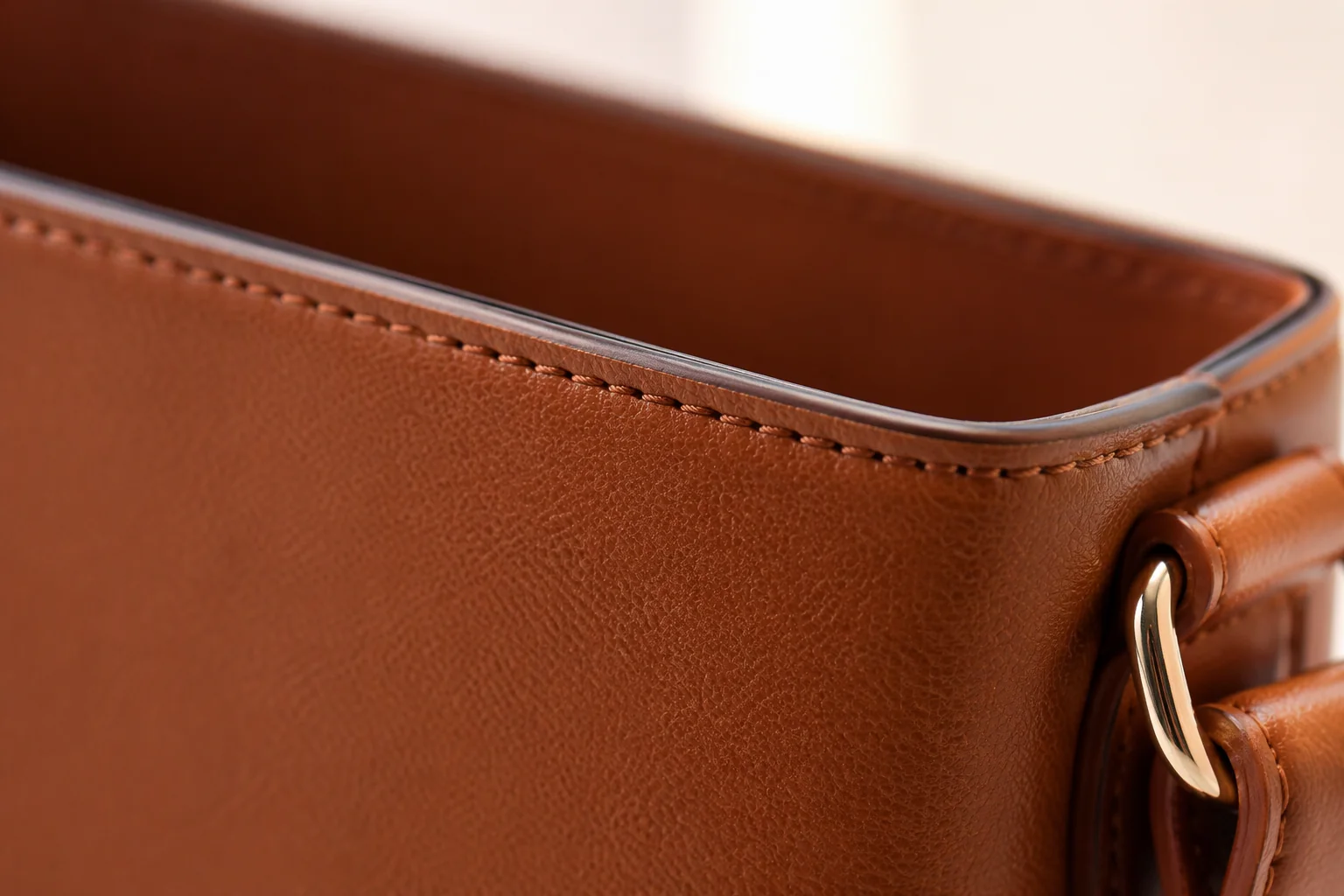
Structured shoulder bags, top-handle bags, small totes, clutches and small leather goods. The material supplies refinement and light weight, and the designs do not ask it to carry heavy loads or survive rough handling.
Where It Suits With Reinforcement
A calf tote can work if the base is reinforced and the straps are built from a denser leather or lined with webbing. Mixing materials by function is normal practice rather than a compromise.
Where It Should Not Go
Heavy backpacks, diaper bags and utility designs. Each demands load capacity, abrasion resistance and water tolerance that thin leather does not provide, whatever the sample looks like.
A Practical Allocation
| Bag type | Suitability | Where calf belongs | Where to substitute |
|---|---|---|---|
| Top-handle or shoulder bag | Excellent | Body, flap, trim | Strap core, base backing |
| Small tote | Good | Body, handles if lined | Base, strap anchors |
| Clutch or pouch | Excellent | Whole bag | Nothing |
| Wallet or card holder | Excellent | Outer and interior | Nothing |
| Structured backpack | Poor | Trim only | Body, base, straps |
| Diaper bag | Poor | Trim only | Body, base, straps |
Calf and Cowhide: The Hand Difference
What a Customer Feels
A customer picking up two bags of similar design will describe one as smooth and the other as sturdy. That is the whole difference in practice, and it is decided by the material before any design detail is considered.
What a Factory Feels
On the bench, calf skives easily, folds tightly and marks instantly. Cowhide resists the knife, holds a fold open, and forgives handling. Operators adjust within a day, but the patterns must suit the material they are cut for.
Where the Two Converge
At a distance, a well-finished calf bag and a good cowhide bag of the same colour look like siblings. The decision between them is commercial and functional, not a question of which material is better.
What Buyers Ask About Calf Bags
Will It Wear Out Quickly?
The honest answer is that calf shows wear sooner than dense cowhide, particularly at corners and handles. It ages into a soft sheen rather than into damage, provided the bag is not used as a utility item.
Does It Stain?
Aniline calf marks from water and oil, and the mark may not lift fully. A pigmented finish resists more, and the choice should be presented as a trade between character and resilience rather than hidden.
Is It Real Leather and How Should It Be Described?
It is, and the description should follow the rules of the destination market. Where a brand makes claims about the animal, the age or the tannage, those claims need to be accurate and supportable, and confirmed against local requirements.
Working With a Tannery on Calf
Selection Before Price
Ask how the tannery selects calf hides and what proportion of a lot is rejected for surface defects. The rejection rate explains the price more clearly than any quotation line.
Consistency Across Orders
Ask for retention samples per lot and for the tannery’s method of matching colour between runs. Fine grain shows drift, so a second order approved against a photograph will not match the first.
Lead Time and Minimums
Calf is often made to order in specific colours, with higher minimums per shade than standard cowhide. A brand planning several colours should confirm minimums before committing to a range.
A calf bag is not a tougher bag. It is a better-finished one, and the specification should say so plainly rather than implying both.
The Conversation That Prevents Returns
Explain what the material will do: soften, mark lightly, hold colour. A customer who was told this reads the changes as intended. One who was told the bag is indestructible files a complaint.
Common Mistakes
- Cutting a calf pattern from a cowhide template. Seam allowances, folds and reinforcement all need rethinking for thin leather.
- Skipping skiving at folded edges. The fold becomes a ridge that is visible along the whole bag.
- Using a heavy thread. It pulls the panel into a wave and cannot be corrected afterwards.
- Reinforcing with a stiffener that ends abruptly. The line shows through the surface permanently.
- Choosing heavy lining. Interior bulk is visible through a thin shell, and it drags the shape out of line.
- Putting calf on a load-bearing strap. The strap stretches, and the bag hangs lower every month.
- Approving colour on a cowhide swatch. Fine grain reads differently, and the batch will not match.
- Promising durability instead of refinement. The product then fails against a promise it never needed to make.
The Pattern
Every mistake is a cowhide habit applied to a material that has no tolerance for it. Calf does not need different skill, it needs different defaults.
Specification Checklist
- Age range, origin and tannage stated explicitly
- Finish type named: aniline, semi-aniline or pigmented
- Thickness with tolerance, measured at several points
- Temper described plus a physical reference sample
- Acceptable surface variation defined
- Panel size limits checked against hide size
- Skiving specification for every folded edge
- Stitch length, needle and thread specified for thin leather
- Reinforcement method and extent defined, with invisible edges
- Lining weight and colour specified, lighter than the shell
- Hardware scale chosen for the panel thickness
- Backing patches at every attachment point
- Edge treatment per edge, with an approved sample
- Retention sample per delivery, labelled and stored
- Care instructions written before the first production run
Repair and After-Sales for Calf
What Can Be Repaired
Straps, linings, edge paint and hardware can all be replaced or renewed, and edge work is the easiest repair because the surface around it is untouched. A bag that is scuffed at the corners can often be refinished rather than rejected.
What Cannot Be Hidden
A patch or a repair in the middle of a grained panel will never blend, because the fine surface shows every change in texture. Where a panel is damaged, the honest repair is replacement, and the cost should be quoted before the customer decides.
Why This Matters at Specification Stage
Brands that offer repairs should specify the strap and trim in materials the tannery can still supply years later. A repair promise is only as good as the availability of the parts it depends on.
Frequently Asked Questions
Is calf leather the same as cowhide?
It comes from the same species but a much younger animal, so the hide is smaller, the grain finer and the fibre thinner. That gives a smoother surface and a lighter bag, with less abrasion resistance.
Why is calf more expensive?
Small hides mean lower yield per bag, more hides per order, and a higher rejection rate at the tannery because fine grain shows every defect. The price reflects selection and finishing, not scarcity of the raw material.
Is calf leather durable?
It is durable for a bag that is carried and cared for, and less durable than dense cowhide or buffalo where abrasion, load and water are constant. It ages into a sheen rather than into damage.
Can calf be used for a diaper bag?
Not for the body, base or straps, which need load capacity and wipeability. It can be used for trim, but a diaper bag built in calf will disappoint in daily use.
Does calf scratch easily?
It marks more readily than grained cowhide, and the marks are more visible on aniline finishes. Most light marks can be left to blend with use, and heavy rubbing makes them worse.
Can calf straps be used on a heavy bag?
Thin calf straps stretch under sustained load. Where a calf bag carries weight, the strap should be lined, built from a denser leather, or reinforced with webbing inside.
What thickness should be ordered?
Thin enough to fold and skive cleanly, firm enough to hold a panel with the reinforcement the design provides. Specify a tolerance, since thin leather shows variation quickly.
Does calf take edge paint well?
Yes. Narrow edges sand flat and hold two or three thin coats well, which is why calf suits painted edges. Burnishing is possible but less forgiving because there is little fibre to lay down.
How should a calf bag be stored?
Stuffed to hold shape, in a breathable dust bag, away from heat and sunlight. Avoid plastic, which traps moisture against a material with no protective coating to lose.
Is calf suitable for a beginner factory?
It is less forgiving than cowhide because defects cannot be sanded out. A factory new to it should run one style, with the actual hide, through every operation before quoting.
How should it be described to customers?
As a fine-grain leather that softens and takes a sheen with use, not as an indestructible material. Leather claims must also match the labelling rules of the destination market.
Conclusion
Calf leather is worth its price when the bag is designed for what it does well. It gives the finest grain, the lightest panel and the most refined edge in the workshop, and it asks for precision in return.
The working rules are short. Skive before folding, use fine thread, keep reinforcement invisible and lighter than the shell, scale the hardware to the panel, and keep calf off straps and bases that carry load or meet the ground. Specify temper and finish with a physical sample, and keep a retention square from every delivery.
Do that, and the bag reads as refined from across a room. Skip it, and the same material exposes every shortcut: the ridge along the edge, the line where the stiffener stops, the wave along the seam. Calf does not forgive, but it does reward, and that is the entire commercial case for using it.
