
How to Clean and Care for Leather Bags: A Manufacturer’s Complete Guide to Cleaning, Conditioning, Storage and Repair
How to Clean and Care for Leather Bags: A Manufacturer’s Complete Guide to Cleaning, Conditioning, Storage and Repair
There is a moment every leather maker knows well: a customer returns a bag after five years, and it looks better than the day it left the factory. There is another moment we know just as well: a customer sends a photo of a bag after one year, and it looks five years old. Same brand, same leather, same craftsmanship — and completely different outcomes. The difference is not luck. It is care.
Leather is a natural material, and like skin, it responds to how it is treated. A bag that is wiped, conditioned, and stored properly can easily last a decade and grow more beautiful every year. The same bag left in sunlight, soaked in rain, or ignored until it cracks will fail in a fraction of that time. The care routine is not an optional extra — it is part of the product’s performance, and it is the difference between a bag that becomes an heirloom and one that becomes a replacement.
This guide is the care manual we wish came with every leather bag. Written from a manufacturer’s perspective, it covers the daily routines, the deep-cleaning methods, the conditioning schedule, the storage rules, and the repairs that keep leather bags alive — and the mistakes that kill them.
- Why Leather Care Matters More Than Most Owners Realize
- The Three Enemies of Leather: Heat, Light and Moisture
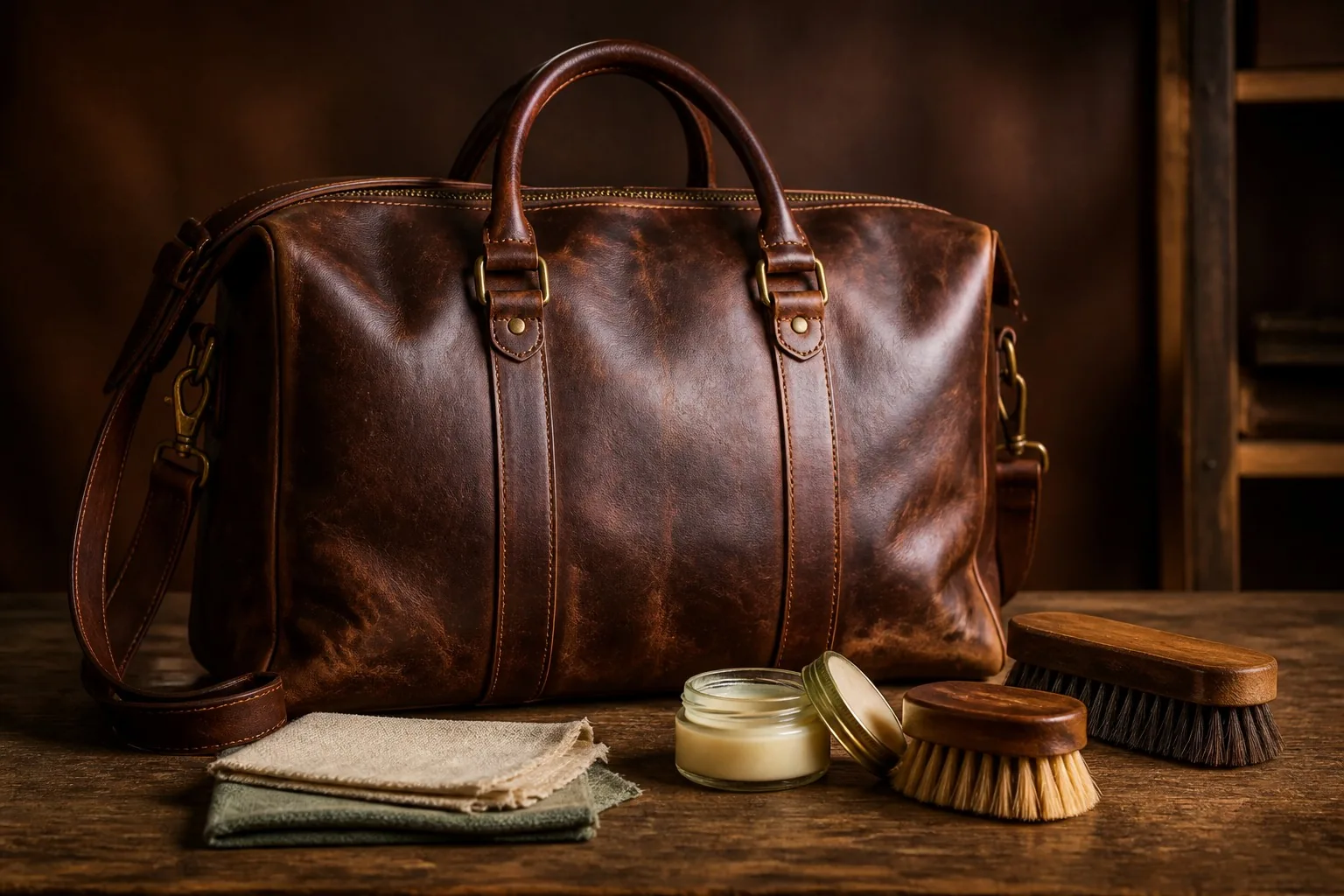
- What You Need: The Complete Leather Care Kit
- Daily and Weekly Care: The Simple Routine That Works
- Deep Cleaning: How to Clean a Leather Bag Properly
- Conditioning: Feeding the Leather
- Stain Removal: Spills, Ink, Oil and Water Marks
- Storage: How to Store Leather Bags Correctly
- Care by Leather Type: What’s Different
- Repair: When to Fix It Yourself and When to Call a Pro
- From the Factory Floor: What We Tell Every Customer
- Frequently Asked Questions
- Final Word from the Factory
Why Leather Care Matters More Than Most Owners Realize
Most people treat a leather bag like a finished product — a thing that is made, bought, and used. Manufacturers know better. Leather is a living material in a practical sense: it contains natural oils that keep its fibers supple, and those oils deplete over time through use, exposure, and the simple passage of years. Care is the process of replacing what time takes away.
The economics of care. A quality leather bag costs real money, and its replacement cost is the baseline for what care is worth. Spending ten minutes a month on cleaning and conditioning protects a purchase that was probably the customer’s most expensive accessory. The return on that ten minutes is measured in years of additional lifespan — and in the bag’s appearance, which is the point of owning it in the first place.
The aging story. Leather can age in two completely different directions. Neglected, it dries, cracks, fades, and develops permanent stains — a sad decline that ends in replacement. Cared for, it develops patina: the rich, warm glow that comes from oils, sunlight, and use, which makes the bag more personal and more beautiful with every year. The same material, the same years — the only variable is care. Every manufacturer has seen both endings, and the difference between them is a routine that takes minutes.
What manufacturers wish customers knew. The single most important fact about leather care is this: prevention beats repair, every time. A drop of water wiped away immediately leaves no trace; a drop left to dry becomes a water mark. A bag stored in a dust bag away from sun stays supple for years; a bag hung in a sunny window dries and fades in months. The care routine is mostly prevention — small, timely actions that stop damage before it starts.
The Three Enemies of Leather: Heat, Light and Moisture
Every care rule in this guide traces back to three enemies. Understand them, and the entire care manual becomes obvious.
Heat. Heat drives the natural oils out of leather and accelerates drying and cracking. The culprits are not just fires and radiators — they are car trunks in summer, hot rooms, and bags left near heating vents. Leather should live in cool, stable environments, and should never be dried with heat after getting wet. A hairdryer on a wet bag is a fast way to ruin it.
Light. Prolonged direct sunlight fades leather’s color and weakens its fibers. The fading is often uneven — the side of the bag that faced the window ages faster than the rest — which is why sun-exposed bags develop that patchy, tired look. Storage away from direct light, and limited sun exposure during use, keep the color and the fibers healthy.
Moisture. Water stains leather, and trapped moisture — a damp bag stored in a dark closet — breeds mildew, the most destructive of all leather problems. The rules are simple: wipe spills promptly, dry a wet bag naturally (never with heat), and never store leather damp. Mildew is one of the few leather conditions that is genuinely hard to reverse.
A manufacturer’s rule: care is not about fancy products. It is about keeping leather away from heat, light, and moisture — and acting quickly when any of the three strike.
What You Need: The Complete Leather Care Kit
Caring for leather does not require a drawer full of products. The essentials fit in a small box, and most households already own most of them.
- A soft, dry cloth — microfiber or soft cotton, for dusting and wiping
- A damp cloth — for light cleaning; water only, never soap on most leathers
- A quality leather conditioner — natural oils and waxes; cream or balm form
- A soft brush — for grain and crevices, and for suede if you own any
- A dust bag — cotton, for storage; the one that came with the bag is ideal
- Paper or soft stuffing — to help the bag hold its shape in storage
- A leather cleaner for stains — only if you need it; most bags never do
The golden rule of products: test everything on an inconspicuous area first — the inside of a gusset, the underside of a flap — before applying it to the visible surface. Leather varies, finishes vary, and a product that is perfect for one bag can darken or damage another. The test spot is the cheapest insurance in leather care.
Daily and Weekly Care: The Simple Routine That Works
Most of leather’s lifespan is decided by the small, regular actions that take seconds. Here is the routine we recommend to every customer, and the one we follow on our own samples.
Every day, if possible. Empty the bag at night, or at least remove anything heavy or damp. A bag left permanently overloaded stretches its seams and stress points. A damp bottle left inside is moisture in contact with leather for hours — the beginning of stains and, in the worst case, mildew. The daily habit of emptying, shaking out crumbs, and checking for spills is the highest-value care there is.
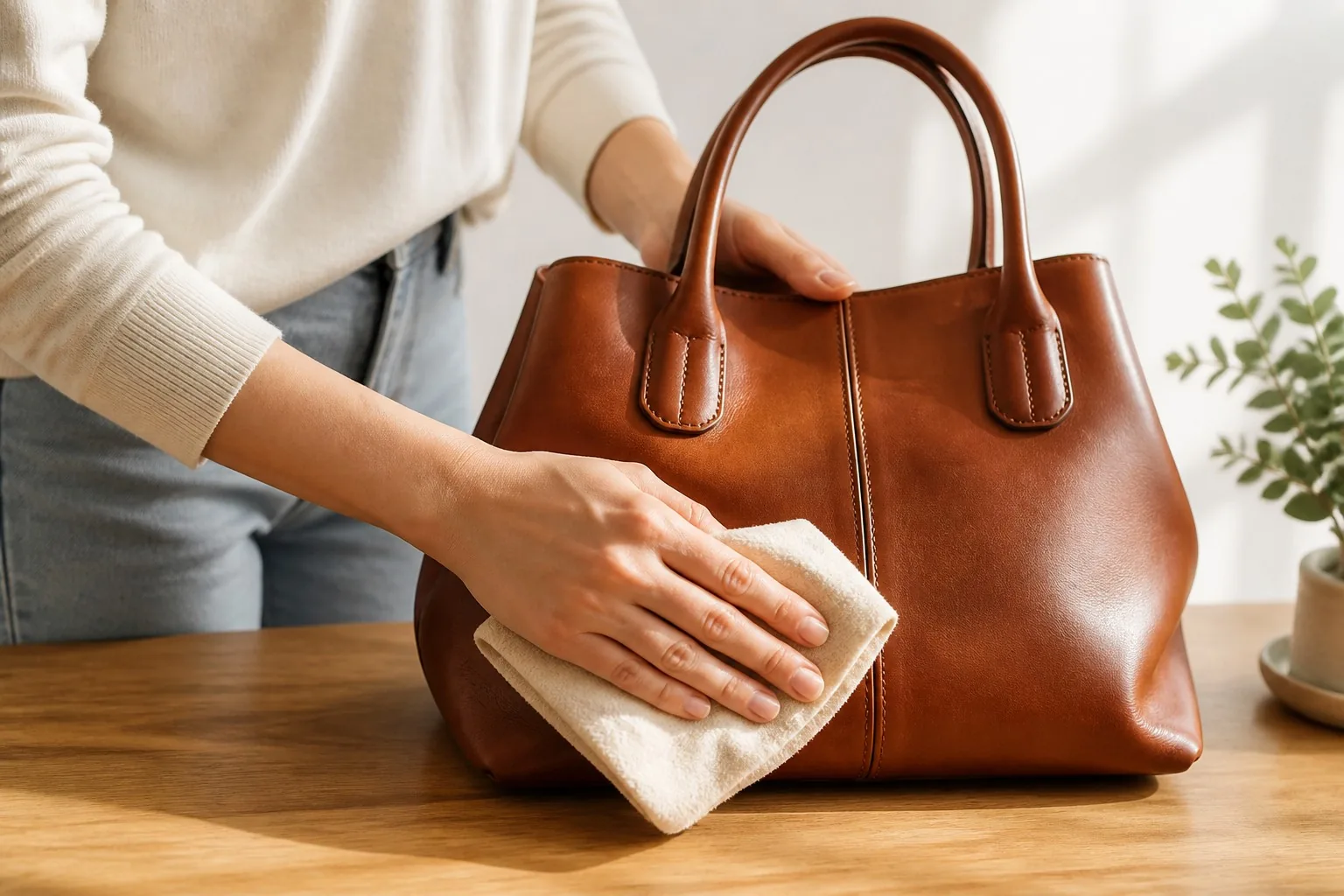
Weekly. Wipe the entire surface with a soft dry cloth to remove dust — dust is abrasive and, left in the grain, slowly wears the finish. Check the bag for scratches, stains, or hardware that has loosened, and deal with anything found immediately. Prevention is the point: a scratch caught in week one is often polishable; a scratch ignored until year one has become permanent.
Monthly. A damp-cloth wipe for the surface (never soaking), followed by a dry wipe, keeps the finish clean. Inspect the hardware — zippers, snaps, buckles — and work any stiff zipper with a tiny amount of the zipper’s own lubricant, never general-purpose oils. These monthly minutes are what keep the bag looking new far longer than it has any right to.
Deep Cleaning: How to Clean a Leather Bag Properly
Occasionally — a few times a year, or when the bag has clearly picked up grime — a leather bag needs more than wiping. Deep cleaning done wrong damages leather; done right, it restores it.
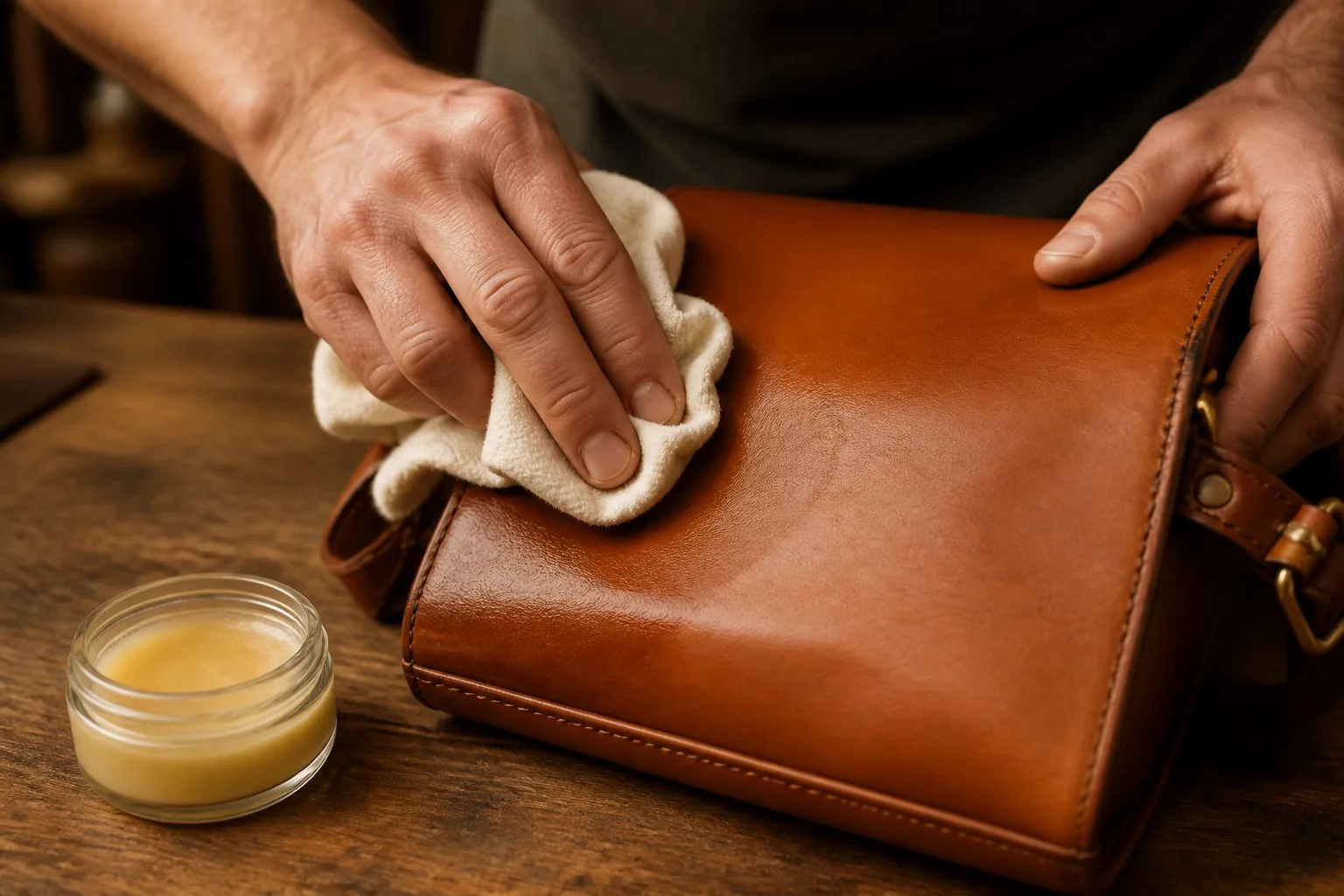
The safe deep-clean process. Start by emptying the bag and removing any detachable hardware or straps. Wipe the surface with a soft dry cloth to remove loose dust. Then use a barely damp cloth — water only, or a dedicated leather cleaner following the product’s instructions — and wipe in gentle, even strokes, working in small sections and wiping each section dry before moving on. Never soak the leather, never scrub, and never use soap, detergents, or household cleaners. Finish by letting the bag air-dry completely, away from heat and sunlight, before conditioning.
What never to use. The list of things that damage leather is long, but the critical ones are: soap and detergents (they strip the natural oils), alcohol and solvents (they dissolve finishes), baby wipes and alcohol wipes (same problem), and any “leather cleaner” that leaves the surface sticky or stiff. If a product is not designed for leather, do not use it on leather. The most expensive damage we see in repairs was almost always caused by a well-meaning household cleaner.
How often to deep-clean. Most bags need a deep clean once or twice a year, or when they are visibly dirty. Over-cleaning is a real problem — every clean removes a little oil and finish, so cleaning a bag more often than necessary shortens its life. When in doubt, wipe rather than clean, and clean rather than scrub.
Conditioning: Feeding the Leather
Conditioning is the step that replaces the oils leather loses over time — and it is the step most people either skip entirely or do too often.
Why leather needs conditioning. The oils in leather keep its fibers flexible. As they deplete, the leather dries, stiffens, and eventually cracks at stress points. Conditioning replenishes those oils, keeping the leather supple and preventing the cracking that ends a bag’s life. It is the closest thing leather has to moisturizing, and it matters most for full-grain and vegetable-tanned leathers, which lack the protective finishes of cheaper grades.
How often to condition. The honest answer is: it depends on the leather, the climate, and the use. As a starting point, condition a leather bag two to four times a year. Dry climates, heavy use, and full-grain leathers move toward the higher end; humid climates, light use, and finished leathers toward the lower. The best signal is the leather itself: when it starts to look dry or feel stiff, it is time to condition.
How to condition properly. Apply the conditioner sparingly with a soft cloth, in small circular motions, working it into the surface. Let it absorb for a few minutes, then buff with a clean cloth to remove any residue. Less is more: a thin, even application beats a heavy one, and excess conditioner can darken leather or leave a greasy film. Always test on a hidden area first, and never condition a dirty bag — the conditioner will seal in the dirt.
The over-conditioning warning. Conditioning too often is almost as bad as never conditioning. Over-conditioned leather becomes soft, greasy, and prone to stretching; it can also darken unevenly. Follow the schedule, watch the leather’s response, and let the material — not the calendar — be the final guide.
Stain Removal: Spills, Ink, Oil and Water Marks
Stains happen. The outcome depends on the stain and, above all, on how quickly it is treated. This table is the field guide we give our customers and our repair team.
| Stain type | Immediate action | Follow-up treatment | Warning |
|---|---|---|---|
| Water | Blot immediately with a dry cloth | Let dry naturally; a light conditioner after | Never rub a wet spot — it spreads the mark |
| Coffee / tea | Blot, then wipe with a barely damp cloth | Condition after drying | Act fast; dried coffee sets permanently |
| Oil / grease | Blot with a paper towel; dust with cornstarch or talc | Leave powder overnight, brush off next day | Never rub oil — it drives it deeper |
| Ink | Blot with a dry cloth; do not rub | Professional treatment recommended | Ink is the hardest stain — do not DIY |
| Mud | Let it dry completely, then brush off | Wipe with damp cloth, condition | Never clean wet mud — it grinds in |
| Alcohol | Blot immediately | Check for finish damage; professional help if discolored | Alcohol dissolves finishes — the fastest killer |
The universal stain rules. Act fast — most stains become permanent once they dry. Blot, never rub — rubbing spreads the stain and drives it deeper into the fibers. Use the gentlest method first — a dry cloth, then a barely damp cloth, and only then a dedicated cleaner. And when a stain is serious — ink, or damage to the finish — call a professional leather repair service rather than risking the bag with home remedies. A professional can often undo what a DIY attempt makes permanent.
Storage: How to Store Leather Bags Correctly
How a bag is stored between uses determines how it looks when it comes out — and most bags spend far more time in storage than in use. The storage rules are simple, and the mistakes are common.
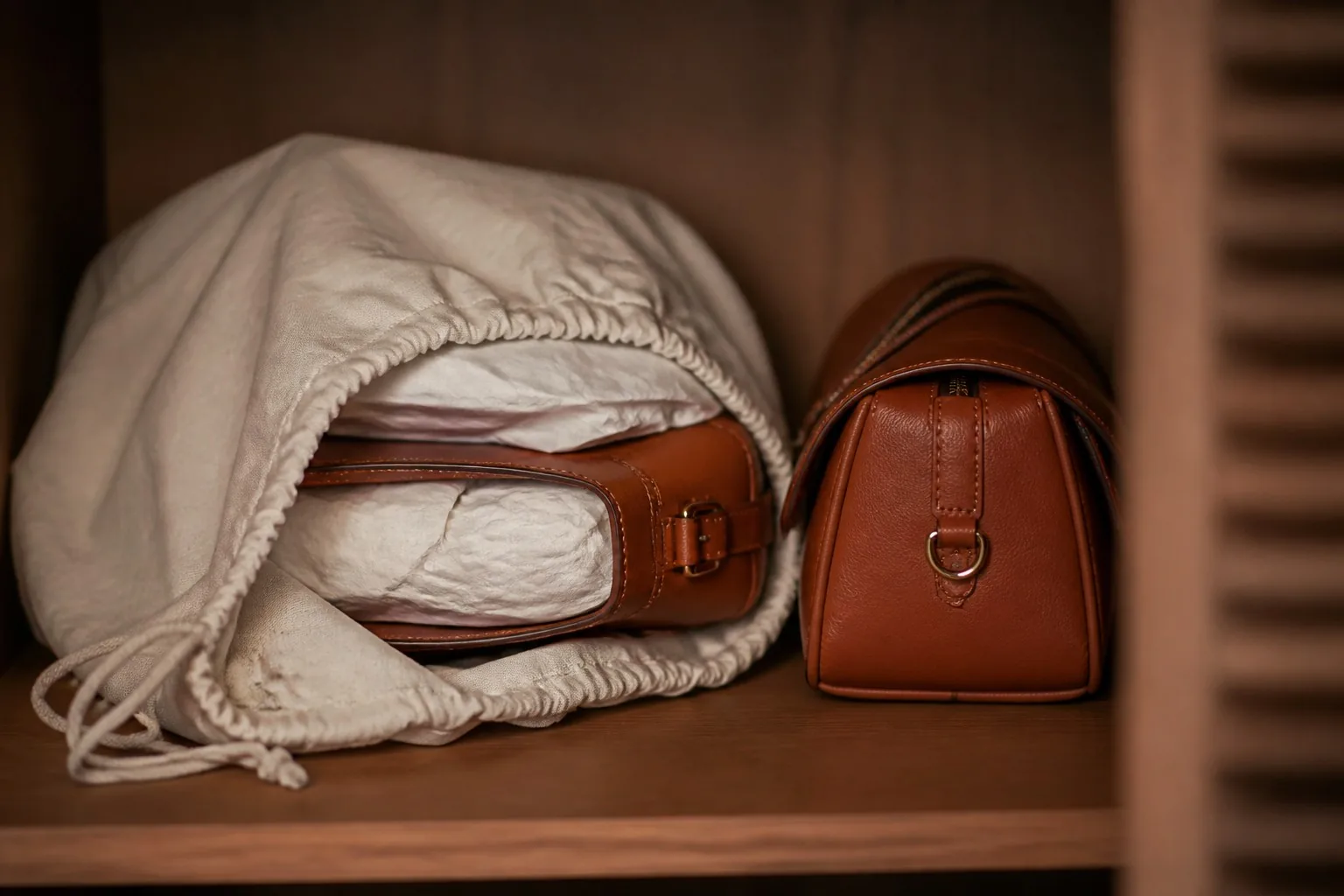
The correct storage setup. Store leather bags in a cotton dust bag — the one that came with the bag is ideal — stuffed lightly with paper or soft cloth to help them hold their shape. Keep them on a shelf or in a drawer, away from direct sunlight, heat sources, and damp. Do not hang leather bags by their handles for long periods — the handles stretch under the bag’s full weight, and a stretched handle is one of the most visible signs of a badly stored bag.
What to avoid. Never store leather in plastic — plastic traps moisture, and trapped moisture breeds mildew. Never store bags in attics, basements, or anywhere hot, cold, or damp — leather hates extremes. And never stack heavy items on a stored bag, which crushes its shape and stresses its seams. A little thought at storage time prevents a great deal of damage at use time.
Long-term storage. For bags stored for a season or longer: clean and condition the bag first, so the leather goes into storage healthy; remove anything heavy; stuff lightly; and check the bag every few months, re-conditioning if it feels dry. Leather should never be stored dirty — dirt in the grain becomes permanent over months of storage, and stains set in exactly the way they do when dried.
Rotating your bags. If you own several leather bags, rotate them rather than carrying the same one daily. Rest between uses lets the leather recover, reabsorb oils, and dry out properly. A rotation of two or three bags, each properly stored, keeps all of them healthier than any single bag carried daily — and it is the storage habit that most extends a collection’s lifespan.
Travel care. Travel is where storage rules bend — bags are packed, carried, and left in hotel rooms. The practical rules are simple: pack the bag in its dust bag, stuffed lightly, and never packed under heavy items; unpack it when you arrive and let it breathe; and keep it out of car trunks in summer, which are the most dangerous environments for leather. A bag that travels well returns home healthy — a bag left in a hot trunk returns home cracked.
Care by Leather Type: What’s Different
The routines above are the universal foundation. Different leathers have different needs, and the differences are worth knowing.
| Leather type | Cleaning | Conditioning | Special rules |
|---|---|---|---|
| Full-grain (finished) | Damp cloth, gentle | 2–4×/year | Wipe spills fast; finish protects, but not forever |
| Vegetable-tanned (unfinished) | Dry cloth mostly; damp rarely | 3–4×/year, natural balm | Expect and embrace patina; protect from water |
| Waxed / pull-up | Dry cloth; rub marks with fingers | Re-wax sparingly when dry | Scratches are features — do not try to remove them |
| Chrome-tanned | Damp cloth, wipes clean easily | 1–2×/year | Most forgiving; still avoid heat and sun |
| Goatskin | Damp cloth | 2–3×/year | Great abrasion resistance; avoid overloading |
| Sheepskin | Delicate dry cloth only | Monthly, light cream | Most fragile; avoid water and rough surfaces |
| Suede / nubuck | Soft brush only | Suede protector spray | Never wet-clean; brushing is the whole routine |
The pattern behind the table. The more finished the leather, the more it resists water and dirt but the less it develops patina — and the less it needs conditioning. The more natural the leather, the more it needs care but the more beautifully it ages. Finishing and care are two sides of one coin: choose the leather that matches the care you will actually provide, and the bag will reward you.
Repair: When to Fix It Yourself and When to Call a Pro
Even well-cared-for bags eventually need repairs. Knowing what to attempt and what to hand to a professional is the last skill of leather ownership.
Safe DIY repairs. Light scratches on finished leather can often be minimized by gentle buffing with a soft cloth — the finish redistributes and the mark fades. Scuffed edges can be touched up with edge paint of a matching color. Loose threads can be carefully trimmed or, if a seam is coming undone, the area can be stitched back with a needle and waxed thread — a skill worth learning for anyone who owns quality leather. Loose hardware — a rivet that has worked free — can sometimes be reseated, though this is better left to a pro.
What to leave to professionals. Real repairs belong in professional hands: zipper replacement (a quality repair that most owners cannot do themselves), torn seams under load, damaged lining, deep scratches or cuts in the leather itself, ink and serious stains, and any damage to the finish that requires re-dyeing. A professional leather repairer has the tools, the thread, the dyes, and the experience — and their work is often invisible, where a DIY attempt is not.
The repair-replace decision. A quality leather bag is worth repairing because it can be repaired — re-stitched, re-conditioned, re-dyed, and re-born. The equation is simple: if the repair costs meaningfully less than replacement and the bag has years of life left, repair it. If the bag was cheap, the damage is structural, or the repair approaches the replacement cost, replace it — and carry the care lessons into the next bag.
What manufacturers see. In our repair records, the most common returns are stretched handles, broken zippers, and cracked corners — all preventable with the routines in this guide. The happiest customers are the ones who brought their bags back after years for a professional refresh: a clean, a condition, a new zipper — and the bag goes out looking like the day it was made. A leather bag that can be refreshed is a product that was worth buying in the first place.
From the Factory Floor: What We Tell Every Customer
Every bag we ship leaves with care guidance, and the guidance is deliberately short — because a care routine that is too complicated will not be followed. Here is the essence of what we tell customers, and what every leather owner should know.
The one-minute daily habit. Empty the bag, check for spills, wipe if needed. This takes a minute at the end of the day and prevents most of the damage we see in repairs.
The monthly check. Wipe the surface, inspect the hardware, catch problems early. Ten minutes a month keeps the bag looking new and keeps small issues from becoming expensive repairs.
The seasonal care. Condition two to four times a year, deep-clean when visibly dirty, and store the bag properly when it is not in use. The seasonal routine is what builds patina instead of wear.
The golden rules. Blot, never rub. Test products on a hidden area first. Keep leather away from heat, light, and moisture. When in doubt, ask a professional. Four rules cover ninety percent of everything that can go wrong.
The honest promise. Care does not make leather indestructible — no material is. But it reliably doubles or triples the useful life of a quality bag, and it turns the bag into something that gets better with age instead of worse. That is the promise we make with every bag we manufacture, and the routine above is how the customer keeps it.
What ships in the box. Every quality leather bag should ship with a care card — a small printed card with the essentials: the leather type, the daily and seasonal routine, the golden rules, and a contact for professional repairs. We include one with every bag, and we consider it part of the product, not an afterthought. When you buy leather, look for the care card; when you sell leather, ship one. The card is the manufacturer’s care knowledge placed directly in the customer’s hands — and it is the cheapest longevity upgrade a leather product can receive.
Frequently Asked Questions
How often should I condition my leather bag?
Two to four times a year is the right starting range. Dry climates, heavy use, and natural leathers like full-grain or vegetable-tanned need the higher end; humid climates, light use, and finished leathers need the lower. Condition when the leather looks dry or feels stiff — the leather is the best calendar.
Can I use baby wipes or soap to clean my leather bag?
No. Soaps, detergents, baby wipes, and alcohol wipes strip leather’s natural oils and can dissolve its finish. Use a dry cloth for dust, a barely damp cloth for light cleaning, and a dedicated leather cleaner for deeper cleaning — always tested on a hidden area first.
How do I remove a water mark from leather?
Blot the spill immediately with a dry cloth — never rub, which spreads the mark. Let the leather dry naturally, away from heat, then apply a light conditioner. Old water marks may need professional treatment, which is why acting fast matters more than anything else.
Is it better to hang a leather bag or store it flat?
Store leather bags on a shelf, stuffed lightly in a cotton dust bag. Never hang them by their handles for long periods — the handles stretch under the bag’s weight, and stretched handles are a permanent, visible sign of bad storage.
How do I store leather bags for a long time?
Clean and condition the bag first, stuff it lightly, put it in a cotton dust bag (never plastic), and store it away from sunlight, heat, and damp. Check it every few months and re-condition if the leather feels dry. Leather stored healthy stays healthy.
Can scratches be removed from leather?
Light scratches on finished leather often fade with gentle buffing using a soft cloth. Deeper scratches, cuts, or damaged finish need professional treatment — re-conditioning, edge repair, or re-dyeing. On waxed pull-up leather, scratches are part of the character and should be left alone.
What should I do if my leather bag gets soaked in rain?
Blot the surface gently with a dry cloth, then let the bag air-dry naturally, away from heat and direct sun. Never use a hairdryer or radiator — heat causes cracking. When fully dry, condition the leather. Never store the bag while still damp, or mildew can form.
Is it worth repairing a leather bag, or should I replace it?
Quality leather bags are worth repairing — they can be re-stitched, re-conditioned, re-dyed, and refreshed to near-new condition. Repair if the cost is meaningfully below replacement and the bag has years of life left. A well-made leather bag is designed to be repaired, which is precisely what makes it a long-term purchase.
Final Word from the Factory
Leather care is not a chore — it is the relationship between an owner and a material. The bag we manufacture leaves the factory healthy: conditioned, inspected, and ready for years of use. What happens next is up to the owner, and the owners who follow a simple routine get a bag that ages like fine wood, growing richer and more personal with every year. The owners who do not get a bag that ages like neglected wood, drying and cracking ahead of its time.
The routine is not complicated. Empty the bag daily. Wipe it weekly. Condition it seasonally. Store it properly. Blot, never rub. Keep it away from heat, light, and moisture. Act fast when something happens, and call a professional when the damage is beyond home care. Six habits, minutes a week, and the difference is measured in years.
At our factory, we see the full spectrum of outcomes — the five-year-old bags that look better than new, and the one-year-old bags that needed professional rescue. The gap between them was never the leather. It was the care. And the beautiful part is that care is free — it only asks for a few minutes and a little knowledge, and it returns years of use and a bag that becomes more beautiful with every passing year. That is the best value in leather, and it is available to every owner who chooses to take it.
