
How Should Pockets and Compartments Be Laid Out in a Leather Bag?
How Should Pockets and Compartments Be Laid Out in a Leather Bag?
Two bags can use the same leather, the same lining and the same hardware and still feel completely different in daily use, because one of them was designed around what goes inside it and the other was designed around a drawing.
Pocket layout is where a bag’s usefulness is actually decided. It determines whether a phone can be reached while the bag is on a shoulder, whether a laptop sits against a padded wall or against a zip pull, and whether the main compartment turns into a bag of loose objects by the end of the week. It also determines a surprising share of the factory’s cost, because every pocket adds panels, stitching, reinforcement and inspection points.
A pocket is not decoration added at the end. It is a structural decision that changes how the bag is cut, sewn, lined and inspected.
- What the Layout Has to Solve First
- The Pocket Types and What They Cost
- Designing to the Bag Type
- Patterns, Panels and Reinforcement
- Construction Sequence on the Floor
- Interior Colour and Visibility
- Security Features Inside the Bag
- Pockets in Different Leathers
- Sampling Stage: What to Check
- Working With Suppliers on Pocket Components
- Cost, Weight and the Temptation to Add More
- Common Layout Mistakes
- Specifying the Layout in a Tech Pack
- Testing a Layout Before Production
- Organising Hardware and Small Items
- Lining Interaction
- Care and Longevity of Pockets
- Working With the Factory on Layout
- Pockets and Material Efficiency
- What Changes the Layout Over Time
- Frequently Asked Questions
- The Bottom Line
What the Layout Has to Solve First
Before choosing a number of pockets, decide what the bag carries.
The Five Questions
Answer these before drawing a pocket.
- What is the largest item, and does it fit through the opening
- What is the heaviest item, and where is the bag reinforced
- What is reached most often without looking
- What must never sit loose against leather or a screen
- What does the bag deliberately refuse to carry
The Carry Set
What actually goes in, in order of size.
A layout should start from a list: the largest item, the heaviest item, the item reached most often, and the item that must never be loose. A diaper bag, a work tote and a travel bag produce three completely different lists, and the pockets follow from the list rather than from taste.
Access While Wearing
The constraint designers forget.
A pocket that cannot be reached with the bag on the shoulder is a pocket that will not be used. Position matters more than count: front wall and near the opening for frequent items, back wall and lower body for items that are carried but rarely touched.
Load Distribution
Where weight sits.
Concentrating heavy items in one unsupported pocket distorts the panel, strains stitching at the pocket mouth and pulls the bag out of shape over months. Pocket placement should respect where the bag is reinforced.
Protection
What must not touch what.
Keys against a screen, a zip pull against a leather panel, a wet item against a lining: these conflicts are solved by separation, not by padding everything. A single dedicated pocket for the hard and abrasive items removes most of the risk.
The Pocket Types and What They Cost
Each type carries a different build cost.
Flat Slip Pocket
The cheapest useful pocket.
A single panel stitched on three sides, usually with a reinforced mouth. It adds minimal material and a predictable stitching operation, and it is the right default for flat items that do not need closure.
Patch Pocket With Gusset
Volume, at a price.
Adding a gusset turns a flat pocket into a compartment that holds bulk. It costs more material and more operations, and it changes how the panel behaves when loaded, so it needs backing where the shape distorts.
Zip Pocket
Security with the highest build cost.
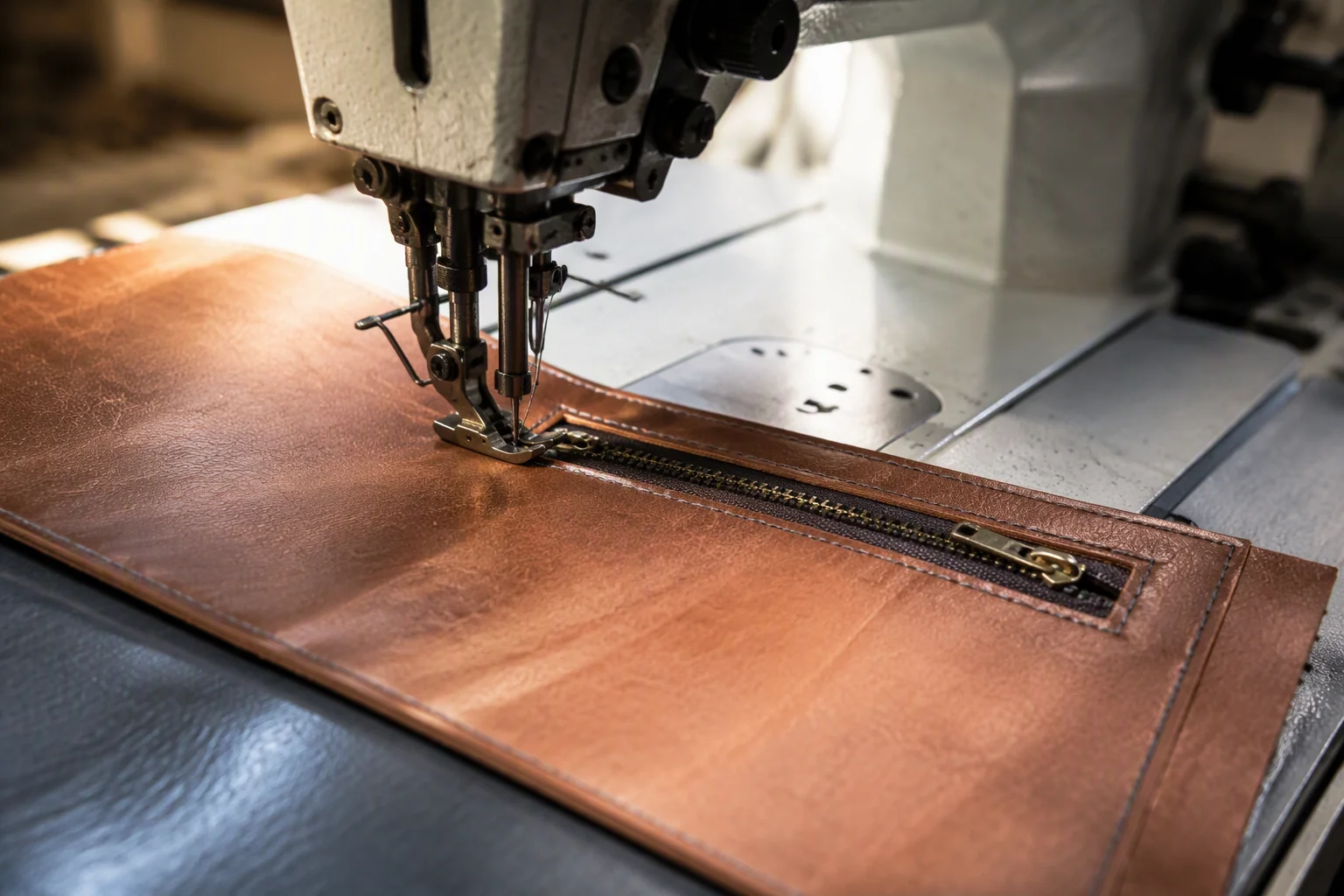
A zipped pocket requires a zip, tape, a facing or welt, and careful alignment. It is the pocket most likely to fail in use if the ends are not reinforced, and the one most worth specifying precisely in the tech pack.
Divider Panel
Structure for the whole bag.
A full-height divider splits the main compartment and stiffens the body at the same time. It is a structural decision as much as an organisational one, and it changes the pattern, not just the trim.
Drop-In Sleeve
For devices and documents.
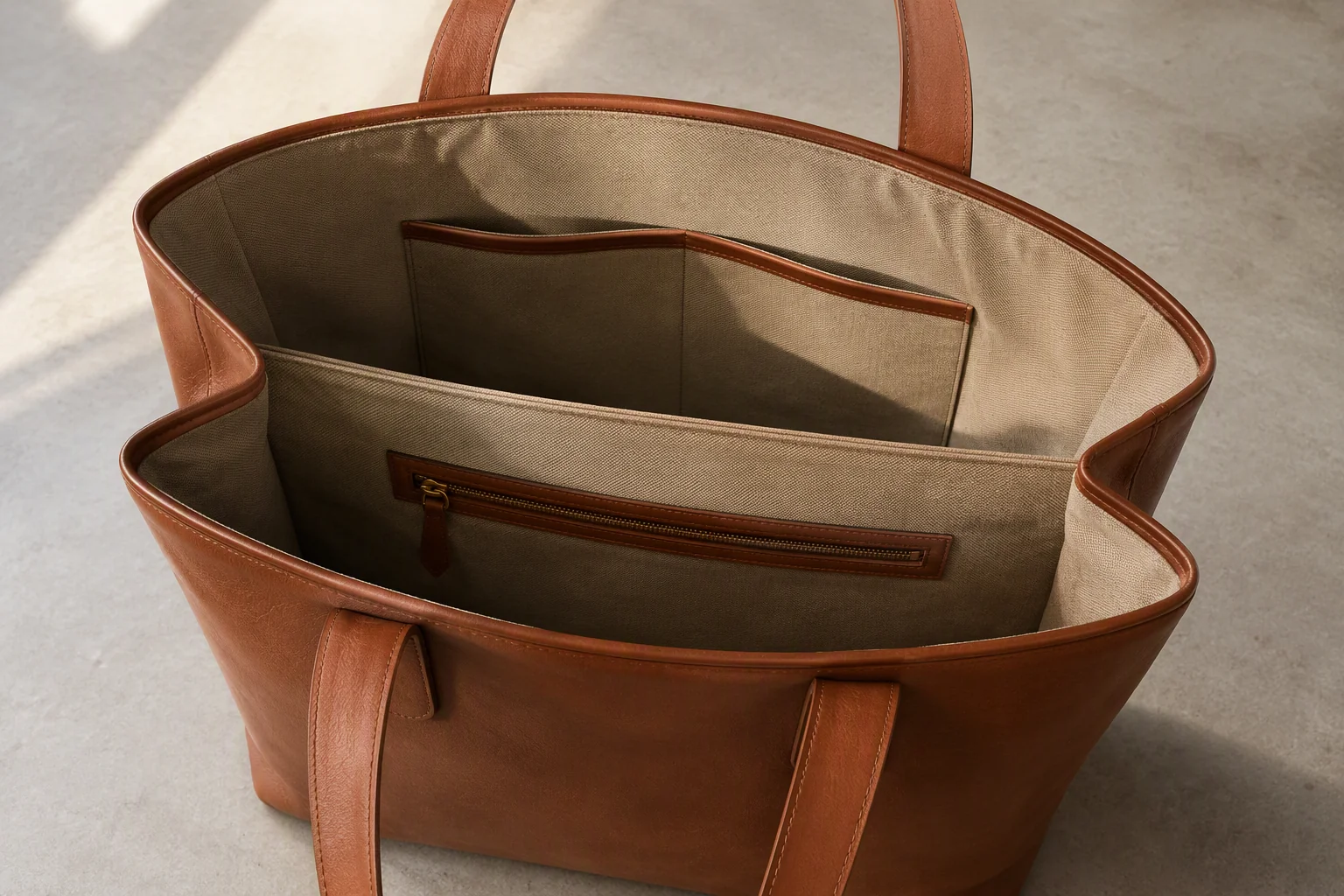
A sleeve with a padded or reinforced wall is standard in work and travel bags. The dimension that matters is internal clearance, not the nominal device size, because lining and seam allowance reduce the usable space.
| Pocket type | What it holds | Build cost | Main failure mode |
|---|---|---|---|
| Flat slip pocket | Phone, cards, receipts | Low | Mouth stretches, edge curls |
| Gusseted patch pocket | Bottles, small pouches | Medium | Panel distortion under load |
| Zip pocket | Valuables, small loose items | High | Zip ends pull out, tape frays |
| Divider panel | Splitting the main body | Medium to high | Sags without stiffener |
| Drop-in sleeve | Laptop, documents | Medium | Too tight once lined |
| Elasticated slot | Cables, pens, tools | Low | Elastic loses tension |
Designing to the Bag Type
The same principles land differently by product.
Diaper Bags
Volume and quick access.
The layout is dominated by bottles, wipes, changes of clothes and a changing mat, with one hand often free and the other holding a child. Insulated side pockets, an exterior wipe pocket and a wide mouth matter more than a neat interior.
Work Totes
Device protection and order.
A padded sleeve, a secure zip pocket for valuables and a small organiser panel cover most of the need. The failure to avoid is a sleeve that fits the device on paper but not once the lining and seam allowance are in.
Backpacks
Vertical access and balance.
Pockets in a backpack are read from the top down and from the outside in: a quick-grab exterior pocket, a secure interior pocket against the back panel, and a sleeve that keeps weight close to the spine.
Shoulder and Crossbody Bags
Small, precise, and unforgiving.
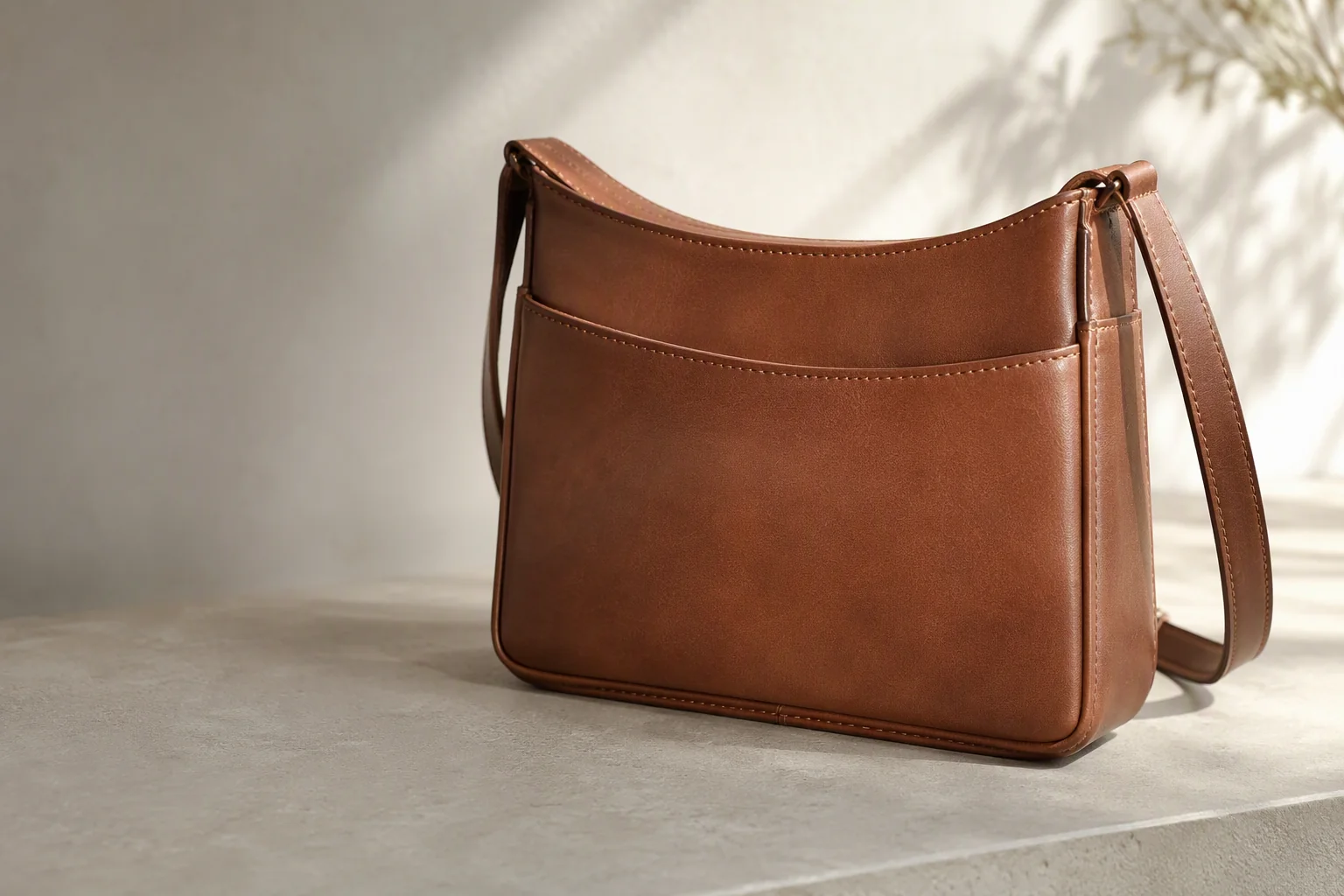
In a small bag every pocket competes for the same volume, so the design is really a decision about what the bag refuses to carry. Two well-placed pockets usually beat five shallow ones.
Patterns, Panels and Reinforcement
How the layout becomes a cutting decision.
Pocket Panels in the Pattern
Cut with the body, not after it.
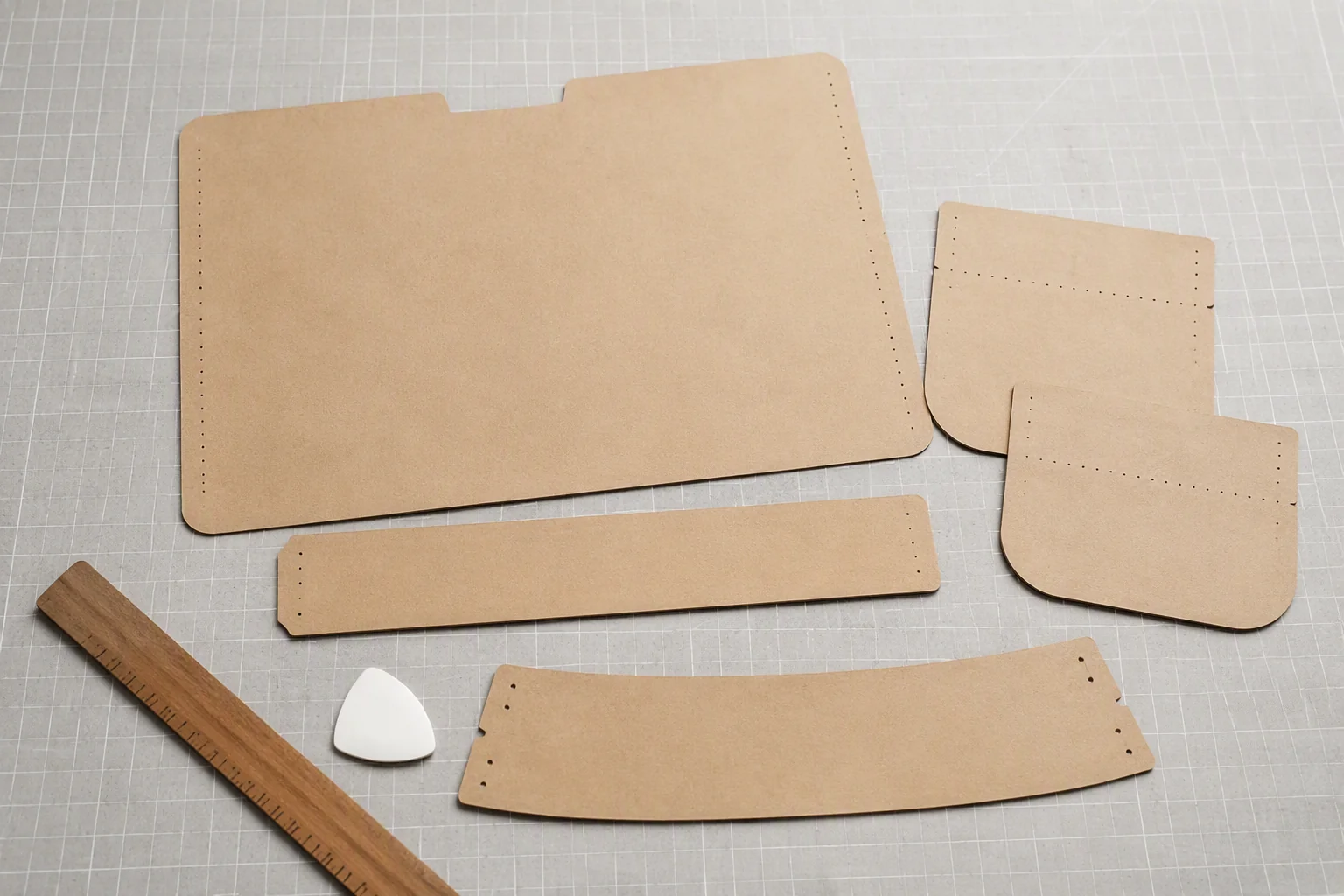
Pocket panels belong in the pattern set with their own grain direction, seam allowance and marking. Treating them as an afterthought produces panels cut across the grain, which behave differently in wear and in finishing.
Backing and Interlining
Where the load is.
Any pocket that will carry weight needs backing at the mouth and at the attachment points. The reinforcement decision is made at design stage, because adding it later changes the panel thickness and the stitching.
Stitch Placement
Load paths, not decoration.
Pocket stitching should terminate in a reinforced area rather than in the middle of a panel. Bar tacks at the mouth ends and at the corners of a zip opening are the difference between a pocket that lasts and one that tears at the first heavy load.
Marking and Alignment
Small errors become visible.
Pocket positions marked on the panel and matched on the lining keep the interior symmetrical. Misalignment is one of the most visible defects on a finished bag because the eye reads the interior as a whole.
Construction Sequence on the Floor
Where pocket work sits in the build.
Before the Body Is Closed
Most pockets first.
Interior pockets and dividers are attached while the body is still flat or open. Sequencing them after the bag is closed turns a simple operation into a difficult one and usually shows in the stitching.
Zip Pockets and Their Ends
The operation that decides durability.
Cutting the opening, attaching the facing, setting the zip and finishing the ends are four distinct steps. Skipping the end reinforcement to save a minute is the most common cause of a zip pocket failing within a season.
Lining Integration
Two assemblies becoming one.
Pockets on the lining must align with the bag’s opening and drop to the right depth. The drop measurement is the one that gets lost between design and production, and it is the one customers notice immediately.
Final Inspection Points
What to check, in order.
Mouth strength under load, zip function through the full travel, alignment against the opposite wall, stitch termination, and the absence of loose lining at the pocket base. These five checks catch most pocket defects before packing.
Interior Colour and Visibility
The layout only works if it can be seen.
Lining Colour and Contrast
A practical choice, not a decorative one.
A dark interior swallows small objects, and a very pale interior shows every mark within weeks. Mid-tone linings in a colour that contrasts with the items typically carried give the best compromise between visibility and maintenance.
Depth and Light
How deep compartments read.
Deep, narrow compartments conceal their contents even in a well-lit interior. Where depth is unavoidable, a contrasting base panel or a light-coloured pocket facing helps the eye find the bottom.
Clutter Control
Design against accumulation.
A bag designed with two or three defined zones resists clutter better than one with a single large cavity. The zones do not need to be pockets; a divider and one structured panel can be enough.
Security Features Inside the Bag
Where the valuable items go.
Hidden Pockets
Accessible to the wearer only.
A flat pocket set against the back wall, below the opening line, is difficult to reach from outside and easy to reach from inside. It costs very little and answers a real concern in travel and city use.
Zip Placement and Pickpocket Risk
Direction matters.
A zip that opens from the top toward the wearer’s body is harder to open unnoticed than one that opens outward. Small details in orientation change the practical security of the same pocket.
Signal-Blocking Linings
A specific, limited claim.
Where a pocket is described as protecting cards from wireless reading, the material and its placement need to be specified, and the claim should be limited to what the construction actually achieves.
Pockets in Different Leathers
The material changes the build.
Firm vs Soft Leather
How the pocket holds its shape.
A firm, tightly structured leather holds a pocket edge cleanly with minimal reinforcement. A soft, stretchy leather needs backing and often a folded or bound edge, or the mouth will curl.
Stretch and Recovery
Where pockets lose their fit.
Softer leathers stretch at the mouth under repeated use, particularly where a phone or a card wallet is pushed in and pulled out. Cutting the mouth slightly tighter at the pattern stage compensates for the change.
Edge Finishing at the Mouth
The visible detail.
A pocket mouth is one of the few interior edges that is handled constantly. Painted, folded or bound edges each behave differently in wear, and the choice should match how the bag is expected to be used.
Sampling Stage: What to Check
A short list that prevents a season of complaints.
- Fill the sample with the real carry set and check access with the bag worn
- Measure internal pocket dimensions against the specification
- Operate every zip through its full travel, repeatedly
- Load each pocket to its intended weight and inspect the mouth and corners
- Check alignment between interior pockets and the bag’s opening
- Confirm the lining does not pull at the pocket base
- Photograph the interior in consistent lighting for the technical file
Why the Real Carry Set Matters
Numbers approved, items rejected.
A specification can be met exactly and still produce an unusable pocket, because the item was measured rather than tried. The sampling stage is the last cheap opportunity to discover this.
Documenting the Approved Layout
One reference, many orders.
Photographs, dimensions and the approved sample together form the reference for repeat orders. Without them, the second production run is interpreted from drawings by a different team.
Working With Suppliers on Pocket Components
Small parts, disproportionate impact.
Zip Specification
Type, length, tape, slider.
A zip pocket is only as good as its zip. The specification should name the chain type, the tape width, the slider and the end treatment, because substituting a cheaper zip changes both durability and feel.
Elastic and Mesh
Consumables by nature.
Elastic and mesh pockets age faster than leather. Specifying them as replaceable and choosing qualities with known recovery behaviour keeps the bag serviceable for longer.
Reinforcement Materials
Thin, stiff, and specified.
Backing and stiffener materials are usually invisible and therefore often substituted. Naming the material and its thickness in the tech pack prevents a quiet downgrade that only shows up in wear.
Cost, Weight and the Temptation to Add More
Every pocket has a price.
The Real Cost of a Pocket
Material, time, inspection.
A pocket consumes panel material, cutting time, a stitching operation, reinforcement, and an inspection point. In a bag with six pockets, that multiplication is visible in the cost sheet, which is why pocket counts creep up slowly and are rarely removed.
Weight and Balance
Small additions accumulate.
Pocket panels, reinforcement and zips add weight unevenly. A bag that is well balanced at four pockets can feel lopsided at eight, particularly when the extra pockets sit on one wall.
Pocket Count and Price Points
A commercial dimension.
Pocket count is often the first thing reduced when a style is re-engineered to a lower price point, and the first thing added when a style is repositioned upward. Both moves are visible to the customer in daily use, so the decision is best made deliberately with the cost sheet open rather than absorbed quietly by the factory.
When Fewer Is Better
Restraint as a design decision.
A bag with three well-placed pockets usually outperforms one with seven shallow compartments that hold nothing properly. The discipline is to justify each pocket by a specific item from the carry list.
Common Layout Mistakes
What shows up in returns and complaints.
Pockets Too Shallow
The most common complaint.
A pocket that holds a phone only to the halfway point will eject it the first time the bag tips. Depth should be specified against the actual item, with margin for lining and seam allowance.
Sleeves Measured Without Allowance
Paper fits, product does not.
Internal dimensions are always smaller than external ones. A sleeve specified at the nominal device size will be tight before the lining goes in and unusable after.
Bottle Pockets Without Insulation or Drainage
Function and hygiene.
A bottle pocket in a diaper bag needs insulation if it is meant to keep temperature, and a wipeable interior if it is not. Both are design decisions, not additions.
Zip Pockets With Unreinforced Ends
A predictable failure.
The zip end takes the load every time the pocket is opened at speed. Without a bar tack or a folded reinforcement, the tape separates from the panel.
Divider Panels Without Stiffener
Sagging structure.
A divider that is not stiffened turns into a hammock under load. If the divider is meant to hold shape, the stiffener belongs in the specification.
Pockets That Ignore the Closure
Interference at the mouth.
Pockets placed too close to the top closure interfere with the zip or the flap. The layout must respect the closure’s travel, not just the available panel area.
| Mistake | Symptom in use | Design fix |
|---|---|---|
| Pocket too shallow | Items eject when tipped | Specify depth against the item plus allowance |
| Sleeve at nominal size | Device does not fit once lined | Add lining and seam allowance to internal size |
| Unreinforced zip ends | Tape separates within a season | Bar tack or folded reinforcement at ends |
| Unstiffened divider | Panel sags under load | Specify stiffener and attachment method |
| Pocket under the closure | Zip or flap catches | Respect closure travel in the layout |
| Too many shallow pockets | Nothing fits properly | Justify each pocket against the carry list |
Specifying the Layout in a Tech Pack
Precision at the design stage prevents rework.
What the Tech Pack Must State
Dimensions with a reference point.
Every pocket needs an internal width, depth and drop, measured from a defined point such as the top edge or the seam line. Nominal sizes without reference points are the main source of disagreement between design and production.
Tolerances
How much variation is acceptable.
Pocket position tolerances of a few millimetres are normal; uncontrolled variation is not. Stating the tolerance prevents a debate at inspection where the only remaining options are acceptance or rework.
Materials per Pocket
Lining, reinforcement, zip specification.
Each pocket should name its facing material, its reinforcement and, for zip pockets, the zip type and length. Ambiguity here is resolved on the floor by whatever is available.
Reference Sample
One approved physical version.
An approved sample with the pocket layout signed off is worth more than a page of dimensions, because it settles questions about feel, depth and access that drawings cannot express.
Testing a Layout Before Production
Cheap experiments, expensive mistakes avoided.
Mock-Up With Real Contents
The fastest test.
Cutting a simple mock-up in the actual dimensions and filling it with the real carry set reveals problems in minutes. Most layout errors are obvious the moment a real bottle, laptop or phone is placed in the prototype.
Wearer Trials
Different bodies, different access.
The same bag is reached differently by different people and over different clothing. A short trial with two or three users, worn as intended, exposes access problems that a table-top review misses.
A Layout Review in Five Steps
Repeatable, before every development.
- Map the carry set against the drawn layout and mark anything without a home
- Check every internal dimension against the reference point and its tolerance
- Walk the access sequence with the bag worn as intended
- Confirm reinforcement and backing positions are on the pattern
- Ask the factory to confirm the construction sequence in writing
Factory Review Before Sampling
Build feasibility.
The factory should review the layout for constructability before sampling: can the pocket be attached in this sequence, does the reinforcement fit, does the lining align. Catching this early is far cheaper than changing a pattern after approval.
Organising Hardware and Small Items
Where bags either work or become a loose bag of objects.
Key Leash and Clip Points
One attachment that pays for itself.
A short leash or a clip point inside the bag keeps keys findable and off the panel. It is one of the cheapest features to add and one of the most appreciated in daily use.
Elastic Slots and Their Limits
Useful, with a lifespan.
Elasticated slots for cables, pens and small tools are effective while the elastic retains tension. They should be specified as consumable elements, replaceable in design terms, rather than as permanent structure.
Card Slots in Small Bags
Depth and tension.
Card slots need enough depth to hold several cards without bowing the panel and enough tension to stop them sliding out. Leather stretches, so slots cut to the exact card width become loose within months.
The Front Pocket Rule
One pocket, one purpose.
Exterior pockets work best when each has a single defined purpose: one for a phone, one for keys, one for a travel card. Pockets that are meant to hold everything end up holding nothing reliably.
Lining Interaction
The pocket and the interior are one system.
Attaching to a Lining Panel
Sequence and alignment.
Pockets are usually built on the lining before the lining is joined to the shell. The alignment references must match the shell’s opening, which means the pattern set has to carry the relationship explicitly.
Pocket Drop and Opening Height
The measurement most often lost.
Pocket drop, measured from the bag’s top edge to the pocket mouth, determines whether the contents are reachable. It is the dimension most often missing from a tech pack and most often corrected after the first sample.
Sag and Support
What happens over a year.
An unsupported lining panel with a loaded pocket will sag, dragging the pocket mouth downward. A small backing panel or a stitched anchor at the top of the pocket prevents most of it.
Care and Longevity of Pockets
What customers ask about after purchase.
Cleaning Pockets
Lining first, leather second.
Pockets collect crumbs, receipts and ink marks before the exterior shows anything. Care instructions should address the lining and the pocket interior specifically, because the cleaning method that suits leather often damages lining.
Repair Points
Where bags fail first.
Pocket mouths, zip ends and attachment corners are the earliest failure points in a leather bag. A repair service that knows this can reinforce rather than replace, which is cheaper and keeps the bag in use.
Signs of Wear to Watch
Early indicators.
Curling at the pocket mouth, fraying zip tape, stitching that has pulled at a corner and a mouth that has stretched beyond the original depth all indicate the pocket is reaching the end of its working life.
Working With the Factory on Layout
Practical collaboration.
What to Give the Factory
Drawings, dimensions, and a sample.
The factory needs the layout drawing, the dimension table with reference points, tolerances, material per pocket and an approved reference sample. Anything missing will be decided on the floor.
What to Ask the Factory
Constructability questions.
Ask which sequence the pockets will be attached in, where the reinforcement will sit, how the zip ends will be finished and what the inspection points are. The answers reveal whether the layout has been thought through for production.
Managing Changes
Cost and timing.
Pocket changes after sampling typically affect the pattern, the cutting list and the stitching sequence, which means cost and lead time. Changes should be batched rather than accumulated one at a time.
Pockets and Material Efficiency
A layout decision that reaches the cutting table.
Cutting Pocket Panels From Offcuts
Where the geometry allows.
Pocket panels are small and can often come from the areas of a hide that are unsuitable for a large body panel. Designing pockets at sizes that fit those areas improves yield without changing the bag.
Layout That Reduces Waste
Grouping by size.
When pocket panels are designed in a small number of standard sizes, they can be nested together in offcut areas rather than cut from fresh material. Variety is expensive in ways that are not visible on a drawing.
The Trade-Off With Consistency
Standard parts, consistent fit.
Standard pocket sizes also simplify production: fewer patterns, fewer operations, fewer inspection variants. The cost is a slightly less tailored interior, which is usually the right trade for a product made in repeat orders.
What Changes the Layout Over Time
Designs do not stay still.
New Devices
Dimensions move.
Phones, tablets and bottles change size, and a layout specified around one generation of devices ages quickly. Specifying clearance in ranges rather than exact fits keeps a bag relevant for longer.
Customer Feedback
The cheapest source of design information.
Returns, complaints and reviews describe exactly which pocket failed and how. A short review of pocket-related feedback before each season’s development is more useful than a design trend report.
Material Substitution
Same pattern, different behaviour.
When a leather is substituted between orders, the same pocket pattern behaves differently: softer material curls, firmer material resists. Substitutions should trigger a review of pocket construction, not only of appearance.
Frequently Asked Questions
How many pockets should a leather bag have?
As many as the carry list justifies, and no more. Three well-placed pockets usually outperform seven shallow ones, because each pocket should correspond to a specific item that needs a home.
Which pocket type is the most durable?
A flat slip pocket with a reinforced mouth and bar-tacked ends is the most durable for its cost. Zip pockets last well only when the ends are properly reinforced and the tape is fully housed.
Why does a laptop sleeve that fits on paper not fit in the bag?
Because internal dimensions shrink once lining, interlining and seam allowance are added. Always specify the internal clearance, measured from the seam line, rather than the nominal device size.
Should pockets be cut from the same leather as the body?
Usually yes, and with the same grain direction. A pocket cut across the grain behaves differently in wear and in finishing, which becomes visible as the bag ages.
Where should an exterior pocket be placed?
Where it can be reached with the bag worn as intended, typically on the front wall and near the opening. A pocket that requires the bag to be taken off will not be used.
Do divider panels need reinforcement?
If the divider is expected to hold shape under load, yes. An unstiffened divider sags into a hammock and can distort the body panels it is sewn to.
How is pocket drop specified?
As a distance from a defined reference, usually the bag’s top edge to the pocket mouth, with a stated tolerance. Without a reference point, the dimension is not repeatable in production.
What is the most common pocket defect found at inspection?
Shallow depth relative to the intended item, and unreinforced zip ends. Both are specification issues rather than operator errors, which is why they should be fixed in the tech pack.
Can pockets be added after sampling?
They can, but the change usually affects the pattern, cutting list and stitching sequence, so it carries cost and lead time. Batching layout changes before sampling is far cheaper.
How do pockets affect the weight of a bag?
Each pocket adds panel material, reinforcement, stitching and often a zip. Several pockets on one wall can make a bag feel lopsided, so placement should be considered alongside count.
What should care instructions say about pockets?
They should address the lining and pocket interiors specifically, since the cleaning method that suits leather may damage lining, and pockets collect marks before the exterior shows wear.
The Bottom Line
Pocket layout is the point where a leather bag stops being a shape and becomes a tool. The work is unglamorous: a carry list, internal dimensions with a reference point, a construction sequence, reinforcement where load sits, and tolerances that can be inspected.
Done properly, the result is a bag that is used rather than managed, and a factory file that produces the same bag on the second order as on the first. Done late, the same decisions are made on the floor, by whoever is at the machine, and the customer discovers the outcome months later.
For a manufacturer, the useful discipline is simple: every pocket must answer a question about a specific item, and every dimension must be measurable from something a person can point at on the pattern.
