
How Should a Factory Hold a Pre-Production Meeting for Bags?
How Should a Factory Hold a Pre-Production Meeting for Bags?
A pre-production meeting is the last cheap conversation in a bag order. After it, cutting starts, the leather is committed, and every misunderstanding becomes rework. Before it, almost anything can still be changed for the cost of a phone call.
Most factories hold something they call a pre-production meeting. In practice it is often a supervisor telling the line what to make, with the specification open on a table and nobody writing anything down. The meeting that prevents defects looks different: it has named attendees, a fixed agenda, a sample in the room, and a written record of decisions with dates attached.
This guide is about the meeting itself: who should be in the room, what has to be decided before anyone sits down, how to walk a sample against a specification, which operations deserve special attention, and how to close the meeting so that the decisions survive contact with the line. Lead-time planning with suppliers is a separate subject; here the question is what happens inside the factory in the days before the first cut.
- What a Pre-Production Meeting Is For
- Who Belongs in the Room
- What the Brand Should Send
- What Must Be Decided Before the Meeting
- The Room and the Kit
- Supplier Coordination Before the Meeting
- The Agenda in Order
- Walking the Sample
- Materials and Components Confirmation
- The Critical Operation Review
- Capacity, Line and Timing
- Quality Criteria at the Start
- Assigning Actions
- Tooling, Patterns and Templates
- The First Piece, Formally
- Decisions and Who Owns Them
- Measuring Whether the Meeting Helped
- Pre-Production in a Small Factory
- Recording the Meeting
- Running It in Under an Hour
- Meetings for Repeat Orders
- When the Brand Attends
- The Second Meeting
- Handover to Finishing and Packing
- Meeting Discipline Over a Season
- Orders That Run Across Several Lines
- Documenting the Deviations You Accept
- Coaching the Chair
- Common Failures
- A Pre-Production Checklist
- Frequently Asked Questions
- Conclusion
What a Pre-Production Meeting Is For
The Moment Before the Line Starts
The meeting sits between sampling and production, at the point where a design has been approved and a line has not yet been assigned. Its job is to convert an approved sample into instructions that a line can follow without interpretation.
What Goes Wrong Without One
Without it, each supervisor interprets the sample independently, materials arrive that nobody checked against the approved lot, and the first unit is discovered to be wrong only when a carton is opened at final inspection. The cost is not the meeting that was skipped; it is the four hundred units made to an interpretation.
What It Is Not
It is not a sales presentation, not a negotiation over price, and not a substitute for a written specification. Where the specification is incomplete, the meeting exposes the gap; it cannot fill it.
Who Belongs in the Room
The Core Five
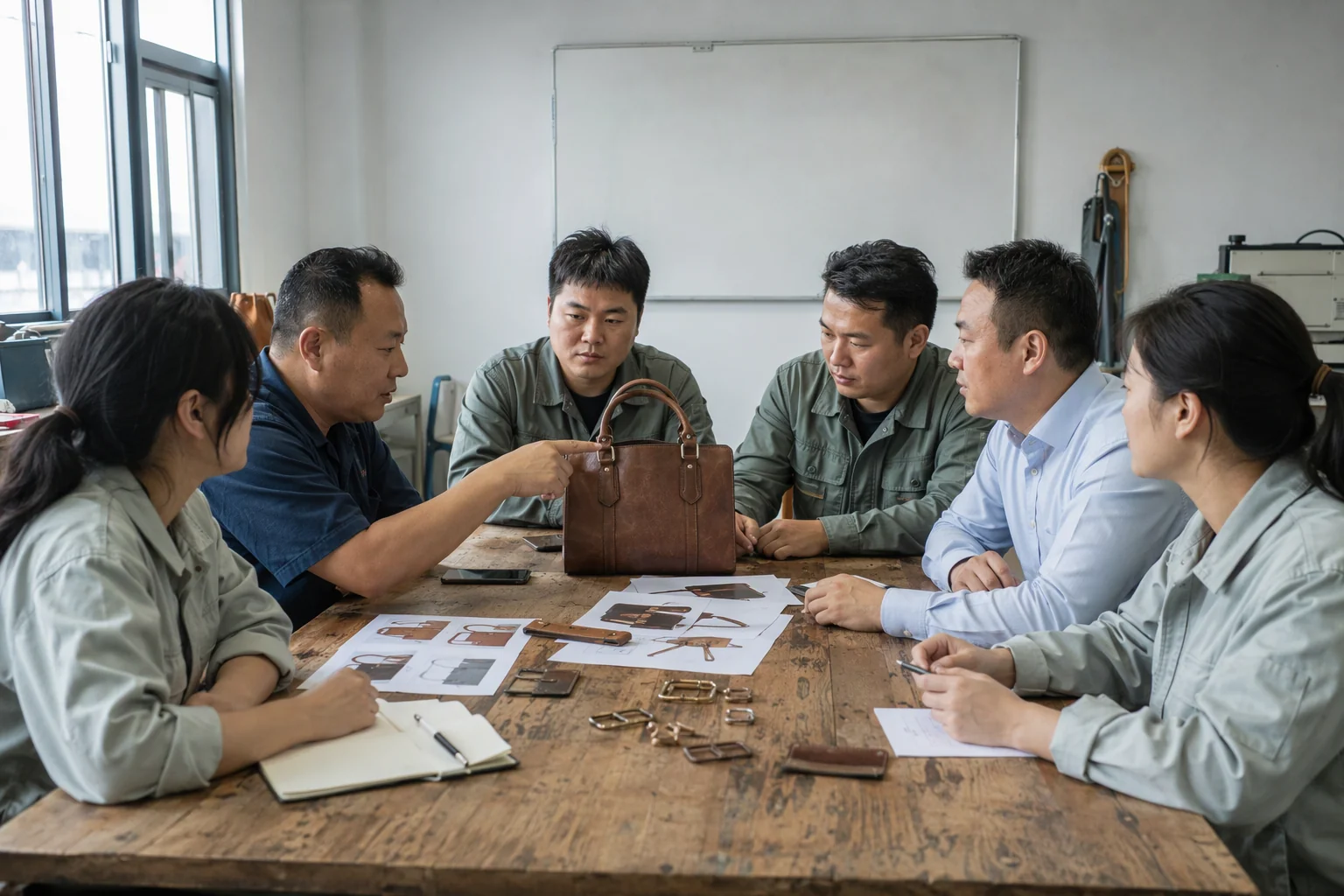
The people who must be present are the production manager, the sample or pattern maker, the line supervisor, the quality lead and whoever owns materials purchasing. Each holds a piece of the order that the others cannot verify.
Optional Attendees
A merchandiser, a hardware buyer or a finishing specialist join when the style requires them. Attending everyone for every order dilutes the meeting; the rule is that each attendee must own a decision.
Who Must Sign
At least one person must be accountable for the final record, and it must be someone senior enough to stop the line. A meeting chaired by someone who cannot halt production produces agreements that the floor quietly ignores.
What the Brand Should Send
The Pack
Before the meeting, the brand should send the final specification, the signed sample reference, the colour approvals, the packaging artwork and the delivery schedule. Anything sent after the meeting is a change, and changes cost more.
The Gap List
A short list of what the brand already knows is unresolved, with deadlines, prevents the meeting from discovering the same gaps aloud. Naming an open point is not a weakness; hiding it is.
The Deadline
The brand should state the date by which it will answer remaining questions. A factory waiting for a brand’s answer is a line that will be rushed later, and the rush is passed on to the goods.
What Must Be Decided Before the Meeting
Sampling Closed
The approved sample must exist, be signed and be physically present. A meeting held around a photograph of a sample that is still in transit decides nothing, because the disagreements have not yet surfaced.
Materials Confirmed
The leather lot, the lining, the thread, the hardware and the packaging should all be confirmed or explicitly flagged as pending. A meeting that discovers a missing zipper pull after the agenda has been worked through wastes the room.
The Order in Writing
Quantity, delivery date, size breakdown, colour breakdown and packaging must be in writing before the meeting. Verbal quantities are the most common cause of a second meeting held in a hurry.
The Room and the Kit
The Physical Kit
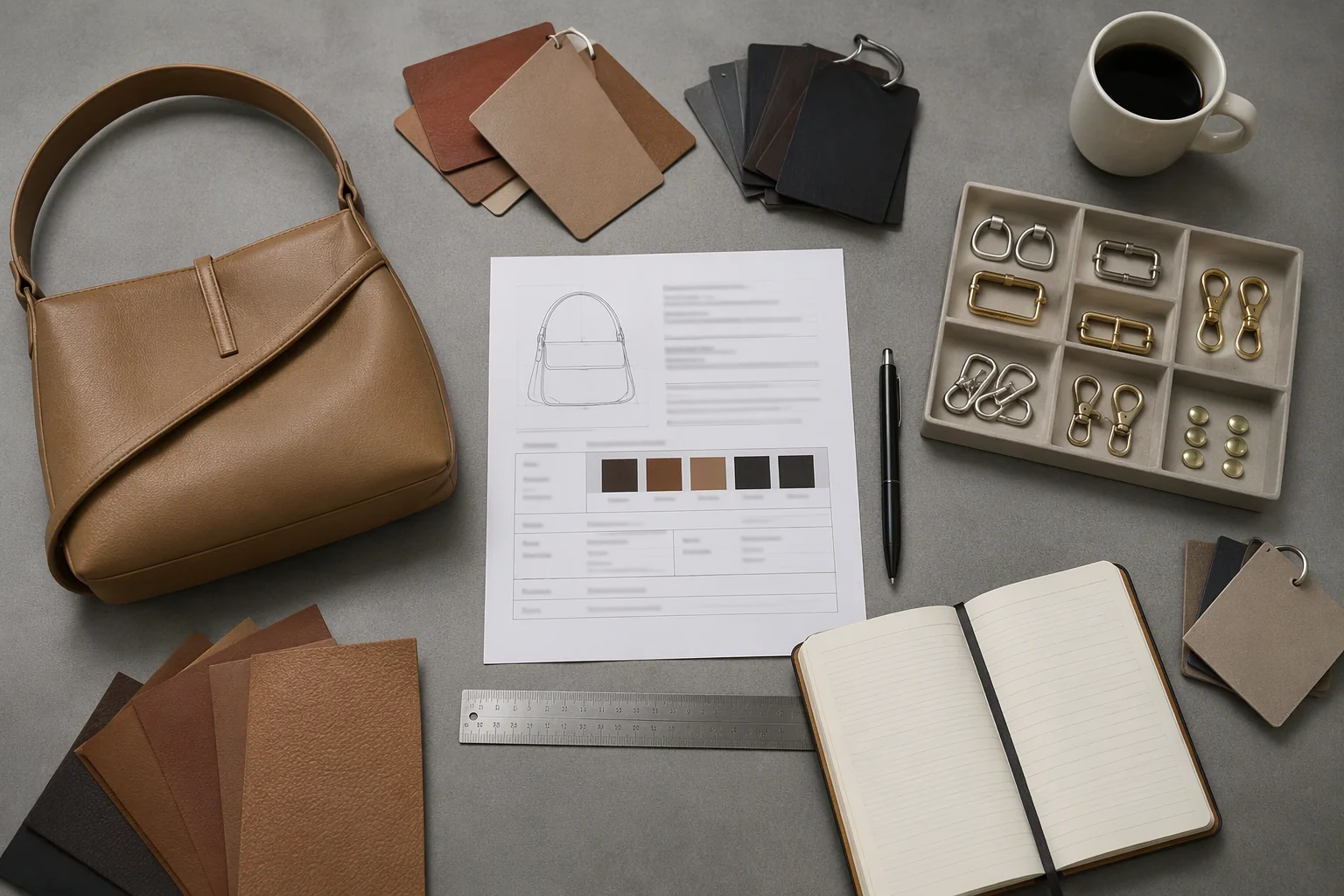
The meeting needs more than a table. A signed sample, a leather swatch set, the hardware parts in trays, the pattern’s key templates, a steel ruler and the packaging all belong in the room. Each object answers a question that words answer badly.
Seating and Sight Lines
Everyone must be able to see the sample without passing it around. A meeting where the bag circulates one person at a time loses thirty minutes and produces opinions instead of decisions.
Minutes in Two Languages
Where a brand and a factory do not share a working language, the minute should exist in both. A single-language record is read by one side and assumed by the other.
Supplier Coordination Before the Meeting
Trims and Lead Times
Hardware, thread, labels and packaging are ordered well before the meeting, and their arrival dates are confirmed, not assumed. A meeting that discovers a six-week trim lead time has discovered a schedule problem rather than a production one.
Split Deliveries
Where materials arrive in parts, the first partial delivery must cover the first production days. A line that starts on a partial lot and waits mid-run loses its rhythm and its first-piece discipline together.
Contingency
For every critical component, the meeting should know the approved alternative. Contingency agreed in advance is a plan; contingency invented mid-run is a substitution, and substitutions are what customers discover.
The Agenda in Order
The Specification Walk-Through
Start with the specification, page by page, with the sample on the table. Every dimension, material and construction note is confirmed against the physical bag, and disagreements are resolved in the room rather than on the line.
The Critical Operations
Identify the two or three operations where this style is most likely to fail, name who owns each, and agree what evidence will show that it was done correctly. This is the part of the agenda that prevents the defects the style is prone to.
The Known Risks
Every order has risks that are already known: a leather with a difficult temper, a new hardware finish, a tight delivery date, a first-time operator. Naming them in the meeting converts them from surprises into plans.
| Agenda item | Owner | Output | If skipped |
|---|---|---|---|
| Specification review | Production manager | Confirmed spec, corrections noted | Each supervisor interprets differently |
| Sample walk-through | Pattern maker | Sample signed as the reference | Approval by memory, disputes later |
| Material confirmation | Purchasing | Lot numbers and shade reference | Substitute material used without approval |
| Critical operations | Line supervisor | Named owner per operation | Known weak points unmanaged |
| Capacity and line plan | Production manager | Line assigned, daily target | Late start, overtime, rushed finishing |
| Quality criteria | Quality lead | Limits, tolerances, first-piece rule | Rejection arguments at final inspection |
| Actions and dates | Meeting owner | Written list with names | Decisions evaporate within a week |
Reading the Table
Each row is a decision, not a discussion topic. A meeting that covers all seven rows in forty minutes is better than one that spends two hours on the first three.
Walking the Sample
Against the Specification, Not Against Taste
The sample is checked against what was specified, not against what each attendee prefers. Opinions raised as preferences should be logged as proposed changes, which then follow the change process rather than being absorbed silently into production.
The Five Points Everyone Forgets
Experience suggests five points are routinely skipped and routinely wrong: the interior, the base, the strap attachments, the closure alignment and the packaging. Each is worth a deliberate minute in the meeting.
Where the Sample and the Spec Disagree
Disagreement is normal and must be resolved explicitly: either the specification is corrected to match the sample, or the sample is corrected before production. Leaving the conflict open guarantees that both versions will exist on the floor.
Materials and Components Confirmation
Leather Lot and Shade
The approved lot must be identified, and a physical reference kept. Where production will run from a different lot, the difference must be approved before cutting rather than explained after delivery.
Hardware and Trim
Each component is confirmed by part, finish and size, with samples present. Two finishes that look identical in a photograph are visibly different on a bag, and the difference is discovered by the customer.
Substitutes and Their Approval
Substitution rules must be agreed in the meeting: what may be replaced, by whom, and what approval is needed. A factory that substitutes quietly is usually a factory that was never told which substitutions were acceptable.
The Critical Operation Review
Identifying the Two or Three
Every style has operations where the margin for error is smallest: a curved topstitch, a gusset join, a frame setting, a strap attachment. Naming them converts general quality talk into specific control.
Who Owns Each
Each critical operation needs one named owner who is accountable for its result, not a committee. Where ownership is shared, nobody stops the line when it starts to drift.
What “Under Control” Looks Like
Agree the evidence in advance: a first-piece check, a photographed reference, a gauge, a limit sample. Evidence agreed before production is accepted; evidence invented afterwards is an argument.
Capacity, Line and Timing
Line Assignment
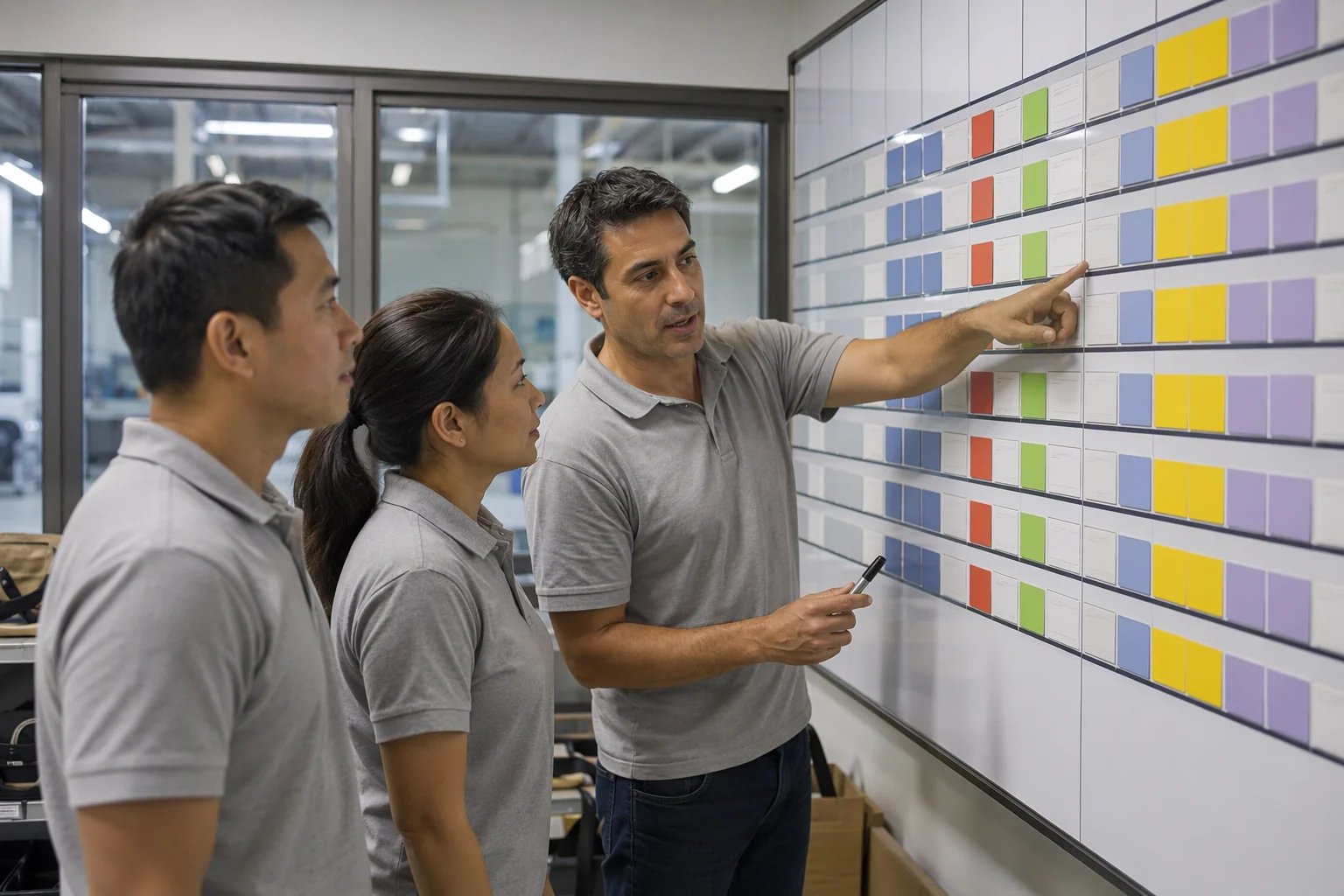
The line, the number of operators and the machine allocation are decided in the meeting. An order that is “somewhere in the factory” on day one is usually late by week three.
Daily Target and Practice
The daily target should be based on what the line has actually achieved on a comparable style, not on what the customer hopes for. Where the style is new, a practice run on the first fifty units is worth scheduling.
The Bottleneck Named Out Loud
One operation will limit the whole line. Naming it in the meeting allows the schedule to be built around it instead of discovering it in week two.
Quality Criteria at the Start
Limits and Tolerances
Dimensions, stitch density, edge width and colour tolerance are stated numerically where possible. “As the sample” is acceptable only where the sample is present and signed.
The First-Piece Standard
The first unit off the line is checked against the approved sample before the run continues. This single rule prevents more defects than any inspection regime applied later.
What Will Be Rejected
The meeting should state plainly what will be rejected, and at which stage. A rejection rule announced after the goods are made is a dispute; announced before, it is a standard.
Assigning Actions
Named Person, Dated
Every action gets a name and a date. Actions assigned to departments are not actions; they are hopes.
The Two-Column List
A single list of what will be done and by when, kept to one page, is more effective than a detailed minute nobody reads. The list is the part that gets followed up.
Closing the Loop
The list is reviewed at the first production day, not at the next meeting. Actions that are not checked within a week are usually not done.
A pre-production meeting that produces no dated list has produced a conversation, not a plan.
Tooling, Patterns and Templates
Pattern Release
The pattern is released to the line only after the sample has been signed and any corrections are incorporated. Releasing an uncorrected pattern because the schedule is tight is the most common cause of a first run that has to be remade.
Templates and Dies
Acrylic templates, cutting dies and jigs are checked against the released pattern in the meeting, not on the cutting table. A die that was made to an earlier revision produces a thousand wrong panels before anyone notices.
Who Holds the Master
The master pattern and its latest revision should have one named holder. Where several copies circulate, several versions are in use, and the version on the line is rarely the current one.
The First Piece, Formally
Who Makes It
The first piece is made by the most experienced operator on the line, not the fastest. Its purpose is to establish a reference, and a reference made quickly is not a reference.
Who Checks It
The quality lead checks it against the signed sample, in the presence of the supervisor, before the run continues. The check is recorded with a photograph and kept with the order file.
If It Fails
A failing first piece stops the run. The fix belongs to the operation or the pattern, and neither is corrected by producing more units. Factories that continue after a failed first piece are choosing to inspect later at a higher cost.
Decisions and Who Owns Them
The Decision Map
Meetings fail when a decision is made by the wrong person and reversed later. The table below assigns the decisions that recur in every order.
| Decision | Who decides | Recorded as | Why it matters |
|---|---|---|---|
| Specification corrections | Production manager with brand | Corrected sheet, dated | Prevents two versions on the floor |
| Colour and shade approval | Brand, on factory advice | Approved lot reference | Shade disputes are unwinnable later |
| Component substitution | Brand, on technical advice | Written approval per part | Silent substitution is a claim waiting |
| Critical operation owner | Line supervisor | Named in the minute | Shared ownership stops nothing |
| Line and daily target | Production manager | Line plan | Late starts are rarely recovered |
| Tolerance relaxation | Brand | Written concession | Concessions expire, memories do not |
| First-piece acceptance | Quality lead | Photo plus signature | The run inherits the first piece |
| Rework authorisation | Quality lead with production | Rework note | Unrecorded rework hides defects |
Using the Map
Before the meeting closes, every row should have an answer. Rows left blank are the ones that generate the arguments three weeks later.
Measuring Whether the Meeting Helped
First-Pass Yield
Compare the share of units that pass first inspection before and after the meeting practice was introduced. A factory that runs the meeting properly usually sees first-pass yield rise within two orders.
Rework Hours
Rework hours per order are the clearest signal, because they reflect everything that was misunderstood. A meeting that shortens rework pays for itself in the first month.
Claims and Credits
Claims and credit notes trace back to decisions that were never made explicit. Tracking them by style shows which kinds of orders the meeting is failing to prepare for.
Pre-Production in a Small Factory
Fifteen Minutes at the Pattern Table
A workshop with eight people does not need a conference room. It needs fifteen minutes at the pattern table with the sample, the leather and the person who will cut it, and three questions: what is difficult, what is missing, who checks the first one.
The Owner as Chair
In a small factory the owner is usually the only person who can stop the line, so the owner chairs. Delegating the meeting to someone without that authority produces notes nobody acts on.
When It Still Matters
Small factories skip the meeting because everyone talks all day. That works until a new style, a new material or a new customer arrives, which is exactly when the fifteen minutes would have paid.
Recording the Meeting
The One-Page Minute
One page is enough: attendees, decisions, actions with names and dates, and any open points with an owner. Length is not a virtue here; recall is.
Photographs
A photograph of the signed sample beside the specification, taken in the meeting, resolves most later disputes about which version was approved.
Distribution
The minute goes to everyone who attended and to the line supervisor who will run the order, the same day. A minute distributed the following week has already lost the argument with the floor.
Running It in Under an Hour
Timeboxing
Ten minutes per agenda item, with the sample present, is usually enough. When an item overruns, it becomes a separate conversation with the people who own it.
The Standing Agenda
A fixed agenda used for every order removes the preparation burden and makes omissions visible. Factories that reuse the same seven-item agenda run faster meetings than factories that design one each time.
When It Needs Two Hours
New constructions, first orders from a new brand, and styles with unusual materials justify a longer session. The signal is the number of open points, not the size of the order.
Meetings for Repeat Orders
What Changes
Repeat orders can be handled in fifteen minutes: confirm nothing has changed, confirm the lot, confirm the date. The value is in the confirmation, not in the discussion.
What Must Still Be Said
Even on a repeat, the sample, the leather lot and the delivery date are stated aloud. The defects that hurt most are usually on repeat orders, where everyone assumed.
Change Alerts
Any change since the last run, however small, must be raised. A changed thread, a new hardware supplier or a different finishing operator all qualify.
When the Brand Attends
The Brand’s Role
The brand attends to confirm the specification and to make decisions that only it can make. It does not run the meeting, and it should not be asked to arbitrate internal factory questions.
Language and Translation
Where a translator is needed, the sample and the photographs carry more meaning than the words. Decisions should be confirmed back in writing in both languages.
Decisions That Need the Brand
Colour approval, substitution approval, packaging approval and any tolerance relaxation belong to the brand. A factory that decides these alone creates a claim it cannot win.
The Second Meeting
When It Is Needed
A second meeting is justified when the first reveals that the specification is incomplete, when a material is unavailable, or when the sample does not match what the brand believed it approved. It is not justified because the first meeting ran out of time.
What It Covers
The second meeting covers only what changed and what was left open, with the first minute in hand. Reopening settled decisions is how a schedule is lost.
Signing the Deviation
Where a decision departs from the specification, the deviation is signed by whoever owns the consequence. An unsigned deviation is a future dispute with no evidence.
Handover to Finishing and Packing
What Packing Needs to Know
The meeting should hand packing its own set of facts: folding method, tissue and stuffing, label position, carton configuration and barcode placement. These are decided late in most factories and are the most common source of a delayed shipment.
Labels and Cartons
Label text, position and the carton mark are confirmed against the approved artwork in the meeting. A carton printed to an older version cannot be used, and reprinting takes longer than the order allows.
The Last Check
Packing is also the last chance to catch a defect. Agreeing in the meeting what packing should look at, and what it should escalate, converts an untrained pair of eyes into a control point.
Meeting Discipline Over a Season
Peak Compression
In peak season, meetings are shortened and then skipped, in that order. The compression is survivable if the seven agenda items are kept and the discussion is cut; it is not survivable if the first-piece check goes with it.
The Rule That Holds
Factories that keep one rule through a busy season keep the first-piece check. It is the cheapest defence in the whole system and the first thing sacrificed under pressure.
Where the Pressure Shows
Late shipments and claims in peak season usually trace to a meeting that was skipped in the week the order started. The connection is rarely made, because the two events are two months apart.
Orders That Run Across Several Lines
One Standard
Where an order is split across two lines, the meeting must produce one standard for both. Two lines interpreting one sample is the most reliable way to produce two products under one order number.
Cross-Line Checks
The first piece from each line is checked against the same signed sample, ideally by the same person. Comparing lines against each other finds drift; comparing each against the sample prevents it.
Comparing Output
Mid-run, the two lines’ output is laid side by side on a table. Differences in shade, rim stiffness and stitch appearance appear immediately at that distance and are almost invisible on a machine.
Documenting the Deviations You Accept
The Deviation Log
Every accepted departure from the specification goes into one log: what, why, who approved, and until when. A deviation that is not logged becomes a precedent without a record.
Expiry
Deviations should expire. A concession made for one lot that becomes permanent quietly becomes the new standard, and the specification drifts away from what is actually being made.
Review
Reviewing the log each quarter shows which deviations recur, and recurring deviations are usually a specification problem rather than a production one.
Coaching the Chair
The First Three Meetings
A new chair should run three meetings with an experienced person watching. The first is usually too long, the second too short, and the third roughly right, which is faster progress than any training course produces.
A Checklist for the Chair
The chair’s job is easier to hold in the hand than in the head:
- Confirm the sample and specification are on the table before starting
- Keep each item to ten minutes and record the decision
- Ask who owns each critical operation, and write the name down
- Ask what is still missing, and who will answer it by when
- Close with the dated list read aloud
What to Fix First
The first improvement is almost always the written list of actions. It costs nothing, it exposes whether the meeting decided anything, and it makes the next meeting shorter.
When the Chair Is the Problem
A chair who cannot stop the line, who attends to settle arguments rather than to decide, or who treats the meeting as a report to management will produce minutes without consequences. Changing the chair is often the entire intervention.
Common Failures
The Meeting Held After Cutting
Held once the leather is already cut, the meeting can only discuss how to live with the decisions already made. Its value collapses to a scheduling exercise.
The Agenda Without Decisions
An agenda of topics produces discussion; an agenda of decisions produces a plan. The difference is visible in whether the minute contains names and dates.
The Undocumented Agreement
Verbal agreement that everyone remembers differently is the most expensive outcome of a meeting. It is also the most common.
A Pre-Production Checklist
The list below is the minimum a factory should be able to tick before the first cut. It is deliberately short enough to be used.
- Approved sample physically present and signed
- Specification confirmed against the sample, corrections noted
- Leather lot identified with a shade reference
- Hardware, lining, thread and packaging confirmed by part
- Two or three critical operations named with owners
- Line assigned, daily target agreed, bottleneck identified
- Quality limits stated, first-piece rule agreed
- Actions listed with names and dates
- Minute distributed the same day
- First-piece check scheduled before the run continues
Frequently Asked Questions
Who should attend a pre-production meeting?
The production manager, pattern or sample maker, line supervisor, quality lead and materials buyer at minimum. Anyone else should attend only if they own a decision on the agenda.
When should the meeting be held?
After the sample is approved and before cutting begins. Holding it after cutting removes most of its value, because the materials are already committed.
How long should it take?
Forty to sixty minutes for a normal order, with ten minutes per agenda item. New constructions or unfamiliar materials may justify two hours, but length should follow open points rather than order size.
What must be in the written record?
Attendees, decisions, actions with names and dates, and open points with owners. A photograph of the signed sample beside the specification is worth adding to every minute.
Is a pre-production meeting needed for repeat orders?
Yes, in shortened form. The sample, the leather lot and the delivery date are confirmed aloud, and any change since the last run is raised. Most painful defects occur on repeat orders where assumptions replaced confirmation.
What are the most commonly missed points when walking a sample?
The interior, the base, the strap attachments, closure alignment and packaging. These are the five areas where the sample and the production unit most often diverge.
How should disagreements between sample and specification be handled?
Decide explicitly in the meeting: either correct the specification to match the sample, or correct the sample before production. Leaving both versions open guarantees that both will appear on the floor.
What is a critical operation?
An operation where the margin for error is smallest for that style, such as a curved topstitch, gusset join, frame setting or strap attachment. Each needs a named owner and agreed evidence that it was done correctly.
Should the brand attend?
Where practical, yes, to confirm the specification and to make decisions only the brand can make, such as colour and substitution approval. The brand should not chair the meeting or arbitrate internal factory questions.
How are actions tracked afterwards?
On a single dated list reviewed on the first production day. Actions not checked within a week are usually not done, and reviewing them at the next meeting is too late.
What is the single most useful rule?
Check the first unit off the line against the signed sample before the run continues. That one rule prevents more defects than any inspection regime applied after the goods are made.
Conclusion
The pre-production meeting is cheap because it happens before anything is committed. Its output is not a document but a set of decisions that the floor can act on: one signed sample, one confirmed specification, one named owner per critical operation, one line with a target, and one dated list of actions.
For a bag manufacturer, the discipline is to treat the meeting as a control point rather than a formality. Seven agenda items, a sample on the table, a minute distributed the same day, and a first-piece check before the run continues will prevent most of the defects that later appear as rework, claims or late shipments.
For a brand, the useful question is not whether the factory holds a meeting, but whether it can produce the minute. A minute with names and dates is evidence of a factory that plans; a factory that cannot produce one is planning on the line, which is the most expensive place to plan.
