
Full-Grain vs Top-Grain vs Genuine vs Bonded Leather
Full-Grain vs Top-Grain vs Genuine vs Bonded Leather
Four labels, one word in common, and wildly different materials underneath. “Leather” on a tag tells you almost nothing about what the bag is made of.
From the factory bench, the four grades — full-grain, top-grain, genuine, and bonded — are as different as silk, cotton, rayon, and polyester. This guide explains each grade honestly: what it is, how it performs, and which bags it belongs on.
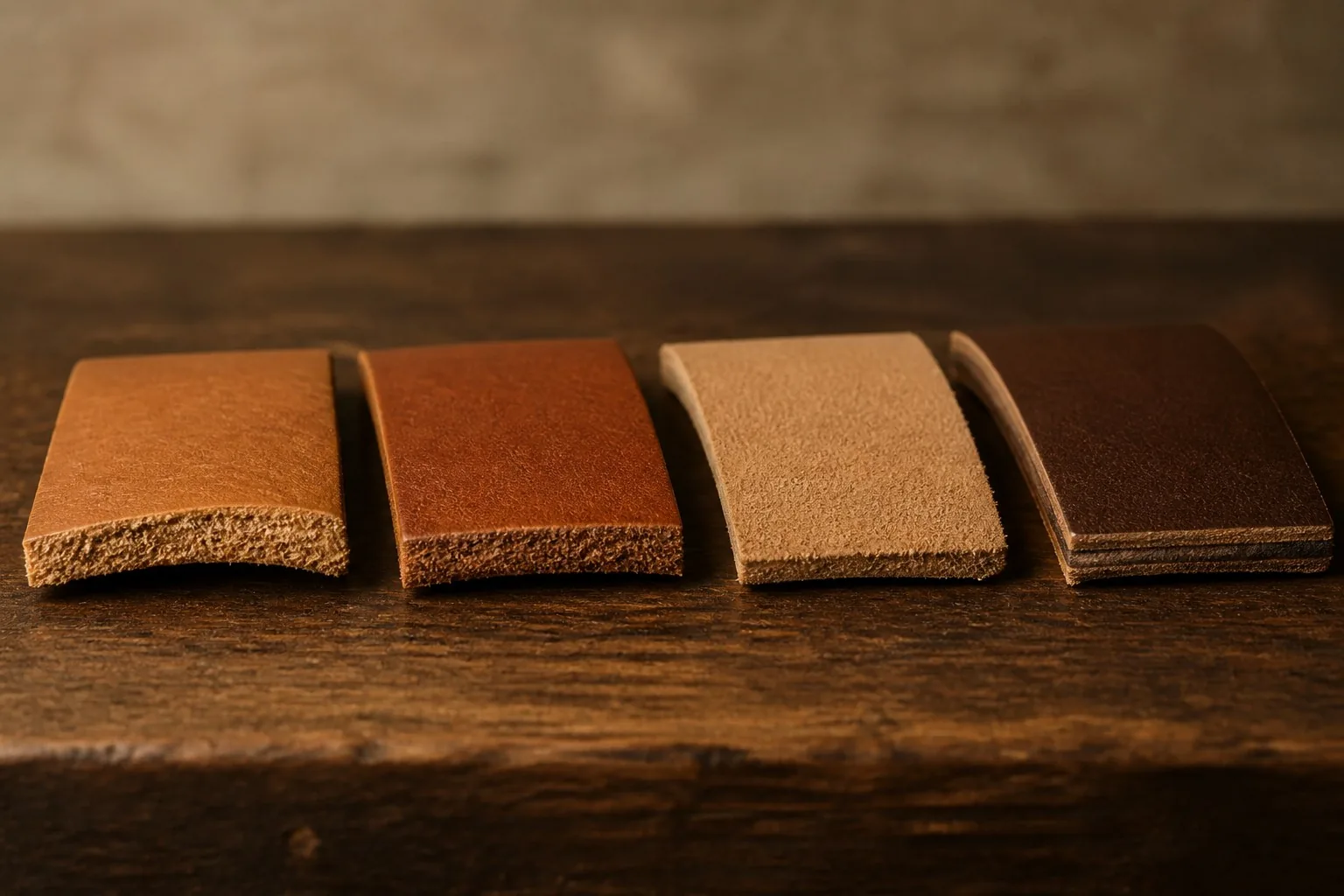
- The Four Grades at a Glance
- Full-Grain Leather: The Top of the Ladder
- Top-Grain Leather: The Practical Premium
- Genuine Leather: The Misleading Middle
- Bonded Leather: The Bottom of the Ladder
- The Head-to-Head Comparison
- How Each Grade Behaves During Manufacturing
- Aging: The Long-Term Test
- Identification: Telling Them Apart in 60 Seconds
- Which Grade Should You Buy?
- Common Labeling Traps
- Care Differences by Grade
- Frequently Asked Questions
- The Bottom Line
The Four Grades at a Glance
The leather industry grades hides by how much of the original animal surface survives and how the material is assembled. That single factor drives almost everything else.
Why Grades Exist
A hide is thick, uneven, and expensive, and most of it cannot serve as a premium bag panel.
Tanneries split hides into layers, treat surfaces, and rebuild what cannot be sold whole. Grades are the result: a ladder from the untouched natural surface down to leather scraps glued back together. Understanding the ladder prevents paying premium prices for entry-level material.
The One Line That Matters
If you remember one sentence from this article, make it this: the more of the hide’s natural surface a leather keeps, the stronger, more breathable, and more valuable it is.
Full-grain keeps everything. Top-grain keeps most of it after light sanding. Genuine and split leathers lose the surface entirely. Bonded leather has no intact structure at all. Every comparison in this guide follows from that line.
A Note on the Word “Genuine”
The word “genuine” sounds like the highest praise and functions as the lowest tier of the real-leather family.
In industry usage, genuine leather usually means a split or corrected hide — real leather, but not the top layer. It is legally defensible and marketing-friendly, which is exactly why it confuses buyers. Treat “genuine” as a grade, not a compliment.
The Four Grades Table
| Grade | What it is | Natural surface | Durability | Price tier |
|---|---|---|---|---|
| Full-grain | Whole hide, surface intact | Yes, 100% | Highest | Premium |
| Top-grain | Surface lightly sanded | Mostly | High | Mid to high |
| Genuine / split | Inner layer, surface removed | No | Moderate | Entry |
| Bonded | Shredded scraps + binder | No | Lowest | Budget |
Full-Grain Leather: The Top of the Ladder
Full-grain is the reference point against which every other grade is judged, and it earns that position.
What Full-Grain Actually Is
Full-grain leather is the hide exactly as it grew, with only the hair removed and the surface left intact.
Nothing is sanded, sanded away, or glued on. The grain you see is the animal’s own skin structure, including its pores, growth marks, and natural variation. That intact surface is the strongest part of any hide, and full-grain preserves all of it.
Why the Surface Matters
A hide is like a roof: the outer surface is dense and tight, while the inner layers get progressively weaker and looser.
Keeping the surface means keeping the strongest fibers in their natural woven arrangement. This is why full-grain resists tearing, stretching, and abrasion better than any other grade of the same hide, and why it develops patina instead of wearing out.
How Full-Grain Ages
Full-grain leather ages rather than degrades: the surface gains depth, softens at the folds, and darkens unevenly in a way enthusiasts call patina.
Small scratches can often be buffed away by hand warmth, because the surface fibers are still intact. Leather repair shops can recondition full-grain panels for decades. No other grade offers this kind of recoverable life.
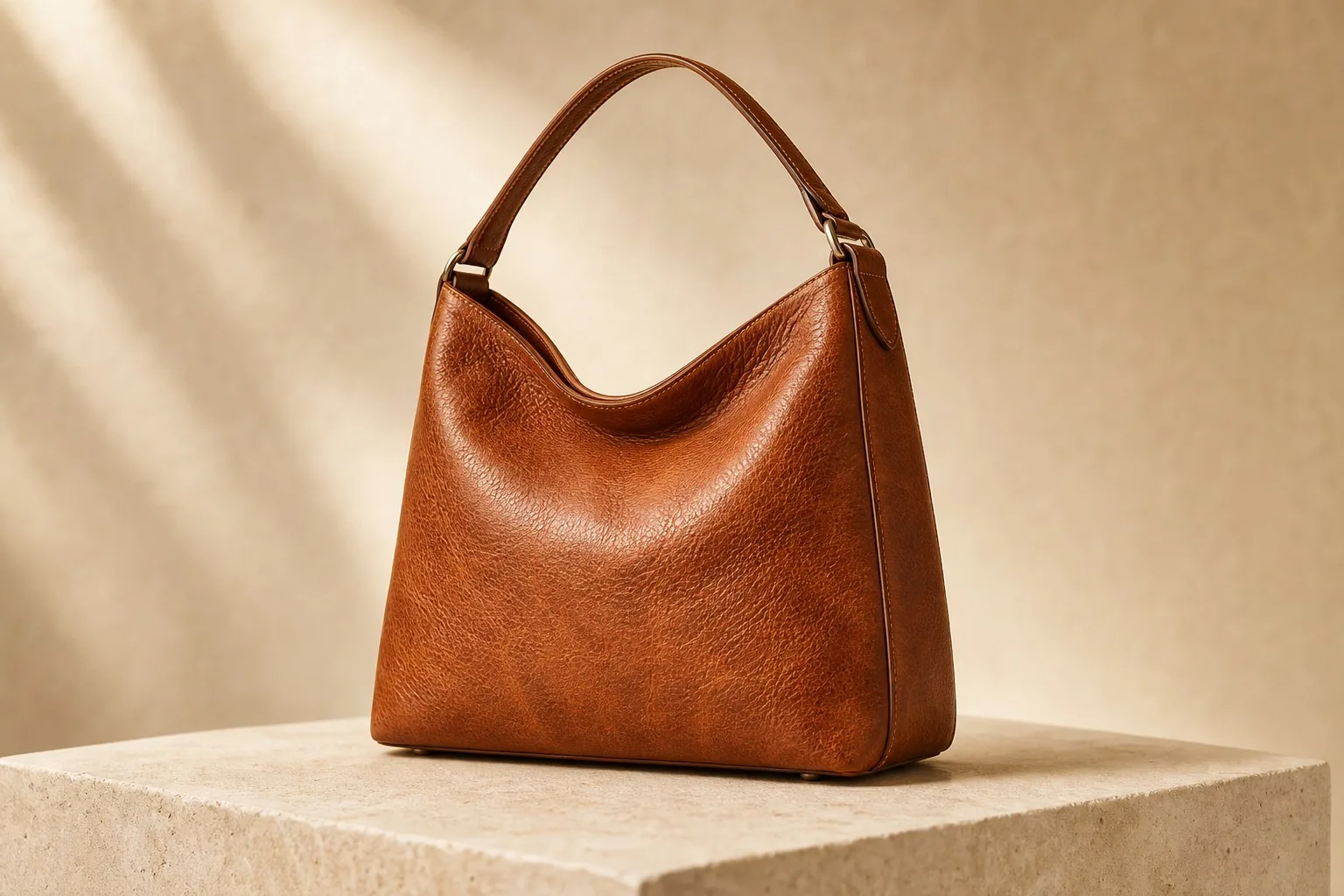
Best Uses in Bags
Full-grain belongs on the parts of a bag that must survive and be seen.
- Premium totes and handbags
- Structured work bags and briefcases
- Straps and handles on any leather bag
- Investment pieces intended to last decades
- Any visible panel where natural character is a selling point
What Full-Grain Costs
Full-grain carries the highest raw material cost because it uses the whole valuable surface of a hide, with no downgrading.
The cost gap is real: full-grain can run two to four times the price of entry-level genuine leather per square foot. For buyers, that difference buys decades rather than years, which makes the cost-per-year calculation far more favorable than the sticker suggests.
Manufacturer’s point: When a brand asks how to make a bag last longer, we rarely suggest adding reinforcement or thicker lining. We suggest moving one grade up on the panels the customer touches every day. Grade beats hardware in durability, every time.
Top-Grain Leather: The Practical Premium
Top-grain is the most common leather in mid-range bags, and it is a genuine compromise rather than a trick.
What Top-Grain Actually Is
Top-grain leather comes from the same top layer as full-grain, but the surface is lightly sanded to remove imperfections.
The sanding creates a more uniform surface, which then receives a light finish or a subtle embossed grain. The hide’s underlying strength stays largely intact; what is removed is the natural variation that some buyers dislike.
Sanding and Its Consequences
Sanding removes the densest part of the surface, which slightly reduces abrasion resistance and eliminates patina.
Top-grain will not develop the deep, uneven character of full-grain because the surface fibers that create patina are gone. In exchange, buyers get consistency: every panel looks nearly identical, with no scars, brands, or growth marks.
Durability in Real Use
Top-grain is genuinely durable and usually lasts many years in daily use, especially with a quality finish.
It resists scuffs reasonably well, cleans easily, and holds color uniformly. Under heavy abrasion, the finish can wear before the leather underneath does, which is the main long-term difference from full-grain. For most everyday bags, the practical difference is small.
Best Uses in Bags
Top-grain suits bags where uniformity and a uniform price point matter.
- Mid-range handbags and shoulder bags
- Business and laptop bags
- Volume production runs needing consistent panels
- Bags where matching color across a line is required
- Any style for buyers who prefer a clean, unmarked surface
Genuine Leather: The Misleading Middle
Genuine leather is where the industry’s language gets genuinely confusing, and where most buyer disappointment originates.
What Genuine Really Means
In practice, genuine leather usually refers to a split: the inner layer left after the top surface has been removed for higher grades.
The split is then finished with a coating and an embossed grain pattern to look like a full surface. It is real leather — the fibers are animal fibers — but it is the weaker inner structure wearing a costume of grain and color.
Why It Performs Differently
Without the dense top surface, split leather is weaker, stretches more, and fails at stress points sooner.
Coated splits also fail in a particular way: the coating separates from the fiber base, producing the peeling and flaking that buyers describe as “fake leather falling apart.” The material is not fake, but the finish is doing work the structure cannot support.
Where Genuine Leather Works
Genuine leather is not automatically bad, and in the right places it performs acceptably.
- Low-stress trim and piping
- Interior pockets and dividers
- Budget bags with short expected lifetimes
- Fashion bags where structure and load are light
- Packaging and accessory elements
The Marketing Fog
The confusion around genuine leather is largely deliberate, and buyers need to read past it.
Labels like “100% genuine leather” describe the fiber content, not the grade. Two bags can both claim genuine leather while one uses full-grain panels and the other uses coated splits with bonded trim. The word is accurate and nearly meaningless at the same time.
Bonded Leather: The Bottom of the Ladder
Bonded leather is the lowest grade sold under the leather name, and it behaves like what it is: a composite.
How Bonded Leather Is Made
Bonded leather is manufactured by shredding leather scraps and dust, mixing them with a polyurethane or latex binder, and pressing the mixture onto a fabric backing.
The result contains real leather fiber but no continuous leather structure. Manufacturers describe the percentage of leather content, which can range widely, but percentages do not restore what grinding destroyed.
Why Bonded Fails
Without continuous fibers, bonded leather has no strength to resist flexing, and it fails earlier than any other grade.
The typical failure is delamination or surface cracking within a few years of regular use, sometimes much sooner in humid conditions. Bonded material cannot be repaired or reconditioned, because there is no intact structure for a repair to hold onto.
When Bonded Is Acceptable
Bonded leather has legitimate uses where the material never faces stress or time.
- Decorative elements inside a bag
- Short-life promotional items
- Binding and packaging
- Very small accents rather than load-bearing panels
The problem is never bonded leather existing. The problem is bonded leather sold and priced as something better.
How to Spot Bonded Leather
A few quick checks identify bonded leather with high confidence.
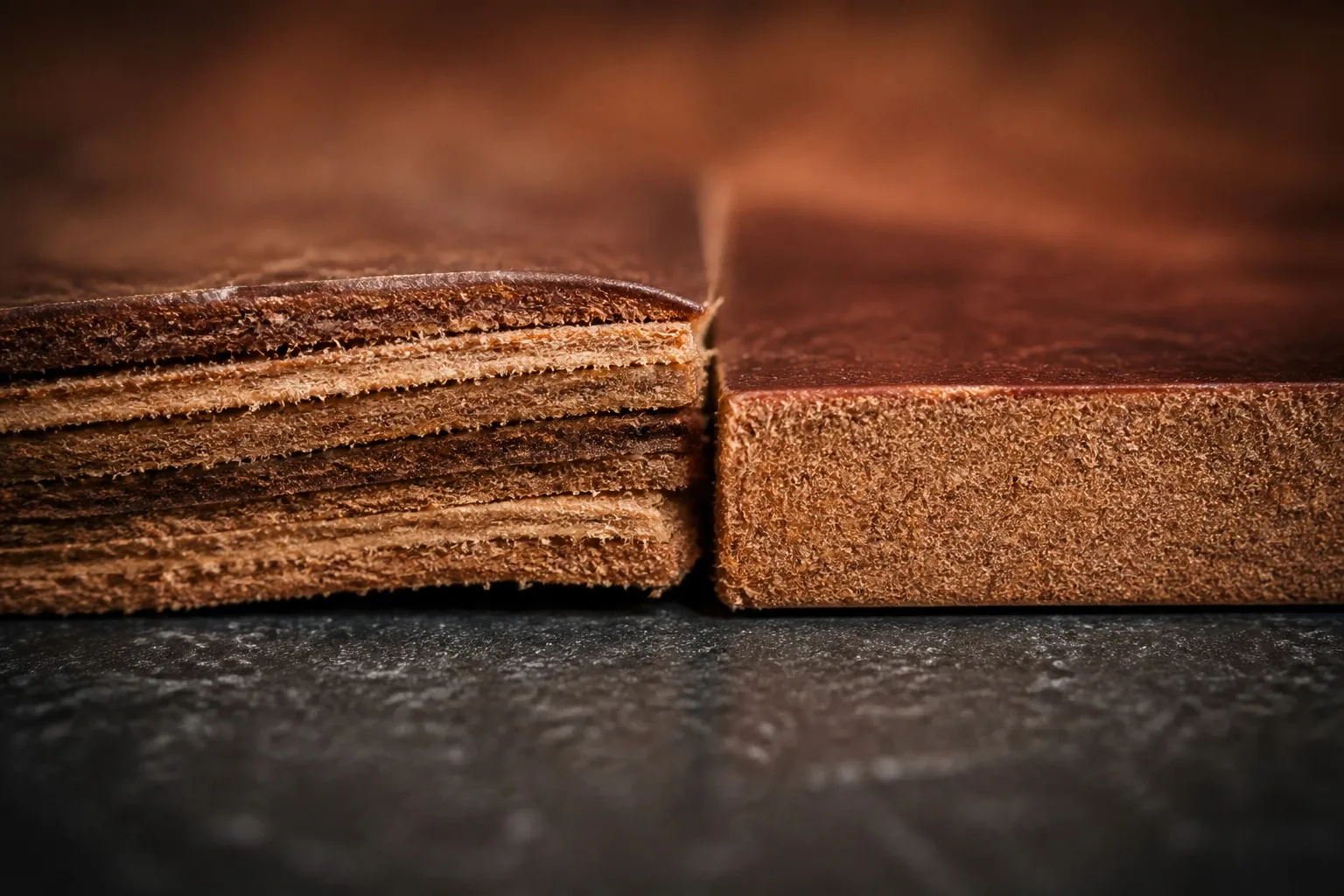
- Look at the cut edge: bonded shows a fuzzy, layered or fabric-like core
- Check the back: bonded has a woven or knit backing rather than suede-like flesh
- Flex it: bonded creases sharply and feels papery
- Smell it: the plastic binder dominates the leather scent
- Price it: a “leather” bag at a fraction of market price is almost never a higher grade
The Head-to-Head Comparison
The table below is the one we use when a brand or buyer asks which grade justifies its price.
| Property | Full-grain | Top-grain | Genuine / split | Bonded |
|---|---|---|---|---|
| Natural surface | Complete | Mostly | Removed | None |
| Tensile strength | Highest | High | Moderate | Lowest |
| Abrasion resistance | Highest | Good | Fair | Poor |
| Breathability | Excellent | Moderate | Low | None |
| Patina | Yes | No | No | No |
| Repairability | Excellent | Good | Limited | None |
| Typical lifespan | 20+ years | 8–15 years | 3–6 years | 1–3 years |
| Cost per square foot | Highest | High | Moderate | Lowest |
Reading the Table
The pattern is consistent across every row: quality follows the intact surface.
Where the surface survives, strength, breathability, repairability, and lifespan all rise together. Where it is sanded, removed, or destroyed, every measure falls. This is not a marketing opinion — it is a structural consequence of how hides are built.
Durability Rankings
Ranked by expected lifespan in normal bag use: full-grain first, top-grain second, genuine third, bonded last.
The gaps are large, not marginal. A full-grain bag can realistically serve twenty years with care; a bonded bag of the same design may struggle to reach three. That is why cost-per-year favors the premium grade despite its price.
Price vs Value
Cheap leather is only cheap at the register. The lifetime math reverses the ranking.
A $400 full-grain bag used for fifteen years costs about $27 per year. A $100 bonded bag replaced every two years costs $50 per year, with none of the aging, repair, or resale value. Value and price are not the same number.
How Each Grade Behaves During Manufacturing
Grades are not only a buyer’s concern. Each one changes how a bag is cut, sewn, and finished.
Cutting and Yield by Grade
Cutting plans differ by grade because the defects and variation differ.
Full-grain panels must be nested around scars, brands, and growth marks, which lowers yield and raises cost. Top-grain is more uniform and wastes less. Splits are consistent but weak, and bonded rolls are perfectly uniform, which is why they suit high-volume automated production.
Skiving, Folding, and Edges
Edge work is where the grade becomes visible to anyone who looks closely.
Top and full-grain hold clean folded or painted edges. Splits must often be turned and glued because their thin structure sags at an exposed edge. Bonded edges are usually sealed with a coating, and that coating is typically the first thing to fail.
Stitching and Reinforcement
Stitching behaves differently across grades, and reinforcement needs change with it.
Full-grain accepts heavy thread and rivets without tearing. Splits tear at the stitch line under load, so makers reinforce them with interfacing or hidden panels. Bonded material can tear completely through the stitch line, which limits how much load any bonded seam can hold.
Where Each Grade Belongs in One Bag
Good bags often combine grades deliberately, putting expensive leather where the hand and eye go.
- Full-grain on the body, flap, and handles
- Top-grain on the back panel and less-visible surfaces
- Genuine or split on pockets and dividers
- Bonded only on decorative or non-structural elements
That mix is not a shortcut. It is cost engineering, and a brand that can explain its mix is usually a brand that knows its material.
Manufacturer’s point: Ask any bag maker which grade sits on the handle, the base, and the strap. If the answer is “full-grain on all three,” the bag is built to last. If the answer is vague, the material budget is probably hiding somewhere.
Aging: The Long-Term Test
Time is the only test that cannot be faked, and the four grades separate dramatically after a few years.
Full-Grain Patina
Full-grain improves with use: colors deepen, the surface burnishes, and the leather takes on the shape of its owner.
Patina is the visible result of intact surface fibers responding to oil, light, and friction. It cannot be manufactured or imitated. This is why vintage full-grain bags often sell for more than they cost new while other grades depreciate toward zero.
Top-Grain Uniform Change
Top-grain ages evenly and quietly: the color may deepen slightly, but the surface stays consistent until the finish begins to wear.
There is no dramatic patina, and that predictability is precisely what many buyers want. Top-grain looks nearly the same at year five as at year one, minus small signs of use. For a business bag, that consistency is a feature.
Genuine Wear Patterns
Split and genuine leathers show wear at the edges, corners, and fold lines first.
Because their strength depends on a coating, wear reveals the difference between finish and fiber. Once the coating abrades through, the revealed surface looks and feels markedly cheaper, and the contrast spreads quickly across the most-handled areas.
Bonded Failure
Bonded leather does not age; it deteriorates.
The binder and coating crack, the surface lifts, and the material can delaminate in sheets. There is no care routine that prevents this, because the failure is inside the material’s construction rather than on its surface. This is why bonded products usually fail within the warranty-adjacent window of one to three years.
Identification: Telling Them Apart in 60 Seconds
Buyers cannot rely on labels, so practical inspection matters. These five checks identify the grade quickly.
The Edge Test
The cut edge is the single most honest indicator of grade.
Full-grain and top-grain edges show a solid, fibrous, single-piece cross-section. Splits look thinner and softer with a suede-like back. Bonded edges show visible layers: a coated top, a fuzzy shredded core, and often a fabric backing. If you can only perform one check, perform this one.
The Grain Test
Natural grain is irregular; printed grain repeats.
Compare several areas of the same panel. Real grain varies in pore size, direction, and spacing. Embossed grain repeats the same pattern exactly, sometimes visibly aligned to a roll direction. A perfect, endlessly repeated grain on a cheap bag is usually a print.
The Pressure Test
Press your thumb into the leather and watch what happens at the surface.
Full-grain and top-grain wrinkle naturally with fine lines that spring back. Coated splits often show a stiff, plastic-like resistance, and heavy creasing may reveal a lighter-colored underlayer. Bonded material creases sharply like heavy paper.
The Smell and Touch Test
Leather has a distinct, warm, animal scent; coatings and binders smell chemical.
Touch adds information too: full-grain warms and softens under the hand, top-grain feels smooth and slightly cool, splits feel thinner and more uniform, and bonded feels stiff and dry. Pair the scent with the edge test and you will rarely be wrong.
The Price Sanity Check
Price is not proof, but it is a useful filter when combined with the physical checks.
A full-grain bag cannot be sold at bonded prices; the raw material alone forbids it. When a price seems too good for the claimed grade, the grade is usually lower than the claim. Trust the edge and the price together.
Which Grade Should You Buy?
The right grade depends on how long you intend to own the bag and what it must survive.
The Decision Matrix
| Your situation | Recommended grade | Why |
|---|---|---|
| Daily bag, want 10+ years | Full-grain | Ages, repairs, holds value |
| Professional, uniform look | Top-grain | Consistent, durable, clean |
| Budget-conscious first bag | Top-grain | Best value per year |
| Occasional fashion piece | Genuine / split | Adequate for light use |
| Promotional or temporary | Bonded | Acceptable if priced as such |
| Family bag facing abuse | Full-grain | Highest abrasion resistance |
| Gift to last a lifetime | Full-grain | Resale and patina value |
For a Daily Carry
For a bag used every day, buy the highest grade you can justify on the panels you touch.
The body, handles, and straps see the most friction and load, so full-grain pays back there even if less-visible areas use top-grain. Spending the budget on visible and handled surfaces is the most efficient way to buy longevity.
For a Family or Diaper Bag
Family bags face wipes, spills, and constant flexing, all of which favor full-grain.
A full-grain exterior handles abrasion and cleaning better than any other grade, and it can be reconditioned when the years accumulate. Bonded and coated splits are poor choices here, because their failure mode is exactly the kind of flaking that families cannot manage.
For a Gift or an Investment
For a gift meant to be kept, full-grain is the safest recommendation because its value grows rather than evaporates.
A full-grain bag carries resale value, can be repaired, and becomes more personal with time. Those properties are what separate a leather gift that lasts from one that quietly disappears from the rotation within two years.
Common Labeling Traps
Labels are written to sell, and several common phrases deserve scrutiny.
“100% Genuine Leather”
This phrase usually describes fiber content, not grade.
It can legally appear on a coated split and even, in some markets, on composites with high leather content. When a tag emphasizes “genuine” without naming full-grain or top-grain, the omission is usually the message.
“Italian Leather”
Origin claims describe where the hide was finished or where the bag was assembled, not the grade of the material.
Italian tanneries do produce exceptional leather, and they also produce entry-level material. Origin is a quality signal only when paired with an explicit grade.
“Premium Split Leather”
The word premium is not a grade; it is an adjective applied to whatever the seller wants to move.
Split leather is split leather. A well-finished split can be serviceable, but the label inflates rather than informs. Ask what the top layer is, and whether the surface is natural or embossed.
What to Ask the Seller
Four questions cut through nearly all labeling ambiguity.
- Is the surface natural or sanded or printed?
- Is there any bonded material in the bag, and where?
- What grade is used on the handles and straps?
- Can the leather be repaired or reconditioned later?
A seller who answers these clearly is either knowledgeable or honest. A seller who deflects has answered the question anyway.
Care Differences by Grade
Care expectations should match the grade, and mismatched care causes most avoidable damage.
Caring for Full-Grain
Full-grain wants minimal but regular care: a dry wipe, occasional conditioning, and protection from prolonged soaking.
Conditioning twice a year keeps the surface supple and supports that all-important patina. Small scratches can often be rubbed out with a fingertip. Full-grain tolerates careful cleaning and professional restoration, which is why it is the grade worth investing care in.
Caring for Top-Grain
Top-grain care focuses on preserving the finish that provides much of its appearance.
Gentle wiping and light conditioning keep the surface in good condition, while harsh cleaners or abrasive cloths can dull the finish prematurely. Avoid oversaturating top-grain with conditioner, which can darken the uniform color the grade was chosen for.
Caring for Splits and Bonded
Coated splits and bonded material need protective rather than restorative care.
Wipe them with a damp cloth and mild soap, and avoid conditioners entirely, since coatings and binders do not absorb them properly. Once the coating or laminate fails, there is no repair — only replacement. Knowing that early saves wasted effort and money.
The Care Comparison
| Care task | Full-grain | Top-grain | Genuine / split | Bonded |
|---|---|---|---|---|
| Routine wipe | Dry cloth | Dry cloth | Damp cloth | Damp cloth |
| Conditioning | 2× per year | Light, 1–2× | Not recommended | Not recommended |
| Scratch recovery | Often excellent | Limited | Poor | None |
| Reconditioning possible | Yes | Partly | No | No |
| Long-term repairability | High | Moderate | None | None |
Frequently Asked Questions
Is full-grain leather better than top-grain?
Full-grain is stronger, more breathable, develops patina, and lasts longer because its natural surface is intact. Top-grain is lightly sanded for uniformity, which reduces abrasion resistance and removes patina. Full-grain is the higher grade, but top-grain is a fine choice when a uniform appearance matters more.
Is genuine leather real leather?
Yes, but it is usually the lower grade of real leather. Genuine leather typically refers to a split — the inner layer left after the top surface is removed — finished with a coating and embossed grain. It is real leather with a weaker structure than full-grain or top-grain.
What is bonded leather made of?
Bonded leather is made from shredded leather scraps and dust mixed with a polyurethane or latex binder, then pressed onto a fabric backing. It contains real leather fiber but no continuous leather structure, which is why it cracks, peels, and delaminates within a few years.
How can I tell full-grain from bonded leather?
Check the cut edge. Full-grain shows a solid fibrous cross-section in one piece. Bonded shows layers: a coated surface, a shredded fuzzy core, and often a fabric backing. Real full-grain also wrinkles naturally under thumb pressure, while bonded creases sharply like paper.
Is top-grain leather durable enough for a daily bag?
Yes. Top-grain is durable and often lasts eight to fifteen years with reasonable care, especially with a quality finish. It resists scuffs well and cleans easily. It will not develop patina and its finish may wear before the leather underneath, but for daily use it performs well.
Why does full-grain leather cost so much more?
Full-grain uses the hide’s entire intact surface, which is the strongest and most valuable part, with no downgrading or rebuilding. Yields are lower because panels must avoid natural marks. The price reflects both the material’s value and its rarity in a world of sanded, split, and bonded alternatives.
Does genuine leather peel?
Coated split leather — often sold as genuine leather — can peel when the finish separates from the fiber base. This is a characteristic failure of coated splits under flexing and abrasion. Uncoated split leather does not peel but wears thin instead.
Which leather grade should I buy for a diaper bag?
Full-grain is the best choice for a diaper bag because it resists abrasion, tolerates wiping, and can be reconditioned after years of use. Top-grain is an acceptable alternative. Avoid bonded leather and coated splits, because their flaking failure mode is difficult to manage in family use.
Does “100% genuine leather” mean high quality?
No. The phrase describes fiber content rather than grade and can appear on coated splits and composites. Quality depends on how much natural surface survives. A tag that says full-grain leather is far more informative than one that says genuine leather.
Can bonded leather be repaired?
Generally no. Bonded leather has no continuous fiber structure, so there is nothing for a repair to bond to. Once the surface cracks or delaminates, the material cannot be reconditioned or patched effectively. It should be understood as a limited-life material.
How long does each leather grade last?
In normal bag use, full-grain can last twenty years or more with care, top-grain roughly eight to fifteen years, genuine or split leather about three to six years, and bonded leather one to three years. Lifespan differences are structural, not cosmetic.
The Bottom Line
Full-grain, top-grain, genuine, and bonded leather are four materials sharing one name and almost nothing else.
Full-grain keeps everything the hide offers: strength, breathability, patina, and repairability. Top-grain trades some of that for uniformity and a lower price. Genuine leather is the weaker inner layer wearing a finish, and bonded leather is a composite with a short, predictable life.
Buy the grade that matches your plans for the bag, read the edge before you read the tag, and let the material’s structure — not the label’s adjectives — make the decision.
