
Leather Bag Care and Refurbishment: A Manufacturer’s Guide
Leather Bag Care and Refurbishment: A Manufacturer’s Guide
Most leather bags do not fail. They wear, and the difference between a bag that looks tired after a year and one that still looks cared for is usually handling rather than quality. Care advice is therefore part of the product, not an afterthought printed on a card.
As a bag manufacturer, we see both sides of this: bags returned as defective that were simply worn out, and bags that were cared for badly and developed problems the leather never had. This guide covers how leather actually ages, what routine care achieves, how professional refurbishment works, how to design bags so they can be repaired, and how to build a care and repair programme that reduces claims.
A leather bag is a consumable worn by use. The manufacturer’s job is to make the material behave predictably, and the owner’s job is to keep the surface working — the boundary between the two should be written down clearly.
- Why Care Advice Is a Manufacturing Responsibility
- How Leather Ages
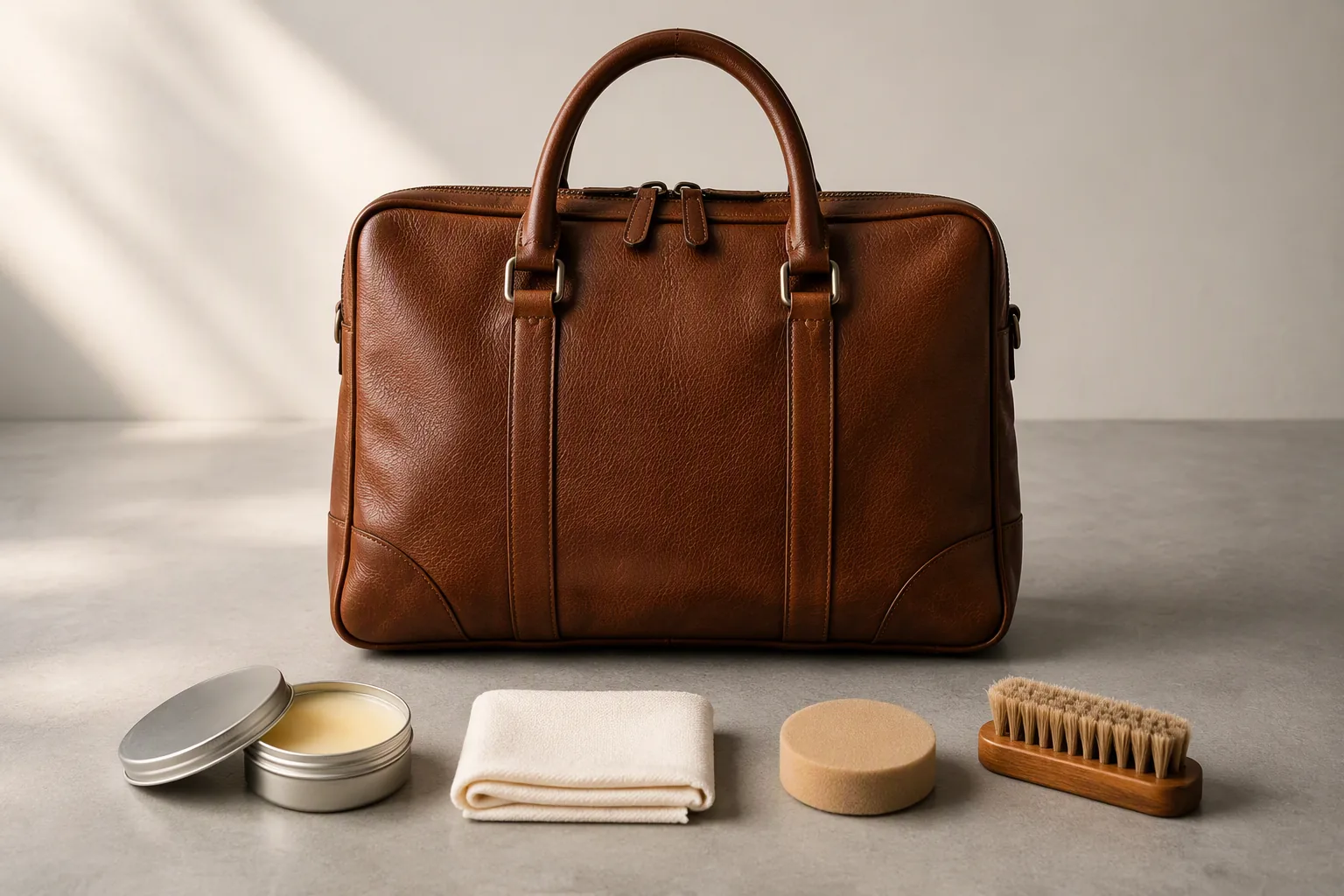
- Routine Care That Actually Works
- Care Products and What They Do
- Extending High-Wear Areas
- Climate Differences in Care
- Refurbishment in Practice
- Repair-Friendly Design
- Building a Care and Repair Programme
- Care Priorities by Bag Type
- Common Care Mistakes and Consequences
- Frequently Asked Questions
- The Bottom Line
Why Care Advice Is a Manufacturing Responsibility
Care advice is where material behaviour meets customer expectation.
What Wear Looks Like After a Year
Wear is predictable, and it follows the same path on most bags.
Handles and strap tops darken and soften first, because they are handled and loaded constantly. Corners and base edges abrade, revealing the layers underneath. Flap and body panels develop creases where they open and close, and the surface finish dulls where hands rest. None of this is a manufacturing defect, and all of it is visible within the first year of regular use.
The Difference Between Wear and Defect
Customers cannot be expected to know the difference, so the specification has to.
Wear is gradual, follows contact patterns and appears where the bag is touched or loaded. A defect appears where the bag is not touched, develops quickly, and shows a structural or material failure such as cracking finish on an unstressed panel, seam slippage or edge coating peeling in a straight line. Clear guidance on this distinction prevents both unnecessary claims and unaddressed real faults.
Why Poor Advice Creates Claims
Bad care guidance is worse than no guidance.
Instructions that push harsh cleaning, frequent conditioning or protective sprays on a leather that needs none of it create the very problems customers then complain about. Over-oiled leather can become limp and mark easily, over-cleaned leather loses its finish, and silicone-heavy dressings can build up and trap dirt.
How Leather Ages
Ageing is a set of processes rather than a single change.
Surface Finish Wear
The finish is the first thing to change.
Pigmented and coated finishes abrade gradually, becoming duller and slightly lighter in tone where hands and clothing rub, and on light-coloured leather this reads as darkening from transferred oils. Aniline and lightly finished leathers behave differently: they absorb and develop a patina rather than wearing through, which is why two bags of equal quality can look very different after a year.
Grain Relaxation and Creasing
Grain relaxes where a panel is repeatedly folded or pressed.
Creases form along the lines the bag naturally uses, and grain relaxes slightly around them. This is normal and it is not the same as a panel becoming loose or baggy, which is a structural change and usually traces back to material selection rather than to care.
Edge and Stitch Wear
Edges and stitching carry the most concentrated wear.
Edge finishes abrade at the base and corners, and painted edges can wear through at the point of contact. Stitching is attacked by abrasion rather than by tension, and it usually fails where thread crosses a hard edge or rubs against a rivet or ring. Both areas benefit far more from prevention, such as replacing a worn base stud, than from remedial care.
Colour Change and Patina
Colour change is expected and should be described honestly.
Vegetable-tanned leathers darken with light and handling and develop a visible patina. Oiled and pull-up leathers lighten and mark at folds, then blend as oils redistribute. Pigmented leathers fade gradually with ultraviolet exposure, most visibly on leather that lives in daylight.
Ageing Patterns by Leather Type
| Leather type | How it ages | Care implication |
|---|---|---|
| Pigmented and coated | Finish dulls and abrades, colour shifts slightly | Gentle cleaning, minimal conditioning |
| Aniline and semi-aniline | Absorbs oils, develops patina, marks easily | Accept patina, protect from liquid, avoid harsh cleaners |
| Oiled and pull-up | Marks lighten at folds, oils redistribute | Light conditioning, no aggressive cleaning |
| Vegetable-tanned | Darkens with light and handling | Let it age, protect from prolonged direct sun |
| Suede and nubuck | Nap flattens, absorbs liquid and oil | Brush regularly with a dedicated brush |
| Embossed and printed | Pattern holds, finish wears at high points | Clean gently, avoid abrasion on raised areas |
Routine Care That Actually Works
Routine care is minimal, and doing less is usually better.
Cleaning: Frequency and Method
Cleaning should be occasional and gentle.
Wiping with a soft dry cloth after use removes dust before it works into the grain, and that single habit prevents most surface dulling. A damp cloth with a small amount of mild leather cleaner is enough for occasional deeper cleaning, applied to a small area first and dried away from heat. Frequent wet cleaning shortens the life of the finish rather than extending it.
Conditioning: When and How Much
Conditioning replaces oils that handling and cleaning remove, and no more than that.
Conditioning is appropriate when the leather feels dry, stiff or dull, and it is not a routine that should be performed by calendar. A small amount of neutral conditioner worked in with a cloth and left to absorb is sufficient; excess should be buffed away rather than left on the surface, because surplus product attracts dirt and can darken the leather unevenly.
Protection Sprays
Protective treatments are a trade-off, not a universal upgrade.
Fluorocarbon-free water and stain repellents help on light-coloured aniline and suede leathers, where liquid marks are difficult to remove. On heavily finished leather they add little, and they can alter the surface feel. Any spray should be tested on an inconspicuous area first, especially on leather that has already been coloured or touched up.
What Not to Do
Some common habits cause damage that cannot be undone.
- Do not use household detergents, alcohol or solvents — they strip finish and dye.
- Do not soak the leather or dry it with heat, which hardens and shrinks it.
- Do not store a bag in a sealed plastic bag, which traps moisture and encourages mould.
- Do not over-condition, which softens structure and attracts dirt.
- Do not use coloured shoe polish on a bag panel, as it builds unevenly and transfers.
- Do not leave a bag in prolonged direct sunlight, which fades dye.
Care Do and Do Not Reference
| Task | Recommended | Avoid |
|---|---|---|
| Routine cleaning | Soft dry cloth after use | Wet wipes with alcohol |
| Deeper cleaning | Mild leather cleaner, small area, air dry | Detergent, solvents, soaking |
| Conditioning | Small amount when leather feels dry | Frequent heavy application |
| Storage | Breathable dust bag, cool and dry | Plastic bags, damp cupboards |
| Rain exposure | Blot with cloth, dry away from heat | Radiators, hair dryers |
| Stains | Seek professional advice early | Scrubbing, unknown home remedies |
Care Products and What They Do
Leather care products do different jobs, and mixing them up causes most home damage.
Cleaners
Cleaners remove dirt and old product, and they should be mild.
A leather cleaner is designed to lift soil without stripping finish or dye, which is why soap, detergent and general-purpose sprays are the wrong tools. Cleaners should be used sparingly, on a small area first, and worked with a soft cloth rather than scrubbed in. On suede and nubuck, the correct tool is a brush and an eraser, not a liquid cleaner at all.
Conditioners
Conditioners replace oils, and they are the most overused product in leather care.
They fall into two broad families: cream and lotion conditioners that absorb into the surface, and heavier wax and oil products that sit closer to the surface and add water resistance. Cream conditioners suit most finished leathers, while wax products suit oiled and rugged leathers. Neither should be applied to suede, nubuck or unfinished suede-like surfaces.
Protectors and Repellents
Protectors buy time rather than preventing damage.
Water and stain repellents reduce how quickly liquid soaks in, which gives the owner time to blot it away. They are most useful on light-coloured, absorbent leathers and on suede, and they need reapplying as they wear. Their value is protection during the minutes after an accident, not immunity.
Colourants and Touch-Up Products
Touch-up products are for small areas, and they are easy to get wrong.
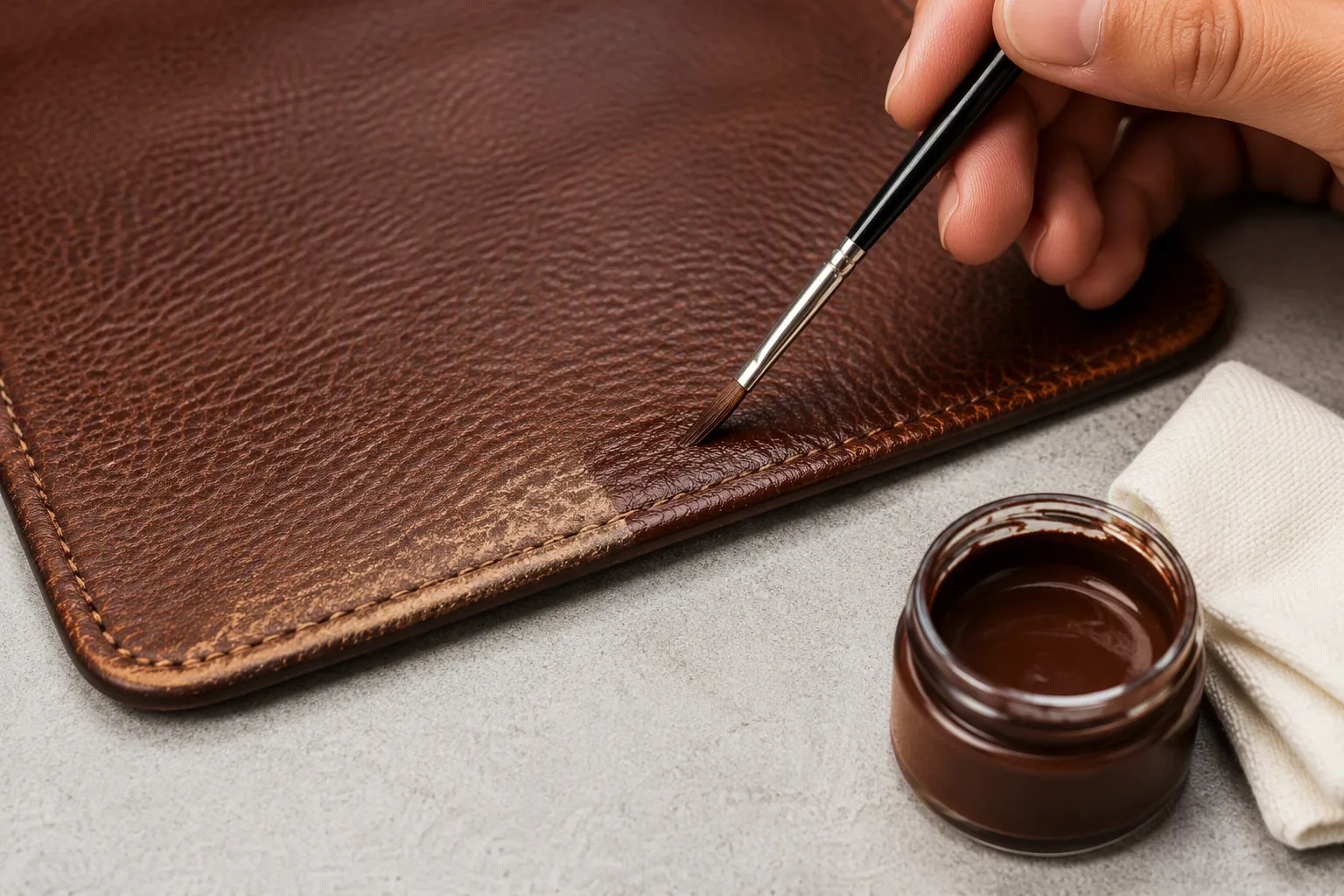
Matched colourants restore scuffs on edges and corners, and they are genuinely useful when applied thinly and dried fully between coats. Applied heavily or in the wrong shade, they build a visible patch and can transfer to clothing. On aniline leathers, colour work should be left to a professional because absorption is uncontrolled.
Extending High-Wear Areas
The most effective care is preventative and targeted.
Handles and Strap Tops
Handles age first, and early cleaning has the largest effect.
Body oils and dirt work into the leather where hands grip, darkening the surface and eventually softening the material. Wiping handles with a dry cloth after use, and cleaning them properly before soil becomes embedded, keeps them presentable far longer than any later restoration attempt.
Base and Corners
Bases and corners carry the abrasion the rest of the bag avoids.
Metal feet are the cheapest protection available, and replacing a worn foot is far less expensive than refinishing a damaged base corner. Owners should be told to check feet and base edges periodically, and to avoid setting a leather bag down on rough surfaces such as concrete.
Straps, Zippers and Buckles
Fittings fail because of grit and load, not age.
Keeping zippers clean with a soft brush prevents the most common premature failure, and checking that buckles and rings are not abrading the leather loop behind them catches wear before it becomes structural. Sagging straps under heavy loads should be reduced rather than tolerated, since sustained tension permanently deforms the attachment.
Climate Differences in Care
The same bag needs different care in different places.
Humid Climates
Humidity is the main enemy of stored leather.
Damp conditions encourage mould, soften structure and can lift adhesives used in laminated constructions. Bags should be aired more often, stored with airflow rather than in closed cupboards, and checked regularly for the first signs of mould, which appears as pale surface bloom or a musty smell long before it is visible.
Dry and Cold Climates
Dry conditions make leather stiff and more prone to cracking.
In dry climates and during cold seasons, leather loses moisture faster and folds become more likely to crack, particularly on wallets and on bag flaps. Light conditioning at fold lines and in flexing areas is more valuable here than in humid conditions, where the priority shifts to cleaning and drying.
Coastal and Salty Environments
Salt accelerates the deterioration of every metal part.
Hardware corrodes faster near the sea, and salt carried on hands and clothing attacks plating. Frequent wiping of hardware, prompt attention to any plating wear, and drying the bag after coastal exposure make a measurable difference to how long fittings last.
Refurbishment in Practice
Professional refurbishment restores appearance and function, within limits.
Assessment Before Work Begins
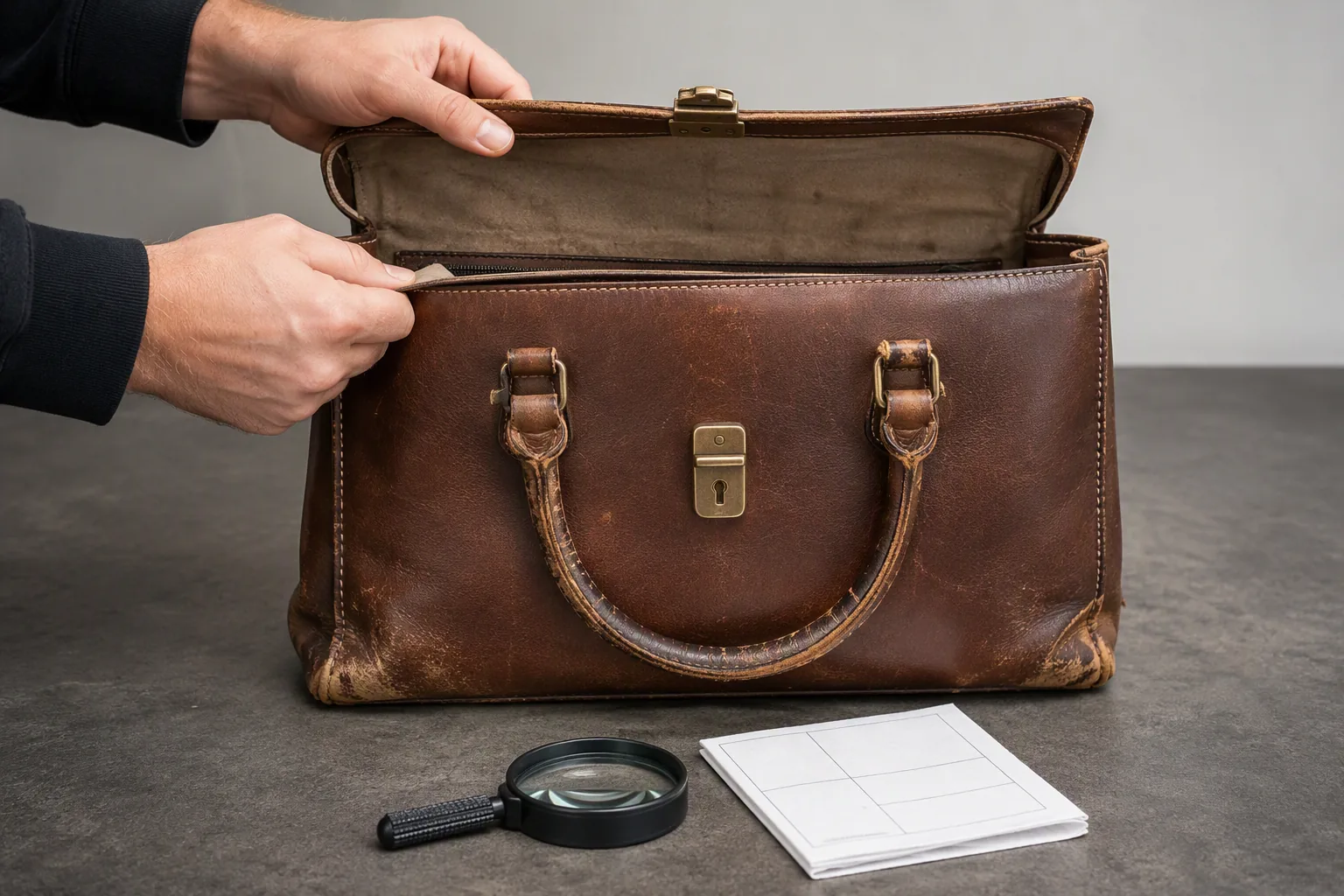
Every refurbishment starts with an honest assessment.
The assessment covers what has failed, why, and whether restoration will hold. Surface wear, edge wear and colour loss are usually recoverable. Split grain, cracked finish on a flexing panel, torn seams in stressed areas and rot from long-term moisture damage are usually not, or only partially, and promising otherwise sets up a second disappointment.
Cleaning and Degreasing
Preparation decides the outcome of every later step.
Refurbishment cleaning removes accumulated dirt, old conditioning product and transferred body oils. Degreasing matters before any colour work, because residual oil and silicone prevent adhesion and cause patchy results. This is the stage where careless work becomes visible weeks later as lifting or blotchy colour.
Colour Touch-Up and Recolouring
Colour work ranges from small touch-ups to full recolouring.
Localised touch-up with a matched colourant restores scuffs and worn edges and is quick and low-risk. Full recolouring is a larger job: the surface is cleaned, prepared, coloured in thin layers and then sealed, and the result depends heavily on the finish type of the original leather. A recoloured bag will also behave differently in future care, which should be explained to the owner.
Edge Refinishing
Edges are the most visibly restored part of a bag.
Edge refinishing rebuilds the edge coating, levels it, colours it and seals it. It makes a substantial visual difference on a worn bag, and it is one of the few repairs that can be executed to a near-original standard when the construction allows. Edges with underlying damage, such as frayed or split leather, must be stabilised first or the new coating will fail at the same place.
Hardware and Lining Repairs
Hardware and linings fail in ways that are visible from inside.
Scratched or corroded hardware can often be replaced rather than polished, provided the fittings are accessible and the design allows opening of the seam. Lining replacement is more involved and requires opening the bag, which is why repairable construction matters. Torn linings left unrepaired usually worsen, because the tear migrates along the seam.
Stitching Repairs
Stitch repairs are localised by design.
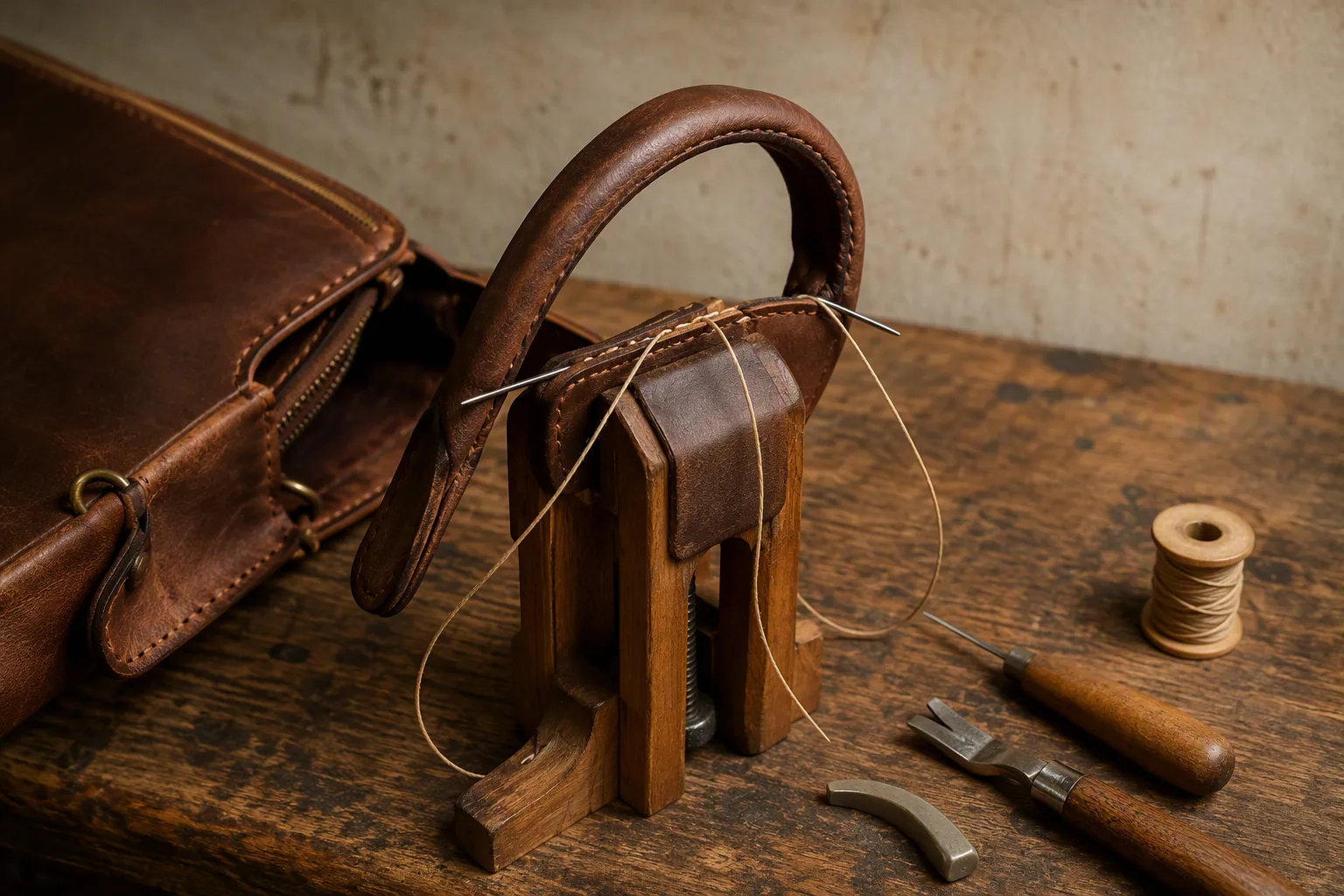
A failed section of stitching can be re-stitched, but the repair is only as good as the leather it passes through. Stitching through fatigued leather pulls out again, so the repairer should assess whether the leather around the seam can carry new stitches. Where original holes remain visible, a repair will always read as a repair rather than as new work.
When Refurbishment Is Not Worth It
Some bags should be retired, and saying so is good business.
If the leather structure has failed, if the lining is unrecoverable, if the hardware is integral and unavailable, or if the cost of work approaches the value of a functioning bag, a clear recommendation against refurbishment protects trust. Manufacturers who advise against uneconomic work are the ones customers return to.
Repair-Friendly Design
Repairability is decided in design, and it costs very little to build in.
Choosing Repairable Construction
Some constructions open; others do not.
A bag constructed so that linings can be accessed, seams can be opened locally, and components can be replaced is far easier and cheaper to repair than one assembled with irreversible processes. Turned, fully glued or laminated constructions often cannot be opened without damaging the panels, which makes any later repair a rebuild.
Making Hardware Replaceable
Replaceable hardware turns a write-off into a routine repair.
Screw-based fittings, split rings and removable straps all allow replacement without opening the bag. Rivets and permanently closed fittings look cleaner but require seam opening, and if the fitting is a buckling point that fails in service, the design choice becomes a warranty cost rather than a saving.
Linings and Accessibility
Access decides what can be repaired at all.
A lining that can be partly opened gives access to the base, internal seams and hardware backs. Designs where the lining is sewn shut around the opening leave no route in, and even a simple handle repair becomes a full deconstruction.
Spare Parts and Availability
Repairability depends on parts existing years later.
Bags sold with non-standard fittings that cannot be sourced later become unrepairable through no fault of the owner. Keeping a small stock of the fittings used on current products, or choosing fittings with long-term availability, is a cheap form of after-sales quality.
Documentation for Repairers
Repairers cannot work well without information.
Telling a repairer the leather type, the finish type, the edge treatment used and the fitting specification prevents wrong products and wrong techniques being applied. A short technical note supplied with a care card costs almost nothing and materially improves repair outcomes.
Building a Care and Repair Programme
A programme converts scattered advice into a managed after-sales system.
Care Instructions That Customers Read
Short, specific and honest beats comprehensive.
Most care failures come from instructions that are too long to read or too vague to follow. A handful of clear actions — wipe with a dry cloth, keep away from heat, store in the dust bag, bring liquid marks to a professional early — is followed far more often. Statements about patina and expected wear also reduce complaints, because the customer knows what is normal.
Care Kits as a Product
Selling the right products prevents wrong ones being used.
A simple kit with a soft cloth, a mild cleaner and a small neutral conditioner covers most leather bags and steers owners away from household products. Kits are also an opportunity to state what should not be used, which is more useful than listing what should.
Warranty Boundaries and Repair Policy
The policy should be clear before the customer asks.
Stating what is covered, what is considered wear, how long the coverage lasts and how a repair is arranged reduces disputes and speeds resolution. A repair path that is described in advance is also a marketing asset, because customers considering a durable product want to know it can be maintained.
Working With Local Repairers
Local repairers extend a manufacturer’s reach, and they need briefing.
Supplying repairers with the leather and finish information, the correct edge treatment products and, where relevant, spare fittings lets them achieve consistent results. Building a short list of trusted repairers in key markets is usually more effective than handling every repair through the factory.
Learning From Repairs
Repair data is the cheapest quality feedback available.
Recording what fails, where, at what age and in which climate turns thousands of individual repairs into a pattern. If edges wear through at the base on one article, if one lining tears consistently at the same seam, or if hardware fails in one market more than another, the pattern points directly at a design or specification change worth making.
Care Priorities by Bag Type
Different products accumulate different kinds of wear.
Diaper Bags and Family Bags
Family bags are exposed to moisture and constant handling.
Cleaning frequency is higher and liquid exposure is routine, so a water-repellent treatment and quick blotting matter more than conditioning. The internal lining and pocket edges deserve attention because they are used hard and rarely inspected, and the base and stroller-attachment points should be checked periodically for abrasion.
Backpacks
Backpacks wear on the surfaces that contact the body and the ground.
Shoulder straps, back panels and bases are the high-wear zones, and sweat exposure is significant, so cleaning of straps and back panels is worth doing deliberately. Zippers and buckles should be kept free of grit, which is the most common cause of premature zipper failure.
Totes and Handbags
Totes wear at the handles and the base.
The handle tops darken first and are difficult to restore once heavily soiled, so early cleaning has a disproportionate effect. Bases abrade on hard surfaces, which is why base studs are worth replacing as soon as they wear, before the leather behind them is damaged.
Wallets and Small Leather Goods
Small leather goods wear at fold lines and edges.
Wallets flex constantly at the spine and on the closure, so the finish there fails first. Light conditioning along the fold keeps the leather supple and delays cracking, and edge wear is worth touching up early because it is small and easy to address.
Care Priorities by Product
| Product | Highest wear zone | Priority care action |
|---|---|---|
| Diaper and family bags | Lining edges, base, attachment points | Wipe and air-dry promptly, protect against liquid |
| Backpacks | Straps, back panel, base, zippers | Clean straps and back panel, clear grit from zippers |
| Totes and handbags | Handle tops, base and corners | Clean handles early, replace base studs when worn |
| Wallets and small goods | Fold lines, edge coating | Light conditioning at folds, early edge touch-up |
Common Care Mistakes and Consequences
Most avoidable damage comes from a small set of habits.
Over-Conditioning and Structural Softening
Excess product changes the bag, not just the surface.
Conditioning products soften leather, and applying them regularly to a structured bag reduces its ability to hold shape. The panels relax, the base loses rigidity and the bag begins to slouch — a change the owner often attributes to a manufacturing fault. On structured products, conditioning should be occasional, minimal and kept away from stiffened areas.
Harsh Cleaning and Finish Loss
Aggressive cleaning removes the protection it was meant to restore.
Detergents, alcohol and general-purpose household cleaners strip the finish, lift pigment and leave the surface more vulnerable than before. The result is a patchy, dull panel that no longer resists staining. Once a finish is stripped, restoring it properly is a professional job.
Heat and Drying Damage
Heat damage is irreversible.
Drying a wet bag with a hair dryer or on a radiator hardens and shrinks the leather, and the effect is permanent. Leather should dry slowly at room temperature, away from direct heat and sunlight, ideally shaped with light packing so panels dry flat.
Storage Mistakes
Poor storage causes damage while the bag is not being used.
Sealed plastic traps moisture and invites mould, damp cupboards do the same, and hanging a heavy bag by a thin strap deforms the handle and the strap attachment. Breathable dust bags, light filling to hold shape and a dry, airy location prevent most storage damage, and bags should be aired occasionally rather than left closed for months.
Mistake and Consequence Reference
| Mistake | Immediate effect | Long-term consequence |
|---|---|---|
| Frequent heavy conditioning | Soft, greasy surface | Structure softens, bag slouches |
| Detergent or solvent cleaning | Finish stripped, colour lifted | Patchy surface, no stain resistance |
| Drying near heat | Leather hardens and shrinks | Permanent distortion of panels |
| Sealed plastic storage | Moisture trapped | Mould, musty odour, lining damage |
| Coloured polish on panels | Uneven build-up, transfer | Discolouration of other surfaces |
| Ignoring early edge wear | Small scuffs | Exposed fibre, base damage, costlier repair |
Frequently Asked Questions
How often should a leather bag be conditioned?
Only when the leather feels dry, stiff or dull — not on a fixed schedule. A small amount of neutral conditioner worked in with a cloth and buffed off is enough. Frequent conditioning softens structure and attracts dirt, and on structured bags it can cause the panels to lose shape.
Can wear be distinguished from a manufacturing defect?
Yes, in most cases. Wear is gradual, follows contact and load patterns, and appears on handles, corners, bases and flap edges. A defect appears in an area the owner does not touch, develops quickly, and typically shows as finish cracking on an unstressed panel, seam slippage or edge coating peeling in a straight line.
Should I use a protective spray on a new leather bag?
It depends on the leather. Water and stain repellents help on light-coloured aniline, suede and nubuck, where liquid marks are hard to remove. On heavily finished leather they add little and can alter the surface feel. Test any spray on an inconspicuous area first, especially on leather that has been touched up.
What should I never use to clean a leather bag?
Avoid household detergents, alcohol, solvents, wet wipes containing alcohol and abrasive pads. They strip finish, lift pigment and leave the leather more vulnerable to staining. A soft dry cloth for routine care and a mild leather cleaner for occasional deeper cleaning cover almost every situation.
My leather bag got wet — what should I do?
Blot it with a soft cloth and let it dry slowly at room temperature, away from radiators, hair dryers and direct sun. Fill it lightly so panels dry flat, and do not rub the wet surface, which can spread marks. Heavy soaking may need professional attention because water can lift finish and leave tide marks.
Does refurbishment restore a bag to new condition?
It restores appearance and function within limits. Surface wear, edge wear and colour loss respond well to cleaning, colour touch-up and edge refinishing. Structure that has failed — cracked finish on flexing panels, split grain, torn stressed seams or moisture rot — cannot be fully restored, and refurbishment should be recommended only where the result will hold.
Is recolouring a leather bag a good idea?
It can be, when the surface is sound and the work is done properly: cleaned, degreased, coloured in thin layers and sealed. The result depends heavily on the original finish type, and the bag will need different care afterwards. A full recolour also costs far more than a localised touch-up, which is often enough.
What makes a bag easier to repair?
Accessible construction. Linings that can be partly opened, seams that can be undone locally, screw-based or replaceable hardware, and fittings that will still be available in several years. Turned or fully laminated constructions often cannot be opened without damaging panels, which turns a small repair into a rebuild.
How should a leather bag be stored?
In a breathable dust bag in a cool, dry, airy place, lightly filled to hold its shape. Avoid sealed plastic, damp cupboards and hanging a loaded bag by a thin strap. Air bags occasionally rather than leaving them closed for months, and keep them out of prolonged direct sunlight.
Why does a structured bag become slouchy over time?
Usually from excess conditioning that softens the leather, constant overloading, or long storage under compression. Leather also relaxes naturally where it is repeatedly flexed. Keeping conditioning minimal, avoiding sustained overload and storing the bag lightly filled slows the change considerably.
Can a torn lining be repaired without replacing it?
Sometimes. A tear that has not migrated can be stabilised and closed if the lining can be reached, and a patch or a reinforcement along the seam may be enough. Once a tear runs along a seam under load, partial lining replacement is usually the durable answer, which is why early repair matters.
The Bottom Line
Care and refurbishment are part of the product, and manufacturers who treat them that way sell more durable bags with fewer disputes.
Tell customers what wear looks like and what it is not, keep routine care simple and minimal, and give honest boundaries for what refurbishment can and cannot restore. Build bags that can be opened, repaired and refitted, document the materials and treatments for repairers, and keep a small stock of the fittings that matter.
Then use repair data as feedback. Every repeated failure at the same edge, seam or fitting is a design decision offered for free — and acting on it is how a product line gets better without any additional market research.
