
Leather Moisture Control in Bag Production: A Guide
Leather Moisture Control in Bag Production: A Guide
Leather moves with the air around it. It takes up moisture when the workshop is damp and gives it up when the air is dry, and every measurable property a bag depends on — thickness, temper, dimension, grain and adhesion — moves with it.
As a bag manufacturer, we treat moisture as a process variable rather than a storage concern. This guide covers why leather responds to humidity, what changes when moisture shifts, how to set and hold workshop conditions, how to manage leather through cutting, sewing and drying, and how to prevent the failures that only appear weeks after the bag has been packed.
Moisture is the quietest variable in bag production. It does not appear on any specification sheet, it changes what the same leather does on different days, and it is the reason two batches made from identical material can behave differently in the field.
- Why Moisture Is a Production Variable
- What Moisture Does to Leather
- Measuring Moisture in Practice
- Setting Workshop Conditions
- Managing Leather Through the Process
- Mould Prevention in Production
- Dry Conditions and Crack Risk
- Moisture and Bag Performance in the Field
- Documentation, Training and Quality Control
- Common Moisture Problems and Fixes
- Moisture Priorities by Bag Type
- Building a Moisture Control Routine
- Moisture and Material Choices
- Frequently Asked Questions
- The Bottom Line
Why Moisture Is a Production Variable
Moisture changes material behaviour, so it has to be managed like any other input.
Leather Is Hygroscopic
Leather absorbs and releases water vapour continuously.
The fibre structure of leather is full of microscopic spaces that take up and release moisture according to the surrounding air, and the material reaches an equilibrium with its environment rather than holding a fixed water content. That is why the same hide behaves differently in a damp coastal workshop and a heated inland one.
What Moisture Changes
Several properties move together as moisture changes.
Leather that has taken up moisture is thicker, softer and more extensible, and it is easier to stretch and easier to mark. Leather that has dried out is thinner, firmer, stiffer and more likely to crack when folded or skived. Neither state is wrong; the problem is a workshop that does not know which state it is working in.
Why Problems Appear Later
Moisture-related failures rarely show up on the bench.
A panel cut while the leather is damp can shrink as it dries, so the bag goes slightly smaller than the pattern intended. A bag assembled in very dry air may look perfect and then relax and soften once it reaches a humid market. Both effects are real and both are invisible at the moment of assembly, which is why the control has to be preventive.
What Moisture Does to Leather
The effects are practical and they can be predicted.
Dimensions and Stretch
Dimension is the most direct consequence.
Damp leather stretches more under the same tension and holds less of its original dimension when it dries. Panels cut during a humid spell and assembled the next day can differ measurably from panels cut in dry conditions, which shows up as small but systematic size variation across a run and, more seriously, as distortion in panels that must match.
Temper and Hand
Temper follows moisture closely.
The same leather feels softer and more pliable when it is damp and firmer and more boardy when it is dry. On programmes where temper is specified and inspected by hand, seasonal swings in workshop humidity read as temper drift unless the conditions are understood and recorded.
Grain and Surface
Surface behaviour depends on moisture as well.
Dry grain marks and creases more readily, so folding and pressing operations are more likely to leave visible lines, and dry leather picks up pressure marks from clamps, folders and even finger pressure. Damp leather is more forgiving to handle but more vulnerable to indentations from edges and tools that press into it.
Mould and Mildew
Mould is the visible failure of moisture control.
It appears first where air does not move: inside stacked hides, along folded edges and in lining bundles that have been left closed. Mould damages the surface, leaves odour and can stain the lining, and it is far cheaper to prevent through airflow and dry storage than to remediate.
Adhesives, Edge Paint and Finish
Wet processes are directly affected by ambient moisture.
Adhesives behave differently depending on both the moisture in the leather and the humidity of the air, with dry conditions shortening the open time available for positioning and damp conditions slowing the set. Edge paint and finishes dry at different rates, and a workshop that changes climate between the first coat and the last can produce edges that look inconsistent across a batch.
Moisture Effects and Production Consequences
| Moisture condition | What changes | Production consequence |
|---|---|---|
| Damp leather | Thicker, softer, more extensible | Panels shrink as they dry, size and fit drift |
| Very dry leather | Firmer, stiffer, thinner | Folding and skiving crack, pressure marks |
| Damp workshop air | Slow adhesive and edge paint drying | Blisters, uneven edge build, longer drying time |
| Dry workshop air | Fast surface drying of wet processes | Short open time, adhesion failures, patchy edges |
| Persistently humid storage | Mould risk, softened structure | Stained surfaces, odour, weakened panels |
| Wide day-to-day swings | Unrepeatable behaviour | Inconsistent assembly, hard-to-trace defects |
Measuring Moisture in Practice
Measurement turns an impression into a working number.
Moisture Meters and What They Report
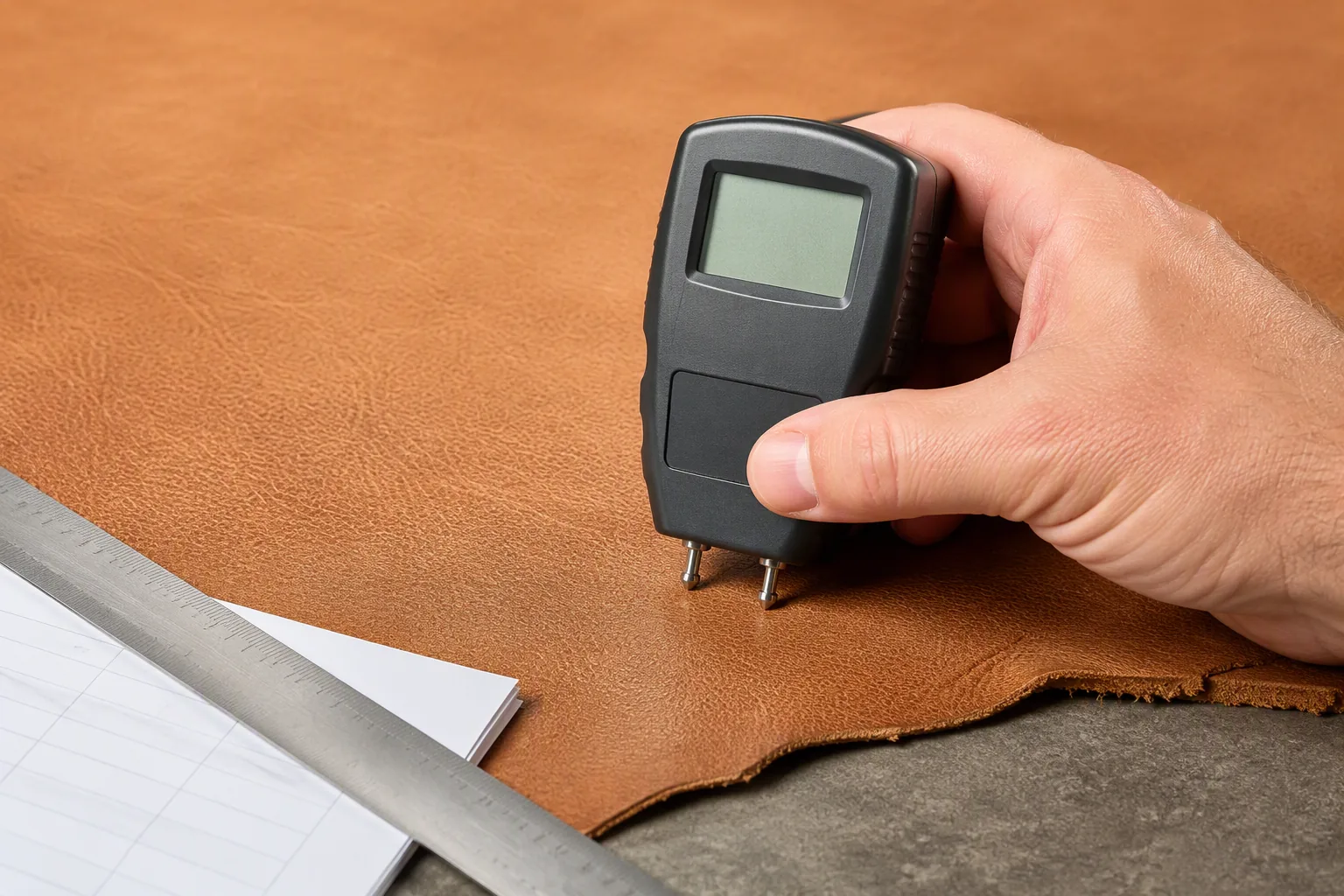
Moisture meters give a comparative figure rather than an absolute truth.
Hand-held meters pressed against the leather surface report a reading that reflects moisture in the material, and the value is most useful when it is compared with readings taken from the same article under known good conditions. Two different meters read differently on the same piece, so consistency of instrument and technique matters more than the number itself.
Hand and Simple Checks
Operators can detect useful signals without instruments.
Feeling the leather for softness and coldness, watching whether an edge springs back when folded and checking whether the surface marks easily under light pressure all indicate where the material sits between damp and dry. These checks are quick, and they are most reliable when they are calibrated against measured readings taken in the same room.
Where and When to Measure
Measurement is useful at a small number of points in the process.
- On receipt, before a lot is accepted into the material store.
- Before cutting, on the hide or side about to be laid out.
- Before folding, skiving and pressing operations, where dry material cracks.
- Before adhesive and edge finishing work.
- On finished goods before packing, particularly ahead of sealed or long transit.
Recording and Trending
The value of measurement comes from the pattern, not the single reading.
Recording readings with the work order, the supplier lot and the ambient conditions builds a picture of how each article behaves through the seasons. That record is what allows a workshop to anticipate problems in a particular month rather than rediscover them every year.
Setting Workshop Conditions
Conditions should be set deliberately rather than inherited from the building.
Air Temperature and Relative Humidity
The two measurements belong together.
Relative humidity describes how much moisture the air holds relative to what it could hold at that temperature, which means heating a room lowers relative humidity even though no moisture has been removed. This is why a heated cutting room in winter can be far drier in practice than the outdoor conditions suggest, and why temperature and humidity must be monitored as a pair.
Ventilation and Air Movement
Moving air is the cheapest moisture control available.
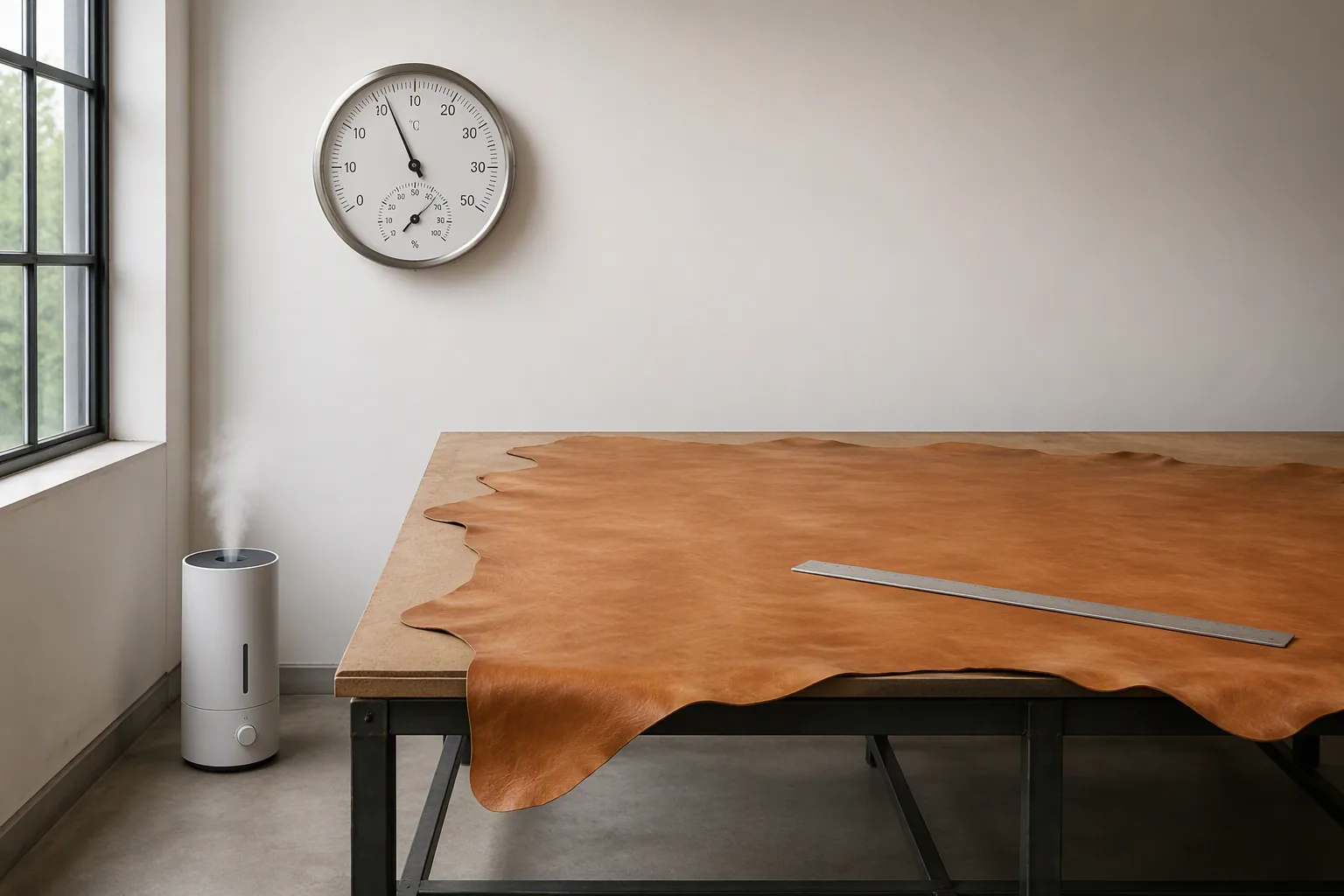
Airflow carries moisture away from stacked leather and prevents the pockets of still, damp air where mould begins. It also speeds the drying of edge paint and adhesives without creating the hot, dry conditions that make leather brittle. Fans and open layout matter more than sophisticated equipment in most workshops.
Seasonal Adaptation
Workshops should change their practice with the seasons.
In humid seasons the priorities are airflow, avoiding closed stacking and allowing longer drying times for wet processes. In dry seasons the priorities shift to protecting leather from excessive dryness, limiting the time panels spend in dry air before assembly, and conditioners or humidification where folding and skiving would otherwise crack material.
Climate Control Equipment
Equipment supports practice; it does not replace it.
Dehumidifiers help hold conditions in humid seasons, humidifiers and evaporative systems help in dry heated rooms, and simple thermometers and hygrometers placed at working height give operators the information to act. Equipment placed at ceiling level and never read contributes little, so instruments should sit where the work happens.
What to Agree With the Tannery
The leather supplier is part of the control loop.
Asking how a lot was conditioned before packing, what its moisture state was at dispatch and how it should be handled for the first days after arrival prevents an avoidable shock to the material. Where an article is known to be sensitive, the working range that suits it should be documented rather than discovered.
Managing Leather Through the Process
Control points follow the material through the workshop.
Goods-In and Conditioning Before Cutting
Arrival is the first control point, and it is often skipped.
Leather that has travelled in a sealed or humid container arrives out of balance with the workshop, and cutting immediately locks that state into the panels. Allowing time for a lot to reach equilibrium in the material store, with airflow around it, is a low-cost habit that reduces later variation.
Cutting Room Practice
The cutting room decides dimensions, so its conditions matter most.
Open hides should not be left flat under dry air for long periods before cutting, since panels lose moisture quickly at the surface. Stacking freshly cut panels with good airflow rather than under weight also limits both moisture-related marking and the risk of trapped damp.
Between Cutting and Sewing
Work in progress is vulnerable because it is no longer a hide and not yet a bag.
Cut panels have more exposed edge, so they take up and give off moisture faster than a whole hide. Covering work in progress loosely with breathable material, keeping it off cold floors and limiting the time it sits in a changing environment all reduce variation.
Sewing Room Practice
Sewing conditions affect both assembly and appearance.
Dry leather marks more easily under the pressure of the machine foot and folders, so operators need clean, well-set machines and a workshop that is not overheated. Damp leather feeds slightly differently and can distort under tension, which is why long seams benefit from being run at consistent conditions rather than across a climate swing.
Drying After Edge Work and Adhesive
Drying is a process step with its own conditions.
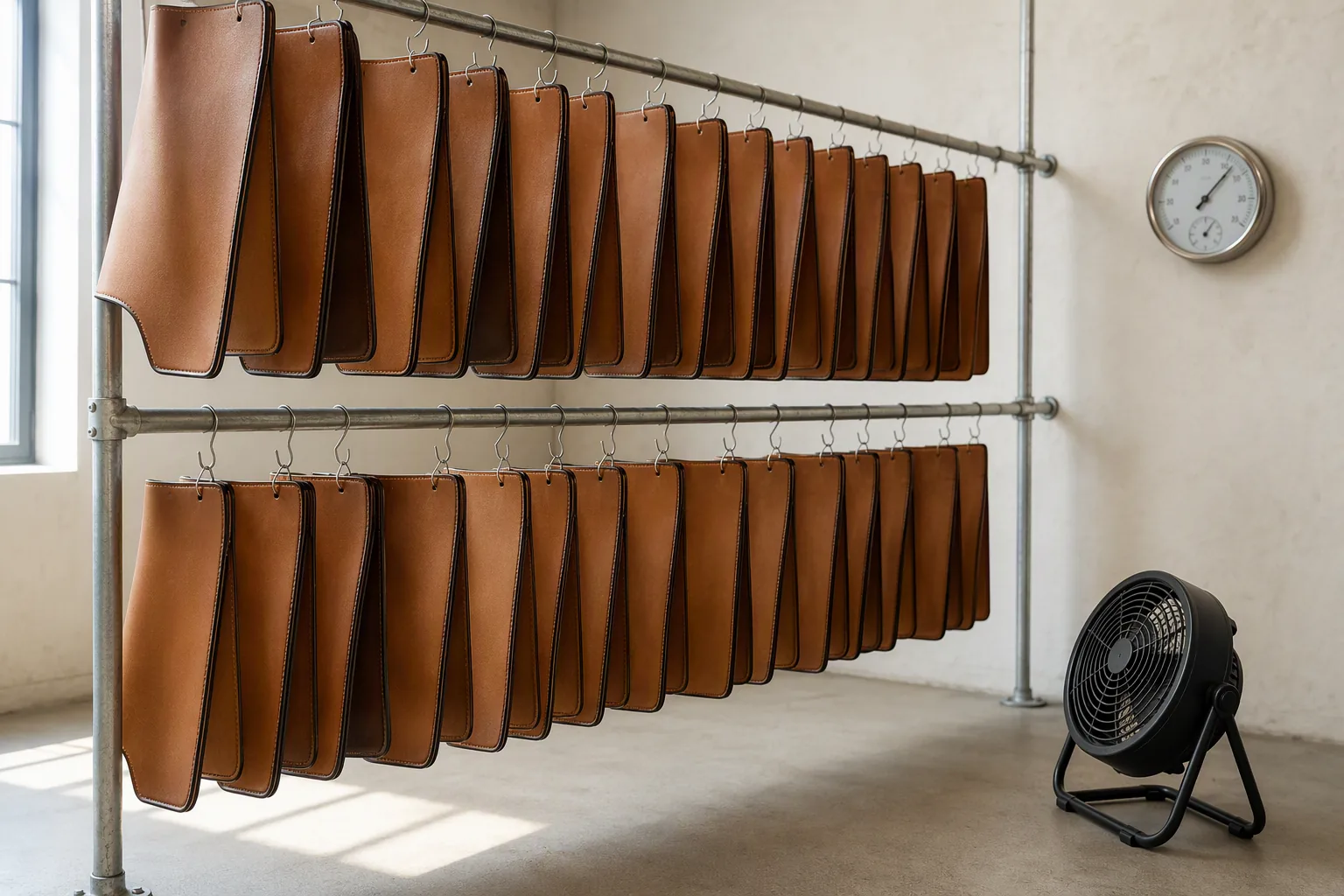
Edge paint, adhesives and finishes need air movement and controlled temperature to dry evenly. Drying too fast in a hot, dry room causes blisters, surface skinning and uneven edge build, while drying too slowly in a damp room delays production and traps solvent or water in the film. A dedicated drying area with airflow and a readable gauge solves both.
Static and Dust
Dry conditions create housekeeping problems.
Very dry air increases static, which attracts dust and fibre to panels, edges and linings, and can be difficult to remove before finishing. Managing the room’s dryness also reduces dust attraction, which is one more reason to control conditions rather than only tracking them.
Mould Prevention in Production
Mould is the failure that costs the most to fix and the least to prevent.
Where Mould Starts
Mould starts where moisture, warmth and stillness meet.
Stacked hides with folded edges, lining bundles stored in closed containers, work in progress left against a cold wall, and material stored on the floor all create the conditions mould requires. The surface most at risk is the one not exposed to air, which is why the inside of a stack and the fold of a hide are usually affected first.
Humidity, Airflow and Stacking
Three habits prevent most outbreaks.
Keep the material store dry and ventilated, stack no higher than necessary with hides laid flat rather than folded where possible, and rotate stock so nothing sits undisturbed for months. Lining and textile components deserve particular attention, because they hold moisture and are often stored in closed bags.
Early Detection
Mould announces itself before it is visible.
A musty smell in a store room, slight dulling or cloudiness on the surface of a hide, or a white bloom along a fold are all early signals. Training operators to notice and report these signs turns a potential batch problem into a local one that can be handled while it is still small.
Handling Affected Material
Dealing with mould requires judgement rather than a wipe.
Light surface mould on an unaffected article can sometimes be cleaned under controlled conditions, but the material must be assessed for staining, odour and structural softening before it is used, and anything on a visible panel should be rejected. Material that has been damp long enough to soften should not be returned to production at all, because the damage is not reversible.
Dry Conditions and Crack Risk
Dryness causes damage that cannot be repaired.
Winter and Heated Workshops
Heating is the most common cause of dry leather in a factory.
A heated room with the same outdoor humidity becomes progressively drier in relative terms, and the effect is strongest in the areas closest to heat sources. Panels stored near radiators, dryers or warm machinery dry out faster than the rest of the room, which is why storage position matters as much as the room reading.
Conditioning Before Folding and Skiving
Some operations should never be attempted on dry leather.
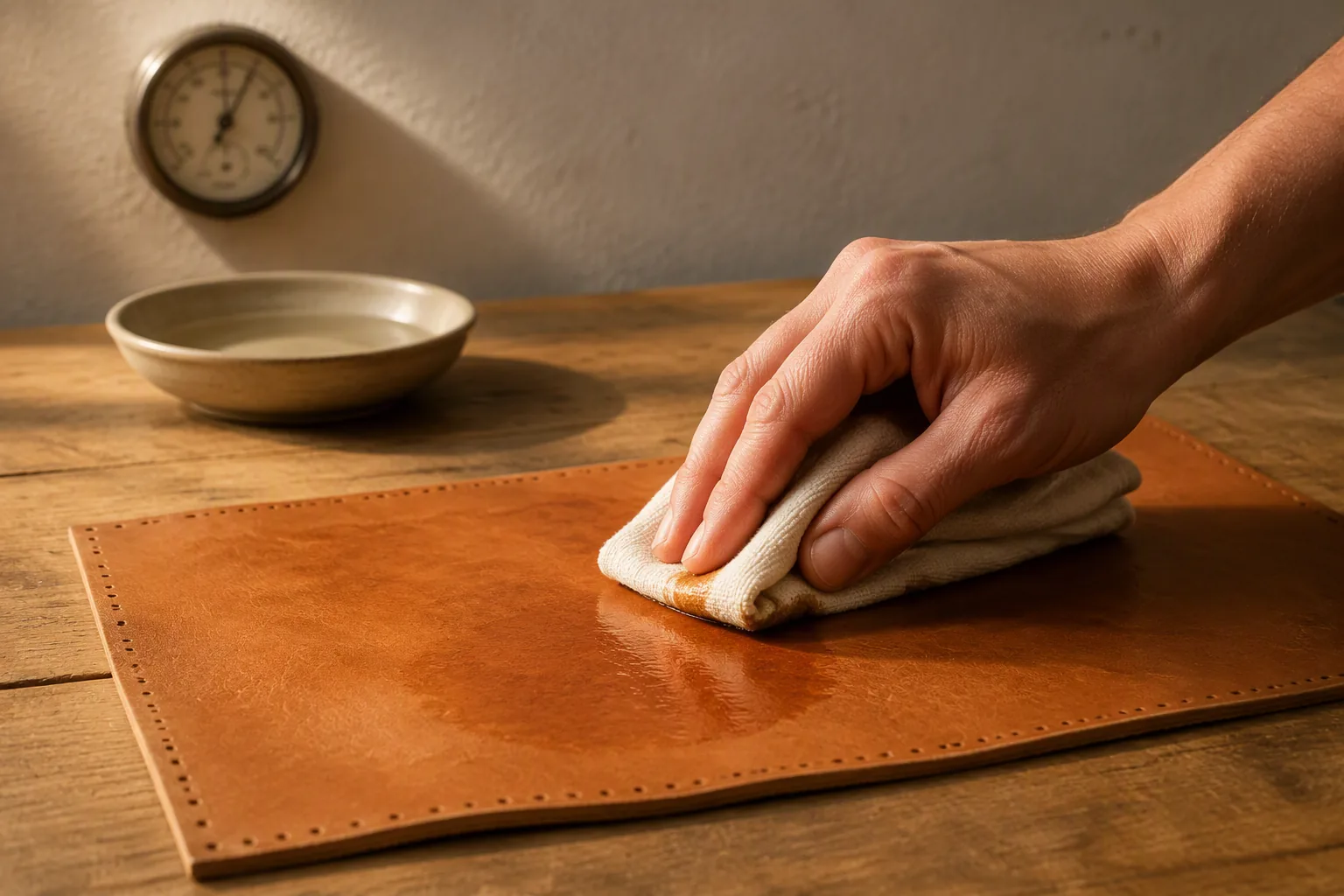
Folding, skiving, edge turning and pressing all concentrate stress on a narrow line, and dry leather cracks along that line rather than deforming. Where the room cannot be held at a suitable condition, conditioning the area to be worked immediately before the operation is a practical alternative, provided the moisture is allowed to equalise rather than left on the surface.
Creasing and Crack Testing
A simple test protects a whole batch.
Folding a scrap of the same article along the line the operation will create, and examining the fold under light, shows whether the material is workable now. Doing it at the start of a run rather than after the first rejected panels is the point of the test.
Moisture and Bag Performance in the Field
Production conditions follow the bag into the market.
Shrinkage and Relaxation After Shipping
Bags continue to move after they leave the factory.
A bag assembled from leather at the damp end of its working range can shrink slightly and firm up as it dries in a drier market, while one assembled very dry can relax and soften in a humid climate. Neither change is dramatic, but both affect how the bag fits its pattern and how it feels in the customer’s hands.
Container and Transit Humidity
Transit is often the most extreme environment a bag experiences.
A sealed container crossing several climate zones can hold high humidity in warm conditions and condense moisture as it cools, which is why goods packed in humid weather arrive with damp packaging, soft firmed-up panels or, in bad cases, early mould. Vents, desiccant packs where appropriate and avoiding packing in the most humid hours all reduce the risk.
Humid Market Performance
Humid markets expose different weaknesses.
Leather softens, structure relaxes and adhesives in laminated constructions are worked harder, so bag structure that looked crisp in a dry factory can look softer in a tropical retail environment. Sampling and testing in conditions closer to the destination market catches this before launch rather than after.
Dry Market Performance
Dry markets do the opposite.
Material firms up, folds become more visible, and panels that had a soft drape can look stiff. Products designed with generous folds or very soft material often read differently in dry conditions, which is worth considering when a design is approved in one climate and sold in another.
Documentation, Training and Quality Control
Moisture management works when it is written into the process.
Process Records
Conditions should be recorded where work happens.
Noting room temperature and humidity on the process record, along with moisture readings at goods-in and before folding, creates a trail that explains variation rather than merely documenting it. When a defect appears, the record is what shows whether the cause was a specific lot or a specific week of weather.
Training Operators
Operators are the first instruments.
Teaching cutting and sewing staff what dry and damp leather look and feel like, and giving them authority to pause and report when material behaves unexpectedly, catches most problems before they reach the next operation. A cutting room that recognises a dry batch folds it aside; one that does not cuts a hundred panels that crack later.
Inspection Points
A small number of checks cover the main risks.
- Goods-in moisture reading recorded per lot.
- Fold test on the actual article before folding or skiving begins.
- Adhesive and edge paint appearance checked across the batch, not just at the start.
- Finished goods checked before packing, with particular attention to the panels that were folded or laminated.
Working With Suppliers
The supplier relationship should include handling advice.
Discussing how a lot was conditioned, how it should be stored on arrival and what has changed if a lot behaves differently is normal practice between a bag manufacturer and a tannery. Where a recurring moisture-related problem exists, it is usually a shared process issue rather than a material fault.
Common Moisture Problems and Fixes
| Symptom | Likely moisture cause | Practical fix |
|---|---|---|
| Panels measure consistently short | Cut while damp, then shrank | Condition before cutting, record readings |
| Cracking along folds and skived edges | Leather too dry, heated room | Condition the working area, reduce heat, fold test first |
| Blisters under edge paint or adhesive | Fast surface drying in dry hot air | Slow drying with airflow, control temperature |
| Edges inconsistent within a batch | Climate swung between coats | Hold conditions through the batch, record them |
| Mould on linings or folded hides | Damp, still air, closed stacking | Ventilate, stack flat and low, rotate stock |
| Bags softer than sample after shipping | Assembled damp, relaxed in humid market | Control assembly conditions, test in destination climate |
| Static and dust on panels | Very dry air | Manage room dryness, improve cleaning routine |
Moisture Priorities by Bag Type
Different products are exposed differently, so the control points differ.
Diaper Bags and Family Bags
Family bags combine leather with lining and textile components.
Those textile components hold moisture, so the storage and handling of linings deserve as much attention as the leather. Bags packed with damp linings inside sealed cartons are one of the more common sources of odour and mould complaints, and finished goods checks before packing are the main defence.
Backpacks
Backpacks use laminated, padded and multiple-material constructions.
Any laminated panel depends on adhesive performance, which is directly influenced by both leather moisture and ambient humidity. The drying area and its conditions matter more here than on simple constructions, and the checks after laminating should be part of the standard process.
Totes and Handbags
Totes depend on large flat panels staying stable.
Large panels express drying shrinkage more than small parts, so controlling moisture before cutting has a disproportionate effect on final dimensions and silhouette. Handles also matter, because a handle cut from damp leather will take up load differently once it has dried.
Wallets and Small Leather Goods
Small goods are built from many thin parts.
Skiving, folding and turning are common operations on wallets, and they are the operations most sensitive to dry leather. Keeping skiving and folding areas at stable conditions, and conditioning where necessary, is the practical priority.
Moisture Priorities by Product
| Product | Main moisture risk | Priority control |
|---|---|---|
| Diaper and family bags | Damp linings in sealed packing | Dry and check components before packing |
| Backpacks | Adhesive performance in laminated panels | Control drying area conditions |
| Totes and handbags | Shrinkage of large panels | Control moisture before cutting and assembly |
| Wallets and small goods | Cracking at folds and skived edges | Stable conditions at skiving and folding |
Building a Moisture Control Routine
Control becomes reliable when it is a routine rather than a reaction.
Daily and Weekly Checks
A minimal routine covers most of the risk.
Reading the room gauge at the start of each shift, checking material by hand when a new lot is opened and recording the fold test before folding operations are the recurring tasks. Weekly, it is worth reviewing what was recorded and noting whether conditions have shifted enough to change how material is handled.
A Seasonal Calendar
Seasonal planning turns surprises into expectations.
Most factories know which months bring humid air and which bring dry heated air, so the adjustments can be scheduled rather than improvised. Planning drying capacity for the humid season and protecting folding operations for the dry season is a calendar item, not an emergency.
Responsibilities and Authority
Someone has to own the conditions.
Assigning responsibility for the room readings, the material store and the drying area makes the difference between a documented intention and actual practice. Equally important is giving cutting and sewing staff the authority to stop and report when material feels wrong, because they see the material before any instrument does.
Moisture and Material Choices
Some choices reduce exposure to moisture problems before production starts.
Leathers That Suit Your Climate
Material behaviour should be considered against the local climate.
A very dry finished leather that performs well in a cold inland workshop can feel harsh in a humid market, while a heavily oiled leather that handles beautifully in humid air can mark easily in dry conditions. Where a product will be sold across climates, the reference sample should be assessed against the destination environment rather than only in the factory.
Linings and Absorbent Components
Not every moisture problem starts with the leather.
Linings, foams, wadding and cardboard stiffeners all absorb moisture, and some hold it far longer than leather does. Choosing components that dry readily, and avoiding sealed packing of parts that were assembled when humid, prevents a class of complaints that has nothing to do with the hide.
Adhesives and Wet Processes
Process choices should match the conditions you can hold.
Adhesives vary in how forgiving they are across humidity ranges, and edge finishes vary in how they behave when drying fast or slow. Where a workshop struggles to hold stable conditions, selecting a more forgiving adhesive system and adjusting drying practice may be more practical than trying to control the building.
Frequently Asked Questions
Does leather have a standard moisture content?
Leather reaches equilibrium with the air around it rather than holding a fixed moisture content, so the useful working figure is the one your workshop establishes for a specific article under known good conditions. The same hide will measure differently in a damp coastal workshop and a heated inland one.
How do I know if leather is too dry to work?
Fold a scrap of the same article along the line your operation will create and examine the fold under light. If the surface cracks or whitens along the fold, the leather is too dry and should be conditioned or the room conditions adjusted before the run starts.
Why do panels come out slightly smaller than the pattern?
The most common cause is cutting leather while it is damp. Damp leather stretches under handling and then shrinks as it dries, so panels cut in humid conditions can end up measurably short. Conditioning before cutting and recording moisture readings prevents it.
How can mould be prevented in a leather store?
Keep the store dry and ventilated, stack hides flat and low rather than folded in tall piles, rotate stock so nothing sits undisturbed for months, and never store leather or linings on the floor or against cold walls. Airflow is the most effective single control.
Can mouldy leather be cleaned and used?
Light surface mould can sometimes be cleaned under controlled conditions, but the material must be assessed for staining, odour and structural softening first. Anything carrying mould on a visible panel, or any material that has stayed damp long enough to soften, should be rejected because the damage is not reversible.
Why does edge paint blister?
Blistering is usually caused by drying too quickly. A hot, dry room skins the surface before the moisture beneath has escaped, trapping it under the film. Slower drying with air movement and a controlled temperature produces an even edge with proper adhesion.
Does workshop humidity affect temper readings?
Yes, and it is one of the most common sources of apparent temper drift. Damp leather feels softer and drier leather feels firmer, so the same article can measure differently by hand in different months unless conditions are recorded alongside the results.
Are bags affected by container humidity in transit?
They can be. A sealed container crossing climate zones can hold high humidity when warm and condense moisture as it cools, which is why goods packed in humid weather sometimes arrive with damp packaging, firmer panels or early mould. Ventilation, appropriate desiccants and avoiding packing during the most humid hours reduce the risk.
Should leather be conditioned before every cutting run?
Not routinely. Conditioning is a corrective measure where the leather has dried out or the room cannot be held at suitable conditions. Frequent conditioning adds moisture unevenly and softens temper, so the better long-term answer is controlling the workshop environment.
How does dry air affect sewing?
Dry leather marks and creases more easily, so the pressure of machine feet, folders and guides leaves visible impressions. Dry conditions also increase static, which attracts dust to panels and linings. Keeping the sewing room from overheating while maintaining airflow is the practical control.
What should be recorded for traceability?
Room temperature and humidity at the time of work, moisture readings at goods-in and before folding or skiving, the supplier lot used, and any conditioning applied. That record is what explains variation later and shows whether a problem came from a particular lot or a particular week of weather.
The Bottom Line
Moisture control is unglamorous, inexpensive and decisive.
Treat leather as a material in equilibrium with its environment rather than as a fixed input. Measure at arrival, before cutting and before folding, hold the workshop at conditions that suit the article, keep air moving, and let wet processes dry evenly instead of quickly. Record what the room and the material were doing on the day.
Then watch the pattern across the seasons. Most moisture problems in a bag factory are not new — they are the same month, the same operation and the same article recurring every year, and once the pattern is visible, the fix is usually airflow, timing or a small change in the cutting schedule.
