
Is Waxed and Oiled Leather Practical for Bag Manufacturing?
Is Waxed and Oiled Leather Practical for Bag Manufacturing?
Waxed and oiled leather is the material buyers fall in love with in a photograph and factories argue about in a meeting. It has depth that a pigmented finish cannot imitate, it scuffs into something rather than into damage, and it looks better after a year of use than it does in the showroom.
It is also the leather that arrives with wax haze on the surface, marks if you look at it too firmly, and refuses to behave on an edge-paint line. A workshop that treats it like any other finished hide will produce bags with fingerprints, uneven colour and edges that crumble.
This is written from the production side: how the material is built, what it does to each operation from cutting to hardware, where it fails, how to specify it, and what a brand should tell its customers. It is not a guide to how the colour changes with use, which is covered separately on this site. Here the question is narrower and blunter: can a bag factory run this leather reliably, and at what cost?
- What Waxed and Oiled Leather Actually Is
- Why Bag Makers Reach for It
- The Costs You Accept
- Cutting a Waxed Hide
- Sewing It on a Production Line
- Edge Finishing: The Hardest Step
- Skiving, Folding and Bonding
- Hardware and Reinforcement
- Lining Choices That Suit It
- Durability in Service
- The Care Regime That Works
- Specifying It to a Supplier
- When It Is the Wrong Choice
- Goods-In Checks
- Yield and Cost Reality
- Working With a Buyer Who Wants the Look
- Common Mistakes in Production
- What Good Looks Like on the Line
- A Specification Checklist
- Waxed Leather by Bag Type
- Packing, Transit and Humidity
- Training for This Material
- Ordering, Lead Times and Repeat Runs
- Frequently Asked Questions
- Conclusion
What Waxed and Oiled Leather Actually Is
A Finish, Not a Species
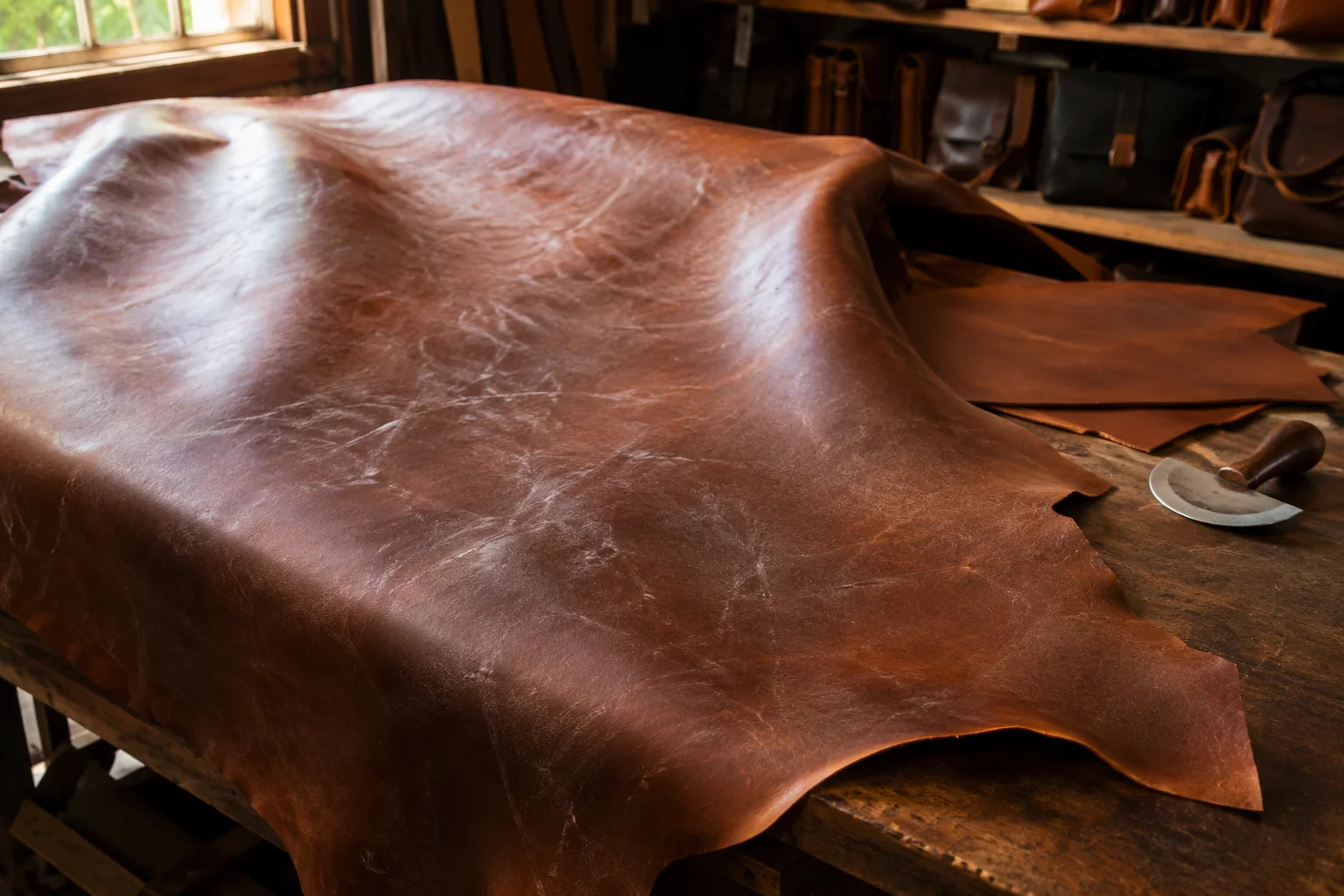
Waxed and oiled describe how a hide was finished, not what animal it came from. The base is usually cowhide, sometimes calf or buffalo, tanned first and then treated with oils, waxes or a combination of both worked into the surface.
What the Oil and Wax Do
The oils penetrate and soften the fibre, giving the leather its weight and pull. The waxes sit nearer the surface, filling the grain and adding a protective film that can be renewed. Together they replace the pigmented coating that would otherwise seal the hide.
Why It Looks Uneven at First
Because nothing seals the surface, the material shows its own variation: bloom, darker patches where oil pooled, lighter areas where the grain stands up. This is not a defect, and a factory that tries to correct it will damage the leather.
Where It Sits Against Pull-Up
Pull-up leather is a member of this family, finished so that it lightens sharply where it is stretched. The colour change that results is a separate subject. What follows applies to the whole family, including the pull-up types.
Why Bag Makers Reach for It
Hand and Drape
The oils make the leather supple without making it thin. A tote in a mid-weight waxed hide folds into shape, holds a soft structure and feels heavier in the hand than its thickness suggests.
Surface Resilience
Scratches on a waxed surface can usually be rubbed out with a thumb, because the wax moves. On a pigmented finish the same scratch removes colour and stays visible. For a bag that will be handled daily, that difference matters more than any laboratory figure.
The Ageing Story
The material darkens, polishes where hands touch it, and develops a sheen that cannot be manufactured. For brands selling on longevity, this is the whole argument, and it is genuinely true rather than a marketing line.
The Costs You Accept
Marking and Scuffing
The same softness that allows a scratch to be rubbed out allows a scratch to appear. Handling marks, hanger marks and the imprint of a stacked panel are normal, and a factory must plan handling around them rather than promise they will not occur.
Colour Shift Under Tension
Any panel pulled during assembly will lighten where it is stretched. Straps, gussets and handle anchors are the usual places. A bag assembled with uneven tension looks blotchy, and no finishing step will fix it.
Oil Migration
Oil moves. It moves into lining, into stitching, into cardboard packaging and into anything stored against the bag. A factory that has not planned for migration will open a carton three weeks later and find the problem has spread.
The Balance Sheet
| What you gain | What it costs |
|---|---|
| Depth of colour and grain character | Visible variation between panels |
| Scratches that can be rubbed out | Scratches that appear in handling |
| Softness with substance | Tension marks during assembly |
| A product that improves with age | Oil migration into lining and packaging |
| No surface coating to peel | Edges that resist paint and need burnishing |
Reading the Table
None of these are reasons to avoid the material. They are reasons to plan for it, and the planning belongs in the specification and the sample, not in a complaint after shipment.
Cutting a Waxed Hide
Blade Sharpness and Drag
The wax film creates drag that a sealed finish does not. A blade that is merely sharp enough for pigmented leather will pull, stretch and leave a ragged edge here. Cutting tools need to be sharper and changed more often.
Direction and Nesting
The grain and the oil distribution differ across a hide. Panels cut from the belly behave differently from panels cut from the back, and mixing them in one bag produces visible mismatching in a few months.
Offcuts and Reuse
Offcuts keep their finish and can be reused for straps, tabs and small goods, which improves yield. What they cannot do is match perfectly, so reuse works best where the pieces are separated on the bag.
The Handling Rule
Panels are moved flat and never stacked face to face under weight. A simple rack or a stack of interleaved boards costs almost nothing and prevents most of the marks that would otherwise appear before sewing.
Sewing It on a Production Line
Machine Settings
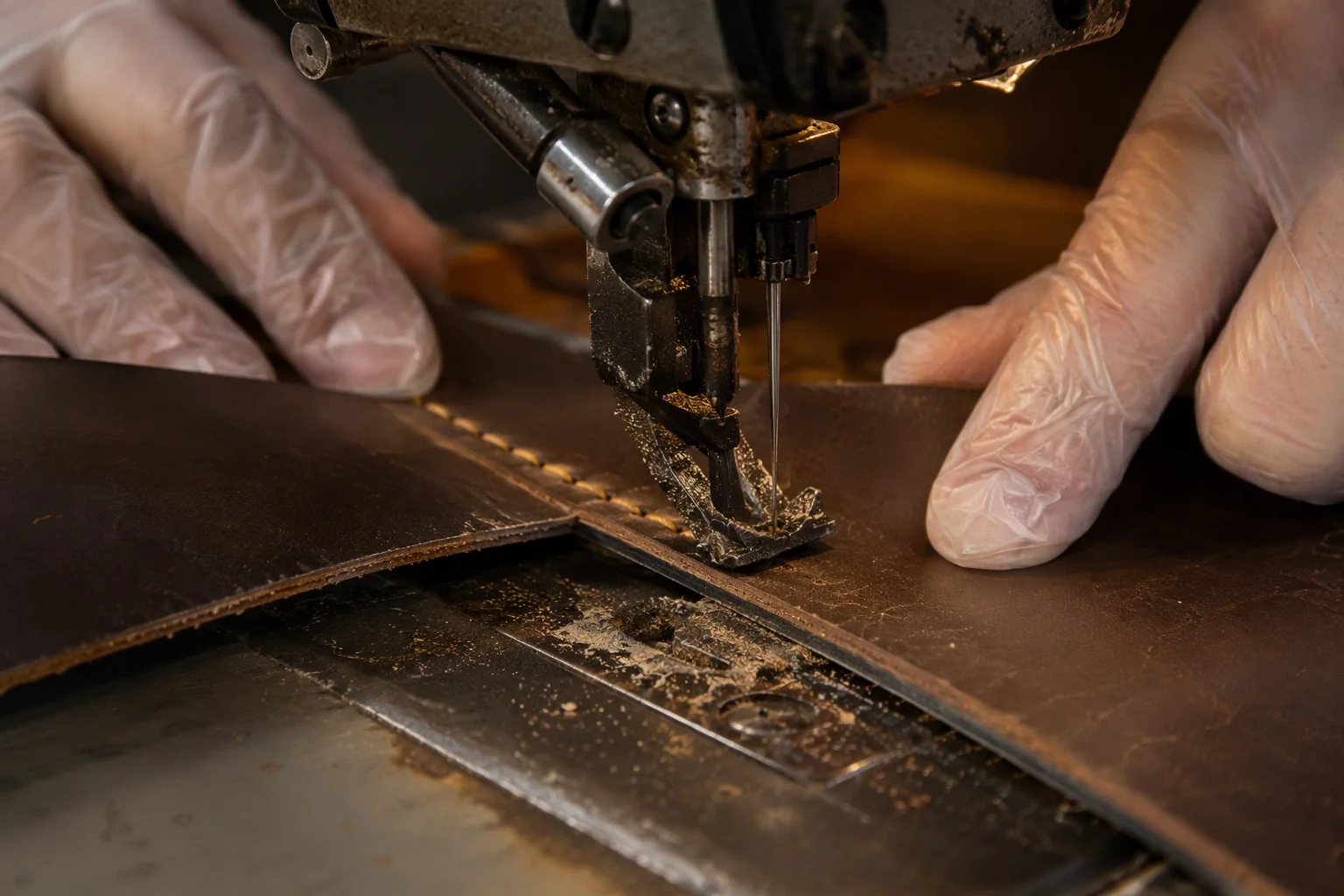
A waxed surface feeds unevenly because the wax acts as a lubricant against the presser foot. Reducing foot pressure and adjusting feed timing usually gives a more even stitch than increasing tension.
Stitch Length and Puckering
Longer stitches suit the material; short, tight stitching compresses the leather and produces a puckered seam that cannot be corrected afterwards. The stitch length should be set on the actual hide, not on a test piece of a different finish.
Needle, Thread and Build-Up
A cutting-point needle reduces drag and heat. Wax accumulates around the needle, the needle plate and the bobbin area, and it must be cleaned at defined intervals, because a machine that has not been cleaned sews a different seam by mid-shift.
The Tension Question
Because the material stretches, seam tension is not a fixed setting but a judgement made at the machine. Operators need to be shown what a correct seam looks like on this leather, in this colour, at this thickness.
Edge Finishing: The Hardest Step
Why Paint Struggles
Edge paint needs a clean, sealed substrate to bond to. A waxed edge is neither: the wax resists adhesion, and the oil keeps migrating underneath the film. Paint goes on, looks acceptable for a week, then lifts in patches.
Burnishing and Wax
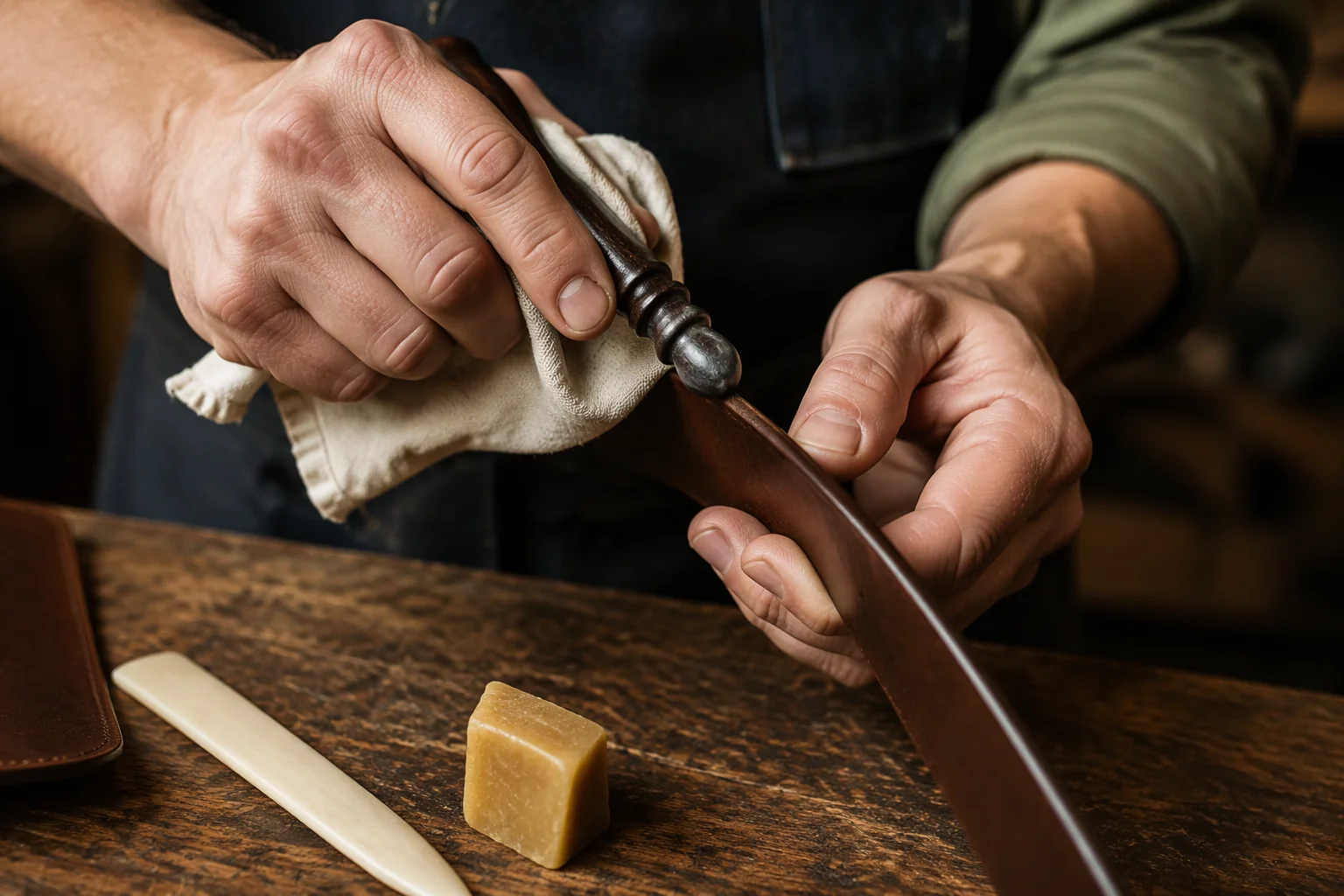
The reliable route is mechanical: sand the edge progressively, then burnish with friction and a wax or gum preparation until the fibre lays down into a sealed, polished edge. It is slower than painting and it suits the material, because the leather’s own oils are part of the finish.
Folded and Bound Alternatives
Where a painted or burnished edge is impractical, the design can fold the edge over and stitch it, or bind it with a strip of the same leather or a contrasting one. Deciding this at sampling is cheaper than deciding it after the first hundred bags.
The Production Consequence
Burnished edges are a skill, not a station setting. A factory needs operators who can judge when an edge is sealed and when it needs another pass. That skill leaves with the operator, which is why edge quality is one of the first things to drift when a line is under pressure.
Skiving, Folding and Bonding
Skiving Waxed Leather
The wax lubricates the skiving blade, which sounds helpful and is not: the blade can slip and produce an uneven taper. Skiving should be checked by feel as well as by measurement, because a taper that measures correctly can still be ragged.
Folding Without Cracking
Folds should be formed along the grain direction and supported by a skived edge. A fold made against the grain on a dry hide will crack along the crease, usually after the bag has been in use rather than during assembly.
Adhesion and Fusing
Adhesive struggles on an oiled surface, and fusible interlinings struggle even more. Where reinforcement is needed, mechanical fixing or a stitched pocket is more reliable than a bond that may release in a warm warehouse.
The Crease Test
Before a style goes into production, fold a sample of the actual hide in both directions and leave it under weight overnight. What a workshop learns from that test is worth more than any data sheet.
Hardware and Reinforcement
Anchors in a Slippery Material
Rings, D-rings and strap anchors load a material that stretches. A single row of stitching on an anchor will elongate over months, so anchors need a backing patch and either two stitch rows or a rivet that carries part of the load.
Backing Patches
A backing patch spreads the load and gives the hardware something firm to sit against. It should be specified by size and position, and it should be cut from a firmer part of the hide or from a reinforcement material.
Rivets, Feet and Magnetic Closures
Rivets hold well in this material if the hole is punched cleanly and the rivet is set with the correct die. Feet and magnetic closures impose a point load, and a point load on soft waxed leather will eventually show as a dimple.
Lining Choices That Suit It
Why Linings Show Oil
Oil migrates into absorbent linings and leaves a shadow that looks like a stain. Light-coloured cotton and untreated canvas are the worst offenders, and the mark appears in storage rather than at inspection.
Suitable Linings
Tight-weave synthetic fabrics, coated linings and darker colours handle migration better. Where a natural lining is required for the brand story, specify a barrier layer or accept that the first months will show transfer.
Unlined Interiors
Unlined interiors avoid the problem entirely and are the traditional answer. They expose the back of the leather, which must then be presentable, and they require cleaner edge work on every internal seam.
Durability in Service
Abrasion
Waxed leather resists abrasion better than an unfinished surface and worse than a hard pigmented coat. Wear appears as a polished area rather than a hole, which most users read as character.
Water and Humidity
Light rain beads and can be wiped away. Prolonged soaking softens the fibre, and drying in heat will harden it. In a hot, humid market, storage is the greater risk: a bag kept in a damp cupboard will grow a problem no finish can prevent.
Sunlight and Heat
Prolonged sun darkens the material unevenly and can draw wax to the surface. Display pieces in a shop window need rotation, and a bag left against a hot window will show a shape that never recovers.
The Comparison
| Behaviour | Waxed and oiled | Vegetable-tanned | Pigmented chrome |
|---|---|---|---|
| Scratches | Rub out with warmth | Darken and stay | Remove colour |
| Water | Beads, then marks | Spots readily | Resists short exposure |
| Ageing | Darkens and polishes | Darkens deeply | Stays uniform |
| Abrasion | Polishes, rarely breaks | Wears through slowly | Coating scuffs first |
| Maintenance | Wax and cloth | Conditioner and cloth | Damp cloth only |
What the Table Means for a Brand
A brand choosing this material is choosing a product that will not look identical in two years. That is either the proposition or the complaint, depending entirely on what the care card says.
The Care Regime That Works
Little and Often
The material is maintained, not repaired. A thin application of a compatible wax or conditioner, worked in with a soft cloth and buffed, replaces what handling removes. Doing this a few times a year is enough; doing it monthly builds a sticky layer that attracts dust.
What Not to Use
Silicone dressings, household leather wipes and anything with solvent in it will strip the finish and leave streaks. Water alone is fine for cleaning marks, provided the bag is dried away from heat rather than over a radiator.
Storage
Stuffed, in a breathable bag, away from sunlight and radiators. Wrapped in plastic is the single most common storage mistake, because trapped moisture causes the damage that the plastic was meant to prevent.
What to Tell the Customer
Three sentences on the care card do more than a page of instructions: wipe with a dry cloth, treat sparingly with wax, keep out of direct sun. Anything longer is not read.
Specifying It to a Supplier
Words That Get Results
Ask for the base tannage, the finish type, the oil and wax content in general terms, the thickness with a tolerance, the temper in the supplier’s own vocabulary, and a colour reference against a physical swatch. Vague adjectives get vague leather.
Samples and Trials
Order a trial quantity and run it through the actual operations: cut, skive, fold, sew, burnish. A hide that looks right on a table can be unusable at the skiving machine, and the only way to know is to try it.
Consistency Between Batches
Ask how the supplier controls colour and finish across lots, and request a retention sample from each delivery. In a material with no covering coat, batch variation is not a defect but it must be managed.
When It Is the Wrong Choice
Structured Bags
Rigid shapes need firmness the oils remove. A structured bag made in a soft waxed hide will sag at the base and lose its line, and no amount of interlining will fully replace a firmer leather.
Coated or Printed Surfaces
If the design needs a printed logo, a foil or a coated surface, the finish fights the process. Adhesion on an oiled surface is unreliable, and the result is a decoration that fails before the bag does.
Hot, Humid Markets
Where bags are stored in humid conditions without climate control, an unprotected absorbent material is a risk. This is not a reason to refuse the market; it is a reason to specify a tighter finish or a different construction.
High-Turnover Fashion
A material whose selling point is how it ages suits a customer who keeps the bag. For a fast cycle where the product is replaced within a season, the advantage is paid for and never seen.
Goods-In Checks
Bloom and Evenness
A light haze of bloom is normal and can be wiped or buffed away. What matters is whether it wipes away evenly and whether the surface underneath is consistent across the hide.
Colour and Thickness
Check colour against the approved swatch under a stated light, and check thickness at several points, because waxed hides vary more than coated ones. Record both, since an argument in month three is settled by a record from day one.
Temper and Feel
Press the hide with the back of a fingernail and fold a corner. A hide that feels dry at the fold will crack there later, and the time to reject it is before cutting rather than after assembly.
Yield and Cost Reality
Price per Square Foot
Waxed and oiled leathers usually cost more per square foot than a standard pigmented hide of the same grade, because the finishing takes longer and the raw material is selected for visible grain.
Yield Loss
Hide variation reduces usable area, and defects that would be hidden under a coating are visible here. A factory should expect lower yield than on a pigmented hide and price the bag accordingly rather than discovering it in the cutting room.
Rework
The rework profile is different rather than higher: fewer colour repairs, more handling marks and edge rework. A workshop that tracks rework by cause will see this shift clearly in the first month and can staff for it.
Working With a Buyer Who Wants the Look
Managing Expectations Early
Send the buyer a photograph of three hides from the same lot before sampling. Variation is easier to accept when it has been seen in advance than when it arrives as a surprise on the first sample.
Sample Approval and Retention
Approve the sample under a stated light, sign it, and keep it. Where a later batch is questioned, the signed sample is the only thing that resolves the discussion, and memory is not a specification.
The Care Text
Write the care instructions before the first production run, not after. The wording determines whether the changes the material will undergo read as intended ageing or as a fault.
Common Mistakes in Production
Most problems with this leather are process problems wearing a material costume. The list below accounts for the failures we see most often.
- Treating it like a coated hide. Same blade, same foot pressure, same edge paint, and then surprise at the result.
- Stacking panels face to face. Weight plus wax equals permanent marks that appear before the bag is even sewn.
- Painting the edges. Reliable for a week, then lifting in patches along the whole run.
- Sewing with tight stitches. Short stitch lengths compress a soft material into a puckered seam that cannot be corrected.
- Ignoring tension during assembly. Straps and gussets lighten where they are pulled, and the bag looks blotchy from day one.
- Using absorbent light linings. Oil transfer shows within weeks in storage, not at final inspection.
- Skipping the retention sample. Without one, every batch dispute becomes an argument about memory.
The Pattern Behind the List
Every item is a decision taken by habit rather than by measurement. That is also why the fixes are cheap: they cost attention, not equipment.
What Good Looks Like on the Line
A workshop that has learned this material stops trying to make it uniform. It plans for variation, cuts around it, and finishes edges by hand because hand work is what the surface accepts.
The Signs to Look For
- A dedicated cutting blade, changed on a schedule rather than when it fails
- Panels moved flat on boards, never stacked face to face
- A burnishing station with operators who can judge a sealed edge
- Stitch length set on the actual hide, not on a test scrap
- A retention sample from every delivery, labelled and stored
- Care cards written and printed before the first run
- Rework tracked by cause, so the shift in profile is visible
The Sign That Something Is Wrong
If complaints arrive six weeks after delivery rather than at inspection, the cause is usually oil migration or edge lifting. Both are process failures, and both are visible in the sample if anyone looks for them.
A Specification Checklist
- Base tannage and animal, stated explicitly
- Finish type: waxed, oiled, or both, with the supplier’s own term
- Thickness with a tolerance, measured at several points
- Temper described in the supplier’s vocabulary, plus a physical sample
- Colour reference against a signed swatch
- Oil and wax content described in general terms
- Grain expectation: how much natural variation is acceptable
- Cutting instructions: direction, nesting and handling
- Skiving specification for each folded or lapped edge
- Stitch length and seam type for every join
- Edge treatment per edge: burnished, folded, bound or raw
- Hardware fixing method with backing patch size and position
- Lining material, colour and any barrier layer
- Adhesive or reinforcement method where a bond is used
- Rework and rejection criteria, written and agreed
- Care instructions and the retail wording
- Retention sample requirement per delivery
- Batch traceability from hide to finished bag
Waxed Leather by Bag Type
Where It Excels
Soft totes, shoulder bags, bucket shapes and slouchy backpacks are its natural home, because the material contributes the drape these shapes need. Unstructured designs let the leather do the work instead of fighting it with boards.
Where It Needs Help
A diaper bag needs a stable base and organised interior panels, which means firmer leather on the base or a reinforcement the waxed hide sits over. Structured backpacks need the same treatment at the back panel and shoulder anchors.
Where to Avoid It
Wallets and small goods are usually better in a firmer, tighter-grained leather, because thin waxed panels stretch at the fold and lose shape where cards are pushed in.
Matching Material to Shape
| Bag type | Suitability | What to watch |
|---|---|---|
| Slouchy tote | Excellent | Handle anchors and strap stretch |
| Bucket bag | Excellent | Base firmness and edge burnishing |
| Soft backpack | Good | Strap anchors and back panel support |
| Diaper bag | Workable | Base structure and interior organisation |
| Structured briefcase | Poor | Sagging and loss of line |
| Wallet or card holder | Poor | Stretch at folds and thin-panel wear |
Packing, Transit and Humidity
Separating the Bag From Itself
A waxed bag wrapped directly in tissue will find the tissue in the morning: oil transfers, and the print on the tissue transfers with it. Acid-free tissue, a dust bag and a gap between surfaces solve most of it.
Cartons and Containers
Cartons absorb and release moisture. A container that sweats in transit will leave a bloom pattern on every bag in the top layer, and the damage is not always visible at destination until the carton is opened in a shop.
Desiccant, Used Properly
A desiccant sachet helps only if the carton is sealed and the sachet is sized for the volume. Scattered loose sachets that touch the leather leave marks of their own.
Training for This Material
What Operators Need to Be Told
That marks are normal and can be rubbed out. That panels are never stacked. That the edge is finished by hand and judged by feel. Three facts, demonstrated once, prevent most of the avoidable damage.
What They Need to Be Shown
A correct seam at the right stitch length, a correctly burnished edge, and a panel that has been marked so they know what the problem looks like. Showing a defect is more effective than describing one.
Why It Matters More Here
On a coated hide, small handling errors disappear under the finish or in the colour repair bay. Here they stay, which is why training pays back faster on this material than on any other in the workshop.
Ordering, Lead Times and Repeat Runs
Lead Time Starts at the Tannery
Waxed and oiled finishes take longer to produce than standard pigmented ones, and stock is often held in limited colours. A brand planning a launch should ask for the tannery’s lead time, not the trading company’s.
Minimums and Colour Runs
Minimums per colour are usually higher because the finishing is set up per lot. Where a brand needs several colours, splitting a single order into colour runs is often cheaper than placing separate small orders later.
Repeats and Batch Matching
A repeat order placed months later will not match the first exactly, and it should not be expected to. Ask for a retention sample from the original run and approve the new batch against it, rather than against a photograph.
Frequently Asked Questions
Is waxed leather the same as oiled leather?
They belong to one family and are often combined. Wax sits nearer the surface and adds protection; oil penetrates and adds softness and pull. Most commercial products use both in different proportions.
Can a bag factory paint the edges of waxed leather?
It can, and the paint usually lifts within weeks because wax and oil resist adhesion. Burnishing, folding or binding are the reliable routes, and they should be chosen at sampling.
Will the white haze on a new hide come back?
Bloom is wax that has risen to the surface and it can reappear in cold storage or in transit. It buffs away with a dry cloth and is not a defect, though it should be checked for evenness at goods-in.
How much will the colour change with use?
It darkens and polishes where it is handled, and lightens where it is stretched. The amount depends on the finish and the user, which is why the care card matters more than any promise about how it will age.
Is waxed leather suitable for a diaper bag?
It works where the shape is soft and the base is reinforced. Fully structured diaper bags are better in a firmer leather, because the material cannot hold a rigid line on its own.
Why do scratches disappear on this leather but not on others?
The wax moves under friction, so a light scratch can be worked back into the surface. A pigmented coating cannot do this because the colour sits in a film that the scratch has removed.
Does oil migrate into lining?
Yes, and it shows most on light absorbent linings. Tight-weave or coated linings, darker colours or a barrier layer reduce the problem, and it appears in storage rather than at inspection.
Can it be laminated to a backing?
Adhesion is unreliable on an oiled surface. Where structure is needed, a stitched pocket or mechanical fixing is more dependable than a fused or glued backing.
What thickness should be specified?
Enough to hold the shape without boards, usually a mid-weight for totes and a heavier weight for straps and bases. Specify a tolerance, because waxed hides vary more than coated ones.
How should the finished bag be stored?
Stuffed, in a breathable dust bag, away from sunlight and heat. Plastic wrapping is the most common mistake, because it traps moisture against a material that has no sealing coat.
What single check catches most problems before shipment?
Fold a corner of the actual hide and leave it weighted overnight, then look at the crease. A hide that cracks at the fold will crack on the bag, and it is cheaper to find out before cutting.
Conclusion
Waxed and oiled leather is practical, provided the factory stops treating it as a coated hide. The material rewards attention in four places: how panels are handled, how the machine is set, how the edge is finished, and how the finished bag is packed and stored.
Everything else follows from those four. Handling discipline prevents the marks that no repair can remove. Machine settings and stitch length prevent puckered seams. Hand burnishing gives an edge the material will accept. Packing and storage prevent the oil transfer that appears weeks after the carton is closed.
The strategic point is simpler. This leather is chosen because it does not look new forever, so a brand that specifies it must also write the care card and train the people who will answer the complaint. A factory that understands the material and a brand that has explained it produce a bag that ages well. One without the other produces a return.
