
Should a Bag Mix Leather Grades Across Its Different Parts?
Should a Bag Mix Leather Grades Across Its Different Parts?
Most bags that sell for a serious price are not made from one leather. The body may be full-grain, the binding and interior pockets a split, the reinforcement patches something firmer and cheaper, and nobody who buys the bag will ever know.
That is not a trick. It is how a factory gets a bag that wears well where it is loaded, looks consistent where it is seen, and stays inside a price the market will pay. The alternative — one grade everywhere — either overpays for the hidden parts or compromises the visible ones.
This article is about that allocation decision. It is not a comparison of what the four common grades are, which is covered elsewhere on this site, and it is not a buying guide to hide selection. The question here is narrower: which part of a bag should get which grade, how to keep the mix invisible, and how to write it down so a factory can quote it.
- Why One Bag Rarely Uses One Grade
- What Each Grade Actually Is
- The Parts of a Bag and What Each Demands
- Where Full-Grain Pays for Itself
- Where Top-Grain Is the Sensible Choice
- Where Genuine Split Earns Its Place
- Where Bonded Leather Should Not Go
- How the Mix Looks to a Customer
- Making the Mix Invisible
- Specifying Mixed Grades
- Cost Modelling a Mixed Bag
- Quality Control for a Mixed-Grade Bag
- Common Mistakes
- A Mixed-Grade Specification Checklist
- What Grade Mixing Does to Repair and Returns
- When the Whole Bag Should Be One Grade
- Talking to a Customer About the Mix
- What the Factory Needs From the Brand
- Grade Allocation by Bag Type
- What Goes Wrong in the Second Order
- Checking a Grade Claim on Delivery
- Frequently Asked Questions
- Conclusion
Why One Bag Rarely Uses One Grade
The Cost Argument
A full-grain body is worth paying for because it is the surface the customer touches, carries and judges. A full-grain interior pocket divider is worth nothing, because it sits inside a lining and is never seen. Spending the same money on both is not quality, it is waste.
The Wear Argument
Different parts of a bag do different work. Straps carry load, gussets flex, bases abrade, trim takes the knocks of a doorway. A grade chosen for appearance may be the wrong grade for a flexing panel, and a grade chosen for strength may be needless on a decorative strip.
What This Guide Decides
The decision has three parts: which grade goes where, how to make the transitions invisible, and how to specify it so the quote and the sample match. Each is a manufacturing question, not a marketing one.
What Each Grade Actually Is
Full-Grain
The outer surface of the hide, intact, with the grain as the animal grew it. It is the strongest part of the hide because the fibre is densest there, and the only one that develops a genuine patina. Scars, growth marks and variation are part of the material.
Top-Grain
The outer surface after a light correction: the grain is sanded or buffed and then finished with a coating. It is more uniform, more resistant to marking and takes colour consistently. It is also thinner in character, because the surface that made it unique has been removed.
Genuine Split Leather
The lower layers of the hide, split away from the grain, usually finished with a coating and an embossed pattern. It has fibre strength but no grain, so it is used where a leather surface is needed without the cost or the look of a full grain.
Bonded Leather
Leather fibre, shredded and bonded with a binder onto a backing. It is a reconstituted material with a leather content rather than a hide, and its behaviour under load, at folds and at edges is different in kind from the three above.
The Grades Side by Side
| Grade | What it is | Strength | Best use on a bag |
|---|---|---|---|
| Full-grain | Intact outer hide surface | Highest fibre density | Body, straps, visible wear points |
| Top-grain | Corrected and coated outer surface | Good, uniform | Large panels, structured shapes |
| Genuine split | Lower hide layers, coated | Moderate, no grain | Trim, binding, pockets, small goods |
| Bonded | Reconstituted fibre on backing | Low at folds and edges | Almost nowhere load-bearing |
Reading the Table
The useful distinction is not good versus bad. It is where the fibre is dense, where the surface is engineered, and where the material has no continuous structure to rely on.
The Parts of a Bag and What Each Demands
Load Paths
Load runs from the handle or strap anchors through the body panels to the base. Every part on that path needs fibre strength and stretch resistance. Parts off the path — an interior pocket, a decorative strip — need neither.
Abrasion Zones
The base, the lower corners, the gusset folds and the strap edges meet the world first. These are the places where a coated surface shows wear as a scuff and an intact grain shows it as a polish.
Visible and Hidden Surfaces
Exterior body panels are judged at arm’s length. Interior surfaces are judged at hand distance, if at all. Deciding which is which before specifying prevents the most common form of over-specification.
Component by Component
| Component | What it must do | Sensible grade | Watch out for |
|---|---|---|---|
| Front and back body | Look right, hold shape | Full-grain or top-grain | Grain matching across the seam |
| Gusset | Flex repeatedly without cracking | Full-grain, softer temper | Cracking at the fold line |
| Strap and handle | Carry load without stretch | Full-grain, firm | Elongation and edge wear |
| Base panel | Resist abrasion | Full-grain or firm top-grain | Wear at corners |
| Binding and piping | Follow a curve neatly | Genuine split | Coating cracking on tight radii |
| Interior pockets | Stay flat, hold shape | Genuine split | Lining shadow through thin material |
| Reinforcement patches | Spread load, stay hidden | Firm split or non-leather | Bulk showing through the outer panel |
| Decorative trim | Match the body | Offcuts of the body grade | Colour mismatch between lots |
Where the Table Bends
Small bags, short runs and brands selling on a single-material claim will bend these rules deliberately. The point is to bend them knowingly rather than by default.
Where Full-Grain Pays for Itself
Body Panels on Premium Bags
The body is where the customer’s hand rests and where the bag is photographed. An intact grain takes light differently from a coated surface, and that difference is the product.
Straps and Handles
Straps fail by stretching and by edge wear, both of which favour dense fibre. A full-grain strap that is cut from the back of the hide will outlast a coated strap of the same thickness, and the difference appears within a year of daily use.
Where It Is Wasted
Interior structure, pocket dividers, reinforcement patches and anything laminated behind a lining. Money spent here buys nothing the customer can perceive, and it can even hurt: a thick full-grain divider makes a bag bulky where it should be flat.
Where Top-Grain Is the Sensible Choice
Large Panels in Mid-Market Bags
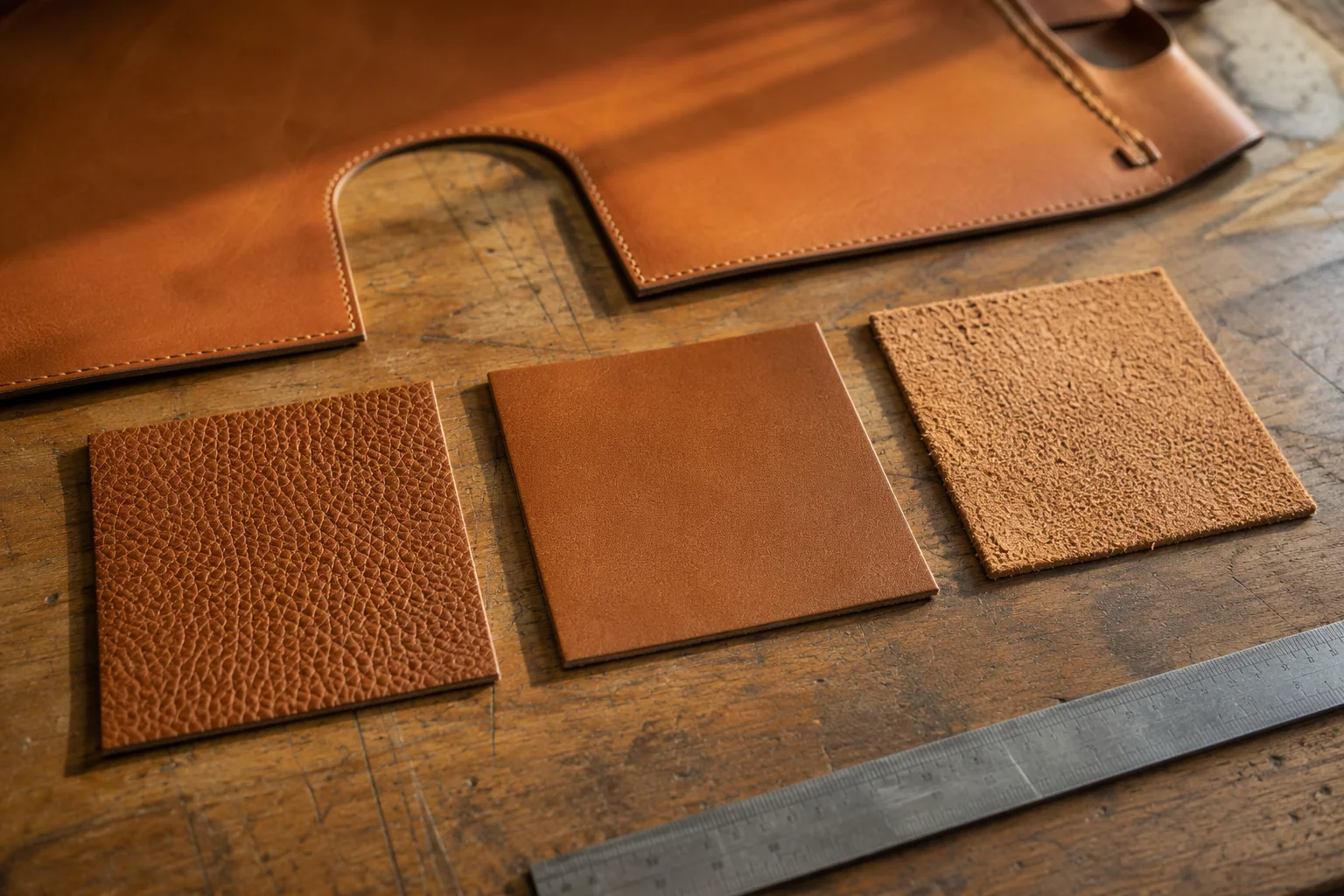
A top-grain body gives a bag an even, unmarked surface across a large area, which is what most mid-market customers expect. Full-grain variation reads as quality to a knowledgeable buyer and as inconsistency to a first-time one.
Colour-Consistent Programmes
Where a brand runs several colours from one style, top-grain keeps those colours controlled across lots and across factories. A corrected surface takes dye and finish predictably, and that predictability is worth more than grain character when the range is broad.
Structured Shapes
Corrected surfaces hold a firmer hand, and firmness suits shapes that must keep a line. For a bag that will be photographed as a silhouette rather than as a texture, top-grain is often the more faithful choice.
The Honest Limitation
Top-grain ages by keeping its appearance rather than changing it. A bag made entirely in top-grain will look almost the same in year three as in month one, which is either reassuring or disappointing depending on what the brand promised.
Where Genuine Split Earns Its Place
Binding, Piping and Thin Strips
A split follows a tight radius better than a thick grain surface and costs less for a part that is largely consumed by the seam. Piping that circles a bag can use a split without any visible loss.
Interior Pockets and Structure
Pocket dividers, slip pockets and organisers sit behind a lining. A split gives the flatness and body these parts need at a price that makes sense for a surface nobody inspects.
Test Runs and Small Goods
For a first production run, or for a small accessory where the leather is a minor component, a split keeps the cost structure workable without changing how the product is experienced.
The Limit to Watch
Split leather is a coated product. On tight radii, at folds and at edges, the coating cracks before the fibre does. Where a part will flex repeatedly, a split is the wrong economy.
Where Bonded Leather Should Not Go
Never on a Load-Bearing Part
Bonded material has no continuous fibre structure, so it creeps under sustained load. A strap, a handle or a shoulder anchor made from it will elongate and eventually delaminate.
Never at an Edge or a Fold
Edges and folds concentrate stress. Bonded leather fails there first, and it fails by separating rather than by wearing, which no repair can hide.
Never Where It Will Be Judged by Hand
The surface feels different, the edge feels different and the weight is different. A customer who handles bags in a shop will notice, even without the vocabulary to explain why.
Where It Legitimately Appears
Some markets accept bonded leather in linings, in packaging components or in decorative panels of low-cost goods. Where regulation or labelling applies to leather content, that is a separate question from engineering, and it should be checked with the authorities in the market concerned.
How the Mix Looks to a Customer
Hand and Touch Points
The customer touches the handle first, then the front panel, then the edge. Those three points should be the highest grade on the bag, because they carry the entire impression of quality.
Colour and Grain Matching
Two grades in one colourway will not match exactly. What matters is that they match under the light where the bag is sold, and that the difference is not concentrated in one obvious place.
The Seam Where Two Grades Meet
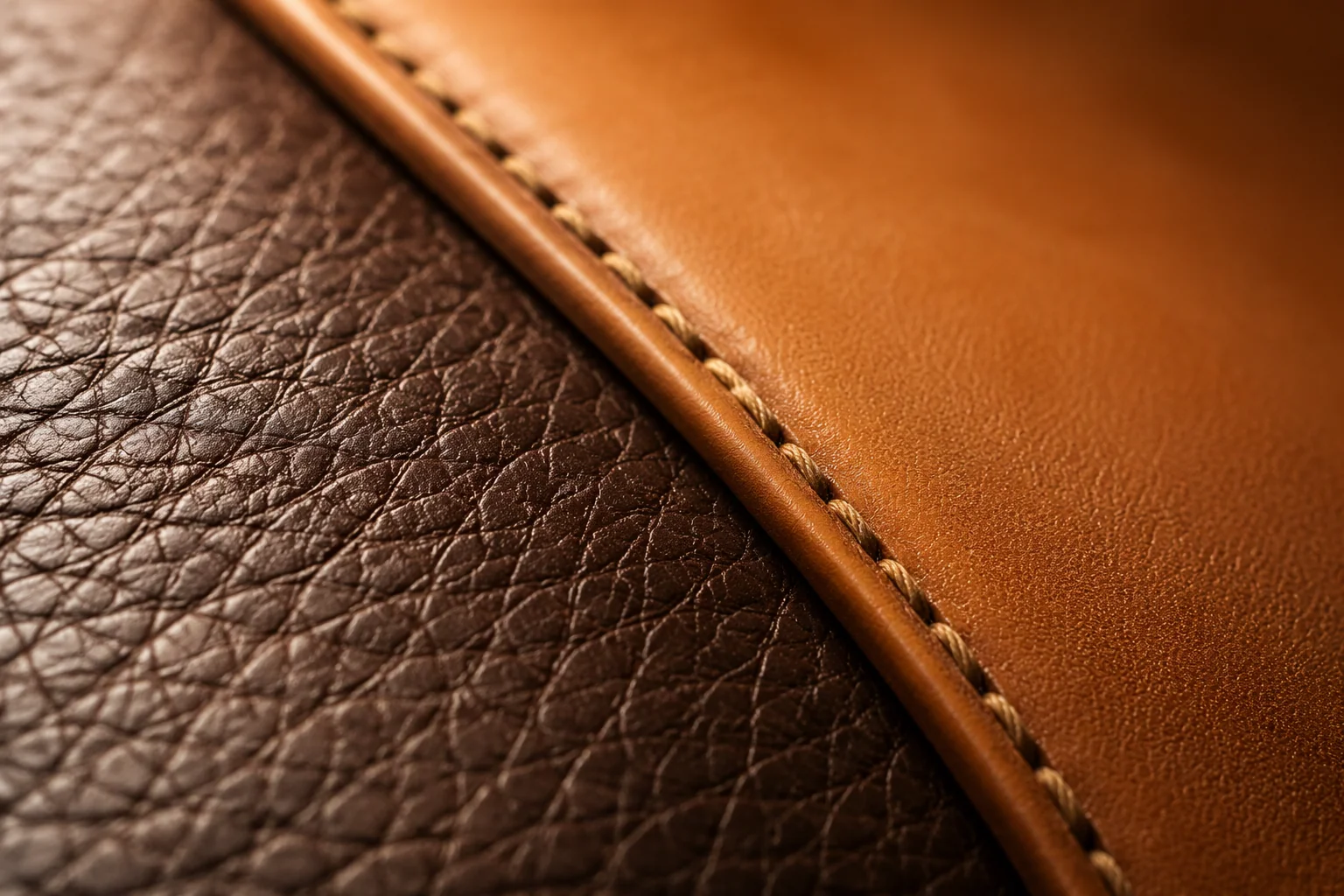
A transition between grades should sit on a seam, a fold, a piping line or a panel break. A transition in the middle of a flat surface draws the eye to exactly the thing the mix was meant to hide.
The Interior Exception
Inside the bag, the expectation changes. A lining, a pocket or a divider in a different material is normal and needs no explanation, which is why the interior is the safest place to economise.
Making the Mix Invisible
Match the Finish Before the Grade
A split finished to the same colour and sheen as a top-grain body reads as the same material at a glance. A full-grain and a split chosen for similar price but different finish read as two materials immediately.
Align the Grain Direction
Where two panels meet, grain direction should continue across the seam. Where a split meets a grain surface, the transition should fall on a feature that interrupts the eye anyway.
Treat the Transition Edge Deliberately
A folded edge, a piping cord, a bound seam or a stitched-down flap gives the transition a reason to exist. An untreated butt join between two grades looks like what it is.
The Light Test
Look at the assembled sample under the light the product will be sold in, at the distance the customer will hold it. Most mixing problems are visible in that test and invisible in a photograph.
Specifying Mixed Grades
Name Parts, Not Percentages
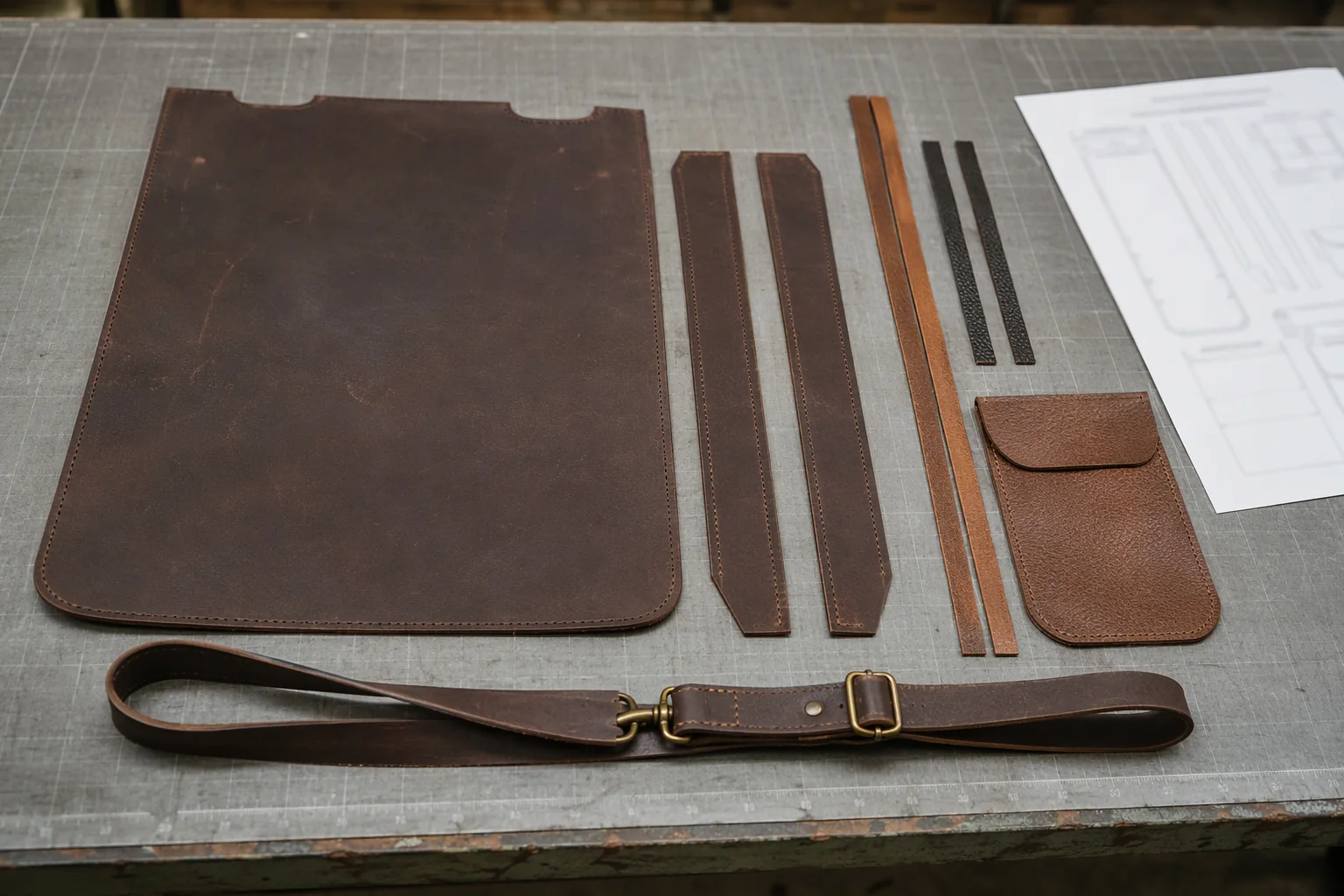
A specification that says “80 percent full-grain” tells a factory nothing, because the percentage can be met by putting the expensive leather in the wrong places. A specification that names each component with its grade, thickness and finish can be quoted and inspected.
One Line per Component
Each part gets its own line: name, grade, thickness with tolerance, finish, grain expectation, colour reference and quantity per bag. Assembled into a bill of materials, that table becomes the quotation basis and the inspection checklist at the same time.
Sample Both Grades Together
The sample must be made from the actual mix, not from a full-grain mock-up approved before the split was introduced. A bag approved in one material and produced in two is a dispute waiting for its first delivery.
Cost Modelling a Mixed Bag
Where the Saving Comes From
The saving comes almost entirely from the parts nobody sees: interior structure, reinforcement, binding and small trim. Moving those parts down a grade reduces material cost without touching a single touchpoint.
Where the Saving Disappears
It disappears in matching, in rework at transitions, in extra handling of two materials at the cutting table, and in minimum order quantities per grade and colour. A mix that saves on material and adds two colour lots can cost more in total.
A Qualitative Comparison
| Part | Single-grade build | Mixed build | Cost effect | Appearance effect |
|---|---|---|---|---|
| Body panels | Full-grain | Full-grain | None | None |
| Straps and handles | Full-grain | Full-grain | None | None |
| Binding and piping | Full-grain | Genuine split | Falls | None if finish matches |
| Interior pockets | Full-grain | Genuine split | Falls | None, hidden by lining |
| Reinforcement patches | Full-grain | Firm split or non-leather | Falls clearly | None if bulk is controlled |
| Decorative trim | Full-grain | Body offcuts | Falls slightly | None if from the same lot |
What the Table Says
The savings are real but they are concentrated in low-visibility parts, and they depend on matching, which is a labour cost rather than a material cost. A factory should quote the mixed build as a separate line item, not as a discount on the single-grade one.
What to Ask the Factory to Break Out
Ask for material cost per grade, matching and handling labour, and the minimum quantity per lot, quoted separately. Without that split a brand cannot tell whether the mix saved money or merely moved it from one column to another, and two factories bidding the same design cannot be compared at all.
Quality Control for a Mixed-Grade Bag
Goods-In by Grade
Each grade arrives as a separate lot with its own colour and thickness variation. Inspect them separately against their own approved swatch, and keep the retention samples apart so a later dispute is not confused by two materials in one folder.
Assembly Checks at Transitions
Every transition point is an inspection point: the seam, the fold, the piping and the binding. Check that the two materials sit at the same height, that the stitch line is even across the join and that no edge of the cheaper material is exposed.
Final Inspection Focus
At final inspection, look at the bag the way a customer will: handle first, front panel second, edge third, interior last. If the interior is the only place the mix is visible, the allocation worked.
Common Mistakes
- Approving the sample in one grade. The approved bag then differs from production in ways nobody signed off.
- Putting the cheap grade on a load path. Straps and anchors made from a split or bonded material fail first and fail visibly.
- Mixing without matching the finish. Two grades with different sheen read as two materials even at normal viewing distance.
- Transitioning on a flat surface. A grade change in the middle of a panel draws attention to the cost decision.
- Quoting a single price for two grades. The factory absorbs the matching labour and recovers it in rework or in the next order.
- Assuming interior grade cannot be felt. A stiff, thick interior divider changes how the bag opens and how it sits.
- Forgetting labelling rules. Where a market regulates leather claims, the mixed build must still be described accurately.
The Pattern
Every mistake above is a failure to write the allocation down. The mix itself is normal practice; an undocumented mix is a future argument.
A Mixed-Grade Specification Checklist
- Every component named, with grade, thickness, finish and colour reference
- Load path identified, and only dense-fibre grades specified on it
- Abrasion zones identified and specified for wear rather than for cost
- Interior parts specified separately from exterior parts
- Transition points listed, each with its construction method
- Finish and sheen matched between grades, checked under retail light
- Grain direction and alignment stated for adjacent panels
- Minimum order quantity confirmed per grade and colour
- Sample built from the actual mix and signed
- Retention sample per grade, per delivery
- Rejection criteria written for each grade
- Leather content wording checked against the rules of the destination market
What Grade Mixing Does to Repair and Returns
Repairability by Part
A full-grain panel can be cleaned, conditioned and re-polished. A coated split can be touched up only until the coating cracks, after which it must be replaced. Where a bag is sold with a repair promise, the grade allocation becomes a warranty decision.
Return Patterns
Returns cluster at touchpoints and at transitions. A mix that puts the cheaper grade anywhere near a handle or a front seam will show up in the return data within a season, usually described by the customer as “looks different from the photo”.
Spare Parts and Repeat Orders
Straps, handles and trims are the parts most often replaced or reordered. If they are specified in a grade the tannery still supplies, a repair in year two is possible. If they were made from an offcut lot, it is not.
When the Whole Bag Should Be One Grade
A Single-Material Claim
Some brands sell on the promise that the bag is one leather throughout. That claim is worth more than the saving, and it should be honoured in the bill of materials rather than in the copy alone.
Very Small Bags
On a wallet, a card holder or a mini bag, the interior is a significant share of the whole and the saving is small, while the risk of visible mismatch at a fold is high. One grade is simpler and usually better.
Very Short Runs
Two grades mean two lots, two minimums and two inspection routines. Below a certain order size, the administrative cost outweighs the material saving, and a single grade is the cheaper total.
High-Repair-Cost Markets
Where returns are expensive to process, the argument for spending on the parts that fail first is stronger than the argument for saving on the parts that are hidden.
Talking to a Customer About the Mix
Say It Plainly, or Do Not Say It
Most customers do not ask what the interior pocket is made from, and a brand is not obliged to volunteer a lecture. What it must not do is imply a single material where there are two, because that is a claim rather than a description.
Where the Wording Matters
Labels, product pages and packaging copy that describe leather content are regulated in many markets. The safe approach is to describe the parts that are leather accurately and to confirm the required wording with the authorities or a compliance adviser for the destination market.
The Sensory Test
A customer judges the bag in ten seconds with their hands. If the handle, the front panel and the edge all feel consistent, the interior will never be questioned. If any of the three feels different, no wording will fix it.
What the Factory Needs From the Brand
Decisions, Not Adjectives
“Premium but affordable” cannot be cut. “Body full-grain, binding split, interior split, straps full-grain” can be cut, quoted, inspected and repeated.
Approval at the Right Stage
Approve the mix at the sampling stage, before the bill of materials is frozen. Approval after the first bulk delivery is a negotiation with no leverage.
One Contact for Material Questions
Where two grades are in play, someone on the brand side must own the material questions: substitutions, lot variation, colour approval and labelling wording. Without that owner, each question is answered by whoever is closest to it.
A mixed-grade bag is not a cheaper bag. It is a bag where the money has been put where the customer’s hands go, and the specification is what proves it was deliberate.
The Sign of a Working Process
The factory can describe the allocation back to the brand, part by part, without reading from the document. That is when the specification is complete enough to produce from.
Grade Allocation by Bag Type
Diaper Bags
A diaper bag is loaded, wiped and set down wet. The base and lower body should be the densest grade available within budget, and the interior should be a split or a wipeable material behind the lining. Handles take the most load of any bag type, so they belong in full-grain.
Totes and Shoulder Bags
Large flat panels dominate the look, which favours a uniform surface on the body and a dense fibre in the straps. Binding, interior pockets and reinforcement sit at the bottom of the range without consequence.
Backpacks
Load is spread across straps, a back panel and a base. All three deserve dense fibre. Side panels and internal organisation can be lighter, since they neither carry nor flex much.
Wallets and Small Goods
The interior is most of the object, and the folds are tight. One grade throughout, chosen firm and thin, avoids both mismatch and bulk.
What Goes Wrong in the Second Order
Substitution at the Tannery
Tanneries substitute lots, and a split supplied in the first run may arrive from a different article in the second. The specification should state what may be substituted and what must be re-approved.
Colour Drift Between Grades
Two grades drift apart in colour faster than one, because they are finished differently. A second order approved against the first order’s body panel may not match the first order’s binding at all.
Loss of the Retention Samples
If the retention samples from run one are discarded, run two is approved against a photograph. That is how a bag quietly changes between seasons without anyone deciding to change it.
The Fix
Keep one signed sample of the finished bag per colourway, plus one swatch per grade, and require both to be checked at goods-in for every subsequent run. The cost is a shelf.
Checking a Grade Claim on Delivery
Look at the Back of the Hide
The flesh side tells you what the material is: dense interlaced fibre on a full-grain, a more open structure on a split, and a visible backing layer on bonded. Ten seconds with a lifted corner is more informative than a certificate.
Look for a Repeat in the Grain
Natural grain has no repeat. A corrected or embossed surface shows the same pattern recurring at a fixed interval across the hide, and a shop can see it by laying two areas side by side.
Look at the Cut Edge
A cross-section shows whether there is a coat, how thick it is and whether there is a backing. A section that looks like a sandwich is a coated or bonded material, whatever the invoice says.
Ask for the Article Code
Tanneries identify every article with a code and a specification sheet. A supplier who cannot produce a code is selling a description, and a description cannot be inspected against a standard.
Keep One Square of Every Delivery
Cut a labelled square from each delivered lot and keep it. Three deliveries later, the difference between the approved grade and the current one is a physical fact rather than a recollection.
Frequently Asked Questions
Is it acceptable to use different leather grades in one bag?
Yes, and most bags above entry level do. What matters is that the allocation is deliberate, documented and matched in finish, and that load-bearing parts carry dense fibre.
Which parts should always be full-grain?
Handles, straps, strap anchors and the front body panel. They carry the load and they are the surfaces a customer touches first, so they determine both durability and impression.
Can bonded leather be used anywhere on a bag?
Not on straps, edges or folds, where it creeps and separates. It appears in low-cost goods and in some non-structural components, but any leather-content claim in a regulated market must be checked separately.
Will two grades look different in the finished bag?
They can, and the risk rises with the difference in finish rather than in grade. Matching sheen and colour first, and placing the transition on a seam or a piping line, keeps the mix invisible.
Does mixing grades reduce the bag’s life?
Only if a cheap grade lands on a part that flexes or carries load. Correctly allocated, the wear parts are the strongest parts and the bag lasts as long as a single-grade build.
How should the specification be written?
One line per component, naming grade, thickness with tolerance, finish and colour reference. Percentages are unusable because they do not say where the expensive material goes.
Should the sample be made from the mixed materials?
Always. A sample approved in one grade does not represent a bag produced in two, and the gap becomes a dispute at the first delivery.
Where does the cost saving actually come from?
From interior structure, binding, trim and reinforcement, not from the visible body. Matching labour and extra minimum quantities per grade can absorb part or all of it on small orders.
Can a split leather be used for interior pockets?
Yes. It is flat, firm and hidden behind the lining, which is exactly the profile interior parts need. Watch for lining shadow where the material is thin.
What is the single biggest error buyers make?
Approving the sample in the most expensive grade. Production then arrives in the specified mix and looks different from the bag that was signed off.
How should leather content be described on the label?
Accurately for each part that is leather, using the wording required in the destination market. Requirements vary, so confirm them locally rather than adopting another market’s phrasing.
Conclusion
A bag can carry four grades and still read as one material, provided the allocation follows the work each part does. Dense fibre on the load path, an even surface where the panel is large, a cheap split where nothing is seen, and no bonded material anywhere that flexes.
The engineering is straightforward. The discipline is in the paperwork: one line per component, a sample built from the real mix, a transition decided at design stage, and retention samples that survive into the next order.
Get that right and the mix is invisible, which is the point. Get it wrong and the bag announces exactly where the money was saved, usually on the handle that stretches or the binding that cracks first. A brand does not choose between quality and cost here; it chooses where each one belongs.
