
How Can a Leather Bag Factory Cut Adhesive and Solvent Use?
How Can a Leather Bag Factory Cut Adhesive and Solvent Use?
Adhesive is the smallest material in a leather bag and the one nobody budgets properly. It does not appear on a drawing, it is not quoted per square metre, and it rarely has an owner. It simply arrives, gets used, and shows up as a line in overheads that nobody defends.
The same is true of the solvent that carries it. A factory can tell you the cost of a hide to the cent and the thread consumption per bag to the metre, then answer a question about adhesive with a shrug and a figure pulled from last year’s purchase records.
This matters for two reasons. Adhesive and solvent are a real cost line once you multiply them by every bag, and they are the part of production that most directly touches the people doing the work. Reducing them is not a compliance exercise imposed from outside; it is a process improvement with a payback.
Two neighbouring topics are deliberately out of scope here. How chemicals should be stored, labelled and segregated is covered separately on this site, and so is where the energy in a bag factory is actually consumed. This guide is about consumption: the quantity used per bag, the chemistry chosen, and the discipline on the line that decides whether either falls.
- Why Adhesive Deserves Its Own Budget Line
- What Adhesive Really Does in a Leather Bag
- Where the Solvent Goes
- The Reduction Hierarchy
- Step One: Question Whether the Adhesive Is Needed
- Step Two: Choose the Chemistry Deliberately
- Step Three: Control the Amount Applied
- Step Four: Control the Container and the Batch
- Application Discipline on the Line
- Ventilation and Extraction
- What to Measure
- Bond Failure: The Hidden Cost of Cutting Adhesive
- Substrate Matters More Than the Adhesive
- Water-Based Conversion: What Changes on the Line
- When Water-Based Is the Wrong Choice
- Hot Melt and the Dry Route
- Working With the Adhesive Supplier
- Where Storage Ends and Consumption Begins
- Waste, Rags, Containers and Residue
- Running Down Consumption: A 90-Day Plan
- The Cost Model Behind the Change
- Common Mistakes
- Documentation Buyers Will Ask For
- What a Good Bonding Station Looks Like
- How the Design Decides Consumption
- Cleaning Without More Solvent
- Adhesive Profiles by Bag Type
- Working With the Buyer on Adhesive Changes
- What Good Looks Like
- Frequently Asked Questions
- Conclusion
Why Adhesive Deserves Its Own Budget Line
The Material That Never Appears on a Drawing
A bill of materials lists leather, lining, thread, zipper, hardware and packaging. Adhesive usually appears as a single line, if at all, with no grade, no quantity and no unit of measure. That omission is why consumption is invisible.
Where the Money Leaks
Three leaks account for most of the waste. The first is over-application: a bead where a film was needed. The second is drying out in open containers. The third is rework, where a failed bond costs the adhesive, the labour and sometimes the panel.
Why Nobody Owns It
Adhesive is bought by purchasing, used by operators, and specified by nobody. When a cost has no owner it drifts upward quietly, and each individual decision that raises it looks reasonable in isolation.
What Adhesive Really Does in a Leather Bag
Temporary Holding
Some adhesive exists only to hold two pieces together until a seam is sewn. It is a third hand, not a structural element, and its strength requirements are far lower than most specifications assume.
Structural Bonding
Other adhesive is load-bearing: folded edges, reinforcements, linings fused to a shell, base panels that never see a stitch. Here the bond must survive flexing, humidity and the weight of contents.
Edge and Fold Work
Turned edges, folded tops and skived joins are where adhesive earns its place. A clean fold that stays flat through assembly is worth a controlled amount of glue, and this is the application where quantity is easiest to govern.
The Four Places Glue Appears
- Holding seams before stitching
- Folded and turned edges
- Lining and reinforcement attachment
- Base, gusset and hardware reinforcement patches
Knowing which of the four dominates tells a factory where to spend its attention. In most bag workshops it is the second and the third.
Where the Solvent Goes
Carrier, Not Ingredient
In a solvent-based adhesive, the polymer is the glue and the solvent is the vehicle that keeps it liquid. The solvent has no structural job. It exists to be evaporated.
The Evaporation Path
Once the two surfaces are coated, the solvent leaves into the room. Some leaves before the bond closes, some after. Either way it ends up in the workshop air or in an extraction system, never in the bag.
Why Evaporation Is the Real Cost
A factory pays for the solvent, pays to move the air that carries it away, and pays again in the drying time that determines how fast a line can run. Every gram evaporated is a gram bought, handled and then discarded.
The Reduction Hierarchy
The order below matters more than any single measure. A factory that starts with extraction is paying to remove a material it did not need to use.
| Level | Action | Effect on consumption | Effort |
|---|---|---|---|
| 1 | Eliminate the bond where a seam can do the job | Removes the demand entirely | Design change |
| 2 | Reduce the quantity applied per unit | Immediate, permanent | Metering and training |
| 3 | Substitute the chemistry | Lower solvent content per gram | Trials and drying capacity |
| 4 | Control the container and batch | Cuts drying out and expired stock | Simple discipline |
| 5 | Capture and extract what remains | No change in consumption | Capital and running cost |
Reading the Table
Levels one to four reduce what is bought. Level five only moves it. A programme that jumps to extraction buys equipment and leaves the consumption line untouched.
What “Eliminate” Does Not Mean
It does not mean removing adhesive from bags that need it. It means asking, for each bond, whether a seam, a fold or a mechanical fixing would do the same job with fewer steps.
Step One: Question Whether the Adhesive Is Needed
Folded and Stitched Instead of Glued
A glued-then-stitched seam uses adhesive for holding only. Where a factory can clamp, pin or tack the assembly, the bond is a convenience rather than a requirement, and convenience is the easiest cost to remove.
Interlocking Seams and Laps
Some joins that are currently glued can be redesigned as laps or interlocking folds that locate themselves. This is a pattern decision, so it must be settled at sampling, not on the line.
Where Elimination Stops
Visible edges, thin leathers, and any bond that carries load should keep their adhesive. Elimination is a question asked per bond, not a policy applied across a product.
Step Two: Choose the Chemistry Deliberately
Water-Based
Water-based systems carry far less solvent and are the obvious substitution for many assembly bonds. They demand more drying time and better airflow, and they behave differently on a finished leather surface.
Hot Melt
Hot melt is applied molten and sets on cooling, so it carries no solvent to evaporate. It suits holding and reinforcement work and is unforgiving about temperature and open time.
Reactive and Two-Part
Two-part systems give the highest strength and the shortest working window. They belong where a bond genuinely carries load, not as a general-purpose workshop adhesive.
Selection Criteria
| Criterion | What to weigh | Why it decides the choice |
|---|---|---|
| Substrate compatibility | Leather finish, lining fibre, fusing | Poor wetting wastes material and fails |
| Open time | Line pace and assembly sequence | Short windows cause rework |
| Drying or setting route | Air, heat, moisture, cooling | Determines line capacity |
| Strength needed | Holding versus load-bearing | Over-specifying is common and costly |
| Solvent content | Carrier fraction in the product | The direct lever on emissions |
| Equipment needed | Dispensing, extraction, drying | Decides the real cost of switching |
The Common Mistake
Factories often choose the strongest adhesive available for every bond, on the reasoning that stronger cannot hurt. It can: it usually costs more per gram, needs more solvent, and takes longer to set.
Step Three: Control the Amount Applied
Metering and Dispensing
A pressure pot with a regulator and a fine nozzle, or a metered roller, converts adhesive from a material poured from a tin into a process input with a number attached. The moment application is metered, consumption becomes measurable.
Roller, Brush or Spray
Rollers give an even film on flat panels. Brushes reach edges and corners but deposit unevenly. Spray covers quickly and wastes the most through overspray unless it is fully enclosed and extracted.
The Thin-Film Rule
The target is the thinnest continuous film that wets both surfaces. A visible bead is almost always too much: it squeezes out at the edges, contaminates the seam allowance, and makes a mess that someone has to clean.

Step Four: Control the Container and the Batch
Decanting Discipline
Large containers are cheaper per litre and more expensive per bag, because every decant exposes the product to air. Working from a small container refilled from a sealed drum keeps the bulk stock intact.
Shelf Life and Open Time
Adhesive has a shelf life and, once opened, a working life. Both should be written on the container and enforced. Expired adhesive that is used anyway produces bonds that fail weeks later, when the cause is hardest to trace.
Kitting
Issuing adhesive in kits sized to a shift, or to a work order, makes consumption visible per unit. It also removes the half-empty tins that accumulate on every bench and dry out quietly.
Application Discipline on the Line
Coverage per Unit as a Key Figure
The single most useful number is grams per bag. It is easy to collect, hard to argue with, and it responds to training within a week. A factory that does not know this figure cannot manage the cost.
The Habits That Waste Most
- Loading a brush and wiping the excess on the bench
- Coating a whole panel when only the edge is bonded
- Leaving the container open between operations
- Re-coating because the first coat dried before assembly
- Using adhesive to fix a fit problem that belongs to the pattern
Training That Sticks
Demonstration beats instruction. A short session showing the thin-film target on the factory’s own materials, with the grams-per-bag figure posted at the station, changes behaviour more reliably than a written procedure nobody reads.
Ventilation and Extraction
Capture at Source
Extraction works when the hood or slot is close to the bond, not at the ceiling. Solvent released at a bench two metres from the intake is already in the room, and the system downstream is only cleaning air that people have breathed.
Airflow Direction
Air should move from the operator’s breathing zone toward the capture point, and never across the bench from a colleague’s station. Direction is set by the layout of the room, so it is easiest to fix before a line is installed.
Filters and Maintenance
An extraction system that nobody maintains is a fan moving air through a loaded filter. Whoever owns adhesive consumption should also own the maintenance record, because the two are the same problem seen from different ends.
What to Measure
Consumption per Unit
Divide the adhesive issued in a period by the units completed in that period, adjusted for stock movement. The number is approximate, and it is consistent enough to show whether a change worked.
Waste Ratio
Compare adhesive issued with adhesive applied, using the kits or the container weights. The gap is what dried out, spilled or went home on a rag, and in most workshops it is larger than anyone expects.
Bond Failure as a Cost Signal
Every failure has a cause: too little adhesive, wrong adhesive, contaminated surface, or a bond that should have been sewn. Track failures by cause for a month and the argument about strength specifications usually resolves itself.
Bond Failure: The Hidden Cost of Cutting Adhesive
Peel and Shear Are Different Problems
A bond can resist being pulled apart and still creep under steady load. Bags load their bonds in shear: a base panel holding contents, a strap anchor holding weight. Testing only peel strength tests the wrong property.
Substrate Preparation
Adhesive bonds to what it finds. Dust, oil from handling, release agents from a finish, and moisture all sit between the glue and the leather. A wiped surface is often the difference between a bond that holds and one that lets go.
A Simple Test Regime
- Bond a sample of the actual leather and lining, not a substitute
- Prepare the surface exactly as the line will
- Test after full set, then again after a period under load
- Record the result with the batch and the operator
- Repeat whenever the leather, lining or adhesive changes
The Failure Mode to Watch
Adhesive that is applied too thin fails at the edges first, where stress concentrates. Adhesive applied too thick fails in the middle, because the core never fully sets. Both look identical on the bench and behave differently in service.
Substrate Matters More Than the Adhesive
Leather Finish and Absorption
Two hides of the same grade can absorb adhesive differently because of their finish. A pigmented, sealed surface needs a different approach from an aniline or oiled one, and a bond that works on one will fail on the other.
Lining and Fusing
Synthetic linings and fusible interlinings behave very differently from leather. Some resist wet adhesives outright, and a factory that uses one adhesive for every combination is choosing convenience over reliability.
Moisture and Temperature
Leather holds moisture, and both leather and adhesive respond to the temperature of the room. A workshop that is comfortable in summer and cold in winter will see bond behaviour change with the seasons, which is why the same procedure can pass in one month and fail in another.
Water-Based Conversion: What Changes on the Line
Drying Capacity Becomes the Constraint
A water-based adhesive removes solvent from the equation and adds water, which leaves more slowly. The line’s capacity stops being set by the sewing machines and starts being set by how fast a coated panel can be assembled.
Equipment and Cleaning
Water-based products need their own dispensing kit and their own cleaning routine. Mixing equipment between chemistries, or leaving residue to dry in a nozzle, produces the blockages that convince a workshop the switch was a mistake.
Rebalancing the Line
In practice the switch is a layout question: coated panels need a place to wait, in a defined airflow, without being stacked. Where there is no such place, the conversion stalls at the first busy day.
When Water-Based Is the Wrong Choice
Bonds That Must Set Fast
Where assembly cannot wait, a water-based product will be over-applied to compensate, which defeats the purpose. Speed requirements genuinely favour other chemistries.
Substrates That Reject Water
Some finished surfaces and some synthetic linings simply do not wet well with a water-borne system. The symptom is a bond that looks closed and opens under load.
Humid Seasons
In a hot, humid season, water has nowhere to go. A factory that has not measured its drying capacity should not assume a conversion will hold year-round.
Hot Melt and the Dry Route
Why It Suits Reinforcement Work
Hot melt sets by cooling, so there is no carrier to evaporate and no drying wait. For holding, reinforcement patches and folded edges, it removes both the solvent and the delay in one step.
The Discipline It Demands
Temperature and open time decide the bond, and both move with the equipment and the room. A pot running too cool gives a weak bond that looks correct; a bond closed too late gives the same result.
Where It Does Not Belong
Large flat panels and long seams are awkward with hand-applied hot melt, and the equipment cost is hard to justify for a small workshop. It is a targeted tool, not a general replacement.
Working With the Adhesive Supplier
What to Ask For
Ask for the technical data sheet, the safety data sheet, the solids content, the recommended film weight and the substrate compatibility list. A supplier who cannot describe film weight in grams per square metre is selling by the tin, not by the bond.
Trial Quantities
Never convert a line on the strength of a sample bottle. Ask for a trial quantity sized to one work order, and run it on real panels with real operators under normal line pressure.
The Conversation That Saves Most
The most useful sentence a factory can say to a supplier is: this is the bond, this is the substrate, this is the load, and this is how fast we need it to set. Suppliers solve defined problems well and vague ones expensively.
Where Storage Ends and Consumption Begins
The Handover Point
Storage keeps material in usable condition. Consumption decides how much leaves the store. A factory can have impeccable storage and appalling consumption, and the second will not be visible in any store record.
What the Line Needs to See
The line needs a working container with a lid, a dispensing method, a stated quantity for the shift, and a place to put the empty. Everything else is storage, which is a separate discipline covered elsewhere.

Waste, Rags, Containers and Residue
Rags and Their Disposal
Adhesive rags are the most overlooked waste stream in a bag workshop. They should have a lidded metal container, a defined owner and a defined route out of the building, never a bench corner and a bin.
Rinse and Cleaning Liquids
Cleaning a brush or a nozzle consumes far more solvent than applying adhesive does. Moving to a dispensing method that needs less cleaning is often a bigger saving than any change of adhesive.
Empty Containers
Empty is not clean. Containers that held solvent-based product should be closed, segregated and handled by whoever takes the workshop’s other chemical waste, not sold with scrap metal.
Running Down Consumption: A 90-Day Plan
| Phase | What to do | What to expect |
|---|---|---|
| Weeks 1–2 | Measure grams per bag, waste ratio and failure causes | A baseline and an uncomfortable number |
| Weeks 3–4 | Meter the application, kit the adhesive, close the containers | A visible fall with no new equipment |
| Weeks 5–8 | Retrain on the thin-film target, post the figures | Habit change, then a small rebound, then stability |
| Weeks 9–10 | Trial a lower-solvent product on one bond type | Data on drying capacity and failure rate |
| Weeks 11–12 | Convert the bonds that passed, keep the rest | A permanent lower baseline for part of the line |
Reading the Plan
The sequence is deliberate. Measurement first, because a factory without a baseline cannot tell improvement from noise. Chemistry last, because it is the change most likely to fail if the process underneath it is uncontrolled.
Who Runs It
One person, with authority over the bench, not a committee. The plan needs someone who can stop a bad batch and change a container that afternoon.
The Cost Model Behind the Change
What a Reduction Is Worth
Multiply the grams saved per bag by the annual volume and the price per kilogram, then add the reduction in cleaning solvent and the labour saved by fewer failed bonds. For most workshops the second and third terms are larger than the first.
What It Costs to Get There
Metering equipment, a few containers, a drying rack and the hours spent training. Compared with extraction equipment, the numbers are small, which is why the hierarchy puts control before capital.
Payback in Real Terms
A programme that costs a few weeks of one person’s attention and returns a permanent reduction in a monthly purchase is worth doing regardless of the payback period. The number usually measures in weeks, not years.
Common Mistakes
Starting With Equipment
Extraction and enclosed spray booths are legitimate purchases, and buying them before controlling application means sizing them for consumption that did not need to exist.
Buying in Bulk Without Decanting
The cheapest price per kilogram becomes the most expensive per bag when the drum is opened at every bench. Bulk is only a saving if it stays sealed.
Removing Adhesive to Hit a Number
A gram saved on a bond that then fails is a gram paid back with interest at the inspection table. The target is the thinnest film that works, not the thinnest film achievable.
Ignoring the Panel That Fails Later
Bonds that fail in the factory are cheap. Bonds that fail after three months of use are returns, and returns cost more than any adhesive saving a workshop will ever find.
Documentation Buyers Will Ask For
What to Keep
Keep the adhesive specification, the film weight used, the substrate combinations tested, the failure record and the batch traceability. Five documents answer almost every question a buyer or an auditor will raise.
What Not to Claim
Do not describe a product as solvent-free because one bond in the bag uses a water-based adhesive. Claims should follow the whole bill of materials, and they should be checked before they are printed on anything.
The Audit Answer
When an auditor asks how consumption is controlled, the strongest answer is a number per bag, a named owner and a record of what changed. A policy document is the weakest.
What a Good Bonding Station Looks Like
The Surface and the Light
A flat, wipeable surface with light coming from the side rather than behind the operator. Glue is judged by its sheen, and a bench lit from behind hides both too much and too little adhesive equally well.
Everything Within Reach
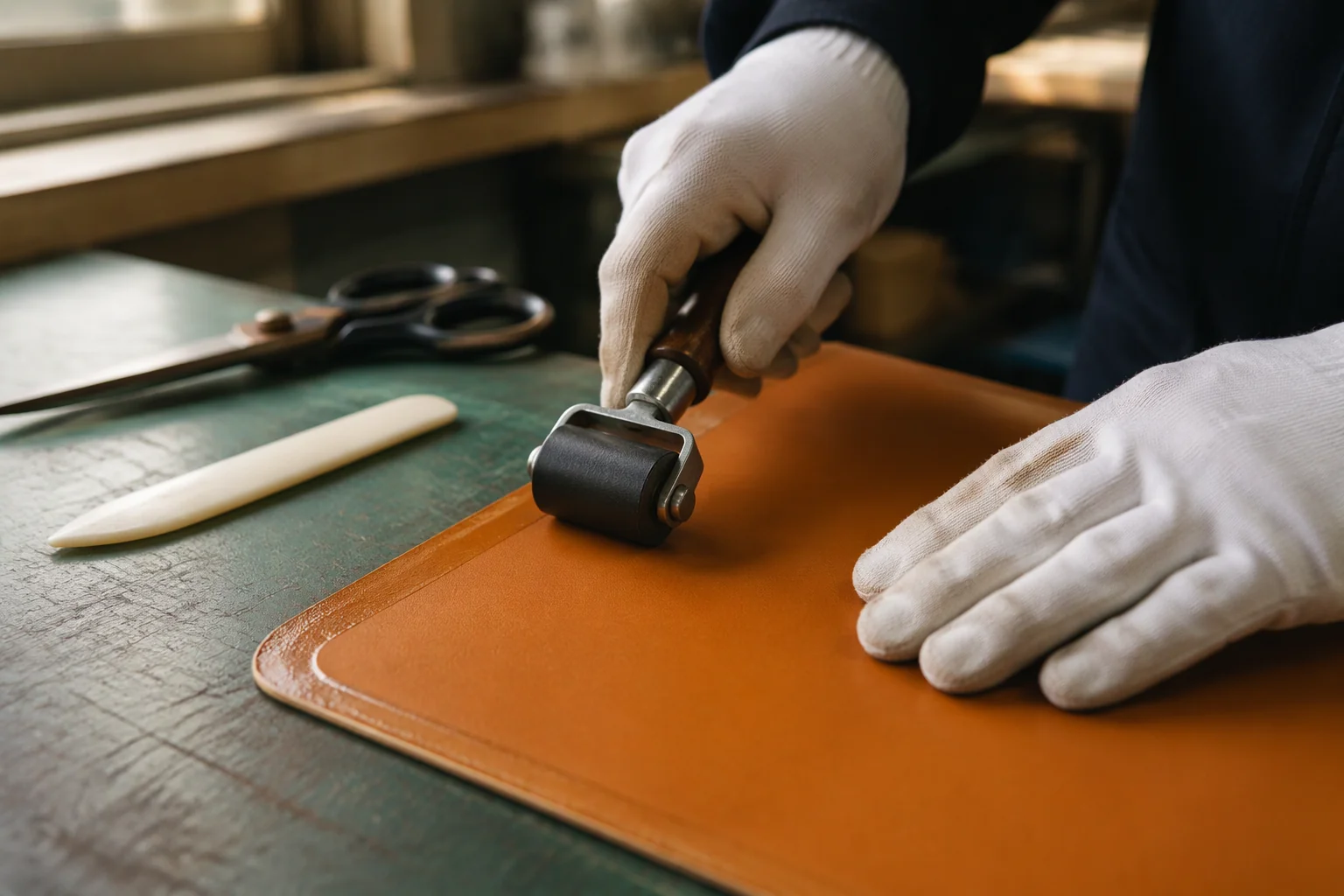
The working container, the roller, a clean rag, a lidded waste container and the panels being bonded, all within arm’s reach. A station that requires walking produces over-application, because the operator coats generously to avoid a second trip.
The Lid Rule
The container is closed between operations. Not loosely covered, closed. This single habit is responsible for a measurable share of the reduction most workshops achieve, and it costs nothing to adopt.
How the Design Decides Consumption
Seam Allowance and Edge Treatment
Wide seam allowances invite adhesive, because there is room for a bead. Tighter allowances and a defined edge treatment push the process toward a thin film, which is why consumption is partly a pattern decision.
Panel Count and the Number of Bonds
A bag built from four panels has fewer joints than one built from nine. Some of that difference is a design choice about shape and some is a choice about cost, and the adhesive line is where the second becomes visible.
Hardware Patches
Reinforcement patches behind hardware are typically glued and then stitched. Where the patch is a fusible interlining applied by heat, the adhesive step disappears, which is why reinforcement is often the first place a factory finds a saving.
Cleaning Without More Solvent
Keep It Wet, Not Flooded
A tool that is cleaned promptly needs a fraction of the solvent of one left to dry. The routine matters more than the product: wipe, rinse, close, and never leave a loaded brush on the bench overnight.
Dedicated Tools
Tools used for one chemistry stay with that chemistry. Shared brushes mean shared cleaning, and shared cleaning is where solvent consumption quietly doubles.
A nozzle that is capped and purged at the end of a shift does not block, which matters because a blocked nozzle is cleared with more solvent than the shift ever used.
Adhesive Profiles by Bag Type
| Bag type | Typical bond load | Where consumption usually hides |
|---|---|---|
| Diaper bag | High, from contents and structure | Base reinforcement and lining panels |
| Tote or handbag | Moderate, concentrated at handles | Handle anchors and folded top edges |
| Backpack | High and cyclic, at straps and base | Strap anchors, base panel, foam backing |
| Wallet or small goods | Low load, high visibility | Folded edges and card-slot layers |
Why the Profile Matters
The same reduction measures do not apply equally. A wallet programme is won on edge work. A backpack programme is won at the strap anchors, where a failed bond is a safety problem rather than a cosmetic one.
What Not to Do
Do not standardise a single adhesive across every bag type for purchasing convenience. The saving in administration is paid for on the line, in rework and in over-application.
Working With the Buyer on Adhesive Changes
What the Buyer Actually Cares About
Buyers care that the bag holds together and that claims are defensible. They rarely care which adhesive is used, provided the factory can show that the substitute was tested on the real substrates.
Sampling Discipline
Any change of adhesive on a production style should pass through a sample that the buyer approves, even when the change is invisible. Invisible changes are the ones that surface as complaints months later.
When the Buyer Specifies a Brand
Sometimes the adhesive is specified by the customer. In that case the factory’s leverage is quantity and method, not chemistry, and the reduction programme should focus on metering, container discipline and cleaning.
What Good Looks Like
The measure of a bonding operation is not how strong the glue is. It is whether the same thin film, applied the same way, holds the same bond on a Monday morning and a Friday afternoon.
The Signs to Look For
- Containers closed on every bench, without being asked
- A metered dispenser in use, with a stated quantity per shift
- No adhesive on the seam allowances that will be visible
- Rags in a lidded container, not on the bench
- A record of grams per bag, updated and understood
- Failure causes written down, not remembered
The Sign That Something Is Wrong
If consumption rises without volume rising, the cause is almost always one of three things: a new operator without training, a change of leather or lining, or a container left open. All three are findable within a day.
Frequently Asked Questions
What is the quickest way to cut adhesive consumption?
Close the containers and meter the application. Both cost almost nothing and typically produce a visible fall within a month, before any change of chemistry.
Is water-based adhesive always better?
It carries far less solvent, but it demands drying capacity the line may not have. In humid weather or on fast assemblies it can increase over-application and failures.
How much adhesive should a bag use?
There is no universal figure. Establish your own baseline in grams per bag, then target the thinnest continuous film that wets both surfaces and passes the bond test.
Can we simply use less adhesive to save money?
Only up to the point where the bond still holds under load. Adhesive that fails after three months costs more than any saving, so the film weight must be tested, not guessed.
Does a stronger adhesive reduce consumption?
Rarely. Over-specified adhesive usually costs more per gram, needs more solvent and sets more slowly, which encourages over-application rather than less.
Why do bonds fail at the edges first?
A film applied too thin starves the edge, where stress concentrates. A film applied too thick fails in the middle instead, because the core never fully sets.
What should we ask our adhesive supplier for?
The technical and safety data sheets, the solids content, the recommended film weight in grams per square metre, and a trial quantity sized to one work order.
Do we need extraction equipment to reduce solvent exposure?
Extraction protects the people in the room and should capture at the source, but it does not reduce consumption. Control application first, then size the extraction for what remains.
How do we handle adhesive rags?
In a lidded metal container with a named owner and a defined route out of the building. Rags are the most commonly overlooked waste stream in a bag workshop.
Will changing adhesive require buyer approval?
Yes, on a production style, even when the change is invisible. A substitute should pass a sample on the real substrates and be recorded before it runs on the line.
How long does a reduction programme take?
Roughly ninety days for a full cycle: two weeks to measure, a month to control application, then a trial period for any change of chemistry.
Conclusion
Adhesive and solvent are small materials with a large multiplier. The way to reduce them is not a purchase but a sequence: measure grams per bag, meter the application, keep the containers closed, train the thin-film target, and only then consider a change of chemistry.
Most of the saving sits in the first three steps and most of the risk sits in the last. A workshop that controls application, then converts one bond at a time, keeps its failure rate flat while consumption falls. One that converts everything at once loses confidence at the first bad batch and returns to the old tin.
The number to watch is not the strength of the bond in a test report. It is the grams per bag on the wall, and whether they are the same on a humid Monday as on a dry Friday. That figure is the whole programme in one line.
