
What Should a Brand Include in a Leather Bag Sourcing Brief?
What Should a Brand Include in a Leather Bag Sourcing Brief?
A sourcing brief is the document that decides whether two factories are quoting the same bag. When it is thin, every reply is priced against a different product: one quotes a bag with a bonded lining, another quotes a full leather interior, a third assumes hardware the brand never wanted. The quotes look comparable and are not.
We receive briefs of every quality, from a single photograph with “how much for this?” to a fifty-page pack that answers questions we had not thought to ask. The difference is not effort. It is knowing which five or six decisions actually move the price, and stating them plainly enough that a factory cannot fill the gaps with its own assumptions.
This is a buyer-side document, and it is worth separating from two neighbours. Specifying a leather’s physical properties is a materials question, covered elsewhere on this site. Deciding who pays for the first sample is a commercial question, also covered elsewhere. What follows is the brief itself: what belongs in it, in what order, and what to leave out.
- What a Sourcing Brief Is For
- The Decisions That Actually Move the Price
- The Bag Itself
- Materials: Leather
- Materials: Lining, Interlining and Thread
- Hardware and Trim
- Colour and Finish Approval Path
- Quantities and Size Breakdown
- Target Price: Useful or Harmful
- Packaging and Labelling
- Testing and Compliance Requirements
- Delivery, Incoterms and Logistics
- Payment Terms and Currency
- Sample and Development Expectations
- Quality Standard and Inspection Rights
- What to Leave Out of a Brief
- Format: One Page or a Pack
- Photographs and References
- Language and Terminology
- The RFQ Email
- Questions to Expect From the Factory
- Comparing the Replies
- Updating a Brief Mid-Process
- Reusing a Brief Across Factories
- Timelines Inside the Brief
- Sustainability Requirements
- Briefing a Factory You Have Not Used
- What the Factory Reads First
- A Briefing Kit for a Small Team
- Common Failures
- A Brief Checklist
- When You Have No Technical Team
- Working With an Agent or Trading Company
- A Brief for a Repeat Order
- Frequently Asked Questions
- Conclusion
What a Sourcing Brief Is For
One Document, One Product
A brief describes a single bag in enough detail that a competent factory can build it without asking what was meant. Where a range is involved, one brief per style is clearer than one document covering six.
It Protects Both Sides
For the brand, a brief fixes what is being bought. For the factory, it fixes what is being promised. Most disputes about “that is not what we agreed” trace back to a brief that allowed two readings.
What It Cannot Do
A brief cannot make a bad design good, and it cannot substitute for a sample. It narrows the range of interpretations; the sample closes it.
The Decisions That Actually Move the Price
Most of a bag’s cost is decided by a handful of choices, and a brief that states them gets comparable quotes. The table below is the list we use when a brief is too vague to price.
| Element | Why it changes the price | What to state in the brief |
|---|---|---|
| Leather grade and thickness | Sets material cost and machine time | Grade, thickness in mm or oz, temper |
| Panel count and construction | Drives cutting, sewing and turning time | Number of panels, lining method |
| Lining and interlining | Cheap to specify, expensive to change | Material, weight, fusing or loose |
| Hardware | The widest spread in any bag | Type, finish, material, brand or generic |
| Dimensions and capacity | Changes material consumption | Height, width, depth, strap drop |
| Order quantity and size split | Determines tooling amortisation | Units per colour and per size |
| Packaging | Often five per cent and rarely discussed | Dust bag, carton, inserts, labels |
| Testing and compliance | Can add cost and weeks | Which tests, which market |
| Delivery terms | Moves freight and risk | Incoterm, destination, date |
| Payment terms | Priced into every quote | Deposit, balance, currency |
Reading the Table
The first four rows account for most of the variance between quotes. If a brief states only those, replies are already comparable. The remaining rows prevent surprises after the price is agreed, which is a different kind of saving.
The Order Matters
State the product before the commercial terms. A factory reading a brief that opens with a target price reads everything afterwards as a negotiation rather than a specification.
The Bag Itself
Construction
Say whether the bag is turned or built right side out, whether seams are bound or lapped, whether edges are painted, folded or raw. These are not details; they are the operations that set the time.
Dimensions and Tolerances
Give height, width, depth, strap drop and capacity, and state the tolerance. “About thirty centimetres” produces a bag that measures twenty-eight and a complaint that arrives in month three.
The Interior
Pockets, dividers, key leash, laptop sleeve, wipeable base: each is a separate operation and a separate cost. A brief that describes only the outside is a brief that will be re-quoted.
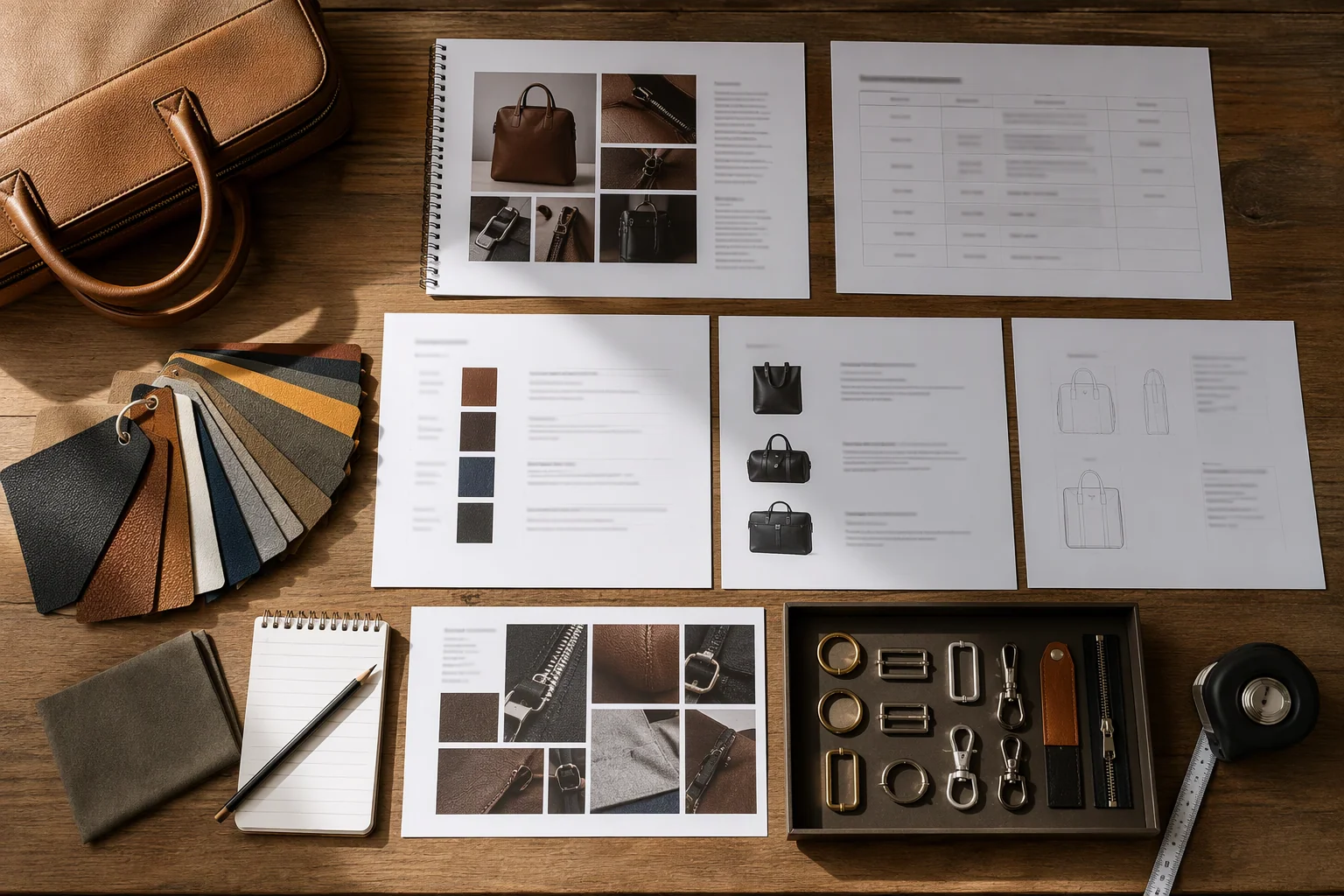
Materials: Leather
Grade and Thickness
State the grade, the thickness with a tolerance, and the temper in words a tannery would use: firm, medium, soft. A brief that says “good quality leather” is a brief that invites the cheapest interpretation.
Finish and Colour
Describe the finish and give a reference, whether a Pantone number, a physical swatch or a previous production. Colour described in words alone is the single most reliable source of rework.
Where It Comes From
If origin, traceability or a specific tannery matters, say so in the brief rather than after the quote. These requirements change both price and lead time.
Materials: Lining, Interlining and Thread
Lining
State the fibre, the weight and the colour, and whether the lining is sewn or fused to the shell. The lining is where a cheap quote usually hides.
Interlining and Reinforcement
Base boards, stiffeners and reinforcement tape determine whether the bag stands up after six months. Specify where they go, not only that they exist.
Thread
Thread size, fibre and colour matter at the seams a customer touches. A brief that names the thread prevents the substitution that shows up as a broken strap.
Hardware and Trim
Type and Finish
Zipper type, slider brand, ring diameter, magnetic closure strength, feet: each is a line item. State whether branded hardware is required or an equivalent is acceptable.
Metal and Plating
The finish and the plating decide how the hardware ages. Where a specific plating is needed, say so; where it is not, say that an equivalent is acceptable, and define equivalent.
Zippers and Pulls
Zipper tape colour, tooth size and pull shape are visible on the finished bag. Photographs of the approved hardware, at the correct scale, remove most of the ambiguity.
Colour and Finish Approval Path
Who Approves What
State who signs off colour, and against what: a physical swatch, a lab dip or a production sample. Ambiguity here produces a bag that is approved by one person and rejected by another.
Light Sources
Colour approved under one light and checked under another will disagree. Name the light source for approval, and accept that retail lighting will differ.
Records
Keep the approved reference with a date and a name. When a later batch is questioned, the record is the only thing that settles it.
Quantities and Size Breakdown
Total and Split
Give the total, then the split by colour and size. A factory prices a split, not a total, because a split determines how many setups the order requires.
Minimums
State the minimum the brand can accept per colour, and ask for the factory’s minimum per article. Where the two conflict, it is better to know before the quote than after.
Repeat Potential
Telling a factory that a style may repeat is legitimate and affects pricing. Inflating the forecast to win a price is a short-term gain that factories remember.
Target Price: Useful or Harmful
When It Helps
A target price with a stated basis helps a factory propose a construction that reaches it. It is a design constraint rather than a demand.
When It Distorts
A target with no basis invites a quote built to hit the number, using cheaper materials that the brief did not forbid. The bag arrives at the price and fails the purpose.
The Honest Version
The most useful formulation is a range with the trade-offs named: at this price we accept a synthetic lining; above it we expect leather.

Packaging and Labelling
The Packaging Set
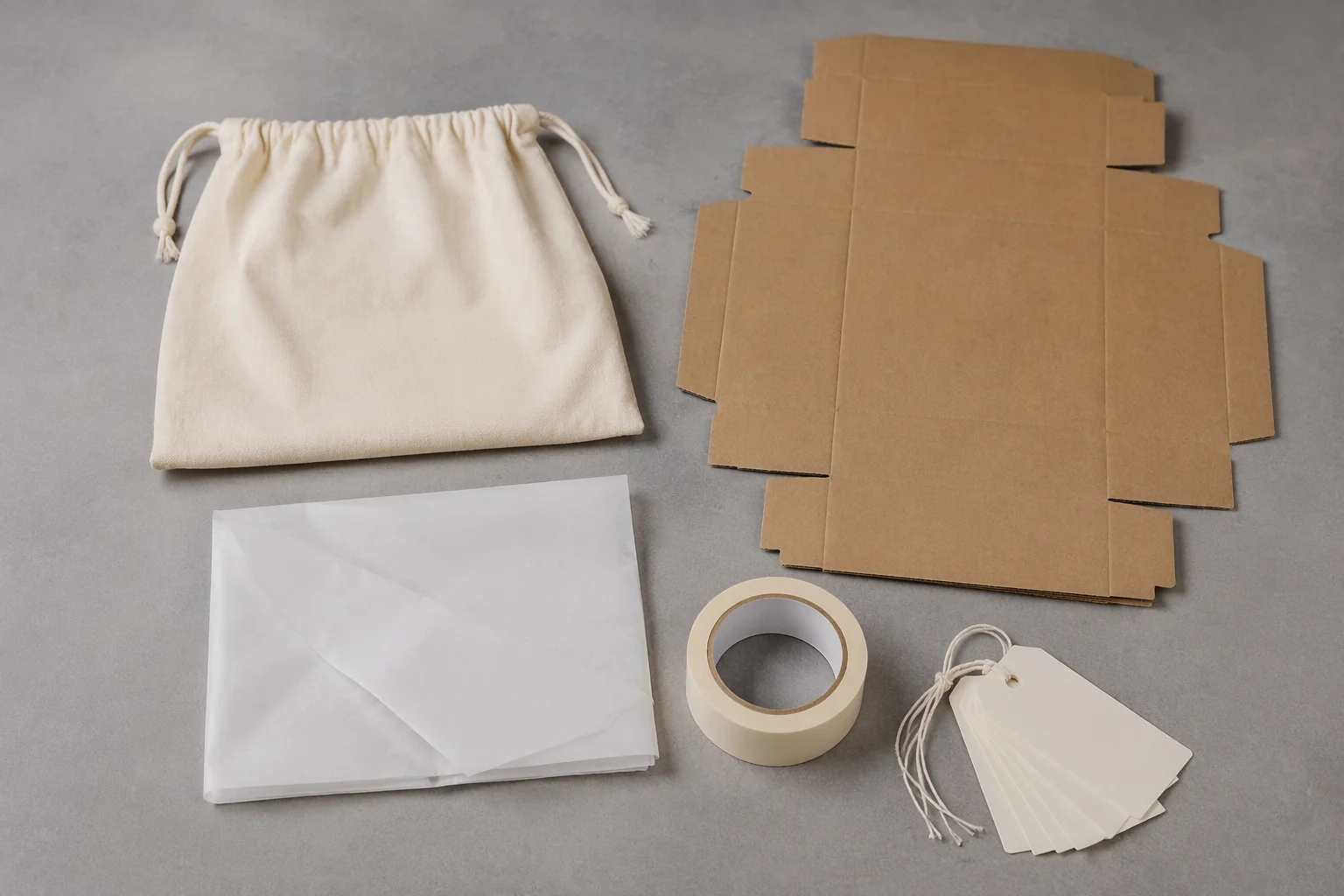
Dust bag, tissue, inserts, carton, tape, labels and any retail fixture. Each item is a purchase and a handling step, and packaging is the most frequently omitted section of a brief.
Labelling and Legal Text
Care labels, fibre content, country of origin and any market-specific text belong in the brief, not in a later email. Getting this wrong can stop a shipment at the border.
Carton Marks
State what must appear on the carton and where. Carton marks are cheap to specify and expensive to correct after packing.
Testing and Compliance Requirements
Which Tests
Name the tests required, the market they are required for, and who arranges them. Physical, colourfastness, hardware and restricted-substance requirements all have different owners and lead times.
Who Pays
Testing is either quoted as an extra or absorbed into the price. Saying which avoids the invoice that arrives after the order is confirmed.
Timing
Tests consume calendar time and often sample material. A brief that mentions testing at the end of the process is a brief that delays the shipment.
Delivery, Incoterms and Logistics
The Incoterm
State the term, the named place and who arranges insurance. A quote without a term is not a price, because it does not say where the goods stop being the factory’s responsibility.
Dates
Give a required delivery date and the date by which the order must be confirmed. Factories plan backwards from confirmation, not from the delivery date.
Partial Shipments
Say whether partial shipments are acceptable. Where they are not, say so early; where they are, define how the balance is handled.
Payment Terms and Currency
Structure
Deposit, balance and any retention, with the trigger for each payment. Terms are priced, so an unusual structure shows up in the quote.
Currency and Rate Risk
Name the currency and who carries the exchange risk between quote and payment. On a long lead time this is a real cost that is invisible until it is disputed.
Instruments
Where a letter of credit or another instrument is required, say so in the brief. The requirement changes both price and the factory’s willingness to quote.
Sample and Development Expectations
How Many Rounds
State how many sample rounds the brief anticipates, and what qualifies as a revision rather than a redesign. A brief that implies unlimited rounds is priced accordingly, or ignored.
What the First Sample Should Prove
The first sample exists to test construction, proportion and hand feel, not to be the production standard. Saying what it is meant to prove keeps the feedback focused.
Who Keeps What
State whether the factory keeps the pattern, whether the brand receives a copy, and whether the sample is returned. Ownership of the pattern is worth a sentence in the brief.
Quality Standard and Inspection Rights
The Acceptable Standard
Define the standard by reference to the approved sample and written limits, not to adjectives. Where the brand has an inspection protocol, attach it rather than summarising it.
Who Inspects and When
State whether the brand inspects, whether a third party does, and at which stages. Inspection rights that appear after the order is placed feel like distrust; the same rights stated in the brief feel like process.
What Happens on Failure
Say what occurs if the inspection fails: rework, sort, discount or rejection. Pre-agreeing the remedy is the cheapest insurance in the document.
What to Leave Out of a Brief
Competitor Prices
Naming a rival’s price invites a quote designed to undercut it by cutting what the brief did not lock. If a target is needed, give a range and its basis instead.
Unenforceable Language
“Best quality”, “top grade”, “export standard” cannot be verified and therefore cannot be enforced. Every adjective should either be defined or replaced with a measurable statement.
Internal Notes
Costing comments, margin calculations and remarks about other factories have a way of reaching the factory. A brief should contain nothing the brand would not show the supplier.
Format: One Page or a Pack
The One-Page Version
For simple styles, one page with dimensions, materials, hardware, quantity, packaging and delivery is enough. The risk is omission rather than length.
The Full Pack
For complex or high-value styles, a pack with drawings, photographs, a bill of materials and the testing plan is worth the effort. The risk is that nobody reads it.
The Rule That Works
A one-page summary at the front, with supporting documents behind it. Factories quote from the summary and check the detail; a pack without a summary is quoted from its cover.
Photographs and References
Scale and Lighting
Photographs need a scale reference and even lighting. A close-up of a hardware finish taken under yellow light will be reproduced in the wrong colour with confidence.
The Reference Bag
Where a physical reference exists, send it or photograph it from six angles with the details that matter. A reference bag answers more questions than two pages of adjectives.
Marking the Differences
When the reference is close but not identical, mark what changes. An unmarked reference is a bag the factory will copy, including the parts the brand wanted changed.
Language and Terminology
Plain Words Beat Jargon
Where a term is ambiguous between languages, define it once in the brief. “Turned edge” means different things in different workshops, and the difference is visible on the bag.
Units
State units explicitly: millimetres or inches, grams or ounces, centimetres of strap drop. Mixed units produce a bag that is correct in one dimension only.
A Glossary
For a long relationship, a one-page glossary of the factory’s terms pays for itself in the first order. It also makes translation errors visible earlier.
The RFQ Email
What It Should Contain
A short message, the brief attached, the required reply date and the questions the brand wants answered. The message should not repeat the brief.
What It Should Ask
Ask for unit price at the stated quantity, the price at half and double quantity, the lead time, the minimum per colour and the sample cost. Those five answers make replies comparable.
What It Should Not Do
Do not send the same brief to fifteen factories and expect serious quotes. Factories price attention, and a mass mailing reads as one.
Questions to Expect From the Factory
The Ones That Reveal a Good Brief
Questions about tolerance, lining method, hardware brand and testing mean the factory read the document. Questions asking what the bag should be made of mean it did not.
The Ones That Reveal a Gap
If three factories ask the same question, the brief is missing something. Treat repeated questions as a defect report on the document rather than on the suppliers.
The Ones to Answer in Writing
Any answer that changes a specification belongs in the brief, with a version number. Answers given verbally are answers that will be disputed.
Comparing the Replies
Normalise First
Before comparing totals, check that every reply addresses the same brief, in the same units, at the same quantity, on the same delivery term. Most “cheapest” quotes are simply quoting less.
The Comparison Table
| What to compare | Why it decides the outcome |
|---|---|
| Unit price at the stated quantity | The headline, and the least informative number |
| Price at half and double quantity | Shows how much of the price is fixed cost |
| Lead time and confirmation date | Determines whether the date is achievable |
| Minimum per colour | Decides whether the colour range is possible |
| Material assumptions | Reveals what was silently substituted |
| Testing and packaging scope | The two most commonly excluded costs |
| Payment terms and currency | A hidden percentage in every quote |
| Sample cost and rounds | The entry price of the relationship |
The Second Question
The most useful follow-up is not “can you do better?” but “what would you change to reach this price?” The answer reveals the trade-offs the factory considers normal.
Updating a Brief Mid-Process
Version Everything
Every revision carries a number and a date, and the factory acknowledges the version it is working to. A brief that changes silently produces two products and one argument.
Say What Changed
A revision note listing the changes, rather than a new document alone, keeps the factory’s attention on the difference. Factories re-read what changed and skim what did not.
Re-Quote When It Matters
Where a change affects material, construction or quantity, ask for a revised price rather than assuming the old one holds. Assumed prices are the ones disputed at invoice.
Reusing a Brief Across Factories
What Travels
Construction, materials, dimensions and standards travel unchanged. Commercial terms and delivery may not, because they depend on the supplier’s location and capacity.
What to Strip
Remove the previous factory’s name, its quoted prices and any comment about its performance. A brief that carries a rival’s numbers is a brief that will be used against the brand.
Confidentiality
Where the design is proprietary, say so and state what may not be shared. A short confidentiality clause in the brief is normal and rarely refused.
Timelines Inside the Brief
The Development Calendar
A brief should carry the calendar it depends on: brief issued, quotes due, factory selected, sample rounds, approval, materials ordered, production start, inspection and shipment. Without it, every date is negotiated twice.
Critical Dates
Two dates decide most of the outcome: when materials must be ordered and when the order must be confirmed. Both sit weeks before the delivery date and are the ones brands forget to ask about.
Buffer, Named Honestly
State where the buffer sits rather than burying it across the plan. A factory that sees the buffer will use it; a factory that sees a plan with no buffer will quote one.
Sustainability Requirements
What to Ask
A brief can ask for information: the origin of the leather, the composition of components, the factory’s energy and water data, and whether a repair service exists. Asking is legitimate and it produces answers that can be checked.
What Not to Promise
Do not put a claim in a brief that the supply chain cannot evidence. A requirement written as a claim rather than as a question becomes a statement the brand must defend, and the defence is usually someone else’s paperwork.
Evidence and Its Owner
For every requirement, state who provides the evidence and by when. Requirements without an owner are aspirations, and aspirations do not survive the first price negotiation.
Briefing a Factory You Have Not Used
What Extra to Include
Add the reference order history, the reason for leaving the previous supplier if appropriate, and a clear statement of what the first order is meant to prove. New relationships are priced on perceived risk.
References and Access
Offer a visit or a video walk-through of the previous production if one exists. A factory that can see the standard quotes it more accurately than one that reads about it.
The Trial Order
Where the relationship is new, a brief for a small first order with identical specifications is the cheapest way to test capability. Testing on a large order is the expensive way.
What the Factory Reads First
The First Page
A factory reads the summary, the quantity and the delivery date, then decides whether the enquiry is worth a careful quote. A brief whose first page is a brand story is quoted from whatever page the reader reaches next.
The Numbers
Dimensions, quantities and dates are read more closely than prose. Where they are inconsistent with the drawings, the inconsistency is read as a sign that the brief is not finished.
The Silence
What the brief does not mention is read as permission. A missing hardware specification becomes the cheapest available hardware, and a missing test requirement becomes no test.
A Briefing Kit for a Small Team
The Template
One template, used every time, with the same sections in the same order. Consistency is worth more than sophistication, because it makes omissions visible to the person writing.
A Two-Hour Habit
Two hours to complete a brief before it is sent, with the reference bag on the table. The habit is what prevents the photograph-and-question-mark brief that costs three rounds of quoting.
Reviewing Together
One other person reads the brief before it leaves, checking only for the six decisions that move price. The review takes ten minutes and catches most of what a factory would otherwise fill in.
Keeping the Kit Alive
Additions to the template come from real questions, not from imagination. When a factory asks something the template does not answer, the template gains a line that week, and the kit improves with every order it survives.
Common Failures
The Photograph and a Question Mark
The most common brief is an image with a price request. It produces quotes that differ by a factor of three, and a conclusion that factories are unpredictable.
The Brief Written After the Quote
Writing the brief to justify a quote already received reverses the process and removes the only benefit: comparability.
The Brief Nobody Updated
A brief that was accurate for the first order and unchanged for the fourth describes a bag nobody is making. Versioning is not bureaucracy; it is the difference between a document and a rumour.
A brief is not a request for a price. It is the definition of the product the price refers to.
A Brief Checklist
- Style name, version number and date
- Six photographs plus a scale reference
- Dimensions with tolerances, and capacity
- Construction: turned or built out, seam and edge treatment
- Leather: grade, thickness with tolerance, temper, finish, colour reference
- Lining, interlining and reinforcement with positions
- Thread size, fibre and colour
- Hardware: type, finish, metal, branded or equivalent
- Colour approval path and light source
- Quantity, split by colour and size, and minimums
- Target price with its basis, if any
- Packaging set, labels, care text and carton marks
- Tests required, market, owner and timing
- Incoterm, named place, required date and confirmation date
- Payment structure, currency and instrument
- Sample rounds, sample cost and pattern ownership
- Quality standard, inspection stages and remedy on failure
- Who answers questions, and by when
When You Have No Technical Team
Borrow the Vocabulary
A brand without a technician can still write a precise brief by describing the reference bag in the factory’s terms. Ask the factory to name the construction and the materials of the reference, then confirm them in writing.
Use the Sample as the Specification
Where the vocabulary is missing, a physical reference plus a list of the changes is a legitimate brief. It is weaker than a written specification and stronger than adjectives.
Hire the Hour
A freelance technician for two hours, reviewing a brief before it is sent, is the cheapest quality improvement available to a small brand.
Working With an Agent or Trading Company
What Changes
An agent will translate the brief into the terms its factories use, and may simplify it. Ask to see what was sent, so the brand knows what was actually quoted.
What to Keep Visible
Material, construction and quantity should reach the factory unchanged. Where the agent rewrites them, the resulting price may refer to a different product.
Who Owns the Relationship
Decide early whether the brand speaks to the factory directly. Both models work; the ambiguity between them does not.
A Brief for a Repeat Order
What to Reference
Reference the previous order number, the approved sample and any deviation accepted on the last run. Repeat orders fail on the details everyone assumed were remembered.
What to Re-Confirm
Materials availability, hardware continuity and packaging artwork. A component discontinued between orders is the most common reason a repeat arrives late.
What to Improve
Carry forward one or two improvements from the last run, in writing. A repeat order that changes nothing repeats its defects as well as its virtues.
Frequently Asked Questions
How long should a sourcing brief be?
One page for a simple style, with supporting drawings and photographs behind it. The summary at the front is what the factory quotes from; the detail is what prevents disputes later.
Do I need technical drawings?
A physical reference bag photographed from six angles with the changes marked is often enough for a first quote. Drawings become necessary when the brand wants the construction to be unambiguous.
Should I include a target price?
Only with a stated basis and named trade-offs. A bare target invites a quote built to hit the number by substituting what the brief did not lock.
How many factories should receive the brief?
Three is usually enough to establish a market price. Fifteen produces shallow quotes and a reputation for shopping rather than sourcing.
What is most often missing from briefs?
Packaging, testing and the interior. All three add cost and time, and all three are routinely discovered after the price is agreed.
How do I describe leather quality without a technical team?
By grade, thickness with a tolerance, temper in the tannery’s words, finish and a colour reference. Ask the factory to name the materials of your reference bag, then confirm it in writing.
What tolerance should I state on dimensions?
A tolerance the factory can hold in production, not one that looks impressive. Stating plus or minus two millimetres on a soft leather bag is a promise nobody can keep.
How do I compare quotes that look different?
Normalise quantity, units, delivery term and scope before comparing totals. Then compare the price at half and double quantity, which shows how much of each quote is fixed cost.
Can I change the brief after the quote?
Yes, with a version number and a revised price where material, construction or quantity changed. Silent changes produce two products and one argument.
Who owns the pattern?
Whoever the brief says. State it explicitly, because the default in many workshops is that the pattern belongs to the factory that made it.
What if the factory asks a question the brief already answers?
It usually means the section was buried. Move the answer to the one-page summary, and treat repeated questions as a defect in the document.
Conclusion
A sourcing brief does three things: it defines the product, it makes quotes comparable, and it records what was agreed. Everything else is detail, and the detail belongs behind a one-page summary that a factory can price from.
The six decisions that matter most are the leather, the construction, the lining, the hardware, the quantity split and the packaging. State those precisely and the quotes converge. State the commercial terms before the product and the quotes diverge, because the factory will read the document as a negotiation rather than a specification.
The measure of a good brief is simple. If three factories return quotes within a narrow band, and each of them can explain what it assumed, the document worked. If the quotes differ by a factor of three, the brief described three different bags.
