
How Should Inline Inspection Be Run on a Leather Bag Line?
How Should Inline Inspection Be Run on a Leather Bag Line?
A defect caught at the end of the line costs a bag. The same defect caught at the operation that created it costs a seam. That difference, multiplied across a production run, is the whole argument for inline inspection, and it is the reason factories that inspect only at the end spend their afternoons reworking rather than shipping.
Inline inspection is not a person walking past the tables with a clipboard. Done properly it is a set of checks attached to specific operations, with written criteria, a defined frequency, a place to record what was found, and an authority to stop work that is going wrong. It is a control system that happens to involve people.
This guide covers how to build that system on a leather bag line: which operations need a check, how a first-piece check differs from a patrol, what a checkpoint between operations should look like, who should do the checking, how to record defects by operation, and how to respond when the checks find something. It does not cover incoming material inspection or the final inspection before shipment, both of which are separate stages with their own logic.
- What Inline Inspection Is For
- Mapping the Operations That Need a Check
- The First-Piece Check
- Patrol Inspection Through the Shift
- Checkpoints Between Operations
- Who Does the Checking
- What an Inline Check Should Look Like
- Recording Defects by Operation
- Responding to What the Checks Find
- Inline Inspection and Rework Control
- Common Failures
- Measuring Whether Inline Inspection Works
- Setting Up Inline Inspection for a New Order
- Writing It Into the Order
- Training and Consistency
- Inline Inspection in Small Factories
- Inspecting What You Cannot See
- Inline Inspection Across Several Lines
- Working With the Brand’s Own Inspector
- The Cost of Doing It Badly
- A One-Week Trial
- Common Objections
- Keeping the System Alive
- Frequently Asked Questions
- Conclusion
What Inline Inspection Is For
The Cost of Finding a Fault Late
A stitching fault found at the machine is a two-minute repair. Found after the bag is turned, it is a bag opened and re-stitched, with the risk of a mark that did not exist before. Found at final inspection, it is a bag in a carton that has to be unpacked, and a delivery that moves by a day.
What Inline Cannot Do
Inline inspection cannot fix a specification that was never clear, and it cannot compensate for a sample that was approved without criteria. Where the criteria do not exist, inspectors invent them, and the line produces to one interpretation while the brand expects another.
Why Final Inspection Is Not Enough
Final inspection samples a population and estimates its quality. It is efficient for release decisions and useless for correction, because by the time it runs, the population has already been made. Inline inspection works the other way: it accepts a higher intervention cost per check in exchange for preventing the population from being wrong.

Mapping the Operations That Need a Check
Cutting and Panel Selection
Cutting decides which parts of the hide become which panels, and a misjudged panel goes into a bag that cannot be repaired without replacing it. The inline check here is visual and quick: grain, scars, stretch direction and shade against the approved sample.
Skiving and Edge Preparation
Skiving sets the thickness at the seam, and a skive that is too thin tears while one that is too thick produces a lump under the stitch. The check is a measurement rather than an opinion, which makes it the easiest check on the line to standardise.
Assembly, Stitching and Turning
This is where most defects originate and where most inspection effort belongs. Stitch density, seam allowance, alignment of panels, thread tension and the state of the bag after turning are the five things that decide whether the product looks like the sample.
Hardware and Final Assembly
Hardware is where force is applied and where failures are most visible to a customer. The check covers seating, orientation, backing and the absence of scratches on plated parts, which appear in handling long before they appear in use.
| Operation | What is checked | Who checks | Frequency |
|---|---|---|---|
| Cutting | Grain, scars, shade, stretch direction | Cutter plus inspector | First piece, then patrol |
| Skiving | Thickness at the seam, edge squareness | Operator | First piece and hourly |
| Stitching | Density, allowance, alignment, tension | Operator plus patrol | First piece and twice per shift |
| Turning | Creases, marks, seam distortion | Operator | Every bag |
| Hardware | Seating, orientation, plating damage | Operator plus patrol | First piece and hourly |
| Packing | Pairing, shade match, cleanliness | Packer | Every carton |
Reading the Table
The frequency column is where most factories improvise. A first-piece check without a patrol catches the setup and misses the drift, and a patrol without a first-piece check catches the drift after an hour of production has already gone through.
The First-Piece Check
What It Is
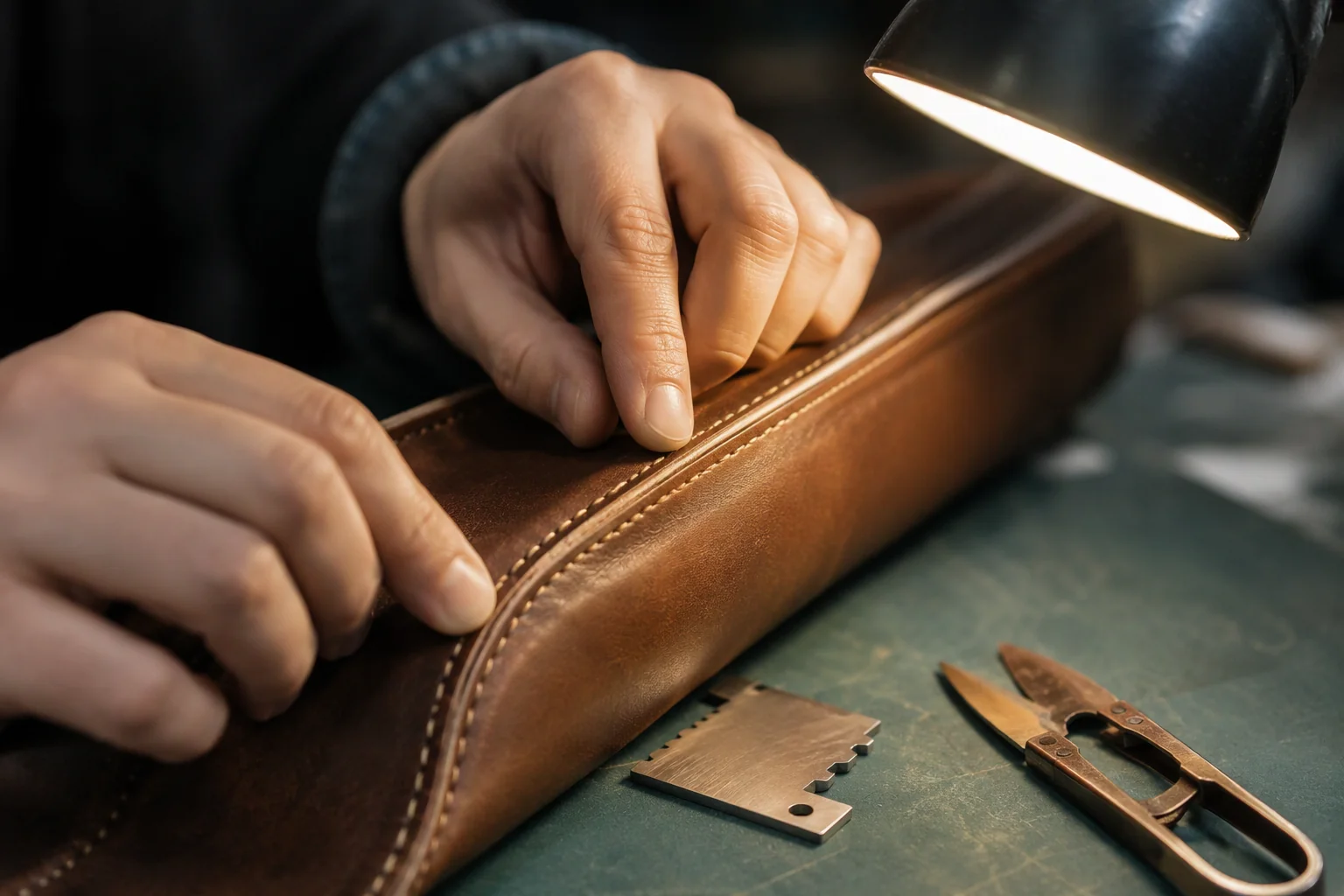
The first piece is the first complete unit produced after a setup: a new style, a new operator, a new lot of leather, a machine adjustment or a shift change. It is inspected in full, against the approved sample, before the line continues.
Doing It Properly
A first-piece check is done by the operator and confirmed by the supervisor, and it is recorded with the piece, the time and the person. The piece is kept until the next setup rather than sent down the line, so that a later disagreement can be settled by looking at it.
What It Catches That Nothing Else Does
It catches the setup errors that would otherwise repeat all shift: a machine threaded with the wrong thread, a pattern reversed, a skive setting carried over from another style. These are the defects that produce a hundred identical failures, and they are cheapest to find on the first one.
Patrol Inspection Through the Shift
Frequency and Sample Size
A patrol every two hours, checking five pieces at each of the critical operations, finds most drift without slowing production. Higher frequency suits new styles and new operators; lower frequency suits a mature style running on a stable line.
What the Patrol Looks For
The patrol looks for change rather than for perfection: a seam that has become tighter than it was at first piece, a shade that has moved as a new hide was loaded, a hardware finish that has started to show handling marks. Comparing against the first piece is the technique that makes this possible.
Recording Without Stopping the Line
The record is a mark on a sheet or a tap on a tablet, not a report. A patrol that requires writing a paragraph per piece will be abandoned within a week, and the abandonment will not be announced.
Checkpoints Between Operations
The Checkpoint That Pays
A checkpoint belongs after any operation whose defects become expensive downstream. Turning, hardware setting and lining attachment are the three that repay a checkpoint most reliably, because each one hides its own errors from the operations that follow.
Buffer or Block
A checkpoint can sit in a buffer, where work accumulates and is checked in batches, or it can block, where nothing proceeds until it is checked. Buffers smooth the line and delay detection; blocking costs time and catches faults sooner. Most lines need blocking at two or three points and buffers elsewhere.
Colour and Component Matching
Where a style uses several panels from different hides, the checkpoint is also where shade is matched across the bag rather than within a panel. This is the check that customers notice first and that final inspection is worst at judging, because a bag alone on a table has nothing to be compared with.
Who Does the Checking
Operator Self-Check
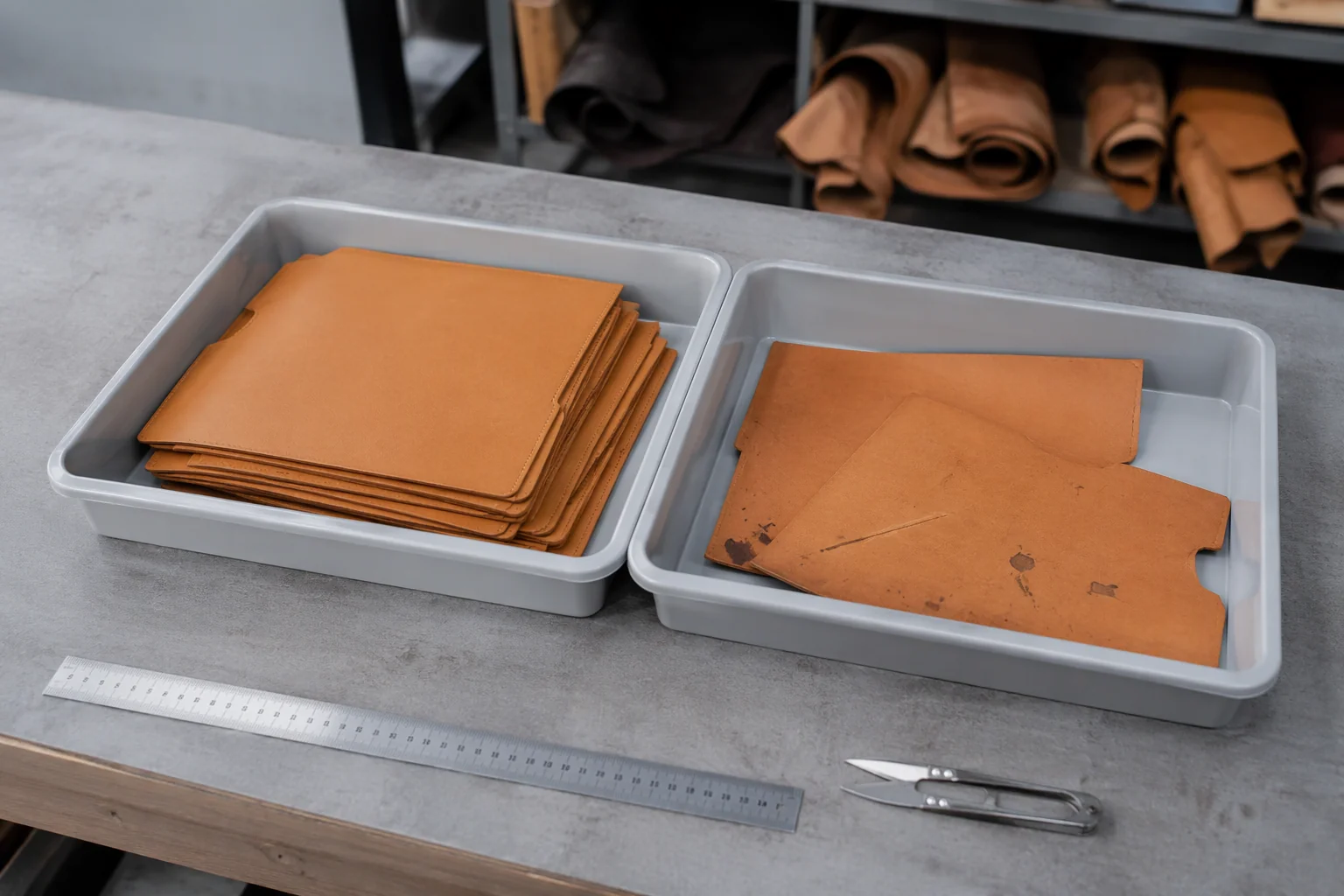
The operator is the cheapest and fastest inspector available, and the only one who can catch a fault at the moment it is created. Self-check works where the criteria are physical and simple, and fails where they require judgement the operator has not been trained to make.
Dedicated Inspectors
A dedicated inspector sees patterns across operators that no individual can see, and is the only role that can compare one station against another. The risk is that a dedicated inspector becomes the quality department, and the operators stop looking because someone else is looking.
The Supervisor’s Hour
The most effective arrangement in small factories is a supervisor who spends one hour per shift on inspection, early in the shift. The hour protects the first-piece discipline, catches the setup errors that appear in the first hours, and gives the supervisor a reason to be on the line that is not scheduling.
What an Inline Check Should Look Like
Written Criteria
Every check needs a criterion that can be applied by two people and produce the same answer. “Stitch density matches the approved sample within one stitch per inch” is a criterion. “Stitching looks good” is a preference, and preferences produce arguments.
Physical Aids
A seam gauge, a shade card, a reference piece and a limit sample do more for consistency than a page of description. Where a limit sample exists, the inspector’s job becomes comparison rather than interpretation, which is faster and harder to dispute.
The Three-Second Rule
If a check takes longer than three seconds per piece, it will be skipped under pressure. The discipline is to design checks that fit the rhythm of the operation, and to move anything slower to a checkpoint where the work is already stationary.
Recording Defects by Operation
The Minimum Data
Four fields make a record useful: the operation, the defect type, the count, and the time. Anything beyond that is optional, and most of it is never read. The operation field is the one that turns a defect list into a production problem.
Paper Versus Screen
Paper survives a workshop, needs no charging and cannot be mis-tapped by a gloved hand. A screen aggregates faster and produces charts without transcription. Factories that have tried both usually end up with paper at the machine and a screen at the supervisor’s desk.
Making the Data Usable
Data that is collected and never discussed changes nothing. A five-minute review at the end of each shift, looking at the three operations with the highest count, is enough to convert the record into a next-day action.
Responding to What the Checks Find
Immediate Containment
The first response is to stop the affected operation adding more suspect work, not to diagnose the cause. Containment is a physical action: mark the pieces already made since the last good check, and hold them.
Sorting Suspect Work
Suspect pieces are sorted against the criterion, not against the clock. Where the sort cannot be completed before the next operation needs the work, the standard answer is to hold the batch and run a different style, rather than to release suspect goods into a process that will hide them.
Correcting the Operation
Correction happens at the operation: re-thread the machine, reset the skive, change the operator’s technique, replace the batch of thread. Correcting at the end of the line is repair, and repair is what inline inspection exists to reduce.
Inline Inspection and Rework Control
Where Rework Hides
Rework is usually done quietly by the operator who made the fault, in the gaps between pieces, and it never appears in any record. A line that reports zero rework is usually a line that does not record it.
Rework Must Be Reinspected
A reworked seam has been stitched twice through the same holes and may be weaker than the original. Rework therefore returns to the checkpoint rather than to the flow, and is checked against the same criterion as new work.
Counting Rework as a Defect
Counting rework as a defect, at the operation where the fault originated, is the single change that makes inline data honest. Without it, the record shows what inspectors caught and hides what the line quietly fixed.
Common Failures
The Inspector Who Cannot Stop the Line
An inspector without authority to stop work is a recorder. The authority has to be explicit, has to survive a bad week, and has to be exercised at least once in a while for anyone to believe it exists.
The Check That Happens After the Fact
Inspecting a bag after it has been turned, lined and fitted is not inline inspection, whatever the job title says. The check belongs where the defect is created, and any arrangement that moves it downstream is a convenience dressed as a control.
Criteria That Live in Someone’s Head
Where the criterion exists only in the supervisor’s experience, it leaves when the supervisor does. Written criteria with a reference piece are the only version that survives a change of staff, which is exactly when they are needed.
Measuring Whether Inline Inspection Works
Detection Rate
Detection rate is the share of defects found at the operation where they were made, rather than downstream. A line that finds most defects at the last checkpoint is not inspecting inline, whatever its paperwork says.
Escapes
Escapes are the defects that reach the customer, counted per thousand units. They are the only measure a brand cares about, and they lag behind the internal measures by one shipment, which is why the internal measures need watching.
Cost per Defect Found
Dividing inspection hours by defects found gives a number that shows where the effort is wasted. A checkpoint that finds almost nothing over several orders is either unnecessary or not looking, and both answers are useful.
| Metric | Definition | What it reveals |
|---|---|---|
| Detection rate | Defects caught at origin divided by total defects | Whether checks sit at the right operations |
| Escape rate | Customer-reported defects per thousand units | Whether the whole system holds |
| Rework share | Reworked pieces divided by pieces made | How much the line is quietly repairing |
| Checkpoint yield | Defects found at a checkpoint per hundred pieces | Whether the checkpoint earns its place |
| Cost per defect | Inspection hours divided by defects found | Where effort is being wasted |
Using the Metrics Together
No single metric survives gaming. Rework share rises when detection improves, because operators start reporting what they used to hide. Escape rate is the honest measure and the slowest, which is why a line should be judged on all five across a quarter rather than on one across a week.
Setting Up Inline Inspection for a New Order
The setup sequence below works on a line that has never run the style before. It takes about a day and pays for itself in the first week of production.
- Walk the operation breakdown and mark where defects become expensive.
- Write a criterion for each marked operation, with a physical reference.
- Choose the frequency from the style’s novelty and the line’s history.
- Name the person responsible and give them the authority to stop.
- Build the recording sheet with four fields only.
- Run the first piece on ten units and check every one.
- Hold a five-minute review at the end of the first shift.
- Adjust frequencies once the first week’s data is in.
Why the Sequence Matters
Starting with the criteria prevents the tool from becoming a form. Starting with authority prevents the inspection from becoming theatre. Starting with ten first pieces prevents the most common failure, which is discovering at final inspection that the setup was wrong from the first bag.
Writing It Into the Order
What the Brand Should Specify
A brand can require inline inspection without dictating how a factory runs its line. What belongs in the order is the outcome: first-piece approval before the run, patrol checks at named operations, a record available on request, and notification when a defect trend appears.
What the Factory Should Report
A short weekly note with the three operations showing the highest defect counts, the rework share, and any change of material or operator that affected quality is enough for a brand to follow the line without micromanaging it.
The Walk-Through
A brand visiting the line should be able to ask any operator what they check and why, and receive an answer in one sentence. Where the answer is a shrug, the inspection exists on paper only, and the paperwork is the evidence against the factory rather than for it.
Training and Consistency
Building a Reference Set
A reference set of five pieces — one perfect, four with named and acceptable variations — teaches a new inspector faster than any document. The set should be kept physically, in the same place, and replaced when it wears.
Calibration Between Inspectors
Two inspectors who disagree on the same piece will produce data that cannot be compared. A monthly session where both inspect ten pieces independently and discuss differences costs an hour and prevents months of misleading numbers.
Turnover
Inspection roles turn over, and every replacement starts with the reference set rather than with a verbal briefing. A factory that keeps its reference set current can absorb turnover; one that relies on memory loses the standard with the person.
Inline Inspection in Small Factories
One Person, Many Roles
In a factory of thirty people, the person doing inline inspection is also scheduling, sourcing and answering the phone. The system must therefore be short enough to survive a busy Tuesday, which means three checkpoints rather than ten.
The Simplest Workable Version
Three checks cover most of the risk: first piece on every setup, a patrol every two hours at stitching and hardware, and a checkpoint after turning. Everything else is optional until the data says otherwise.
When to Add a Second Inspector
Add a second inspector when the first is missing checks because of other duties, when a new style is running in parallel, or when escapes rise despite the checks being recorded. The signal is missed checks, not volume.
Inspecting What You Cannot See
Hidden Construction
Some of the most consequential faults are sealed inside the bag: an interlining that was not fused, a backing that was not inserted, a reinforcing tape that was skipped. None of them is visible at final inspection, and all of them show up as shape loss or strap failure within months.
The Squeeze Test
A physical check at the checkpoint, pressing the base and the strap attachments by hand, catches a missing reinforcement before the bag is closed. It takes two seconds and is the only opportunity the line will ever have to find that fault.
Records for Later
Where such a check is done, recording it matters more than recording a visual check, because the fault it prevents appears after the goods have been accepted. A record that the base was pressed and passed is what allows a later claim to be answered with evidence rather than opinion.
Inline Inspection Across Several Lines
Shared Criteria
A factory running three lines must use one criterion per operation, not three. Where each line writes its own, defects become incomparable and the data cannot be pooled, which removes most of its value.
Comparing Lines
With shared criteria, line-level defect rates become meaningful, and the comparison usually reveals that one supervisor is catching far more than another. That is a training finding rather than a discipline finding, and it is the fastest route to raising the whole plant.
Who Owns the Data
The data belongs to production rather than to a quality department, because production is the only function that can act on it. Where quality owns the record, production reads it as an audit and responds defensively.
Working With the Brand’s Own Inspector
Access and Boundaries
A brand inspector needs access to the line, the record and the approved sample, and needs to know what they may not do: instruct operators directly, change settings, or hold goods without telling the factory’s supervisor. Written boundaries prevent the friction that makes factories resist visits.
Duplicate Checks
Where the brand inspects and the factory inspects, the two must use the same criterion. Otherwise the brand’s findings look like new defects, the factory disputes them, and the argument consumes the visit.
Reporting
A short joint report at the end of a visit, listing what was found, what was agreed and who does what by when, is worth more than a long report sent a week later. The visit’s value is in the agreement, not in the document.
The Cost of Doing It Badly
Escapes
An escape is a defect that reaches a customer, and its cost is not the bag. It is the return, the replacement, the freight, the review and the doubt it creates about the next order. A single escape usually costs more than a month of inspection time at the operation that caused it.
Chargebacks
Brands increasingly deduct the cost of sorting and returns from the invoice. A factory that has no inline record cannot contest the deduction, because it has no evidence that the goods were in specification when they left.
An inline record is not paperwork for the buyer. It is the only defence a factory has when a claim arrives six weeks after shipment.
Reputation
Factories lose customers slowly and then suddenly. The slowly part is a rising escape rate that the customer tolerates; the suddenly part is the order that is moved elsewhere after a bad season. Inline inspection is the instrument that keeps the first part visible.
A One-Week Trial
Where a factory is unsure whether the effort is worth it, a one-week trial answers the question with its own data. It costs almost nothing and produces a number that can be shown to a customer.
- Pick the two operations with the most visible rework.
- Write one criterion for each, with a reference piece.
- Check the first piece on every setup and record it.
- Patrol both operations twice per shift for one week.
- Count rework at those operations, including the quiet repairs.
- Compare escapes and rework with the previous month.
- Keep the checks that produced findings and drop the rest.
Common Objections
It Slows the Line
A first-piece check costs fifteen minutes at setup and prevents a shift of rework. A patrol costs the inspector’s time and not the operators’. Measured over an order, inline inspection is usually faster than the rework it replaces, and the comparison is rarely made because rework is not counted.
The Operators Resent Being Checked
Operators resent being blamed for faults caused by setup, material or specification. Where inspection findings are treated as information rather than accusation, resistance falls sharply, and the reporting improves rather than degrades.
We Already Inspect at the End
Final inspection answers a different question: whether to ship. It cannot answer whether the line is in control, because it looks at the output rather than at the process. A factory that ships at a ninety-eight per cent pass rate while reworking ten per cent of output is not in control; it is absorbing cost.
Keeping the System Alive
Reviewing the Checks
Checks accumulate and never retire. Once a quarter, each checkpoint should justify itself with the defects it found, and the ones that found nothing should be reduced in frequency or moved. A system that only grows eventually collapses under its own paperwork.
Handing Over
Every check needs a named owner who is not the person currently doing it, so that holidays and departures do not suspend quality control. A written one-page standard, a reference set and a named deputy is the minimum that survives a fortnight of absence.
Frequently Asked Questions
What is the difference between inline inspection and final inspection?
Inline inspection checks work at the operation that creates a defect, so the fault can be corrected before more units are made. Final inspection samples finished goods to decide whether to ship. Both are needed, and neither replaces the other.
How often should a patrol inspection run?
Every two hours is a practical default for a stable line. New styles, new operators and new leather lots justify hourly checks until the process settles. The frequency should follow the risk, not the calendar.
Who should do the checking?
Operators check their own work where the criteria are simple and physical. A dedicated inspector or supervisor confirms the first piece and patrols the critical operations. The mistake is to make inspection a separate department that owns quality on behalf of everyone else.
What is a first-piece check?
The first complete unit made after a setup, inspected in full against the approved sample before the line continues. It catches the setup errors that would otherwise repeat all shift.
How many checkpoints does a bag line need?
Most leather bag lines need two or three: after turning, after hardware setting and often after lining attachment. Each should sit where a defect becomes expensive at the next operation.
Should rework be counted as a defect?
Yes, at the operation where the fault originated. Otherwise the record shows what inspectors caught and hides what the line quietly fixed, and the improvement effort goes to the wrong place.
Can inline inspection be done without extra staff?
In smaller factories it usually is, with the supervisor carrying the patrol and the operators checking their own work. The constraint is time rather than headcount, which is why the checks must be short.
What records should a factory keep?
Operation, defect type, count and time are enough to be useful. Adding more fields rarely adds insight, and usually reduces compliance. A weekly summary with the top three operations is what a brand can actually act on.
How is inline inspection different from a quality audit?
An audit examines whether a system exists and is followed. Inline inspection is the system running, day by day, on the line. An audit can confirm the checks are documented; only the data shows whether they are working.
What if the factory refuses to let anyone stop the line?
That refusal is itself information about how quality is ranked against output. It is worth raising before the order is placed rather than after the first escape, because the answer rarely improves under delivery pressure.
Does inline inspection guarantee a defect-free shipment?
No. It reduces the number of defects made and catches most of them early. Some faults appear only after assembly, and final inspection still has to sample for those. The two systems cover different failures.
Conclusion
Inline inspection is the cheapest quality investment on a bag line and the one most often reduced to a form. The reason is that its benefits are invisible: the defects it prevents never appear in any record, and the rework it avoids is never counted. A factory that measures only escapes will always be tempted to cut the checks that keep escapes low.
The workable version is modest. Write a criterion for each operation where a fault becomes expensive, check the first piece in full, patrol the critical stations twice a shift, keep a record with four fields, and give one person the authority to stop. That is a day of setup and an hour a week of review.
For a bag manufacturer, the commercial value is in the record. A factory that can show a brand which operations generated defects last month, what was changed, and whether the change held is answering a question most factories cannot answer at all. That answer wins orders more reliably than a lower quotation, because it tells the buyer what the next delivery will actually look like.
