
Leather Cutting and Yield: A Manufacturer’s Guide to How Hides Are Cut, Patterns Are Nested and Costs Are Controlled
Leather Cutting and Yield: A Manufacturer’s Guide to How Hides Are Cut, Patterns Are Nested and Costs Are Controlled
Ask a factory manager where a leather bag’s cost is really decided, and most will give the same answer: at the cutting table. Not at the tannery, not at the sewing line — at the moment when a pattern is laid on a hide and a knife follows its lines. Everything before that moment determined the leather’s price; everything after it determines how much of that price is used. The cut decides how many bags a hide produces, how consistent those bags are, and how much the customer ultimately pays.
Leather cutting is the least glamorous part of bag making and the most consequential. Fabric can be cut with mathematical efficiency — a roll of cloth is uniform, and every inch is usable. A hide is the opposite: an irregular, imperfect, natural object, where every square foot is different, some of it is unusable, and the placement of every pattern piece is a small decision with a real price. The skill of cutting is the skill of turning a beautiful but awkward natural material into clean, consistent, profitable products.
This guide is written from the factory floor, where cutting runs every day. It covers why cutting matters so much, how hides differ from fabric, what yield really means, the cutting methods and their trade-offs, the art of pattern nesting, the discipline of working around defects, the economics that connect cutting to price, and the questions buyers should ask about how their bags are cut.
- Why Cutting Is Where Bags Are Won or Lost
- The Nature of the Material: Hides Are Not Fabric
- Understanding Yield: The Core Metric
- The Cutting Methods: Hand, Knife, Die and CNC
- Pattern Nesting: The Art of Layout
- Working Around Defects and Grain Direction
- Cutting Economics: What Drives Cost
- How to Evaluate a Factory’s Cutting
- The Human Skill of the Cutter
- Cutting and Quality: From Cut to Craft
- Frequently Asked Questions
- Final Word from the Factory
Why Cutting Is Where Bags Are Won or Lost
The cutting table is the first quality gate and the first cost center in leather bag production. Every decision made there echoes through the rest of the factory — and through the customer’s price.
The cost weight of leather. In a quality leather bag, the leather is typically the largest single material cost — often half or more of the total material bill. The cut decides how much of that expensive material becomes product and how much becomes waste. A factory that cuts well gets more bags from the same hide; a factory that cuts poorly throws away money on the cutting-room floor. Over a production run, the difference between good and poor cutting is a real share of the product’s cost — and of the factory’s margin.
The quality weight of cutting. Cutting also decides quality. A panel cut cleanly, on the grain direction, away from defects, becomes a beautiful, durable bag. A panel cut carelessly — across the grain, through a flaw, from a weak area of the hide — becomes a bag that distorts, tears, or fails early. The cut is where the bag’s future strength is set: stitching can be corrected, edges can be finished, but a badly cut panel carries its flaw for the bag’s entire life.
The customer connection. For buyers, cutting quality shows in ways that are subtle but decisive: the consistent grain direction of panels, the absence of flaws in visible areas, the even color across a bag. And for OEM and wholesale buyers, cutting shows in the price — because yield is one of the biggest levers on unit cost. The customer who understands cutting understands the price they are quoted. The customer who does not pays for the factory’s cutting mistakes without knowing it.
The Nature of the Material: Hides Are Not Fabric
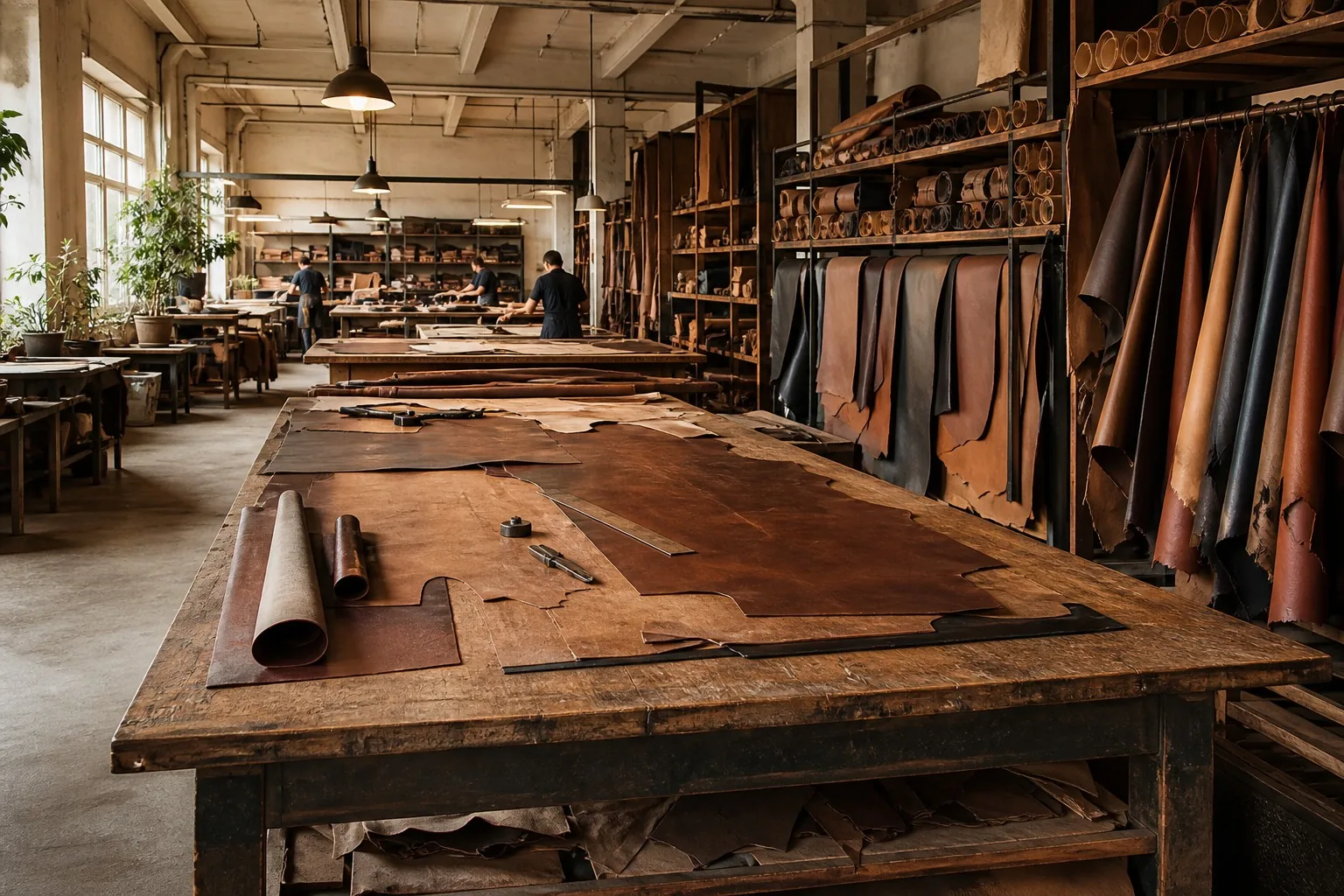
To understand cutting, you must first understand what a hide is — and what it is not. Every cutting rule follows from the material’s nature.
Hides are irregular. A cowhide is not a rectangle. It is a roughly shaped, organic object — wider at the rear, narrower at the front, with legs, a tail, and a neck. Its area varies from hide to hide, and its shape means that no layout can use every square foot. The irregularity is the first reason yield is never 100 percent — the hide’s shape alone wastes a share of its area.
Hides have zones of quality. The back and shoulder are the tightest, strongest, most even areas — the “best” leather. The belly and legs are looser, stretchier, and less consistent — the “worst.” A skilled cutter knows these zones and places high-visibility, high-stress panels (the bag’s front, back, and straps) on the strong zones, and hidden or low-stress panels (inside pockets, linings, gusset bottoms) on the weaker ones. The zone knowledge is the difference between a bag that holds its shape and one that sags.
Hides have defects. Scars, brands, insect marks, growth wrinkles, and tannery marks all live in the hide’s surface. None of them are hidden — they are visible to anyone who looks — and every one of them must be worked around: either excluded from the bag entirely or placed in areas where it will not be seen. Defect management is a constant part of cutting, and it is one of the reasons cutting cannot be rushed.
Hides have a grain direction. Leather has a nap — the fibers lie in a direction, and the material flexes and stretches differently with the grain than against it. Panels cut consistently with the grain behave consistently; panels cut across the grain stretch and distort. On a quality bag, every panel’s grain direction is marked and respected — the strap follows the grain so it does not stretch, the body panels are cut consistently so they hang evenly.
Understanding Yield: The Core Metric
Yield is the number that governs leather cutting economics, and it is the first number any serious buyer should understand.
What yield means. Yield is the share of a hide’s area that becomes usable product — expressed as a percentage, or in the more practical terms of “square feet of cut panels per hide” or “bags per hide.” A yield of 80 percent means one-fifth of the hide’s area is lost to shape, defects, and cutting waste. Yield is the direct measure of cutting efficiency, and it is the number that connects leather cost to product cost.
The yield reality. For leather bags, realistic yields run roughly 65 to 85 percent — a range that surprises buyers used to fabric, where yields above 90 percent are routine. The shortfall is not ineptitude; it is the material: irregular shape, natural defects, and the zones of quality that force placement decisions. A factory’s skill shows in how close to the top of that range it operates — and in how honestly it reports the number.
What drives yield. Five factors dominate: the pattern design (how efficiently panels nest together), the hide quality (fewer defects mean more usable area), the cutting method (die cutting wastes less than hand cutting on repeat panels), the cutter’s skill (defect avoidance without waste), and the panel sizes (many small panels use a hide more fully than a few large ones). Every factor is controllable to some degree, and good factories control all of them.
The cost math. The connection to price is arithmetic: if a hide costs $300 and yields 10 bags, the leather cost per bag is $30; if the yield drops to 8 bags, the cost rises to $37.50 — a 25 percent increase from cutting alone. This is why cutting is where the price is decided, and why a factory with strong yield can quote lower prices without cutting quality — or quote the same price with better margins.
The Cutting Methods: Hand, Knife, Die and CNC
Leather is cut by four main methods, and each has a place. The method shapes cost, consistency, and the character of the finished bag.
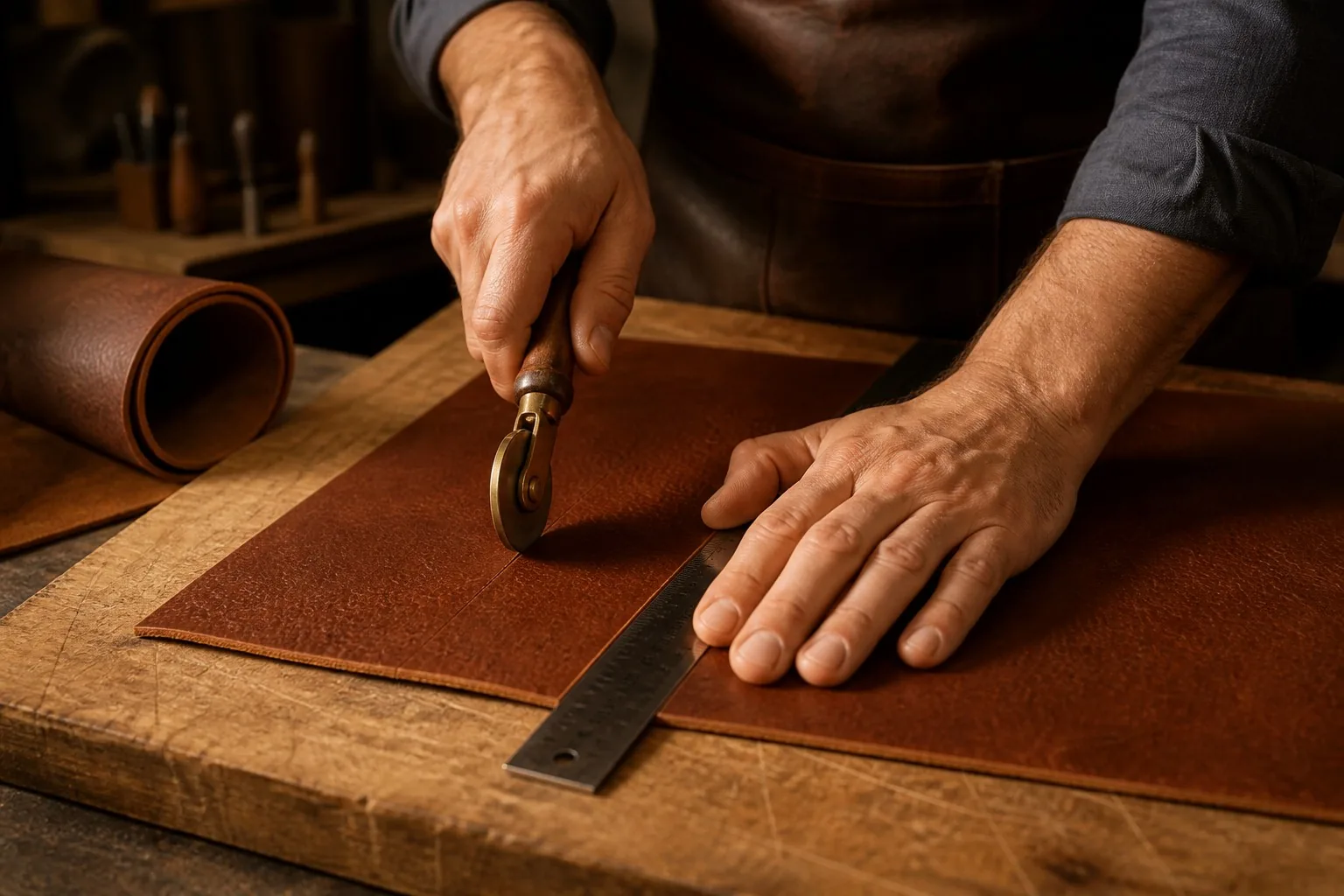
Hand cutting. The craftsman lays a pattern on the hide and cuts around it with a round-blade leather knife, following the pattern’s edge by eye and hand. Hand cutting offers maximum flexibility — the cutter can work around defects and grain zones with judgment no machine can match — but it is slow, skill-dependent, and less consistent than machine methods. It is the method of small workshops, bespoke work, and premium lines where the character of hand cutting is itself the selling point.
Die cutting (clicker press). A sharp steel die in the shape of the panel is pressed into the leather by a hydraulic clicker press, cutting the panel in one stroke. Die cutting is fast, consistent, and efficient on repeat panels — the same die cuts the same shape hundreds of times with identical results. It is the workhorse of production bag factories, and it requires the die investment and a flat, stable hide to work well.
CNC cutting. A computer-controlled cutting head follows a digital pattern, guided by a camera that maps the hide’s shape and defects. CNC cutting is the most modern method: it automates defect avoidance, nests patterns with software precision, and cuts with speed and consistency. It requires significant equipment investment, but for high-volume factories it is the most efficient method — and it is changing the economics of leather cutting.
Hybrid production. Most serious factories use a combination: die or CNC cutting for the repeat structural panels, hand cutting for the panels that need judgment — the pieces that must avoid a specific defect, or the premium visible panels where character matters. The hybrid approach balances the efficiency of machines with the flexibility of hands.
| Method | Speed | Consistency | Defect handling | Investment | Typical use |
|---|---|---|---|---|---|
| Hand cutting | Slow | Variable | Excellent | Minimal | Bespoke, premium, small runs |
| Die cutting | Fast | Excellent | Limited | Medium | Production, repeat panels |
| CNC cutting | Fast | Excellent | Excellent (camera) | High | High-volume, complex nesting |
| Hybrid | Mixed | Good | Good | Medium | Most quality factories |
Pattern Nesting: The Art of Layout
Before a single panel is cut, the patterns must be arranged on the hide — and that arrangement, called nesting, is where yield is won or lost.
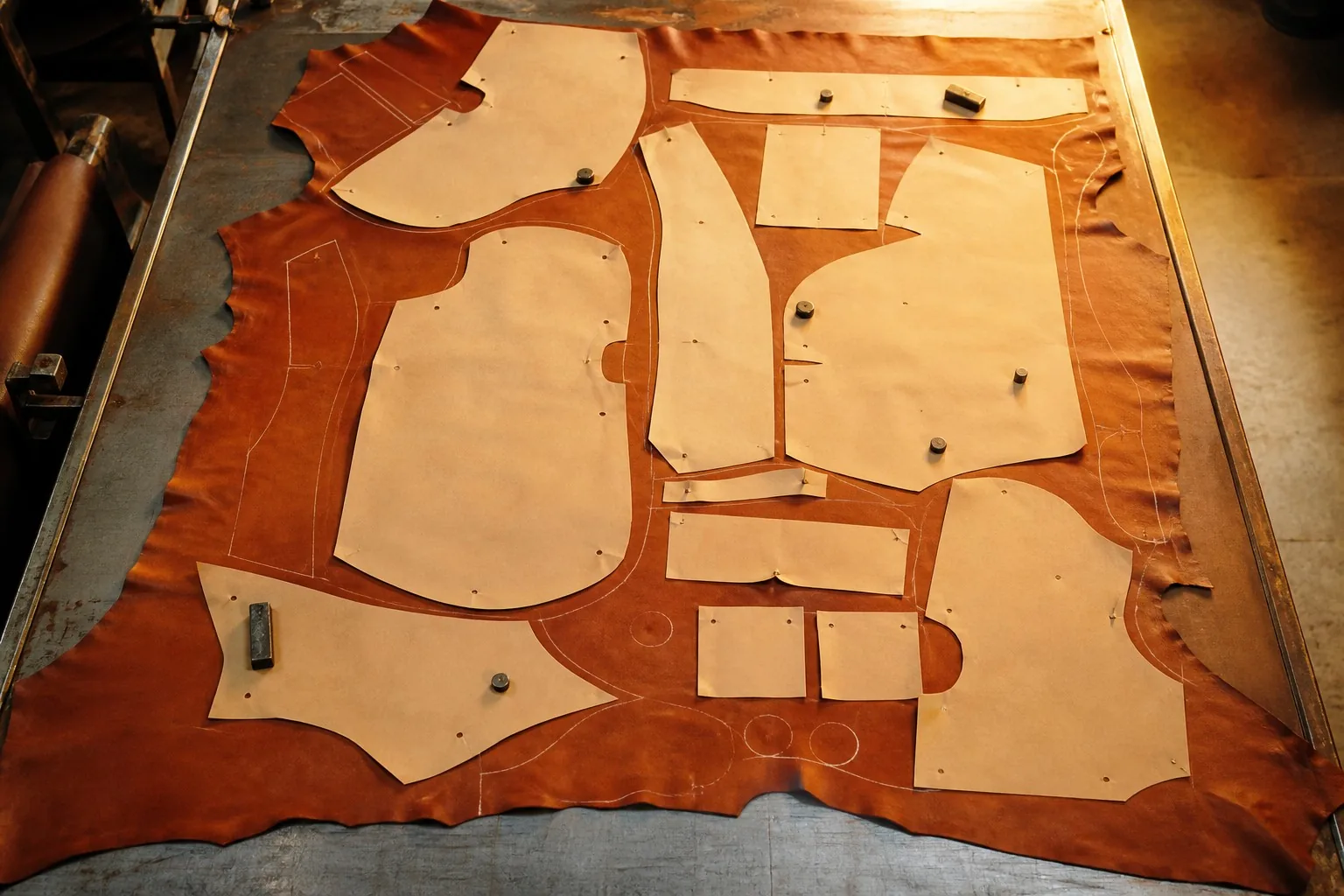
What nesting is. Nesting is the layout of pattern pieces on the hide: fitting the panels together like pieces of a puzzle, leaving as little unused area as possible, while respecting the hide’s shape, defects, and grain direction. A good nest is tight — pieces touch or nearly touch, sharing edges where the design allows. A poor nest wastes area, and wasted area is wasted money.
The constraints. Nesting is not free-form puzzle-solving; it is constrained by the material’s reality. Panels must respect the grain direction (they cannot be rotated arbitrarily). They must avoid the hide’s defects and weak zones. They must leave allowance for the cutting method — die cutting needs space between dies, hand cutting needs room for the knife to turn. The constraints make nesting a genuine skill: the best nest is not the densest, but the densest that still respects the material.
The nesting strategies. Skilled nesters use several techniques: sharing straight edges between adjacent panels; placing small panels (pockets, tabs, straps) in the irregular margins that large panels cannot fill; turning panels to align their grain consistently while maximizing fit; and saving the hide’s best zones for the highest-visibility panels. The strategies are learned over years, and they are the difference between a 70 percent yield and an 80 percent yield on the same hide.
Digital nesting. Modern factories use nesting software that computes layouts in seconds and optimizes for the hide’s actual shape and defects — the same math a skilled nester does by eye, but exhaustive and repeatable. Digital nesting is one of the main reasons CNC cutting improves yield: the software finds layouts a human would miss, and the camera maps defects the eye would overlook. The technology does not replace the craft; it amplifies it.
Working Around Defects and Grain Direction
The daily discipline of cutting is the management of the hide’s imperfections. It is invisible in the finished bag and entirely visible in the factory’s cost.
Defect avoidance. Every hide is inspected at the cutting table, and every visible defect is marked or mentally mapped. The rules are simple and strict: no defect in any visible panel, no defect in any structural panel (straps, handles, load-bearing seams), and defects only tolerated in hidden, low-stress areas — and even there, only small ones. The discipline costs time, but it is non-negotiable: a defect that slips into a visible panel is a bag that will be rejected, returned, or discounted.
Grain direction discipline. Every panel is cut with its grain direction marked on the pattern — the direction the fibers run, and the direction the panel will flex. Straps are cut with the grain so they do not stretch under load; body panels are cut with consistent grain so the bag hangs evenly; gussets are cut to flex along the direction of the bag’s movement. A factory that respects grain direction produces bags that keep their shape; a factory that ignores it produces bags that twist and sag. The discipline is invisible in the finished product and decisive in its behavior.
The zone strategy. The hide’s zones — back, shoulder, belly, legs — are allocated by importance: premium zones to visible panels and high-stress parts, weaker zones to hidden panels and low-stress parts. The strategy is the daily expression of the hide’s nature: the bag’s front deserves the hide’s best, and the inside pocket can accept the belly. Buyers who understand the zone strategy recognize it in the finished bag: consistent panels, even color, and no weak areas where they matter.
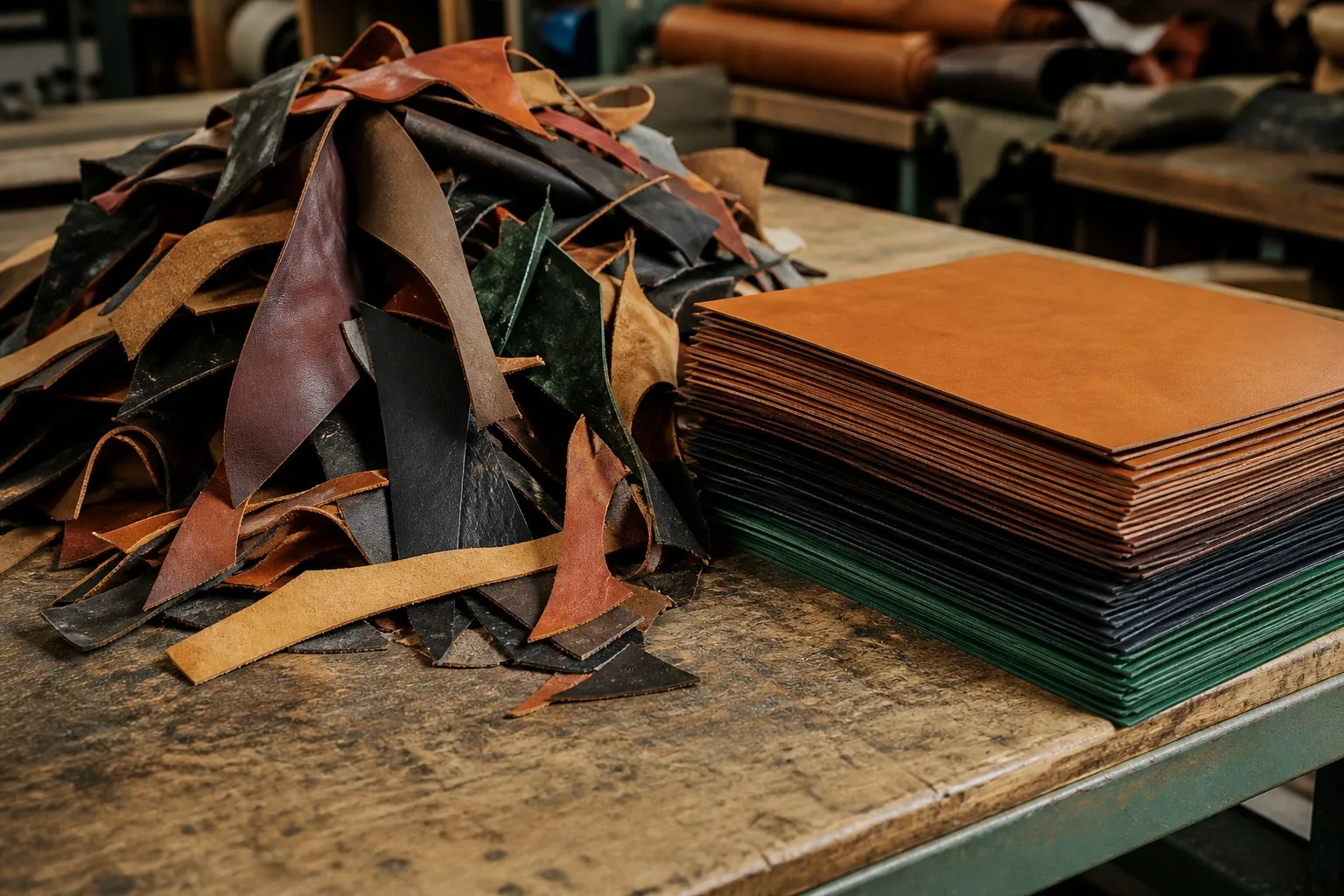
The waste question. Cutting always produces waste — offcuts, trimmings, and unusable pieces. Good factories manage it: offcuts are sorted, graded, and reused for small goods (wallets, key chains, samples), and only truly unusable pieces are discarded. The management of waste is both an economic discipline and an environmental one — and it is one more place where a serious factory shows its standard.
The hide’s zones at a glance. The zone strategy is the daily expression of the hide’s nature, and it is worth holding in a single view:
| Hide zone | Quality | Strength | Typical use in a bag |
|---|---|---|---|
| Back (butt) | Highest — tight, even grain | Highest | Front/back panels, flaps, visible surfaces |
| Shoulder | High — consistent | High | Side panels, gussets, pockets |
| Belly | Lower — loose, stretchy | Lower | Hidden panels, linings, internal pockets |
| Legs | Lowest — irregular | Lowest | Small hidden pieces, scrap-reuse goods |
The allocation is the craft in miniature: the hide’s best goes where the customer looks and the bag stresses, and its weakest goes where neither the eye nor the load will find it. When you see a bag with clean, consistent visible panels, you are seeing a cutter who allocated the zones well.
Cutting Economics: What Drives Cost
The price of a leather bag is built on the cutting table, and the economics are worth understanding in full — they explain prices that otherwise seem arbitrary.
The hide price and the yield. Leather cost per bag = hide price ÷ bags per hide. The two levers are the price paid for the hide and the number of bags cut from it. Hide prices are set by the market and the tannery; yield is set by the factory. A factory cannot control the hide’s price, but it can control the yield — and yield control is the factory’s main economic skill in the cutting room.
The cutting cost itself. Cutting is not free labor: the cutter’s time, the machine’s time, the dies, the maintenance, and the inspection all cost money. Hand cutting costs more per panel in labor; die and CNC cutting cost more in equipment. The total cutting cost is the sum of labor, equipment, and waste — and it is a real line item in every bag’s price.
The quality-cost balance. The temptation in cutting is to trade quality for yield — to relax the defect rules, ignore grain direction, or crowd the nest to save leather. Every factory faces the temptation daily, and the good ones refuse it, because a bag that fails in the field costs more than the leather it saved. The balance is the craft: maximize yield without compromising the panels that matter.
What buyers should know. The quoted price of a bag embeds the factory’s yield and cutting standard. A suspiciously low quote may mean a factory with brilliant yield — or a factory that cut corners on quality. A fair quote reflects realistic yield at the factory’s quality standard. The honest way to compare quotes is not price alone, but price relative to the cutting standard — which is why serious buyers visit factories and watch the cutting table.
How to Evaluate a Factory’s Cutting
For buyers — whether commissioning a first production run or evaluating a supplier — the cutting table is the most informative place in the factory. Here is what to look for.
Watch the cutting room first. A factory’s cutting department tells its quality story faster than any brochure. Look for organization: hides staged, patterns filed, tools maintained, and cutters working deliberately rather than hurriedly. A clean, disciplined cutting room predicts a clean, disciplined factory.
Ask about yield. Ask the factory its typical yield and how it manages defects, grain direction, and zones. A factory that answers specifically — with percentages, processes, and examples — knows its cutting. A factory that answers vaguely is either hiding its numbers or does not track them, and either answer is informative.
Check the defect rules. Ask what happens when a defect is found in a visible panel, and what standard is applied to straps and structural parts. The strictness of the rules is the factory’s quality commitment made concrete. A factory with written defect standards and inspection gates is a factory that will not ship flawed panels.
Look at the offcuts. The waste pile tells the truth. Offcuts that are large and numerous suggest poor nesting; offcuts that are small, sorted, and reused suggest efficient cutting. A factory that manages its waste manages its cost — and a factory that manages its cost honestly manages its customers’ prices honestly.
Ask about the methods. Which panels are die-cut, which are hand-cut, and why? The answer reveals the factory’s reasoning — the hybrid logic that matches methods to panels is the mark of an experienced maker. A factory that can explain its method choices understands the craft; one that cannot is cutting without thinking.
The Human Skill of the Cutter
The methods and the economics explain the system, but the system runs on people — and the cutter’s skill is the rarest resource in the cutting room.
What a skilled cutter knows. A great cutter does not just follow a pattern; they read the hide. They see the zones at a glance, spot defects the untrained eye misses, and feel the grain direction in the material’s resistance. They know which panels must be perfect and which can tolerate a compromise — and they make those judgments in seconds, hundreds of times a day, without hesitation. The knowledge is built over years, and it cannot be downloaded or automated away.
The judgment calls. Every hide forces small decisions: this panel overlaps a scar — shift it an inch and lose a pocket, or leave it and risk a flaw; this strap must follow the grain — but the grain is irregular here, so which direction is true? The skilled cutter makes these calls constantly, balancing yield, quality, and speed in a continuous stream of micro-decisions. The finished bag hides every one of them; the factory’s cost sheet reveals them all.
Training and retention. Cutting skill is learned slowly and retained carefully. Factories train cutters on scrap, apprentice them to masters, and pay for the skill, because a great cutter is worth more than the machine they use. The retention of cutting skill is one of the quiet measures of a factory’s stability — a factory that keeps its cutters keeps its quality, and a factory that churns them pays for the churn in its bags.
The respect factor. In the best factories, cutting is respected as the craft it is — the first act of making, where the material’s value is realized or wasted. The respect shows in the tools (sharp blades, maintained presses), in the environment (clean tables, good light), and in the pay. When you visit a factory, watch how the cutters are treated. It will tell you more than the brochure.
Cutting and Quality: From Cut to Craft
Cutting is the first act of making, and its quality flows into every later act — the seam that follows a clean edge, the shape that holds because the panel was cut on grain, the finish that covers a panel cut from the hide’s good zone.
The cut’s ripple effects. A panel cut cleanly and on-grain sews true, edges cleanly, and holds its shape — every later operation goes smoothly. A panel cut carelessly fights every later operation: it stretches at the seam, distorts at the edge, and fails at the stress point. The cut is the foundation of the craft, and foundations are only visible when they are missing.
The inspection connection. Cutting quality is checked at the cutting table itself — the first-piece inspection, the in-line checks, and the final panel review. The inspection gates we described for stitching apply to cutting first: the panel must be the right size, the right shape, the right grain direction, and free of defects before it ever reaches the sewing line. A factory that inspects at the cut protects every downstream operation.
The customer’s bag. For the buyer, all of this resolves into a few visible facts: the bag’s panels are consistent, its straps do not stretch, its shape holds, and its visible surfaces are clean. These are the marks of good cutting, and they are the marks of a bag that will last. The next time you hold a leather bag, look at it with the cutting table in mind — the straightness of the panels, the consistency of the pieces, the absence of flaws where they matter. You are looking at the factory’s first skill, and the foundation of everything that follows.
Frequently Asked Questions
What is leather yield and why does it matter?
Yield is the share of a hide’s area that becomes usable product, typically 65–85 percent for leather bags. It matters because it directly sets the leather cost per bag — a hide that yields 10 bags instead of 8 cuts the leather cost per bag by 25 percent. Yield is the core metric of cutting efficiency.
Why is leather cutting less efficient than fabric cutting?
Fabric is uniform and rectangular — every inch is usable and layouts are mathematical. Hides are irregular, have zones of quality, carry natural defects, and have a grain direction that must be respected. The material’s nature makes perfect yield impossible, and skilled cutting is about getting as close as the hide allows.
What is the best method for cutting leather bags?
There is no single best method — the right answer is a hybrid. Die cutting and CNC cutting give speed and consistency for repeat structural panels; hand cutting gives judgment for defect avoidance and premium visible panels. Most quality factories combine methods, matching each to the panel’s needs.
Why do some leather bags stretch out of shape?
The most common cause is ignoring grain direction at the cutting table. Leather flexes differently with the grain than against it — a panel cut across the grain stretches and distorts. Quality factories mark and respect grain direction on every panel, especially straps and body panels.
How can I tell if a bag was cut well?
Look for consistency: panels that are even and uniform, straps that do not stretch, a bag that holds its shape, and visible surfaces free of defects. These are the marks of good cutting. Inconsistent panels, sagging, and visible flaws in prominent areas all point to careless cutting.
Does a higher leather yield mean lower quality?
Not necessarily — yield and quality are different axes. A factory can achieve good yield through skilled nesting, defect management, and efficient methods while maintaining full quality standards. The danger is only when yield is pursued by cutting corners — ignoring defects or grain direction — which a serious factory never does.
What happens to leather offcuts?
Good factories sort and reuse offcuts — the pieces are graded and used for small goods like wallets, key chains, and samples, and only truly unusable pieces are discarded. Offcut management is both an economic discipline and an environmental one, and it is a visible sign of a factory’s standard.
What should I ask a factory about its cutting before placing an order?
Ask four things: its typical yield and how it is tracked; its defect rules for visible and structural panels; how it manages grain direction; and which panels are die-cut, hand-cut, or CNC-cut and why. Specific answers reveal a factory that understands its craft; vague answers reveal one that does not.
Final Word from the Factory
The cutting table is where leather bag making begins and where its economics are set — the place where a beautiful but awkward natural material meets the discipline of craft. Every hide is different, and every hide demands decisions: where to place the patterns, how to work around the defects, which direction the grain must run, how tightly the pieces can nest. The decisions are invisible in the finished bag and decisive in its cost and its quality.
At our factory, cutting is treated as the craft it is. Hides are inspected before they reach the table. Patterns are nested with care, zones are allocated by importance, grain direction is marked and respected, and defects are routed away from everything that matters. Methods are matched to panels — machines for the repeat work, hands for the judgment work — and waste is managed as the resource it can be. Every panel is inspected before it leaves the cutting room, because a bad cut cannot be fixed downstream, and a good cut makes everything downstream easier.
When you buy a leather bag — or commission a production run — remember the cutting table. Ask about yield, watch the cutting room, check the defect rules, and look at the offcuts. The answers will tell you how the bag was made and what its price really contains. Because in leather, the craft is decided before the sewing starts — and the cutting table is where the best bags are already won or lost.
