
Leather Bag Stitching and Seam Strength: A Manufacturer’s Guide to Thread, Stitches and the Seams That Hold
Leather Bag Stitching and Seam Strength: A Manufacturer’s Guide to Thread, Stitches and the Seams That Hold
Every leather bag has a moment of truth, and it rarely happens in the store. It happens months later, when the bag is full and heavy and the owner swings it onto a shoulder — and the seam that was holding everything together quietly gives way. The leather was fine. The hardware was fine. But a seam failed, and the bag is done.
The seam is the skeleton of a leather bag. The leather is the skin, the hardware is the joints, but the stitching is what holds the whole structure together — and it is the most common failure point in leather goods that fail. In our factory, we see the returns: seams that unraveled, thread that snapped, stitches that were beautiful to look at and useless at holding. And we know the same truth every repairer knows: a bag is only as good as its seams.
This guide is the stitching knowledge we use on the factory floor, written for buyers and makers alike. It covers why stitching matters, the two great stitching worlds — machine and hand — the materials that go into thread, the anatomy of a stitch, the seam constructions that join panels, the defects that ruin seams, and the checks that separate a bag that will hold for a decade from one that will fail in a season.
- Why Stitching Is the Bag’s Skeleton
- The Two Stitching Worlds: Machine vs. Hand Saddle Stitch
- Thread: The Material That Holds Everything
- Stitch Anatomy: SPI, Tension and Lock
- Seam Construction: The Joints of a Bag
- Stitching Defects and Their Causes
- How to Judge Stitching Quality When You Buy
- The Factory Perspective: Machines, Needles and Quality Gates
- Stitching and Edge Work: Two Crafts, One Standard
- How Load Requirements Differ by Bag Type
- Frequently Asked Questions
- Final Word from the Factory
Why Stitching Is the Bag’s Skeleton
It is easy to think of a leather bag as a piece of material — a sheet of hide shaped into a container. But every bag is actually dozens of pieces joined together: panels, gussets, straps, flaps, pockets, linings. The joints between those pieces are seams, and the seams are made of thread. The bag’s strength is the strength of its weakest seam.
What seams carry. A full tote carries kilos of weight, suspended from two handles. Every kilogram is transferred through the handle attachment — usually a strap sewn into the bag’s side — down through the seams, and into the body of the bag. The seams at the stress points carry the entire load of the bag, every single day. A bag’s seams are not decoration; they are load-bearing structure, and they fail exactly where the load concentrates.
The failure patterns. In our repair records, the failures tell a consistent story. Seams fail at the top of handle attachments, where the strap meets the body. They fail at the gusset corners, where side panels join the body under stress. They fail where seams end — the stitch that is not back-stitched or secured unravels from its end. Every pattern is predictable, and every pattern is preventable with the right thread, the right stitch, and the right seam construction.
What stitching quality signals. Beyond strength, stitching is the most visible evidence of how a bag was made. Even stitches, consistent spacing, clean tension, and secure ends all require skill and patience — and a factory that stitches well usually does everything else well. Buyers who check stitching are checking the factory; makers who perfect stitching are perfecting their reputation. The stitch is where craftsmanship becomes countable.
The Two Stitching Worlds: Machine vs. Hand Saddle Stitch
Leather bags are joined by one of two fundamentally different stitching methods, and the choice between them shapes everything — appearance, strength, cost, and repair.
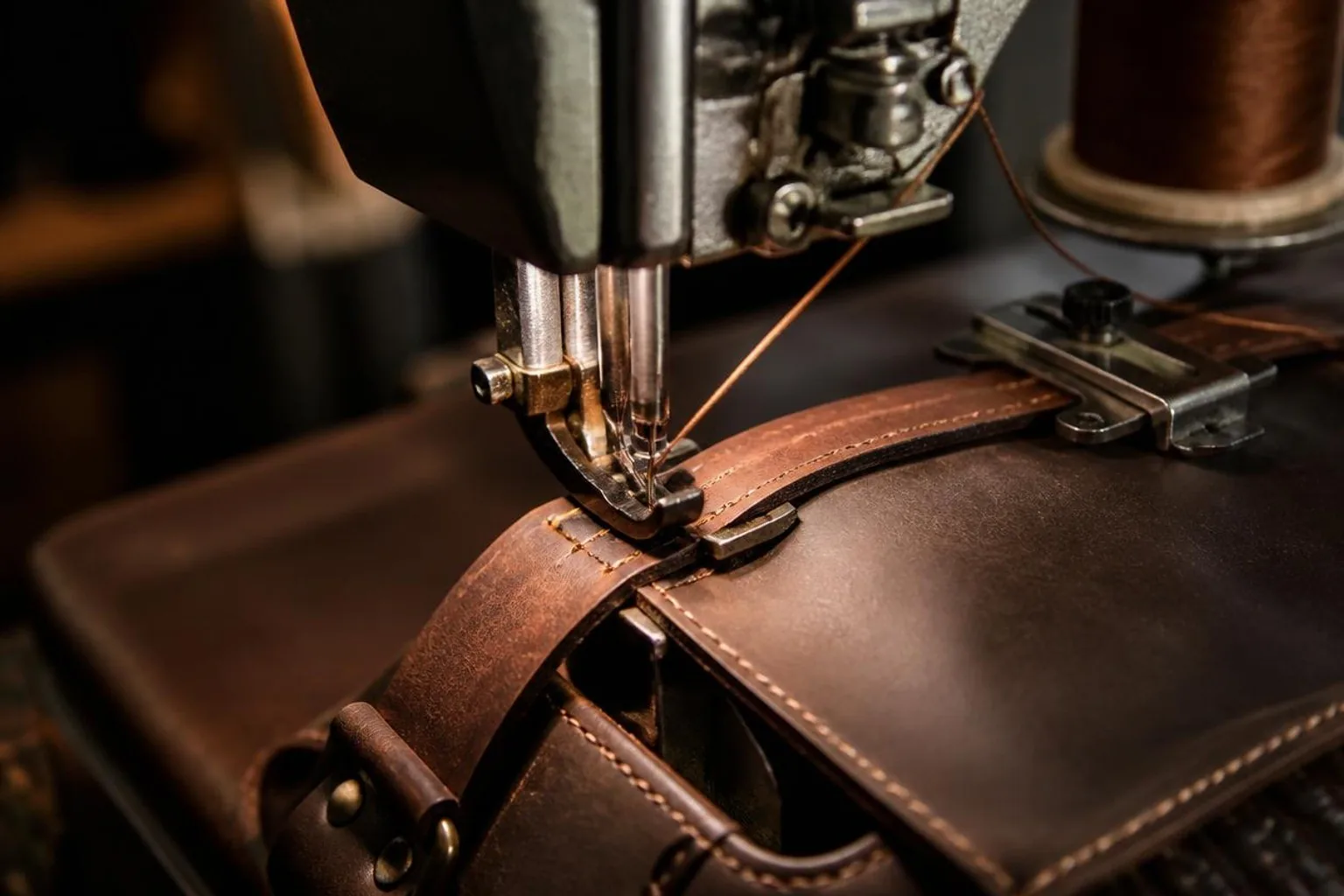
Machine stitching (lockstitch). The workhorse of modern leather manufacturing. An industrial sewing machine pushes a needle through the leather and locks a bobbin thread against the top thread, creating a locked stitch on every pass. Machine stitching is fast, consistent, and inexpensive — which is why it is used for the vast majority of bags at every price point. Quality machine stitching, done on proper machines with the right needles and tension, is strong, durable, and entirely appropriate for most bags.
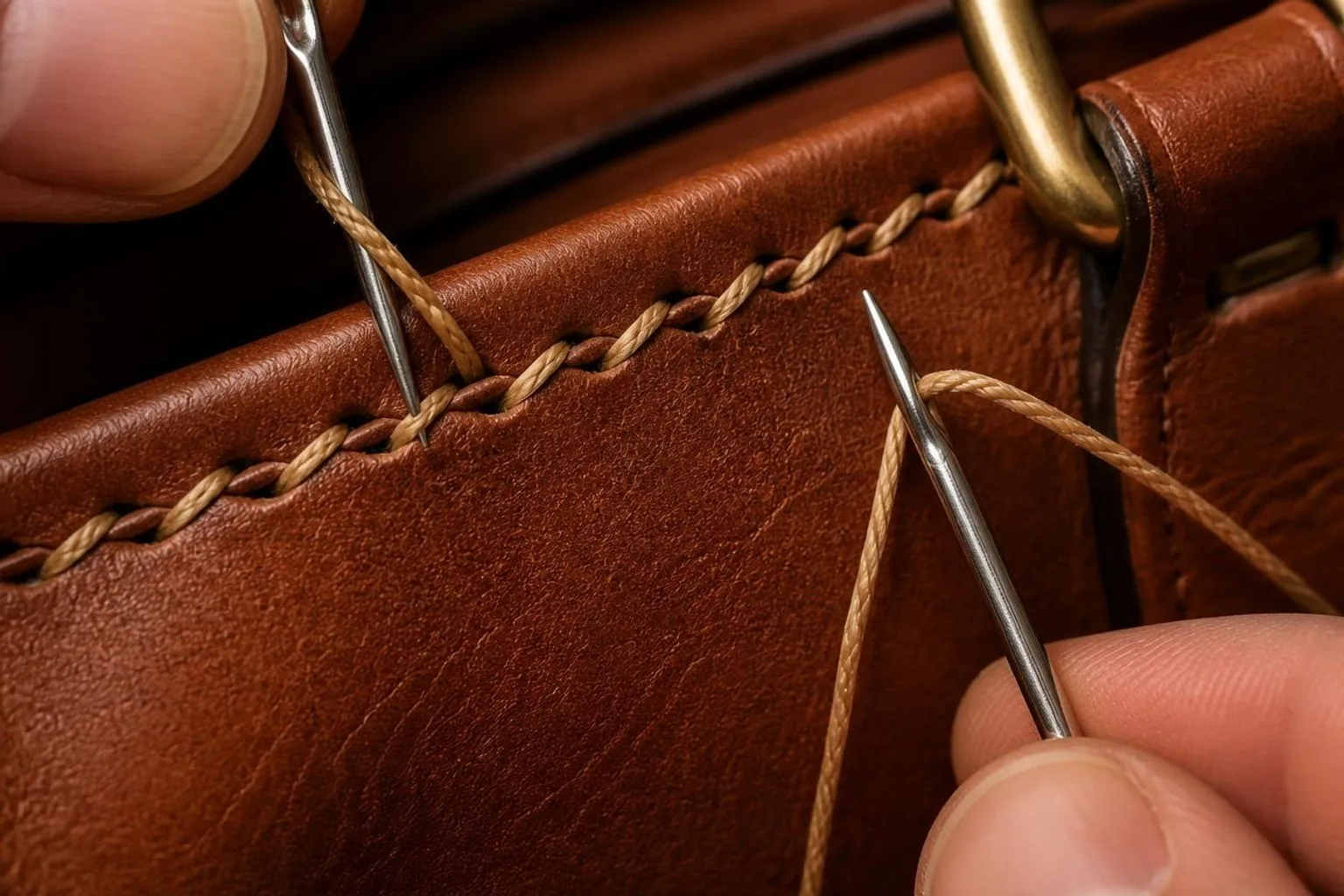
Hand saddle stitching. The traditional method, used since leather goods were first sewn. Two needles are threaded on one continuous line, and each pass alternates — the stitch is two needles meeting in the middle of the leather, wrapping the thread around itself. Saddle stitching has two famous advantages: it does not unravel if one thread breaks (each stitch is independent), and it is done through holes punched in the leather, which lets the maker control placement precisely. It is slower and costlier than machine stitching, which is why it appears on premium and artisanal goods.
Which is better? Neither is categorically superior — the right answer depends on the product, the price, and the claim being made. The honest comparison:
| Criterion | Machine lockstitch | Hand saddle stitch |
|---|---|---|
| Appearance | Even, uniform, slightly recessed | Diagonal, handcrafted, characterful |
| Strength | Excellent if properly tensioned | Excellent; resists unraveling better |
| Failure mode | Unravels if a stitch breaks | Holds even if one thread breaks |
| Speed / cost | Fast, low cost per bag | Slow, high cost per bag |
| Best for | Volume production, all price points | Premium, artisanal, high-end lines |
| Repair | Easy to re-stitch by machine | Re-stitched by hand, matches original |
| Typical price signal | Mainstream | Premium |
The two methods also coexist on the same bag: machine stitching for the hidden structural seams, saddle stitching for the visible, load-bearing ones. What matters is not which method a bag uses, but whether the stitches it has are done well — and whether they match the bag’s price and promise.
Thread: The Material That Holds Everything
The thread is the seam’s raw material, and thread choice decides a seam’s strength, durability, and appearance. Four materials dominate leather bag sewing, and each has a personality.
Nylon thread. The workhorse of machine stitching. Nylon is strong, durable, resistant to moisture and abrasion, and relatively inexpensive. It is the default for most production bags and an honest, sensible choice for most seams. Its downside is appearance — nylon can look utilitarian, and it does not carry the traditional warmth of waxed cotton.
Polyester thread. The modern rival to nylon, often coated for smoothness. Polyester resists UV degradation better than nylon (nylon weakens in sunlight), holds tension well, and is available in a wide color range. It has become the default for quality machine stitching in many factories, especially where bags see sun and outdoor use.
Waxed cotton thread. The classic hand-stitching thread. Cotton is waxed to protect the fibers, lubricate the needle, and give the thread body and a subtle sheen. Waxed cotton carries the traditional look of quality leather goods, but it is weaker than synthetics, absorbs moisture, and degrades faster. It is used where tradition and appearance matter more than maximum strength — and where the owner accepts the care routine that cotton deserves.
Linen thread. The premium traditional option, used in the finest handcrafted goods. Linen is strong for its diameter, naturally rot-resistant, and ages beautifully — but it is expensive, hard to work with, and rare in production. Linen is the thread of heirloom pieces and bespoke work.
| Thread | Strength | UV / moisture | Look | Typical use |
|---|---|---|---|---|
| Nylon | High | Good / good | Utilitarian | Production machine stitching |
| Polyester | High | Very good / good | Clean, modern | Quality machine stitching, outdoor bags |
| Waxed cotton | Medium | Fair / absorbs | Traditional, warm | Hand saddle stitching, classic goods |
| Linen | Medium-high | Fair / rot-resistant | Premium, natural | Bespoke, heirloom work |
The matching principle. In our factory, thread is matched to the job: synthetics for strength-critical structural seams, cotton or linen where the look and tradition justify it, and always a thread whose strength exceeds the load the seam will carry. The thread is the seam’s first decision, and it is made before a single stitch is sewn.
Stitch Anatomy: SPI, Tension and Lock
A stitch looks like a simple line, but a quality stitch is a precisely balanced structure. Three variables decide whether that line holds: stitches per inch, thread tension, and the lock.
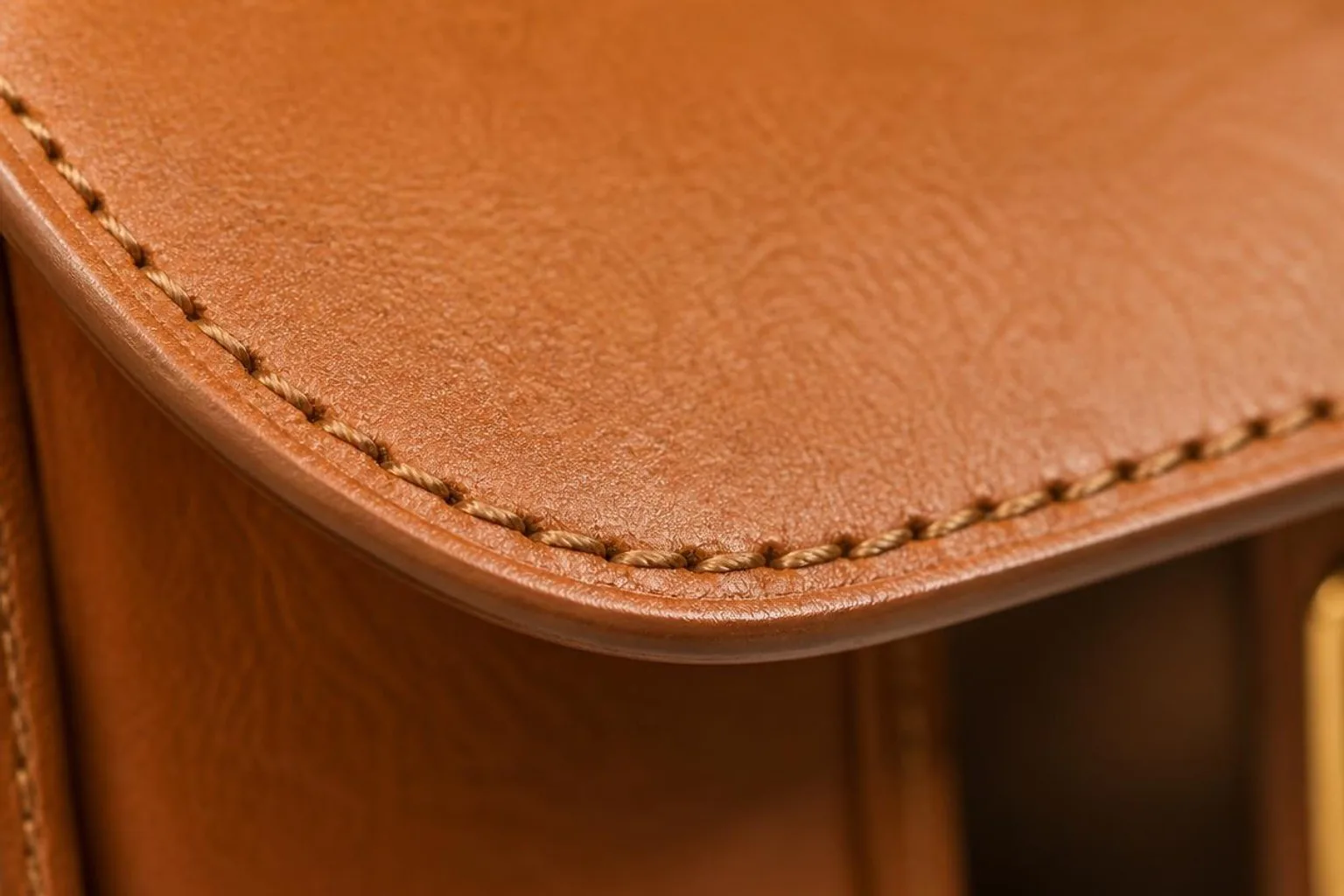
Stitches per inch (SPI). The number of stitches in one inch of seam. Higher SPI means more stitches per inch — tighter, denser stitching. The right SPI balances strength and practicality: too few stitches leave gaps that weaken the seam; too many can perforate the leather excessively and slow the seam’s own failure. For most leather bags, 6 to 8 stitches per inch is the sweet spot; fine goods may reach 10. The SPI should be consistent along the whole seam — inconsistent SPI is a reliable sign of rushed or careless work.
Thread tension. The balance between the top thread and the bobbin thread. Correct tension produces a lock that sits in the middle of the leather’s thickness — invisible from both sides. Wrong tension produces loops on one side, puckering, or a lock that sits on the surface where it wears away. Tension is set on the machine, tested on scrap, and rechecked throughout the day — it drifts, and drifted tension is one of the most common quality failures in production.
The lock. In a lockstitch, the top and bobbin threads interlock at every stitch. The lock is the stitch’s anchor — the point where the two threads grip each other and the leather. A properly locked stitch resists pulling apart; a poorly locked one pulls out like a zipper. The lock’s position — buried in the leather, not on the surface — is the single best visual test of tension quality.
Backstitching and securing. Every seam must be secured at both ends, or it will unravel from its own ends. The standard securing methods are backstitching (sewing backward over the first few stitches) and thread burning or tying off. An unsecured seam end is the most common stitching defect we see on failed bags — the seam did not break; it simply unraveled because it was never locked at its end.
Seam Construction: The Joints of a Bag
The seam type — how the panels are arranged and joined — is as important as the thread and the stitch. Different joints carry different loads and suit different parts of a bag.
Flat seam (plain seam). The simplest joint: two panels placed edge to edge or slightly overlapped and stitched. Fast and inexpensive, it is used for linings, internal pockets, and low-stress joins. Its strength is limited — the stitch row carries the load directly along one line.
Lapped seam (overlap seam). One panel overlaps the other, and the stitch runs through the overlap — often two rows of stitching for extra grip. The lapped seam is the standard for straps, handles, and gussets: the overlapping material distributes the load, and double rows of stitches create redundancy. Most load-bearing joins on a bag are lapped seams.
French seam (double seam). The panels are stitched once on the wrong side, then folded and stitched again on the right side, enclosing the raw edge inside. The French seam is strong and clean — no raw edge visible — and is used for fine linings and premium construction. It costs more in material and labor, and it is a sign of careful making.
Turned seam (stitch-and-turn). The panel is stitched, turned inside out, and edge-stitched — the technique used for folded edges, flaps, and the crisp rim of a tote. Turned seams give a clean, finished edge and add structure. They are standard on quality bags and are another mark of careful construction.
Reinforced seams. At high-stress points — handle bases, gusset corners, the tops of straps — good bags add reinforcement: extra rows of stitching, bar-tacks (dense, short stitch blocks), or rivets over the stitches. Reinforcement is the difference between a seam that survives years of heavy loads and one that fails at the first full bag. When you see bar-tacks at a handle base, you are seeing a maker who knows where bags fail.
| Seam type | Load capacity | Cost | Typical use |
|---|---|---|---|
| Flat seam | Low–medium | Low | Linings, internal pockets |
| Lapped seam | High | Low–medium | Straps, handles, gussets |
| French seam | High | Medium | Premium linings, fine goods |
| Turned seam | Medium–high | Medium | Flaps, folded edges, rims |
| Reinforced (bar-tack) | Very high | Medium | Handle bases, stress points |
Stitching Defects and Their Causes
Quality control in stitching is the art of knowing what to look for. These are the defects we inspect for on every production line — and the causes behind them.
Uneven stitches. Stitches that vary in length or spacing along the seam. Cause: inconsistent feed (the machine pulling the leather unevenly), a worn feed dog, or operator speed variation. Prevention: proper machine setup, even feeding, and operator training.
Puckering. The leather gathers and wrinkles along the seam line. Cause: tension imbalance, thread too heavy for the leather, or stitching through mismatched panel layers. Prevention: correct tension, matched thread, and balanced panel preparation.
Looped stitching. Loose loops on one side of the seam. Cause: bobbin tension too loose or too tight, or a mis-timed machine. Loops are a strength problem — the lock is not seating properly — and they are also an appearance problem.
Broken or skipped stitches. Gaps where the needle skipped the lock. Cause: wrong needle size or type for the leather, dull or bent needle, or too-thick thread for the needle eye. Prevention: match the needle to the leather and thread, and replace needles on schedule.
Unraveling seam ends. The seam comes undone from its end. Cause: no backstitch, no tie-off, or thread burned too close. This is the most common failure on returned bags, and it is entirely preventable with a few seconds of securing.
Stitching too close to the edge. The stitch row runs so close to the panel edge that the material tears at the stitch line under load. Cause: poor edge allowance — the margin between the stitch and the edge is too small. Prevention: design standards that specify minimum edge distance, and tooling that enforces it.
A manufacturer’s rule: a beautiful stitch that is not secure is decoration, not construction. The seam’s job is to hold — appearance follows strength, never the other way around.
How to Judge Stitching Quality When You Buy
For buyers, stitching quality is the most accessible test of a leather bag’s construction — and it takes thirty seconds. Here is the checklist we teach customers, the same one our QC team applies.
Run your eye along the stitches. The stitch line should be straight, even, and consistent — uniform spacing, no wandering, no gaps. Stitches should sit at a consistent distance from the edge, all the way along the seam. A wavy or uneven stitch line is a confession of rushed work.
Check both sides. A quality lockstitch looks clean on both sides of the leather. Loops, puckering, or loose threads on the underside mean the tension is off and the lock is not seated. Flip the flap, open the bag, look at the seams from the inside — the hidden side tells the truth about the visible side.
Count the stitches per inch. Six to eight stitches per inch is the healthy range for most bags. Count a few inches of seam: consistently in range means a well-set machine; sparse or erratic stitching means the seam is weaker than it should be. SPI is the seam’s density, and density is strength.
Look at the stress points. Find the handle bases, the gusset corners, the strap tops — and look for reinforcement: double rows of stitching, bar-tacks, or rivets. A bag with un-reinforced stress points is a bag that will fail at its most loaded seams. The reinforcement is the maker telling you they know where bags break.
Check the seam ends. Every seam should be secured at both ends — back-stitched, tied off, or burned clean. An unsecured seam end is a seam that will unravel. Look at the ends of straps and pockets: if the stitching just stops, the seam has a timer on it.
Pull the seam gently. With two fingers, gently pull the two panels of a seam apart. A quality seam holds firm — no gaping, no thread stretching. A weak seam shows give immediately. This is the closest a buyer can come to a tensile test in a store, and it separates construction from decoration.
The Factory Perspective: Machines, Needles and Quality Gates
Stitching quality is made on the factory floor — by the machines, the needles, and the inspections that sit between them. Here is how a serious factory controls stitching.
The machines. Leather bags are sewn on industrial machines built for the material: walking-foot machines (which pull the top and bottom layers evenly, preventing slippage), cylinder-bed machines (for tubes and straps), and flatbed machines (for panels). The machine must match the job — a bag sewn on the wrong machine shows it in every seam. In our factory, machines are dedicated by task, and maintenance is scheduled, not reactive.
The needles. The needle is the machine’s contact point with the leather, and needle choice is a craft. The needle must be the right size for the thread (the thread passes through the needle’s eye and the groove in its shaft), the right point for the leather (sharp for natural leather, ball-point for synthetics), and sharp — dull needles crush and tear leather fibers instead of cutting them cleanly. Needles are changed on a schedule, not when they fail, because a dull needle damages the leather before it ever shows in the stitch.
Thread tension management. Tension is set at machine setup, tested on scrap leather, and checked throughout the day — because tension drifts as machines warm, threads change, and bobbins rewind. A factory with discipline checks tension on a schedule; a factory without discipline ships puckered seams and looped stitches. The tension check is the invisible quality gate.
The inspection gates. Quality stitching is inspected at three points: first-piece inspection (the first bag of a run is checked against the sample), in-line inspection (stitchers check their own work against standards), and final inspection (every finished bag passes a QC pass before packing). The final pass includes the stitch checks — SPI, tension, reinforcement, seam ends. A seam that fails inspection goes back to the machine, never forward to the customer.
The sample standard. Every production run begins with a pre-production sample that sets the standard — the stitch pitch, the tension, the seam type, the reinforcement, all locked in a physical reference. Production is compared to the sample throughout the run. The sample is the contract between the factory and the quality it promised; when production drifts, the sample is the proof.
Stitching and Edge Work: Two Crafts, One Standard
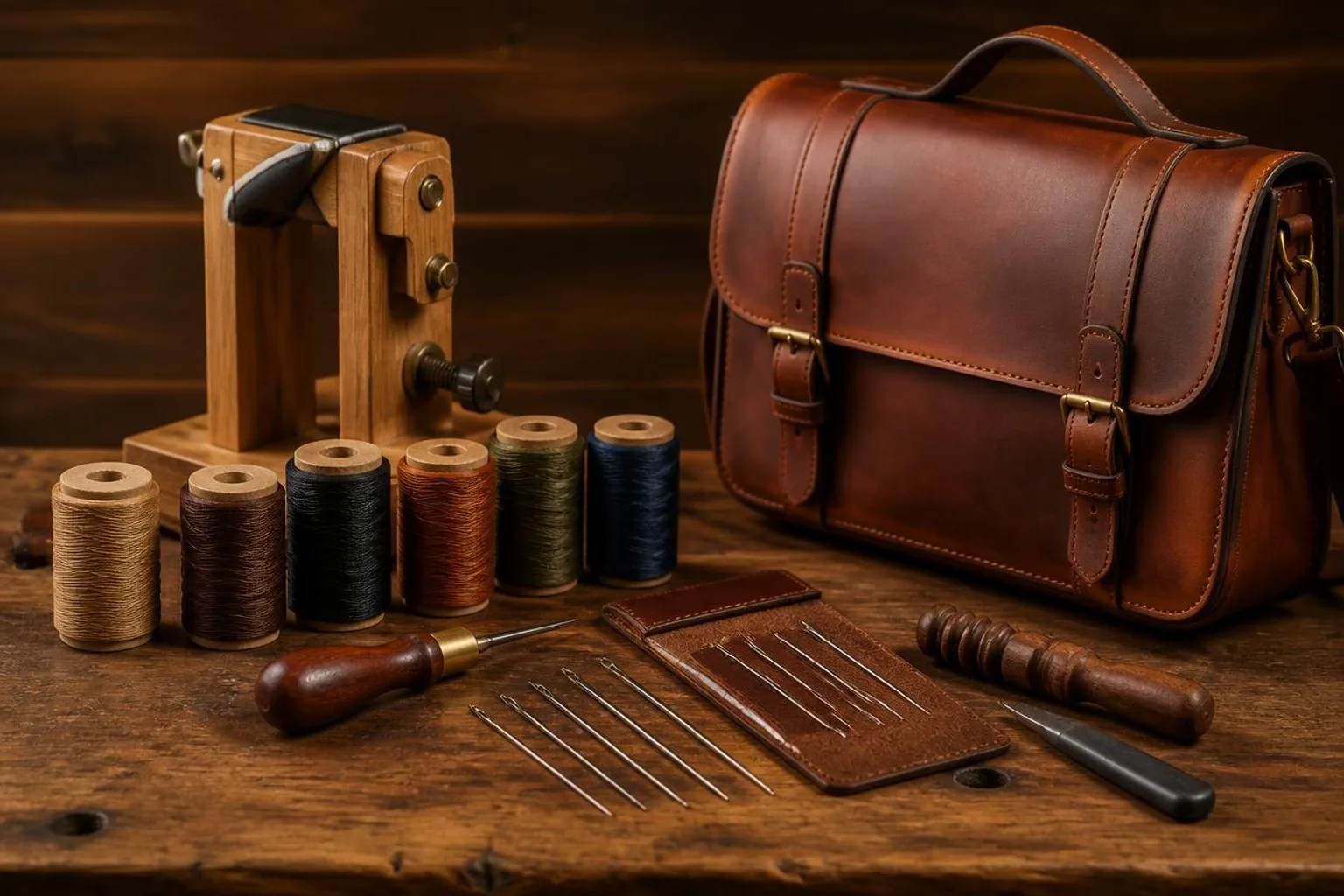
Stitching does not exist in isolation — it works with the edge finishing covered in our previous guide, and the two crafts set the standard together. A bag with perfect stitching and rough edges looks half-made; a bag with perfect edges and weak stitching fails in use. The premium bag has both, because both are expressions of the same discipline.
How they interact. The stitch line is typically set back from the finished edge by a consistent margin — the edge distance. That margin must match the edge’s bevel and the seam’s load: too close, and the edge tears; too far, and the seam looks sloppy. The edge distance is a design decision, set once in the pattern and enforced by the tools and the stitching jigs. It is also one of the most visible signs of design care — consistent edge distance along a whole bag is the signature of a well-made product.
The visual balance. The eye reads a bag’s quality from its proportions: stitch line, edge, and hardware in harmony. A fine stitch on a fine edge says premium; a heavy stitch on a raw edge says budget; a fine stitch on a raw edge says a factory that did one thing well and cut corners elsewhere. When you evaluate a bag, evaluate the whole system — the stitching and the edges and the hardware must all meet the same standard, because a bag is a single product, not a collection of parts.
The repair connection. Stitching and edges meet again in repair: a re-stitched seam must be re-finished to match, and an edge repair must not disturb the adjacent stitching. Bags that were well made in both crafts are repairable in both crafts — which is why the two standards together are what make a bag a long-term purchase.
How Load Requirements Differ by Bag Type
Not every bag carries the same load, and stitching should be matched to the bag’s real job. The seam specifications that suit a wallet are different from those that suit a diaper bag — and the difference is engineering, not decoration.
Diaper bags and tote bags. These are the load champions. A full diaper bag carries bottles, wipes, a change of clothes, and the accumulated weight of parenting; a tote carries laptops, groceries, and whatever the day demands. Both need maximum seam strength: heavy-duty thread, dense SPI, lapped seams at the stress points, and reinforcement at the handle bases. If a bag is designed to carry weight, its seams must be designed to carry weight — and the buyer should see the evidence at the handle attachments.
Backpacks. Backpacks distribute load across two straps and a framed body, which changes the stress profile: the load concentrates at the strap attachments, the base, and the gussets. Backpack seams need heavy reinforcement at the strap joints and along the base, and the seams must survive constant movement — the flexing of a worn backpack is a stress test no static bag experiences. Backpack stitching is the most engineering-driven of bag stitching, and quality shows in the bar-tacks at every joint.
Handbags and crossbody bags. Moderate loads, moderate seams — but high daily use. Handbags need consistent, clean stitching that survives years of opening, closing, and carrying; crossbody bags need secure strap attachments where the strap meets the body. The standard here is quality rather than maximum strength: even SPI, clean tension, proper reinforcement at the obvious stress points.
Wallets and small goods. Light loads, but constant handling and flexing. Wallets are folded, stuffed, sat on, and opened dozens of times a day — the seams must survive repeated flexing without cracking the thread or perforating the leather. Small goods favor fine, dense stitching and careful edge distance; the failure mode is wear, not overload.
The matching principle. When a manufacturer designs a bag, the seam specification is set by the bag’s job — thread strength, SPI, seam type, and reinforcement all follow the load. A wallet sewn like a diaper bag looks heavy-handed; a diaper bag sewn like a wallet fails. When you buy, match the stitching you see to the weight the bag will carry: the seams should look equal to the bag’s promise.
Frequently Asked Questions
How can I tell if a leather bag has good stitching?
Check four things: stitches should be even and consistent (6–8 per inch for most bags), clean on both sides with no loops or puckering, set at a consistent distance from the edge, and secured at both ends. Stress points like handle bases should show reinforcement — double stitching, bar-tacks, or rivets.
Is hand saddle stitching better than machine stitching?
Not categorically — each has strengths. Saddle stitching resists unraveling (each stitch is independent) and offers handcrafted character, but it is slower and costlier. Quality machine lockstitch is strong, consistent, and appropriate for most bags. What matters is whether the stitching is done well and matches the bag’s price and promise.
What is the strongest type of stitching for leather bags?
The strongest seams combine three things: a strong thread (nylon or polyester), the right stitch density (6–8 SPI), and proper seam construction — lapped or reinforced seams at stress points, with bar-tacks or rivets over the highest-load areas. Strength comes from the system, not from any single element.
Why does stitching unravel at the ends of seams?
Unraveling happens when a seam end is not secured — no backstitch, no tie-off, or thread burned too close to the last stitch. Every seam must be locked at both ends; an unsecured seam end is the most common stitching failure we see on returned bags, and it is entirely preventable.
How many stitches per inch should a leather bag have?
Six to eight stitches per inch is the healthy range for most leather bags; fine goods may reach ten. Too few stitches weaken the seam; too many perforate the leather excessively. Consistency matters most — erratic spacing signals rushed or careless stitching.
What thread is used for stitching leather bags?
Production bags typically use nylon or polyester thread for strength and durability; premium and artisanal bags often use waxed cotton or linen for traditional appearance. The thread is matched to the job — strength-critical seams get synthetics, and visible traditional work gets cotton or linen.
Can leather bag stitching be repaired?
Yes — seams can be re-stitched, both by machine and by hand. A torn or unraveled seam is one of the most straightforward leather repairs, especially if the seam was properly made to begin with. Quality stitching makes repair possible, which is one more reason it is worth paying for.
Why do the seams on cheap bags fail so quickly?
Cheap bags typically combine weak thread, sparse stitches, un-reinforced stress points, and unsecured seam ends — every element that makes a seam fail. The stitching looks adequate in the store because surface appearance is cheap to produce; strength is what costs money, and it is what the cheap bag lacks.
Final Word from the Factory
The seam is the part of a bag that nobody buys — and the part that decides whether the bag survives. The leather catches the eye, the hardware catches the hand, but the stitching carries the load, day after day, kilo after kilo, until the bag is either retired with honor or discarded in failure. Every bag we make is only as good as its weakest seam, and every seam we sew is only as good as the thread, the tension, the reinforcement, and the inspection behind it.
At our factory, we treat stitching as structural engineering with a needle. We choose thread by load, not by look. We set tension by test, not by guess. We reinforce the points where bags fail, and we secure every seam end because we have seen what unraveling costs. We inspect first pieces, in-line work, and finished bags — because the stitch is where the factory’s discipline becomes visible, and visible quality is what brings customers back.
When you choose a leather bag, give the stitching a few seconds of your attention. Look at the evenness, the density, the stress points, the seam ends. The leather will tell you how the bag looks; the stitching will tell you how long it lasts. And in the end, that is the only question that matters. A beautiful bag that falls apart is a disappointment; a well-stitched bag is a companion for a decade — and the seams are the quiet reason why.
