
How Should the Base of a Leather Bag Be Built to Carry Weight?
How Should the Base of a Leather Bag Be Built to Carry Weight?
A leather bag is judged standing up, and it is used standing on its base. That single panel at the bottom takes the entire load of the contents, transfers it into the seams and the body, and absorbs every surface the bag is set down on.
Base construction is where a bag either earns its structure or quietly loses it. Two styles can share a pattern and a hide and behave completely differently after six months, because one base has a load path and the other has a seam. The difference shows up as a sagging bottom, a rounded corner, a split at the base seam, or feet that tear through the leather.
This article looks at how a bag base is built for support: the panel types a factory can produce, the reinforcement stack, the placement of feet, the load path through the bag, and the checks that catch a weak base before a shipment is packed.
The base is the only part of a bag that meets every surface the bag is ever put down on, and the only part that carries all of the contents at once.
The question here is structural support and load. Interlining and fusible materials as a general subject, and leather thickness by ounce, are covered separately.
- What the Base Actually Does
- Base Types a Factory Can Build
- The Reinforcement Stack
- Feet: Placement and Load
- Geometry and Balance
- The Load Path Through the Bag
- Stitching at the Base
- Base by Bag Type
- Materials at the Base
- Tolerances and Production Control
- Testing Before Production
- How Users Actually Load a Bag
- The Base and Moisture
- Base Assembly on the Line
- Base Changes Across a Size Range
- Common Failures
- Working With the Factory
- Cost and Longevity
- Repair and Longevity
- Frequently Asked Questions
- The Bottom Line
What the Base Actually Does
Four jobs, one panel.
Carrying the Load
Everything above it presses down.
The base supports the weight of the contents and transmits it to the body panels through the seam that joins them. Where that seam is weak, the leather around it stretches; where the panel is soft, the middle sags and the corners drop.
Holding the Shape
The flat plane that keeps a bag upright.
A base with stiffness holds the bag’s footprint and keeps the body panels vertical. Without it, the bag collapses into a soft shape as soon as it is set down, and the customer reads that as poor quality regardless of the leather.
Protecting the Contents
Distance from the ground.
The base separates what is inside from what is underneath: wet pavements, hot car floors, grit, and the edges of tables. That protection comes from the reinforcement stack and the lining, not from the outer leather alone.
Taking the Abrasion
The first part to wear.
Corners and the base perimeter touch every surface. Base construction decides how much leather is exposed at the corner, whether an edge is painted, bound or turned, and whether a scuff becomes a hole.
Base Types a Factory Can Build
Five constructions, different consequences.
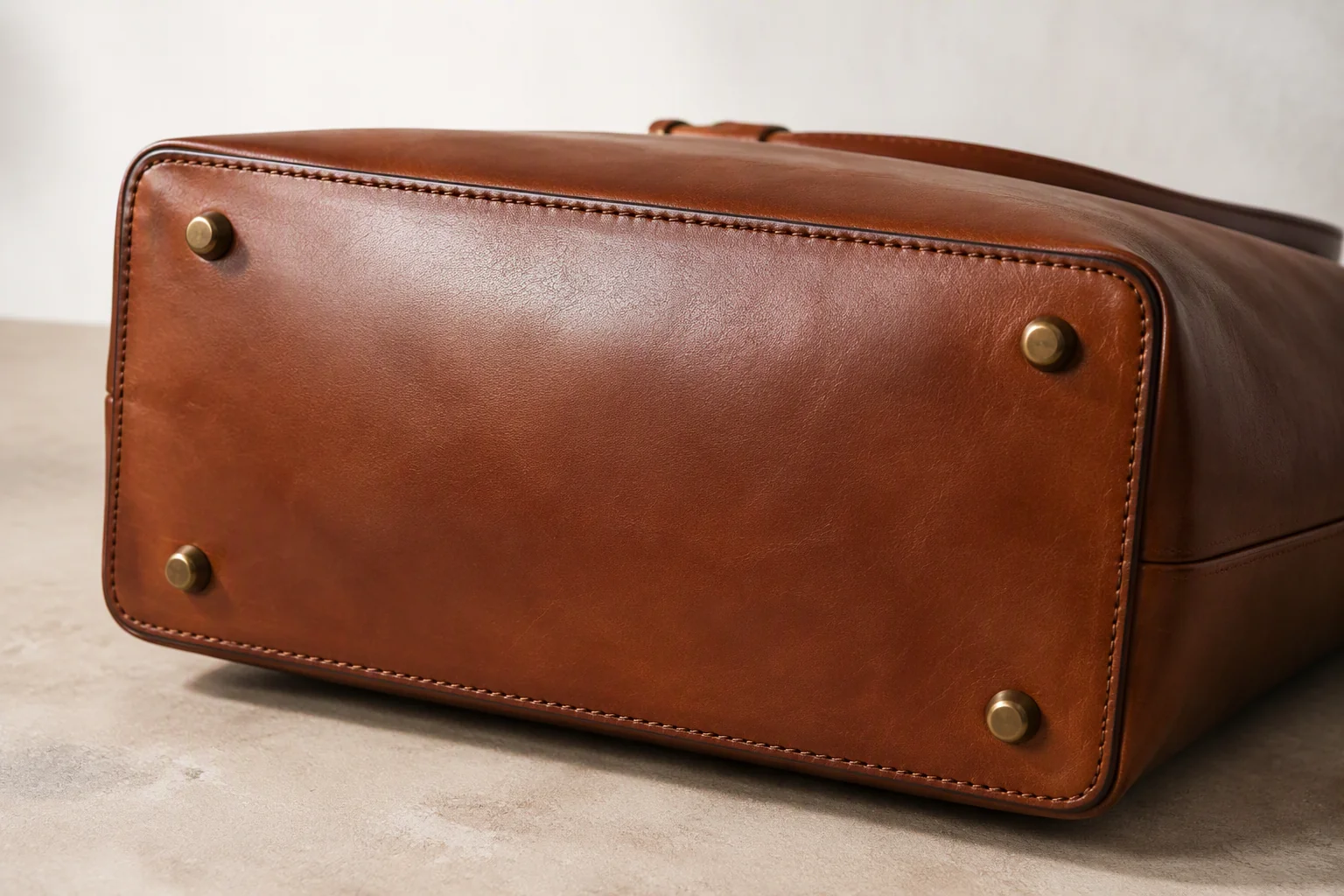
Flat Single Panel
The simplest and least stable.
A single piece forming the bottom, joined to the body by a seam around its perimeter. It is efficient to cut and easy to sew, and it relies entirely on the leather and any inserted stiffener for shape.
Gusset-Wrapped Base
The bottom formed by the gusset.
Where a single gusset runs around the bag, the base is part of that strip. The advantage is continuity: fewer seams, fewer weak points. The disadvantage is that the base inherits the gusset’s temper, which may be too soft for a wide bag.
Separate Base Panel With Seam
The most common structured approach.
A distinct base panel joined to the body, often with a bound or lapped seam. It allows a different material or thickness at the base and gives the factory control over the corner geometry, at the cost of an additional seam line.
Folded Base
Formed by folding the body.
Some soft styles form the base by folding the body panel rather than joining a separate piece. There is no base seam, which removes a failure point, but the shape is only as firm as the fold allows.
Moulded or Laminated Structure
For rigid frames.
Where a bag needs a fixed footprint, a laminated or moulded base insert provides it. This is the firmest option and the least forgiving: the insert must match the pattern exactly, and any misfit shows at the corners.
| Base type | Stiffness | Seams | Best for | Main risk |
|---|---|---|---|---|
| Flat single panel | Low to medium | Perimeter seam | Soft totes, pouches | Sagging centre |
| Gusset-wrapped | Medium | None at the base | Slouchy shoulder bags | Soft corners |
| Separate base panel | Medium to high | Perimeter plus join | Structured totes, diaper bags | Corner bulk |
| Folded base | Low | None | Soft leather styles | Rounded, unstable footprint |
| Moulded insert | High | Depends on assembly | Briefcases, formal bags | Insert misfit |
The Reinforcement Stack
Order matters as much as material.
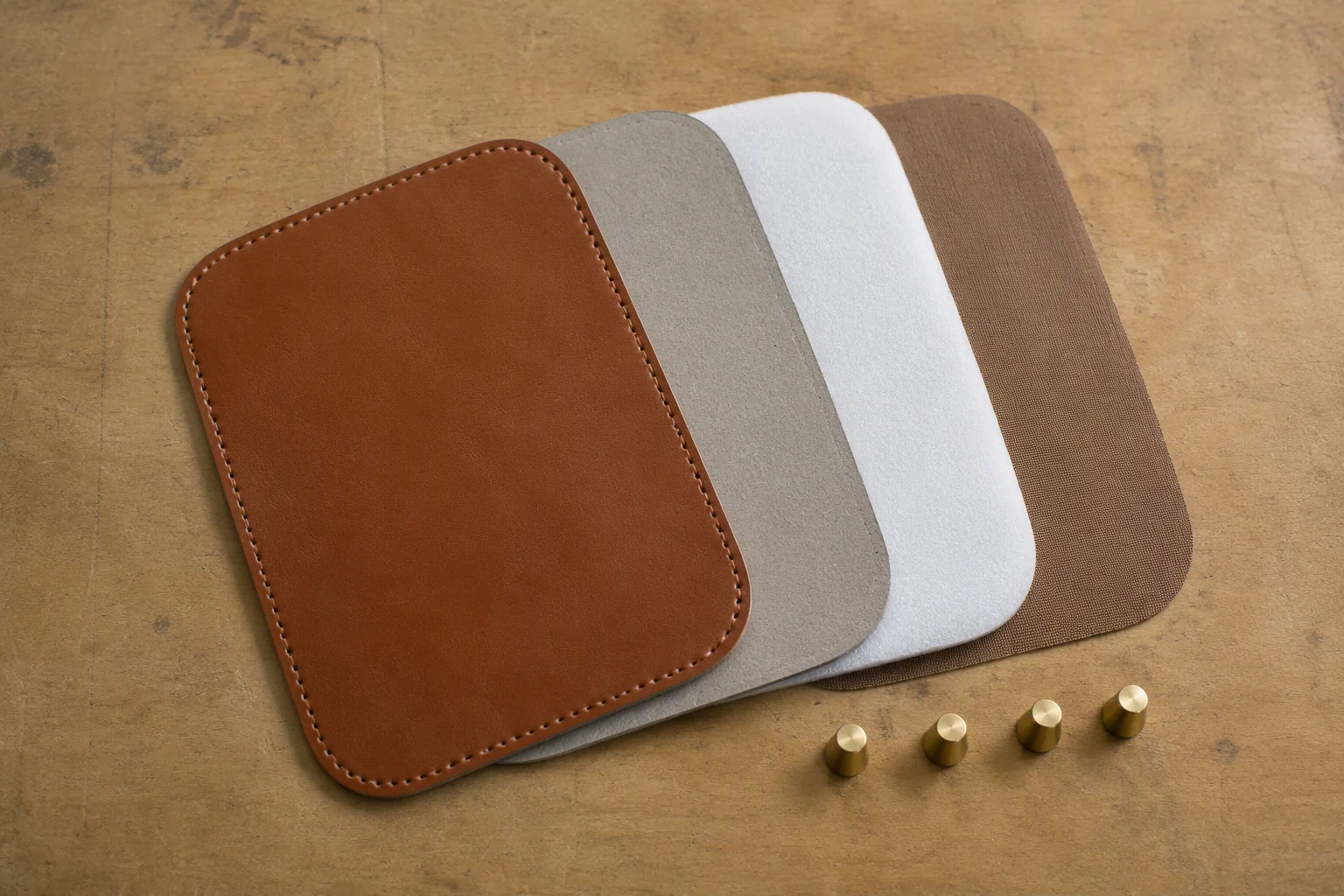
The Layers
From outside in.
A typical stack is outer leather, a stiffener, a padding layer and the lining. Each layer has one job: the leather presents the surface, the stiffener holds the plane, the padding softens the contact and protects the contents, the lining closes the assembly.
Why the Order Cannot Be Swapped
Stiffener against leather, or not.
Placing a rigid board directly against thin leather produces a hard edge that telegraphs through the surface and wears the leather from behind. Padding between the board and the leather distributes the contact and hides the board’s edge.
Stiffener Selection
Board, sheet or reboard.
The stiffener has to be stiff enough for the footprint and thin enough not to distort the pattern. A wide bag needs more resistance than a small one, and a base that is too stiff will not follow the corners and will pucker.
Edge Treatment of the Insert
The hidden cause of wear.
An insert cut with a sharp corner and no edge softening abrades the leather from inside as the bag flexes. Rounded corners and a taped or skived edge are small details that decide whether the base survives years of use.
Bonding Versus Floating
Attached or loose.
A bonded stack behaves as one panel and holds shape; a floating insert allows some movement but can shift and crease. Large bases usually need bonding at least at the perimeter to stop the insert migrating.
Feet: Placement and Load
Small components with a structural job.
What Feet Do
Distance and dignity.
Feet lift the base off the ground, protecting the leather from abrasion and moisture, and they let a bag stand without resting its whole surface on dirt. On a structured bag they also complete the silhouette.
Placement Rules
Inset, and on the load points.
Feet belong inside the base perimeter, never on the edge where they would tear through under load. They should sit under the corners or the main load points rather than evenly spaced for appearance, because a bag loaded unevenly presses hardest at the corners.
Backing Behind Each Foot
The part nobody sees.
Every foot needs reinforcement behind the leather: a small patch, a plate or a bonded disc. Without it, the foot pulls through the leather at the first heavy set-down, and the failure is not repairable in a way that looks original.
Feet Versus No Feet
A design decision with consequences.
A bag without feet relies on edge finishing and a reinforced base perimeter. That can be entirely appropriate for soft styles, but it puts the base leather directly onto every surface and shortens its life at the corners.
Geometry and Balance
Why a wide bag tips.
Footprint Against Height
The ratio that decides stability.
A bag stands securely when its footprint is proportionate to its height and to the load it carries. Increase the height without increasing the base and the centre of gravity rises; increase the load and the same base becomes marginal.
Corner Radius
Where the base meets the body.
A tight corner radius concentrates stress and is difficult to sew cleanly. A generous radius distributes the load and turns more easily, which is why structured bags often use a softened corner even when the drawing implies a sharp one.
When the Sides Bulge
Base width and body width.
If the base is narrower than the body, the sides lean inward and the bag loses usable volume; if the base is wider, the bag flares and the load pushes outward at the base seam. The two dimensions are a pair.
Balance Under Load
Testing the stance.
Setting a loaded bag on a flat surface and checking whether it stands without support is a fast test. A bag that tips or rocks has a geometry problem that no reinforcement will fix.
The Load Path Through the Bag
Following the weight.
From Contents to Base
Where pressure lands.
Contents press on the base panel, which pushes outward on its perimeter seam, which pulls on the body panels. Any interruption in that chain, such as an unbonded insert or a seam with insufficient allowance, shows up as distortion.
From Base to Handle
The path that matters most.
When a bag is lifted, the load reverses and travels from the base seam up the body to the handle attachments. A base that is strong in compression but poorly joined in tension will fail at the seam when the bag is picked up full.
Where Seams Should Sit
Away from the highest stress.
Base seams placed on the outer edge see abrasion and load at once. Placing the seam on the base itself or hiding it in a bound edge reduces exposure, at the cost of construction complexity.
The Role of the Body Panel
Structure continues upward.
The base cannot hold a shape that the body panels cannot support. A firm base under soft sides produces a bag that is flat at the bottom and shapeless above it.
Stitching at the Base
The seam that takes the most punishment.
Seam Type
Bound, lapped, or plain.
A bound seam covers the raw edges and distributes abrasion; a lapped seam is strong and flat but visible on the outside; a plain seam relies on edge finishing and is the most exposed. The choice follows the base type and the price point.
Stitch Density and Thread
Short stitches, strong thread.
Fine stitches look better and hold better on leather, provided the thread is matched to the material. A heavy thread in a fine stitch length can perforate the leather along the seam line.
Reinforcement at the Corners
Where seams fail.
Corners concentrate stress and require either a reinforced stitch pattern or a change of construction. Back-stitching at the corner, or a small reinforcement patch inside, prevents the tear that starts at the seam end.
Allowances
Enough to hold, not enough to bulk.
Base seams need enough allowance to grip and not so much that the corner becomes thick and unmanageable. Skiving the allowance at the corners is often the difference between a clean base and a lumpy one.
Base by Bag Type
Different loads, different answers.
Structured Totes
Flat, firm, with feet.
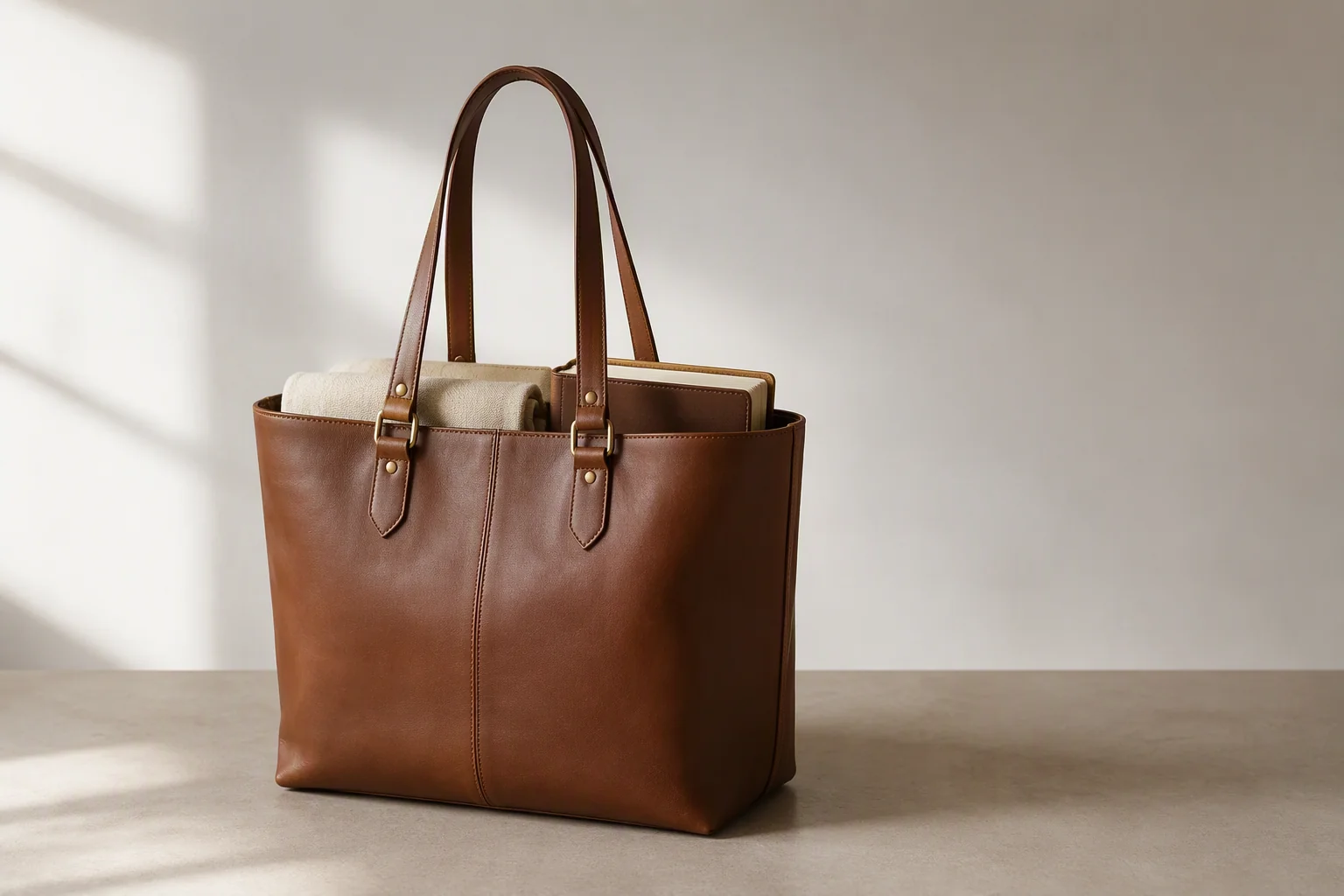
A structured tote needs a stable footprint, a bonded stack and feet under the corners. The base is where the bag’s price is read, because a tote is seen standing.
Diaper Bags
Load and cleaning.
Diaper bags carry dense, irregular loads and are put down anywhere. The base needs stiffness, a wipeable lining above it and protection at the corners, and it often benefits from a wider footprint than the silhouette suggests.
Backpacks
Compression, not standing.
A backpack base is usually rounded or shaped rather than flat, because the bag is carried and set down briefly. Abrasion resistance matters more than a stable stance.
Briefcases and Formal Bags
Fixed geometry.
Formal bags need a moulded or laminated base for a defined footprint and a clean edge. The margin for error is small, and the base often carries a visible frame.
Small Crossbody Bags
Light loads, thin construction.
Small bags rarely need a rigid base. A light stiffener and a clean edge finish are usually sufficient, and adding too much structure makes a small bag feel stiff and heavy.
Materials at the Base
Which leather belongs underneath.
Firm Versus Soft Leather
The base is not the place for softness.
Soft leather at the base collapses under load and wears quickly at the corners. A firmer temper, or the same leather backed with a stiffener, is the usual answer, and the base is often cut from a firmer part of the hide.
Grain and Finish
Abrasion tolerance.
Tight grain and a finished surface resist scuffing better than an open, natural grain. Where the base is visible in use, the finish is also a design consideration.
Suede and Split Sides
Cheap, and short-lived.
Using a split or suede-facing material at the base reduces cost and increases wear. Where it is used, it needs protection at the corners and a clear expectation of life.
Consistency With the Body
A visual question.
A base in a noticeably different leather is visible whenever the bag is lifted. Where a firmer base material is chosen for structural reasons, the difference should be a deliberate design decision.
Tolerances and Production Control
A base that repeats.
Where Base Dimensions Drift
Cutting, bonding, sewing.
Panel dimensions, insert size, bonding position and seam allowance each shift the finished footprint. On a wide base, small errors accumulate into a visible twist.
Setting the Tolerance
Footprint and flatness.
The useful controls are the finished footprint dimensions and the flatness of the base under load. Both can be checked with simple tooling at the packing station.
Checking in the Line
Two quick measurements.
A template for the footprint and a flat-surface check catch most defects. Adding a loaded stance check costs seconds and prevents the most visible complaint.
| Check | Method | What it catches |
|---|---|---|
| Footprint dimensions | Template or gauge | Cutting and seam drift |
| Base flatness | Set on a flat surface, loaded | Weak or shifted stiffener |
| Corner symmetry | Compare four corners | Twisted assembly |
| Foot security | Pull test on each foot | Missing backing |
| Seam integrity | Visual and flex check | Corner stitch failure |
| Edge finish | Rub and flex check | Exposed or thin edge coating |
Testing Before Production
Cheap tests, early answers.
The Loaded Stance Test
Fill it, set it down.
Load the sample to its intended working weight and set it on a flat surface. A base that sags, rocks or bulges at the seam is not ready, and the failure appears in minutes.
The Lift Test
Weight in tension.
Lift the loaded bag by its handles and watch the base seam and corners. This is where a base that is strong in compression but weak in tension reveals itself.
The Set-Down Test
Repeated contact.
Setting a loaded bag down repeatedly on a hard surface, corner first, simulates months of use in a short time and shows whether the feet and edge finishing hold.
Documenting the Result
Photo, number, decision.
Each test should produce a recorded outcome: the load used, the observed behaviour, the accepted tolerance and any correction. A base specification without test results is an intention rather than a control.
How Users Actually Load a Bag
Real loads are not evenly distributed.
The Single Heavy Item
A laptop, a bottle, a folded pram.
Most bags are loaded around one heavy object placed where it fits, not spread evenly. The base has to tolerate a concentrated load at an arbitrary position, which is a different requirement from supporting a uniform weight.
Repeated Point Loading
Where the base fatigues.
A bottle set down in the same corner every day creates a local compression that no uniform test reveals. Local reinforcement, or a stiffener that spans the whole footprint, is the practical answer.
Testing With Real Contents
Not with sandbags alone.
A test load of uniform weight proves less than a test with the objects the bag is designed for. The shape of the load matters as much as its mass.
The Base and Moisture
Where water collects.
Contact With Wet Surfaces
The everyday exposure.
A bag set down on a wet pavement or a damp floor takes moisture at the base first. The outer leather, the seam and the lining above the base all see it.
The Lining Above the Base
The layer that decides what happens next.
A lining that sits directly on the base without a barrier passes moisture upward into the bag’s contents. A coated or tightly woven lining above the base limits the spread, and it is a specification line that costs very little.
Materials That Tolerate It
Finishes and linings.
A finished, tight-grain leather at the base resists absorption better than an open grain, and a lining that does not hold water limits the spread. These are material choices made at the specification stage.
Drying and Its Risks
What happens afterwards.
A wet base dried quickly in direct heat will stiffen and crack. Care guidance for the customer, and a base that can be wiped rather than soaked, prevent the damage that follows a single wet day.
Base Assembly on the Line
The sequence that produces consistency.
The Order of Operations
Stack, bond, join, finish.
Preparing the stack, bonding it, joining the base to the body and finishing the edge is the usual order, and each step has a quality gate. Skipping a gate moves a defect downstream where it costs more to correct.
Jigs and Templates
Consistency without skill dependence.
A template for the insert and a jig for foot placement remove the variation that comes from individual judgement. On a base, where small errors are visible, this matters more than on the body.
Who Checks What
Two sets of eyes.
The operator checks the assembly, and inspection checks the finished footprint, flatness and feet. Where only one check exists, the defect that passes is the one nobody was asked to look for.
Recording the Batch
Traceable components.
Stiffener batch, foot batch and leather lot all belong in the production record, so that a base failure can be traced to a material rather than to a person.
Base Changes Across a Size Range
Scaling is not multiplying.
What Scales and What Does Not
Stiffener and feet.
Doubling the footprint does not double the stiffness: it reduces it, because the span grows faster than the resistance. A size increase usually needs a thicker or stronger stiffener rather than the same one in a larger piece.
Foot Count and Position
More load points.
A larger base needs additional feet or a different arrangement, because the same four corners now span a longer distance and the centre is unsupported.
Seam and Allowance Adjustments
Where the corners change.
Larger bases turn corners differently, and allowances that worked at one size can produce bulk at another. Each size step should be sampled rather than extrapolated.
Documentation per Size
One specification each.
A size family shares a construction but not a specification. Recording the stack, the foot layout and the tolerance for each size prevents a later order from being built to the wrong one.
Questions worth settling before the base is drawn:
- What is the heaviest single item the bag must carry
- Will the bag be set down loaded, and on what surfaces
- Does it need to stand unsupported
- How long is the bag expected to stay in use
- Which size in the family carries the most weight
Common Failures
What comes back from the market.
- Centre of the base sagging under load
- Corners rounding and losing the footprint
- Base seam splitting at the corner
- Feet pulling through the leather
- Insert edge wearing through the lining
- Base leather scuffing through at the perimeter
- Bag tipping when set down loaded
- Base and body dimensions mismatched after a size change
- Edge paint cracking at the corner
- Stiffener creasing where the bag folds
These are structural outcomes, not cosmetic ones, and each traces back to a decision made at the pattern stage.
Working With the Factory
Getting the base you specified.
Specify the Stack
Layers, order, thickness.
A base specification should name each layer, its material, its thickness and its order. Leaving the stack to the factory’s habit produces a base that varies between orders.
Specify the Feet
Type, position, backing.
Foot type, the inset distance from the perimeter, the corner positions and the backing method all belong in the specification, with a note that feet must not sit on the seam.
Agree the Test
Load, surface, acceptance.
Agreeing the loaded stance test and its acceptance criteria in advance gives both sides one definition of a good base.
Freeze the Pattern
The base changes with everything.
Any change to width, depth, gusset or corner radius changes the base. Treating the base as a derived part, recalculated with each change, prevents the mismatches that appear after a size revision.
Cost and Longevity
Where the money goes.
What the Base Costs
Material, labour, components.
The base consumes leather, stiffener, padding, lining, feet and the labour to assemble them. It is one of the more material-heavy parts of a bag, and it is also where a small saving is most visible.
Where Not to Save
Feet backing and stiffener quality.
Removing the backing behind a foot or downgrading the stiffener saves very little and shortens the bag’s life at its most stressed point. These are the last items to cut and the first to fail.
The Long-Term Calculation
Reputation per base.
A base that holds its shape keeps a bag in use for years, and a bag in use is the most effective advertisement a manufacturer has. The calculation is not only unit cost.
Repair and Longevity
What can be restored.
When a Base Can Be Repaired
Structure, not surface.
A scuffed base perimeter can be refinished; a collapsed or split base usually cannot be restored without opening the lining. Repair decisions should be made on structure first.
Replacing Feet
Simple, if backed.
Feet are replaceable when the backing is intact. Where the leather has torn, the repair needs a patch behind the base, which is a workshop job rather than a service one.
Design for Repair
Access and parts.
A base with a serviceable lining or a standard foot size is easier to maintain. Designing for repair is a small constraint at the pattern stage and a large benefit over the bag’s life.
Frequently Asked Questions
What is the most important part of a bag base?
The reinforcement stack and the way it is bonded. The stiffener holds the shape, the padding protects the leather from the stiffener’s edge, and the bonding stops the insert shifting. All three have to be right together.
Do leather bags need feet?
Not always, but they help. Feet lift the base off wet or abrasive surfaces and protect the corners. Any bag with feet needs reinforcement behind each foot, or the foot will pull through the leather under load.
Why does the bottom of my bag sag?
Usually a stiffener that is too thin or too small for the footprint, an insert that has shifted, or a base panel in leather that is too soft. A wide bag needs more resistance than the same construction in a small size.
Can the base be a different leather from the body?
It can, and often is, because the base needs a firmer temper and better abrasion resistance. Where the difference is visible, it should be a deliberate design decision rather than a cost shortcut.
Where should the base seam be?
Away from the highest stress and the most abrasion. A seam on the outer edge of a base sees both load and contact with the ground, so many constructions place it on the base itself or hide it in a bound edge.
How is base stiffness specified?
By naming the stiffener material and thickness, the layer order and the bonding method. Describing the base as firm or structured leaves the factory to interpret it, and interpretations vary between orders.
Does a base need to be bonded or can the insert float?
Small bases can carry a floating insert; large ones usually need bonding at least at the perimeter, otherwise the insert migrates and the base creases or loses its flatness.
How can a base be tested before production?
Load the sample to its working weight, set it on a flat surface, lift it by the handles and set it down repeatedly corner first. Those three checks reveal sag, seam weakness and foot security in a short session.
What causes feet to tear through the leather?
Missing or inadequate backing behind the foot, a foot placed too close to the base edge, or leather that is too thin for the load. Backing patches or plates solve most of it.
Why do corners lose their shape first?
Because corners concentrate stress, take the most abrasion and are the hardest place to sew cleanly. A generous corner radius, skived allowances and reinforced stitching all extend corner life.
Does base construction affect the bag’s price?
Yes, substantially. The base consumes multiple materials and several operations, and it is one of the places where a small saving is most visible to the customer over time.
The Bottom Line
A bag base is a small area doing four jobs at once: carrying the load, holding the shape, protecting the contents and absorbing abrasion. It works when the panel type suits the load, the reinforcement stack is complete and correctly ordered, the feet are placed on reinforced load points, and the seams are built for both compression and tension.
The failure modes are predictable, which means they are preventable at the pattern stage rather than in the market. A factory that specifies the stack, the feet, the test and the tolerance produces a base that repeats, and a bag that still stands straight after a year of use.
For the manufacturer, the base is a useful discipline: it forces the question of what the bag is expected to carry and how long it is expected to last, before any leather is cut.
