
How Do You Specify Durability in a Leather Bag Before Production?
How Do You Specify Durability in a Leather Bag Before Production?
Most bags are not bought because they were specified to last. They are bought because they look right, hit a price and arrive on time. Longevity is treated as an outcome that either happens or does not, rather than as a requirement with a number behind it.
That is a costlier position than it looks. A bag that fails early generates returns, replacements and complaints, and every replacement carries the material and processing cost of the original with none of its revenue. Durability is therefore both a quality question and the most defensible sustainability argument a leather bag can make.
This article is about how a manufacturer turns service life into something specified, tested and reviewed before the first production run.
A bag’s life is decided long before a customer holds it. It is decided in the choice of leather, the geometry of the load paths and the specification of the parts that wear first.
- What “Long Life” Means for a Leather Bag
- Why Durability Is the Strongest Sustainability Argument
- The Failure Modes That Decide Service Life
- Leather Choices That Extend Life
- Construction Choices That Extend Life
- Hardware: Often the First Part to Fail
- Specifying Service Life
- Designing for Repair
- Testing and Evidence
- A Durability Review Before Sampling
- Where Durability Claims Go Wrong
- Common Mistakes Brands Make
- Frequently Asked Questions
- The Bottom Line
What “Long Life” Means for a Leather Bag
The phrase needs to be made concrete.
Durability Is Not One Property
Several properties, one outcome.
A bag survives because its leather resists abrasion, its construction tolerates repeated loading, its edges hold, its lining stays intact and its hardware keeps working. Durability is the weakest link in that chain, not the average of it.
The Three Ways a Bag Dies
Wear, failure and abandonment.
A bag can wear out gradually, fail suddenly at a stressed point, or be discarded while still functional because it no longer suits the owner or cannot be repaired economically. All three outcomes shorten service life, and only the first two are addressed by material choice alone.
Why Service Life Belongs in the Specification
A requirement can be reviewed.
If a brand cannot state what a bag should withstand, no supplier can be held to it and no improvement can be measured. A written service-life requirement, even an approximate one, changes the conversation from opinion to evidence.
Durability Versus Fashion Life
Two different clocks.
A bag can be structurally sound for a decade and still be replaced in two years because the shape or colour has moved on. Fashion life is a commercial decision rather than a manufacturing one, but it shapes the sensible durability target: there is little value in specifying a twenty-year bag for a silhouette that will not be offered in three.
What a Brand Actually Controls
Design, specification and verification.
A brand controls the requirement, the approved materials, the construction methods agreed with the factory, the acceptance criteria and the tests performed. What happens in use is partly outside its control, which is why use conditions belong in the requirement.
Why Durability Is the Strongest Sustainability Argument
The environmental case rests on use.
Material Use Is Front-Loaded
Most impact is decided at production.
For a leather bag, the significant material and processing inputs occur before the bag reaches a customer. Extending the working life of an existing bag therefore avoids the creation of a new one, which is the single largest saving available to the product.
Replacing a Bag Costs More Than Making It Well
The arithmetic is unfavourable.
A replacement consumes new material, new processing and new transport, and it usually replaces a bag that failed at a point that could have been strengthened. Reinforcing a wear point at design stage is inexpensive compared with the cost of a returned product.
Why Claims Need Evidence
Sustainability statements need to hold up.
Asserting that a bag lasts longer than a competitor’s requires something behind it: a test, a return rate, a repair record. Without that, the statement is marketing, and markets are increasingly willing to challenge it.
The Limits of the Argument
Durability is not the whole answer.
A durable bag made with poorly managed chemistry is still a poorly made product, and a bag that lasts but cannot be repaired eventually becomes waste. Durability is a necessary part of a credible product story rather than a complete one.
The Failure Modes That Decide Service Life
Failures repeat in the same places.
Abrasion at Contact Points
Where the bag meets the world.
Corners, base edges, handle roots and the areas that rub against clothing wear first. Abrasion removes finish, then surface, then material, and the rate depends on how much of the load is concentrated at that point.
Flex Fatigue at Folds and Hinges
Repetition rather than force.
Points that open and close thousands of times crack long before a load-bearing area tears. Flap hinges, gussets and pocket mouths are the usual locations, and leather that is too stiff or too dry at the fold accelerates the process.
Edge and Seam Failure
The most visible failure.
Edges that are unfinished or thinly coated deteriorate quickly, and seams fail where the loading runs across the stitch line rather than along it. Both tend to appear where a panel carries more than its share of the load.
Hardware and Attachment Failure
Often the first failure in the field.
Fittings lose plating, seize, bend or break free of their attachment. Because hardware is small, it is where cost pressure is strongest and where the consequence of a poor choice arrives earliest.
Lining and Interior Failure
Failure inside the bag.
Lining wear, seam separation, pocket failure and zip-track damage affect usability long before the exterior looks worn. Interior failures are also hard to inspect, which is why they are frequently discovered by the customer.
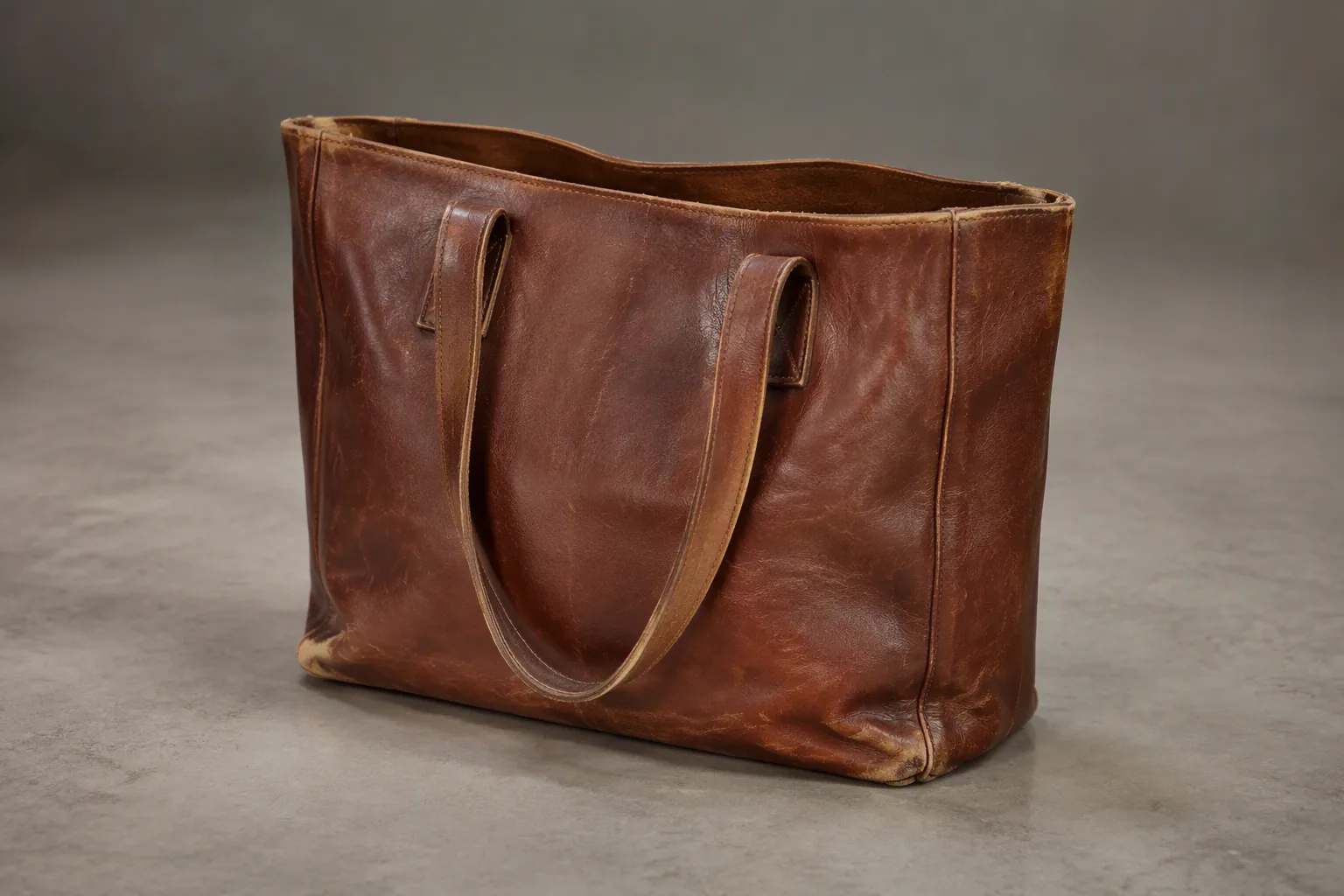
The Failure Map
Six modes cover most field failures.
| Failure mode | Where it usually starts | What drives it | Design lever |
|---|---|---|---|
| Abrasion | Base corners, handle roots, top edge | Load concentration, finish durability | Reinforcement, edge treatment, finish choice |
| Flex fatigue | Flap hinges, gussets, pocket mouths | Repetition, stiffness at the fold | Softer material, fold geometry, thickness at the joint |
| Edge failure | Long edges and gusset edges | Exposure, coating depth, material thickness | Edge treatment depth, material selection |
| Seam failure | Strap attachments and panel joins | Load crossing the stitch line | Load-path geometry, stitch layout, reinforcement |
| Hardware failure | Handles, straps, closures | Plating wear, attachment method, load | Plating specification, attachment design, serviceability |
| Lining failure | Pocket mouths, linings, zip tracks | Abrasion from contents, poor access | Lining material, access geometry, closure choice |
Which Modes Matter Most
It depends on the bag.
A tote carried by hand concentrates wear at the handle and base corners. A backpack concentrates it at strap attachments and the base. A diaper bag concentrates it at the opening, at the straps and wherever the bag is repeatedly lifted while full, which is why the intended carry pattern should determine where reinforcement is specified.
Leather Choices That Extend Life
Material sets the ceiling.
Tannage and Ageing Behaviour
Different chemistry, different ageing.
Leather does not simply wear out; it changes. Some tannages darken and soften and keep improving with handling, while others hold their colour but stiffen or surface-crack. A brand that knows the intended ageing path can choose a tannage that ages in a way the customer will accept.
Fibre Structure and Thickness
Density where it matters.
The fibre structure of a hide varies, and the same nominal thickness behaves differently depending on where it was cut. Panels that carry load benefit from denser, more consistent material, while panels that mainly flex benefit from a structure that tolerates repeated bending.
Grain and Finish Durability
The surface is the first casualty.
Finish durability determines how a bag looks after a year of use. A finish that is chosen for its appearance at approval but cannot tolerate abrasion will show wear at exactly the points a customer looks at first.
Choosing for the Part, Not the Bag
One bag, several leathers.
Where a single specification is applied to every part of a bag, some parts are over-engineered and others are under-protected. Allocating leather by panel function — load-bearing, flexing, decorative, lining-adjacent — usually improves service life without changing the headline material.
Why Rejection Rate and Durability Are Different
Two separate signals.
A leather that arrives with few visible defects can still wear quickly, and a leather with character marks can last for years. Goods-in rejection rate measures how a material looks on arrival, while durability measures how it behaves in use, and a programme managed only on the first number will not improve the second.
Where a Softer Leather Is the Right Answer
Comfort and durability are not opposites.
Softer leathers can outlast firmer ones in areas that need to flex, because they distribute movement instead of resisting it. The mistake is assuming that the heaviest leather is always the longest lasting one.
Construction Choices That Extend Life
How the bag is put together decides where it fails.
Seam Direction and Load Paths
Load should run along the seam.
Where a load pulls across a stitch line, the stitches work against the leather and the material tears between them. Where the load runs along the seam, the seam distributes it. This is a geometry decision, and it is cheapest to make at pattern stage.
Reinforcement at Stress Points
Small additions with long returns.
Handle roots, strap attachments, base corners, flap hinges and pocket mouths are the places most likely to need reinforcement. The reinforcement has to be located so that it does not create a stiff edge that becomes the next failure point.
Edge Treatment and Its Life
Edges age faster than panels.
Edges take abrasion on both sides and lose their finish first. Edge treatment choices, and the thickness of material they are applied to, determine whether an edge degrades gracefully or opens up within months.
Interior Protection
The inside is used harder than the outside.
Bags are loaded, searched, emptied and reloaded many times for every one time they are admired. Lining specification, pocket construction and the protection around closure hardware should be chosen with that in mind.
Where Reinforcement Usually Belongs
A short working list.
- Handle roots, where the strap leaves the body of the bag
- Strap attachment points, especially where a fitting sits between two layers
- Base corners, which take both abrasion and impact
- Flap hinges, which flex on every opening
- Pocket mouths, which are loaded and pushed against
- Zip ends and slider stops, where closure loads concentrate
- Points where a heavy component such as a laptop sleeve hangs from a panel
The list is a starting point rather than a rule. The point is to place reinforcement deliberately, then check that it has not created a new stiff edge that becomes the next failure point.
Simplicity as a Durability Strategy
Fewer parts, fewer failures.
Every additional layer, attachment and decorative element is a potential failure point and an additional joint to get wrong. Where two designs achieve the same look, the one with fewer joints usually lasts longer.
Hardware: Often the First Part to Fail
Small parts, early failures.
Plating Wear and Corrosion
The finish is a layer.
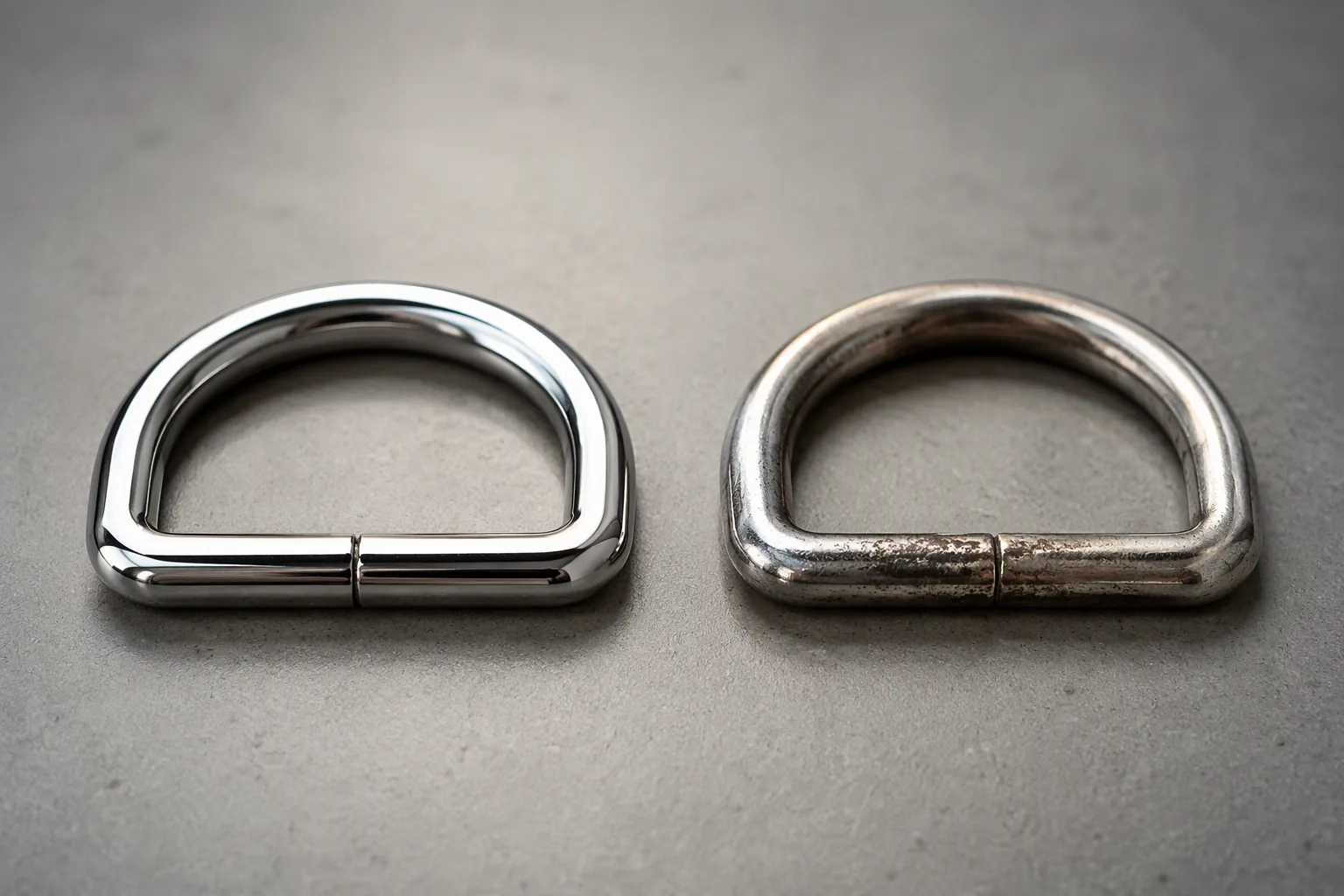
Plating is a surface layer, and it wears where it contacts skin, straps and other metal. Once the layer is breached, the base metal is exposed to moisture and the change accelerates, which is why plating specification matters more on handles and straps than on decoration.
Attachment Versus Fitting
Two different failure questions.
A fitting can be perfectly sound and still fail because of how it is attached. Rivet and stud applications, bar geometry and the material immediately around an attachment determine whether load transfers into the leather or concentrates at a hole.
Maintenance Access
Can it be tightened or replaced?
Hardware that can be re-tightened, cleaned or replaced extends the life of the bag at very low cost. Hardware pressed, glued or concealed so that it cannot be serviced converts a small repair into a rejected bag.
Questions Worth Asking About Hardware
Simple questions with structural answers.
- What is the base metal and the plating specification?
- What load must the fitting carry, including swing and lift loads while full?
- How is the fitting attached, and does the attachment transfer load into the leather?
- Can the fitting be re-tightened, cleaned or replaced in service?
- Is the fitting a standard component, so spares remain available?
- Has the same fitting been used in a comparable bag with field history?
Choosing Hardware for Load, Not Looks
Tensile reality.
A small, elegant fitting may be entirely adequate for a light bag and structurally wrong for one that carries weight daily. Matching hardware to the actual load, including the dynamic loads from lifting and swinging, is more important than matching it to a mood board.
Specifying Service Life
Turn intention into a requirement.
Writing a Testable Requirement
Something a supplier can meet.
A usable requirement describes the conditions of use, the parts most exposed, and the behaviour expected after a defined period or number of cycles. Even an approximate, clearly stated requirement is more useful than a general instruction to make the bag strong.
Use Conditions Belong in the Requirement
How the bag is carried changes everything.
Daily commuting, occasional evening use, travel with a laptop, and constant lifting while full place very different demands on the same construction. Stating the intended use lets the factory direct reinforcement where it will actually be needed.
Reference Bags and Competitive Benchmarks
Compare against something real.
Where a brand has a bag that performs well in the field, it can be dismantled and used as a benchmark for the new programme. Comparing construction and wear points between a known-good bag and a new sample is fast, cheap and informative.
A Workable Structure for the Requirement
Keep it short and specific.
- Intended use, including how the bag is carried and what it usually holds
- Reference to a known-good bag, where one exists
- The parts identified as most exposed, by name
- Material and construction expectations for those parts
- The behaviour expected after defined representative use
- The verification method, whether inspection, bench test or field comparison
- The conditions under which the result may be reported
A one-page requirement built this way is far more useful than a long document that describes a bag as high quality without saying what that means in behaviour.
Where Suppliers Add Value
Ask them early.
Factories see failure patterns across many brands and often know which construction detail has caused returns elsewhere. Bringing them the failure map before sampling, rather than after a problem, converts their experience into design decisions.
What Suppliers Can and Cannot Promise
Honest limits.
A supplier can control material choice, construction and process consistency. It cannot promise a specific number of years in unpredictable use, and any supplier that does is describing a warranty rather than a test. The requirement should be expressed in behaviour the factory can verify.
Designing for Repair
Long life often means a second life.
Accessible Seams and Replaceable Parts
Designed so it can be opened.
A bag that can be reopened along a seam, or whose strap, slider or fitting can be unscrewed, has a service life that extends beyond its first failure. Sealing a bag at every joint makes it robust and unrepairable at the same time.
Spare Availability
Order the parts with the bag.
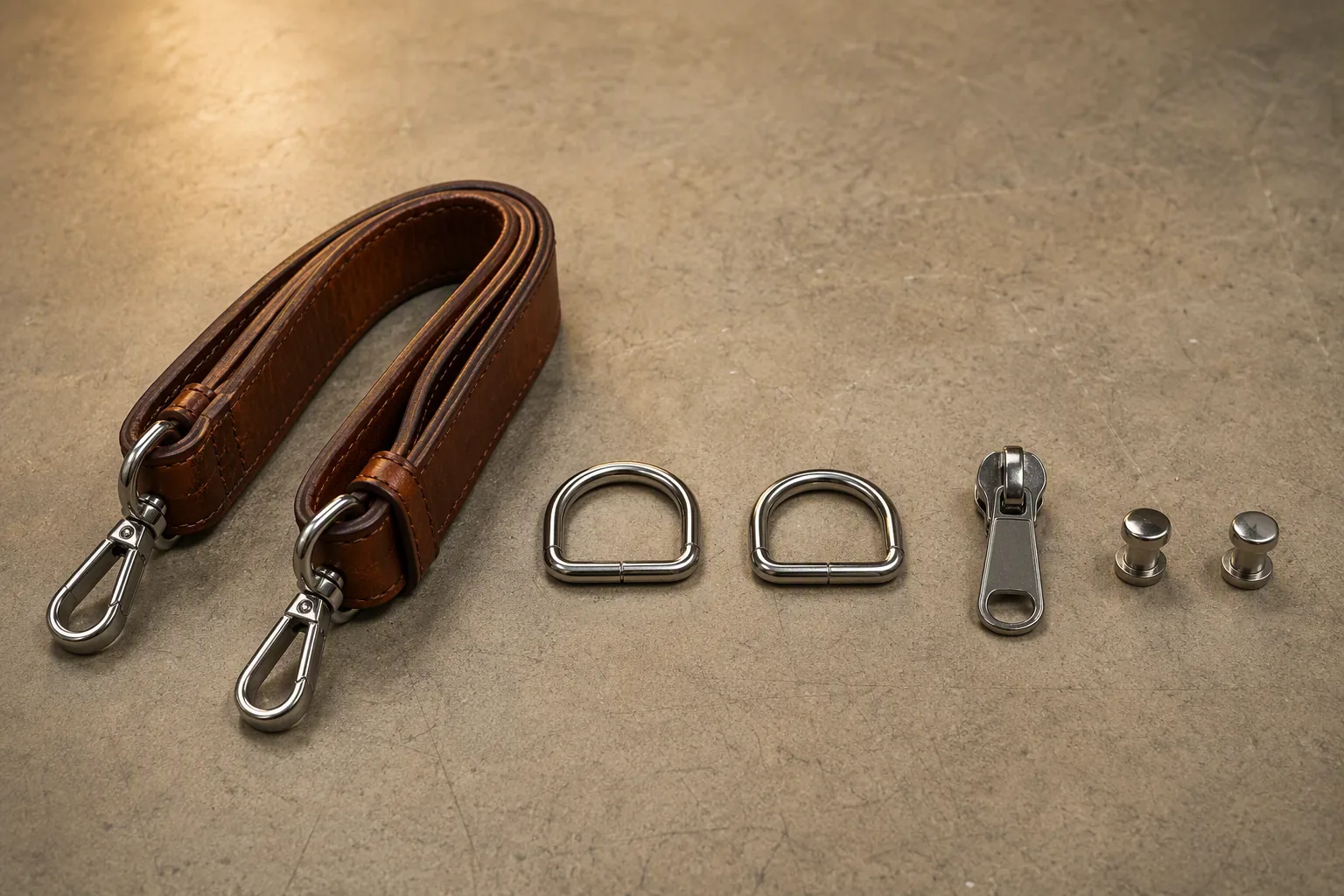
Spares are cheapest when they are produced alongside the main run and cheapest still when the fitting is a standard component rather than a proprietary one. A brand that specifies a proprietary fitting should plan its spare stock at the same time as its production stock.
Information for the Owner
Repair starts with knowing what is possible.
Owners usually discard bags because they do not know whether a strap can be replaced or where to take it. A short statement of what is replaceable, and what the bag should not be exposed to, does more for service life than most construction changes.
What Owners Actually Ask For
Repair requests follow a pattern.
Owners most often ask for a strap, a zip, a handle or a lining to be dealt with, and for the surface to be refreshed. Those requests describe exactly which parts of a bag are consumed first in use, and a brand that tracks them has a continuously updated list of where the next design should spend its reinforcement budget.
Repair Economics
The decision is often financial.
A repair is only undertaken if the cost is a reasonable fraction of a replacement. Designing so that a strap, a zip slider or a base foot can be replaced cheaply is what keeps that fraction low for the owner.
Testing and Evidence
Claims need something behind them.
What to Test and Why
Test the failure mode, not the product.
Testing is most informative when it targets the specific way a bag is expected to fail: abrasion at contact points, flexing at hinges, loading at attachments, function of closures. A generic test that does not reproduce a failure mode produces numbers without insight.
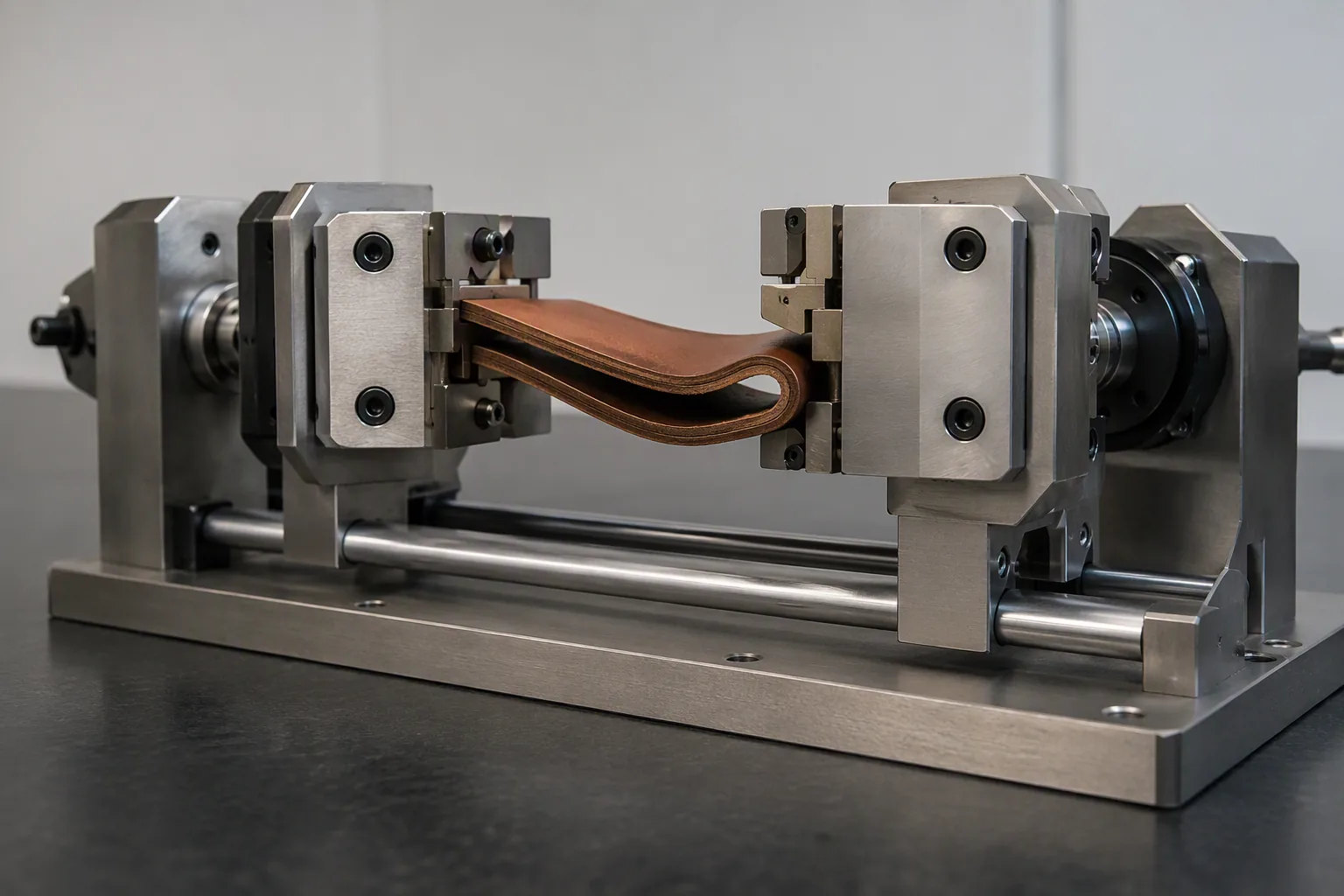
Wear and Flex Testing in Principle
Reproduce the stress, then repeat it.
Flex and abrasion testing works by applying a repeated motion or contact that represents real use, then observing when the material or joint changes. The value lies in comparison between samples rather than in an absolute figure, so conditions and sample preparation must be identical to be meaningful.
Which Parts to Test
Follow the failure map.
- Base corners and handle roots, for abrasion resistance
- Flap hinges and gussets, for flex endurance
- Strap attachments, for static and repeated loading
- Closure hardware, for function after repeated cycles
- Lining and pocket mouths, for abrasion from contents
- Edges on exposed panels, for finish retention
Testing more parts than this rarely changes a decision. Testing fewer usually leaves the first field failure untested.
Ageing and Conditioning
New samples are optimistic.
Leather conditions and changes with handling, light, humidity and time. Where a claim concerns long-term behaviour, samples should be conditioned or compared against field-returned bags, because a fresh sample flatters the finish and the leather.
Interpreting Results
A test is a comparison, not a verdict.
The output of a wear or flex test is a ranking between options under defined conditions. Stating those conditions when reporting results is what keeps a test defensible, and comparing results produced under different conditions is one of the most common sources of misleading internal conclusions.
A Durability Review Before Sampling
A short review prevents an expensive correction.
The Questions to Ask at Pattern Stage
Ask before the first sample is cut.
- How is the bag carried, and what load does that place on which panel?
- Where will the bag touch the ground or rest against a surface?
- Which points open and close most often?
- Which joints carry load across the stitch line?
- Which parts will a customer handle every single day?
- What happens if that part fails — is the bag still usable?
- Which part is most likely to be replaced first, and can it be?
Marking the Wear Points
Put it on the drawing.
Marking the abrasion and flex points directly on the pattern or the technical drawing makes them visible to everyone who touches the programme. Points that exist only in a conversation tend to be forgotten between sampling and production.
Agreeing What Will Be Tested
Decide before sampling.
Agreeing which parts will be tested, and under what conditions, at the same time as the design ensures that the samples are made in a way that can actually be evaluated. Deciding afterwards usually means the sample cannot produce a meaningful result.
Keeping the Review Short
Half a day is enough.
The review does not need to be a formal programme. A focused session with the designer, the factory and whoever sees the returns will identify the wear points on almost any bag, and the conclusions are quick to record on the drawing.
Where Durability Claims Go Wrong
Ambition outruns the evidence.
Vague Longevity Claims
Words without conditions.
Statements such as built to last or designed for a lifetime carry no testable content. Where a brand wants to make a durability claim, it should state the context: the use conditions, the parts verified and the method used.
Testing That Proves Nothing
Effort in the wrong direction.
A test on a component that never fails in the field, or on a sample prepared differently from production, uses budget without reducing risk. Testing should follow the failure map rather than a catalogue.
Ignoring Use Conditions
The customer decides the load.
A bag specified for occasional use and carried daily with a laptop will fail on schedule for daily use, not on schedule for the specification. Reviewing the actual carrying pattern with the retailers or customers who see returns is the cheapest correction available.
Overstating Repairability
A claim the workshop cannot support.
Promising repairability requires that parts exist, that a repair route exists and that the repair is economic. A design that is theoretically repairable but has no spare fittings available is, in practice, a disposable bag with a better story.
Common Mistakes Brands Make
| Mistake | Consequence | Prevention |
|---|---|---|
| No written service-life requirement | Nothing to review or improve | State conditions of use and expected behaviour |
| One leather for every panel | Over-engineering and weak points together | Allocate material by panel function |
| Design for looks at wear points | Early failure exactly where it shows | Map abrasion and flex points at pattern stage |
| Hardware chosen by appearance | First field failure arrives early | Match fittings to static and dynamic load |
| Every joint sealed | Robust but unrepairable | Keep defined joints serviceable |
| No spare parts planned | Repairs become uneconomic | Order spares with the production run |
| Testing without a failure mode | Cost without risk reduction | Test against the failure map |
| Durability claims without evidence | Claims that cannot be defended | Report the method and conditions used |
Frequently Asked Questions
Is durability really a sustainability claim?
It is the most defensible one available for a leather bag, because the largest share of material and processing impact happens before the customer receives the product. A bag that stays in use avoids the creation of a replacement, which is a much larger saving than any packaging change.
Which part of a leather bag usually fails first?
Hardware and its attachments, closely followed by edges and the high-abrasion points such as base corners and handle roots. These are also the parts where cost pressure is strongest, which is why they deserve explicit specification rather than being left to default choices.
Does heavier leather always last longer?
No. Heavier leather resists abrasion better in some places and resists flexing worse in others. Panels that open and close repeatedly can outlast a firm, thick material with a softer one that distributes movement instead of fighting it.
How should a service-life requirement be written?
As a statement of use conditions plus expected behaviour on the parts most exposed, for example the condition of the base corners and strap attachments after a defined period of representative use. Even an approximate requirement gives the factory something to design and verify against.
Can a supplier guarantee a number of years?
A supplier can commit to material, construction and process consistency, and can be held to test outcomes under defined conditions. A specific number of years in unpredictable use is a commercial warranty rather than a test result, and it should be treated as such in the specification.
What is the cheapest durability improvement available?
Reinforcement and load-path review at pattern stage. Identifying where the load concentrates and where abrasion falls, then adjusting geometry, reinforcement and edge treatment before sampling, costs design time rather than material and repeatedly removes the most common field failures.
How do we compare durability between two suppliers?
Give both the same requirement, the same acceptance criteria and the same test conditions, and ask each to submit samples from production materials rather than hand-made specimens. Comparing field returns between the two is more informative still, if either has a record.
Should the lining be specified as carefully as the leather?
Yes, because the interior is used harder than the exterior. Lining and pocket failures affect usability early, are hard for a customer to inspect at purchase and are usually discovered only after the bag is in daily use.
How does repairability relate to durability?
They extend service life in different ways. Durability delays the first failure; repairability limits how much a failure costs the owner. A product designed with both in mind lasts longer in practice than one that is only made robust.
Do spare parts really change the outcome?
They do, because the repair decision is usually financial. Where a strap, slider or base foot can be replaced at a modest cost, owners repair rather than replace, and the bag stays in use for another stretch of time.
What should be reviewed before the next production run?
The failure map, any changes to materials or fittings, the spares stock and the previous season’s return reasons. Most early-life durability problems are visible in return data long before they appear in a customer complaint.
The Bottom Line
Service life is decided at specification stage. The leather chosen for each panel, the geometry of the load paths, the reinforcement at stress points, the specification of the parts that wear first and the accessibility of the joints together determine whether a bag lasts a season or a decade.
Making that explicit is not complicated. State how the bag will be used. Map where it will abrade and where it will flex. Allocate material and reinforcement accordingly. Specify hardware against load rather than appearance. Keep defined joints serviceable and order spares with the run. Then test against the failure map, and report the conditions alongside the result.
A brand that can describe its durability requirement, and show what was done to meet it, holds an advantage on two fronts at once. It gives customers a product that stays useful, and it has an answer when someone asks what the bag’s longevity claim is actually based on.
