
Leather Diaper Bags: What to Look For Before You Buy
Leather Diaper Bags: What to Look For Before You Buy
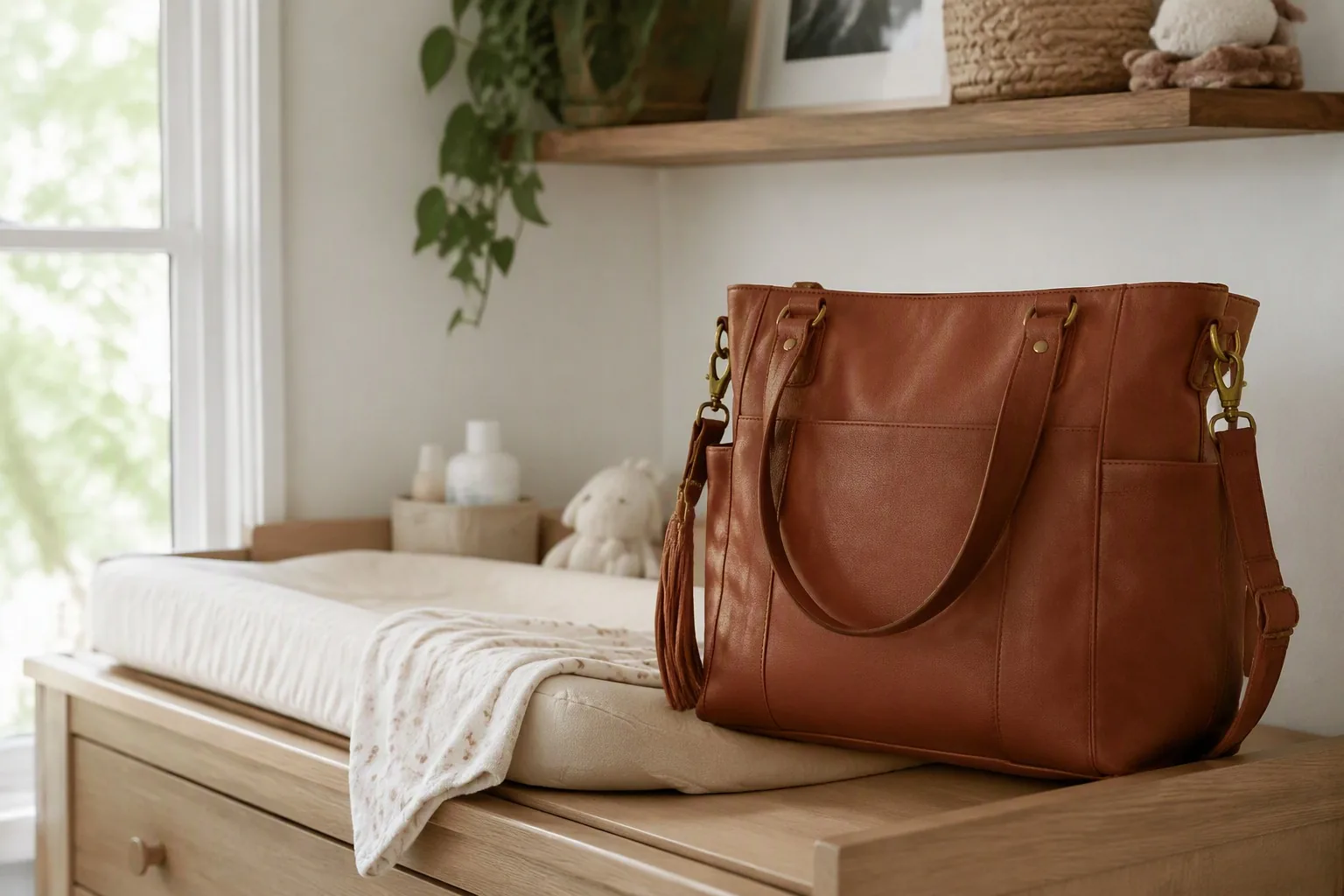
The diaper bag is the hardest-working bag most parents will ever own. It carries more weight, meets more spills, and opens more times a day than any briefcase or travel bag. And for many parents, it is also the most visible bag they carry — which is why leather is so tempting.
A leather diaper bag promises to look good while doing a job that punishes bags. Some leather diaper bags deliver on that promise for years. Others look beautiful and fail within months.
The difference is not luck. It is a set of decisions made at the factory: the leather, the construction, the organization, and the hardware. This guide explains what to look for — from the manufacturer’s side of the table.
- The Most Demanding Bag You Will Own
- The Leather Question
- The Material Question: Leather vs the Alternatives
- Construction: What Holds Under Pressure
- Organization: The Interior Test
- Straps and Carry
- Care Reality: Leather vs Fabric
- Sizes and Bag Types
- Smell, Sound and First Impressions
- Budget Reality: What Quality Costs
- Red Flags in Cheap Diaper Bags
- From the Factory: How We Build Diaper Bags
- From Baby to Toddler: The Bag’s Lifecycle
- Where to Buy and How to Verify
- The Buying Checklist
- Frequently Asked Questions
- The Bottom Line
The Most Demanding Bag You Will Own
Before choosing a leather diaper bag, understand what the bag will actually face. The job description explains every requirement that follows.
What a Diaper Bag Carries
A loaded diaper bag carries bottles, wipes, diapers, a change of clothes, snacks, toys, and the parent’s own wallet and phone.
The loaded weight is real: five to eight kilograms on a bad day, carried over shoulders, hung off strollers, and dropped on floors. No other bag in the house works this hard.
How Often It Opens
The diaper bag opens constantly: every change, every bottle, every snack, every toy retrieval.
A working parent opens the bag dozens of times a day, which means the zippers, snaps, and closures cycle thousands of times a year. This is the wear test that separates real diaper bags from fashion bags wearing the label.
Why Leather Fits or Fails
Leather fits the job when it is chosen and built for it. Quality leather shrugs off daily handling, develops a rich patina, and lasts for years.
Leather fails the job when it is thin, poorly finished, or built with fashion priorities instead of parent priorities. The failure is rarely the leather itself — it is the choices made around it.
Manufacturer’s point: A diaper bag is a tool that happens to be beautiful, not a fashion piece that happens to carry diapers. Design it in that order and both jobs succeed.
The Leather Question
The leather choice decides the bag’s behavior for its whole life. The right leather for a diaper bag is not the same as the right leather for a clutch.
What Leather Works for Diaper Bags
The best diaper bag leathers balance durability, water resistance, and easy care.
Full-grain and top-grain cowhide lead the list: tough, tight-grained, and available in finishes that resist spills. Chrome-tanned leathers handle moisture better than vegetable-tanned. Oiled and waxed leathers add natural water resistance. The leather should be finished enough to resist the daily wipe-down, but genuine enough to age well.
Full-Grain vs the Rest
The leather grades matter here as much as anywhere, but the diaper bag context changes the advice slightly.
Full-grain is the strongest and most durable, and it patinas beautifully — but lighter full-grain shows water spots and scratches. Top-grain with a protective finish trades some natural character for wipe-clean practicality. Both are fine choices; the deciding factor is the finish, not just the grade.
Leather Grades Compared
| Grade | Durability | Spill resistance | Aging | Best role |
|---|---|---|---|---|
| Full-grain | Highest | Depends on finish | Patina | Premium, long-term bags |
| Top-grain | High | Good with finish | Even | Best all-round choice |
| Genuine (split) | Moderate | Moderate | Faster wear | Budget bags |
| Bonded | Low | Poor | Short life | Avoid for daily use |
The Finish Decision
The finish is the detail most buyers miss, and it decides the spill question.
A sealed, pigmented finish wipes clean and resists bottle leaks. A natural aniline finish is beautiful and vulnerable. For a diaper bag, choose the finish that survives parenting — the leather underneath can still age beautifully through the sealed surface.
The Water Resistance Recap
A diaper bag meets water constantly: rain at the school gate, bottle condensation, wet wipes, and the eternal leaky sippy cup.
Sealed and finished leathers repel light moisture by design. Chrome-tanned leather handles dampness better than vegetable-tanned. For the honest expectations: no genuine leather is fully waterproof, but a well-finished leather diaper bag survives real parenting days without drama. Treat it before the wet season and blot it dry after storms.
The Weight of the Leather
Leather is heavier than the synthetic materials used in most diaper bags, and the weight difference matters.
A leather bag adds half a kilogram or more before a single diaper goes in. For parents who carry the bag all day, the added weight is a real consideration. Thinner leathers lighten the bag but shorten its life. The right balance is a mid-weight leather with solid construction — not the thinnest leather that makes the bag light.
The Material Question: Leather vs the Alternatives
Most diaper bags are not leather, and the comparison explains both the premium and the compromises of choosing leather.
Fabric Diaper Bags
Nylon and canvas diaper bags are light, washable, and inexpensive. They also stain, fray, and look worn within a year.
Fabric bags win on practicality and price. They lose on longevity and appearance. For parents who want a bag that still looks good when the second child arrives, fabric is usually not the answer.
PU and Synthetic Leather
PU “leather” diaper bags offer the leather look at a fraction of the price, and their surfaces wipe clean.
The catch is durability: PU surfaces peel and crack within a year or two of daily use, especially at the corners and strap points. A PU diaper bag looks like leather at purchase and like worn plastic eighteen months later.
The Honest Comparison
| Material | Durability | Care | Weight | Cost | Aging |
|---|---|---|---|---|---|
| Full-grain leather | Decades | Wipe + condition | Heaviest | Highest | Patina |
| Top-grain leather | Years | Wipe + condition | Heavy | High | Even |
| PU synthetic | 1–2 years | Wipe clean | Light | Low | Peels, cracks |
| Coated nylon | 2–4 years | Machine washable | Light | Moderate | Frays, fades |
| Canvas | 1–3 years | Machine washable | Light | Low | Stains, wears |
Construction: What Holds Under Pressure
The leather is the face; the construction is the skeleton. A diaper bag’s skeleton works harder than any other bag’s.
Stitching and Stress Points
Every diaper bag has known stress points: the strap attachments, the handle base, the corners, and the top opening edges.
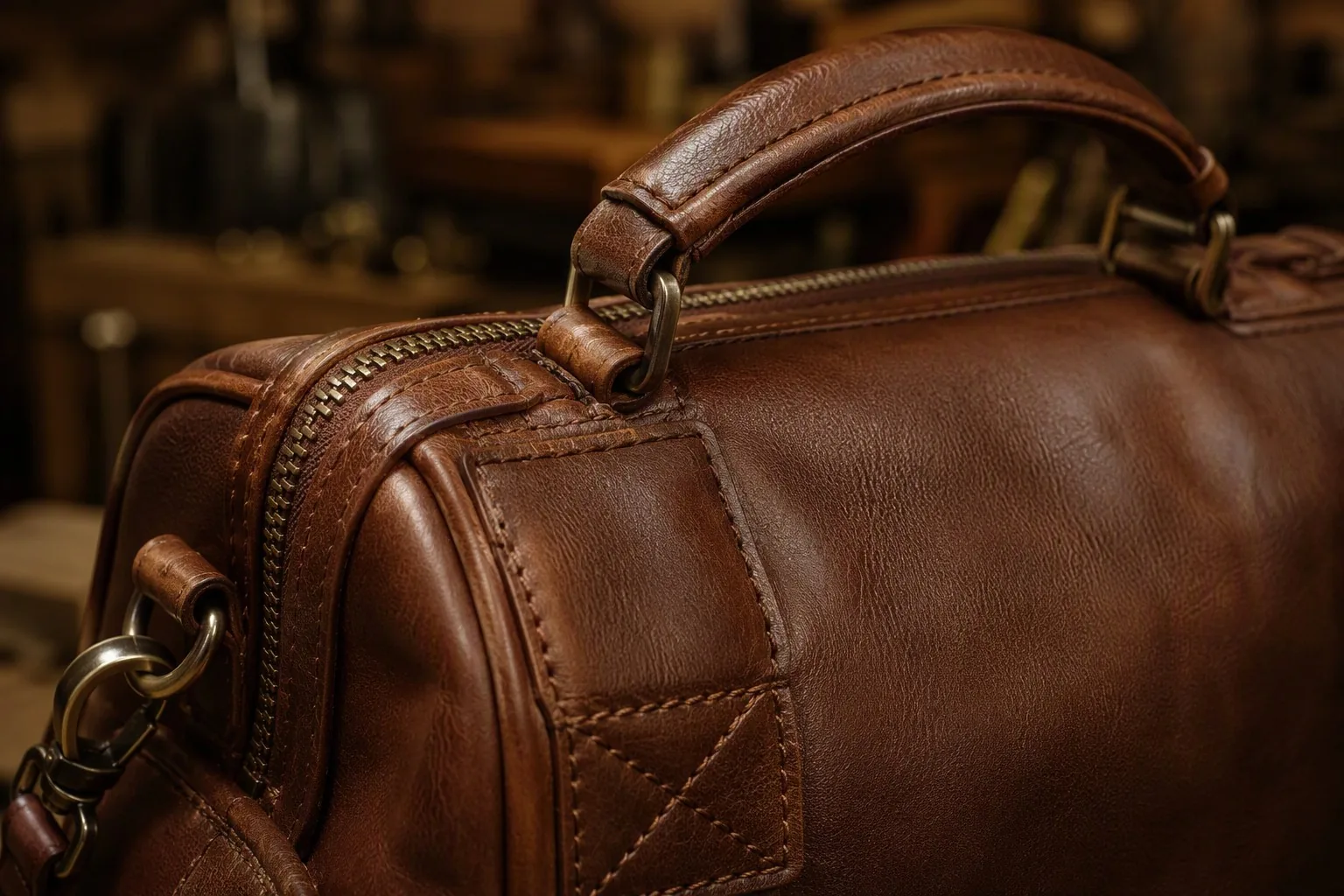
Quality bags reinforce these points with bar-tack stitching, doubled layers, and extra rows of stitches where the load concentrates. Cheap bags stitch them once and hope. Look inside the bag at the attachment points before you buy.
Hardware That Survives
Diaper bag hardware cycles thousands of times a year and must survive wet hands, sand, and impatient tugs.
Choose solid zippers with quality sliders, sturdy snaps, and hardware that does not rattle. The zipper is the most used part of a diaper bag, and a cheap zipper fails at the worst moment — usually with a full bag and a crying baby.
Lining and Cleanability
The interior of a diaper bag sees spills that would ruin a normal bag lining.
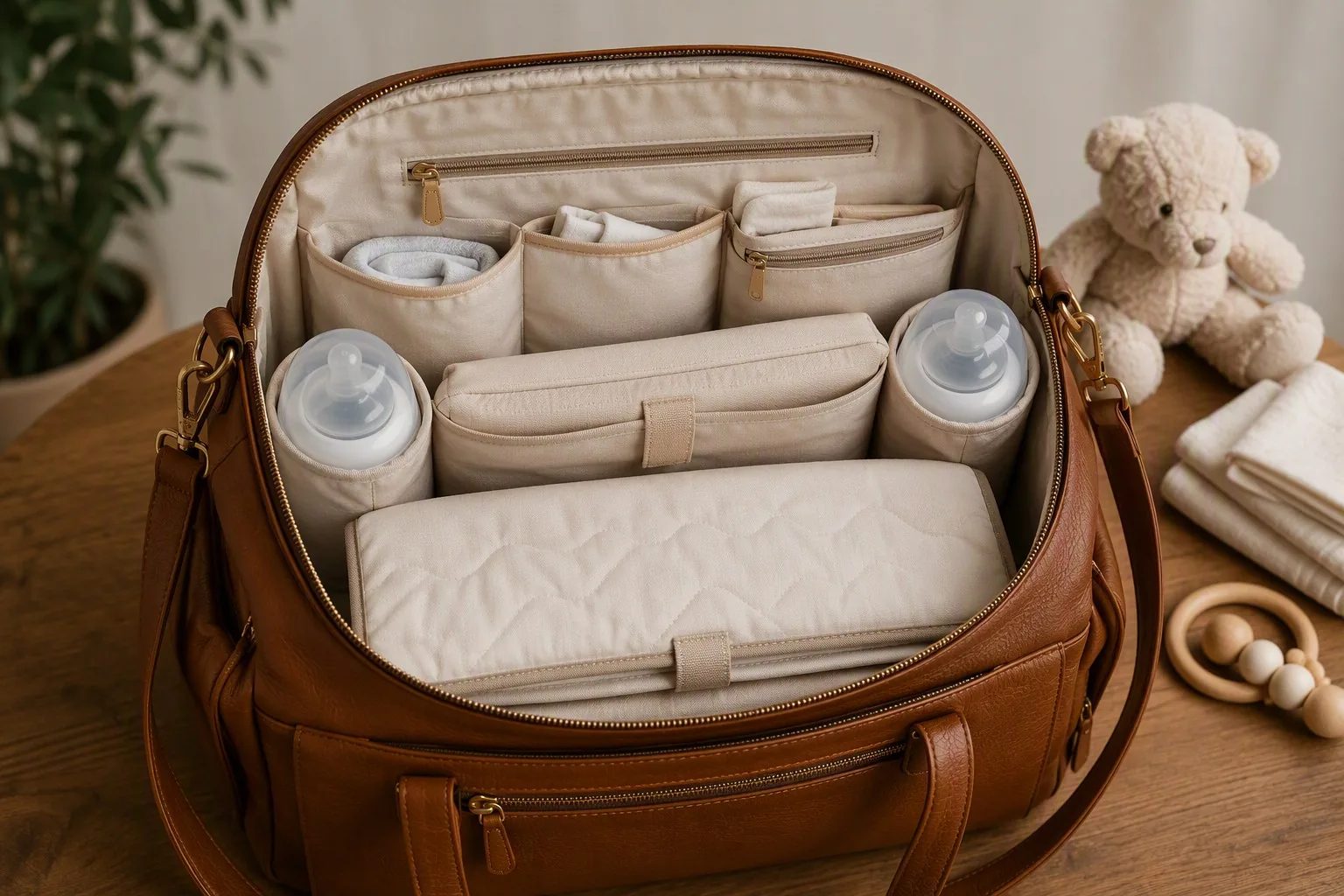
A wipe-clean lining is a requirement: coated fabric or smooth nylon that cleans with a cloth. Deep, unreachable fabric linings trap crumbs and smells. Check that the interior pockets are also wipeable, because that is where bottles leak.
Organization: The Interior Test
Organization is the soul of a diaper bag. Parents do not carry a bag — they live out of it, one-handed, in the dark, while the baby screams.
The Bottle Problem
Bottles leak, condense, and need to stay warm or cold. The bag must handle all three.
Insulated bottle pockets are the first requirement: two or more, sized to fit bottles, positioned so a leak does not soak the whole bag. Bottle pockets that are open at the bottom leak into the main compartment; sealed-bottom pockets contain the mess.
Pockets That Work
The pocket layout decides whether a parent can find the pacifier in seconds.
The practical layout has a few large zones rather than many small ones: a main compartment, a wipe-access pocket, a quick-grab front pocket, and hidden zip pockets for the parent’s own valuables. Each item should have a home that is findable one-handed.
The Changing Pad Question
Many diaper bags include a changing pad, and the pad quality varies enormously.
A good pad is wipeable, padded enough for a baby’s comfort, and sized generously. A thin, flimsy pad is a box-ticking extra. If the pad matters to you, check it folds into a pocket that does not steal main-compartment space.
Straps and Carry
A bag that hurts to carry gets abandoned, no matter how beautiful. The carry system is a practical decision, not a detail.
The Weight Distribution
A loaded diaper bag weighs several kilograms, and how that weight sits on the body matters.
Wide, padded straps spread the load and prevent the shoulder strain that narrow straps cause. A bag that carries on the shoulder and converts to stroller straps gives options. The top handles should be reinforced, because the handles take the weight every time the bag is lifted into a car or off a hook.
Wearing Styles
The three main styles suit different phases and preferences.
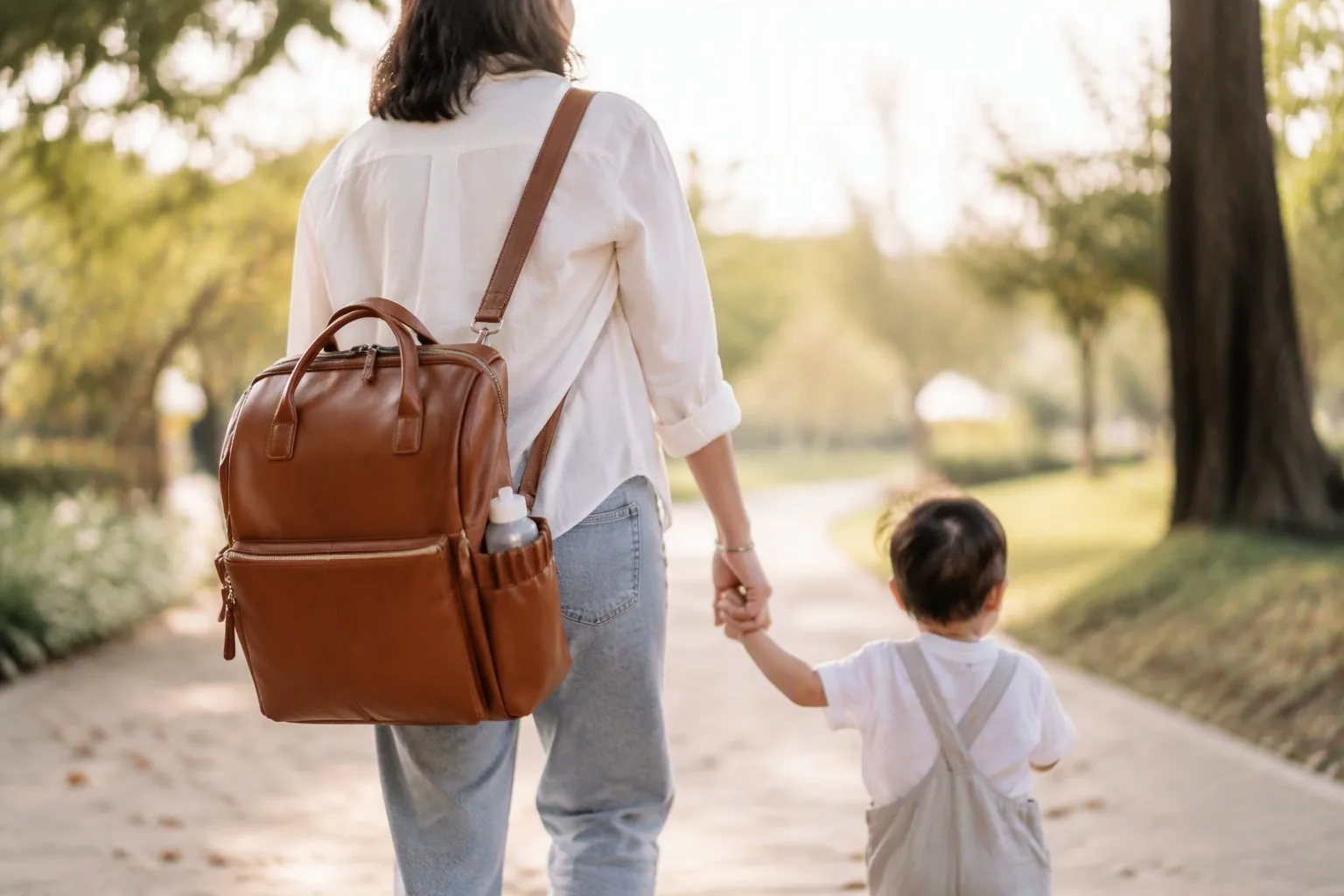
The tote is the classic: easy access, shoulder or arm carry, the most open layout. The backpack frees both hands — the practical winner for toddlers who run. The messenger crosses the body and stays put while chasing a child. Many parents end up owning two styles for different stages.
The Stroller Attachment
Real life involves a stroller, and the bag needs to ride on it.
Check for stroller straps or pass-through loops on the back. A bag that slides off the stroller handle is a daily annoyance; one that hooks securely is a small daily joy. Also confirm the bag stands upright when set down, since floors are part of a diaper bag’s life.
Care Reality: Leather vs Fabric
The care conversation is where leather diaper bags win or lose buyers. The honest version helps parents choose with open eyes.
The Wipe-Clean Question
Parents ask one question: can I wipe it clean? The answer depends on the finish, not on whether it is leather.
A sealed-finish leather bag wipes clean like a fabric bag with a coated interior. A natural-finish leather bag needs more care and shows its life more. If the parent is a wiper, choose the sealed finish; if they appreciate patina, the natural finish rewards them.
What Parents Actually Need
The realistic care routine for a leather diaper bag is shorter than most parents fear.
Wipe spills promptly, blot rain, condition twice a year, and store it dry. That is the whole routine. The leather does the rest, aging into a bag that looks better at year two than at week two — which is the opposite of most fabric diaper bags.
The Long-Term Value
A quality leather diaper bag costs more upfront and lasts longer than a fabric one.
The cost per year tells the story: a $250 leather bag that serves two children and sells on still has value. A $60 fabric bag that stains and frays after one child is done. Parents who do the math often choose leather for the second child even if they did not for the first.
Sizes and Bag Types
The right size depends on the stage and the family’s habits. Bigger is not always better — a bag that is too large becomes a black hole.
The Tote
The diaper tote is the classic choice: roomy, open, and easy to pack and unpack.
It suits the early months, when parents carry everything. The open layout makes items visible, and the wide opening accepts a full change of clothes without wrestling. Its weakness is hands-free carrying — the tote occupies one hand.
The Backpack
The diaper backpack is the modern favorite for mobile parents.
It distributes weight across both shoulders, frees both hands for the toddler, and fits under strollers and airplane seats. The trade-off is access: parents must take the backpack off or swing it around to reach the contents.
The Comparison
| Feature | Tote | Backpack | Messenger |
|---|---|---|---|
| Access speed | Fastest | Slower | Fast |
| Hands-free | No | Yes | One hand |
| Weight comfort | Shoulder strain | Best | Good |
| Toddler phase | Early months | Best | Good |
| Stroller fit | Good | Good | Awkward |
| Best for | Full loads | Mobile days | Quick trips |
Smell, Sound and First Impressions
The sensory details of a leather diaper bag matter more than most buyers expect. They are also honest quality signals.
The Leather Smell Question
Some parents worry about leather smell around a baby. The honest answer is that quality leather has a mild, natural scent that most people find pleasant and that fades within weeks.
Strong chemical smells are the warning sign: they come from poor tanning or cheap finishes. A quality leather diaper bag should smell like leather, not like a factory. If the smell bothers you in the store, it will bother you at home.
The Rattle Test
Shake the bag gently before buying. Quality hardware is silent; loose hardware rattles.
A rattling buckle, a clinking zipper pull, or a snap that shakes in its housing all point to hardware chosen for price, not for a thousand daily cycles. The quiet bag is the well-built bag.
The Weight and Feel Signal
Lift the empty bag and feel the leather. Quality leather has substance and a pleasant texture.
Paper-thin leather that feels like plastic, hollow panels, and hardware that flexes under light pressure are all signals of corners cut. A diaper bag that feels cheap when empty will feel worse when full.
Budget Reality: What Quality Costs
Leather diaper bags span a wide price range, and the range maps to real differences. The budget question deserves an honest answer.
What the Price Bands Mean
Entry-level leather diaper bags run from $80 to $150, mid-range from $150 to $300, and premium from $300 upward.
The entry band usually means thinner leather, simpler construction, and plated hardware. The mid band is where full-grain or quality top-grain with solid construction appears. The premium band buys the best hides, the strongest hardware, and the finishing details that last.
Where to Spend and Where to Save
The construction and hardware deserve the money; decorative details do not.
Spend on the leather grade, the stitching, the zippers, and the straps. Save on decorative extras that add cost without adding parenting value. A plain, well-built leather diaper bag beats an ornate, poorly built one at the same price.
The Second-Child Math
The economics change with the second child, and many parents upgrade at that point.
A quality bag that serves two children costs half as much per child as a cheap bag that barely serves one. Parents who bought fabric the first time often buy leather the second time — the first bag taught them the lesson.
Red Flags in Cheap Diaper Bags
The market is full of leather-look diaper bags at tempting prices. The red flags are consistent, and they are visible if you know where to look.
The Material Red Flags
Bonded leather and thin “genuine” splits wear quickly under diaper-bag duty. PU leather that claims to be leather is not leather at all.
Check the label, the edge, and the texture. Ask directly what the leather is. A seller who cannot answer is selling something they do not want to name.
The Construction Red Flags
Thin single stitching at stress points, rattling hardware, and zippers that catch are all warnings.
Look inside at the attachment points, pull gently on the handles, and zip and unzip everything several times. A bag that struggles in the store will fail in the field.
The Function Red Flags
A diaper bag that fails the organization test fails as a diaper bag, whatever it looks like.
No insulated bottle pockets, no wipe-clean interior, no way to find anything one-handed — these are not compromises, they are disqualifiers. The most beautiful bag without basic diaper-bag function is a handbag with extra pockets.
From the Factory: How We Build Diaper Bags
The factory perspective explains why some diaper bags work and others disappoint. The process is where the decisions happen.
The Design Meeting
Every serious diaper bag starts with a design brief written around real parenting, not around a catalog.
The brief lists the load, the opening frequency, the spill scenarios, and the carrying styles. The designer and the factory then argue about every detail: where the bottle pockets sit, how the pad folds, where the straps attach. The arguments are the product.
The Material Selection
Leather selection for diaper bags follows the use case, not the look.
We test candidate leathers for spill resistance, flex durability, and cleanability before production. The leather that looks best in the showroom is rarely the leather that survives the second year of parenting.
Testing for Real Life
Real diaper bag testing is less elegant than laboratory testing, and more honest.
We load bags with the real weight, open and close the closures hundreds of times, spill water on the finishes, and hang the straps under load for days. The bags that pass the boring tests are the ones that survive the interesting life.
The One-Handed Test
The most revealing test is one-handed use, because that is how parents actually open a diaper bag.
Every closure is tested one-handed: the main zipper, the quick-access pocket, the bottle compartment. If a parent cannot open it while holding a baby, the design fails its purpose. This test catches the details that look fine in photos and fail in real life.
The Mess Test
Spills are not accidents for a diaper bag; they are the job description.
We test the interior against the real spills: formula, juice, wet wipes, and the mysterious contents of a toddler’s pocket. The interior should wipe clean and the leather should survive the wipe-down. The bags designed around the mess are the bags that outlive the mess.
From Baby to Toddler: The Bag’s Lifecycle
A good diaper bag does not serve one phase; it adapts as the child grows. The lifecycle test separates real diaper bags from phase-specific fashion.
The Newborn Phase
The newborn phase is the maximalist era: bottles, formula, diaper supplies, a change of clothes, and the parent’s own essentials.
The bag lives on the stroller or by the door, opens constantly, and needs maximum organization. Roomy totes and structured backpacks suit this phase best. The bag that works now must still work in two years.
The Toddler Phase
The toddler phase changes the load: fewer diapers, more snacks, toys, and emergency outfits.
The bag gets lighter but opens faster, and the parent needs both hands free to chase. The backpack comes into its own. A bag that converts between styles earns its keep across both phases.
The School-Age Transition
By school age, the diaper bag becomes a day bag: spare clothes, snacks, and the child’s own small belongings.
A quality leather bag transitions gracefully into this role, carrying the parent’s things and a few child essentials. The bag that survived the baby years now looks distinguished rather than tired — which is the full argument for leather.
Where to Buy and How to Verify
The purchase channel shapes what you can check before buying. Knowing what to verify where prevents most disappointments.
Buying in Store
In-store buying allows the full sensory test: feel the leather, open every pocket, try the straps.
Take the checklist and spend ten minutes with the bag. Zip and unzip everything twice, lift it loaded with your own items, and ask the staff the material questions directly. The store is where the checklist does its best work.
Buying Online
Online buying needs different verification: photos, specifications, and honest reviews.
Request close-up photos of the stitching and hardware, ask for the leather type in writing, and check reviews for construction complaints rather than style opinions. A seller who answers specific questions is selling a specific product.
The Verification Questions
Three questions verify most claims: what is the leather, what is the finish, and what does the warranty cover?
The leather answer reveals the grade. The finish answer reveals the spill resistance. The warranty answer reveals the manufacturer’s confidence. Sellers who answer all three clearly are selling what they know; the others are selling what they hope.
The Buying Checklist
Before buying a leather diaper bag, run through this checklist. Every item is a requirement, not a preference.
- Confirm the leather type and finish, and ask what it is.
- Check the interior is wipe-clean, pockets included.
- Verify insulated bottle pockets with sealed bottoms.
- Test every zipper, snap, and closure repeatedly.
- Inspect stitching at stress points from inside.
- Feel the strap padding and check the width.
- Confirm stroller attachment or pass-through loops.
- Check the bag stands upright when loaded.
- Confirm the changing pad is padded and wipeable.
- Ask about the care routine before you commit.
Frequently Asked Questions
Is a leather diaper bag practical for everyday use?
Yes, when the leather is finished for spills and the interior is wipe-clean. Sealed-finish full-grain or top-grain leather handles daily parenting well and ages beautifully with modest care.
What is the best leather for a diaper bag?
Full-grain or top-grain cowhide with a protective finish is the practical best: durable, spill-resistant, and wipeable. Chrome-tanned leather handles moisture better than vegetable-tanned for this job.
How do I clean a leather diaper bag?
Wipe spills promptly with a damp cloth, blot rain and let it dry away from heat, and condition the leather twice a year. The interior should wipe clean; vacuum crumbs and spot-clean the lining as needed.
Are leather diaper bags worth the price?
For parents who use the bag daily for two or more children, yes. A quality leather bag outlasts several fabric bags, keeps its value, and looks better with age rather than worse.
What features should a diaper bag have?
Insulated bottle pockets with sealed bottoms, a wipe-clean interior, quick-access pockets, reinforced strap attachments, padded straps, and stroller attachment. Organization and construction matter more than brand.
Tote, backpack, or messenger for a diaper bag?
The backpack suits mobile parents and toddlers best; the tote suits early months and full loads; the messenger suits quick trips. Many parents own one style first and a different style for the next stage.
How long should a leather diaper bag last?
A quality leather diaper bag lasts through one child easily and often two, with modest care — five years or more of daily use. Cheap or bonded leather versions may fail within a year.
What should I avoid when buying a leather diaper bag?
Avoid bonded or unlabeled leather, non-wipeable interiors, missing bottle pockets, thin straps, rattling hardware, and weak stitching at stress points. Look inside the bag and test every closure before buying.
The Bottom Line
A leather diaper bag is a purchase with two jobs: carrying a baby’s world and looking good while doing it.
The bags that succeed at both are built on the same choices: real leather with a practical finish, construction that holds under daily load, organization a tired parent can navigate one-handed, and carry that does not hurt.
Buy with the checklist in hand, ask the questions a manufacturer expects, and the leather diaper bag will be the last diaper bag you need to buy.
