
Why Leather Bag Straps Break: A Manufacturer’s Guide to Strong Handles
Why Leather Bag Straps Break: A Manufacturer’s Guide to Strong Handles
Ask any repair shop what they fix most on leather bags, and the answer will not be leather. It will be straps. The strap is the part of a bag that carries the entire load — and the part most likely to fail. It breaks at the stitching, at the attachment point, at the buckle, or along its own length. The bag itself is often still perfect. The strap gave way, and suddenly a beautiful bag is unusable.
The reasons straps break are not mysterious, and they are almost never the leather’s fault. They are design decisions: the strap was made too thin, sewn too few times, attached with a single point of failure, or built without the reinforcements that carry daily weight. In our factory, straps and handles are engineered like load-bearing parts, because that is exactly what they are. This guide explains how straps are built, why they fail, and what separates a strap that lasts years from one that gives up in months.
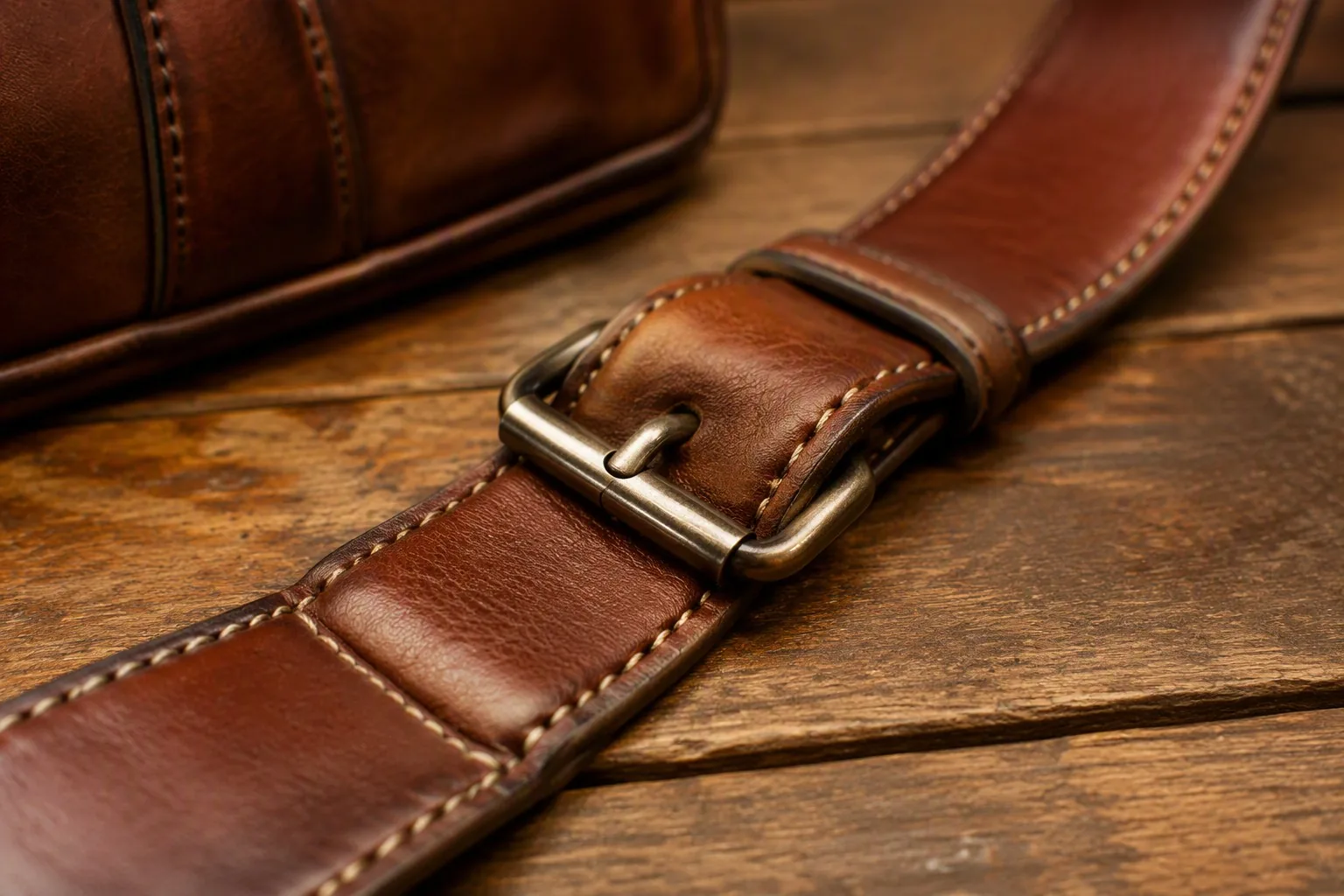
- The Part That Carries Everything
- How Straps and Handles Are Built
- Why Straps Break: The Six Failure Modes
- The Load Question: How Heavy Is Too Heavy
- How Straps Are Attached to Bags
- Materials: Leather, Thread and Hardware
- The Anatomy of a Great Strap
- How Factories Test Straps
- The Strap Length and Fit Question
- Choosing Bags with Strong Straps
- Care Habits That Extend Strap Life
- Diaper Bags and Heavy Loads: The Strap Matters Most
- Frequently Asked Questions
- The Bottom Line
The Part That Carries Everything
A leather bag’s strap does the hardest work in the bag’s life, and it does it every single time the bag is picked up. Understanding that job is the first step to understanding why straps fail.
The numbers behind a strap. A typical tote bag carrying a laptop, a water bottle, and daily essentials weighs between three and five kilograms. When the bag is lifted, that weight is transmitted entirely through the strap and its attachment points. Swinging the bag multiplies the force: a walking pace adds roughly 30 percent more load, a running pace can double it, and a snag or a hard swing can briefly multiply the force several times over. Over a year of daily use, a strap endures millions of load cycles. The leather may be a decade old and fine; the strap is doing ten years of work in the first one.
The failure is rarely sudden. Almost no strap snaps without warning. It fails progressively: stitching wears, thread frays, the leather at the attachment point cracks, a bar tack loosens. The visible break is the last step of a long process — which is good news, because it means straps can be inspected, and failures can be caught early.
Manufacturer’s point: A strap is not an accessory attached to a bag; it is a load-bearing component of the bag. Design it like a seatbelt, not like a shoelace — and inspect it like you would inspect a tire.
How Straps and Handles Are Built
A strap looks simple — a strip of leather with stitching — but a well-made strap is a small engineering project. Its layers, core, and reinforcements decide how long it survives.
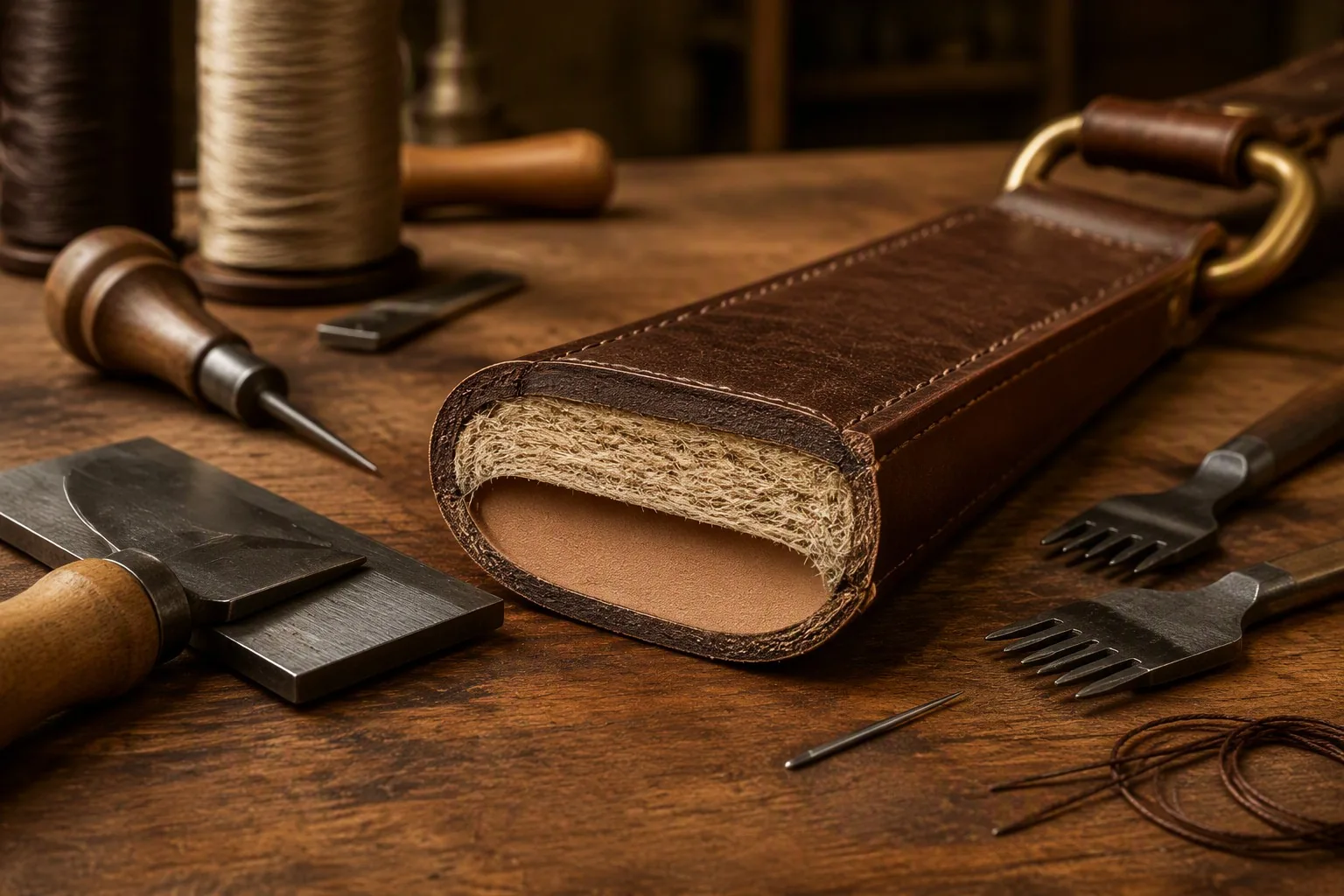
The basic construction. A quality leather strap is built from multiple layers, not a single strip:
- The face layer: the visible leather, chosen for looks and feel — typically 1.4–2.0 mm thick.
- The core (optional): a reinforcing layer inside the strap — another leather strip, or a nylon webbing core for high-load straps — that carries most of the tension.
- The back layer: the underside of the strap, often a lighter leather or lining, which protects the core and finishes the look.
- The stitching: two or more rows of lockstitch or saddle stitching running the full length, holding the layers together and transferring load.
- The end reinforcements: bar tacks and extra stitching at each end, where the strap attaches to the bag — the highest-stress points.
Handles vs straps. Handles and straps are different components with different engineering:
- Handles are short, usually carry the bag by hand, and are typically built from folded leather with a stiffening core so they hold their shape. They are stressed by weight and by constant bending.
- Straps are long, worn over the shoulder or across the body, and are stressed along their entire length. They need tensile strength and comfortable width.
- Detachable straps add a hardware element: swivel hooks or clips attach the strap to the bag, and those connectors become additional failure points — which is why high-quality detachable straps use solid, tested hardware.
Why Straps Break: The Six Failure Modes
After years of seeing failed straps — in production testing and in customers’ photos — the failures reduce to six predictable modes. Each has a cause, and each has a design answer.
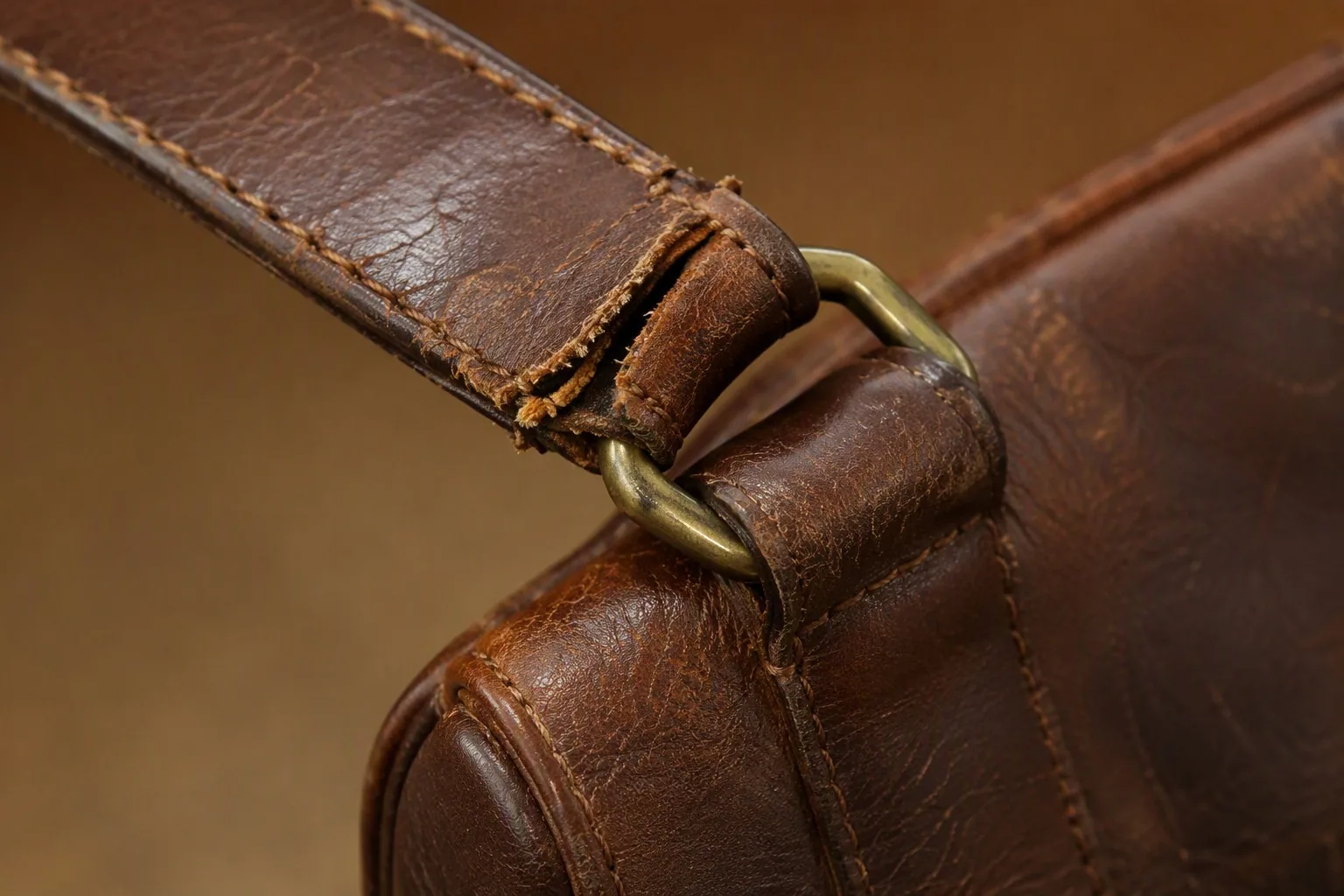
1. Attachment-point failure. The strap separates from the bag where it is sewn or riveted. This is the most common failure, and it usually means the attachment was under-reinforced: too few stitches, no bar tack, or stitching too close to the strap’s edge, where the thread pulls through the leather. The answer is layered reinforcement and bar tacks at every stress point.
2. Stitching failure. The thread itself wears, frays, or snaps. Causes include thread that is too thin for the load, stitching that rubs against clothing and edges, and tension that is too tight or too loose. The answer is heavier bonded thread, protected stitch lines, and consistent tension control in the factory.
3. Leather failure at the fold. The leather cracks or tears where the strap bends repeatedly — at the handle fold, at the buckle, or where the strap wraps an attachment ring. Thin leather, dry leather, and sharp bend radii all cause this. The answer is adequate thickness, flexible tannage, and rounded, generous bends.
4. Hardware failure. Buckles bend, swivel hooks deform, rivets pull through. Hardware fails when it is undersized for the load or made from weak alloys. The answer is solid brass or steel hardware, correctly sized, tested under load.
5. Core failure. In straps with a hidden core, the core can stretch, tear, or rot while the outer leather looks fine. Nylon webbing cores are strong but can creep; leather cores can dry and crack. The answer is quality core materials and edge sealing that keeps moisture out.
6. Edge and abrasion failure. The strap’s edges fray or its surface wears thin from years of rubbing against clothing and seatbelts. Edges that were not sealed or bound eventually unravel. The answer is painted, burnished, or bound edges on every strap.
The inspection rule. Every strap failure mode starts small. A monthly check of the attachment points, the stitching, and the leather at the folds catches almost every failure before it becomes a break — and the same check applies to bags you already own.
The Load Question: How Heavy Is Too Heavy
Straps are designed to a load, and knowing the numbers prevents both disappointment and danger. The table below is the working specification our factory uses when a brand asks how strong a strap should be.
| Bag type | Typical loaded weight | Strap width | Construction | Hardware size |
|---|---|---|---|---|
| Light crossbody / clutch | 0.5–1 kg | 1–2 cm | Single or folded leather | Small, solid |
| Everyday handbag | 1–2 kg | 2–3 cm | Folded leather, reinforced | Medium, solid |
| Work tote / laptop bag | 3–5 kg | 3–4 cm | Multi-layer with core | Medium-heavy |
| Diaper bag | 4–6+ kg | 4–6 cm, padded | Reinforced, webbing hybrid | Heavy, tested |
| Large travel bag | 5–8+ kg | 5+ cm, padded | Maximum reinforcement | Heavy, tested |
Reading the table. The strap must be engineered for the bag’s loaded weight plus a safety margin of several times — a strap rated for 5 kg on a bag that will really carry 5 kg is under-engineered, because real life adds swinging, snagging, and drops. The visible clues — width, layering, hardware size — track the engineering underneath. A thin strap on a heavy bag is not a style choice; it is a design error waiting to happen.
How Straps Are Attached to Bags
The attachment is where most straps fail, and the attachment methods themselves are worth understanding — they explain why some bags fail at the strap and others never do.
Sewn-in attachment. The strap ends are inserted into the bag’s seams during assembly and sewn in place, often with reinforcement panels between the layers. This is the strongest attachment for fixed handles and straps: the load spreads across the whole seam structure rather than one point. The downside is that the strap cannot be removed.
Riveted attachment. The strap is anchored with solid rivets through a reinforced panel, sometimes with a leather patch on the inside of the bag. Riveted attachments are strong and allow strap replacement, but the rivets must be large enough and the panel thick enough that the rivets cannot pull through under load.
Hardware attachment (detachable). Swivel hooks, clips, or D-rings connect a removable strap to the bag. Detachable straps are practical — they can be swapped, cleaned, or replaced — but every connector is a potential failure point. Quality detachable systems use solid brass or steel hardware rated for the load, attached to reinforced loops or rings that are themselves sewn into the bag’s structure.
What to look for in any attachment:
- The strap or its anchor is attached to the bag’s structure, not merely to the surface leather.
- There is reinforcement at the attachment point — extra stitching, a patch, or a ring sewn into the seam.
- The attachment hardware is solid, correctly sized, and smooth-edged.
- The attachment point is inspectable: you can see the stitching or rivets and check them for wear.
Materials: Leather, Thread and Hardware
The three materials in every strap — leather, thread, and hardware — each carry part of the responsibility, and each has its own quality rules.
The leather. Strap leather must be strong in tension and resistant to repeated bending. The rules our factory applies:
- Full-grain or top-grain leather, never split or bonded — a strap made from split leather fails early.
- Thickness matched to the job: 1.6–2.0 mm for everyday straps, more for heavy loads; handles often use folded 2.0–2.4 mm leather.
- Flexible tannage: vegetable-tanned leather is beautiful but stiffer; chrome-tanned leather flexes better for long straps.
- Unblemished hides: a strap concentrates stress along a narrow strip, so a hidden flaw that a bag panel would forgive becomes a break in a strap.
The thread. The stitching is what actually holds a strap together under load. Quality rules:
- Bonded nylon or polyester thread — bonded thread is coated to resist abrasion and fraying.
- Weight matched to the strap: heavy straps need heavier thread (typically 138–277 weight for load-bearing seams).
- Two or more parallel rows of stitching where the load is highest, plus bar tacks at the ends.
- Consistent stitches per inch — 6–8 SPI is the standard range for leather straps; more than that weakens the leather, less than that weakens the seam.
The hardware. Buckles, hooks, rings, and sliders are load-bearing parts:
- Solid brass, stainless steel, or zinc alloy with proper plating — never pot metal that bends and snaps.
- Hardware rated for the bag’s expected load, with a generous safety margin.
- Smooth edges and secure riveting or stitching — a sharp edge on a buckle will cut the strap’s own leather over time.
What the combination means. A strap is only as strong as its weakest material. A beautiful leather strap with thin thread fails at the thread; a strong thread on split leather fails at the leather; perfect leather and thread attached with a weak hook fails at the hook. Quality straps match all three materials to the job.
The Anatomy of a Great Strap
When a customer asks us what makes a strap “good,” the honest answer is a list of specific details — and the details are visible if you know where to look.
| Feature | What to check | Why it matters |
|---|---|---|
| Width | 2–4 cm for shoulder straps; wider for heavy loads | Narrow straps concentrate pressure and dig into the shoulder |
| Layers | Folded or multi-layer construction, not a single strip | Single-strip straps stretch and tear under load |
| Stitching | Two or more rows, 6–8 SPI, even tension | One thin row is the classic early-failure design |
| End reinforcement | Bar tacks and extra stitching at both ends | The ends carry the entire load and fail first |
| Attachment | Riveted or double-sewn into the bag structure | Single-point sewing pulls out under load |
| Edges | Painted, burnished, or bound — never raw | Raw edges fray and unravel over time |
| Hardware | Solid brass or steel, correctly sized | Weak alloy bends and breaks without warning |
| Flexibility | The strap should flex comfortably, not creak | Stiff straps crack at the folds |
The handle-specific checks. Handles add one more test: hold the handle and bend it. A good leather handle has a stiffening core that keeps its shape — it should not collapse or twist in your hand. The stitching at the handle ends should be doubled, and the handle should be attached to the bag’s structure (sewn into the seam or riveted through a reinforced panel), not merely glued or stitched to the surface.
How Factories Test Straps
Quality straps are tested before they ship, and the tests are brutal on purpose. If a strap survives the factory test, it will survive daily use.
The load test. A finished bag is filled to its rated capacity — often more — and hung by its strap for a set period, typically 24 to 48 hours. The strap must hold the load without stretching, tearing, or pulling free at the attachment. Heavy-duty bags may be tested at 2–3 times rated capacity.
The cycle test. The strap is loaded and unloaded repeatedly — hundreds or thousands of cycles — to simulate months of daily use in minutes. This is the test that catches progressive failures: stitching that loosens, cores that creep, and attachments that slowly pull apart.
The drop test. A loaded bag is dropped from a height onto a hard surface, sometimes repeatedly. The strap and its attachments must survive the impact. This simulates the real world, where bags are dropped, swung, and snagged far more often than manufacturers would like.
The materials test. Incoming leather, thread, and hardware are tested at the material level: leather for tensile strength and thickness, thread for breaking strength, hardware for deformation under load. A strap is only as good as its weakest material, and weak materials are caught before they enter production.
The seam test. A strap sample is pulled in a machine that measures the strength of its seams directly. The seam must break only at a force far above the bag’s real-world load — the margin is the safety factor that makes a strap trustworthy.
The Strap Length and Fit Question
Strength is not the only strap issue owners face — fit matters just as much, and the two are linked. A strap that is the wrong length gets adjusted constantly, and constant adjustment wears the hardware and the leather at the adjustment points.
Finding the right length. A shoulder strap should let the bag sit at hip level or just below; a crossbody strap should let the bag rest at the hip with the strap crossing the chest comfortably. When you try a bag, adjust the strap and carry it loaded — the empty-bag length is never the real length. An adjustable strap is essential for bags shared between people, and for diaper bags that parents of different heights will carry.
The adjustment wear point. On adjustable straps, the buckle or slider where the strap folds is a hidden wear point: the leather bends there every time the length changes, and the hardware rubs the surface. Check the adjustment area when you inspect the strap, and set the length once and leave it rather than fiddling with it constantly.
Padding and comfort. For heavy bags, a padded section on the strap is not luxury — it is the difference between a bag that is comfortable for an hour and one that hurts after ten minutes. The padding should be firm, not soft, and securely stitched so it does not slide. On diaper bags especially, wide padded straps are the standard for a reason: they make a heavy load bearable.
Choosing Bags with Strong Straps
For buyers, the factory tests are invisible — but the quality signals are visible in the store, and a two-minute inspection tells you most of what you need to know.
The store inspection checklist:
- Feel the strap’s thickness. A quality strap has substance — it is multi-layer or folded, not a flimsy single strip. Squeeze it; a good strap resists.
- Check the stitching. Look for two or more rows of even stitches, ending in bar tacks at the attachment points. One thin row of stitching is a warning.
- Examine the attachment. The strap should be sewn into the bag’s structure or riveted through a reinforced panel — not stitched to the surface leather only.
- Bend the strap. It should flex comfortably without creaking or showing stress marks at the fold points.
- Test the hardware. Buckles and hooks should be solid metal with smooth action — no wobble, no sharp edges, no cheap feel.
- Look at the edges. Sealed, painted, or bound edges mean the strap was finished properly; raw edges will fray.
- Ask about the rating. A serious maker knows what load their straps are tested to. An honest answer is a good sign; a shrug is not.
The weight-to-strap rule. Match the strap to what you will carry. A light crossbody bag needs less strap than a work tote that will hold a laptop every day. If you know the bag will be heavy, buy the stronger strap — width, layering, and hardware size are the visible clues to strength.
Care Habits That Extend Strap Life
The strap carries the load, but the owner controls how long it lasts. A few habits make the difference between a strap that wears gracefully and one that fails early.
Daily habits. Do not overload the bag beyond what it was designed to carry — the strap is engineered for a load, and exceeding it accelerates every failure mode. Lift the bag by the strap or handles, not by snatching at one corner. When setting the bag down, do not let the strap dangle where it can be stepped on or caught — a snag is one of the few ways a healthy strap can suddenly tear.
Weekly habits. Wipe the strap with a soft dry cloth to remove the abrasive grit that settles into stitching and edges. Check the attachment points as you wipe: feel for loosening stitches and look for developing wear. Two minutes a week catches what two seconds a month cannot.
Seasonal habits. Condition leather straps when you condition the bag — a dry strap cracks at the folds long before the bag’s panels show problems. Check the hardware seasonally: tighten any loose rivets, clean and lubricate buckles and sliders, and replace anything that has bent or worn. For detachable straps, check the hooks and clips specifically — they carry the entire load at a single point.
The edge rule. Straps with painted or bound edges last longer than raw-edged straps, but the edge finish itself needs a glance: if the edge paint is chipping or the binding is fraying, have it repaired early. An edge failure spreads quickly once it starts.
Diaper Bags and Heavy Loads: The Strap Matters Most
Diaper bags deserve a special section because they are the extreme case of strap engineering — and because this site exists for parents who carry them.
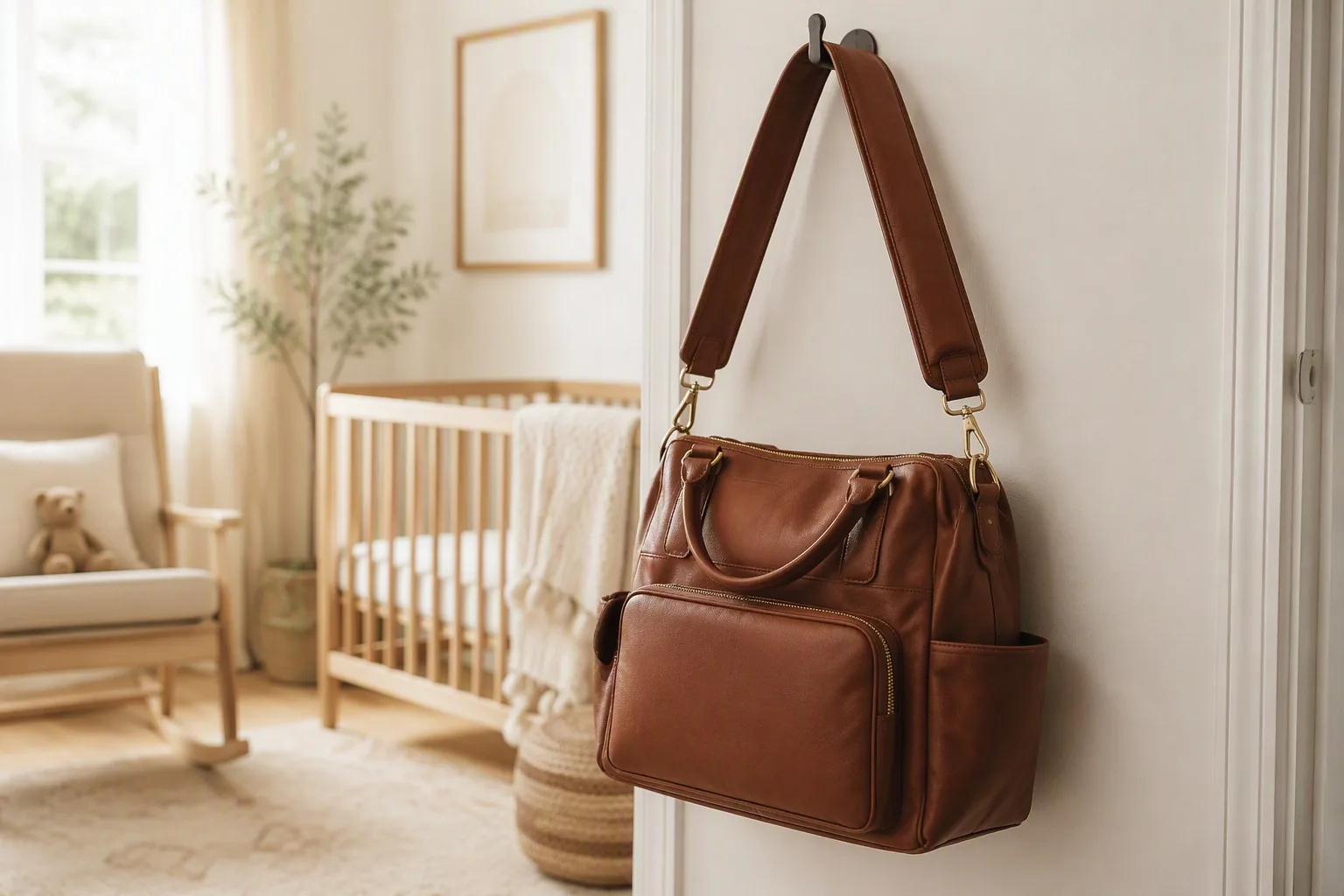
Why diaper bags are the hardest test. A diaper bag is the heaviest bag most people will ever carry regularly. It holds bottles, diapers, wipes, a change of clothes, toys, snacks, and the parent’s own essentials. Fully loaded, a diaper bag can weigh five kilograms or more — and it is carried with one hand, on one shoulder, and across the body, often while holding a child in the other arm. The strap takes abuse that a fashion tote never sees: constant load, frequent swings, drops, and the unique stress of being pulled and repositioned one-handed.
What a diaper bag strap needs:
- Width and padding: a wide strap — 5 cm or more — with padding spreads the load and protects the shoulder. A thin strap on a heavy diaper bag is a design failure.
- Strong attachment: the strap must be attached to reinforced points, not surface stitching. Look for double-stitching, bar tacks, or riveted attachments.
- Adjustable and detachable: parents need to switch between shoulder and crossbody carry, and to remove the strap for machine washing of the bag — but the hardware must be solid enough that detachability never becomes a weak point.
- Wipe-clean materials: for a diaper bag, the strap surface matters as much as the structure. Leather straps are beautiful and durable; nylon or webbing straps are more practical and easier to clean. The hybrid — leather-trimmed webbing — gives the look with the practicality.
The parent’s monthly check. For a diaper bag, check the strap attachments monthly: look for loosening stitches, developing cracks at the fold points, and worn hardware. A diaper bag strap failure with a child nearby is not an inconvenience; it is a hazard. Five minutes a month prevents it.
Frequently Asked Questions
Why do leather bag straps break?
Straps break because of design and material weaknesses, not because leather is weak: thin single-layer construction, under-reinforced attachment points, light thread, weak hardware, and dry or thin leather at the folds. Progressive wear then turns those weaknesses into breaks.
Can a broken strap be repaired?
Often, yes — if the leather is still sound. A professional can restitch, reattach, or replace a strap. Replacement straps for quality bags are a common repair. The cost depends on the bag; for many bags, a new strap restores years of use.
How do I know if a bag strap is strong?
Check the thickness and layering, the stitching (two rows plus bar tacks is good), the attachment (sewn into the structure, not the surface), the hardware (solid metal), and the edges (sealed, not raw). Strong straps are visibly engineered.
How much weight can a leather bag strap hold?
A quality strap on a well-made bag is tested to hold several times the bag’s real-world load — typically 20–50 kg in factory tests. The safe working load depends on width, layering, stitching, and attachment quality, not on the leather alone.
What is the best material for a diaper bag strap?
For heavy loads and daily abuse, a wide padded strap in webbing or nylon with leather trim is the most practical choice: strong, comfortable, and easy to clean. All-leather straps are beautiful but need more care and are stiffer on the shoulder.
How often should I inspect my bag’s straps?
Monthly for bags carried daily — especially heavy ones like diaper bags and work totes. Check the attachment points, the stitching at the ends, the leather at the fold points, and the hardware. Most strap failures give visible warning signs for weeks before breaking.
Does strap width affect comfort?
Yes, significantly. A wider strap spreads the load over a larger area of the shoulder, reducing pressure. For heavy bags, 4–5 cm padded straps are noticeably more comfortable than 2 cm straps carrying the same weight.
Why did my strap crack at the buckle?
Cracking at hardware points means the leather was too dry, too thin, or bent too sharply around the hardware. Quality straps use adequately thick, flexible leather and rounded hardware with generous bend radii so the leather is not stressed at a sharp angle.
The Bottom Line
Straps break for predictable reasons, and almost all of them are preventable. The leather itself is rarely the problem; the design is — the single thin stitch line, the attachment sewn to the surface, the undersized hardware, the unsealed edge. A strap that is layered, stitched twice, reinforced at the ends, and attached to the bag’s structure will carry daily weight for years, and it will announce its wear long before it fails.
Whether you are buying a bag, carrying a diaper bag, or choosing materials for your own brand, the rule is the same: treat the strap as the load-bearing component it is. Look at it, feel it, bend it, and check it monthly. The bag may be the star — but the strap is what carries the show.
