
How Does Leather Thickness Affect the Build of a Wallet?
How Does Leather Thickness Affect the Build of a Wallet?
A wallet is the smallest bag a manufacturer makes and the hardest to get right, because every millimetre of leather is multiplied by the number of panels stacked in the same place. A bifold with eight card slots and two note compartments can carry ten layers at the spine before the lining goes in.
Thickness is therefore not a material preference on a wallet. It is the structural decision that determines whether the wallet closes flat, whether the cards slide, whether the stitch line holds and whether the edge looks finished or bulky. Get it right and the rest of the build follows; get it wrong and no amount of careful stitching rescues it.
This guide works through wallet thickness the way a factory does: how it is measured, which zone of the wallet needs which weight, how thin panels are cut, skived, sewn and edged, what fails when the numbers are wrong, and how to write a specification a tannery and a sample room can both work to.
- Why a Wallet Is a Thickness Problem
- How Thickness Is Measured
- The Thickness Zones of a Wallet
- Thickness by Wallet Type
- Choosing the Outer Panel
- The Card Slot Problem
- Spine and Fold Behaviour
- Lining Choices and Their Weight
- Cutting Thin Leather
- Skiving and Splitting
- Sewing Thin Leather
- Edge Finishing on Thin Panels
- Hardware and Thin Leather
- What Fails and Why
- Cost and Yield in Thin Leather
- Writing a Wallet Specification
- Common Misunderstandings
- Working With a Factory on Thin Builds
- How Climate Affects a Thin Wallet
- Repair, Refinishing and Longevity
- Pairing Thicknesses in One Wallet
- Using the Whole Hide
- Quality Checks on the Line
- Deciding by Use Case
- Wallet Thickness Checklist
- Frequently Asked Questions
- Conclusion
Why a Wallet Is a Thickness Problem
The Arithmetic of a Folded Stack
A bifold folds once, and everything inside that fold doubles. An outer panel at 1.4 mm plus two card slot layers at 0.8 mm plus a lining at 0.6 mm becomes 4.4 mm at the fold, before the second half of the wallet is counted against it.
Where Bulk Appears
Bulk collects at the spine, at the ends of the card slot stack, and at any point where a pocket seam crosses a fold. It does not distribute itself evenly, which is why a wallet can feel thin in the hand and still refuse to close.
What Goes Wrong When It Is Ignored
The classic symptoms are a spine that bows outward, card slots that grip too tightly when full, a stitch line that puckers along the fold, and an edge that cannot be brought to a clean finish because the layers will not compress.
A wallet is designed in cross-section, not in plan view. If the cross-section is wrong, the pattern is wrong no matter how carefully it is drawn.
How Thickness Is Measured
Ounces, Millimetres and the Conversion Trap
Leather weight is quoted in ounces, where one ounce corresponds to roughly 0.4 mm. The number is nominal, measured on the hide as it left the tannery, and it describes an average rather than a guarantee across every square centimetre.
Measuring Finished Versus Split
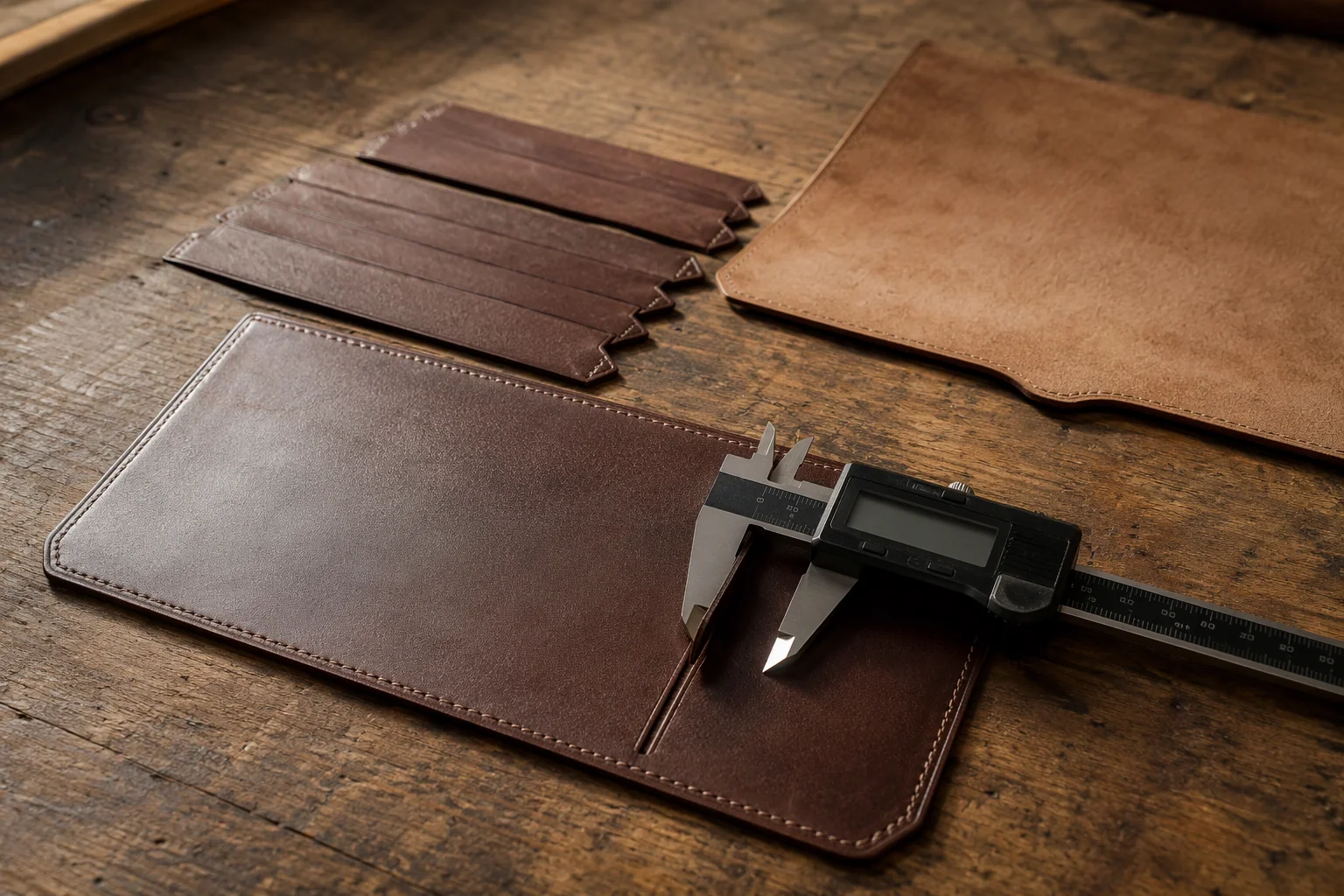
A hide measured at 4 oz may run thicker at the backbone and thinner at the belly. Once split to a target, the piece is measured again, and that second figure is the one that governs the wallet, because it is the thickness the machine actually has to sew.
Tolerance and Why It Matters
A tolerance of plus or minus 0.2 mm sounds generous until it is multiplied across six layers, where it becomes a 1.2 mm swing at the spine. Thin builds need tighter tolerances than bags, and the specification should say so explicitly.
The Thickness Zones of a Wallet
Outer Panel
The outer panel carries the shape and the visual surface, so it is usually the thickest single layer. Full-grain at 3 to 4 oz gives a wallet that holds its form, and anything above 5 oz makes a bifold that will not sit flat when empty.
Card Slot Strips
These are the thinnest parts of the build, commonly skived to around 0.6 to 0.8 mm. Their job is to grip a card without adding bulk, and the tolerance here has more effect on the finished wallet than the outer panel does.
Spine and Gusset
The spine is where every layer meets, so it is usually reduced rather than reinforced. Skiving the ends of the inner panels, or stopping the slot stack short of the fold, keeps the spine from becoming the thickest point.
Lining
A lining at 0.5 to 0.6 mm adds structure without weight. Thicker lining turns a soft wallet rigid, and a very thin one lets the outer panel’s hand dominate, which may be exactly what a minimal card holder needs.
Thickness by Wallet Type
Bifold
A bifold needs an outer panel light enough to fold and stiff enough to hold cards. Most production bifolds sit between 3 and 4 oz on the outside, with slot strips around 0.7 mm and a lining under 0.6 mm.
Card Holder
A card holder is a stack of thin strips with almost no structure, so it can use 2 to 3 oz on the outer faces. Here thinner is better, because the wallet’s whole appeal is that it disappears in a pocket.
Long Wallet and Travel Organiser
Length adds leverage at the fold, so a long wallet benefits from a slightly firmer outer panel than a bifold, and from a spine that is deliberately thinned. The extra length also exposes any inconsistency in the hide.
Zip-Around
A zip needs a stable edge to run against, which argues for a firmer outer panel and a reinforced zip tape line. Thinning the panels too far makes the zip wavy, and a wavy zip is the most visible defect a wallet can have.
Choosing the Outer Panel
Full-Grain at 3 to 4 Ounces
This is the default for a reason. It is thick enough to burnish, firm enough to hold a fold, thin enough to keep the wallet pocketable, and it takes a dye or a finish evenly across the panel.
When Five Ounces Is Justified
A5 oz outer panels suit minimalist wallets, sleeve designs and any build where the leather is the structure and there are few internal layers. In a conventional bifold, the same panel produces a brick.
When Two Ounces Needs Backing
At 2 oz the leather drapes and stretches, so it needs a backing or a lining to carry load. Used alone on an outer panel, it produces a wallet that bags out at the corners within months.
| Component | Typical range | Note |
|---|---|---|
| Outer panel | 1.2 – 1.6 mm | 3 – 4 oz |
| Card slot strip | 0.6 – 0.8 mm | Skived |
| Spine | 0.8 – 1.0 mm | Reduced, not reinforced |
| Lining | 0.5 – 0.6 mm | Adds structure |
| Zip tape line | 1.2 – 1.4 mm | Needs stability |
The Card Slot Problem
Why Slots Are the Hardest Part
A slot is a narrow strip folded over itself and stitched at both ends, and it must hold a card firmly without tearing at the stitch. Every property that makes leather good for a bag works against it here: stretch, thickness variation and a soft temper.
Skiving to a Working Thickness
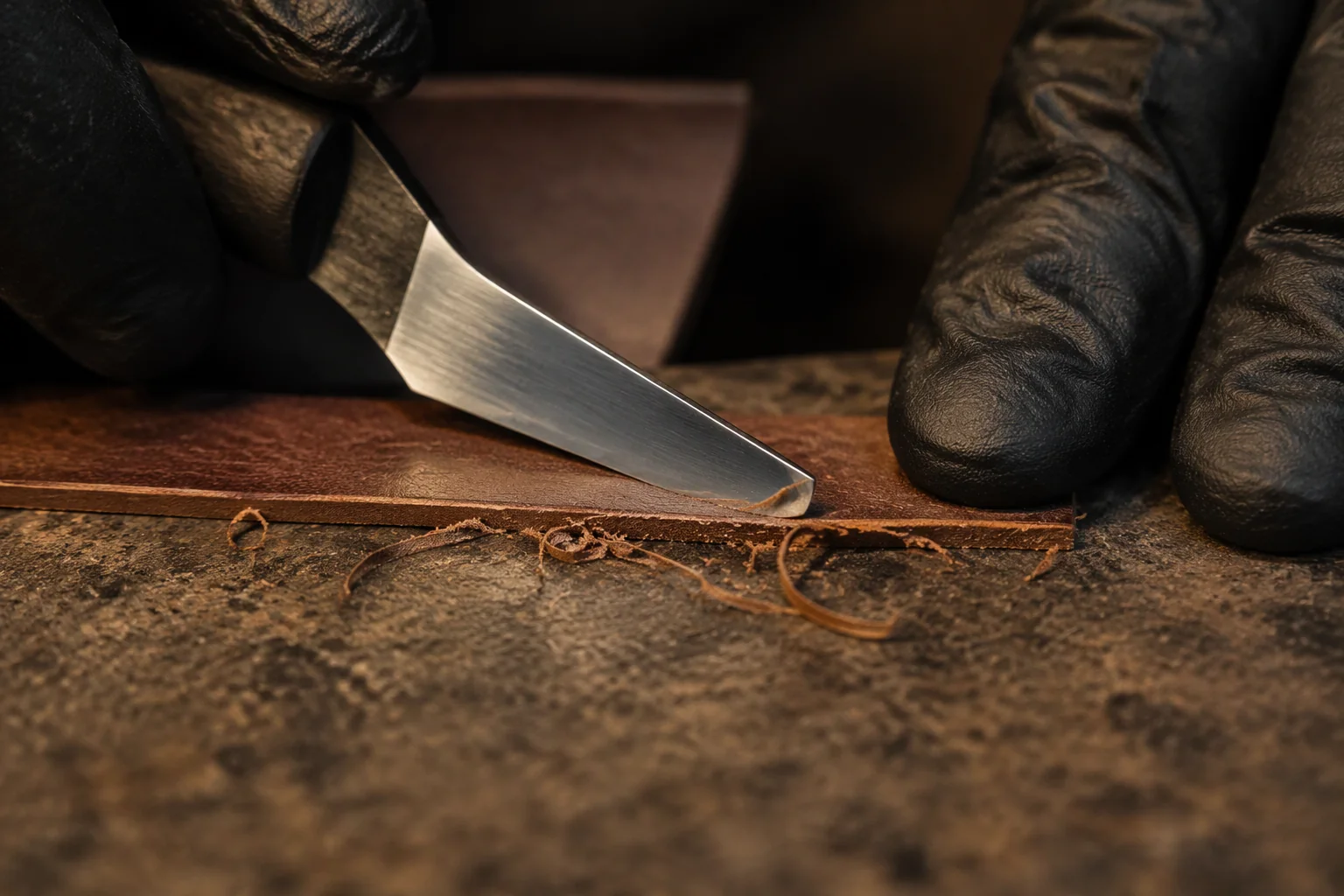
The strip is skived along the edges that will be folded and stitched, leaving the centre at full thickness for grip. A strip skived uniformly across its width loses the body that keeps the slot from stretching out of shape.
Slot Spacing and Capacity
Slot pitch determines how many cards fit and how easily they slide. A tight pitch looks neat when empty and becomes unusable when full, which is why capacity should be tested with cards rather than assumed from a drawing.
Spine and Fold Behaviour
The Fold That Defines the Wallet
The spine is the hinge, and a hinge made of ten glued and stitched layers does not flex, it cracks. Designers who thin the spine deliberately, and stop internal stacks short of the fold, produce a wallet that opens flat for years.
Reducing Spine Thickness
Two techniques do most of the work: skiving the inner panel ends down to a taper before assembly, and setting the card slot stack back by a few millimetres so it never reaches the fold. Both cost nothing at the cutting stage.
Testing the Fold Before Production
Fold a completed sample a hundred times and look along the spine for separation between layers. A sample that survives this crude cycle test will usually survive a year of ordinary use, and one that fails here will fail in the market.
Lining Choices and Their Weight
Textile Lining
A woven textile lining at a fraction of a millimetre keeps the wallet light and lets the outer panel’s hand show. It needs a clean attachment method, because a textile edge cannot be burnished and must be turned or bound.
Leather Lining
Leather lining at 0.5 mm adds structure, takes stitching well and gives a finished look on the inside. It also adds a layer to every calculation, which is why a wallet lined in leather must be designed with that layer from the start.
Lining That Adds Structure
Where a wallet needs a stiff front panel for a logo or an emboss, a stiffer lining does the job without thickening the leather. Adding a stiffener between layers is cheaper and cleaner than buying a heavier hide.
Cutting Thin Leather
Blades and Pressure
Thin leather cuts cleanly with a sharp blade or a well-set die, but it also distorts under pressure. A dull die crushes rather than cuts, and a crushed edge on a 0.7 mm strip cannot be recovered by skiving.
Nesting Narrow Strips
Wallet patterns are mostly long thin strips, which nest badly and waste area. Strips should be nested along a consistent direction and grouped by thickness, so that offcuts from one component remain usable for another.
Stretch and Distortion
Thin leather stretches when it is pulled, and a strip cut slightly long will grow further during stitching. Cutting to a template with minimal handling, and letting pieces rest before assembly, keeps dimensions where the pattern put them.
Skiving and Splitting
Machine Skiving Versus Hand
A machine skives a consistent taper quickly and is the right choice for production volumes. Hand skiving gives more control at a difficult curve or a very narrow strip, and a sample room still relies on it for one-off work.
Skiving at the Fold
Where a panel folds over itself, the fold line is skived to a fine taper so the fold forms a crisp edge rather than a roll. This is the single most common technique in wallet making and the most common source of inconsistency.
Splitting the Whole Hide
Splitting reduces a hide to a uniform thickness before cutting, which solves variation but removes the strongest part of the grain structure. For wallets the trade is usually worth it, provided the split surface is finished or hidden.
Sewing Thin Leather
Needle and Thread
Thin panels need a small needle and a thread that does not overwhelm the material. An oversized thread in a 1.2 mm panel creates a seam that reads as heavy and pulls the leather out of shape along its length.
Stitch Length
A shorter stitch length distributes load and looks finer on a small product, but too short a stitch perforates a thin strip and turns it into a tear line. Wallet seams usually sit shorter than bag seams but longer than garment seams.
Avoiding Puckering
Puckering comes from tension, feed and thickness mismatch in the same seam. Teflon feet, light presser pressure and sewing a thin layer against a thicker one rather than two thin layers together all reduce it.
Edge Finishing on Thin Panels
Burnishing Thin Edges
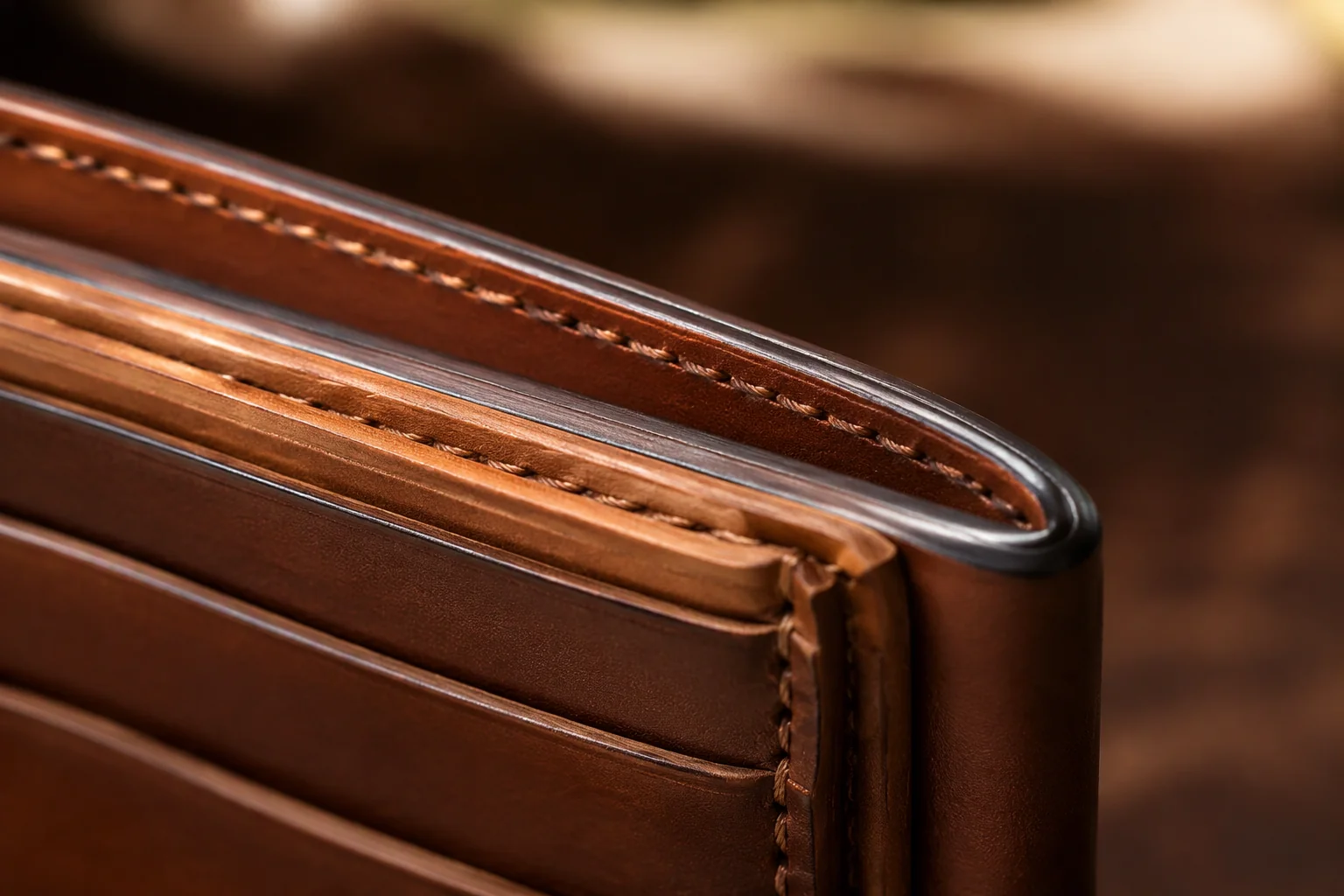
Burnishing works when the edge has enough fibre to lay down. On a stack of thin layers the edge is mostly adhesive and lining, so burnishing alone gives a polished look that wears through quickly under thumb pressure.
Edge Paint on Layered Edges
Paint suits layered edges, because it fills and seals rather than relying on the leather’s own fibre. Two thin coats on a prepared edge outlast one thick coat, which is also the most common cause of a cracked edge.
When to Fold Instead
Where the edge will take constant handling, folding the outer panel over the stack hides everything and creates a durable rounded edge. It costs a little more material and a little more skiving, and it removes an entire failure mode.
Hardware and Thin Leather
Rivets and Thin Panels
A rivet in a thin panel concentrates load on a small area, and the leather around it stretches until the rivet is loose. A small reinforcement patch behind the fixing spreads the load and is standard practice on better wallets.
Snap Placement
A snap needs a stable panel on both sides, and on a thin wallet the snap usually sits through the whole stack. If the stack is too compressible, the snap will not seat; if it is too stiff, it will not close.
Reinforcing Behind a Snap
A thin stiffener behind the snap panel keeps the fixing flat and stops the leather from cupping around it. It is invisible in the finished product and is the difference between a snap that lasts and one that tears out.
What Fails and Why
Stretch and Sag
Thin panels under load stretch at the corners and around any fixing. The wallet keeps its shape when empty and deforms as it fills, which reads to a customer as poor material rather than poor design.
Slot Edge Cracking
Cracking at the mouth of a card slot comes from a fold that was skived too thin and then flexed thousands of times. A slightly heavier strip with a longer skive taper resists this far better than a uniformly thin strip.
Stitch Pull-Through
Perforations close to an edge behave like a tear line, and a thin strip with a stitch too near its edge will eventually pull through. Moving the stitch line inward, or adding a turned edge, solves it.
Corner Wear
Corners abrade first, and on a thin wallet there is no material reserve to lose. A reinforced corner, a rounded profile or a folded edge all buy time, and none of them costs much at the pattern stage.
| Failure | Likely cause | Design fix |
|---|---|---|
| Spine bowing | Stack reaching the fold | Set slots back, skive ends |
| Slots too tight | Pitch and strip thickness | Adjust pitch, thin the edges |
| Edge cracking | One thick paint coat | Two thin coats, prepared edge |
| Stitch pull-through | Seam too near the edge | Move seam inward, fold edge |
| Corner wear | No material reserve | Round the corner, reinforce |
Cost and Yield in Thin Leather
Price per Square Foot Versus Yield
A thin hide costs less per square foot than a heavy one, but a wallet uses long narrow strips that waste area at the edges of every panel. The number that matters is cost per finished wallet, not cost per square foot.
The Cost of Splitting
Splitting adds a process step and creates a split surface that must be finished or hidden. On a large order the cost is small per unit; on a short run it can exceed the saving from buying a lighter hide in the first place.
Wastage on Narrow Strips
Slot strips generate offcuts that are too small for another strip but large enough for a reinforcement patch. Planning the cutting layout around a family of components rather than a single wallet keeps that material in the product.
Writing a Wallet Specification
Name the Thickness per Component
A specification that says 3 to 4 oz for the whole wallet is not a specification. Each component needs its own figure with a tolerance, because the outer panel and the slot strips are doing different jobs at different weights.
What to Send the Tannery
Send the component list, the target thickness after splitting, the temper, the finish and the colour reference. A tannery can hit a thickness target reliably only if it knows which surface will be visible and which will be skived away.
Sample Approval
Approve a sample built from production leather, not from a stock piece, and approve it filled with cards. A wallet approved empty can still fail in the customer’s hand, which is the most common approval mistake in small leather goods.
Common Misunderstandings
Thicker Is Not Better
In bags, heavier leather often signals quality. In wallets the relationship reverses: past a certain point, thickness makes the product unusable, and the skill lies in removing material where it is not needed.
Thin Is Not Weak
A well skived 1.2 mm panel with a folded edge and a correctly placed seam outlasts a 1.8 mm panel with the same seam in the wrong place. Thickness distribution matters more than total thickness.
Grain Is Not Thickness
Full-grain describes the surface, not the weight. A full-grain hide can be split to 0.8 mm, and a corrected-grain hide can be 2 mm. Confusing the two leads to specifications that ask for the wrong property.
Working With a Factory on Thin Builds
Tooling and Templates
Thin work is less forgiving of tooling error, so templates and dies should be cut for the actual pattern rather than adapted from a bag. A die that is half a millimetre out produces a slot stack that will not align.
Operator Skill
Skiving and edge work on thin leather are hand skills, and the difference between two operators is visible in the finished wallet. Sample approval should name the operators who will run the production batch.
First-Article Approval
Approve the first article off the line, measured with a gauge, before the batch continues. Thin builds drift gradually as blades dull and adhesive builds up, and a single check at the end of a run will not catch it.
How Climate Affects a Thin Wallet
Humidity
Leather takes up moisture, and a thin panel takes it up faster than a thick one. In humid climates a wallet can swell, soften and lose shape, which is why storage and transit packing matter as much as the specification.
Cold
Cold stiffens leather and makes a thin panel brittle at the fold. A wallet designed for a cold market benefits from a slightly heavier outer panel and a spine that is skived a little less aggressively.
Storage and Transit
Wallets should travel flat, in a breathable wrapper, without heavy cartons pressing on the fold. Compression in transit sets a crease that no amount of conditioning will remove, and the customer sees it first.
Repair, Refinishing and Longevity
What Can Be Repaired
Stitching can be replaced, edges can be repainted, and a stretched slot can sometimes be tightened. These repairs are realistic on a well-built wallet because the layers can be separated and reassembled.
What Cannot
A cracked slot mouth or a torn stitch line through thin leather cannot be restored invisibly. Once the fibre is broken at a fold, the wallet’s service life at that point is over.
Designing for Repair
A wallet that can be opened along one seam, and whose edges are painted rather than fused, is repairable. Designing for repair costs a little in assembly time and buys a story the brand can sell.
Pairing Thicknesses in One Wallet
Mixing Two Weights
Most good wallets use at least two weights: a firm outer panel and thin internals. The contrast is deliberate, and it is the reason a wallet can feel substantial in the hand and still fold flat.
Combining With Embossed or Exotic
Embossed and exotic leathers behave differently under a blade, and many cannot be skived as thinly as a smooth cowhide. Where a design mixes them, the smooth leather usually carries the thin work.
Suede and Nubuck Interiors
Suede at 0.6 to 0.8 mm makes an excellent interior because it grips cards and hides scuffs. It also stretches more than a finished leather, so it should be backed where it carries a seam under load.
Using the Whole Hide
Why Thin Builds Suit Small Hides
Wallet production consumes relatively small panels, which means it can use areas of a hide that a bag would reject. This is an economic argument for wallets in a bag factory’s range, not just a product decision.
Splitting Offcuts
Offcuts that are too small for a panel can be split and used for reinforcements, slot strips or small internal pockets. A cutting plan that includes a second use for offcuts reduces the effective cost of the leather.
Avoiding Over-Thickness
Buying a heavier hide and splitting everything down is wasteful if a lighter hide would have done the job. The most sustainable thickness is the thinnest one that meets the performance requirement.
Quality Checks on the Line
Measuring With a Gauge
A dial or digital gauge on the cutting table catches thickness drift before it becomes a folding problem. Measure the outer panel and a slot strip from every batch, and record the figures rather than judging by feel.
The Fold and Fill Test
Fold the assembled wallet and fill every slot with a card, then close it. A wallet that will not sit flat when full is over-thick at the spine, and this test finds the fault in seconds where a measurement takes longer.
Checking the Edge
Look along each edge under a light for gaps between layers, uneven paint and any place where a lining edge shows. Edge quality is the clearest signal of whether the thickness work was done properly upstream.
Deciding by Use Case
Matching the Market
A market that carries many cards needs a wallet that tolerates being full, which argues for a slightly larger pitch and a spine that is thinned more aggressively. A minimal market tolerates a slimmer build with a firmer hand.
Matching the Price Point
At a lower price, thicker leather is often used to give an impression of value, and the wallet is designed around that bulk. At a higher price, the expectation shifts to precision, and precision means removing material deliberately.
| Wallet type | Outer panel | Slot strip | Priority |
|---|---|---|---|
| Minimal card holder | 0.8 – 1.0 mm | 0.6 mm | Slimness |
| Bifold | 1.2 – 1.4 mm | 0.7 mm | Balance |
| Long wallet | 1.3 – 1.5 mm | 0.8 mm | Fold life |
| Zip-around | 1.4 – 1.6 mm | 0.8 mm | Zip stability |
| Travel organiser | 1.4 – 1.6 mm | 0.8 mm | Capacity |
A Working Sequence
- Count the layers at the spine in the pattern, before any leather is ordered.
- Set the outer panel from the wallet type and the hand you want.
- Thin the internals until the stack closes flat when full.
- Choose the edge treatment for the wear the wallet will take.
- Build a sample, fill it, fold it, and measure before approving.
Wallet Thickness Checklist
- Outer panel weight named in ounces and millimetres
- Tolerance stated per component
- Card slot strips specified after skiving, not before
- Spine reduction method defined
- Slot stack set back from the fold
- Lining weight and attachment method agreed
- Stiffener specified where a snap or emboss sits
- Stitch line distance from each edge defined
- Needle size and thread ticket stated
- Edge treatment chosen per edge
- Fold and fill test included in first-article approval
- Thickness gauge readings recorded per batch
- Transit packing specified to prevent compression
- Repair route decided before production
- Split surface finish agreed where visible
- Offcut reuse planned for reinforcements
Frequently Asked Questions
What leather thickness is best for a wallet?
Most wallets use an outer panel around 1.2 to 1.4 mm and card slot strips of 0.6 to 0.8 mm after skiving. A minimal card holder can go thinner, and a zip-around needs a firmer outer panel for the zip to run straight.
Is thicker leather better for a wallet?
No. Beyond a point, thickness stops the wallet folding flat and makes the spine stiff enough to crack. Thickness distribution matters more than total weight, which is why thin stripped internals and a firm outer panel work best together.
Why do wallet card slots need skiving?
A slot holds one or two cards, so the leather only needs strength along the seam and grip in the middle. Skiving the edges lets the strip fold tightly and keeps the stack thin, while the centre stays at full thickness.
How many ounces is 1.2 mm leather?
Roughly 3 oz, using the common approximation that one ounce is about 0.4 mm. The figure is nominal, so a split-to-order specification in millimetres is more reliable than an ounce range for wallet work.
Why does my wallet bow at the spine?
The internal stack is reaching the fold, so the spine has more layers than the rest of the wallet. Setting the card slot stack back a few millimetres and skiving the panel ends to a taper usually removes the bow.
Can thin leather be used for a wallet outer panel?
Yes, with support. At 0.8 to 1.0 mm the leather needs a lining or a stiffener to carry load, and it suits a card holder far better than a bifold that will be filled with cards and folded daily.
Does lining add too much thickness to a wallet?
A textile or thin leather lining at 0.5 to 0.6 mm adds structure without much bulk, and it must be counted in the cross-section from the start. Adding a lining to a pattern designed without one is what creates excess thickness.
What causes wallet edges to crack?
Usually one thick coat of edge paint on an unprepared edge, or a stack that flexes because it was never skived. Two thin coats on a sanded, cleaned edge, or a folded edge on high-wear areas, both last far longer.
How tight should card slots be?
Tight enough to hold a card in place when the wallet is shaken, loose enough that a card slides out with one hand. Test with the number of cards the wallet is designed for, not with a single card.
Should a wallet be split from a heavier hide or bought at weight?
Splitting gives uniform thickness across every panel, which matters in a thin build, at the cost of an extra process. Buying at weight is cheaper on short runs but leaves variation that shows up at the fold.
How is a wallet’s thickness tested before production?
Measure each component with a gauge against the specification, then build a sample and fill every slot with cards before folding it repeatedly. A wallet that lies flat when full and survives a hundred folds is ready for production approval.
Conclusion
Wallet thickness is a design decision disguised as a material choice. The outer panel sets the hand and the shape, the slot strips set the capacity, and the spine decides whether the wallet opens flat in a year or bows after a month. Each of those is a number, and each number can be specified.
The practical method is to work in cross-section: count the layers at the fold, give every component its own target thickness and tolerance, skive the internals rather than buying heavier leather everywhere, and test the assembled wallet full of cards. That sequence removes most of the failures that make a small leather good feel cheap.
For a bag manufacturer, wallets are also a sensible use of material that would otherwise be offcuts, and a product where careful thickness work is visible to the customer every time the wallet opens. The leather does not need to be thicker; it needs to be in the right place.
