
How Do Manufacturers Create Embossed and Pebbled Leather for Bags?
How Do Manufacturers Create Embossed and Pebbled Leather for Bags?
Most leather used in bags does not show the grain the animal grew. It shows a grain that was pressed, printed, tumbled or coated onto the surface, chosen for how it looks, how it wears and what it costs.
This is a separate question from which layer of the hide a leather comes from, and separate again from whether a finish is aniline, semi-aniline or pigmented. Grain creation is about the pattern on the surface and the process that put it there — and that process decides how the leather creases, how it cleans and how consistent it looks across a production run.
For a brand, the practical value is simple. When you know how a grain was made, you know what can go wrong with it, what to write into a specification and what to check when the shipment arrives.
A grain pattern is a manufacturing decision with a cost, a tool and a failure mode. Treating it as a colour choice is how inconsistencies reach the customer.
- What Grain Actually Means on a Finished Bag
- Why Factories Change the Natural Grain
- The Main Surface Effects
- How Embossing Works
- How Pebble Grain Is Produced
- Printed and Coated Grains
- Nubuck, Suede and Brushed Effects
- What Grain Does to Bag Performance
- How Grain Affects Design and Cutting
- Specifying a Grain on an Order
- Quality Control of Grained Leather
- Sampling and Approvals
- Cost and Lead Time Effects
- A Grain Specification Checklist
- Common Mistakes Brands Make
- Frequently Asked Questions
- The Bottom Line
What Grain Actually Means on a Finished Bag
The word covers several different things.
Grain as a Surface Property
Pattern, depth and regularity.
In bag making, grain describes the visible surface pattern of the leather: its scale, its depth, its regularity and whether it looks like the natural hide or like something made. Two leathers of identical thickness and colour can behave completely differently because of it.
Why Grain Is Chosen at All
It is chosen for a purpose.
Grain is selected to give a bag a particular character, to hide what the hide does not want shown, to make a surface easier to maintain, or to allow a lower-cost material to read as a more expensive one. Usually several of those reasons apply at once.
Where Grain Sits in the Specification
It is a line item with consequences.
Grain should appear in the specification as a named pattern with a reference sample, not as a descriptive word. “Pebbled” alone says almost nothing, because pebble scale and depth vary enormously between suppliers and between plates.
Why the Distinction Matters Commercially
Two bags, one texture, one price.
Two bags can look similar in a photograph and differ substantially in material cost, yield and durability, purely because one uses a plain surface and the other uses an embossed or printed grain. Understanding the difference is how a brand avoids paying for a pattern it did not intend to buy.
Why Factories Change the Natural Grain
Left alone, hides are inconsistent.
Hides Are Not Uniform
Nature does not repeat.
A hide varies in thickness, fibre tightness, growth marks, scars and insect damage across its area. If every panel had to show its natural grain, a large share of each hide would be unusable for visible parts of a bag.
Covering Natural Variation
Grain makes the hide more usable.
Where a pattern is pressed or printed onto the surface, small natural irregularities are absorbed into it. This raises usable yield and helps the panels of one bag look as though they came from the same hide, even when they did not.
Design Intent
Some grains are simply the look.
Part of the demand comes from design rather than from hiding anything. A bag in a fine pebble, a bold shrunken grain or a glossy coated surface is a deliberate product decision, and the leather is made to serve it.
When the Natural Grain Is the Selling Point
Not every bag should hide its surface.
Some products are built precisely around visible natural grain, growth marks and tonal variation, and the brand’s promise is that no two pieces match. In that case the goal is not to remove variation but to manage it: agreeing which marks are acceptable on visible panels, how panels are matched within one bag, and how much variation a customer should expect.
Mixing the two intentions in one collection is what causes trouble. A bag advertised for its natural character and inspected against an embossed standard will be rejected for doing exactly what it was sold to do.
The Cost Trade-Off
Processing buys consistency with money.
Every added surface operation consumes equipment, plates, energy and time, and each step carries its own reject risk. The trade-off is usually worth it, but it should be a conscious decision rather than a default.
The Main Surface Effects
Five families cover most bag leather.
Pressed Grain
A plate transfers the pattern.
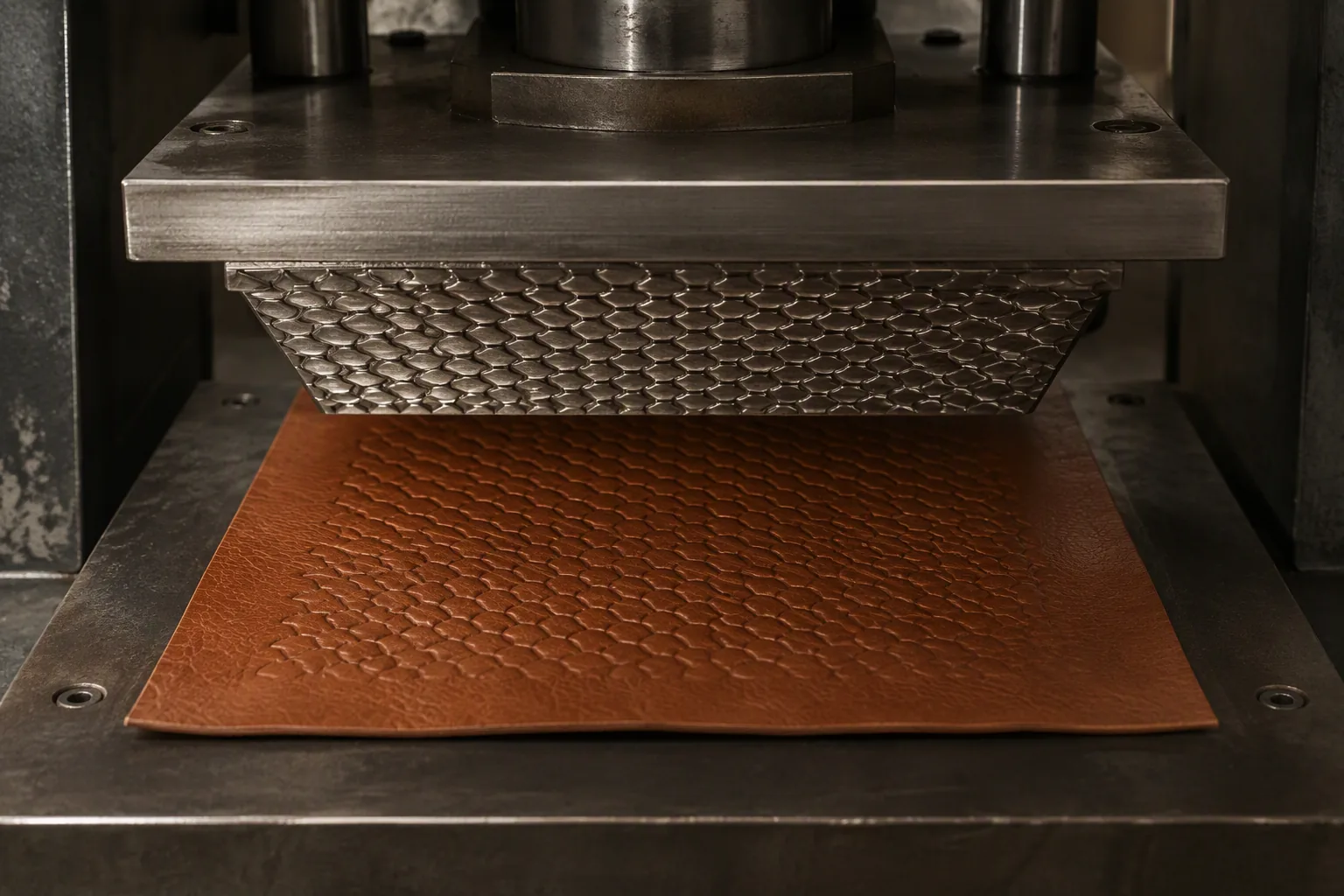
Pressed grain is produced by holding a heated engraved plate against the leather under pressure. It gives a repeatable pattern with depth, and the pattern is only as good as the plate and its condition.
Pebbled Grain
Texture with irregular relief.
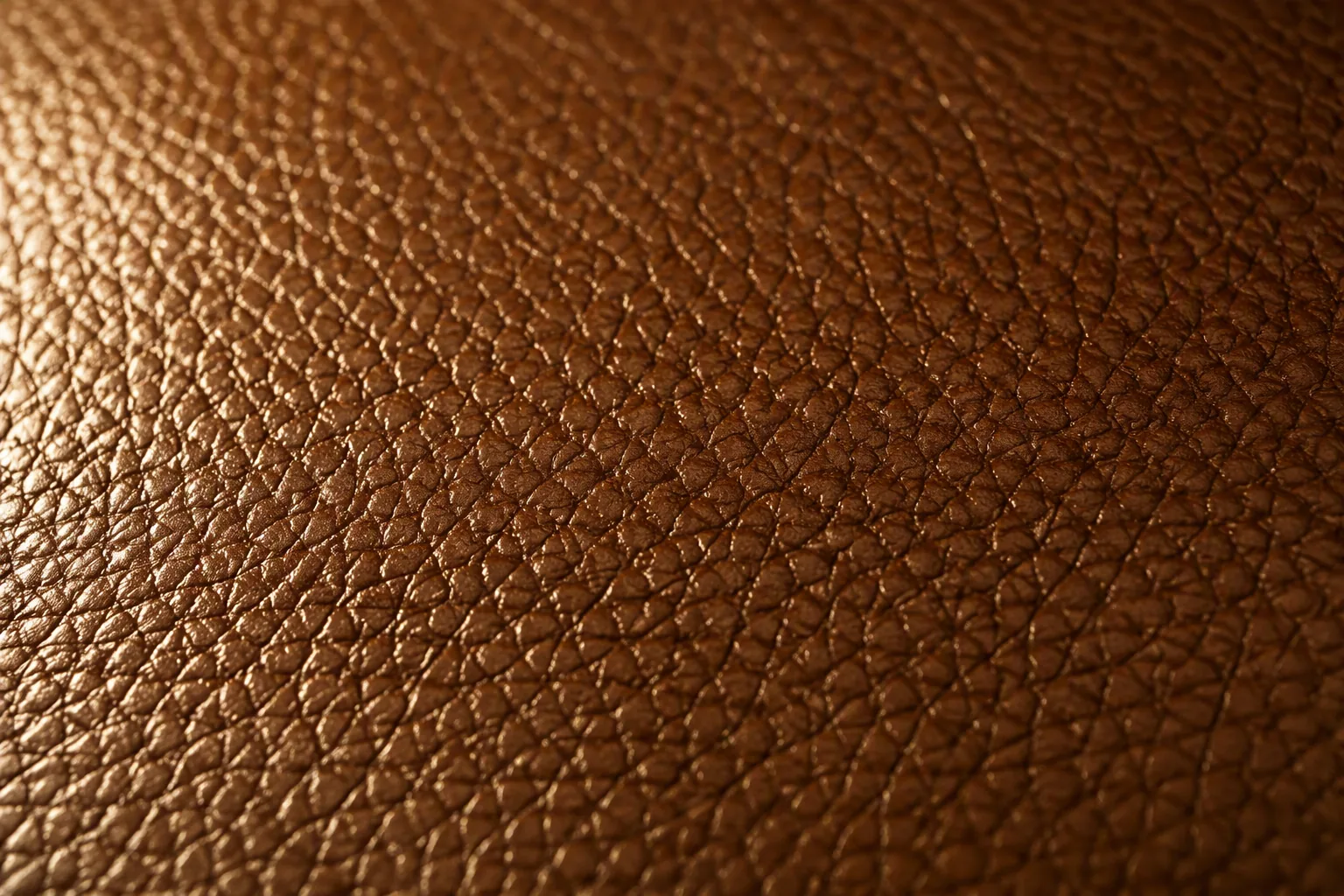
Pebble grain can come from plating, from tumbling the leather so the surface breaks into fine relief, or from a shrunken grain effect created during processing. The result reads as soft and irregular rather than sharply printed.
Printed Grain
Pattern applied to a coated surface.
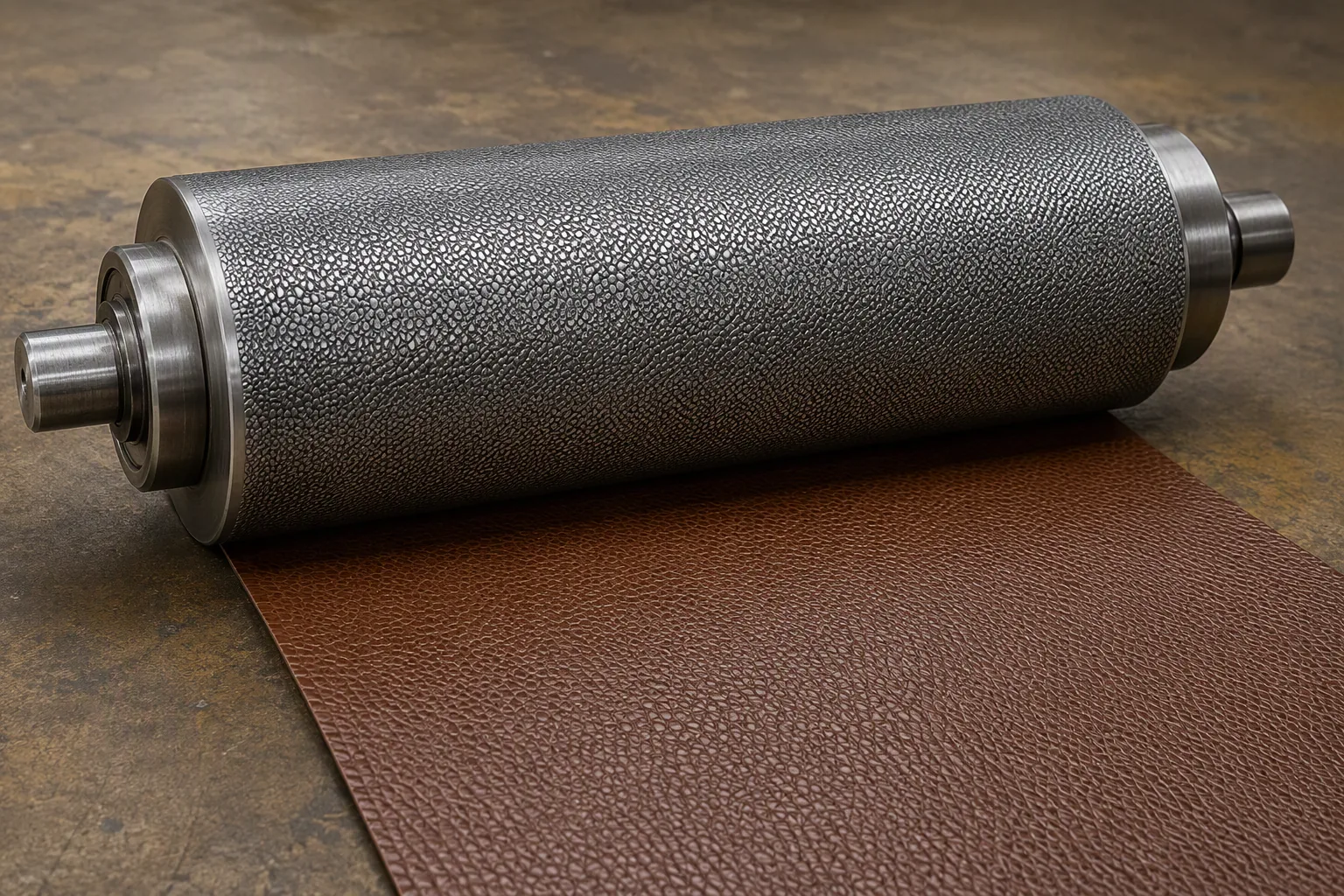
Printed grain is applied with an engraved roller onto a prepared surface, often over a coated or finished split. It can reproduce fine patterns very consistently, and its durability depends heavily on the bond between the print and what lies beneath it.
Brushed and Buffed Surfaces
Nubuck and suede effects.
Buffing the grain side produces nubuck; buffing the flesh side produces suede. Both create a soft, light-catching surface with a fibre nap, which changes how the leather marks, cleans and stains.
Coated Surfaces
Patent, metallic and pearl.
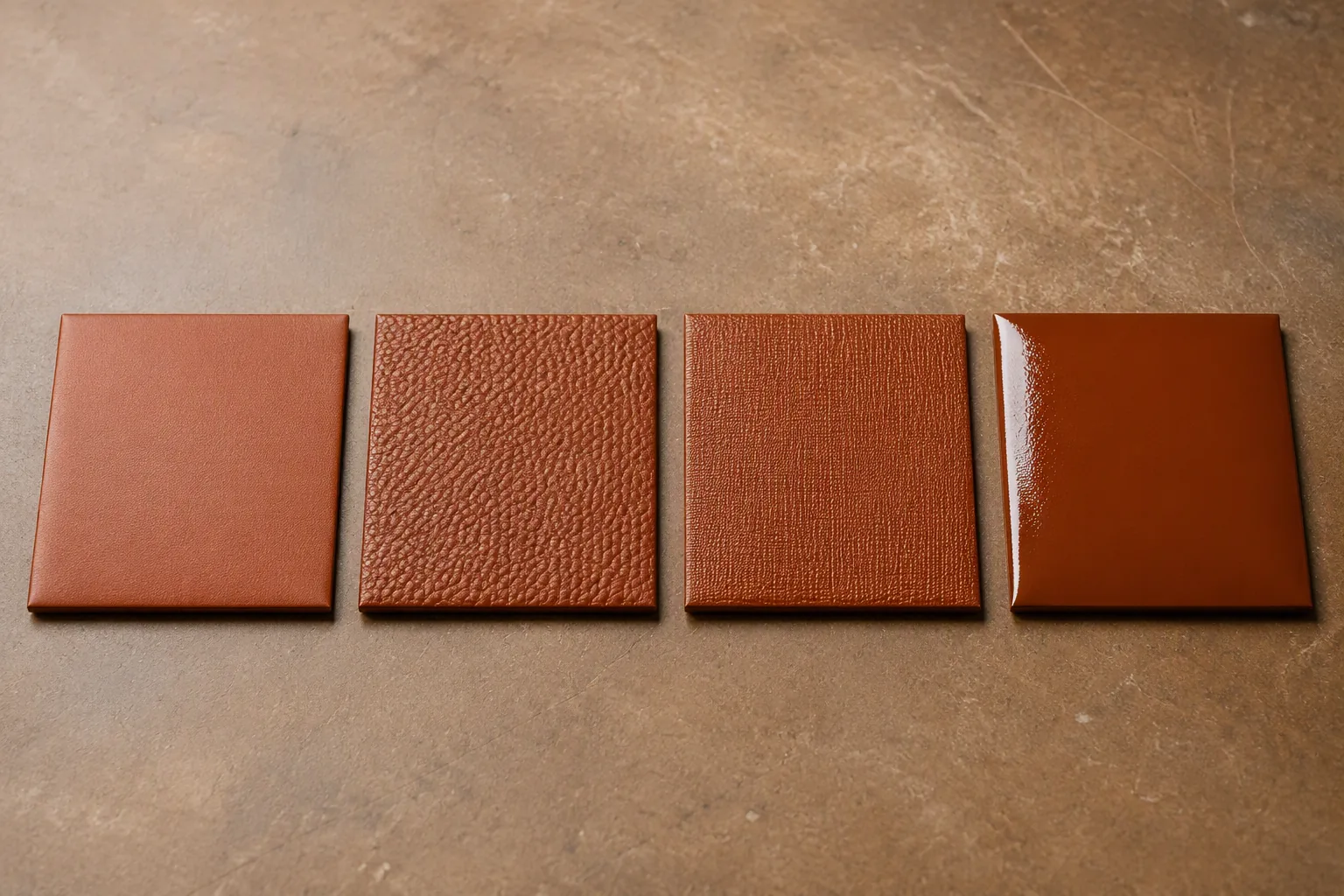
Where a film or coating carries the appearance, the surface can be glossy, metallic or pearlescent. These effects are visually strong and are the most sensitive to flexing, handling and packing.
| Surface effect | How it is produced | Appearance | Main risk to manage |
|---|---|---|---|
| Pressed grain | Heated engraved plate under pressure | Repeatable pattern with depth | Plate wear and batch variation |
| Pebbled grain | Plating, tumbling or shrunken grain | Soft irregular relief | Uneven relief across panels |
| Printed grain | Engraved roller onto prepared surface | Fine, consistent pattern | Print adhesion and rub-off |
| Nubuck or suede | Buffing one side to raise fibres | Soft matte nap | Staining and nap flattening |
| Patent or coated | Film or coating layer | Glossy, metallic or pearl | Flex cracking and marking |
Why These Are Not the Same as a Finish
Pattern and finish are separate decisions.
The aniline, semi-aniline and pigmented families describe how a surface is finished and how much of the natural grain is left visible. Grain creation describes what pattern is on the surface and how it was applied. A single bag can combine any finish family with any grain family.
How Embossing Works
Pressure, heat and a plate.
The Plate
The pattern lives in the tool.
An embossing plate is an engraved metal plate carrying the grain pattern as a raised or recessed surface. Pattern scale, depth and sharpness are all decided when the plate is made, and changing any of them means making a new plate.
Heat, Pressure and Dwell
Three settings decide the result.
Temperature, pressure and dwell time together determine how deeply the pattern sits and how sharp it looks. Change one and the surface changes, which is why the settings belong in the production record rather than in an operator’s memory.
Plate Wear and Replacement
Tools age.
A plate used for a long run wears, and a worn plate produces a shallower, softer pattern. Where several plates are in use for the same pattern, a shipment can contain leather from more than one of them, so plate identity is worth recording.
Registration and Repeat
How the pattern lines up.
Where a pattern has a direction or a visible repeat, the way it registers across a panel matters, especially on large panels and on parts that meet at a seam. Poor registration is easy to see on a bag even when each panel looks acceptable on its own.
How Pebble Grain Is Produced
Soft irregular relief comes from three routes.
Plating a Pebble Pattern
The tool decides the pebble.
A pebble can be pressed with a plate engraved with an irregular pattern. The advantage is control and repeatability; the limitation is that the plate carries one fixed pattern, and the whole run inherits its character.
Tumbling and Milling
Mechanical movement breaks the surface.
Softening the leather in a drum relaxes the fibre structure and lets the surface break into fine relief. The result is a natural, slightly irregular pebble that suits soft bag structures, though it varies more from lot to lot than a plated pattern.
Shrunken Grain
The pattern comes from the structure.
Some shrunken grain effects are created during processing so that the surface contracts into a visible relief. It produces a strong, organic pattern that reads as premium, and it comes with correspondingly less predictability across batches.
Mild Versus Deep Pebble
Depth changes everything downstream.
A fine pebble is more forgiving and holds up on structured panels. A deep pebble offers more character but consumes more of the surface, and the same pattern reads differently depending on the panel it sits on.
Why Pebble Suits Certain Bags
It hides what will happen later.
Because the surface already has relief, a pebbled leather absorbs the small creases and marks that come with daily use far better than a smooth surface. That is the main reason it is common on bags that will be handled heavily.
Printed and Coated Grains
The pattern is applied, not pressed.
The Engraved Roller
Continuous pattern application.
An engraved roller transfers a repeating pattern onto a prepared leather surface. It produces very consistent, fine patterns at speed, and the tooling is generally less costly than a large embossing plate.
Release Paper and Transfer
A pattern carried on paper.
Some printed grains are transferred using a patterned release paper pressed onto a coated surface, which allows finer detail and softer hand than direct printing. The transfer route requires careful control of the surface it is applied to.
What Lies Beneath
The base has to be right.
Printed grain is only as good as the surface underneath it. Where the base is a coated split, the grain, the depth and the durability of the whole surface are limited by that preparation, and no print can compensate for it.
Adhesion and Rub-Off
The failure mode to watch.
Because the pattern sits on top of the surface, the bond matters. Where adhesion is weak, the grain can rub off at high-wear points — corners, handles, flap edges and anywhere that contacts a strap or a pocket.
Nubuck, Suede and Brushed Effects
Texture instead of pattern.
Which Side Is Buffed
Grain side or flesh side.
Buffing the grain side produces a nubuck, with a very fine nap and a soft, matte appearance. Buffing the flesh side produces a suede, which is thicker in nap and generally more open. Both change how the leather behaves at the surface rather than adding a pattern.
Nap and How It Behaves
Fibres lie in one direction.
Nap means the appearance changes with the direction of light and the direction of touch. That is why these surfaces need consistent cutting direction across the panels of a bag, and why a panel fitted the wrong way can look like a different shade after assembly.
Staining and Cleaning
The trade-off of a soft surface.
An open, fibrous surface takes up marks more readily than a finished one, and cleaning it usually requires more care. For bags that will be handled constantly, this is a real cost rather than a cosmetic detail.
Where These Surfaces Suit a Bag
Not everywhere.
They work well on decorative panels, interior details and bags with light use. They demand more attention where they sit against a hardware edge, under a strap or on a surface that will be set down repeatedly.
What Grain Does to Bag Performance
The surface decides how the bag ages in use.
Creasing
Where the pattern meets the fold.
Leather creases where it folds, and how that crease looks depends on the surface. A fine pattern creases quietly; a deep, glossy or heavily coated surface turns every fold into a visible line that the customer will notice early.
Abrasion and Scuff Visibility
Some surfaces forgive, some record.
A matte pebbled surface disguises light scuffing well. A smooth glossy surface shows it immediately, and a printed grain shows abrasion as a change in pattern rather than a change in colour, which is often harder to repair.
Cleaning and Maintenance
Surface texture changes the job.
Pebbled and matte surfaces are generally more forgiving to clean than smooth glossy ones, because the relief hides small marks. Open fibrous surfaces require more restraint, since aggressive cleaning lifts the nap and leaves a visible patch.
Water and Staining Behaviour
Relief slows penetration.
Surface relief tends to slow the spread of a spill, which buys time, while a smooth surface spreads liquid quickly. This is a behavioural difference rather than a protection, and no grain should be described to a customer as making a bag waterproof.
| Surface effect | Creasing appearance | Scuff visibility | Cleaning forgiveness |
|---|---|---|---|
| Fine pressed grain | Subdued | Low | High |
| Deep pressed grain | Pronounced but textured | Moderate | Moderate |
| Pebbled grain | Well disguised | Low | High |
| Printed grain | Visible, pattern distorts | Moderate to high | Moderate |
| Nubuck or suede | Soft but darkens | Shows as nap change | Low |
| Patent or coated | Sharp and glossy | Very high | Moderate but delicate |
How Grain Affects Design and Cutting
The surface changes what the pattern can do.
Pattern Direction and Grain Matching
Panels must agree.
Where a pattern has a direction, all panels of a bag should be cut so that the pattern runs the same way. Grain matching across a seam or a flap is one of the first things a customer notices, and one of the hardest things to fix after cutting.
Panel Size and Pattern Scale
Scale has to suit the panel.
A bold pattern that looks good on a large tote becomes busy on a small front pocket, and a fine pattern that reads well on a pocket can disappear on a large panel. Scale is a design decision that has to be made per panel, not per collection.
Folds, Darts and Panel Behaviour
Texture changes how leather bends.
A deep pattern stiffens the surface slightly, which affects how a panel folds, how a dart closes and how a gusset turns. These effects are small on a sample and obvious once a full run is closed.
Where a Bold Grain Should Not Be Used
Some places punish texture.
High-wear edges, areas that contact hardware, and surfaces that must lie perfectly flat are poor candidates for bold or glossy grains. Choosing a quieter surface for those parts usually costs less than managing the complaints.
Specifying a Grain on an Order
Adjectives do not travel well between factories.
Name the Pattern and Cite a Sample
The sample is the specification.
A grain should be identified by a supplier pattern reference, a plate or roller identity where available, and a physically approved sample. Written descriptions alone are the most common cause of a wrong-grain shipment.
State Scale and Depth, Not Adjectives
Words like “medium” drift.
Terms such as fine, medium or bold are interpreted differently by different people. Where a pattern needs to be reproduced, scale and depth expectations should be tied to the approved sample rather than described in words.
Reference the Tooling
Tools explain variation.
Recording which plate or roller produced a lot explains why two deliveries of the same pattern can differ. Where a supplier has several tools for one pattern, the brand should know which one is running for its order.
Documentation and Traceability
Records answer questions later.
Lot references, plate or roller identity, and approval dates turn a dispute into a short conversation. They also allow a brand to trace a problem back to a specific delivery rather than suspecting the whole programme.
Quality Control of Grained Leather
Inspect the surface as a surface.
What to Check at Goods-In
Look at the right angle.
Grained leather should be examined under raking light rather than flat overhead light, because shallow defects disappear under direct light. Checks should cover pattern depth, cleanliness, uniformity and the absence of marks from handling.
Plate Wear and Ghosting
Shallower than the approved sample.
Where the pattern has become shallower than the sample, or where the surface shows a faint ghost of an earlier impression, the tooling or the settings have drifted. Both are visible on a comparison against the approval sample.
Registration Across Panels
Panels that will meet.
Where the pattern has a visible repeat, panels that will be assembled together should be checked as a set, not individually. A bag assembled from four panels that each passed inspection can still show obvious misalignment.
Adhesion and Buffing Checks
The two failure modes of applied surfaces.
For printed and coated surfaces, adhesion is the critical property, and it should be established at approval and monitored as a property of the production process. For nubuck and suede, buffing consistency matters more than adhesion, because uneven nap reads as a shading difference.
| Defect observed | Likely cause | What to check |
|---|---|---|
| Pattern shallower than sample | Worn plate or changed settings | Plate identity and press record |
| Faint ghost impression | Double pressing or tool mark | Handling between operations |
| Pattern misaligned across panels | Cutting direction not controlled | Nesting and cutting plan |
| Grain rubbing off at edges | Weak adhesion on printed surface | Surface preparation and approval sample |
| Uneven nap or shading | Inconsistent buffing | Buffing operation and panel direction |
| Gloss variation across panels | Coating thickness variation | Coating line settings |
Sampling and Approvals
Approval is where surface quality is decided.
Physical Samples Over Photographs
Photographs hide the important part.
A photograph cannot convey depth, relief or how a surface behaves in the hand, and lighting differences between a supplier’s photo and the brand’s expectation cause most sample disputes. Approval should be against a physical piece.
Approving the Surface, Not Just the Colour
Colour approval is not grain approval.
It is common for a colour to be approved while the grain is barely examined, which leaves the surface effectively unspecified. The approval record should name both, and the sample should be retained for comparison at goods-in.
Keeping an Approval Record
One controlled sample beats many opinions.
A single retained, dated and labelled approval sample, kept in controlled conditions, answers most questions about whether a delivery matches what was agreed.
Re-Approval After Any Change
Changes travel silently.
A change of plate, roller, supplier, base material or surface preparation can alter the grain without altering the colour. Each of those changes should trigger re-approval of the surface rather than only of the shade.
Cost and Lead Time Effects
The surface has a price and a calendar.
Plate and Roller Tooling
Tooling is a fixed cost with a long tail.
A new plate or roller carries a one-off cost and a lead time, and it belongs to whoever commissioned it. Where a brand creates a proprietary pattern, it should know who holds the tool and under what conditions it can be used for others.
Yield and Consumption
Pattern can change the maths.
Surface treatment can require additional trimming, can restrict which areas of a hide are acceptable for visible panels, and can affect how efficiently patterns nest. The effect is often modest per panel and significant per order.
Rework and Reject Risk
Every added step adds a reject point.
Each surface operation introduces its own failure modes — shallower pattern, ghosting, adhesion weakness, uneven nap — and each one is a reason for goods being reworked or rejected. That risk should be priced into the decision to use a bolder surface.
Where Money Is Actually Saved
Cheaper base, more surface.
The commercial case for a printed or coated grain usually rests on using a less expensive base material and giving it a more expensive appearance. That is a legitimate strategy, but it makes the surface operation the critical quality step rather than a decoration.
A Grain Specification Checklist
- Pattern named with a supplier reference
- Plate or roller identity recorded where available
- Physical approval sample retained and dated
- Scale and depth referenced to that sample, not described in words
- Pattern direction specified for cutting
- Panels that will meet checked as a set
- Adhesion requirements agreed for printed and coated surfaces
- Buffing consistency requirements agreed for nubuck and suede
- Inspection lighting condition stated for goods-in
- Re-approval triggered by any change of tool, base or supplier
- Tooling ownership and usage rights confirmed in writing
- Records kept by lot so that a delivery can be traced
Common Mistakes Brands Make
| Mistake | Consequence | Prevention |
|---|---|---|
| Specifying grain with adjectives only | Wrong grain arrives and is hard to reject | Name the pattern and cite a sample |
| Approving colour but not surface | Grain is effectively unspecified | Approve and retain both |
| Ignoring pattern direction at cutting | Visible mismatch after assembly | Specify direction in the cutting plan |
| Judging quality under flat overhead light | Shallow defects are missed | Inspect under raking light |
| Assuming two deliveries match | Shade and relief drift across lots | Compare each lot against the sample |
| Changing the base material silently | Print adhesion fails after approval | Require re-approval on any change |
| Treating tooling as the supplier’s business | Pattern can be reused elsewhere | Confirm ownership and usage rights |
| Choosing a bold grain for high-wear areas | Early scuffing and complaints | Use quieter surfaces on wear points |
Frequently Asked Questions
Is embossed leather lower quality than natural grain leather?
Not automatically. Embossing is a deliberate process that improves consistency and usable yield, and it appears at every price level. What matters is the quality of the base material, the tool and the process control, not the fact that a pattern was pressed on.
How can you tell whether leather is embossed or printed?
Pressed grain is transferred under heat and pressure and usually shows depth and a defined pattern; printed grain sits on a prepared surface and reveals itself where the surface has worn or flexed. Examining a crease, a cut edge and a high-wear point usually distinguishes them.
Does a pebbled surface make leather more durable?
It makes small marks and creases less visible rather than making the material stronger. The relief absorbs and disguises what daily use does to a surface, which is why pebbled leather tends to keep its appearance longer than a smooth equivalent of the same base.
Why do two deliveries of the same grain look different?
Usually because of the tool or the settings. A worn plate produces a shallower pattern, a different plate produces a different version of it, and changed press or coating settings alter depth and gloss. Lot records and a retained approval sample resolve these questions quickly.
Does grain direction matter in production?
Yes, whenever the pattern has a direction or a visible repeat. All panels of a bag should be cut with the pattern running the same way, and panels that will meet should be checked as a set, because misalignment is obvious on a finished bag even when each panel passed inspection alone.
What is the most common cause of a wrong-grain shipment?
A vague specification. Descriptions such as fine, medium or bold are read differently by different people, so a supplier may meet the words while missing the intent. A named pattern plus a retained physical sample removes most of that risk.
How should grained leather be inspected on arrival?
Under raking light rather than flat overhead light, comparing pattern depth and uniformity against the approval sample, and looking specifically at ghosting, handling marks, registration on panels that will be assembled together, adhesion on printed surfaces and nap consistency on brushed ones.
Can a printed grain be repaired if it rubs off?
Localised rub-off is difficult to repair invisibly, because restoring the pattern is not the same as restoring a colour. That is why printed and coated surfaces should be managed through adhesion control at approval and through quieter surfaces at high-wear points rather than through after-the-fact repair.
Does an embossed pattern increase the cost of a bag?
It adds a process, tooling and a reject risk, while also allowing a less expensive base material to be used. The net effect depends on the pattern, the volume and the base material, so the decision should be made with the yield and consumption effect included rather than on tooling cost alone.
Does a glossy or coated surface suit every bag?
No. Glossy and coated surfaces show creasing, scuffing and handling marks more than matte ones, and they are more sensitive to flexing and packing. They work best on structured shapes with limited folding, and poorly on soft, heavily handled bags.
What should be written into the order for a grained leather?
The pattern name and supplier reference, the plate or roller identity where applicable, the retained approval sample, the required pattern direction for cutting, adhesion requirements for printed surfaces, buffing consistency for brushed surfaces, the inspection lighting condition and a requirement for re-approval after any change of tool, base or supplier.
The Bottom Line
Most bag leather shows a grain that was made rather than grown, and the way it was made decides how the surface behaves for the life of the bag. A pattern is a tool, a process and a set of settings, and all three have to be specified if the result is to be repeatable.
The practical sequence is short. Decide whether the surface should be pressed, pebbled, printed, brushed or coated, and choose it for the panel it will sit on rather than for a photograph. Name the pattern and retain a physical sample, because adjectives do not survive a change of supplier or a change of tool.
Control direction at cutting, and check panels that will meet as a set. Set the inspection condition in advance so that shallow defects are actually visible at goods-in. Then treat any change of base material, tool or surface process as a reason to re-approve the surface, not only the colour.
For buyers, the test is whether the grain can be described in a way that another factory could reproduce. A specification that names the pattern, cites a retained sample and records the tooling will produce the same surface twice. One that asks for a medium pebble will produce two different bags and a conversation.
