
Leather Finishes for Bags: Aniline, Semi-Aniline, Pigmented
Leather Finishes for Bags: Aniline, Semi-Aniline, Pigmented
Two bags can be made from the same hide, in the same tannery, with the same thickness and temper, and still age in completely different ways. The difference is the finish: the thin system of coatings applied to the grain surface that decides how the leather looks, how it resists water and abrasion, how it marks, and how it should be cared for.
As a bag manufacturer, we specify finishes as precisely as we specify thickness, because the finish is what the customer actually touches. This guide explains what a finish is made of, how the main families differ, how each behaves on a bag, how finish interacts with care and repair, and how to write a finish specification that a tannery can deliver.
Finish is not decoration applied at the end. It is a performance layer, and it is usually the first part of a leather bag to show its age.
- Why Surface Finish Decides How a Bag Ages
- What a Leather Finish Actually Is
- The Finish Families
- Aniline Finishes
- Semi-Aniline Finishes
- Pigmented Finishes
- Special Finishes
- How Finish Affects Durability
- Choosing Finish by Bag Part
- Care Advice by Finish
- Finish and Repair
- Specifying Finish to a Supplier
- Testing Finish Performance
- Finish Faults and Their Causes
- Sampling and Bulk Control
- Common Mistakes and How to Avoid Them
- Frequently Asked Questions
- The Bottom Line
Why Surface Finish Decides How a Bag Ages
The finish is where the customer’s experience of the bag begins.
The Surface Is What Is Touched
Hands, clothing and doorways all meet the finish first.
Every daily contact with a bag happens at the surface, so scuffing, marking, water spotting and shine all appear on the finish before they reach the leather structure beneath. A finish that suits the bag’s use hides these events; one that does not makes them permanent records.
Why the Same Hide Can Behave Differently
Finish changes the material’s daily behaviour.
The same crust leather can be left almost bare or covered with several coats, and those choices change how it responds to water, friction, light and oils. Two panels that look similar on a swatch card can therefore perform very differently on a bag.
Where Finish Sits in a Specification
Finish belongs with thickness, temper and colour.
A complete leather specification names the grain character, the finish type, the colour system, the thickness, the temper, the tannage and the performance tests. Leaving finish undefined means the tannery chooses, and the tannery will choose what is easiest to make.
What a Leather Finish Actually Is
A finish is a layered system, not a single coating.
The Layers
Several thin layers do different jobs.
A typical finish includes a preparation or impregnation step that seals the grain, a base or pigment coat that carries the colour and covers the surface, and one or more top coats that provide the final feel, gloss and resistance. A protective coat may sit on top of that.
Coverage and Transparency
The decisive question is how much of the grain you still see.
A finish can be almost invisible, letting the natural grain and its variation show, or it can cover the surface fully and present an even colour. That single choice is what separates the aniline and pigmented families, and it drives most of the differences in durability and care.
Thickness of the Coating
More coating is not automatically better.
A heavier coating resists water and abrasion better and feels less natural, while a light coating feels better and shows marks and water more readily. The aim is the thinnest system that delivers the required performance for the bag’s use.
Grain Character
Finish and grain work together.
Smooth grain, natural grain, corrected grain and embossed grain are all finished differently, because a corrected or embossed surface has to carry a heavier coating to hold its appearance. Grain character and finish type should therefore be specified together.
The Finish Families
Most bag leathers fall into a small number of families.
Family Overview
| Family | How much grain shows | Water resistance | Marking | Care |
|---|---|---|---|---|
| Aniline | Full natural grain visible | Low | Shows marks and water | Gentle, regular |
| Semi-aniline | Natural grain with light colour | Moderate | Shows some marks | Gentle |
| Pigmented | Grain largely covered | Good | Resists light marking | Simple |
| Corrected grain | Grain replaced by an even surface | Good | Resists marking | Simple |
| Patent | Coated to a high gloss | Good | Shows fingerprints and scuffs | Specialised |
| Waxed or oiled | Natural grain with a wax or oil layer | Moderate | Pulls up and lightens | Conditioning rather than cleaning |
| Nubuck and suede | Surface buffed, no protective film | Very low | Shows water and oil marks | Brush and protect |
How Families Are Chosen
Choice is driven by use, not by price alone.
A bag that will be handled daily by many people, exposed to weather and cleaned rarely suits a more covered finish, while a bag chosen for its natural character suits a lighter one. Price differences between families are real but usually secondary to the service conditions.
Reading a Swatch Card
A swatch card tells you less than it appears to.
Swatches are usually flat, clean and new, which is the condition in which finishes differ least. Marking, water spotting and shine appear with use, so a swatch comparison should be supported by a test of the finish that matters for the intended bag.
Aniline Finishes
Aniline is the most natural and the least protective family.
Appearance
Almost nothing is applied over the grain.
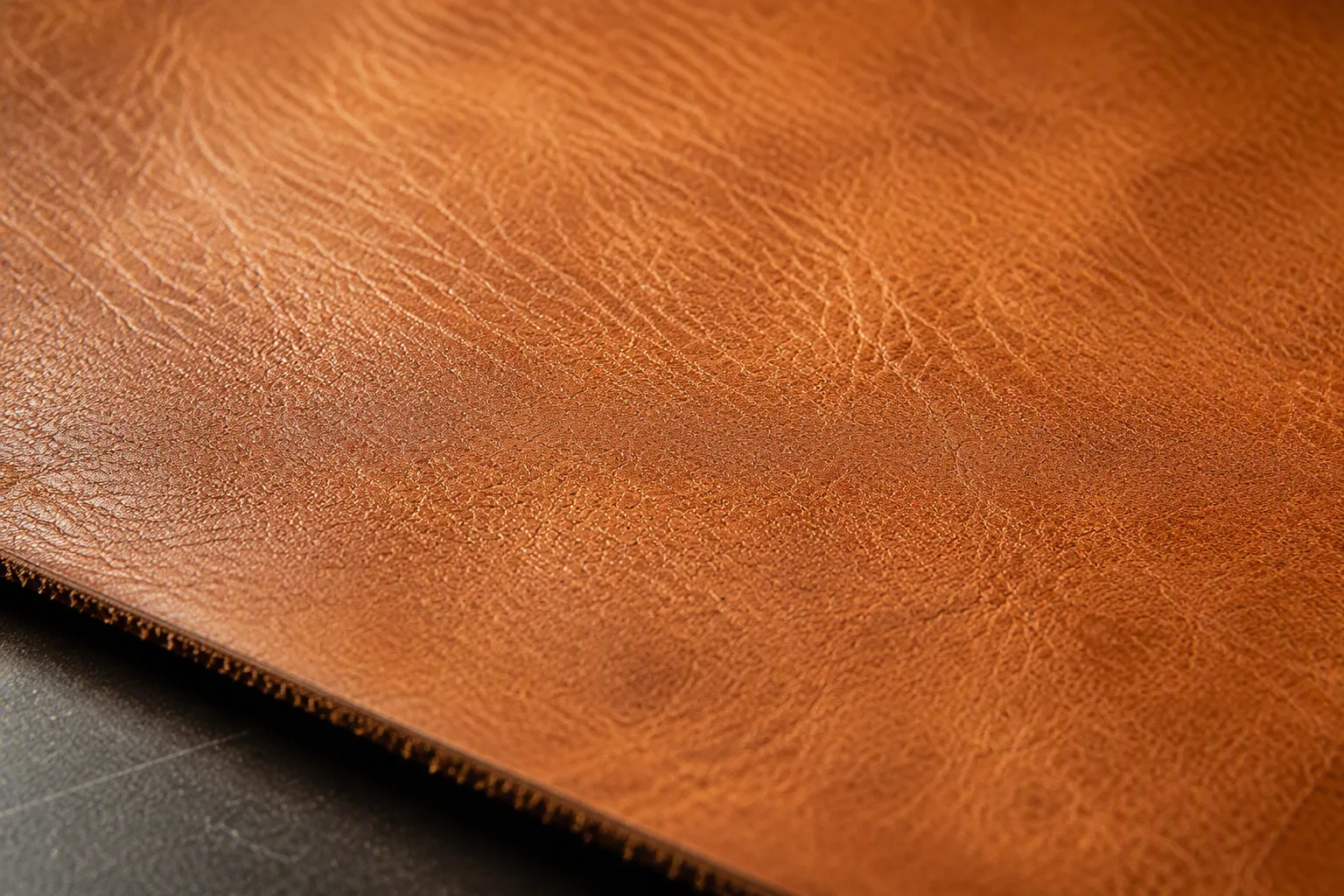
Aniline leather is dyed through and finished with a light, largely transparent treatment, so the natural grain, pores and tone variation remain visible. Colour depth is richer and less uniform than in coated leathers, and no two panels look identical.
Behaviour in Use
It shows its history.
Aniline finishes mark from oils and water, darken where they are handled most, and develop a patina that many buyers value. They are unsuited to bags that must look unchanged after heavy use, and well suited to bags whose character is expected to develop.
Where It Works on Bags
Use it where handling is light and intentional.
Aniline suits shoulder bags, briefcases and designs where the owner expects the leather to age, and where the leather is thick enough to carry the load without relying on a coating. It is a poor choice for high-contact areas such as handles on a shared family bag.
Care Implications
Care is conditioning rather than cleaning.
Because there is no protective film, aniline should be kept dry, conditioned sparingly with products made for it, and protected from ink and oils. Cleaning products formulated for coated leathers can strip or darken an aniline surface.
Semi-Aniline Finishes
Semi-aniline is the family most bags settle on.
Appearance
Natural grain stays visible under a light colour layer.
A thin pigment layer evens the colour without hiding the grain, so the leather keeps its natural character while looking more consistent across panels. This is the usual compromise where a programme needs both natural appearance and manageable colour matching.
Behaviour in Use
More forgiving than aniline, still natural.
Water resistance and abrasion resistance improve compared with aniline, and light marks are less likely to become permanent. The finish still develops character with use, but more slowly and less unevenly.
Where It Works on Bags
A broad middle ground.
Semi-aniline suits most handbags, totes and business bags, and works well where panels must match each other closely. It is often the best available option for a programme that needs consistent colour without a fully coated look.
Care Implications
Simple care with mild products.
A neutral cleaner made for finished leather, applied lightly and followed by occasional conditioning, is usually sufficient. The main risk is over-cleaning, which dulls the surface over time.
Pigmented Finishes
Pigmented means the surface is covered.
Appearance
The colour is in the coating, not only in the leather.
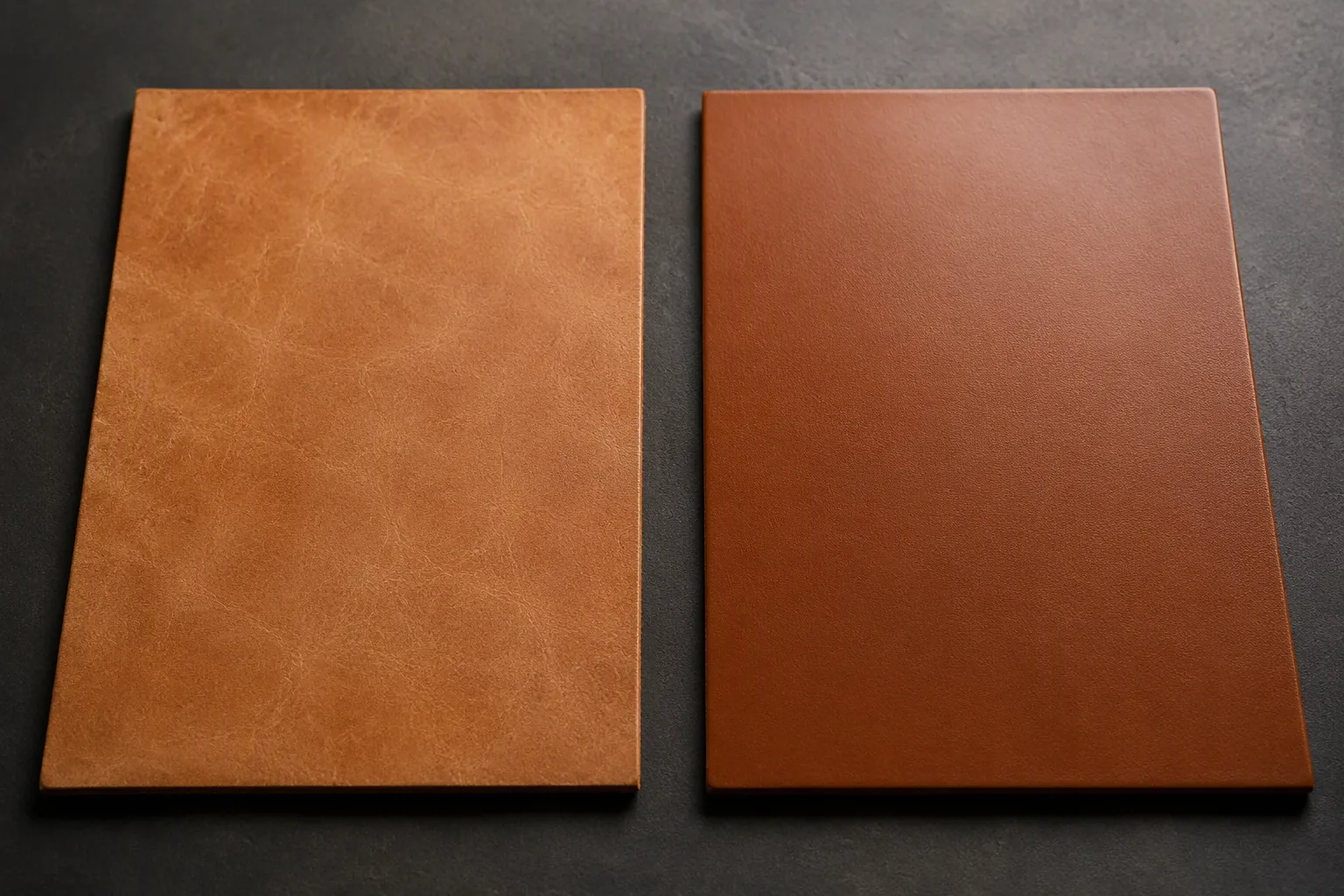
A pigmented finish carries pigment in the coating layers, which makes the surface even in colour, resistant to fading differences and available in a wide colour range. The trade-off is that the natural grain is largely covered, so the surface looks more uniform and less open.
Behaviour in Use
The most protective of the common families.
A pigmented finish resists water, abrasion and light marking better than aniline or semi-aniline, and it is easier to clean. In exchange it feels less natural, can show gloss changes where it is handled repeatedly, and can crack along fold lines if the coating is too heavy for the leather.
Where It Works on Bags
Use it where the bag will be used hard.
Family bags, school bags, travel pieces and any design used daily in weather suits a pigmented finish, because it tolerates cleaning and resists marking. It is also the family used where colour consistency across a large order matters most.
Care Implications
Cleaning is straightforward but should stay gentle.
A soft damp cloth and a product made for finished leather are normally enough, and aggressive solvents should be avoided because they attack the coating. Repeated heavy cleaning produces a dull or uneven sheen rather than a clean surface.
Corrected Grain
A corrected surface is a pigmented finish built on a changed grain.
Where the original grain is too marked for a smooth result, the surface is buffed and an embossed grain is pressed in, then finished with pigment. The result is very even and very durable, and visually less natural than grain that no coating was needed to correct.
Special Finishes
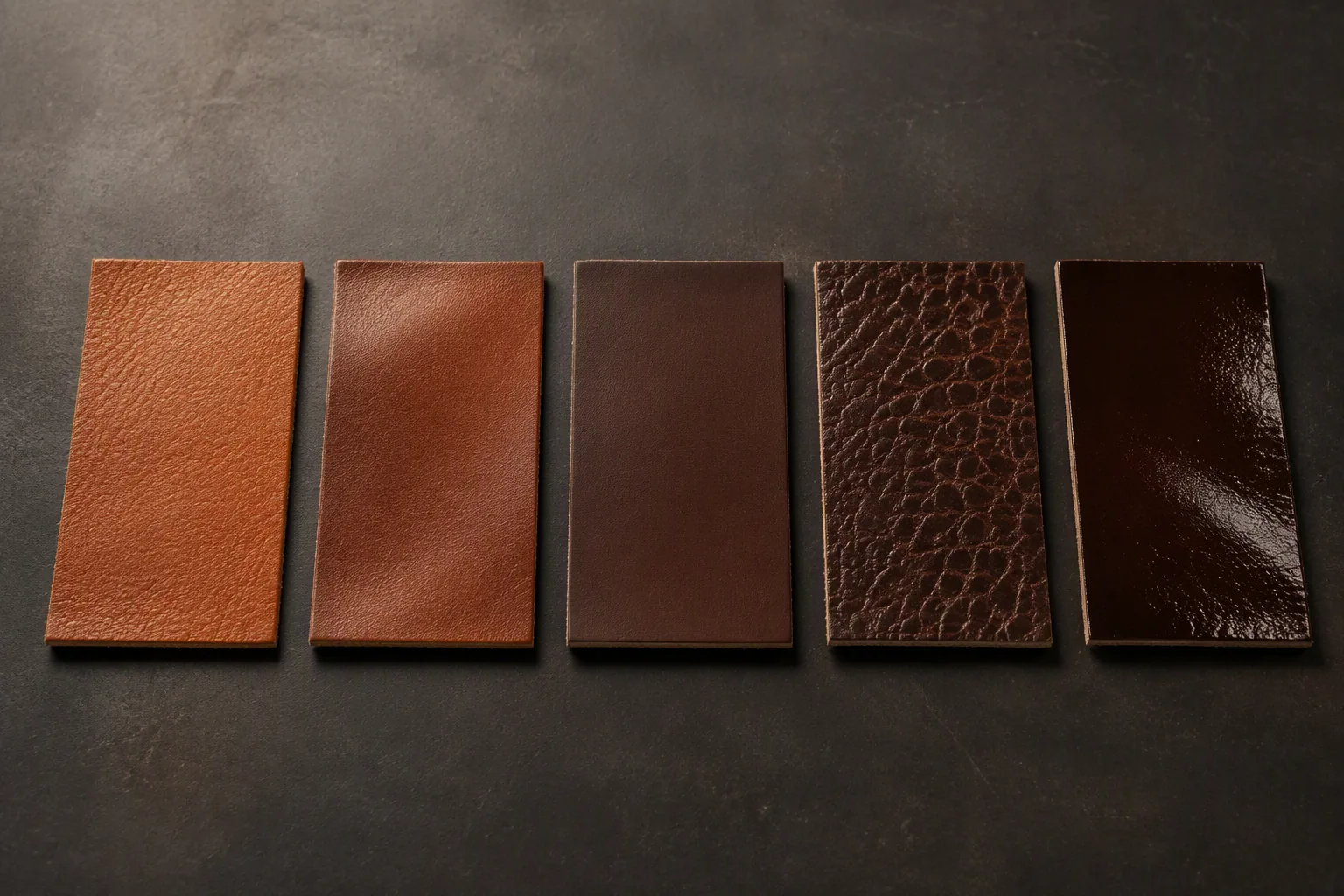
Some finishes change the bag’s daily behaviour in specific ways.
Patent and High-Gloss
Gloss is a surface film, not a leather property.
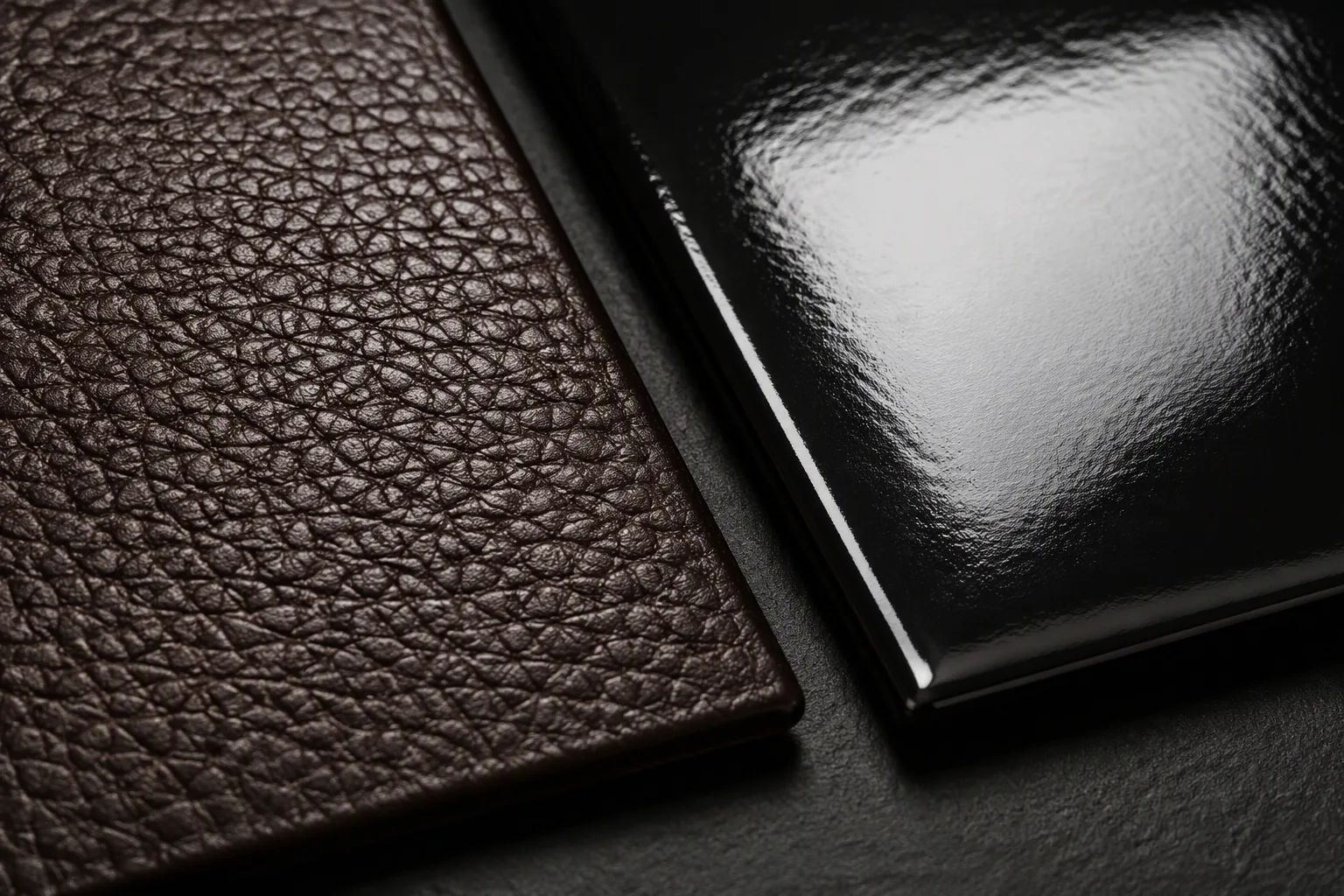
Patent and high-gloss finishes rely on a smooth, reflective coating that shows fingerprints, scuffs and dust clearly, and that can stick to other surfaces in warm conditions. They suit structured designs and occasional use more than soft bags.
Embossed and Printed Grains
Patterns are pressed into the surface.
Embossed finishes can reproduce a grain pattern, a texture or a brand-specific pattern, and they suit programmes that need consistency across many lots, since the pattern is a tool rather than a natural variation. Depth of embossing should be specified, because deep patterns need heavier coatings.
Waxed and Oiled
Wax and oil change colour as they move.
Waxed and oiled leathers have a surface layer that lightens or darkens when the leather flexes, which gives them a distinctive pull-up character. They resist water reasonably well but need conditioning rather than cleaning, and they mark if scrubbed.
Nubuck and Suede
Buffed surfaces have no protective film.
Nubuck and suede present a raised fibre surface without a coating, which makes them soft and very susceptible to water, oil and abrasion marks. They require protective treatment and a brush rather than a cloth.
Metallic and Pearlised
Effect finishes demand care in production.
Metallic and pearlised coatings use reflective particles that can shift with the direction of viewing, so panels should be cut and laid consistently to avoid a visible difference under shop lighting. They also show scuffs at the coating level rather than in the leather.
How Finish Affects Durability
Finish performance can be divided into five questions.
Water Resistance
Coating coverage determines water behaviour.
A pigmented or patent finish resists water far better than aniline, which spots readily and can darken permanently. Semi-aniline sits between the two. Water resistance is best treated as a range rather than a yes-or-no property.
Abrasion and Scuffing
Contact wear happens at the surface.
Coated finishes take scuffs in the coating, where they are often removable or refinishable; aniline takes them in the leather, where they are not. This is why coated leathers suit structured, high-contact bags.
Flex and Crack Resistance
Bending fatigue is the coating’s weak point.
Finishes crack when the coating cannot extend as far as the leather it sits on, which usually reflects a coating that is too heavy for the leather’s thickness or an unsuitable base. Flexing tests along a fold line are the practical check.
Colour Fastness to Rubbing and Light
Colour is held differently in each family.
Pigmented colour sits in the coating, which is largely stable against rubbing but can shift with light; aniline colour sits in the leather and moves with oils and daylight. Transparent or light-coloured finishes are the most likely to show transfer onto clothing in humid conditions.
Gloss Stability
Repeated handling changes the gloss level evenly and unevenly.
An area of the surface that is handled daily polishes to a higher gloss than the panels beside it, which becomes visible after months of use. This effect is strongest on coated and gloss-finished leathers.
Choosing Finish by Bag Part
One bag can carry more than one finish.
Parts with Different Demands
The grip differs from the body.
Handles, straps and closure areas are handled constantly, while the lower panels of a bag meet surfaces and abrasive contact. Panels that must look natural may be finished lightly, while parts that take the wear may be finished more heavily.
Finish by Part Reference
| Bag part | Suggested finish direction | Reason |
|---|---|---|
| Handle and strap body | More protective coated or treated finish | Constant hand contact and oils |
| Strap edges and folds | Finish with good flex resistance | Bending fatigue concentrates here |
| Front and back panels | Can be lighter where character is wanted | Less mechanical contact than handles |
| Base and lower corners | More protective finish | Abrasion against surfaces |
| Closure and flap area | Coating that resists creasing | Repeated opening and closing |
| Lining | Separate lining material | Not a leather finish decision |
| Interior pocket panels | Simple, cleanable surface | Frequent direct contact with contents |
Staying Within One Visual Family
Mixed finishes should still look intentional.
Where parts carry different finishes, the colour and gloss should be matched closely enough that the bag reads as one piece, which usually means specifying both finishes from the same tannery reference rather than choosing them independently.
Care Advice by Finish
Care instructions should follow the finish, not the colour.
Why Care Advice Varies
The wrong product does the most damage.
A cleaner formulated for coated leather can strip a waxed surface and darken an aniline one, and a conditioner applied too generously to a coated surface leaves a greasy film that attracts dust. Care instructions should therefore name the finish family.
Care by Family
| Finish family | Everyday care | Products to use | Products to avoid |
|---|---|---|---|
| Aniline | Dry cloth, keep dry, condition sparingly | Products made for aniline leather | Solvent cleaners, wax polishes |
| Semi-aniline | Soft dry cloth, occasional light conditioning | Mild cleaner for finished leather | Abrasive pads, heavy conditioners |
| Pigmented | Damp cloth, dry immediately | Cleaner for coated leather | Solvents, repeated heavy cleaning |
| Patent | Wipe with a soft dry cloth | Nothing, or a product made for patent | Most creams and conditioners |
| Waxed or oiled | Brush off dust, condition when dry | Wax or oil matched to the original | Soap and water, solvent cleaners |
| Nubuck and suede | Brush the nap, protect before use | Suede brush and protective spray | Water, cloths, conditioners |
Care Instructions for the Customer
Instructions should be short and specific.
A short card naming the finish family, the recommended product type and the treatments to avoid will prevent most customer damage. General advice such as “clean with a leather cleaner” is what leads to the wrong product being applied.
Finish and Repair
Repairability depends heavily on how the leather was finished.
What Can Be Refinished
Coated surfaces can be re-coated.
Pigmented and corrected-grain leathers can usually be cleaned, recoloured and re-coated by a specialist, because the finish is a layer that can be replaced. This makes them the more repairable family for scuffed panels.
What Cannot
Natural surfaces cannot be hidden.
Aniline and nubuck damage sits in the leather itself, so a repair that only touches the surface will not conceal it. Where these finishes are used, the design should accept that wear will be visible and treated as character.
Finish and Warranty Claims
Finish failures are usually visible.
Cracking along folds, peeling coating and uneven gloss changes are the finish faults most often raised as claims, and they are examined by looking at the fold lines, the coating weight and the conditions of use. Keeping a reference panel from the approved lot makes this assessment straightforward.
Specifying Finish to a Supplier
A finish specification should be short and unambiguous.
What to Write Down
Name the family, the grain character and the performance.
A complete finish specification states the finish family, the grain character and any correction or embossing, the colour reference, the desired gloss level, the required performance tests with acceptance criteria, and the care advice that will be published with the product.
Questions to Ask the Tannery
| Question | Why it matters |
|---|---|
| Which finish family is this, and how many coats? | Predicts water resistance, marking and flex behaviour |
| Which performance tests were run, and with what results? | Provides evidence rather than assurance |
| How does the finish behave on a flex test at low temperature? | Cold cracking is a common field failure |
| Is the colour in the leather or in the coating? | Determines how it fades and how it can be repaired |
| Can the finish be matched on a repeat order? | Coating recipes drift between lots |
| What care advice should accompany this finish? | Care guidance must match the actual system |
Testing Finish Performance
Finish tests are quick, and they answer the questions that matter.
The Practical Tests
| Test | Method | What it reveals |
|---|---|---|
| Rubbing fastness | Rub a white cloth across the surface under light pressure | Whether colour transfers onto clothing |
| Flex test | Flex the sample repeatedly along a fold line | Whether the coating cracks with use |
| Cold flex test | Flex the sample at low temperature | Whether the finish becomes brittle in winter |
| Water spot test | Place a drop of water and let it dry | Whether spotting or darkening is permanent |
| Abrasion test | Rub a defined area with a standard abrasive | How the surface wears under contact |
| Adhesion check | Attempt to lift the coating at a cut edge | Whether the coating is properly bonded |
| Gloss comparison after handling | Handle the sample repeatedly, then compare gloss | How visible the wear pattern will be |
Recording and Comparing
Results are only useful in comparison.
Testing two candidate finishes side by side on the same bench, under the same conditions, and recording both results is far more informative than testing one finish in isolation. The record also provides a benchmark for later deliveries.
Finish Faults and Their Causes
Most finish complaints fall into a small set of patterns.
Fault Table
| Fault | Usual cause | Correction |
|---|---|---|
| Cracking along fold lines | Coating too heavy for the leather’s thickness | Reduce coating weight or change the base |
| Coating peeling at edges | Poor adhesion or an unprepared surface | Review preparation and adhesion checks |
| Uneven gloss after use | Coating that polishes under handling | Choose a more matte top coat |
| Permanent water spots | Light or absent protective coating | Add protection or move to a covered finish |
| Colour transfer to clothing | Pigment not fully fixed in the coating | Review fixation and rubbing fastness |
| Fading in shop lighting | Light-sensitive colour system | Test light fastness before approval |
| Marks that cannot be cleaned | Oils absorbed into an uncoated surface | Match the finish to the intended use |
| Visible panel difference | Effect finish viewed at different angles | Control cutting direction across panels |
Diagnosis Order
Start with the use, then the finish, then the leather.
Check whether the fault appears where the bag flexes, where it is handled or where it meets water, because that pattern identifies whether the finish was unsuitable for the use or defective in production.
Sampling and Bulk Control
Finish problems are cheapest to find on a sample.
What the Sample Must Prove
The sample should be used, not inspected.
Handling the sample repeatedly, flexing the folds, getting it wet and letting it dry shows what a swatch never will. Where a programme depends on a specific appearance, the sample should be approved after that treatment rather than before it.
Incoming Checks on Finish
Incoming checks should compare, not just inspect.
Comparing the delivered lot against the approved reference panel for colour, gloss, grain and feel catches drift early, and a rubbing test on a small area confirms that the surface behaves as approved.
Reference Panels for Finish
A reference panel settles most finish arguments.
Keeping an approved panel from the first accepted lot, stored away from light and handling, gives the factory and the tannery a shared standard for colour, gloss, grain and feel. Comparisons against a stored panel are reliable; comparisons against memory are not.
A reference panel is worth photographing and recording as well, with the finish family, coating information and approval date noted alongside it, so that a programme running for several seasons can be re-sourced without rediscovering its own history.
Change Control
Any change to the finish is a new material.
A change of coating, gloss level, grain correction or colour system changes the way the bag ages and how it should be cared for, so each change should be re-sampled and the published care advice updated accordingly.
Common Mistakes and How to Avoid Them
| Mistake | Consequence | Prevention |
|---|---|---|
| Specifying colour but not finish family | Tannery chooses the easiest system | Write the family, grain and gloss into the specification |
| Choosing a natural finish for a hard-used bag | Early marking and permanent water spots | Match the finish to the contact level |
| Choosing a heavily coated finish for a soft bag | Cracking along folds | Balance coating weight against flex |
| Approving on a flat swatch only | Performance problems appear after use | Test handling, water and flex before approval |
| One care instruction for every finish | Customers use the wrong product | Publish care advice per finish family |
| Using effect finishes without cutting control | Panels look different under shop light | Control cutting direction and panel pairing |
| Ignoring light fastness | Fading in display | Test light fastness for the intended retail setting |
| Changing coating without re-approval | Appearance and care advice become wrong | Re-sample every change and update documentation |
Frequently Asked Questions
What is the difference between aniline, semi-aniline and pigmented leather?
The difference is how much coating covers the grain. Aniline is almost bare, so the natural grain and its variation show; semi-aniline adds a thin colour layer that evens the tone while keeping the grain visible; pigmented covers the grain with a coating that carries the colour, giving a more even surface and better protection.
Which leather finish is best for a bag used every day?
A pigmented or corrected-grain finish is usually the better choice for daily use, because it resists water, abrasion and light marking and is easier to clean. A natural finish looks and feels better but records every contact, which is a poor match for constant handling.
Does a pigmented finish mean the leather is not real?
No. Pigmented describes the surface treatment, not the material underneath. It is a real leather whose grain has been covered by a colour coating, and it is common in bags where colour consistency and durability are more important than a visibly natural surface.
Why does my aniline leather bag darken where I hold it?
Because there is almost no coating between your hand and the leather. Oils and moisture from the skin are absorbed into the surface, which darkens it, and the same property means water and ink marks are difficult to remove. This behaviour is expected with aniline rather than a defect.
Can a leather finish be repaired?
Coated finishes usually can be, because the coating is a layer that can be cleaned, recoloured and re-coated by a specialist. Aniline, nubuck and suede damage sits in the leather itself and cannot be hidden by surface work, so those finishes should be chosen with visible wear in mind.
Why does the coating sometimes crack along folds?
Usually because the coating cannot extend as far as the leather beneath it. A coating weight that is too heavy for the leather’s thickness, or an unsuitable base layer, produces cracking at the fold lines, and a flex test along a fold is the practical way to catch it before production.
How should a patent-finish bag be cared for?
With a soft dry cloth and very little else. Patent finishes are surface films that show fingerprints and scuffs clearly, and most creams and conditioners can damage them or leave a film, so the care advice is usually to wipe rather than to treat.
Why do some leather swatches look different once they are on the bag?
Because swatches are flat and new, while a finished bag flexes, is handled and is viewed from different angles. Effect finishes such as metallic and pearlised change with viewing direction, and cut panels can look different under shop lighting if their orientation was not controlled.
Does the finish change how the leather should be cleaned?
Yes, and this is the most common source of customer damage. Cleaning products made for coated leather can strip a waxed surface or darken an aniline one, so care instructions should name the finish family and the product type to use rather than giving general leather advice.
What is corrected grain leather?
It is leather whose surface grain was buffed away and replaced with an embossed pattern, then finished with pigment. The result is very even and durable, and it is used where the original grain was too marked to deliver a consistent appearance across a large order.
What finish tests should a buyer ask for?
Rubbing fastness, flex and cold flex, water spotting, abrasion and coating adhesion are the practical set, since they correspond to the ways a bag actually fails. Asking for the results, rather than confirmation that tests were done, is what makes the answer useful.
The Bottom Line
The finish is where the leather meets the world.
Aniline, semi-aniline and pigmented families are not better or worse in themselves; they trade natural appearance against protection, and the right choice depends on how the bag will be handled, cleaned and stored. Specifying the family, the grain character and the performance tests at the start prevents the tannery from deciding on the factory’s behalf.
For buyers, the practical questions are short. Ask which finish family the leather is and how many coats it carries, and whether the colour sits in the leather or in the coating.
Then ask which performance tests were run and with what results, how the finish survives flexing at low temperature, and what care advice should accompany the product. A supplier that can answer those questions is delivering a specified finish; one that cannot is delivering whatever the tannery had available.
