
Leather Shrinkage and Stretch: Specifying Tolerance for Bags
Leather Shrinkage and Stretch: Specifying Tolerance for Bags
Leather moves. It relaxes on the cutting table, stretches where a bag is loaded, shrinks slightly when it dries and grows when it takes up moisture, and every one of those changes is measured in fractions of a millimetre — until it accumulates into a sagging base, a wavy seam or a panel that no longer matches its neighbour.
As a bag manufacturer, we treat dimensional change as a material property to be specified and controlled, not as an occasional surprise. This guide explains what actually moves inside a hide, how direction and moisture drive the change, how to test and record it, how to write tolerances that production can hold, and how to stop movement from turning into visible defects.
Dimensional stability is not a single number. It is a direction, a moisture condition and a load — and a specification that names only one of the three tells the factory almost nothing.
- Why Shrinkage and Stretch Matter in Bag Making
- What Actually Moves Inside a Hide
- Hidden Stretch: How Leather Behaves Under Load
- Moisture, Heat and Dimensional Change
- Direction, Grain and Panel Orientation
- Testing Shrinkage and Stretch
- Measuring and Recording Dimensional Change
- Specifying Tolerance in a Bag Programme
- Tolerance by Bag Part
- How Relaxation and Conditioning Fit In
- Cutting Layout and Orientation Control
- Construction Choices That Absorb Movement
- Where Movement Becomes a Defect
- Faults, Causes and Corrections
- Bulk Control and Incoming Checks
- Working With the Tannery on Stability
- Common Mistakes and How to Avoid Them
- Frequently Asked Questions
- The Bottom Line
Why Shrinkage and Stretch Matter in Bag Making
Most quality problems that appear late begin as a dimensional change early.
Movement Accumulates
Small changes add up across a bag.
A millimetre of relaxation on a side panel is invisible on its own, but the same movement along a gusset, a base and a top edge changes the geometry of the whole bag. By the time the bag is assembled, the error belongs to the assembly rather than to any single panel.
Why Fit Matters More Than Size
Bags are assemblies, not single parts.
Every panel has to meet its neighbours along a seam or a fold, so what matters is not the absolute size of a panel but whether the panel still matches the one beside it. Two panels that move in the same direction keep their relationship; two panels that move differently do not.
Cost of Getting It Wrong
Movement related defects surface in sampling, at final inspection or in the customer’s hands, and each stage costs more to correct than the last. Corrections usually mean re-cutting panels, which means buying more leather and losing more of the hide’s yield.
What Actually Moves Inside a Hide
Leather is a fibre network, and fibre networks behave directionally.
The Fibre Network
Collagen fibres do not run in every direction equally.
Hides are built from a dense network that is tighter along the spine and looser toward the belly, with fibres that respond differently depending on how they are loaded. That is why the same leather can feel firm in one direction and stretchy in another.
Direction and the Spine Line
The spine line is the reference for every layout decision.
Stretch is lowest along the spine and highest across it, so the orientation of a panel on the hide decides how much it will move in use. Two panels cut from the same area but rotated ninety degrees can behave like different materials.
Area of the Hide
Position matters as much as direction.
Shoulder and back areas are dense and stable, while belly and neck areas are looser and stretch more. Allocating stable areas to load-bearing panels and looser areas to less critical parts is the first line of defence against movement defects.
Moisture Content
Water is a plasticiser for leather.
Dry leather is stiffer and shorter; leather that has taken up moisture is softer and slightly larger. This is not a defect but a physical response, and it means any thickness or dimension measured on leather depends on the condition it was measured in.
Temperature and Time
Heat accelerates what moisture begins.
Warm conditions let leather relax faster, which is why pressing, drying and storage temperature all influence final dimensions. Time works the same way: a panel left flat overnight is not the same panel that was cut in the afternoon.
Hidden Stretch: How Leather Behaves Under Load
Stretch under load is invisible until the bag is used.
Elastic and Permanent Deformation
Part of the movement comes back, and part does not.
When a strap is loaded, it extends elastically and recovers when the load is removed. Loaded for long enough, leather also creeps permanently, which is why a strap that measured correctly at inspection can sit longer after a season of use.
Where Load Concentrates
Bags load a few points far more than the rest.
Handles, strap anchors, the base of a tall tote and the back panel of a backpack take most of the force, and they are exactly where stretch becomes visible. A panel that behaves well in a flat test can still be the wrong choice there.
Why Straps Lengthen
Strap length in service is the clearest symptom.
A strap cut across the spine direction will lengthen noticeably under a loaded bag, and by the time the customer notices, the bag hangs lower and the anchor points carry the strain at an angle they were not designed for.
Moisture, Heat and Dimensional Change
Environmental change is the most predictable source of movement.
Uptake and Release
Leather gains and loses moisture with the air around it.
Moving a bag from a dry warehouse to a humid retail floor, or from a humid factory to a dry aircraft hold, changes its moisture content and therefore its dimensions. The change is small per unit but continuous across a whole product.
Conditioning Before Cutting
Cutting condition should be deliberate.
Panels should reach a stable moisture content before they are cut and, ideally, be cut and assembled at a similar condition. Cutting very dry leather and assembling it in a humid room is a reliable way to produce panels that no longer line up.
Drying and Shrinkage
Drying removes water and shortens leather.
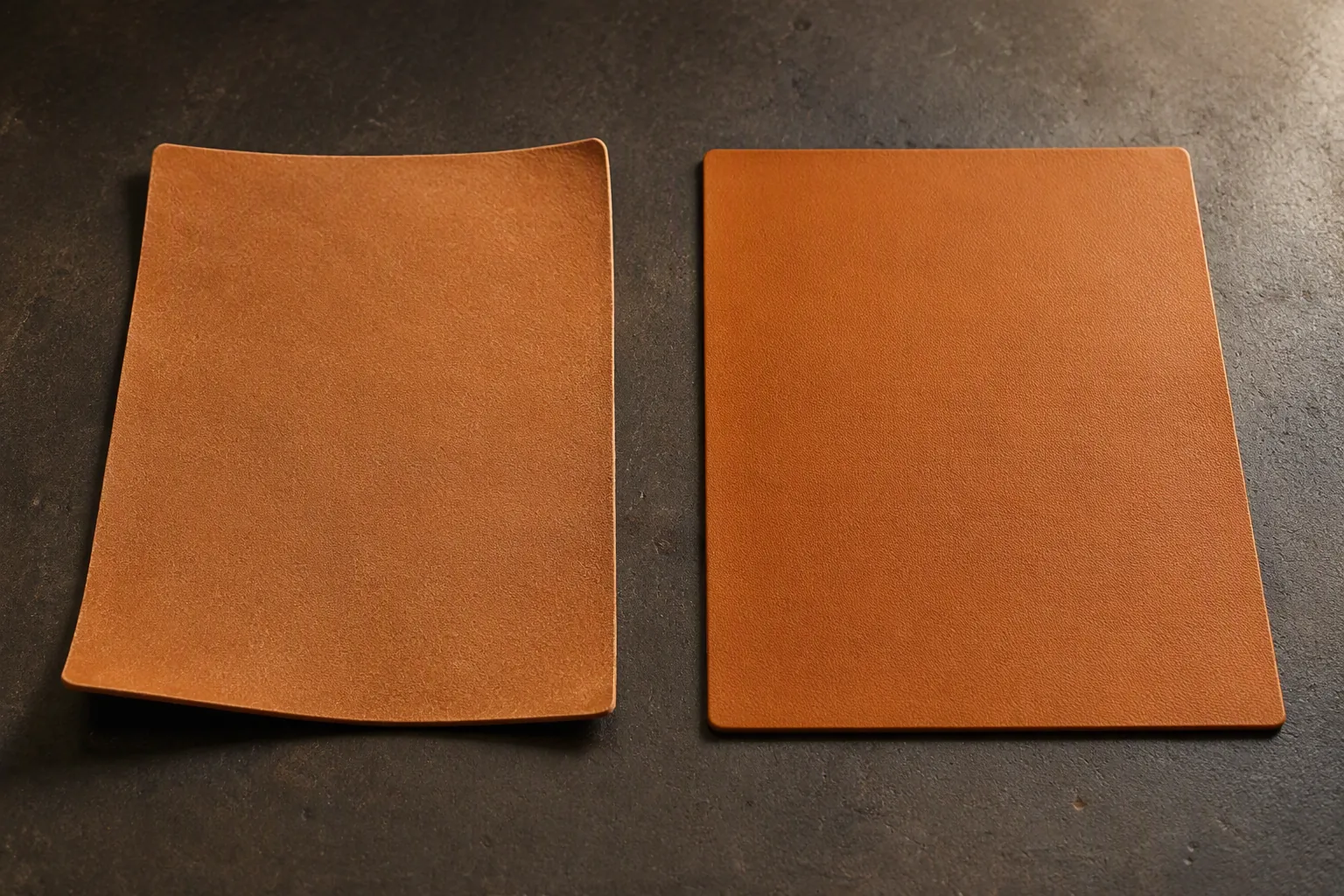
Whether that shortening is recoverable depends on how the leather is dried and how far it is taken. Controlled drying at moderate conditions is part of dimensional stability, while aggressive drying can lock in shrinkage that no later conditioning will fully reverse.
Storage and Transit
Conditions after production still matter.
A bag that spends weeks in a container passes through temperature and humidity ranges nothing in the factory predicted, and panels under tension, such as a loaded strap folded into a box, can take a set during that time. Protective packing and relaxed positioning exist partly for this reason.
Direction, Grain and Panel Orientation
Orientation is the cheapest control a factory has.
Reading Direction on a Hide
Direction can be identified before cutting.
The spine line, the tightness of the grain and the way a panel curls when it is held up all indicate direction, and an experienced cutter reads them before laying a pattern. Consistency here prevents a whole class of mismatched panels.
Cutting Direction and Behaviour
The same shape behaves differently in two directions.
A long panel cut along the spine resists stretch lengthwise, while the same panel cut across it extends far more readily. For straps, gussets and handles the difference is not cosmetic but structural.
Matching Direction Across a Bag
Panels that work together should point the same way.
When two panels that meet along a seam are cut in different directions, they will respond differently to the same load and the seam will eventually show it. Direction consistency is a layout rule, not a preference.
Direction and Appearance
Direction also affects how the material looks.
Grain, sheen and any natural markings change with viewing direction, so mismatched orientation can produce a bag with panels that appear to be different colours under shop lighting. Our guide to colour matching in bag production covers that effect in detail.
Testing Shrinkage and Stretch
If it is not tested, it is not controlled.
Test Methods at a Glance
Simple workshop tests reveal most of what matters.
The usual approach is to mark a known distance on a leather sample, apply a defined condition or load, and measure the result. The method does not need to be sophisticated, but it must be repeatable and recorded in the same way every time.
Sample Preparation
Samples must represent the panel.
Samples should be taken from the same areas of the hide that will be used for critical panels, cut in the direction that will actually be used, and conditioned before testing. A test sample from the middle of the hide tells you about the middle of the hide and nothing else.
| Test | What is done | What it reveals |
|---|---|---|
| Dry-to-humid change | Measure a marked sample, condition it in humid air, measure again | How much the panel grows in a normal service environment |
| Humid-to-dry change | Condition in humid air, then dry, measure both times | Shrinkage risk in dry storage or transit |
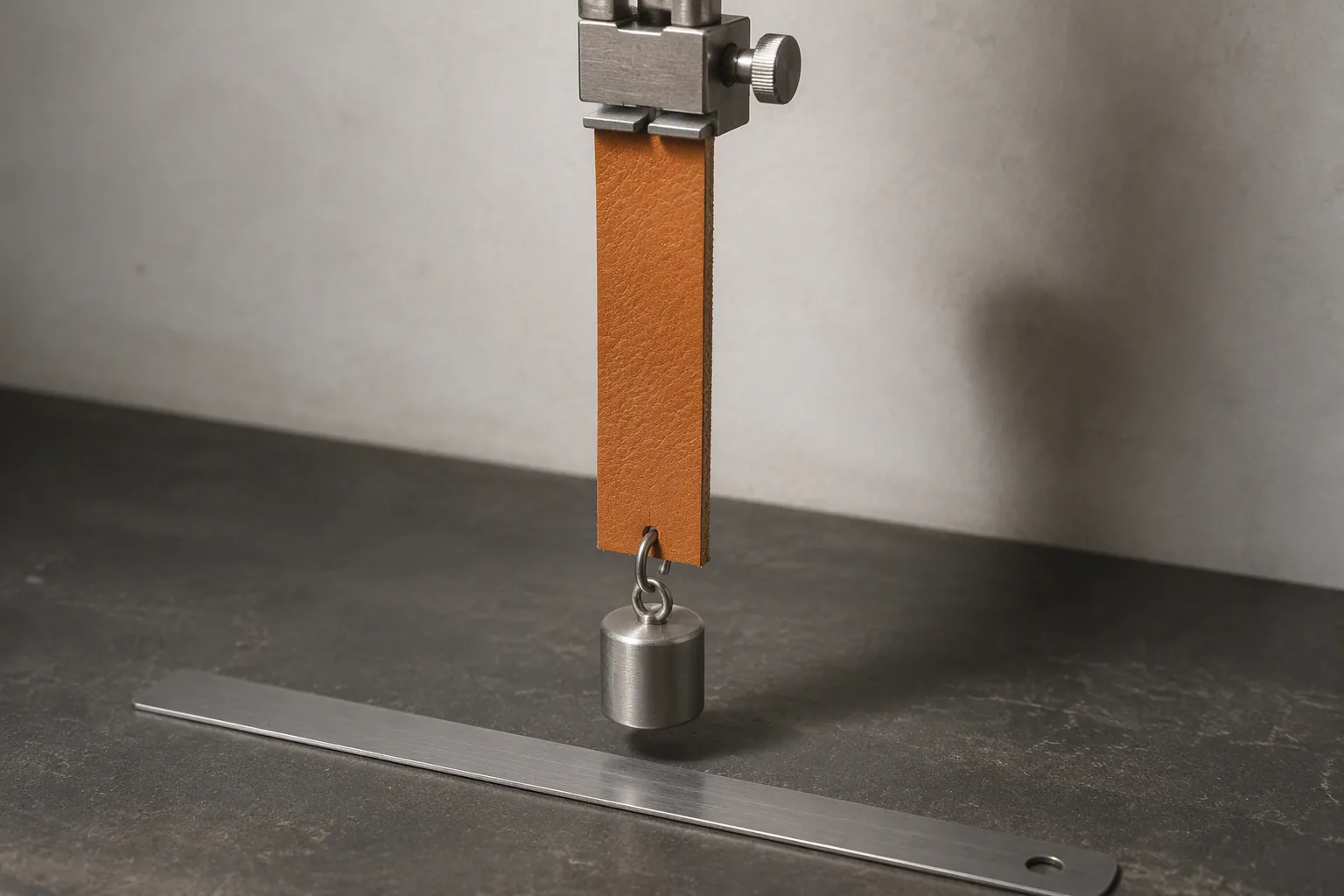
| Stretch under load | Suspend a strip with a defined weight, measure extension | Whether the panel is suitable for straps and handles |
| Load and recovery | Load a strip, remove the load, measure again | How much of the extension is permanent |
| Recovery after stretching | Measure a relaxed panel after stretching and resting | Whether the material will return to its cut dimension |
| Grain-side and flesh-side check | Measure both surfaces of the same sample | Whether drying pulls a curl or a twist into the panel |
Loaded Soak Tests
Time under load is the closest proxy for use. Suspending a loaded strap sample for an extended period and measuring its length at intervals reproduces the slow extension a customer experiences, which a single instantaneous pull cannot show.
Interpreting the Results
A number only means something next to another number, so tests should be run as pairs or groups rather than in isolation. Comparing the same figure for the direction used in straps against the direction used in a decorative panel immediately shows which allocation is safer.
Measuring and Recording Dimensional Change
Records are what turn a test into a specification.
Marking and Measuring
Mark before, measure after, in the same way.
A defined gauge length marked on the sample, measured with the same instrument, at a defined condition, produces figures that can be compared across lots. Changing the method halfway through an order makes every earlier record useless.
Reference Panels and Benchmarks
A benchmark keeps judgement consistent.
Keeping a reference panel from an approved lot gives everyone in the factory a physical standard to compare new material against, which is far more reliable than comparing against memory or against the previous delivery.
When to Measure
Dimensional checks belong at defined points.
| Stage | What to check | Why |
|---|---|---|
| Incoming goods | Sample dimensions and stretch direction | Confirms the lot matches the approved material |
| After splitting or skiving | Dimensions of prepared panels | Confirms the preparation did not distort the panel |
| After relaxation before assembly | Panel dimensions against the pattern | Catches relaxation before it becomes a fitting problem |
| During assembly | Panel alignment at seams and folds | Detects direction errors while they can still be corrected |
| Final inspection | Base flatness, strap length, panel symmetry | Confirms the finished bag behaves as designed |
| Reference storage | Benchmark panel kept under stable conditions | Keeps future comparisons meaningful |
Condition at Measurement
Dimensions recorded without a moisture and temperature note cannot be compared with anything, including a figure taken the following week, so recording the condition costs a line and prevents arguments later.
Specifying Tolerance in a Bag Programme
A specification is a set of limits a supplier can plan against.
Nominal, Minimum and Maximum
Limits are more useful than a target.
A nominal dimension tells the supplier what the design intends, while a minimum and maximum tell it what will be accepted. Supplying all three removes the most common source of rejects, which is a supplier meeting the nominal in one direction and the buyer expecting it in the other.
Tolerance by Function
Tolerance should follow the part’s job.
A strap anchor dimension has to hold more precisely than a decorative facing, because the anchor interacts with hardware and carries load. Writing tolerance by function keeps the tight limits where they earn their cost.
| Specification field | What to write | Why it matters |
|---|---|---|
| Nominal dimension | The design figure with unit | Shared reference for buyer and supplier |
| Tolerance range | Acceptable minimum and maximum | Removes ambiguity at inspection |
| Measured direction | Along or across the spine line | Makes the figure meaningful |
| Condition at measurement | Moisture and temperature basis | Keeps records comparable |
| Test method | How stretch or shrinkage was measured | Allows results to be repeated |
| Percentage limits | Allowed change after conditioning or load | Separates good panels from unsuitable ones |
| Recovery requirement | Minimum return after load is removed | Controls permanent deformation |
| Parts exempt from tight limits | Panels where movement is acceptable | Avoids over-specifying the whole bag |
Working With the Supplier on Limits
Limits should be agreed rather than announced.
A supplier that has contributed to the limits can plan leather selection around them, and the agreed figures become part of the purchase specification. Where a supplier cannot meet a limit with its current range, that is a design conversation, not a rejection.
Tolerance by Bag Part
Different parts tolerate movement to very different degrees.
Load-Bearing Parts
These parts get the tightest limits.
Straps, handle bodies, anchors and base panels should be cut in the stable direction and specified with the tightest percentage limits, because their dimensional change is directly visible in how the bag hangs.
Non-Critical Parts
Some movement is harmless.
Decorative facing panels, internal dividers and hidden reinforcement layers can accept wider limits, especially when they are not loaded and are fixed on more than one edge.
Parts Where Movement Causes Appearance Problems
Appearance defects rarely come from the part that moved.
A panel that relaxes slightly is invisible until it sits beside a panel that did not, which is why the limits for adjacent panels should be written as a group rather than individually. Our guide to leather temper for bags covers the related question of how panels are specified by feel.
| Bag part | Suggested limit direction | Why |
|---|---|---|
| Handle and strap body | Tightest; cut along the spine | Lengthening is immediately visible in use |
| Strap anchor and attachment | Tightest; cut in the stable direction | Interacts with hardware and carries load |
| Base and back panel | Tight; minimal relaxation allowed | Flatness controls whether the bag stands |
| Gusset and side panel | Moderate but matched to the front panel | Must move with the panel it is seamed to |
| Front and back decorative panels | Moderate; matched as a pair | Appearance depends on the pair behaving alike |
| Lining | Wider; allow for natural slack | Slight looseness is normal and safer than tension |
| Pocket and divider panels | Wide | Low load, often fixed on several edges |
| Reinforcement and interlining | Wide within process limits | Hidden inside the construction |
How Relaxation and Conditioning Fit In
Time is a production input.
Letting Panels Rest
Panels should rest before assembly.
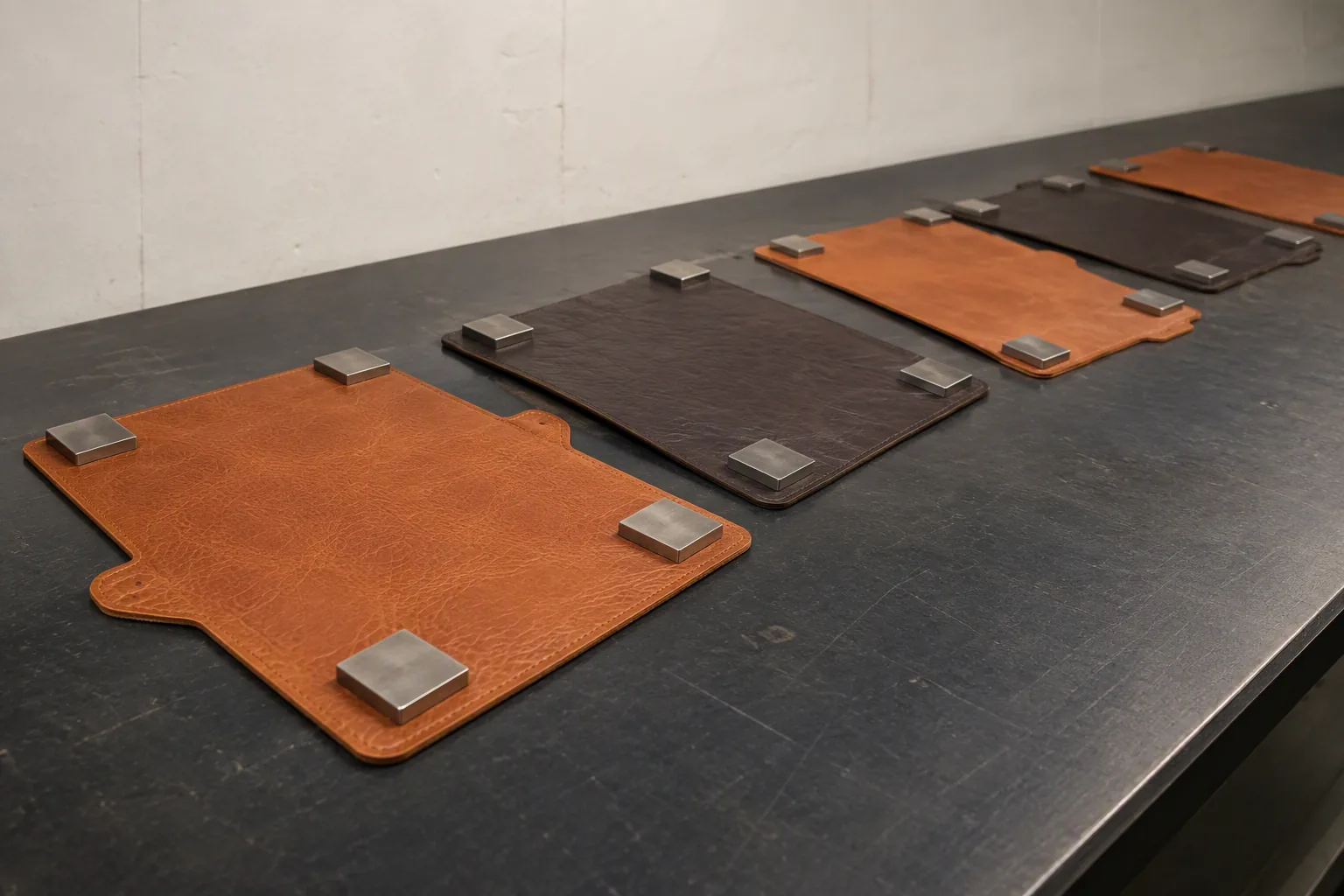
Leather that has just been split, skived or cut carries stresses from the process, and those stresses release over hours rather than minutes. Allowing panels to rest flat under light weights before assembly is a simple, low-cost way to remove most of the relaxation that would otherwise appear after stitching.
Weighting and Flat Storage
Storing prepared panels flat rather than hanging or folded prevents them from taking a set in the wrong direction, and where flat storage is impractical, rolling at a generous radius is better than folding.
Setting the Rest Period
The rest period should be defined, not improvised.
A defined period, recorded in the work instruction, makes relaxation part of the process instead of something that happens when the schedule allows. Where a factory is under pressure, relaxation time is one of the first things to be skipped and one of the most expensive to skip.
Cutting Layout and Orientation Control
Most movement problems are decided at the cutting table.
Marking Direction on Patterns
Direction should be written into the pattern.
Pattern pieces should carry a direction mark, and the layout should state which way that mark faces for each panel role. Relying on the cutter’s judgement works until the cutter changes, and then a whole order can be cut with inconsistent orientation.
Nesting for Stability
Nesting is a balance between yield and behaviour.
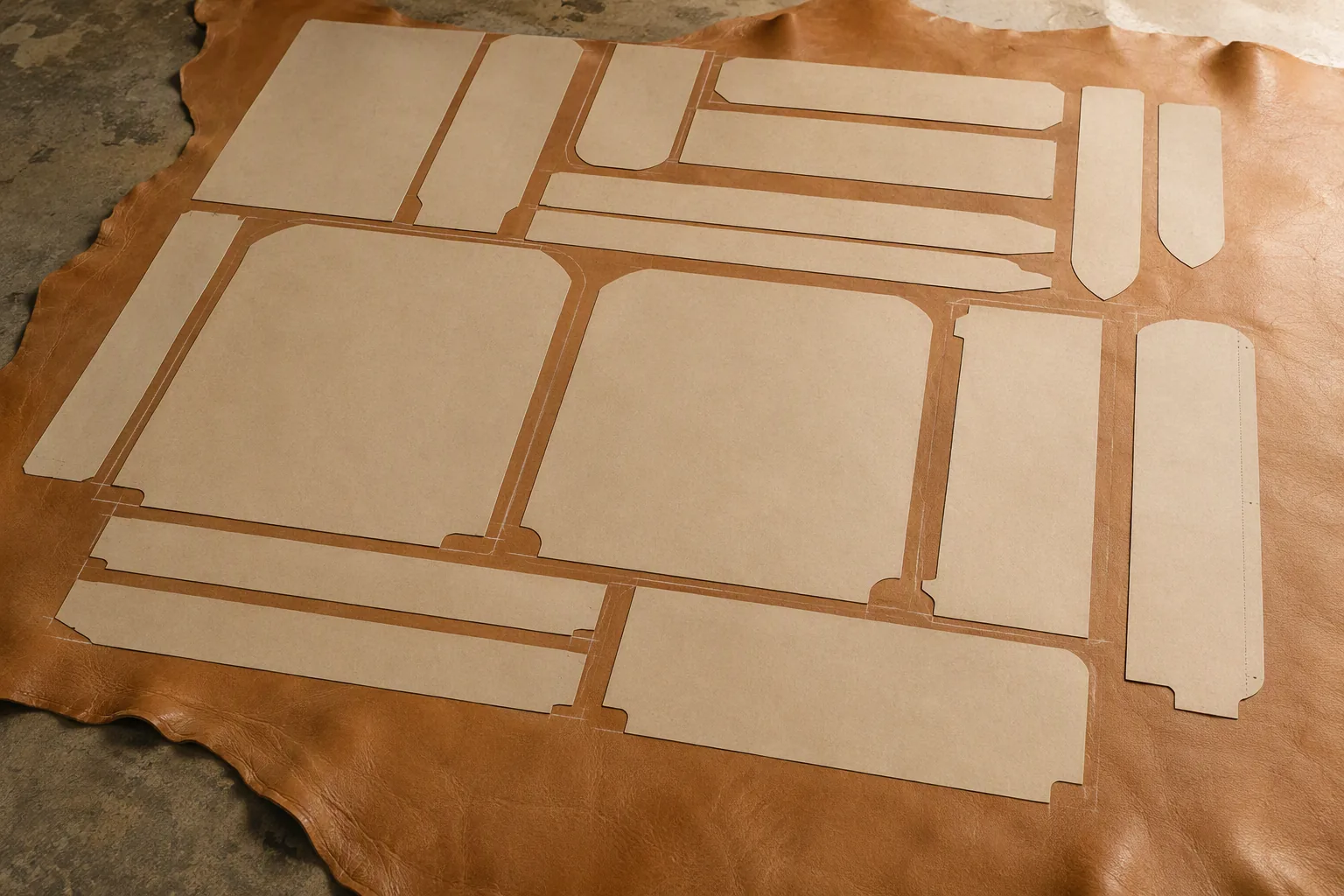
The most economical layout is not always the most stable one, because it may rotate a panel into a direction where it will stretch more in use. Stable panels should be placed first, and the remaining pieces nested around them.
Yield versus Stability Trade-offs
The trade-off is real, and it should be a decision.
Slightly lower yield on a strap panel is almost always cheaper than replacing bags that stretch in service, while the same reasoning does not apply to a hidden lining panel. Making that distinction explicitly keeps cost and quality in the right order.
Recording the Layout
Keeping the approved layout on file, with its direction marks and panel allocation, allows the cutting room to repeat it and prevents the quiet drift that shows up as inconsistency between deliveries.
Construction Choices That Absorb Movement
Design can make movement harmless.
Seam Allowance and Ease
A little slack in the right place helps.
Allowing small amounts of ease in lining and internal panels gives the construction somewhere to absorb movement without pulling on the outer leather. Tension is what turns a harmless dimensional change into a visible distortion.
Reinforcement and Interlining
Reinforcement stabilises without thickening.
A bonded or stitched reinforcement layer reduces how much a panel can extend under load, which is often a better answer than choosing a heavier leather. It also lets a designer keep a thin, soft outer surface while controlling behaviour underneath.
Stitch and Fold Placement
Lines of stitching stiffen what they cross.
Stitching restricts movement along its line, so placement of seams and topstitching changes how a panel behaves in use. That effect can be used deliberately, but it happens whether or not the designer intended it.
Edges and Openings
Bag mouths, zipper openings and pocket edges concentrate movement because they are free on one side, which is why these areas usually need either reinforcement or a construction that lets the panel move without distorting the shape.
Where Movement Becomes a Defect
Movement only becomes a problem in combination.
Sagging and Loss of Shape
A sagging base is usually a stretch problem.
If a base panel extends under load, the bag loses its flat bottom and the sides begin to lean, which then transfers load to seams that were not designed to carry it. The visible symptom appears far from the panel that caused it.
Wavy Seams and Puckering
Puckering is a mismatch symptom.
When one panel moves more than the panel it is sewn to, the longer panel has to go somewhere, and it goes into waves along the seam. Matching direction and limiting adjacent panels as a group is the preventative answer.
Wavy Zippers
A zipper is a fixed-length element.
A zipper tape does not stretch the way leather does, so a panel that relaxes or extends beside a zipper creates a wave that no amount of pressing will remove. Zipper runs need panels with tight dimensional limits and, usually, a reinforcement strip.
Edge Cracking and Curling
Edges concentrate stress.
A panel that shrinks slightly while its neighbour does not puts stress on the edge finish between them, which shows up as cracking or lifting paint. Edges also curl when drying pulls the grain and flesh sides differently.
Hardware Misalignment
Movement reaches the hardware.
Snaps, rivets and rings are installed at fixed positions, so any dimensional change after installation shifts the alignment and can make a closure stiff or a strap hang unevenly. Where hardware is installed, dimensional limits should be at their tightest.
Faults, Causes and Corrections
Most movement faults have a small set of causes.
Fault Table
| Fault | Usual cause | Correction |
|---|---|---|
| Bag sags at the base | Base panel cut in the stretchy direction | Re-cut across the stable direction and re-sample |
| Strap lengthens in use | Strap body cut across the spine | Re-cut along the spine, or reinforce the strap |
| Seam puckers | Adjacent panels with mismatched direction | Match direction and specify the pair together |
| Zipper waves | Panel relaxation beside a fixed-length tape | Tighten limits, add a reinforcement strip |
| Edge finish cracks or lifts | Differential shrinkage between panels | Condition panels together, re-check edge prep |
| Panels no longer align at assembly | Relaxation between cutting and stitching | Add a defined rest period before assembly |
| Bag shrinks after storage | Dry storage or transit conditions | Control packing conditions, avoid tension in packing |
| Hardware becomes stiff or misaligned | Movement after hardware installation | Tighten limits at hardware positions, install later |
Working Backwards from the Symptom
Diagnosis starts at the visible fault.
Identify which panel moved, in which direction, and at what stage it was cut, then check the layout and the rest period for that panel. Most faults trace back to one of those two places rather than to the leather itself.
Bulk Control and Incoming Checks
Control belongs at the start of the order.
Incoming Dimensional Checks
Incoming checks catch a change of material early.
Measuring sample dimensions and stretch direction from each delivered lot, against the approved benchmark, is quick and prevents a whole order being cut from material that behaves differently from the one that was approved.
In-Process Checks
In-process checks catch drift.
Checking panel dimensions after preparation and after relaxation identifies a process drifting before it produces rejects. These checks are most useful when the results are recorded rather than judged at the bench.
Final Inspection Criteria
Base flatness, strap length, panel symmetry and hardware alignment are dimensional criteria that can be written into the final inspection routine rather than left to subjective assessment.
Working With the Tannery on Stability
Dimensional behaviour starts before the leather reaches the factory.
What to Ask About
Ask how the leather behaves, not only how it looks.
Suppliers should be able to describe the direction of lowest stretch, the typical response to conditioning and the storage conditions the material was produced for. Where a supplier cannot answer, the factory should test rather than assume.
Selecting Consistent Lots
Where a programme will run for months, selecting lots that behave consistently matters as much as selecting a good colour and temper, because a stable supply of consistent material is worth more than a marginally better single lot.
Documenting Agreement
Agreed dimensional limits, test methods and measurement conditions belong in the supplier specification alongside thickness and colour requirements, so the requirement survives staff changes on both sides.
Common Mistakes and How to Avoid Them
| Mistake | Consequence | Prevention |
|---|---|---|
| Specifying a dimension without a direction | The same figure means two different things | State along or across the spine line |
| Ignoring the spine line in layout | Straps stretch and bases sag | Mark direction on patterns and record the layout |
| Cutting very dry leather in a humid room | Panels relax and no longer fit | Condition material before cutting |
| No rest period between cutting and assembly | Panels move after stitching | Define and record a rest period |
| Measuring without noting conditions | Records cannot be compared | Record moisture and temperature with every figure |
| Testing only a sample from the middle of the hide | The test does not represent the panels | Sample from the areas actually used |
| One tolerance for the whole bag | Tight limits wasted, critical panels unprotected | Write tolerance by panel function |
| Changing material without re-testing | Movement behaviour changes unnoticed | Re-test each significant material change |
Frequently Asked Questions
Does leather shrink over time?
It can, usually by a small amount, and mostly in response to drying. Leather that loses moisture shortens slightly, while leather that takes up moisture grows. Whether the change is recoverable depends on how far the drying went and under what conditions, which is why dry storage and aggressive drying are both worth controlling.
Which direction does leather stretch most?
Leather stretches least along the spine line and most across it, with variation depending on where on the hide the panel is cut. Belly and neck areas stretch noticeably more than shoulder and back areas in either direction.
How do I specify leather stretch in a purchase specification?
Give a direction, a measurement condition and a percentage limit, plus the test method used to check it. A single figure without a direction or a condition means different things to different suppliers and cannot be verified at inspection.
Why do leather bag straps get longer with use?
Straps are loaded continuously and leather creeps under sustained load, so a strap cut in a stretchy direction lengthens progressively. Cutting the strap body along the spine line and reinforcing it where load concentrates limits this effect.
Should panels be allowed to rest before stitching?
Yes. Splitting, skiving and cutting leave stresses in the leather that release over hours, so panels left flat under light weights before assembly reach a more stable dimension. Skipping the rest period is a common cause of panels that no longer line up at the bench.
Can shrinkage be reversed by conditioning?
Partly, and not reliably. Leather that has lost moisture will usually relax again when conditioned, but shrinkage that has been taken too far or locked in by aggressive drying may not fully reverse. Prevention is more dependable than correction.
Why do leather panels on the same bag look slightly different in colour?
Orientation is one cause. Grain, sheen and natural markings change with viewing direction, so two panels cut in different directions can appear to differ under shop lighting even though they came from the same hide and dye lot.
How much stretch is acceptable for a bag handle?
It depends on the load the handle carries, but the working rule is that a handle should show minimal permanent extension under a loaded soak test. Because lengthening is visible in use, handles and strap bodies take the tightest limits in a specification.
Does reinforcement reduce stretching?
Yes, and it is often the more efficient answer. A bonded or stitched reinforcement layer restricts how far a panel can extend under load, allowing a thin, soft outer leather to be used while the panel underneath controls the behaviour.
How does humidity in the factory affect dimensions?
Leather gains and loses moisture with the surrounding air, so panels cut in a dry room and assembled in a humid one can change dimension between the two operations. Keeping cutting and assembly at similar conditions removes most of that variation.
What should be checked at final inspection for movement problems?
Base flatness, strap length, panel symmetry and hardware alignment are the practical checks. Each can be written as a measurable criterion, which is more reliable than judging whether the bag looks right.
The Bottom Line
Dimensional change is manageable when it is specified.
Leather will always respond to moisture, heat and load, and no specification will stop that. What a specification can do is name the direction, the condition and the limit, so that panels suited to their jobs are chosen deliberately and the ones that must stay stable are protected.
For buyers, the practical questions are short. Ask which direction each critical panel is cut in, how the factory conditions and rests panels before assembly, what dimensional tests were run and under what conditions, and how the results are recorded. A supplier that can answer those questions is controlling movement; one that cannot is waiting for it to appear in the customer’s hands.
