
OEM vs ODM: How to Start Custom Bags with a Factory
OEM vs ODM: How to Start Custom Bags with a Factory
Every brand starts the same way: with an idea and no factory. The founder knows the bag they want to sell. They do not know how a bag gets made, what the terms mean, or where the money actually goes.
The first real lesson is that a factory partnership is a process, not a purchase. It runs through discovery, quoting, sampling, revisions, and approvals before a single production line starts. Brands that understand the process save months and thousands of dollars. Brands that do not learn it the expensive way.
This guide walks through the whole journey from a manufacturer’s point of view: the OEM and ODM models, what happens before an order, how sampling really works, and the questions to ask before you commit.
- Why Brands Work with Factories
- OEM and ODM: The Two Models Explained
- What Happens Before the First Order
- Sampling: The Five-Round Reality
- MOQ and the Economics of Price
- Quality Control: Inspections That Matter
- Materials: The Conversation That Decides Quality
- Packaging and Branding: The Last Details
- Payment, Lead Time and Contracts
- Working Across Time Zones and Cultures
- Red Flags: Warning Signs in a Factory
- The Question Checklist Before You Order
- Frequently Asked Questions
- Scaling: From First Order to Reorders
- The Bottom Line
Why Brands Work with Factories
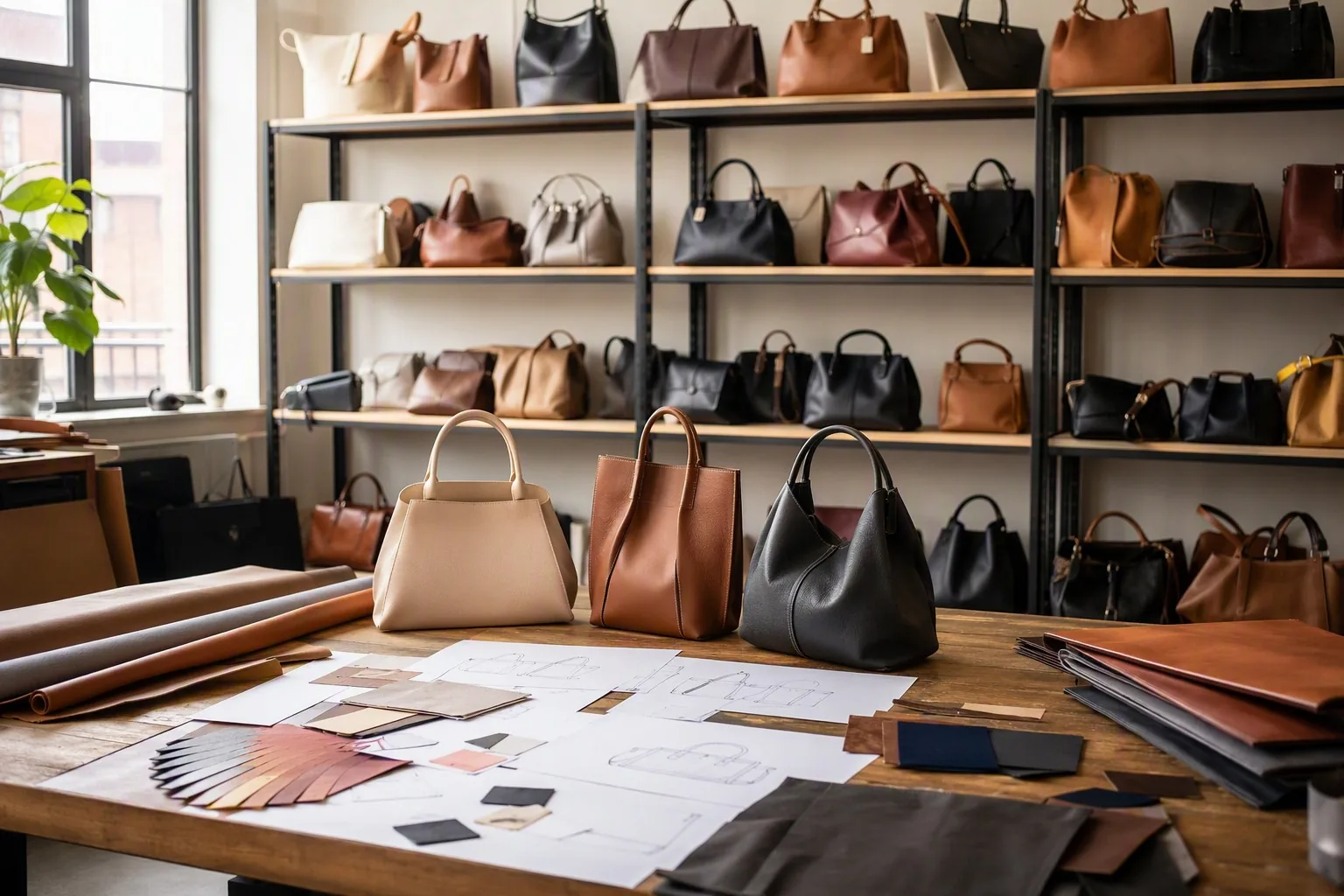
Almost no serious bag brand makes its own bags. The economics make that impossible: a factory invests in cutting tables, sewing lines, hardware tooling, and skilled labor that a brand cannot justify for its own production.
The Two Paths to a Bag
Every bag on a shelf arrived through one of two paths. The first is a factory’s own design, sold to brands that add their label. The second is a brand’s custom design, manufactured to order.
Most new brands assume they need the second path. Many actually start on the first. Neither is wrong; they serve different stages of a business.
When Custom Beats Catalog
Catalog products (ODM) are ready, proven, and cheap to start. Custom products (OEM) are unique, protectable, and harder to copy.
The decision usually comes down to one question: what is your brand selling? If it is a point of view with a logo, catalog works. If it is a product difference, custom is the only honest option.
Manufacturer’s point: We tell every new brand the same thing: start with ODM if you can, go OEM when you must. The best time to go custom is when you understand your customer well enough to design for them.
How Factories See New Brands
A factory sees a hundred new brand inquiries a year. Most never order. The pattern shapes how factories respond to new names.
Serious inquiries share three traits: a clear product idea, a realistic budget, and a timeline that respects the process. Inquiries without these get treated as casual interest, not as pipeline.
The fastest way to be taken seriously is to act seriously: send a proper RFQ, ask informed questions, and follow up with decisions rather than silence.
OEM and ODM: The Two Models Explained
The terms OEM and ODM are thrown around so casually that most buyers misuse them. They describe two different relationships, and the difference changes everything about your project.
OEM: Your Design, Their Hands
OEM stands for Original Equipment Manufacturing. You bring the design; the factory makes it.
You own the design, the patterns, and the specifications. The factory provides cutting, sewing, hardware sourcing, and quality control. You pay for tooling and development because the factory builds nothing reusable until you approve it.
ODM: Their Design, Your Brand
ODM stands for Original Design Manufacturing. The factory brings the design; you bring the brand.
The factory shows you existing styles — often hundreds — and you pick one to customize. You change the color, the leather, the hardware, maybe the dimensions. The factory already has patterns and tooling, so development costs stay low and lead times stay short.
Choosing Between OEM and ODM
| Factor | ODM (catalog custom) | OEM (full custom) |
|---|---|---|
| Design ownership | Factory’s design | Yours |
| Starting cost | Low (sample + small MOQ) | Higher (tooling + development) |
| Lead time to first order | Weeks | Months |
| Minimum order | Small (100–300 pcs typical) | Larger (300–1000+ pcs typical) |
| Uniqueness | Shared with other brands | Exclusive to you |
| Best for | New brands, first orders | Established brands, signature styles |
The Semi-Custom Middle Ground
Between catalog and full custom sits semi-custom: a factory style reworked to your specification.
You keep the proven structure and tooling but change the materials, colors, dimensions, or hardware. The bag reads as yours, yet development costs stay near ODM levels. Semi-custom is the smartest route for most first orders.
What the Terms Really Cost You
The real cost difference between OEM and ODM is not the unit price. It is the development chain.
OEM means you fund tooling, multiple sample rounds, and longer material lead times. ODM means the factory absorbs design risk and you start selling sooner. A $2–4 unit price gap between models is small next to a three-month delay in your launch.
What Happens Before the First Order
Before any production, a real factory partnership runs through a defined sequence. Skipping steps is how mistakes get made and budgets get blown.
The Discovery Conversation
The first call is not about prices. It is about feasibility: your target price, your volumes, your materials, your timeline.
Good factories ask about your market and your customer before they quote. If a factory quotes instantly without questions, treat that as a warning, not a convenience.
The RFQ: What a Good One Contains
The Request for Quotation is your design brief in document form. The quality of your RFQ determines the quality of your quote.
- Product type and target dimensions (length, width, height).
- Materials: leather type, thickness, lining, hardware finish.
- Target quantity and expected annual volume.
- Target retail price and target factory price.
- Reference photos or sketches, even rough ones.
- Quality expectations: stitching, edges, packaging.
Reading a Real Quote
A serious quote is itemized, not a single number. It shows materials, labor, hardware, packaging, and overheads separately.
It states the MOQ, the sample cost, the production lead time, and what changes cost extra. If a quote is vague on any of these, ask before you proceed. A vague quote becomes a vague invoice.
The Target Price Conversation
The most important number in your RFQ is the target price, and hiding it wastes everyone’s time.
Factories engineer to a price: leather grade, hardware quality, and construction depth all bend to hit a number. If your target is $12 and the factory quotes $18, the honest answer is either a material change or a redesign.
State your target early and ask what it buys. The answer shows you the real choices inside your budget.
Sampling: The Five-Round Reality
Every brand underestimates sampling. The industry joke is that it takes one round. The industry reality is closer to three to five.
How Sampling Actually Works
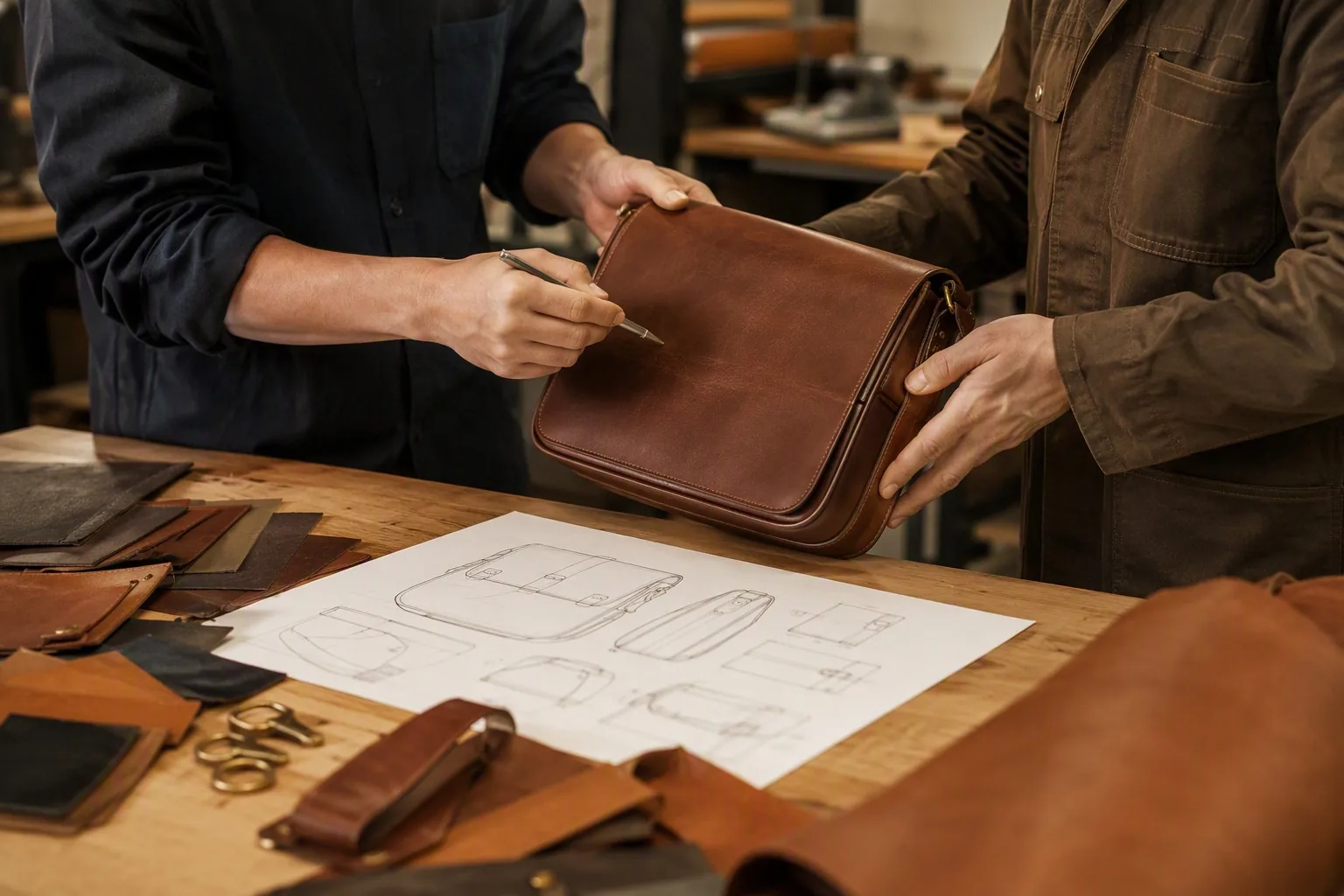
Round one is the concept sample: does the design work at all? Round two fixes proportions and materials. Round three fixes details — pocket sizes, strap length, edge finish. Later rounds polish fit and finish.
Each round takes one to three weeks and costs money. The brands that suffer are the ones who treat round one as final. The brands that succeed budget for three rounds and celebrate when it takes two.
What Makes Sampling Slow
Sampling slows down for predictable reasons, and most are avoidable.
Vague feedback is the biggest one: “make it better” starts another round, while “raise the pocket 2 cm and lengthen the strap by 8 cm” ends one. Changing materials after approval restarts the clock. And slow replies from the buyer side stretch every round by days.
The fastest projects are the ones where the buyer answers quickly, changes are specific, and decisions stick.
What Samples Can and Cannot Tell You
A sample proves the design and construction. It does not prove the leather will age well or the hardware will last two years.
Those answers come from material knowledge and factory testing, not from looking at one sample. Ask the factory about leather tannage, thread weight, and hardware finish. Their answers tell you more than the sample does.
What Samples Cost and Who Pays
Sample costs follow a pattern that surprises most new buyers. The factory pays for development only when the design is proven and the volume is real.
| Sampling stage | Typical cost | Who pays |
|---|---|---|
| Concept sample | $80–200 | Buyer (refundable against order) |
| Revised samples | $50–150 each | Buyer |
| Counter sample | Often free | Factory |
| Pre-production sample | Free | Factory |
| Production sample | Free | Factory |
MOQ and the Economics of Price
The Minimum Order Quantity is the number that frightens new brands most. It deserves understanding rather than fear.
How MOQ Works
An MOQ exists because every production run has fixed costs: pattern making, cutting dies, machine setup, and material ordering.
Those costs are the same whether you order 100 bags or 1,000. The MOQ is simply the volume at which the factory can spread those fixed costs without the unit price becoming absurd.
Lowering the MOQ: Practical Tactics
New brands often need smaller runs than factories prefer. The gap closes with tactics, not arguments.
Order one style in one color instead of three styles in three colors. Combine a new style with a reorder of an existing one in the same material. Accept standard hardware instead of custom-engraved pieces. Each choice reduces the factory’s setup burden, and factories reward that with lower minimums.
Mixed Containers and Shared Runs
Another path to small quantities is grouping: several styles or several colors in a single production run and a single shipment.
Factories quote mixed runs readily when the total volume is healthy. The per-style minimum drops even when the total MOQ stays the same. It is the standard way small brands build a collection without ordering a container of one bag.
The Price Ladder
Unit price falls as volume rises, but not evenly. The biggest drops happen at the early steps, where fixed costs still dominate.
| Order quantity | Typical unit price (relative) | Why it changes |
|---|---|---|
| 100 pcs | 100% (baseline) | All fixed costs on few units |
| 300 pcs | 80–88% | Setup costs spread further |
| 500 pcs | 72–80% | Material buying power improves |
| 1,000 pcs | 65–72% | Leather bought in bulk lots |
| 3,000+ pcs | 55–65% | Full production efficiency |
Quality Control: Inspections That Matter
Quality is not a final check. It is a sequence of gates from material arrival to packed cartons. Understanding the gates helps you ask for the right inspections.
Pre-Production Checks
Before the line starts, the factory approves the materials and the pre-production sample. That sample is your contract: the production bags must match it.
Inline and Final Inspections
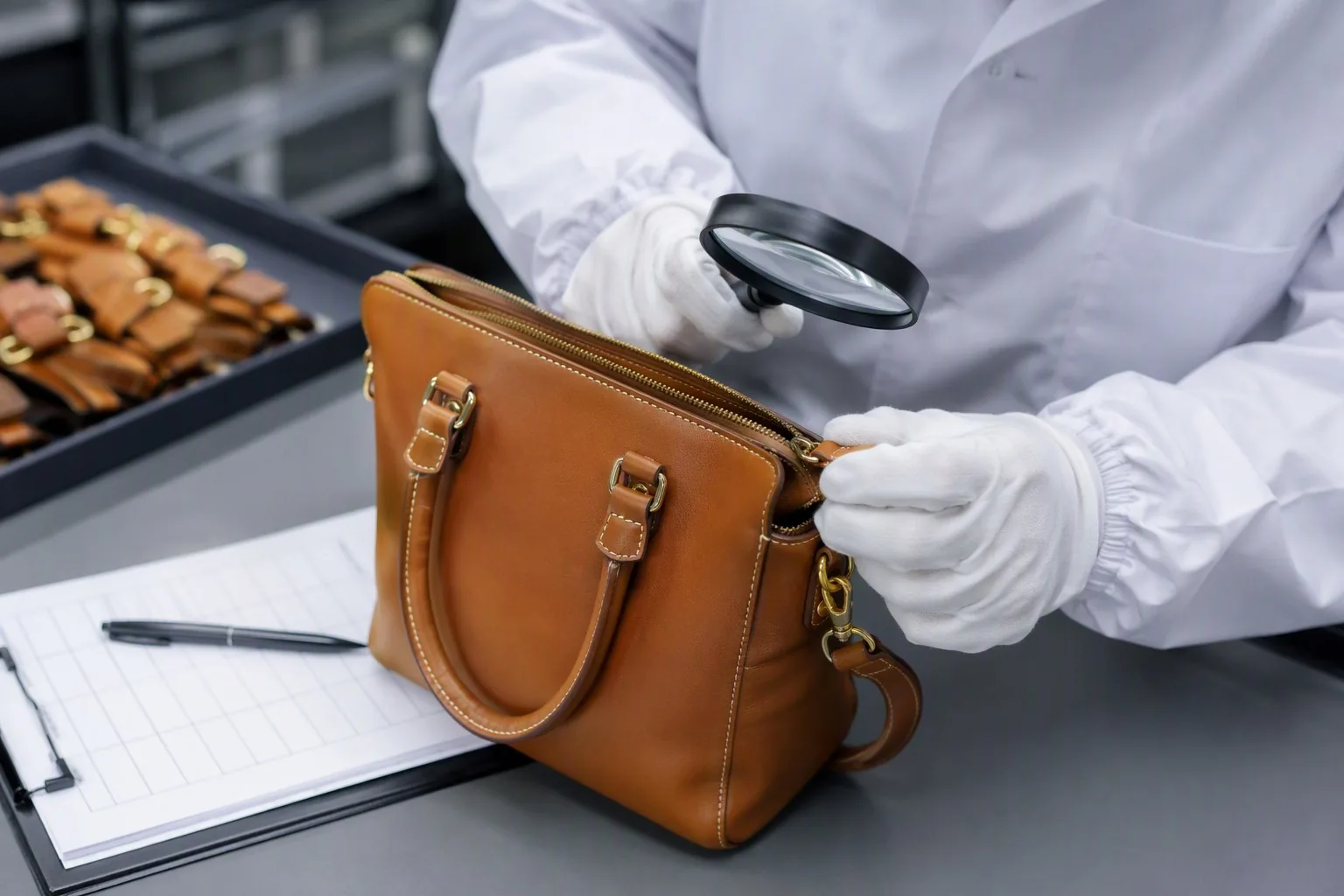
Inline inspection happens during production, when problems are still cheap to fix. Final inspection happens on finished goods, usually with a random sample.
You can hire a third-party inspector for the final check. Most serious brands do for their first orders. It costs a little and catches a lot.
AQL in Plain Words
AQL stands for Acceptable Quality Limit, the statistical sampling standard used in final inspections.
Instead of checking every bag, the inspector checks a random sample and counts defects. The result is compared with a table that decides pass or fail. A typical standard for bags is AQL 2.5 for major defects and 4.0 for minor ones.
What Third-Party Inspection Costs
A professional inspection of a typical order runs from $200 to $400, plus travel for on-site visits in some regions.
For a first order of a few hundred bags, that is a small fraction of the shipment value. It buys an independent record of quality, which is worth more than the price when disputes arise.
The Defect Definition Conversation
Before inspection, both sides must agree on what counts as a defect. A loose thread is minor; a broken zipper is major.
Factories and buyers often disagree on borderline cases. Agree the defect categories in writing with your order, and the inspection becomes a formality instead of a negotiation.
Materials: The Conversation That Decides Quality
The materials conversation is where quality is actually decided. Leather type, thickness, lining, and hardware are not details; they are the product.
Leather Choices for Your First Order
Full-grain leather is the premium choice: durable, natural, and expensive. Top-grain is corrected and slightly cheaper. PU and PVC imitate leather at a fraction of the cost.
For a first order, choose the material your customer expects at your price point, and ask the factory what they recommend for your usage. A diaper bag needs wipe-clean materials; a luxury tote needs the real thing.
Thickness and Hardware Specifications
Leather thickness is measured in ounces or millimeters. Bag bodies typically run 1.2–1.6 mm; straps and handles need more.
Hardware finish matters as much as material: solid brass ages beautifully, plated zinc looks good for less. Specify everything in your RFQ, because the factory builds exactly what the specification says.
The Sample-Material Trap
A common disappointment arrives when the production leather differs from the sample leather. The sample used a premium hide; production used a cheaper grade.
Prevent it by agreeing the material specification in writing with the sample, and naming the leather grade and tannery in the order confirmation. The pre-production sample exists precisely to confirm this.
Packaging and Branding: The Last Details
The bag is finished, but the brand is not. Packaging and branding details arrive at the end and are forgotten by most first-time buyers.
Labels, Dust Bags and Hang Tags
Every custom bag needs at least a brand label, and most need a dust bag and hang tag. These are cheap per piece but need lead time and tooling.
Embossed logos on leather need a brass stamp; woven labels need a weaving run. Both are one-time costs that drop sharply per unit as volume grows. Order them with your sample so the pre-production sample shows the full finished product.
Cartons, Barcodes and Compliance
Shipping details are boring and essential: export cartons, barcode labels, and compliance documentation for your market.
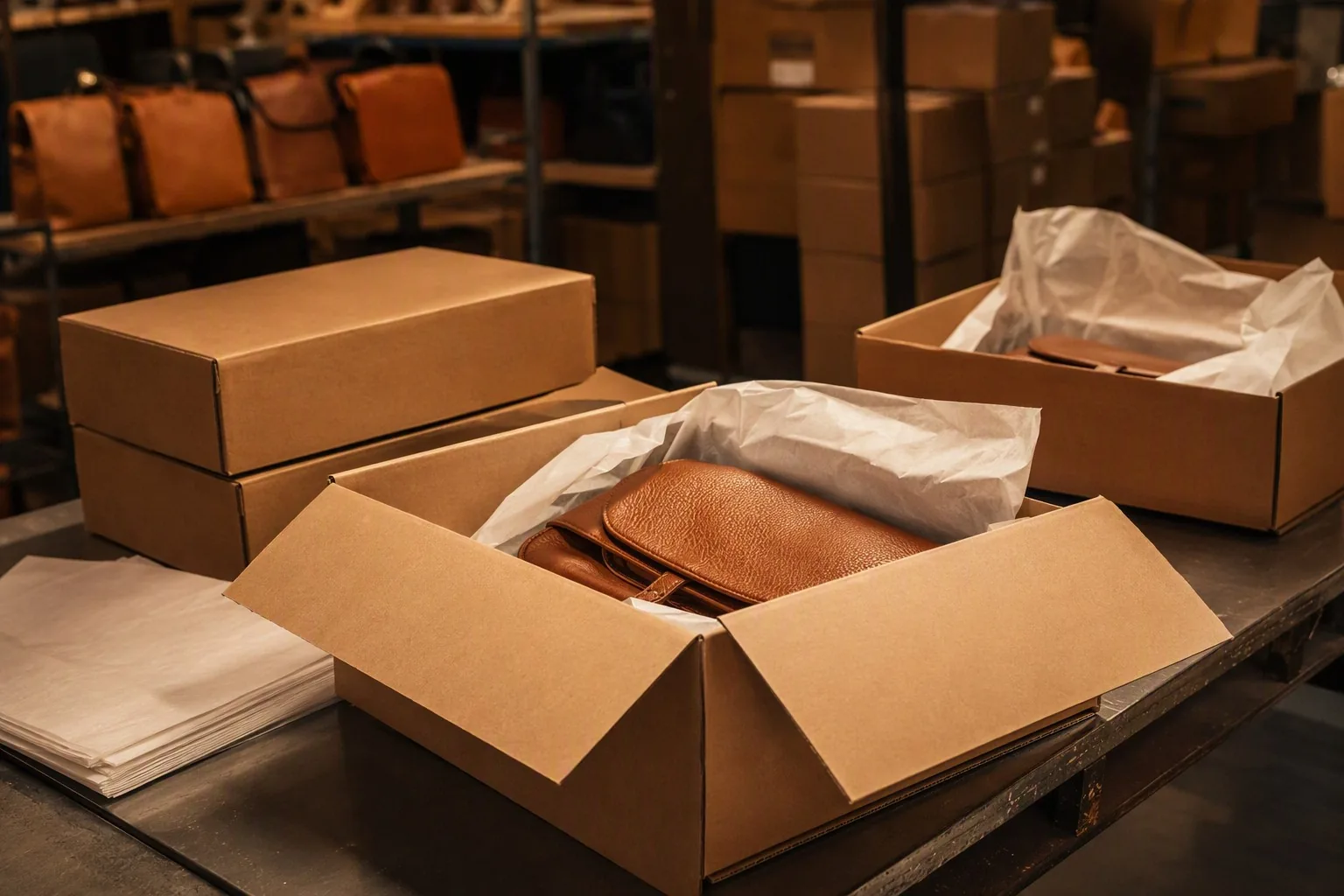
Ask about carton dimensions and weights early, because they determine freight costs. Ask about material compliance for your destination country. These questions cost nothing and prevent expensive surprises at customs.
Payment, Lead Time and Contracts
Money and time are where partnerships succeed or fail. The terms are negotiable, but they follow industry patterns you should know before you negotiate.
Payment Terms
The industry standard is a deposit before production and the balance before shipment. Typical splits are 30/70 or 50/50.
Sample fees are usually paid upfront and credited against your first order. Watch for factories that demand full payment before production with no inspection step.
Realistic Lead Times
Production lead times follow a pattern: materials first, then production, then a quality buffer.
- Sample rounds: 1–3 weeks each.
- Material sourcing: 1–3 weeks.
- Production: 3–6 weeks for typical MOQs.
- Buffer for inspections and shipping: 1–2 weeks.
A brand ordering today with a launch date next month is already late. Plan for 8–12 weeks from approval to delivery as a safe first-project estimate.
Shipping Terms in Plain Words
Trade terms decide where your responsibility starts and ends. Three cover most bag orders:
- EXW (Ex Works): you collect the goods at the factory; every cost after the factory door is yours.
- FOB (Free On Board): the factory covers cost and risk until the goods are on the ship. Most common for overseas orders.
- DDP (Delivered Duty Paid): the factory delivers to your door, duties included. Easiest for you, priciest in the quote.
| Term | Factory handles | You handle | Best for |
|---|---|---|---|
| EXW | Goods at factory | Everything after | Local buyers, freight forwarders |
| FOB | To the ship | Ocean freight onward | Most importers |
| DDP | To your door, duties paid | Unpacking | First orders, small volumes |
Ask which term the quote uses. Two quotes can look identical and mean very different costs.
The Contract Basics
The order confirmation should state everything: the agreed sample number, materials, dimensions, MOQ, unit price, delivery date, and inspection terms.
Photographs of the approved sample should be attached. When disputes happen, the contract and the photos are what settle them.
Working Across Time Zones and Cultures
Most bag buyers work with factories on the other side of the world. The distance adds friction, and the friction is manageable with habits.
Communication That Works
Written communication wins. Every decision that matters should arrive by email or message, not only by call. Summaries after calls confirm what was agreed and give both sides a record.
Time zones mean replies arrive overnight. Answer within one business day, and the project moves daily rather than weekly. Silence is the real project killer.
The Confirmation Culture
Factories in many regions treat a verbal agreement as a step, not a finish. Confirmation in writing is how both sides protect themselves.
Send clear approvals: “Sample approved, proceed to production” means something definite. “Looks good” starts ambiguity. Precise language is not cold; it is how serious partners communicate.
Visits and Video Calls
A factory visit is the strongest trust builder, and video calls are the practical substitute. Seeing the cutting line, the sewing floor, and the sample room tells you more than any brochure.
For first orders, a video call during sampling and another before production build a relationship that emails cannot. Factories that welcome the calls are usually proud of their floors.
Red Flags: Warning Signs in a Factory
After years in this industry, certain warning signs repeat. None is fatal alone, but several together should send you elsewhere.
- Quotes far below every competitor — the saving appears somewhere later.
- Instant quotes with no questions about your product or market.
- Reluctance to show the factory floor or provide references.
- Demands for full payment before any inspection.
- Vague answers about materials or leather grades.
- Samples that differ noticeably from the production bags.
- No written contract or order confirmation.
Manufacturer’s point: The best factories welcome questions, show their work, and put everything in writing. If a factory treats your questions as a nuisance, they will treat your order the same way.
The Question Checklist Before You Order
Before you commit to any factory, run this checklist. Written answers protect you more than any handshake.
- Are you quoting OEM, ODM, or both?
- What is the MOQ for each model?
- What does the sample cost, and is it refundable?
- How many sample rounds does the typical project need?
- What is the production lead time after sample approval?
- What are the payment terms, and when is the balance due?
- Which inspections are included, and can I add third-party inspection?
- What leather and materials are standard, and what costs extra?
- What is your defect policy on arrival?
- Can I see the factory floor and speak to a previous client?
How to use the checklist. Send the questions in writing with your RFQ, and keep the answers on file. Compare answers across two or three factories before deciding — the differences reveal the quality of each partner.
A factory that answers all ten clearly and without defensiveness is showing you how the relationship will run. A factory that dodges three of them is showing you something else. Trust the pattern, not the promises.
Frequently Asked Questions
What is the difference between OEM and ODM?
OEM means you provide the design and the factory manufactures it. ODM means the factory provides the design and you customize it with your brand. OEM costs more and takes longer but gives exclusivity; ODM is faster and cheaper for new brands.
What is a typical MOQ for custom leather bags?
For ODM catalog styles, MOQs commonly start around 100–300 pieces. For full OEM custom designs with new tooling, MOQs usually start at 300–500 pieces, sometimes higher for complex hardware or embossing.
How much does a leather bag sample cost?
Concept samples typically cost $80–200, often refundable against your first order. Revised samples run $50–150 each. Counter samples and pre-production samples are usually free once the design is approved.
How long does it take to make a custom bag?
Plan for 8–12 weeks from design approval to delivery on a first project: 1–3 weeks per sample round, 1–3 weeks for materials, 3–6 weeks for production, plus inspection and shipping buffer.
Can I order a custom leather bag with a small quantity?
Yes, but expect a higher unit price and limited options. Small runs carry the same fixed costs as large ones. Starting with an ODM style at 100–300 pieces is the most economical way to test a market.
What should a factory quote include?
A complete quote itemizes materials, labor, hardware, packaging, and overhead separately. It states the MOQ, sample costs, production lead time, and what changes cost extra. Vague quotes should be questioned before you commit.
Do I need a third-party inspection?
Not always, but it is wise for first orders. A third-party inspector checks a random sample against your agreed standard and reports defects objectively. The cost is small compared with receiving a bad shipment.
How do I protect my bag design with a factory?
Work with factories that respect design exclusivity, and put it in writing in the order confirmation. For valuable designs, consider design registration in your target markets. A non-disclosure agreement with the factory is standard practice.
Scaling: From First Order to Reorders
The first order is the entrance exam. The relationship that follows is where the real value lives.
What Happens After the First Order
Factories learn your product, your standards, and your preferences with every run. Reorders are faster and smoother than first orders by design.
Unit prices often improve at higher volumes, and the factory can suggest material upgrades or construction refinements they now know suit your product. The brands that grow with one factory build a quality memory that new partnerships lack.
Building a Product Roadmap with Your Factory
The best partnerships plan seasons ahead rather than order by order.
Share your next collection’s direction early, and the factory can reserve materials, plan capacity, and flag problems while they are still cheap to fix. A factory treated as a partner returns the favor with priority scheduling and honest advice.
When to Change Factories
Most brands change factories for one of three reasons: persistent quality problems, pricing that stops improving, or a need for capabilities the current partner lacks.
Before switching, give the current factory a clear chance to fix the issue. The cost of rebuilding a relationship — new samples, new tooling, new trust — is higher than most buyers estimate.
The Bottom Line
A factory partnership rewards preparation. Understand the two models, budget for real sampling, learn how MOQ and pricing interact, and put every agreement in writing.
The brands that fail are rarely the ones with bad designs. They are the ones who skipped the process. The brands that succeed treat the factory as a partner, ask the questions, and let the sample rounds do their work.
If you are ready to start, bring a clear idea, a realistic budget, and an open mind about the process. The factory that answers your questions honestly is the one worth starting with.
