
Full-Grain vs. Top-Grain vs. Genuine vs. Bonded Leather: A Bag Manufacturer’s Guide to Choosing the Right Leather for Bag Making
Full-Grain vs. Top-Grain vs. Genuine vs. Bonded Leather: A Bag Manufacturer’s Guide to Choosing the Right Leather for Bag Making
Every week, our factory receives the same question in slightly different forms. A brand owner sends a photo of a competitor’s bag and asks, “Can you match this?” A startup founder asks why two bags that look almost identical cost so differently. An online seller asks which leather they should choose for a diaper bag that has to survive three years of daily abuse.
The honest answer always starts with one word: grain. More specifically, it starts with understanding the four labels you will see on almost every leather product in the market — full-grain, top-grain, genuine, and bonded. These are not four equal options, and they are not even four versions of the same thing. They are four completely different materials that happen to share a family name.
As a bag manufacturer who sources leather weekly, cuts it daily, and sees the finished products come back in for repairs years later, I want to give you the perspective you will not find on a product listing page. This guide explains what each leather grade really is, how it behaves on a sewing table and in a customer’s hands, and how to match the right leather to the right bag.
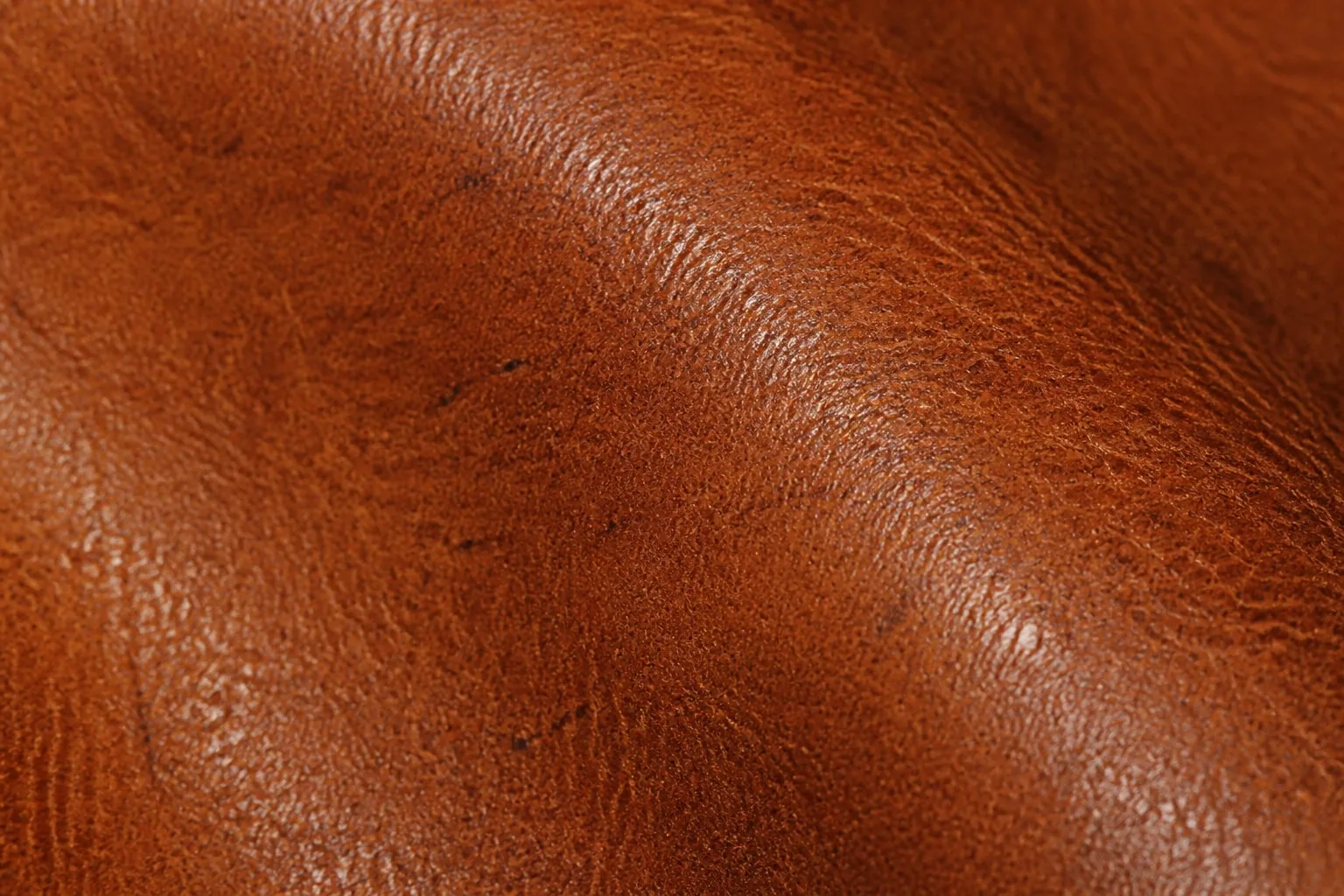
!Close-up of full-grain vegetable-tanned leather showing natural grain and pores
The First Thing Every Buyer Should Understand About Leather Grades
Leather begins as an animal hide — most commonly cowhide in the bag industry. A fresh hide is thick, uneven, and full of imperfections: scars from barbed wire, insect bites, stretch marks, and natural variations in texture. The entire art and science of leather making is about turning this raw, imperfect material into something stable, beautiful, and durable.
The four grades describe what happened to the surface of the hide during processing. Think of the hide as a three-layer structure. The outermost layer is the grain — the tight, fibrous surface that gives leather its signature texture and strength. Below it lies the corium, the softer, looser fiber layer. What separates one grade from another is simply how much of the original grain surface survives the finishing process.
This is the single most important concept in this entire guide: leather grading is a measure of how much of the original hide surface remains, and that directly determines durability, character, and price.
A hide is roughly 1.3 to 1.5 square meters in usable area for bags. When a tannery processes it, the resulting “finished” leather can be graded by the quality of its surface. The best hides, with clean, tight grain, become full-grain leather. Hides with minor surface flaws get lightly sanded and become top-grain. Heavily corrected hides, or the lower layers of split hides, become what the industry calls genuine leather. And the fibrous leftovers, mixed with adhesive and pressed back together, become bonded leather.
Understanding this hierarchy matters because the bag market is full of clever marketing that sounds more premium than the material actually is. A label that says “100% genuine leather” is technically true — but as you will see, it tells you very little about quality. By the end of this guide, you will be able to read any product description and translate it into what the bag will actually look like after a year of use.
Full-Grain Leather: The Gold Standard for Premium Bags
Full-grain leather is the entire thickness of the hide with the grain surface left completely intact. No sanding, no buffing, no artificial embossing. Every scar, pore, and natural marking is preserved, which is exactly why tanners reserve full-grain treatment for the highest-quality hides in the first place — you cannot hide flaws you choose not to remove.
Why manufacturers love working with it. Full-grain leather is the strongest leather you can buy. The grain layer is the densest, most tightly woven part of the hide, and leaving it untouched means the finished material retains its maximum structural integrity. For bags, this translates directly into real-world performance: it resists tearing at stress points like handles and straps, develops a rich patina over time instead of looking worn, and can last for decades with reasonable care.
The character factor. No two full-grain hides are identical. The natural markings are part of the product’s identity — leather enthusiasts actively seek out bags with visible grain and scars because they prove the material is authentic and unprocessed. A full-grain bag is like a fingerprint: it is genuinely one of a kind.
The trade-offs. Full-grain leather is the most expensive option, and it demands the most careful sourcing. Because flaws are not sanded away, a single hide might yield less usable area for clean panels — a factor manufacturers have to account for in cutting yield and, ultimately, in price. It also shows scratches more readily than corrected leathers, though most scratches can be buffed out or simply embraced as patina.
Best suited for. Premium backpacks, structured totes, high-end diaper bags, and any product positioned as a long-term investment piece. If your brand story is about quality that outlasts trends, full-grain is the material that makes that story true.
Top-Grain Leather: The Workhorse of Mid-Range Manufacturing
Top-grain leather starts from the same top layer of the hide as full-grain, but the surface is lightly sanded to remove imperfections, then often embossed with an artificial grain pattern. It is sometimes called “corrected grain” leather, which is a far more honest name.
What the sanding actually does. The light sanding removes the very top of the grain layer — taking away natural flaws but also removing some of the leather’s densest fibers. Top-grain is therefore slightly less durable than full-grain in theory, though in practice the difference is modest for most bag applications. What you gain is uniformity: a consistent, predictable surface that looks the same across every piece, which is exactly what many mass-produced bag lines need.
Why it dominates the market. Top-grain offers the best balance of price, appearance, and performance for mid-range products. It takes dyes and finishes beautifully, resists stains better than full-grain (the protective finish creates a barrier), and produces very consistent cutting yields. For a factory, top-grain means fewer rejects and more predictable production runs. For a brand, it means you can deliver a product that feels premium at a price point most customers can actually afford.
The honest caveat. The embossed grain pattern is artificial. It will not develop a natural patina the way full-grain does, and the protective finish, while helpful for stain resistance, can eventually wear and crack on heavily flexed areas. A well-made top-grain bag still lasts for years — just with a different aging story than full-grain.
Best suited for. Everyday backpacks, work totes, mid-priced diaper bags, crossbody bags, and any product where consistent appearance and a reasonable price matter more than the romance of natural patina.
Genuine Leather: The Most Misunderstood Label in the Industry
Here is where the industry gets murky, and I want to be completely straight with you. The term “genuine leather” sounds like a quality claim — most shoppers read it as “real, authentic leather, the good stuff.” In industry practice, it means almost the opposite.
Genuine leather is most commonly made from the split of the hide — the lower, looser fiber layer left over after the top grain is removed. This layer is softer, more porous, and far less durable than the grain layer. It is often embossed with a printed grain pattern and coated with finishes to imitate the look of higher grades. Some manufacturers also use the term for heavily corrected top-grain, which muddies the definition further.
The uncomfortable truth for manufacturers. We buy genuine leather when a client’s budget simply will not stretch to top-grain, and we are always transparent about what they are getting. Genuine leather can make a perfectly acceptable entry-level product — a budget backpack that looks decent and holds up for a season or two. What it cannot do is deliver the durability or aging characteristics customers associate with “real leather.” A genuine-leather bag that is heavily used will show wear far faster: the finish can peel, edges can fray, and the soft fiber structure can stretch out of shape.
The practical guidance. If you are a brand selling genuine leather products, price them honestly and describe them accurately. If you are a buyer, treat “genuine leather” as a starting point for questions, not a badge of quality. Ask the seller what the bag is made of underneath the marketing — a reputable manufacturer will tell you the truth, because we would rather earn your trust than your first order.
Bonded Leather: Not Leather in the Traditional Sense
Bonded leather takes the story one step further from the hide. It is made by grinding up leather scraps and fiber remnants — often as little as 10 to 20 percent actual leather fiber — mixing them with polyurethane and adhesives, and pressing the blend into sheets that are then embossed and finished to look like leather.
Why it exists. Bonded leather is cheap to produce, easy to cut, and remarkably consistent. You will find it in low-cost furniture, budget accessories, and promotional products where the words “leather” on a label matter more than the material’s actual performance.
Why manufacturers avoid it for bags. Bonded leather has almost none of leather’s structural strength. It can tear at seams, peel at edges, and degrade quickly under daily use. Its surface is essentially a thin coating that wears through to reveal the fibrous backing — the “peeling leather” look you have probably seen on an old car seat or a cheap handbag. There is no patina, no character, no longevity. In our factory, we use bonded leather only when a client explicitly demands the lowest possible price and fully understands the trade-off.
A buyer’s red flag. If a product description boasts “genuine leather” but the price is suspiciously low, check the fine print — bonded leather is sometimes dressed up with premium-sounding names. As a rule of thumb for bags: bonded leather and long-term durability do not belong in the same sentence.
The Four Grades Side by Side: A Manufacturer’s Comparison Table
| Property | Full-Grain | Top-Grain | Genuine (Split) | Bonded | |—|—|—|—|—| | Source layer | Top grain, untouched | Top grain, lightly sanded | Lower split layer | Leather scraps + adhesive | | Grain surface | Natural, intact | Sanded + embossed | Printed imitation | Printed imitation | | Relative durability | Highest | High | Moderate-low | Low | | Patina / aging | Beautiful, natural | Minimal | Minimal | None (can peel) | | Consistency | Low (natural variation) | High | High | Very high | | Relative cost | $$$$ | $$$ | $$ | $ | | Best bag uses | Premium backpacks, totes, heirloom diaper bags | Everyday bags, work bags, mid-range lines | Budget entry-level bags | Promotional items only | | Manufacturer’s verdict | Investment-grade | Best price/performance | Price-driven compromise | Avoid for real bags |
As the table shows, there is no universally “best” leather — there is only the right leather for the right product, price point, and customer promise. The rest of this guide covers how a factory actually makes that call.
From the Factory Floor: How We Actually Select Leather
The grades above are the vocabulary, but real selection happens in the details. When a new order lands on our desk, our leather buyer walks through the same checklist every time. Sharing it here will help you ask better questions of any manufacturer you work with.
1. Define the product’s real life first. A diaper bag that gets tossed into car trunks and dragged through airports needs different leather than a dressy evening clutch that lives in a closet. We always ask clients about the bag’s intended use, target customer, and expected lifespan before we even look at samples. The leather grade follows the product’s job, not the other way around.
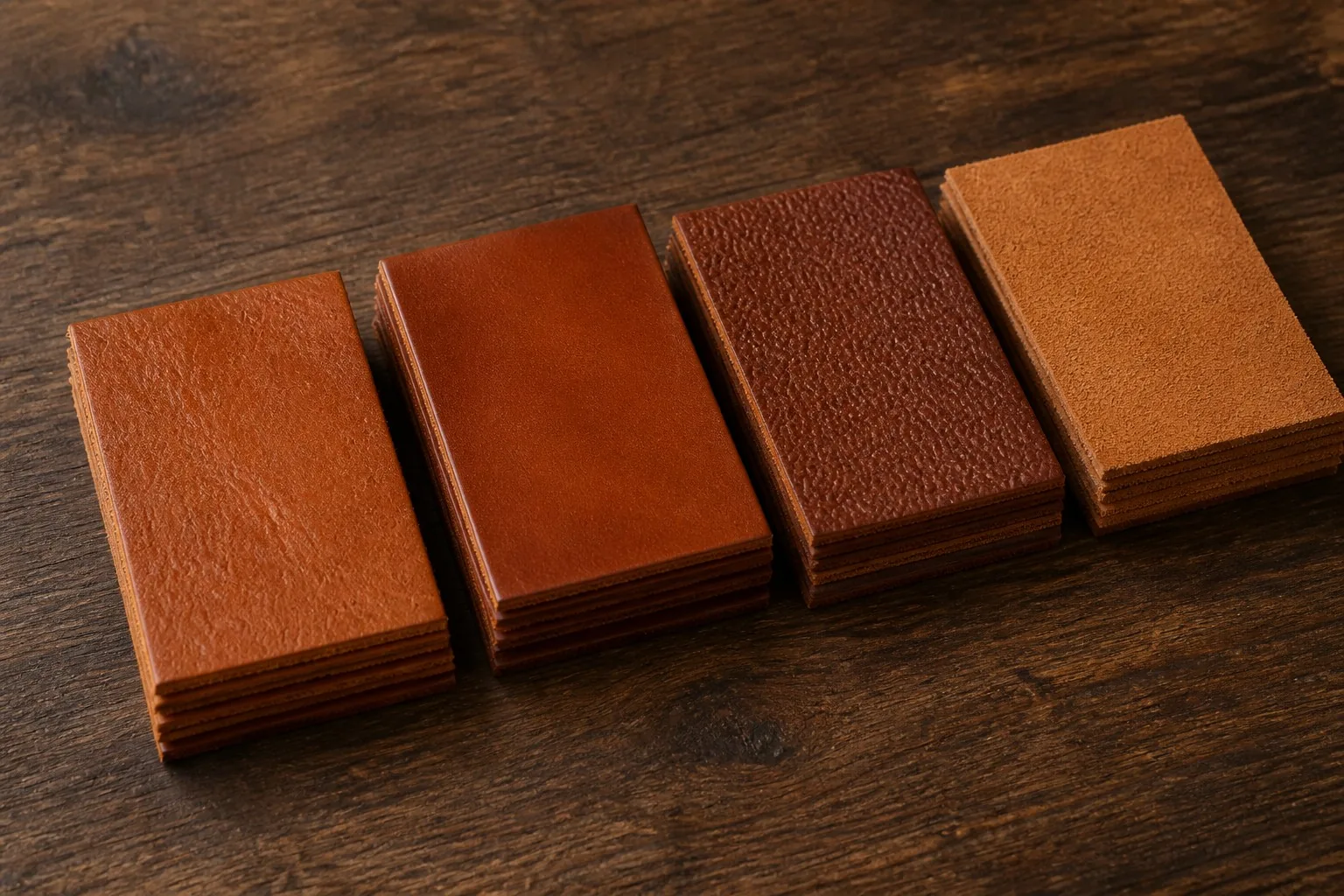
2. Specify the tannage as carefully as the grade. Grade tells you what layer of the hide you are getting; tannage tells you how it was processed. Vegetable-tanned leather is tanned with natural plant extracts. It is firm, develops a rich patina, and can be stamped and carved — ideal for structured bags and any product where shape retention matters. Chrome-tanned leather is tanned with chromium salts. It is softer, more supple, and far more water-resistant, which makes it the default choice for everyday and travel bags. Neither is “better” — they are different tools for different jobs.
3. Check the thickness — and know what “oz” means. Leather thickness is measured in ounces, where one ounce equals 1/64 of an inch. A 2-3 oz leather is thin and flexible, suited to linings and small accessories. A 3-4 oz leather is the sweet spot for wallets and small pouches. A 4-5 oz leather offers the structure and body that most handbags and diaper bags need to hold their shape. A 5-6 oz leather is firm enough for heavy backpacks and briefcases. Ask for the exact ounce weight in writing; it changes both the feel and the longevity of the finished bag.
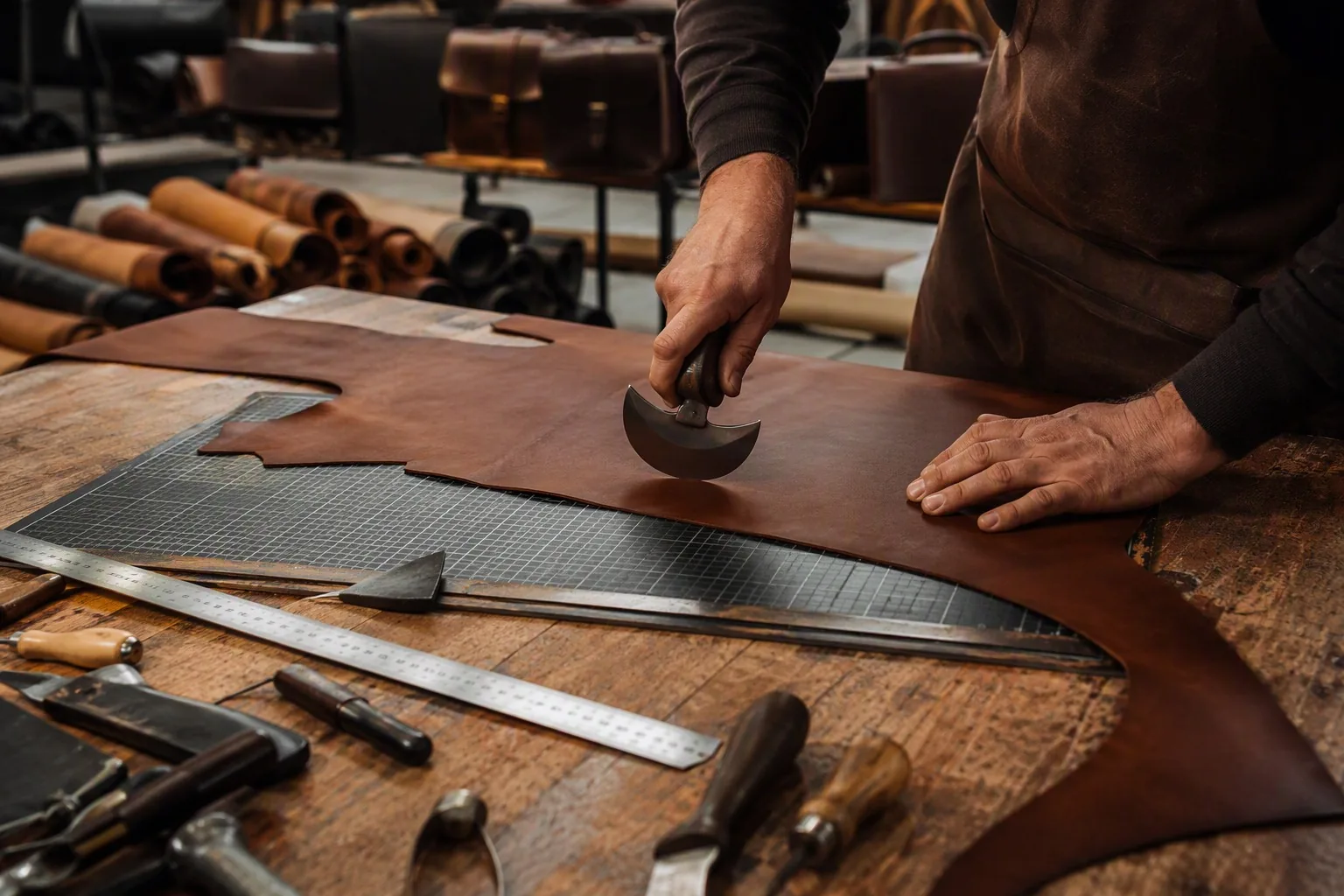
4. Physically inspect every lot. Even within the same grade and tannage, leather varies by batch, supplier, and season. Our buyer checks every delivery for surface defects, color consistency, softness, and thickness uniformity. We cut test panels and flex them, wet them, and abuse them before approving a lot for production. If a supplier cannot stand behind their hide quality, we do not risk our client’s product on it.
5. Calculate the cutting yield honestly. A full-grain hide with beautiful character might yield only 70 percent usable panel area, because we work around natural flaws. A uniform top-grain hide might yield 90 percent. This is why the material cost per square foot never tells the full story — the real cost per bag depends on yield, and yield depends on the grade. A skilled pattern engineer can dramatically improve yield by placing patterns around flaws, which is a silent competitive advantage of an experienced factory.
6. Match the finish to the market. Do your customers want a matte, natural finish that shows the leather’s character, or a glossy, protected finish that repels stains? Do they expect the leather to darken with use? These choices are part of the leather specification, and they affect the final look as much as the grade does.
!Artisan cutting a leather hide on a workbench in a bag factory workshop
Matching Leather Type to Bag Type
Theory is useful; application is what sells bags. Here is how we typically match leather grades and tannages to the most common bag categories, based on years of production data and customer feedback.
Backpacks. A backpack is a structural bag: it carries weight, gets handled constantly, and needs to hold its shape for years. We favor 4-6 oz full-grain or top-grain chrome-tanned leather for everyday backpacks — chrome tanning gives the suppleness and water resistance heavy use demands. For premium or heritage-style backpacks, full-grain vegetable-tanned leather is the classic choice; it stiffens beautifully, takes hardware well, and develops exactly the patina customers pay extra for.
Tote bags. Totes live on shoulders, in shopping carts, and under airplane seats. They need flexibility at the top opening and enough body at the base to stand up when set down. A 3.5-5 oz top-grain leather is the workhorse here — supple enough to drape, firm enough to hold structure, and priced to keep the product competitive. Full-grain works beautifully for luxury totes where natural character is part of the appeal.
Diaper bags. This is the category where we see the widest gap between what customers expect and what cheap materials deliver. A diaper bag is used harder than almost any other bag: it is overstuffed, wiped down, thrown into stroller baskets, and exposed to spills and weather. The ideal is a water-resistant chrome-tanned top-grain or full-grain leather at 4-5 oz, with reinforced stress points at the straps. Genuine or bonded leather should be avoided entirely for this use — peeling seams and stretched shapes are the fastest way to earn a one-star review. If budget forces a lower grade, design the bag with less exposed leather area and protect the high-wear zones with reinforcements.
Wallets and small goods. Small items are where leather choice is most forgiving, because the panels are small and the loads are light. 2-3 oz vegetable-tanned leather is the classic wallet material — it skives beautifully, holds stitching tightly, and develops the most satisfying patina of any product in the lineup. Top-grain chrome-tanned works for modern, minimal cardholders.
Crossbody and everyday bags. For mid-range crossbody bags, top-grain at 3-4 oz is the default recommendation. It balances weight, softness, and price, and its protective finish shrugs off the day-to-day contact these bags endure.
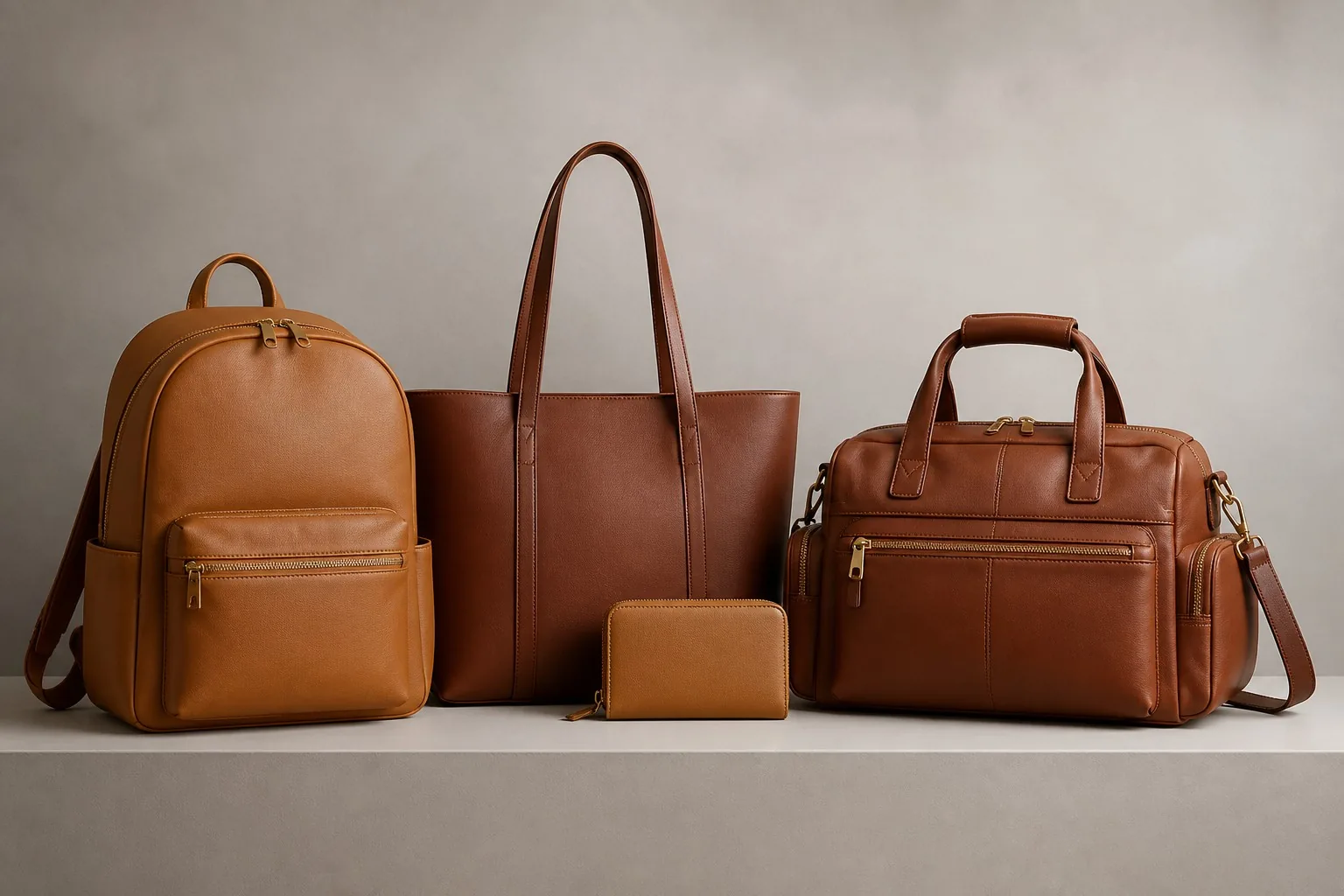
!Finished leather bags displayed on a studio shelf, including backpack, tote, diaper bag and wallet
Durability, Care, and What to Tell Your Customers
The best leather in the world will disappoint if it is not cared for, and the cheapest leather will surprise you if it is. Customer education is part of product quality — here is what we teach every brand we work with, so they can pass it on.
What actually damages leather. Heat, prolonged direct sunlight, and moisture are leather’s three enemies. Heat dries out the natural oils and causes cracking. Sunlight fades and weakens the fibers. Water, especially when trapped against the surface, can stain and, over time, degrade the finish. Cheap finishes fail first; quality leather fails last, but nothing is indestructible.
The care routine that works. For finished leathers, a dry soft cloth removes dust, and an occasional wipe with a damp cloth — never soaking — handles everyday dirt. Conditioners with natural oils, applied sparingly a few times a year, keep full-grain leather supple and prevent cracking. We recommend testing any conditioner on an inconspicuous area first, because over-conditioning can darken the leather. When a bag is not in use, store it in a dust bag away from direct light, and stuff it lightly to help it hold its shape.
Setting honest expectations. A full-grain bag that shows scratches is not defective — that is the material’s character, and most scratches can be buffed out with your fingers or a soft cloth. A top-grain bag that looks the same after two years is also not defective — that is the benefit of a protective finish. Explain to your customers which aging story their bag will tell, and you eliminate most “is this normal?” complaints before they happen.
The manufacturer’s warranty perspective. We inspect every bag before it leaves our factory, but we are also honest with clients about the limits of material performance. A bag made with quality leather and solid construction can reasonably be expected to last years; a bag made to a price point will last in proportion to its price. Designing the product, choosing the material, and communicating the expectation as one coherent package is the difference between a brand customers trust and a brand customers return.
Cost vs. Value: What You Are Really Paying For
The price gap between a full-grain backpack and a bonded-leather lookalike can be tenfold or more. Understanding where that money goes helps you decide whether the premium is worth it — and helps you explain the price to your own customers.
Material cost. Full-grain hides cost significantly more per square foot, and yield losses during cutting push the effective cost higher still. Top-grain is more affordable per square foot and yields better. Genuine and bonded leather cost a fraction of either. Material alone can account for 30 to 50 percent of a bag’s manufacturing cost.
Labor and construction. The leather is only half the story. A quality bag also means reinforced stress points, properly skived seams, durable hardware, and rigorous quality inspection at every stage. Cheap materials often go hand in hand with cheap construction, because both are driven by the same price target. When a customer asks why a bag costs more, the honest answer is: better material, more labor hours, and a standard of construction that survives real life.
What the customer actually experiences. The value difference shows up over time. After one year, a quality full-grain or top-grain bag looks better than the day it was made, with a patina that tells a story. A bonded-leather bag at the same age is likely peeling at the corners. After three years, the gap is enormous. For products like diaper bags, which take daily abuse, this difference is not cosmetic — it is the difference between a one-time purchase and a recurring replacement expense.
The recommendation we give every brand. Choose the highest leather grade your target price can support, then protect it with honest construction and honest marketing. Customers rarely complain that a bag lasted too long. They complain — loudly and permanently — when a “leather” bag falls apart, and that complaint travels further than any advertising budget.
Frequently Asked Questions
Is full-grain leather always the right choice? No. Full-grain is the most durable and beautiful, but it is also the most expensive and the most variable. For a budget-friendly everyday bag, a well-made top-grain bag will outperform a poorly priced full-grain bag from an unknown source. Match the grade to the product’s job and price point.
Does “genuine leather” mean good quality? Not necessarily. In industry practice, “genuine leather” usually refers to split or heavily corrected leather — real leather, yes, but not the premium quality the words imply. Always ask what layer of the hide the product is made from.
How can I tell real leather from bonded or synthetic leather? Several simple tests work in most cases. Real leather feels warm to the touch and has a slightly irregular, natural surface; bonded and synthetic materials feel cooler and more uniform. Press a fingertip into the surface — real leather shows slight wrinkles that relax slowly, while synthetic finishes spring back instantly. The edge is also revealing: real leather edges show a fibrous structure, while bonded or synthetic edges look uniform. When in doubt, ask the seller for a sample and have a professional examine it.
What does “oz” mean when describing leather thickness? It is a unit of thickness: one ounce equals 1/64 of an inch. Higher numbers mean thicker, firmer leather. Most handbags use 3-5 oz leather; wallets use thinner 2-3 oz; heavy backpacks may use 5-6 oz.
Which leather is best for a diaper bag? A water-resistant, chrome-tanned full-grain or top-grain leather at 4-5 oz, with reinforced stress points, is the best choice for daily use. Avoid genuine and bonded leather for this category.
Does vegetable-tanned or chrome-tanned leather matter? Yes. Vegetable tanning produces firm leather that develops a rich patina and can be stamped or carved — great for structured, heritage-style bags. Chrome tanning produces softer, more water-resistant leather — the default for everyday and travel bags. Neither is universally better; choose based on how the bag will be used.
Why does my leather bag show scratches? If it is full-grain or vegetable-tanned leather, scratches are normal and often buff out with light friction. The material ages gracefully by design. If it is a finished top-grain bag, the protective surface should resist most marks — heavy scratching there may indicate the finish is failing.
Can bonded leather be made to last? Bonded leather is a budget material by construction. With careful use it can last a few years, but it lacks the structural strength of genuine leather layers and will typically peel or crack under regular use. For bags, we advise against it.
Final Word from the Factory
Walk into any tannery and you will hear the same proverb in a dozen languages: leather is a natural product, and nature does not make perfect things. The grades we have covered in this guide are the industry’s way of organizing that imperfection — deciding how much of the hide’s original character to preserve, how much to correct, and what the finished material can honestly promise.
For brands, the practical takeaway is simple. Decide what your bag must survive, choose the grade and tannage that match that promise, and be transparent with your customers about what they are buying. For buyers, the takeaway is equally simple: a leather label is a starting point for questions, not an ending point for trust. Ask what layer of the hide was used. Ask about tannage and thickness. Ask how the bag is expected to age.
At our factory, we have seen bags made from every grade in this guide leave our shipping dock. The ones that build brands, earn repeat customers, and survive years of daily life are almost never the ones that chased the lowest price. They are the ones where someone — designer, manufacturer, and customer — understood exactly what they were buying. Choose your leather the way you would choose a partner for a long journey: not for how it looks on the first day, but for how it holds up along the way.
If you are planning a leather bag line and want honest guidance on material selection, construction, or sampling, a good manufacturer will talk you through the options with samples in hand. That conversation, more than any guide, is where the right leather for your product gets found.
