
How Does Handle Drop Length Change How a Leather Bag Carries?
How Does Handle Drop Length Change How a Leather Bag Carries?
Two leather bags of the same size, made from the same hide by the same factory, can feel entirely different to carry because of one dimension that rarely appears in a product description: the handle drop.
Drop length is the distance from the top of the handle arc down to the top edge of the bag. It looks like a minor detail and behaves like a structural decision. It determines whether a bag can be carried in the hand, hooked over the forearm, worn on the shoulder, or across the body. It changes where the bag’s weight sits against the body, how the leather at the attachment points is loaded, and whether a coat can be worn underneath in winter.
For a manufacturer, drop length is also a specification that has to be calculated rather than drawn. A handle that is short by fifteen millimetres stops fitting over a shoulder; one that is long by thirty millimetres looks out of proportion and swings against the hip. This article sets out how the number is measured, how it is chosen for each carry mode, and how it is controlled through sampling and production.
Drop length is not a style preference. It is the number that decides which part of the body carries the bag.
This article deals with the geometry of the handle arc and the ergonomics of the drop. It does not cover why handles break under load, which is a separate question of reinforcement, thread and attachment construction.
- What Handle Drop Length Actually Measures
- Which Carry Mode the Number Buys
- Anatomy of the Handle and How It Changes Drop
- Drop Length by Bag Type
- Drop and the Bag’s Proportions
- Adjustable and Detachable Straps
- Drop Across a Product Family
- Drop and the Retail Specification
- Maintenance and Replacement
- Calculating Strap Length
- Structure and Load at the Attachment
- Calculating Strap Length
- Tolerances and Production Control
- Testing Before Production
- Adjusting an Existing Style
- Common Mistakes
- Working With the Factory
- Frequently Asked Questions
- The Bottom Line
What Handle Drop Length Actually Measures
A single number, defined precisely.
The Reference Points
Where the tape starts and stops.
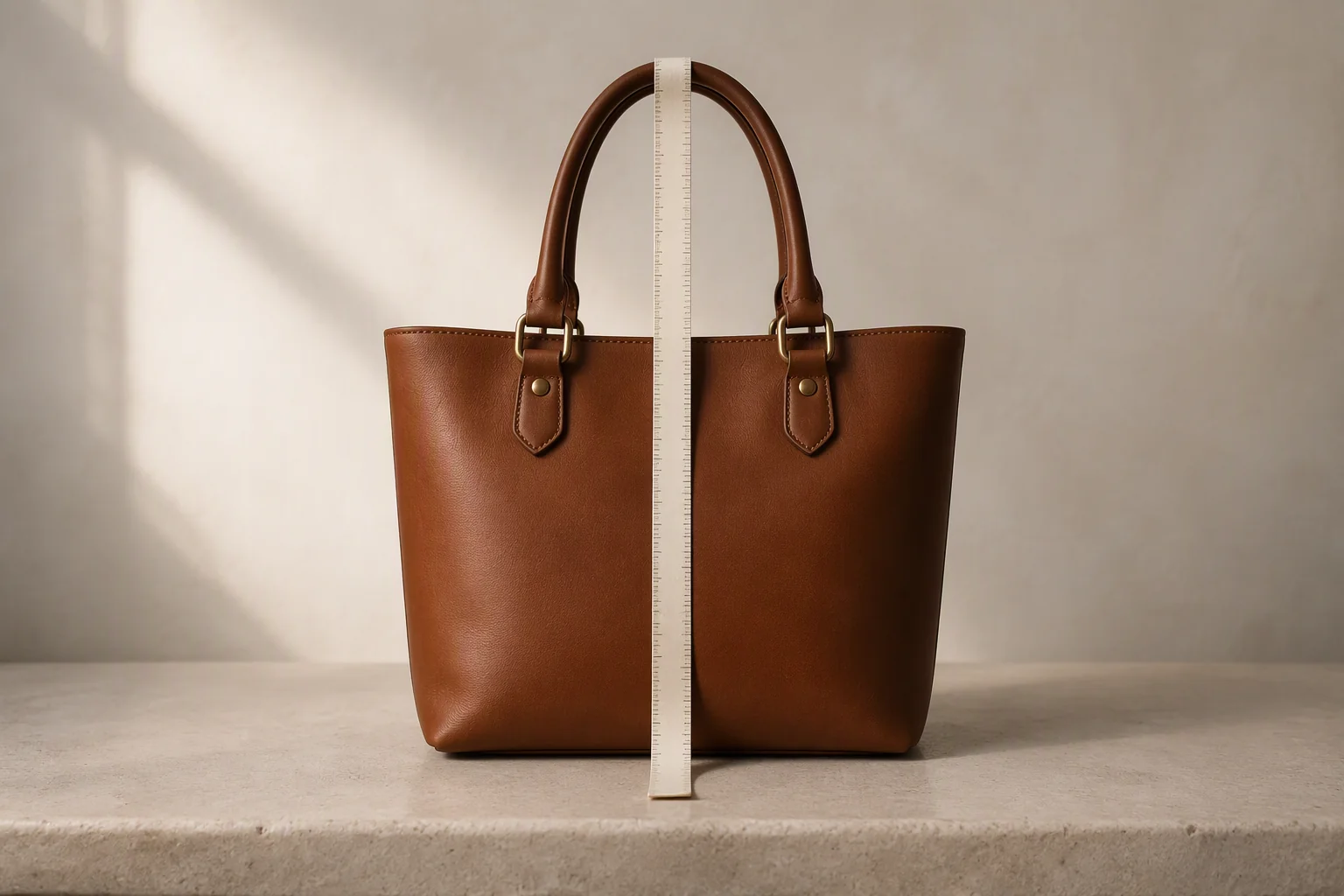
Drop length is measured vertically from the highest point of the handle arc, taken at the centre of the grip, down to the bag’s top edge. On a bag with a flap, the reference is the flap’s top edge in its closed position. On a bag with a curved mouth, the measurement is taken at the centre of the curve.
Why the Definition Matters
Two factories, two numbers.
Without a stated reference, one factory measures to the bag’s highest point and another to the lowest point of the mouth, and the same drawing produces handles that differ by twenty millimetres. The specification has to name both points and the position at which the measurement is taken.
Handle Length Versus Drop
Not the same dimension.
Handle length is the total length of the strap material between its two ends. Drop depends on handle length, the height of the attachment points, the thickness of the material, and the height of any hardware in the arc. Two handles of identical length can produce different drops.
The Clearance That Actually Matters
Hand, arm, or shoulder.
The useful question is not the drop itself but the clearance it produces at the point of contact: the space for a hand grip, for a forearm, or for a shoulder with clothing. Clearance is what the customer experiences, and drop is how the factory delivers it.
Which Carry Mode the Number Buys
Each carry mode has a working range.
Hand Carry
Short and precise.
A hand-carried bag uses a short drop so the bag sits close to the hand without dragging. The constraint is the width of a gripped hand plus the thickness of the handle, and the risk is knuckles brushing the bag’s top edge.
Forearm Carry
The crook of the arm.
Carrying a bag in the crook of the arm requires a drop long enough for the forearm to pass through comfortably and short enough that the bag does not slide to the wrist. This is the range where formal and structured bags usually sit.
Shoulder Carry
Clearance for a shoulder.
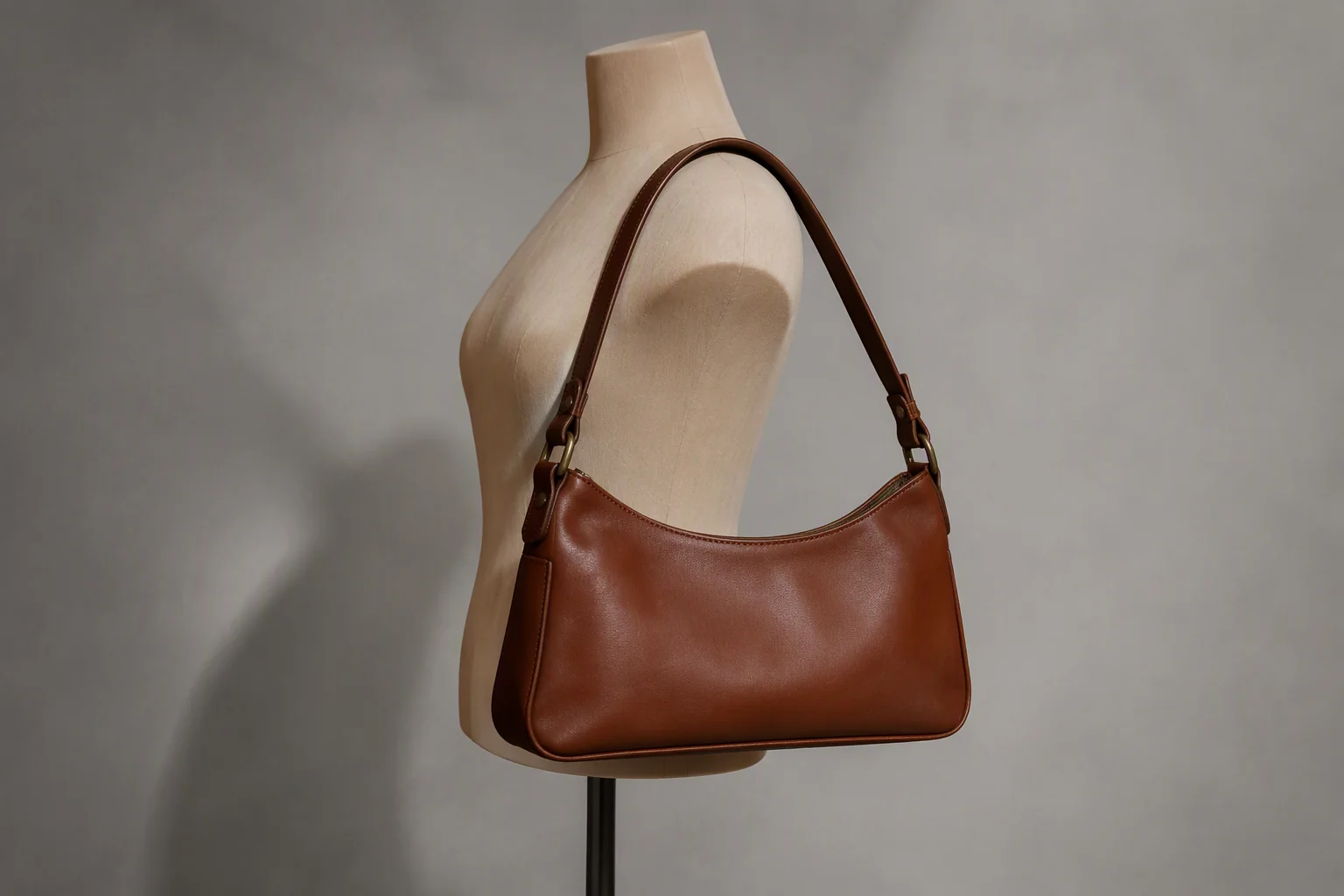
Shoulder carry needs enough drop for the shoulder plus clothing, with margin for a jacket. Bags designed for this mode often sit at the higher end of the range and use a wider handle or a flat strap to spread pressure.
Crossbody
Length set by the torso.
A crossbody strap is a different calculation: the strap passes over one shoulder and across the body, so its length is set by torso dimensions rather than by the hand or arm. Detachable straps allow one bag to serve two modes, at the cost of hardware at the attachment.
| Carry mode | Typical drop | Constraint that sets it | Common failure if wrong |
|---|---|---|---|
| Hand carry | Short | Gripped hand plus handle thickness | Knuckles brush the bag mouth |
| Forearm carry | Medium | Forearm passing through the arc | Bag slides to the wrist |
| Shoulder carry | Long | Shoulder plus clothing clearance | Handle will not pass over a coat |
| Crossbody | Strap length, not drop | Torso circumference and height | Bag sits at the hip or rides high |
| Convertible | Two specs, one bag | Both modes must work | One mode feels like a compromise |
Anatomy of the Handle and How It Changes Drop
The arc is a construction, not a line.
Material Thickness
Where the drop disappears.
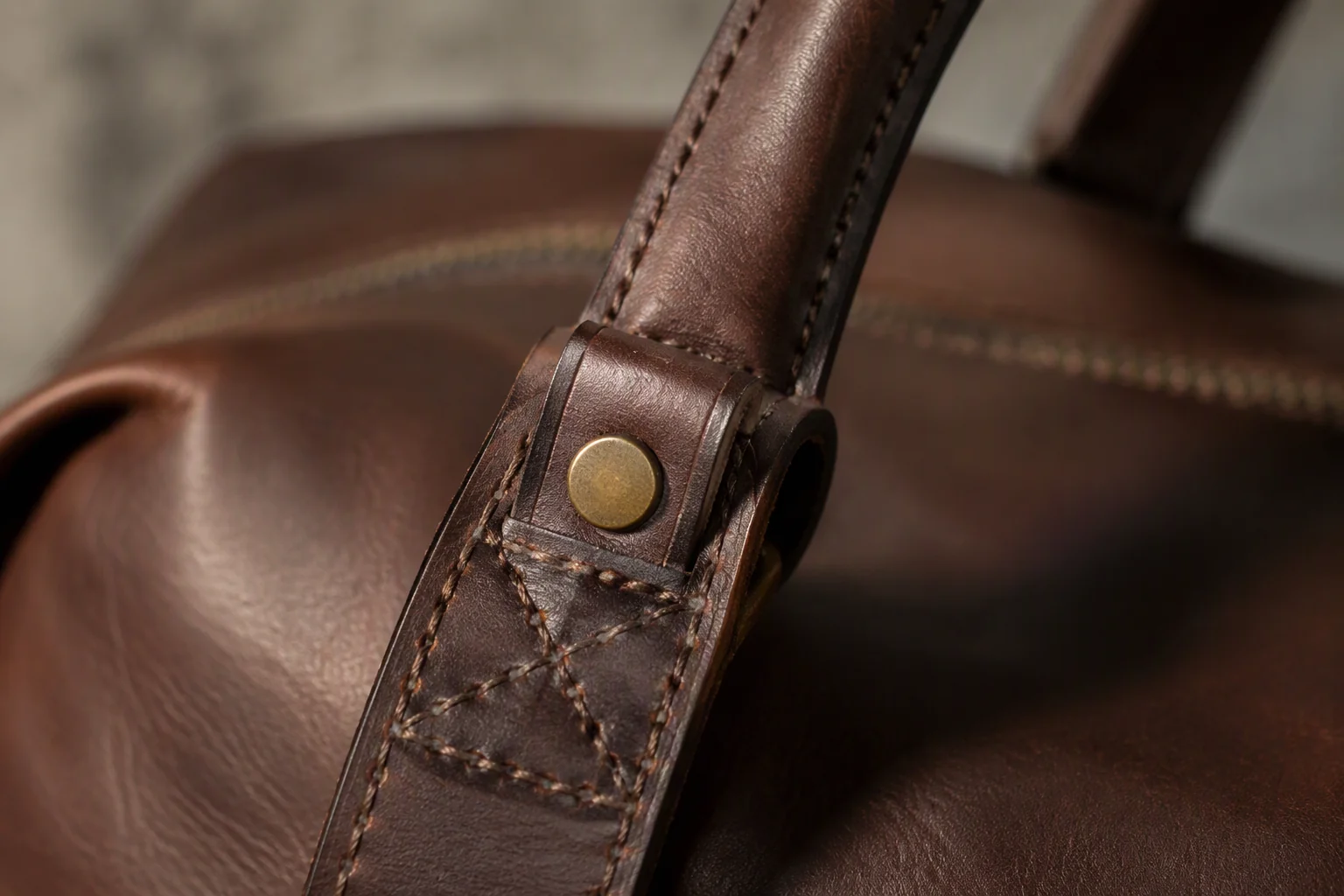
A thicker handle consumes part of the arc: the same nominal length produces a smaller drop because the material occupies space at the bend. Rolled handles and padded grips reduce effective drop further.
Hardware in the Arc
Height that counts.
Where a handle passes through a ring or over a bar, the hardware adds height to the arc and therefore to the drop. Specifying a drop without accounting for the hardware produces a bag that measures long and carries short.
Attachment Position
The anchor point.
Handles attached at the bag’s top edge, or slightly below it on an exterior patch, produce different drops from the same strap length. Moving the anchor down by ten millimetres reduces the drop by the same amount.
Folded Ends and Stitched Patches
Consumed length.
The portion of the strap folded and stitched into the attachment is not available for the arc. On heavy leather this can be a meaningful share of the total length, and it is the first thing forgotten in a length calculation.
Handle Shape
Round, flat, or tapered.
A flat strap bends into a tighter arc than a rolled handle of the same length, producing a slightly smaller drop and a different contact area on the hand.
Drop Length by Bag Type
Ranges, and the reasoning behind them.
Structured Totes
Hand and forearm.
A structured tote usually carries a drop in the hand-to-forearm range, with the lower end suiting a bag that is carried by the hand and the upper end allowing it to sit on the forearm. The bag’s own width matters: a wide tote needs a longer drop to clear the hip when carried in the hand.
Diaper Bags
One hand, often occupied.
Diaper bags are frequently carried on the shoulder or hung on a stroller, so the drop tends to be generous, with detachable straps for crossbody use. The design priority is getting a hand in and out quickly rather than a precise silhouette.
Backpacks With a Top Handle
A grab handle, not a carry handle.
The handle on a backpack exists to lift the bag from a car seat or a hook, so its drop is short and the grip is wide enough for a full hand. It is not designed for extended carrying.
Small Crossbody Bags
Strap length dominates.
On a small bag, the strap length sets the position on the body and the handle drop is almost irrelevant unless the bag converts. The critical dimension becomes the range of adjustment.
Wallets, Clutches and Wrist Straps
Where drop becomes a loop.
Small leather goods use a wrist loop rather than a handle, and the loop’s circumference is the equivalent dimension. It has to pass over a hand comfortably and stay on the wrist when the hand relaxes, which is a narrower range than a bag handle allows.
Formal Top-Handle Bags
Proportion first.
A formal top-handle bag has the least freedom: the drop is set by the hand plus a margin, and any deviation is visible in the silhouette. The handle is often the visual signature of the style.
Drop and the Bag’s Proportions
A number the eye reads before the hand does.
Balance Against Height
Where the arc sits.
A handle arc occupies visual space above the bag. A short drop on a tall bag can look mean; a long drop on a small bag can look top-heavy. The proportion that reads as balanced is usually the one where the arc’s height is a modest fraction of the bag’s own height.
Drop Across a Size Family
Consistency matters more than the number.
Where a style is offered in several sizes, keeping the same drop across the family makes the range feel coherent, even though the larger bag might carry better with a slightly longer handle. Consistency is a design decision with a service cost.
When Proportion Wins
Formal and minimal styles.
On a formal bag the silhouette carries the price, so the drop is set to the proportion and the ergonomics are made to fit within it. That trade should be made consciously, not by leaving the number to the sample room.
Adjustable and Detachable Straps
Two specifications in one product.
Adjustment Range
The useful part of a strap.
On an adjustable strap, the range matters more than the nominal length. The range should cover the intended carry positions for the target customer, with the shortest setting still comfortable and the longest not below the hip.
Hardware at the Attachment
Clips, rings and their height.
Detachable hardware adds height at the attachment, which changes the effective drop. It also introduces a component that can open or wear, so its strength and its position belong in the specification.
Two Modes, One Bag
Where the compromise lands.
A convertible bag rarely carries as well in both modes as a dedicated bag does in one. Deciding which mode is primary keeps the specification honest and the marketing accurate.
Drop Across a Product Family
Consistency as a manufacturing value.
Shared Components
One handle, several bags.
Where a family shares a handle, the drop is fixed for every style in it. That simplifies cutting and purchasing and constrains design, which is a trade worth stating explicitly.
Variation by Size
Scaling rules.
Where drop does scale, the rule should be written: a fixed increment per size step, or a proportion of bag height. An unwritten rule produces a range that looks assembled rather than designed.
Documentation for Reorders
The number travels with the pattern.
A family specification that records the drop for each size, with reference points and tolerance, keeps a repeat order consistent years later.
Drop and the Retail Specification
What the customer is told.
Measuring for Listings
State the method.
If drop is published, the reference points should be published with it. Two sellers measuring differently produce numbers that cannot be compared, and customers notice when a bag arrives shorter than described.
Photography That Shows Drop
Side views and scale.
A front view flatters a bag but hides the drop. A side view, ideally with a reference object or a worn shot, communicates the carry mode honestly.
Warranty and Service Language
What drop implies.
A bag sold as shoulder-carry should pass over a shoulder with ordinary clothing. Where a style sits at the edge of a range, the listing should describe the intended carry mode rather than leaving it to the customer to discover.
Maintenance and Replacement
The handle outlives the season.
Replacing a Handle
Keeping the drop.
A replacement handle should reproduce the original drop, which means the cut length, the attachment consumption and the hardware height all have to be matched. Replacing by eye produces a bag that hangs differently on one side.
Repair at the Attachment
Restoring the anchor.
Repairs at the patch should preserve the anchor position. Moving it slightly during a repair changes the drop and the load path at the same time.
Drop After Repair
Re-measure.
Any repair that touches the handle, the patch or the top edge should end with a drop measurement against the specification, because the check takes seconds and the consequence of drift lasts for the life of the bag.
Calculating Strap Length
The same drop suits different people differently.
Body Dimensions
Not a standard figure.
Shoulder width and torso length vary enough that a drop comfortable for one wearer is tight for another. A range with an adjustable element serves more customers than a single fixed number.
Clothing and Season
Winter changes the calculation.
A coat adds thickness at the shoulder. A bag that passes comfortably over a shirt in summer may not pass over a padded jacket, and this is a common seasonal complaint on shoulder bags.
Public Transport and Crowds
Handling in tight spaces.
A long drop on a crowded train puts the bag at hip level where it is knocked. A short drop keeps it under control but limits capacity.
Signs the Drop Is Wrong
What wearers report.
- The bag will not pass over a shoulder in a coat
- The handle slides down the arm to the wrist
- The bag knocks against the hip when walking
- The mouth collapses under the handles
- One side hangs lower than the other
- The bag sits under the armpit and cannot be opened
Load and Deformation
A full bag hangs differently.
A handle that sits well on an empty bag can pull into the shoulder when the bag is loaded, because the attachment points rotate and the arc flattens. Testing with the working load is the only reliable check.
Structure and Load at the Attachment
Drop changes the load path.
Why Drop Affects Stress
A longer lever.
Every millimetre of drop increases the lever arm between the bag’s mass and its attachment point. A longer handle does not just look different: it loads the attachment patch and the top edge of the bag differently, and that difference appears first at the seam.
The Attachment Patch
Size and position.
The patch that anchors the handle has to sit where the load arrives. When drop is increased, the patch usually needs to grow or move, and the reinforcement between leather and lining has to follow it.
Rivets Versus Stitching
Different failure paths.
Rivets concentrate load at a point; stitching distributes it along a line but relies on thread and leather strength. The choice interacts with drop: a long drop on a riveted attachment puts more stress on a small area of leather.
The Bag’s Top Edge
Where the load arrives.
A heavy bag on a long drop pulls the top edge out of shape. Edge reinforcement, a bound mouth or a firm interlining keeps the mouth from collapsing, and its necessity grows with drop and load.
Calculating Strap Length
From drop to cut length.
The Working Formula
Four additions and one subtraction.
Cut length is calculated from the desired drop, doubled for the two sides of the arc, plus the length consumed by the attachment at each end, plus the allowance for the arc’s curvature, minus the height gained by hardware. Each term has to be stated, not assumed.
Curvature Allowance
The arc is longer than the straight line.
A handle that arcs over the hand travels a longer path than the vertical drop suggests. The allowance depends on the arc’s shape, which is why handle shape belongs in the calculation rather than in the workshop’s judgement.
Attachment Consumption
Measured, not guessed.
The folded and stitched portion at each end should be measured on a sample of the actual material. On thick, firm leather it can differ noticeably from a thin strap.
Stretch and Settling
The leather moves.
Leather straps stretch slightly in use and settle into their arc. Building in a small allowance keeps the drop stable after the first weeks rather than lengthening progressively.
When the Numbers Conflict
A short arc, a thick handle.
Where a handle is short and the material is thick, the arc consumes a large share of the length and the drop becomes sensitive to every allowance. These are the styles where a millimetre-level error is visible.
Tolerances and Production Control
A specification that survives the floor.
Where Drop Drifts
Operators, material, hardware.
Strap cutting length, the position of the attachment patch, the tightness of the fold and the hardware height all shift the finished drop. Each source is small and the combined effect is not.
Setting a Tolerance
Tight enough, not tighter.
A drop tolerance tight enough to keep the bag comfortable and loose enough to be achievable in production is a manufacturing decision. Too tight produces rejections on bags that carry perfectly well.
Measuring in the Line
A simple gauge.
A marked board or a height gauge at the packing station lets an operator check drop in seconds. Eyeballing against a sample works only until the sample is lost.
| Check | Method | What it catches |
|---|---|---|
| Drop at the grip centre | Tape from arc apex to top edge | Cutting and attachment errors |
| Patch position | Height from top edge to patch centre | Anchor drift |
| Hardware height | Height of ring or bar in the arc | Unplanned extra drop |
| Arc symmetry | Left and right drop comparison | Twisted or uneven handle |
| Loaded drop | Measure with working load inside | Deformation under weight |
| Post-use drop | Measure after a short carry trial | Stretch and settling |
Testing Before Production
Cheap tests that answer real questions.
The Mock-Up
Card, then leather.
A cardboard mock-up of the bag’s mouth with a strap at the intended drop shows whether a hand or forearm passes comfortably before any leather is cut. It takes minutes and settles arguments.
The Hanging Test
Loaded, and left to hang.
Hanging the sample with its working load for a period reveals how the arc settles, whether the patch holds its position and whether the top edge deforms.
The Wearing Test
Different builds, different verdicts.
A short trial with several wearers of different builds, with and without a jacket, produces more useful information than any single measurement. Where possible, test both the minimum and maximum of the intended range.
A Test Sequence That Fits a Day
Ordered, and quick.
- Measure the sample at the grip centre and record the result
- Check the patch height and the hardware height in the arc
- Compare left and right drop for symmetry
- Fill the bag with the intended working load and measure again
- Carry it in the intended mode, with outerwear, for a short walk
- Note where the handle contacts the body and whether the mouth deforms
- Record every deviation with a photograph and a number
Documenting the Result
A drop specification, not a number.
The record should include the reference points, the measurement method, the load used in testing, the tolerance and the wearers tried. That document is what prevents the next order from drifting.
Adjusting an Existing Style
Every change has a consequence.
Lengthening the Drop
What else moves.
Extending the handle changes the strap length, the patch position, the hardware selection and often the bag’s visual balance. It also increases the lever on the attachment, so reinforcement is reviewed rather than assumed adequate.
Shortening the Drop
The opposite risk.
A shorter drop reduces leverage but can make the bag unusable over a shoulder or a coat. It may also require a different handle shape to keep the arc comfortable for a hand.
Why Drop Slips Through Review
It looks settled.
A handle drawn on a technical sketch appears finished, so the number behind it is rarely questioned in a design review that is focused on proportion and material. Adding a drop measurement to the sample approval checklist is the simplest way to stop it being overlooked.
When Both Modes Are Needed
Convertible designs.
A bag intended for hand and shoulder use carries two specifications in one product. The usual solution is a fixed short handle plus a detachable longer strap, with hardware that does not interfere with either mode.
Cost of the Change
Material, hardware, time.
A drop change touches strap consumption, patch size, hardware height and inspection time. It is rarely a single figure on a cost sheet, which is why it should be quoted as a revision rather than absorbed silently.
Common Mistakes
What shows up in complaints and returns.
- Drop specified without stating the reference points
- Hardware height ignored in the arc calculation
- Attachment consumption estimated rather than measured
- Drop measured on an empty bag only
- One fixed drop offered where the market expects a range
- Shoulder drop tested without a coat
- Patch position carried over unchanged from a shorter handle
- Tolerance set tighter than the process can hold
- Handle shape changed without recalculating the arc
- Convertible strap hardware interfering with the fixed handle
Each of these is cheap to correct at the drawing stage and expensive after the first shipment.
Working With the Factory
How to get the number you asked for.
Write the Specification
Points, method, load, tolerance.
A drop specification that names the start and end points, the measurement position, the load at which it is checked and the permitted variation leaves nothing to interpret.
Ask About the Calculation
Strap length, patch, hardware.
Asking how the factory arrives at the cut length reveals whether the allowances have been considered. A calculation that reproduces the sample is a calculation that will reproduce the next order.
Review the Sample Properly
Measure, then carry.
Measure the sample against the specification, then carry it with a realistic load in the intended mode. The two checks catch different problems and both are necessary.
When the Factory Proposes a Change
Ask what it does to the drop.
Factories sometimes adjust a handle for cutting efficiency or material availability. Any such change affects the drop, and it should be evaluated against the specification rather than accepted as an equivalent, even where the bag looks the same on the bench.
Keep the Record
For the next order.
Drop specifications and the sample measurements belong with the pattern, so that a repeat order starts from a known number rather than from a bag on a shelf.
Frequently Asked Questions
How is handle drop length measured?
From the highest point of the handle arc at the centre of the grip, vertically down to the bag’s top edge. On a flap bag the reference is the flap’s top edge closed; on a curved mouth it is the centre of the curve. Both points should be stated in the specification.
Is handle drop the same as handle length?
No. Handle length is the total strap material between the two ends. Drop depends on that length plus the attachment height, the material thickness, the hardware in the arc and the length consumed by the folded ends.
What drop suits a shoulder bag?
Enough for the shoulder plus clothing, with margin for a coat. The exact figure depends on the wearer and the bag’s width, which is why a range or an adjustable element serves more customers than one fixed number.
Why does a bag feel different when it is full?
Because the load flattens the arc, rotates the attachment points and pulls the top edge. A drop that is comfortable on an empty sample can become tight or uncomfortable at working load, so testing should always be done loaded.
Does a longer handle put more stress on the bag?
Yes. Every millimetre of additional drop increases the lever between the bag’s mass and the attachment, so the patch, the stitching or the rivets and the top edge reinforcement all see more load.
Can one bag serve hand and shoulder carry?
Usually by combining a fixed short handle with a detachable longer strap. The two modes need separate specifications, and the hardware must be arranged so that neither interferes with the other.
How much does leather thickness affect drop?
A thicker handle consumes part of the arc, so the same nominal length produces a smaller drop. Rolled and padded handles reduce effective drop further, and the effect is largest on short handles.
Should drop be checked with a coat on?
For any bag intended for shoulder carry, yes. A winter coat adds thickness at the shoulder, and a drop that works over a shirt may not clear a padded jacket.
What tolerance is reasonable on drop?
One that reflects the construction: tight enough that the bag stays comfortable, loose enough that the process can hold it. Setting it from the measured spread of a production run is more reliable than choosing a round number.
Why do two factories produce different drops from one drawing?
Almost always because the reference points or the allowances were not stated. Attachment consumption, hardware height and arc curvature are each interpreted differently in the absence of a written method.
Does drop change when a bag is used for months?
It can, slightly. Leather straps settle into their arc and stretch a little under load, so a small allowance at the cutting stage keeps the drop stable rather than progressively longer.
The Bottom Line
Handle drop is a small number that decides how a bag is carried, how it sits on the body and how its attachment points are loaded. It is chosen from the carry mode and the customer’s body, calculated from the strap length with the attachment, hardware and curvature allowances stated, and then controlled through sampling and a measured tolerance.
The bag that gets this right feels obvious in the hand, which is the hardest result to achieve. The bag that gets it wrong is returned for a reason nobody can quite name, or is carried reluctantly and never bought again.
For the manufacturer, the discipline is to treat drop as a specification with reference points rather than a number on a sketch, and to test it loaded, worn and in the season the customer will actually use it.
