
How Should a Leather Bag Factory Store Chemicals and Solvents?
How Should a Leather Bag Factory Store Chemicals and Solvents?
Walk into two bag factories making the same product and you can often predict which one has more defects before you look at a single bag. The tell is the chemical store: how the drums are arranged, whether anything is labelled, whether the floor is clean, whether the adhesives sit next to the solvents.
Chemical storage is usually treated as a housekeeping topic, something for an audit checklist. In practice it is a production control. Adhesives that have been stored badly bond differently. Solvents that have absorbed moisture leave marks. A single unlabelled bottle can ruin a batch of edge paint.
This article covers what a leather bag factory actually keeps, why storage goes wrong, and how the arrangement should be set up so that both the product and the people are protected.
A store that is organised by hazard rather than by convenience prevents more defects than most inspection steps can catch.
- Why Chemical Storage Is a Production Issue
- What a Bag Factory Actually Keeps
- What Goes Wrong When Storage Is Loose
- Segregation by Hazard, Not by Convenience
- Setting Up a Store From Scratch
- Labelling and Identification
- Temperature, Ventilation and Containment
- Quantity, Issue and Return
- Spill Response and Waste
- Access, Training and Records
- When a New Chemical Arrives
- What a Buyer Should Look For
- Measuring Whether It Is Working
- Common Failures in Chemical Storage
- Frequently Asked Questions
- The Bottom Line
Why Chemical Storage Is a Production Issue
Defects that begin before the bag does.
The Hidden Input
Most chemicals never appear on a bag’s specification.
Adhesives, cleaners, edge products and lubricants are bought as consumables, recorded as overhead and rarely reviewed with the same discipline as leather or hardware. Yet they touch almost every bag, and their condition at the moment of use decides how the work behaves.
Defects That Start in the Store
A short list of familiar failures.
- Adhesive that has thickened or skinned over, giving a weak or lumpy bond
- Solvent that has taken up water, leaving white marks or a haze on leather
- Edge paint that has separated in the container and dries unevenly
- Contamination from a shared funnel, brush or measuring cup
- Vapour from an open container softening a finish on nearby work
- A mislabelled bottle used on the wrong material
None of these look like a storage problem when the defect is discovered at final inspection.
The Cost of a Loose Store
Money, time and risk.
A badly arranged store costs in four ways: materials that expire before use, rework on affected orders, audit findings that hold up shipments, and the higher insurance and safety exposure that comes with uncontrolled flammables. All four are avoidable with arrangements that cost very little to implement.
Who Owns It
Not only the safety officer.
Storage discipline breaks down when it is owned exclusively by a compliance function. The people who make it work are the ones who issue, decant and return chemicals every day, which means the store has to be designed around their actual workflow rather than around an inspection template.
What a Bag Factory Actually Keeps
The inventory is broader than most buyers expect.
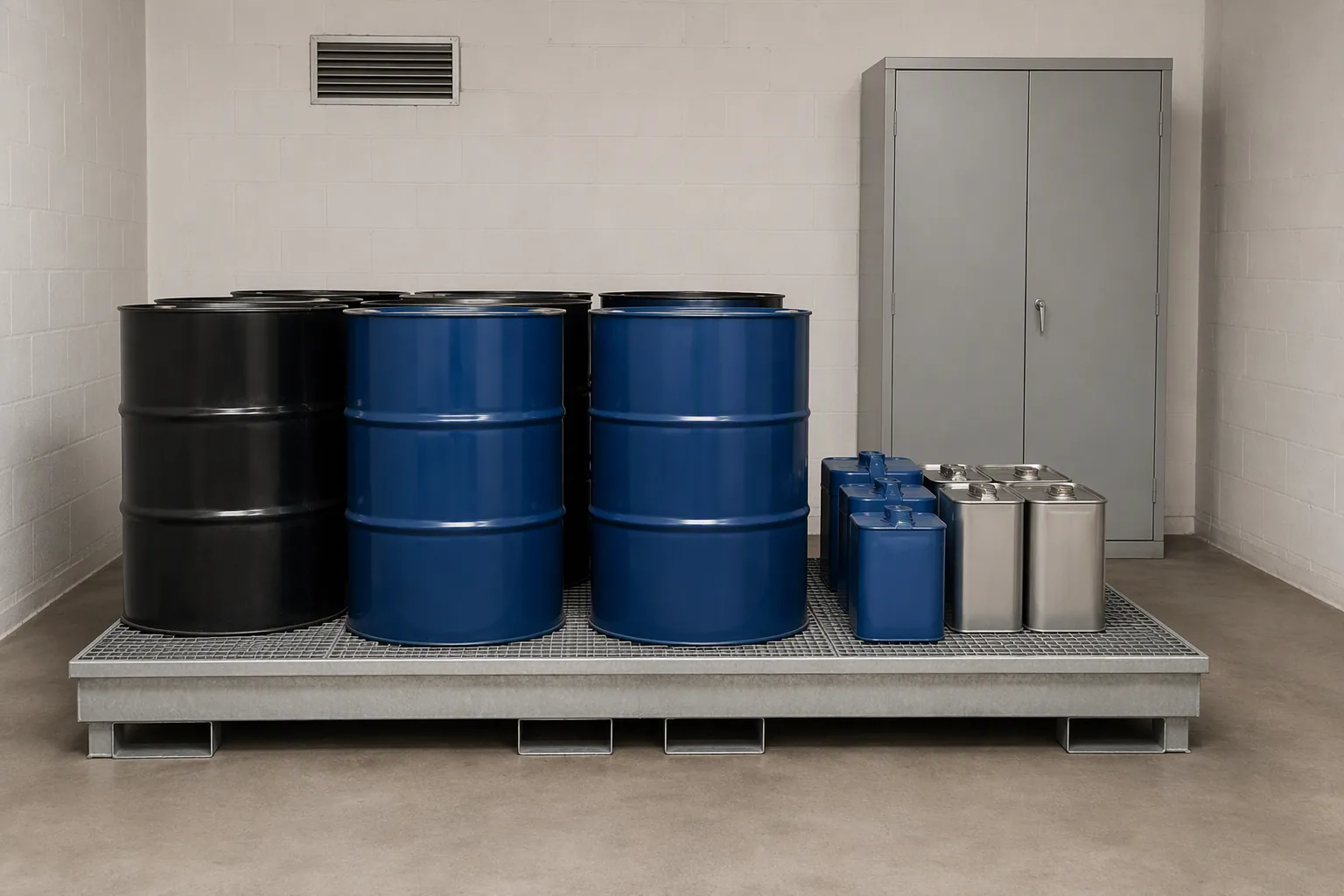
Adhesives and Cements
The largest category by use.
Bag assembly relies on adhesives for folded edges, seam reinforcement, lining attachment and small component fixing. Most are supplied in drums or pails and decanted into smaller containers at the bench, which is exactly where identification and contamination control matter most.
Solvents and Cleaners
Small volumes, large consequences.
Solvents are used for cleaning leather, removing marks, cleaning equipment and thinning adhesives. They are usually flammable, often aggressive to finishes, and frequently kept in unlabelled bottles at the workstation, which makes them the most common source of both quality problems and safety incidents.
Finishes, Dyes and Edge Products
Sensitive to time and temperature.
Edge paints, finishes, pigments and dye solutions have shelf lives and storage conditions. Some settle, some skin over, some are affected by freezing or by heat. A store that is merely dry and tidy is not necessarily suitable for them.
Lubricants and Machine Chemicals
Easy to overlook.
Sewing machine oil, grease, cleaning agents for machine parts and anti-rust treatments are all present in a bag factory. They are rarely considered part of the product, yet a leaking oil container above a leather trolley creates a defect that cannot be repaired.
| Chemical group | Typical use | Main storage risk |
|---|---|---|
| Adhesives and cements | Edge folding, lining, reinforcement | Skinning, thickening, contamination from shared tools |
| Solvents and thinners | Cleaning leather, tools and equipment | Flammability, vapour, moisture pickup, finish damage |
| Edge paints and finishes | Edge treatment, surface touch-up | Separation, skinning, colour drift with age |
| Dyes and pigment pastes | Colour matching, repairs | Settling, freezing, exposure to heat |
| Lubricants and oils | Machine maintenance | Leaks onto materials, contamination of work surfaces |
| Cleaning agents | Floors, benches, equipment | Mixing with other products, unlabelled decants |
Why the List Matters
You cannot segregate what you have not listed.
A store organised around a written inventory is easier to control than one organised by whatever shelf happened to be free. The inventory also becomes the basis for shelf-life tracking, which is the only way to stop expired adhesive being used on a rush order.
What Goes Wrong When Storage Is Loose
Four failure routes.
Cross-Contamination
Shared tools, shared surfaces.
A funnel used for solvent and then for adhesive, a brush that has dried in one product and is dipped into another, a bench where containers are set down without a drip tray: each is a route for contamination. The result is unpredictable behaviour that is almost impossible to trace back to its source.
Degradation in Storage
Time and temperature do the damage.
Adhesives skin over, pigments settle, solvents absorb moisture from humid air and finishes lose their flow. The rate depends on the container, the seal, the temperature and how often the container is opened. Frequent decanting from a large drum therefore accelerates the very problem it is meant to solve.
Vapour and Migration
An invisible route to defects.
Solvent vapour is heavier than air and spreads along surfaces. A leather panel stored near an open solvent container can pick up enough vapour to dull a finish or lift an edge. Because the effect appears later, it is usually blamed on the material rather than on the store.
Fire and Exposure
The reason the subject is regulated at all.
Solvents, thinners and many adhesives are flammable, and their vapours can ignite at a distance from the container. Poor storage concentrates that risk in one place while adding ignition sources such as motors, switches and hot equipment. This is the part of the topic where compliance requirements exist for good reason, and where local rules must be followed rather than approximated.
Segregation by Hazard, Not by Convenience
The arrangement is the control.
The Principle
Things that react together do not sit together.
Segregation is not about neatness. It is about separating materials that would react, ignite, contaminate or confuse if they met. In practice this means grouping by hazard class first and by process second, so that the person issuing a material walks to a defined zone rather than searching a shelf.
Practical Zones
A workable layout for a bag factory.
- Flammable solvents and thinners, in a dedicated cabinet or store with containment
- Adhesives and cements, kept closed, away from heat and separate from solvents
- Finishes, dyes and edge products, in a temperature-stable area out of direct light
- Lubricants and machine oils, in their own zone with drip trays
- Cleaning agents, kept apart from production chemicals to prevent mix-ups
- Waste and used rags, in lidded metal bins away from stock
The exact boundaries depend on the products in use, but the logic is consistent: incompatible groups never share a shelf, a tray or a decanting station.
| Zone | What belongs there | What must stay out |
|---|---|---|
| Flammables cabinet | Solvents, thinners, flammable adhesives | Oxidisers, heat sources, cardboard stock |
| Adhesive store | Cements, water-based adhesives, applicators | Solvents, open flames, dusty materials |
| Finish and dye shelf | Edge paints, pigments, finishes | Direct sunlight, freezing positions, food |
| Lubricant corner | Machine oils, greases, anti-rust products | Leather stock, packaging, clean benches |
| Cleaning bay | Floor and equipment cleaners | Production chemicals, measuring tools |
| Waste point | Used rags, empty containers, absorbents | New material, packaging for finished goods |
Why Proximity Matters More Than Labels
The shortest route wins.
If the solvent cabinet sits beside the adhesive bench, someone will eventually carry an open container between them. If the waste bin is across the factory, rags will accumulate at the machine. Layout decisions that ignore walking distance are quietly overruled by daily habit.
Keeping the Zones Visible
Floor marking and signage.
Marked floor areas, shelf labels and a simple zone map at the store entrance cost little and remove the need for judgement at the moment of use. They also make an unfamiliar store navigable, which matters when a substitute operator covers a shift.
Setting Up a Store From Scratch
Sequence matters more than equipment.
Start With the Inventory
You cannot zone what you have not listed. Walk the factory, collect every container that is used in production and maintenance, and record the product name, the supplier, the container size, the batch reference and the shelf life. Include the bottles already sitting at machines, because those are the ones nobody has counted.
Then the Layout, Then the Rules
With the list in hand, group the products by hazard and by frequency of use, then decide where each group lives. Only after the layout is fixed does it make sense to write the rules, because a rule that contradicts the layout will be ignored within a week. The order is inventory, layout, rules, training.
Labelling and Identification
Every container, every time.
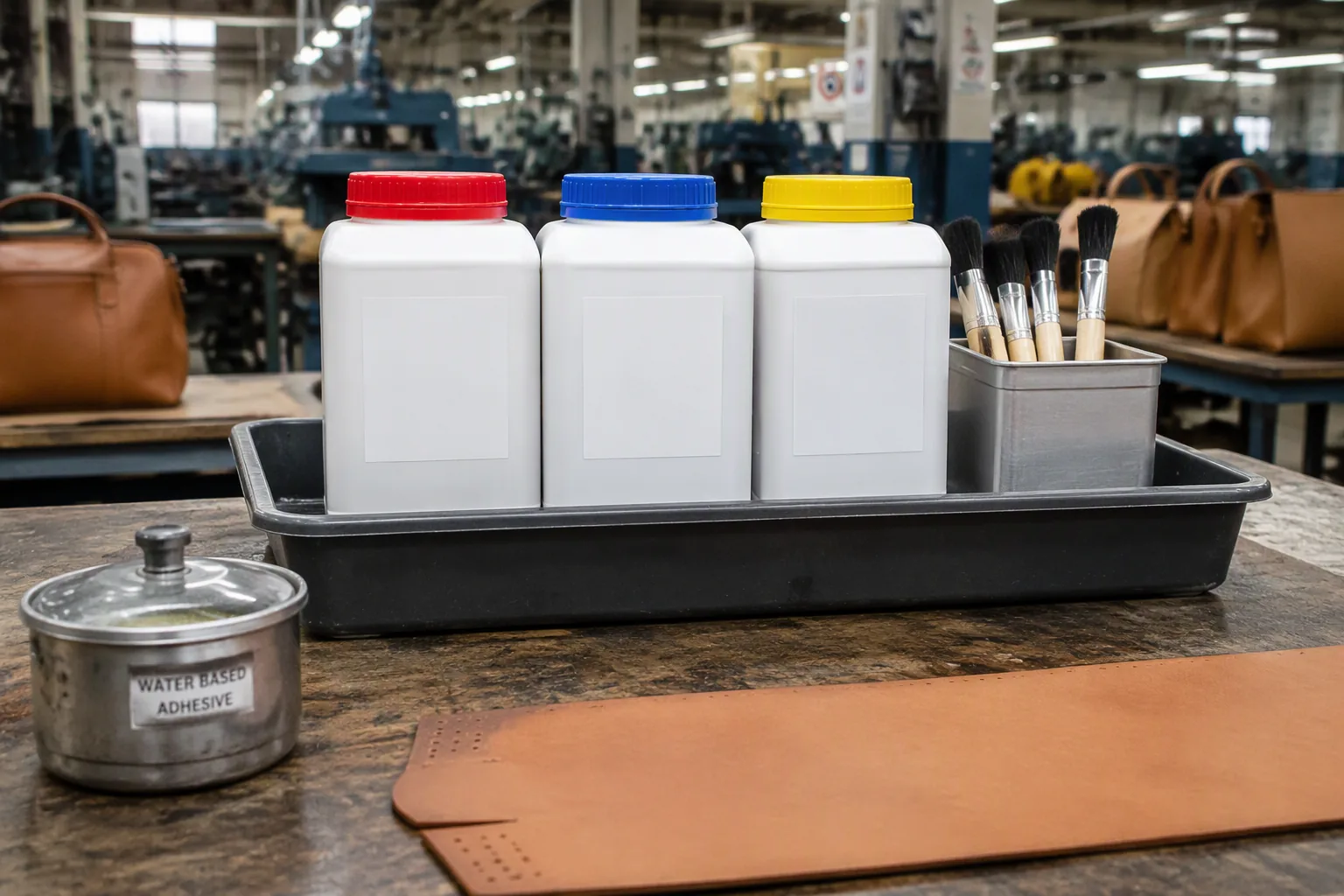
Primary and Secondary Containers
The second one is where control is lost.
Supplied containers usually arrive labelled by the manufacturer. The risk sits in the secondary container at the bench: a bottle filled from a drum and identified by memory. Whatever system is used, the rule should be that a container without a label does not stay on the bench.
What a Label Should Carry
Enough to act on.
- The product name as it appears in the store record
- The hazard information carried over from the supplier label
- The date of decanting or the batch reference
- The person or section responsible
- Any dilution or mixing instruction that applies
A label written in a language the operator does not read is decoration. Where a workforce is multilingual, the practical answer is a pictogram plus the product code, with the written detail held in the store record.
Decanting Rules
Three habits that prevent most mix-ups.
First, decant in one place, not at the machine. Second, use a dedicated container per product and never top up a part-used bottle with a different batch. Third, return or empty the container at the end of the shift rather than leaving it on the bench overnight.
The Unlabelled Bottle Problem
Why it persists.
Unlabelled containers survive because they are convenient and because nothing goes wrong immediately. The cost appears weeks later as an unexplained defect or an exposure incident, by which time nobody remembers what was in the bottle. Treating an unlabelled container as a stop-work item is the only rule that holds.
Temperature, Ventilation and Containment
Three physical controls.
Heat and Solvent Stores
Keep the store cool and away from ignition.
Solvent stores should be sited away from ovens, drying equipment, motors and direct sun, and should not share space with materials that burn readily. Where local rules require a fire-rated cabinet or a detached store, that requirement sets the design; where they do not, the same logic still reduces risk.
Ventilation
Moving air out, not around.
A store needs air movement that carries vapour away from the breathing zone rather than pushing it across the workshop. Extracting at low level is usually more effective for heavy vapours than extracting at ceiling height, and a store that smells strongly of solvent is telling you the ventilation is inadequate.
Secondary Containment
Assume a container will leak.
Spill pallets, drip trays and bunded shelves mean that a leaking drum becomes a cleanup rather than a contamination event. The cheapest version is a shallow tray under every container that is opened regularly, which also makes the leak visible earlier.
Storage Furniture
Simple and inspectable.
Closed metal cabinets for flammables, open steel shelving for stable products, and slatted racks for items that need air. Wooden shelving absorbs spills and burns, which makes it a poor choice for any chemical store, however tidy it looks.
Quantity, Issue and Return
Keep the line lean.
Why Less on the Bench Is Safer
A small stock at the workstation is easier to control than a large one. It is used before it degrades, it is visible, and it is less likely to be left open overnight. The store, not the bench, should carry the reserve.
Issue Control
A simple signature or a board.
Issue does not need software. A sheet or a board recording who took what and when is enough to make a store traceable, and it is also the record that tells you how much is genuinely consumed versus how much disappears into unlabelled bottles.
Returns and Part-Used Containers
Decide the rule in advance.
Part-used containers are where contamination begins, because the next person tops them up from a different batch. Either return them to the store with a label showing the batch, or treat them as waste at the end of the shift. Leaving the decision to the individual guarantees inconsistency.
The End-of-Shift Routine
Ten minutes that hold the system together.
Closing containers, wiping the decanting point, returning part-used bottles with a batch label and emptying the rag bin take less time than a single rework. Where the routine is written into the shift handover rather than left to goodwill, it survives busy weeks, which is when the store is most likely to drift.
Spill Response and Waste
Plan for the small event.
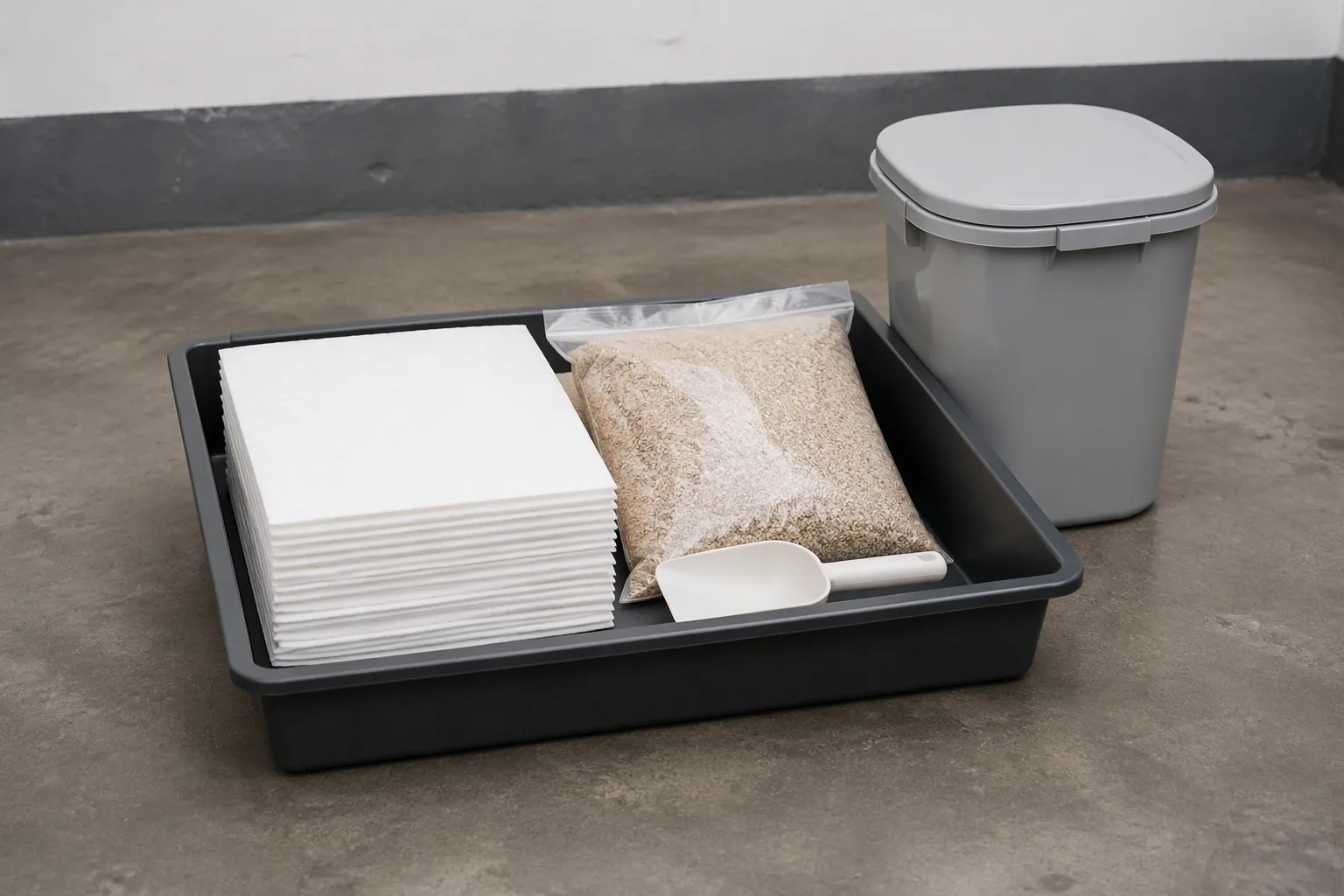
Spill Kits Where the Risk Is
Close to the point of use.
A kit kept only in the main store is useless for a spill at the far end of the sewing floor. Small kits in the areas where solvents are handled, checked periodically for missing contents, are more valuable than one large kit in a locked cupboard.
Absorbents and Rags
Use the right material.
Absorbent pads, granular absorbent and dedicated rags all have a place, and the choice depends on the chemical. A rag used on solvent and then left in a bin is a fire risk; the bin, not the rag, is the control point.
Waste Streams
Separate at the source.
- Solvent-contaminated rags and absorbents, kept in lidded metal bins
- Empty containers, drained and stored for the correct waste route
- Waste adhesive, kept separate from solvent waste
- General workshop waste, kept clear of any chemical contact
Mixing streams makes disposal harder and more expensive, and it makes the factory unable to describe what it sends for treatment. Local rules define the permitted routes; the internal discipline is to keep the streams apart so those routes remain available.
Cleaning Up Properly
The last five per cent.
A spill is not finished when the visible liquid is gone. Residue on a floor or a bench continues to contaminate, and a surface that still smells of solvent will transfer onto leather. Cleaning until the surface is neutral, then drying, is part of the response rather than an optional extra.
Who Does What in a Spill
Three roles, decided in advance.
Someone isolates the area and stops the source, someone brings the kit and contains the spill, and someone records what happened and what was used. In a small factory one person may hold all three, but the roles still need naming, because a spill that everyone responds to is often a spill nobody contains.
Access, Training and Records
The human side of the store.
Who May Enter
Fewer people, better control.
Restricting the store to named people is the simplest way to keep segregation and labelling intact. It also concentrates knowledge, which is a risk in itself, so the answer is a small group with a named deputy rather than a single gatekeeper.
Information at the Point of Use
Available, not filed away.
Supplier safety information should be reachable in the store and in the areas where the product is used, in a language the operators read. A folder locked in an office satisfies an auditor and helps nobody at the bench.
Training That Changes Behaviour
Short, specific, repeated.
Training that covers the actual products in the store, the specific hazards of each and the reason for the labelling rule is more effective than a general session. Brief refreshers when a new product arrives keep the knowledge current, which matters more than a certificate on the wall.
The Inventory Record
The spine of the system.
A store record listing products, quantities, receipt dates, batch references and shelf lives supports everything else: rotation, reorder, expiry control and traceability when a defect appears. It also turns a vague audit question into a specific answer.
When a New Chemical Arrives
The store has to absorb it deliberately.
Before the First Use
A new product should be reviewed before it reaches a bench: what it is, how it behaves, what it is incompatible with, what it does to leather and what protection it needs. A small trial on scrap material answers questions that a supplier sheet cannot, particularly about finish compatibility and odour.
What Changes in the Store
Every new product needs a place, a label, a record entry and, where relevant, a change to the training brief. Products that arrive without that step tend to end up on whatever shelf is free, which is exactly how a well-organised store drifts back into disorder over a year.
What a Buyer Should Look For
A walk-through takes fifteen minutes.
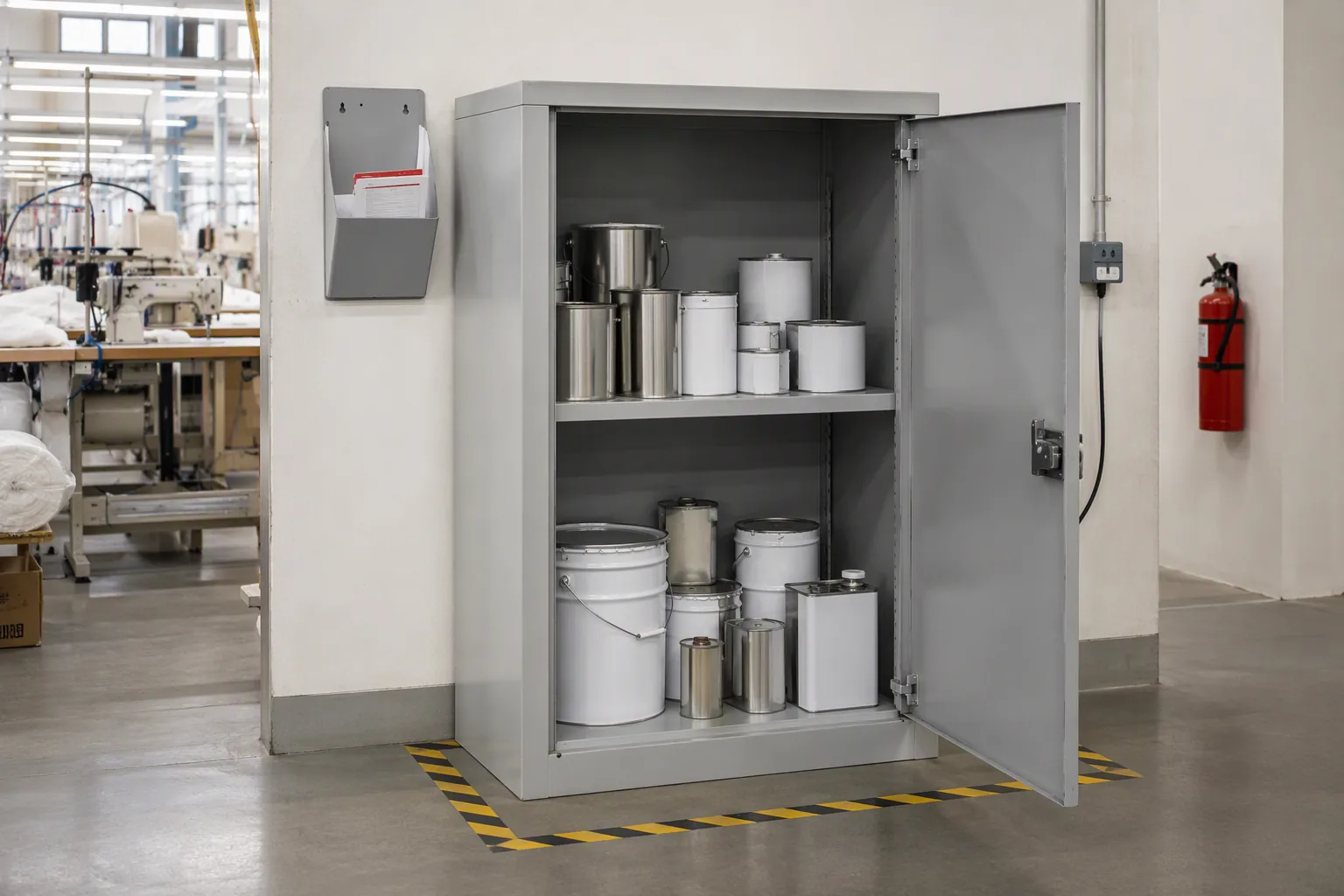
The Physical Checks
What to look at, in order.
- Are containers closed, upright and on containment?
- Is every container labelled, including the small ones at the bench?
- Are solvents separated from adhesives, finishes and stock?
- Is there ventilation, and does the store smell of solvent?
- Are there spill kits in the areas where chemicals are handled?
- Are waste rags in lidded metal bins?
- Is the floor free of stains and residue?
- Is the store locked or restricted, with a named person responsible?
- Is there a written inventory with dates and batch references?
The Questions to Ask
Answers reveal the system.
- Who is allowed into the store, and who covers for them?
- How do you know when an adhesive is past its useful life?
- What happens when a container is decanted at the bench?
- How do you prevent a shared funnel or brush from contaminating a product?
- Which products are incompatible, and where are they kept apart?
- How is spill waste separated from general waste?
Red Flags
Patterns worth treating seriously.
A store that is tidy but unlabelled is a common and misleading picture: the appearance of control without the substance. Equally, a store that is fully labelled but has open containers on the bench is telling you the rules exist on paper only. The reliable signal is whether the bench and the store look like the same system.
| Signal | What it suggests | What to do |
|---|---|---|
| Unlabelled bottles at the bench | Decanting is uncontrolled | Require labels and a decanting point |
| Solvent stored beside adhesive | Segregation is by convenience | Re-zone the store by hazard |
| Strong solvent smell in the store | Ventilation is inadequate | Improve extraction and container closure |
| No spill kit outside the main store | Response is improvised | Place kits at points of use |
| Rags in an open bin | Fire and contamination risk | Lidded metal bins, emptied daily |
| No inventory or dates | Expired material will be used | Introduce a store record with batch dates |
| Store accessible to everyone | Control depends on goodwill | Restrict access, name a deputy |
Measuring Whether It Is Working
The store leaves evidence in the defect data.
Indicators Worth Tracking
Four signals that move when storage improves.
- Rework caused by bonding failures, tracked by product and by line
- Finish defects such as haze, dull patches or lifting edges near storage areas
- Incidents involving spills, vapour or skin contact, however minor
- Time lost searching for a product, or orders delayed waiting for adhesive
What a Falling Defect Rate Tells You
Correlation, not proof, but useful. When bonding rework falls after a decanting point and labelled bottles are introduced, the store was part of the cause. When it does not move, the problem is elsewhere in the process, and the store work has at least removed one explanation.
Common Failures in Chemical Storage
| Failure | Why it happens | Effect on the product | Fix |
|---|---|---|---|
| Decanting at the machine | It saves a walk | Contamination, mislabelled bottles | One decanting station, labelled bottles |
| Shared funnels and brushes | Tools are scarce at shift change | Unpredictable bonding and finish defects | Dedicated tools per product group |
| Open containers overnight | Closing takes a moment | Vapour migration, skinning, moisture pickup | Close and return at end of shift |
| Storing by shelf availability | Nobody designed the layout | Incompatible products adjacent | Zone the store by hazard |
| No shelf-life tracking | Consumables are not in the product file | Expired adhesive used on rush orders | Inventory record with batch dates |
| Solvent store beside drying equipment | Space is tight | Fire risk, heat degradation | Relocate or separate by wall |
| Waste rags in an open bin | Convenience at the machine | Fire risk, contamination spread | Lidded metal bins, daily emptying |
| Training only at induction | No refresher when products change | Rules not applied in practice | Short refreshers on new products |
Frequently Asked Questions
Is chemical storage a quality issue or a safety issue?
Both, and they overlap. The same open solvent container that creates a fire risk also releases vapour that can dull a finish on nearby leather. Treating storage as a safety topic alone usually leaves the quality consequences unmanaged.
How many separate storage zones does a bag factory need?
Enough to keep incompatible groups apart, which in most factories means separating flammables, adhesives, finishes and dyes, lubricants, cleaning agents and waste. The exact number follows the products in use rather than a fixed template.
Can adhesives be stored in the freezer or a cold room to extend life?
Some products tolerate cool storage and others are damaged by it, and the answer belongs to the supplier’s instructions for that specific product. Storing everything cold is as wrong as storing everything warm; the condition should be confirmed per product and recorded.
What should a small factory do first with a limited budget?
Start with labelling and one decanting point. Those two changes remove the most common cause of mix-ups and cost almost nothing. Containment trays and a lidded waste bin are the next cheapest steps, followed by ventilation and a proper cabinet.
How do you stop workers keeping a bottle at the machine?
Make the alternative easier than the habit. A labelled bottle issued at the start of the shift and returned at the end is more convenient than walking to a locked store, and it removes the reason the bottle was kept in the first place.
Does a tidy store mean the storage is under control?
Not necessarily. A tidy store with unlabelled containers and shared tools looks controlled and is not. The test is whether the bench, the containers and the record tell the same story as the shelves.
How often should the store be checked?
Often enough that a missing label or an open container is found before it causes a defect. Many factories use a short daily visual check plus a fuller monthly review of quantities, dates and containment, which is enough to keep the system honest.
Should buyers ask about chemical storage during a factory visit?
Yes, because it predicts product consistency. A factory that cannot describe how it labels, decants and returns chemicals is likely to have intermittent adhesive and finish problems that no inspection step will reliably catch.
What is the biggest fire risk in a bag factory store?
Usually the combination of flammable solvents and accumulated combustible material such as cardboard, rags or packaging stored in the same space. Separating the two is more effective than adding another extinguisher.
How should empty containers be handled?
Drained, closed and kept in a designated area for the correct waste route, never reused for another product and never left where they can be mistaken for stock. Reusing a solvent container for adhesive is a classic route to contamination.
Does this apply to water-based adhesives as well?
Yes, though the hazards differ. Water-based products are less flammable but are sensitive to freezing, to drying out and to microbial growth, and they still need labelling, closed storage and clean tools to perform consistently.
The Bottom Line
Chemical storage decides more about a bag than its reputation suggests. Adhesive that has skinned over, solvent that has taken up water and a bottle that nobody labelled all end up as defects on a finished bag, and none of them can be inspected out at the end of the line.
The arrangement that prevents this is not complicated. List what the factory keeps. Zone the store by hazard rather than by shelf space. Label every container, including the small ones at the bench. Decant in one place and return containers at the end of the shift. Keep spill kits where the risk is, and keep waste streams apart.
A buyer visiting a new supplier can learn a great deal in fifteen minutes by looking at the chemical store before looking at the samples. A factory that controls its chemicals usually controls its process; one that does not will produce good samples and inconsistent production.
