
What Makes Leather Bags Fade in Sunlight and How Is It Prevented?
What Makes Leather Bags Fade in Sunlight and How Is It Prevented?
A bag that spends a season in a shop window often comes back a different colour. The change is gradual, uneven and almost impossible to reverse, and by the time anyone notices, the whole batch has been exposed.
Fading is not a single fault. It is the visible end of several processes that start in the dyehouse, continue through finishing and accelerate wherever light, heat and moisture meet. A brand that understands where colour sits, how it is tested and where exposure accumulates can specify for it.
This article is written from the manufacturing side: what fading actually is, which choices make it worse, how it is specified and tested, and what can honestly be promised when a customer asks for a bag that holds its colour.
Colour loss is one of the few defects that a factory cannot inspect out at the end of the line. Once the shade has moved, the only remedies are cosmetic.
- What Fading Actually Is
- Why Leather Fades
- What Fading Looks Like on a Bag
- Where the Colour Comes From
- Which Leathers and Finishes Fade Most
- How Light Exposure Is Specified and Tested
- How Much Light Is Too Much?
- Storage and Handling Before the Bag Is Sold
- What a Brand Can Specify
- Working With the Tannery on Colour Stability
- Restoration and Its Limits
- Communicating Colour Life to Customers
- A Fade-Resistance Checklist
- Common Mistakes That Accelerate Fading
- Frequently Asked Questions
- The Bottom Line
What Fading Actually Is
Four different changes, one complaint.
Loss of Depth
The shade gets lighter.
The most common form is a straightforward reduction in colour intensity: a deep brown becomes a mid brown, a saturated tan drifts toward beige. The hue may hold while the depth goes, which is why two panels can look like different colours under the same light.
Shift in Hue
The colour moves sideways.
Some colourants fade unevenly across the spectrum, so a warm brown can drift red, and a navy can drift grey. Hue shift is harder to spot in isolation and easier to spot when a faded panel sits beside an unexposed one.
Surface Change
The coating, not the colour.
A finish can yellow, chalk or lose gloss without the underlying colour changing much. This reads as fading to a customer, but the corrective action is different: it is a finish problem rather than a dye problem.
Where It Is Not Fading
Three lookalikes worth separating.
- Pull-up leather lightens where it is flexed, and recovers or stays light depending on the article
- Vegetable-tanned leather darkens with light and handling rather than fading
- Surface scuffing removes a thin top layer and exposes a lighter core
Telling these apart matters, because each has a different cause and a different response.
Why Leather Fades
The mechanism is cumulative.
Ultraviolet Light
The main driver.
Ultraviolet radiation carries enough energy to break the chemical bonds that produce colour. The damage accumulates with every hour of exposure, which is why a bag can look unchanged for months and then appear to fade suddenly.
Visible Light and Heat
Slower, but not neutral.
Long exposure to bright visible light also moves colour, and heat accelerates most chemical change. A display position near a window combines both, which is why shop windows produce the most dramatic examples.
Moisture and Humidity
A multiplier.
Moisture facilitates the reactions that ultraviolet light starts, and repeated humid-dry cycles stress finishes. A damp bag in a bright room ages faster than a dry bag in the same light.
Chemistry in the Air and on the Hands
Small contributions that add up.
Ozone, vehicle exhaust and airborne acids all attack surfaces over time. Handling adds oils, salts and cosmetics, which can shift shade locally and interact with the finish.
Design Choices That Decide the Rate
Not all leathers fade at the same speed.
- Dye chemistry chosen for the shade, since some hues are inherently less light-stable
- Whether colour is dyed through the substance or carried in a surface coating
- The topcoat system, which can include light-stabilising components or omit them
- Pigment loading, since heavy surface colour hides more than a thin transparent finish
- The colour of the lining, thread and edge finish, which fade at their own rates
What Fading Looks Like on a Bag
Patterns point to causes.
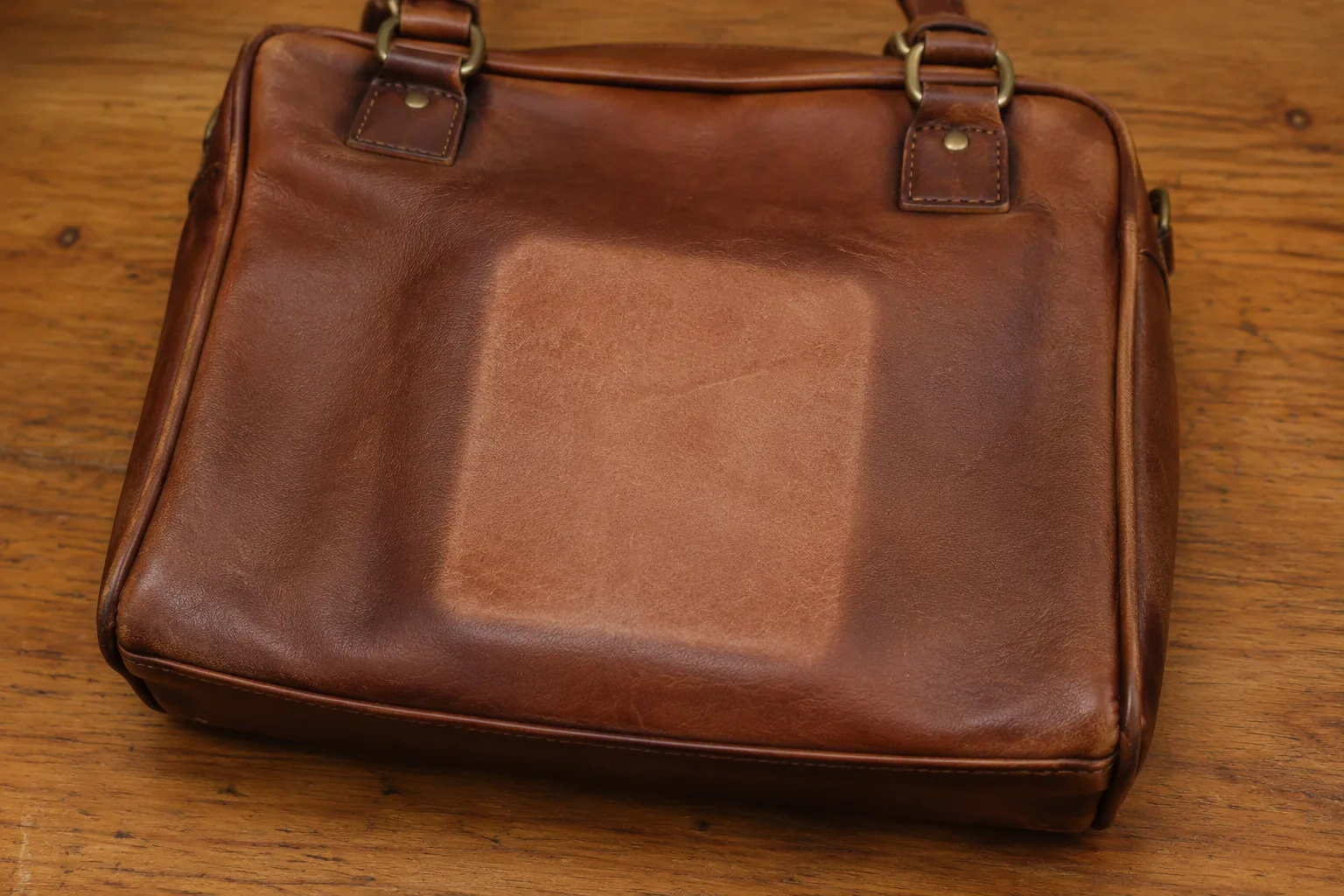
Covered and Uncovered Areas
The clearest evidence.
Where a tag, a card or a folded flap protected part of a panel, the covered area keeps its original shade. A crisp lighter patch is close to proof that light, rather than chemistry, did the work.
Panels That Do Not Match
A single bag can fade unevenly.
Shoulder panels, outer pockets and gussets receive different exposure, so one bag can end up with panels that no longer match each other. The mismatch usually appears first where a panel faces outward in the way the bag is normally carried.
Edges and Creases
Where the eye goes first.
Edges, fold lines and the tops of pleats present a different surface angle and often a thinner finish, so they change shade earlier. On a heavily used bag these areas read as wear even when the cause is exposure.
Interior and Trim
Consistency checks.
Linings, zip tape, edge paint and stitching all carry their own colour, and they fade at their own rates. A bag whose exterior has held but whose lining has gone pale tells you the two were specified without reference to each other.
Where the Colour Comes From
The construction of the colour decides how it ages.
Dyed Through the Substance
Colour in the fibre.
Where a hide is dyed in the drum, the colourant penetrates the structure rather than sitting on top. The advantage is that wear and light damage progress gradually, because there is no thin coloured layer to lose. The limitation is that the achievable depth and uniformity depend on the raw material.
Surface-Coated Colour
Colour in a film.
Pigmented finishes place colour in a coating applied over the surface. This allows very uniform shades and covers natural variation, which is why it dominates volume production. The trade-off is that the colour now depends on a film, and a film can chalk, yellow or wear through.
Two-Tone and Effect Finishes
Colour that changes on purpose.
Some articles are built around a deliberate tonal variation, a burnished edge or a shaded surface. These finishes are harder to fade-test meaningfully, because a change in appearance may be an intended effect rather than a defect, and the acceptance criteria have to say which is which.
Why This Matters for a Fade Complaint
The right question changes the answer.
If the colour is in the fibre, a fade complaint is a dye-selection issue. If the colour is in a film, it may be a coating issue. Investigating with the wrong assumption produces a remedy that does not work, and a second complaint on the same article.
Which Leathers and Finishes Fade Most
Some combinations are riskier than others.
Shade Families
Not all hues are equal.
Certain saturated reds, oranges and some blues are historically harder to hold than browns, tans and blacks. This is a property of the colourant chemistry rather than a sign of poor quality, and it is one reason a shade card cannot be treated as a promise about light stability.
Finish Systems
Thin and transparent versus heavy and opaque.
A thin, transparent finish shows the material and shows damage. A heavier pigmented system hides more and resists light better in the short term, though it introduces the risk of the film itself changing. Neither is universally better; the choice follows the article’s use.
Natural and Unfinished Surfaces
Beautiful and exposed.
Leathers left close to their natural state have little between the fibre and the environment. They age characteristically, and a brand that sells them is selling that ageing, which makes an honest description more important than a fade guarantee.
Mixing Systems Within One Bag
A common and avoidable error.
A bag assembled from a dyed-through body, a pigmented pocket and a coated trim has three fading behaviours. When one moves first, the bag looks defective even though every component met its own specification.
| Colour system | Where the colour sits | Typical fading behaviour | What to specify |
|---|---|---|---|
| Dyed through | In the fibre | Gradual, follows wear | Dye class and light stability for the exact shade |
| Pigmented finish | In a surface film | Film may chalk or yellow before colour loss | Coating system plus adhesion and flex behaviour |
| Thin transparent finish | Over a dyed surface | Shows both dye fade and finish wear | Both dye and topcoat, tested together |
| Two-tone or effect | Engineered surface | Appearance changes are ambiguous | Acceptance criteria that define intended change |
| Mixed assembly | Different per component | One component moves first | A single shading standard across all components |
How Light Exposure Is Specified and Tested
Testing ranks articles; it does not guarantee a lifetime.
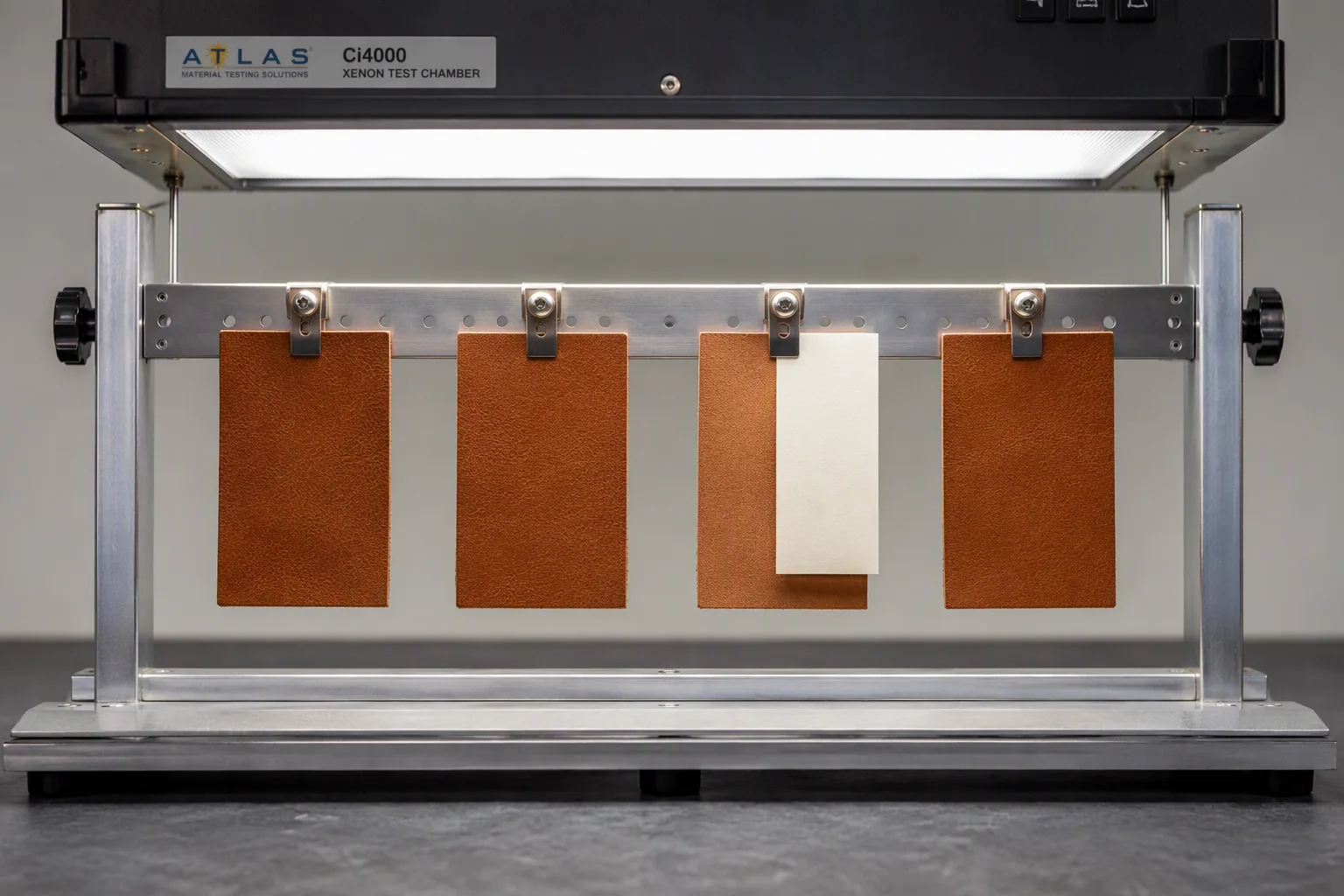
What a Light Stability Test Does
It compares, under controlled light.
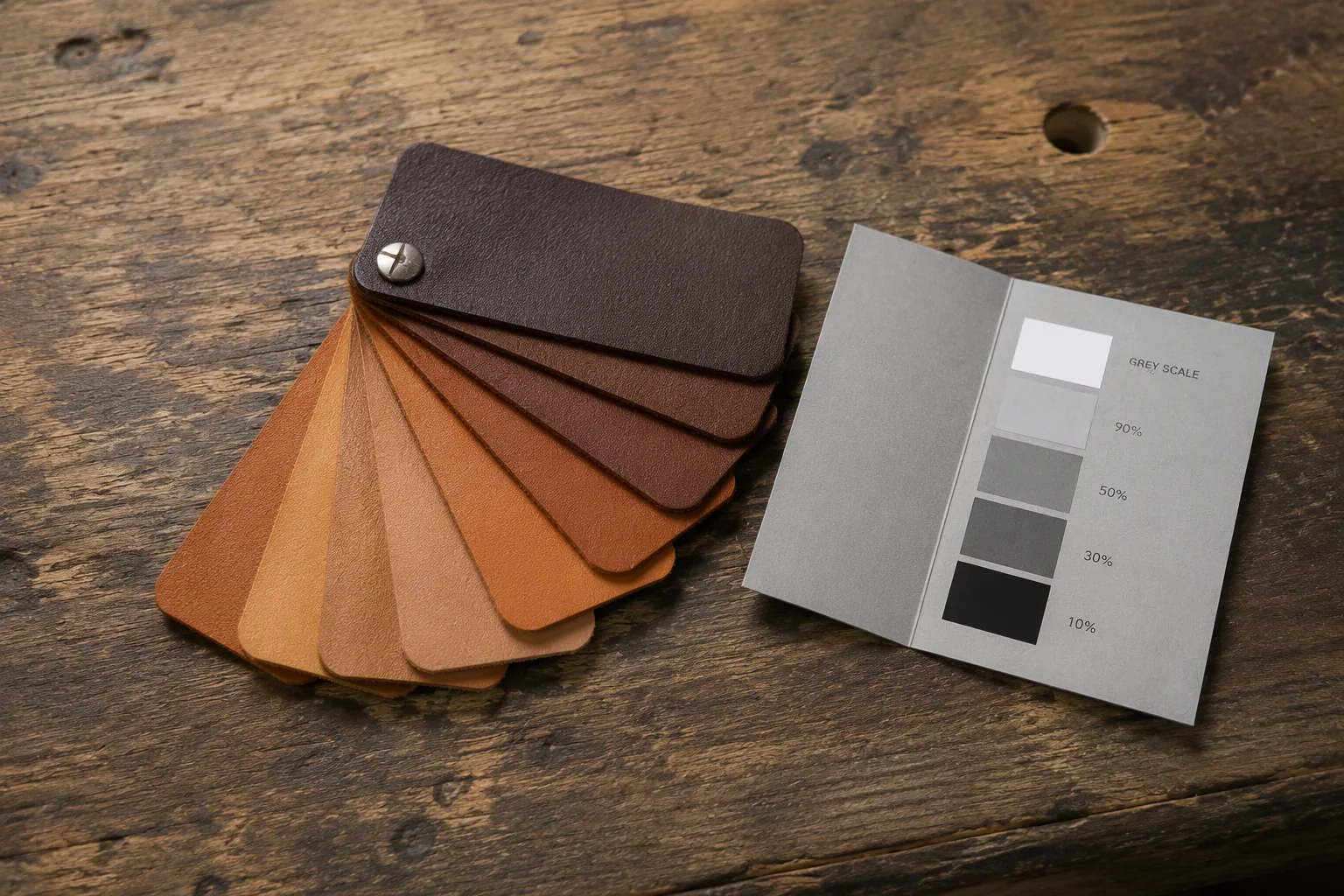
A sample is exposed to a defined light source for a defined period, and its change is compared against an unexposed control and a graduated reference scale. The output is a ranking of how much the shade moved, which lets a brand compare two candidate articles on the same basis.
Preparing the Sample Properly
Half the value is in the preparation.
- Use the actual production shade, not a similar one from a colour card
- Include the finish that will be used, since a topcoat changes the result
- Mask part of the sample so the exposed and unexposed areas sit side by side
- Condition samples before exposure so that moisture is comparable
- Test the lining, thread and edge finish as well, because they are visible too
Reading the Result Honestly
Three cautions.
First, a good result on a reference scale does not mean a bag will not fade in a window; it means it faded less than the reference. Second, laboratory exposure compresses time in a way that does not reproduce every real condition, particularly moisture cycling. Third, results apply to the tested shade and finish, so a change of colourant or topcoat invalidates them.
What a Factory Can and Cannot Promise
The boundary matters commercially.
A factory can promise that the article meets a stated test result on a stated shade. It cannot promise that a bag will hold its colour indefinitely under any exposure, and any supplier willing to make that promise is offering something it cannot verify.
The useful specification is not “will not fade” but “will not exceed this measured change under this defined exposure, on this shade, with this finish”.
How Much Light Is Too Much?
Exposure is a dose, not a level.
The Cumulative View
Small amounts add up.
A bag does not fade because of one bright afternoon; it fades because of a total dose received over months. Thinking in doses changes the questions a brand asks: not whether a position is bright, but how many hours of bright light the article will accumulate before it reaches a customer.
The Places That Surprise People
Everyday positions that carry real risk.
- A car interior in summer, where heat and light combine
- A windowsill used as a storage spot
- A desk beside a window, where a bag sits for years
- A shop window with an afternoon aspect
- A glass-fronted display cabinet that concentrates light
None of these look like a hazard, which is exactly why they account for so many complaints.
Judging Risk Without Instruments
Practical signals.
Where a printed card left on a shelf fades within weeks, the position is aggressive. Where a fabric swatch yellows over a season, the light is doing measurable work. These simple observations are usually enough to decide whether a display position needs a blind, a rotation schedule or a different shelf.
Storage and Handling Before the Bag Is Sold
Most exposure happens before a customer sees the bag.
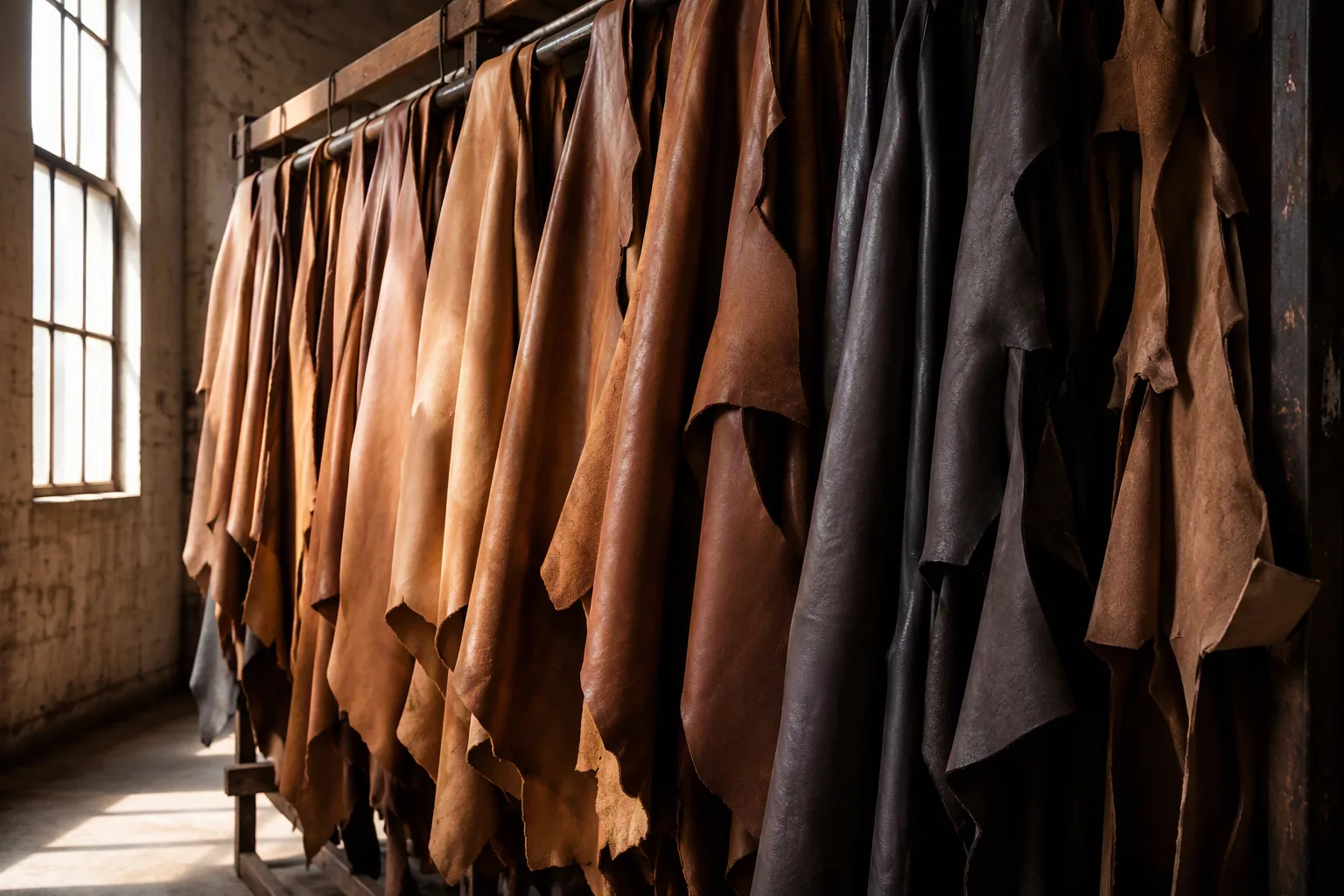
Light Is Cumulative
Every hour counts.
A hide that waits three weeks in a bright warehouse has already absorbed a meaningful part of its exposure budget before it is cut. Because the change is slow, nobody notices at the time, and the loss is only discovered when a finished bag is compared with a fresh swatch.
Where Stock Actually Sits
The unglamorous list.
- Hides stored near windows or under skylights
- Finished bags on open shelving in a daylit showroom
- Sample rooms with large glass and no blinds
- Photography areas with continuous lighting
- Trade fair displays under high-output lamps
- Retail windows with direct afternoon sun
Each of these is a place where a well-specified article can still lose colour.
Covering and Rotation
Two cheap controls.
Covering stock costs little: an opaque sheet over a rack, a closed cabinet for finished bags, blinds on a window. Rotation matters as much, because the front of a rack takes the light and the back does not, so a first-in-first-out discipline spreads exposure rather than concentrating it.
Display and Photography
The highest-intensity exposure.
Studio lighting used for catalogue photography can deliver more light in an hour than a shelf receives in a week. Where the same sample bag is photographed repeatedly, the sample should be treated as a consumable and checked against a reference swatch before each session.
Transit and Packaging
Protection that also blocks light.
Opaque packaging protects colour as well as surfaces, and a bag that travels in a printed box arrives with less exposure than one that travels in a clear polybag. Where packaging is transparent for retail reasons, the display position matters more, not less.
| Exposure point | What tends to happen | Practical control |
|---|---|---|
| Hide storage near glazing | Panels cut from outer hides arrive pre-faded | Cover racks, blind the windows, rotate stock |
| Finished goods shelving | Front-facing bags fade unevenly | Closed storage, periodic rotation |
| Sample and photography rooms | Samples fade faster than production | Replace samples, check against a reference |
| Trade fairs and showrooms | Intense short exposure, handled often | Rotate display pieces, keep spares |
| Retail windows | The most visible and most damaging | Advise the retailer, supply a rotation piece |
| Transit in clear packaging | Gradual exposure in transit and storage | Opaque or tinted packaging where possible |
What a Brand Can Specify
Turn the risk into a requirement.
Specify on the Production Shade
The test must match the article.
A light stability result is only meaningful for the shade and finish that were tested. The specification should reference the production colour by name and sample, and should state that any change of colourant, topcoat or supplier requires re-testing.
Extend the Requirement to Every Visible Component
The bag fades as a set.
- Body leather, in the exact shade and finish
- Pocket and trim leather, which may come from a different article
- Lining fabric, which is often the first thing to look tired
- Thread, which can fade to a visibly different tone
- Edge finish and piping, which are thin and exposed
- Zip tape and webbing, which are dyed by a different process again
Define What Counts as a Defect
Agreement before delivery.
Two people looking at a faded panel will disagree unless the boundary is written down. The practical approach is to agree a reference swatch, an exposure condition and a maximum acceptable change, then to state that the acceptance is judged against that reference rather than against memory.
Ask for the Method, Not Only the Result
A number without context is useless.
The report should identify the test method, the exposure applied, the sample preparation and the reference used. A supplier that can describe all four is telling you something about its process control as well as its product.
Working With the Tannery on Colour Stability
The conversation that produces a usable answer.
What to Ask at Qualification
Questions with technical answers.
- Which colourant family is used for this shade, and how does it behave under light?
- Has this exact shade been tested with the finish that will be applied?
- What method and reference were used, and what change was recorded?
- Do the lining, thread and edge finish share the same colourant logic?
- What changes would invalidate the result?
A tannery that can answer all five is managing colour as a process, not as a catalogue entry.
Batch-to-Batch Consistency
The quieter failure.
Two deliveries of the same shade can differ slightly in depth before any fading occurs. Where a bag is assembled across two batches, that difference reads as fading even when nothing has been exposed. Retaining a reference swatch from the approved batch is the cheapest control available.
When a Change Requires Re-Approval
Any change, in practice.
A different colourant, a reformulated topcoat, a new finishing line or a new tannery should each trigger re-testing and re-approval. Treating a substitution as an equivalent because the shade matches on the bench is the most common route to a complaint six months later.
Restoration and Its Limits
Some damage can be dressed; none of it can be undone.
What Can Realistically Be Improved
Cosmetic recovery.
- Surface yellowing or chalking on a coated article, where the film can be cleaned or refinished
- Local colour loss on a small area, where a recolouring treatment can be matched to the surrounding shade
- A single damaged panel, which can sometimes be replaced if the leather is still available
- Dull or dry surfaces, which respond to conditioning without changing the underlying colour
What Cannot Be Reversed
The honest list.
- Colour lost from the fibre itself, which no surface treatment restores
- A uniform shade shift across a whole bag, where there is no reference area to match to
- Damage that has also changed the hand or strength of the leather
- A perfect match between a repaired area and leather that has aged for years
The Colour Matching Problem
Why repairs show.
Matching a repair to aged leather is harder than matching two new swatches, because the surrounding colour is itself a moving target. A repair that looks correct in the workshop can look wrong in daylight, which is why repairs should be assessed under the light in which the bag will be used.
Setting Expectations Before the Repair
Say what the outcome will be.
The most useful thing a factory can do is describe the expected result before work starts: a visible repair, a close but not exact match, or a recommendation to replace rather than restore. Customers accept limits they were told about in advance and resent limits they discover afterwards.
Restoration is a cosmetic service, not a reversal. A bag can be made presentable again; it cannot be made new.
Communicating Colour Life to Customers
Words that survive contact with reality.
Avoid Absolute Claims
Nothing holds colour forever.
A claim that a bag will not fade sets up a complaint from the first customer who leaves it in a car. Claims should describe the care expected and the conditions the article was designed for, not a guarantee against physics.
Give Instructions That Actually Help
Three habits that matter.
- Keep the bag out of prolonged direct sun, including car interiors and windowsills
- Store it covered, in a dust bag or a closed cupboard, rather than on an open shelf
- Rotate between bags, so no single piece absorbs all the exposure
These are simple, verifiable and directly connected to the failure mode, which makes them more useful than a general instruction to look after the product.
What Retail Partners Need to Know
The last link in the chain.
A brand can control its own warehouse and still lose the sale to a shop window. Telling retail partners which shades are most exposed, how to orient a display and how often to rotate stock is a small instruction that prevents a large share of visible fading, and it costs nothing beyond a line in the display guide.
Handle Complaints as Data
A complaint is a measurement.
Recording where a faded bag was used, how long it was displayed and how it was stored turns a series of complaints into an exposure profile. That profile is what tells a brand whether the article is under-specified or whether the retail environment is the real problem.
A Fade-Resistance Checklist
A short list to work through before approving an article.
- Is the shade light-stable in the colourant family being used?
- Has the actual production shade been tested, not a colour-card equivalent?
- Was the finish tested with the dye, rather than separately?
- Have lining, thread, edge finish and zip tape been checked as a set?
- Is there a reference swatch retained for the approved shade?
- Is the storage area free of direct light, with stock covered and rotated?
- Are sample and display bags replaced on a schedule?
- Does the care instruction tell the customer where the real risk lies?
- Has the retailer been told how to place the bag in a window?
- Is re-testing triggered whenever a colourant or topcoat changes?
Common Mistakes That Accelerate Fading
| Mistake | Why it happens | Consequence | Better practice |
|---|---|---|---|
| Testing a colour-card swatch | It is quicker than waiting for production shade | Result does not describe the article | Test the production shade and finish |
| Treating one test as a guarantee | The result is easier to sell than to explain | Complaints the factory cannot answer | Report method, exposure and reference |
| Specifying body leather only | Trims are bought separately | Lining or thread fades first | Specify every visible component |
| Storing hides near glazing | Warehouse space is tight | Panels arrive pre-faded | Cover racks and blind windows |
| Leaving samples on open shelves | Convenient for showroom visits | Samples no longer represent production | Replace samples on schedule |
| Clear packaging for visibility | Retail wants the product seen | Exposure continues in storage | Opaque or tinted packaging |
| Promising no fading | Marketing pressure | Unwinnable claims disputes | Describe care conditions instead |
| Repairing without expectation setting | Repair is treated as a fix | Customer expects invisible repair | State the expected result first |
Frequently Asked Questions
Can a faded leather bag be brought back to its original colour?
Only partly. Surface yellowing or chalking can often be cleaned or refinished, and a small area can be recoloured, but colour lost from the fibre cannot be restored. The result is presentable rather than original, and the repair is usually visible under close inspection.
Is fading a sign of poor leather quality?
Not on its own. Some shades are inherently less light-stable than others, and a well-made bag in a difficult colour can fade faster than a cheaper bag in black. Quality shows in whether the risk was understood and specified for, not in whether the shade moved at all.
Does a pigmented finish fade less than an aniline one?
It usually holds its colour better in the short term because the colour sits in an opaque film, but the film itself can chalk or yellow. Aniline surfaces show change sooner and more honestly. Neither system is universally superior; the choice depends on the article and its use.
How long does it take for a bag to fade in a shop window?
It depends on the shade, the finish, the orientation of the window and the season. A sunny window can produce visible change within weeks on a sensitive colour, while a shaded position may show nothing for months. This is why display rotation matters more than any single figure.
Can I ask a supplier for a fade guarantee?
You can ask for a tested result on a stated shade under a stated exposure, and that is the useful request. A guarantee that a bag will never fade is not something a tannery or a factory can verify, and treating such a promise as protection usually leads to a dispute nobody can win.
Why did only one panel of the bag change colour?
Because exposure is uneven. The outward-facing panel in the way the bag is normally carried, or the panel nearest a window, receives far more light than the rest. Uneven fading is evidence of an exposure pattern rather than of inconsistent material.
Does the lining fade as well?
Yes, and it often shows first because lining fabrics are usually dyed to a lighter shade with less demanding colourants. A lining that has gone pale next to an intact exterior is a common and avoidable mismatch.
Is fading worse in humid climates?
Moisture tends to accelerate the changes that light starts, and repeated humid-dry cycles stress finishes. A damp bag in bright conditions will generally age faster than a dry bag in the same light, which is why storage advice combines light and humidity.
Can a bag be protected with a spray?
Protective treatments can help with water and staining, and some include light-stabilising components, but none makes a leather immune to prolonged sun. A treatment is a supplement to sensible use and storage, not a substitute for them.
What should be written into the specification?
The production shade and finish, a tested light-stability result with its method and reference, the same requirement for lining, thread and trims, and a retained reference swatch. That set is short, checkable and directly tied to the failure mode.
Does re-testing need to happen if the colourant changes but the shade looks the same?
Yes. Two colourants that produce a similar shade can behave very differently under light, so a substitution that looks identical on the bench is a new material for this purpose. Re-testing after any change is the only reliable control.
The Bottom Line
Fading is decided long before a customer notices it. It is set by the colourant and the finish, shaped by how the stock was stored, and revealed by the first season in a window.
The practical response is short. Test the production shade with its finish rather than a colour card. Extend the requirement to the lining, thread and trims so the bag ages as a set. Keep hides and finished goods out of direct light, and rotate what is on display. Describe the care conditions honestly instead of promising that colour will never move.
A brand that does these things still sells bags that age. What it avoids is the surprise: the batch that changed colour in a window, the panels that no longer match, and the complaint that arrives with no way to explain it.
