
Leather Broker or Direct Tannery: Which Route Should Bag Buyers Use?
Leather Broker or Direct Tannery: Which Route Should Bag Buyers Use?
Every bag programme eventually reaches the same fork. The leather can be bought through a broker who holds stock, sources from several tanneries and speaks the buyer’s language, or it can be bought directly from the tannery that makes it. The two routes sell the same material and behave completely differently.
The choice is rarely about price alone. It changes who answers a technical question at eleven at night, who carries the cash tied up in a minimum order, who can find four hundred square feet of a shade that has just been discontinued, and who is accountable when a lot arrives slightly darker than the last one. For small programmes the answer is often a broker. For large continuous programmes it is often direct. Many brands, in practice, need both.
This guide compares the two routes from the buyer’s side of the table: what each party actually does, how traceability, shade consistency, pricing and minimum quantities differ, and how to decide which route fits a particular programme. It does not cover how to evaluate a tannery’s environmental performance or how to specify a leather’s technical properties, both of which are separate exercises.
- What a Leather Broker Actually Does
- What Buying Direct From a Tannery Involves
- Broker or Tannery: The Comparison That Matters
- Traceability and Documentation
- Shade and Lot Consistency
- Price and Transparency
- Minimum Order Quantities and Cash Flow
- Technical Support and Problem Solving
- Risk, Credit and Payment Terms
- Logistics and Consolidation
- When a Broker Is the Better Choice
- When Direct Is the Better Choice
- The Hybrid Route
- Choosing and Evaluating a Broker
- Qualifying a Tannery Directly
- Working With an Agent Who Is Not a Stockholder
- Quality Claims: Tolerance and Remedy
- Insurance, Claims and Losses in Transit
- Managing a Leather Supply Calendar
- Sustainability Questions and the Two Routes
- Negotiating With Either Route
- Common Mistakes
- A One-Page Decision Framework
- Frequently Asked Questions
- Conclusion
What a Leather Broker Actually Does
The Broker’s Function
A broker buys or represents leather and sells it onward, adding sourcing reach, stock and commercial handling. Some hold physical stock and ship from it; others work against a tannery’s availability and take a margin for the connection. The distinction matters, because a stock-holding broker can supply in a week and a pure agent cannot.
Where Brokers Add Value
Three things, repeatedly. They can supply quantities too small for a tannery’s minimum. They can hold several origins and shades in one place, which turns a five-tannery problem into one order. And they can absorb the administrative work of inspection, consolidation and shipping that a small brand has no team for.

Where the Route Breaks Down
A broker’s technical knowledge stops where its supplier’s begins. Ask a finishing question about a specific article and the answer travels through a chain, arriving later and less precisely. When a lot goes wrong, the broker can escalate but cannot always resolve, and the buyer discovers that the accountability it assumed was never contractual.
What Buying Direct From a Tannery Involves
Minimum Quantities
Tanneries set minimums by lot, by colour and by article. A minimum that looks modest per lot becomes substantial when a programme needs four colours, because each colour is a separate run. This is the single most common reason small brands abandon the direct route after one enquiry.
Technical Dialogue
Direct buying gives access to the people who actually make the leather: the technician who can explain why a finish is cracking, the colourist who can match a reference, the production planner who can say what is possible in six weeks. For a brand developing its own articles, this access is worth more than the discount.
Lead Times and Scheduling
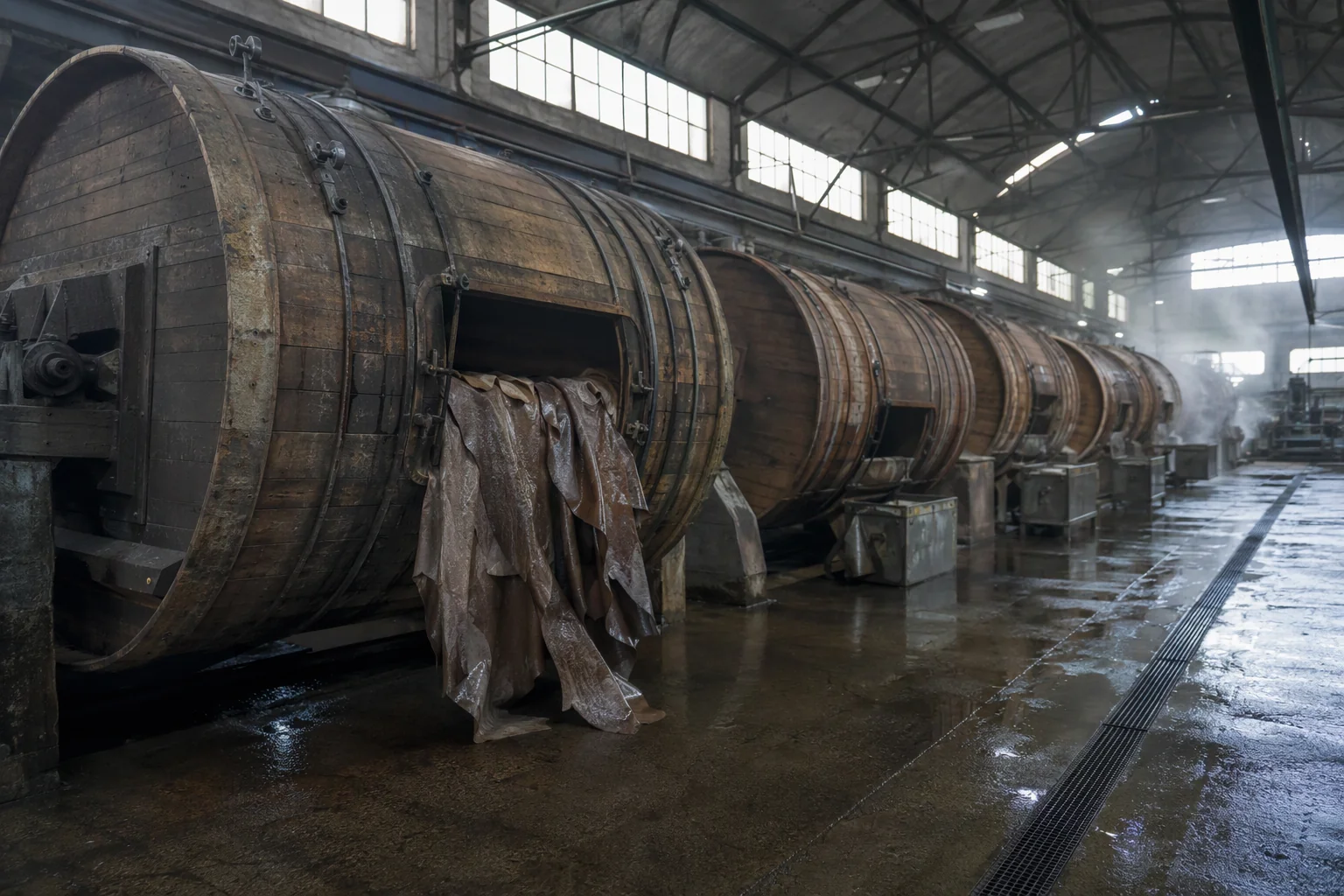
A tannery schedules its drums and its finishing lines, and a buyer’s order enters that schedule. Lead times are therefore real production times rather than stock availability, and they move when the tannery’s larger customers move. A buyer without visibility of that schedule experiences lead times as unpredictable.
Broker or Tannery: The Comparison That Matters
| Criterion | Through a broker | Direct from a tannery | What to verify before committing |
|---|---|---|---|
| Minimum quantity | Low, often by the piece | Set by lot and colour | Whether minimum is per colour or per article |
| Lead time | Days to weeks from stock | Production schedule, weeks | Written lead time with a stated basis |
| Technical support | Passed through a chain | Direct to technician | Who answers a finishing question |
| Shade consistency | Limited to what is held | Controlled at the source | How a repeat order is matched |
| Price | Includes a margin | Closer to production cost | Whether both quotes cover the same article |
| Traceability | Depends on disclosure | Full chain available | Which documents the supplier will issue |
| Small repeat orders | Easy | Difficult below minimum | Policy for top-up quantities |
| Problem resolution | Escalation only | Direct remedy | What happens when a lot is rejected |
Reading the Table Correctly
The table describes tendencies, not rules. A large broker with technical staff can outperform a small tannery on support, and a tannery with a stock programme can beat a broker on lead time. The right question is not which column is better but which column describes the specific supplier in front of you.
Traceability and Documentation
What Each Route Can Prove
A tannery can document the hides it received, the processes applied and the lots it shipped, because those records are part of its own production. A broker can pass on whatever its supplier provides, which may be complete, partial or summarised. The difference appears when a customer asks for evidence rather than an assurance.
Chain of Custody
Chain of custody requires an unbroken record from hide to finished article. Buying through an intermediary adds a link that must also document its part, and not every broker is set up to do so. Where a brand intends to make a traceability claim, the route should be chosen with that requirement in view from the start.
Claims That Depend on It
Origin claims, welfare claims and process claims all rest on documentation rather than on the material itself. A brand that buys through a broker without confirming disclosure may find that its claim cannot be supported at the moment it is questioned, which is the worst possible time to discover the gap.
Shade and Lot Consistency
The Practical Problem
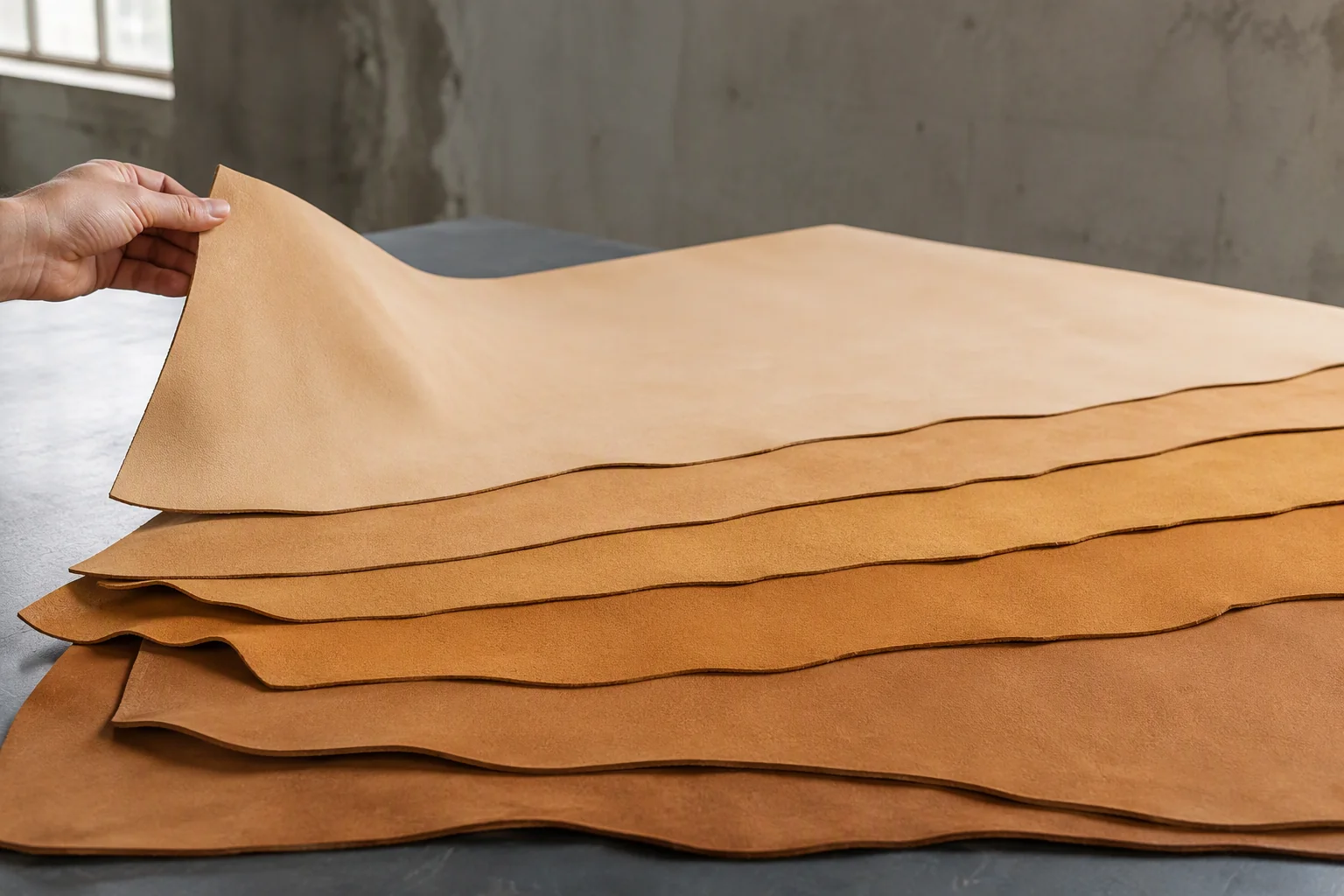
Two lots of the same article can differ visibly, because hides differ and because dyeing has a tolerance. In a bag, a difference that is invisible in a swatch becomes obvious across two panels of the same product. Consistency is therefore a production requirement rather than an aesthetic preference.
What Brokers Can Do
A broker holding stock can supply the same physical lot over several months, which is the strongest consistency a buyer can obtain for a small programme. The limitation is that when the stock runs out, the replacement may be a different lot with a different tone.
What Tanneries Can Do
A tannery can match a repeat order against a retained reference and can plan a colour run to cover a larger quantity. This works when the buyer commits to volume and orders ahead. It does not work when the buyer returns after a year asking for one hundred square feet.
Price and Transparency
How Broker Pricing Works
Broker pricing bundles the leather, the margin, the stock-holding cost and the service. The buyer sees one number and cannot decompose it, which is convenient for budgeting and unhelpful for negotiation. Requests to see the underlying supply price are usually declined, and reasonably so.
How Tannery Pricing Works
Tannery pricing is closer to cost but arrives as a set of components: article, thickness, finish, colour, quantity and terms. Two tannery quotes for the same description can differ by twenty percent because one includes a finish the other does not. Comparing them requires reading the specification, not the total.
Comparing Like With Like
| Cost element | Usually quoted by the broker | Usually quoted by the tannery | Risk if ignored |
|---|---|---|---|
| Leather per square foot | Bundled | Separately by article | Comparing different articles |
| Colour and finish | Bundled | Priced as additions | Underestimating the finished cost |
| Minimum order surcharge | Absorbed or shared | Applied per lot | Small orders priced as if large |
| Inspection | Included or extra | Extra | Paying twice or not at all |
| Freight and consolidation | Often included | Usually excluded | A cheap quote that is not cheap |
| Payment terms | Negotiable | Tied to credit approval | Working capital surprises |
The Comparison Discipline
The only reliable comparison is a written specification sent to both routes, with the same article description, thickness, finish, colour reference, quantity and delivery point. Without that, the difference in price measures the difference in scope.
Minimum Order Quantities and Cash Flow
The Real Minimum
A tannery minimum is per lot, and a lot is one colour of one article. A programme needing four colours therefore commits four times the stated minimum. Brokers convert this into a per-piece purchase, at a price that reflects the risk they carry.
Stock Lots and Availability
Brokers sell from stock, which means availability changes without notice and a shade that exists today may be gone next month. Buyers relying on a broker for a continuity programme should secure a stock reservation rather than assume repeatability.
Working Capital
Direct buying ties up cash earlier and in larger amounts, because production is paid for before shipment and minimums are higher. For a growing brand, that cash is often the binding constraint rather than the price, which is why the direct route frequently becomes viable only after volume stabilises.
Technical Support and Problem Solving
Who Answers a Finishing Question
Finishing problems are the most common technical issue in bag leather: a finish that cracks at a fold, a print that lifts, a colour that migrates. The person who can answer is the technician who formulated it. Direct access shortens the loop from weeks to hours, and in development that difference is decisive.
Sampling and Development
Developing a new article requires trials, and trials require a tannery willing to run small batches. Brokers can arrange this but cannot perform it. A brand developing its own finish should expect to work directly with a tannery at least during development.
When Something Goes Wrong
A rejected lot needs a remedy: replacement, credit or a technical explanation. A tannery can grant all three. A broker can request them. In a dispute involving significant value, the difference between granting and requesting is the difference between a week and a quarter.
Risk, Credit and Payment Terms
Credit Exposure
Buying direct means the tannery extends credit to the buyer, subject to approval and often to a limit. Buying through a broker means the broker’s credit terms apply, which are frequently more flexible for small buyers because the broker knows them and carries the risk itself.
Payment Instruments
Letters of credit, documents against payment and open account all behave differently across the two routes. A broker accustomed to small buyers will accept simple terms; a tannery may require instruments that cost money and time to arrange.
Currency
Where the tannery prices in one currency and the broker in another, the comparison includes an exchange assumption. That assumption should be stated, because a favourable quote in a volatile currency is a position rather than a price.
Logistics and Consolidation
Small Orders and Groupage
A single pallet of leather is an awkward shipment. Brokers consolidate, which turns several small purchases into one economic movement. Direct buyers must either meet a shipment minimum or accept the cost of shipping little.
Documentation
Direct import brings documentation obligations that a domestic broker may absorb: origin, packing lists, certificates and the classification of the goods. A buyer new to direct importing should budget time for the first shipment, because the learning curve is real.
Inspection Points
Inspection can happen at the tannery, at the broker’s warehouse or on arrival. Each location implies a different remedy if defects are found, and the cheapest place to find a problem is the earliest one.
When a Broker Is the Better Choice
Small Volumes, Many Shades
A programme that needs two hundred square feet each of six colours cannot buy directly at sensible terms. A broker with the shades in stock solves the problem in a week, and the margin is the price of that convenience rather than a penalty.
New Brands Without a Technical Team
A new brand without a technician benefits from a broker who can narrow choices, explain differences and filter unsuitable articles. The saving in development time usually exceeds the margin, at least until the brand has its own product developer.
Multi-Origin Sourcing
Where a collection combines leather from several origins, a broker can consolidate and ship once. Managing three tanneries, three sets of documents and three shipments is a full-time job that few small teams can absorb.
When Direct Is the Better Choice
Volume and Continuity
Once a programme runs continuously at volume, the tannery knows the article, holds the reference and can plan production. The margin saved is real, and the consistency gained is worth more than the margin.
Custom Development
Any brand that wants its own finish, its own thickness or its own colour must work directly at some point, because those things are created rather than selected. A broker can mediate the conversation but cannot conduct the trial.
Cost-Critical Programmes
Where leather is a large share of the bag’s cost, a percentage point matters. Direct buying at volume, with a written specification and an agreed tolerance, is the only way to control that share rather than accept it.
The Hybrid Route
Broker for Development, Direct for Production
Many brands begin with a broker to test a shade, then move to the tannery once the article is fixed and volume is known. This sequence works because development needs flexibility and production needs consistency, and the two routes provide them respectively.
A Two-Source Policy
Keeping a broker alongside a direct tannery provides a fallback for shortfalls and small top-ups. The cost is a slightly higher average price; the benefit is that a production line does not stop when a tannery’s schedule slips.
Managing the Transition
Moving from broker to tannery requires matching the article exactly, which means a physical reference retained from the broker’s lot and a trial run at the tannery before the switch. Brands that skip the trial usually discover the difference after cutting.
Choosing and Evaluating a Broker
Questions and Evidence
- Which tanneries do you buy from, and can you name them?
- Do you hold stock of this article, and how much?
- Can you provide the tannery’s technical data for the article?
- What is your procedure when a lot is rejected?
- Which documents can you supply for a traceability claim?
Red Flags
A broker who cannot name a single tannery is a reseller of unknown goods. One who quotes a price without a specification is quoting a hope. And one who discourages direct contact with the tannery is usually protecting a position rather than a customer.
Contract Points
Volume tolerance, shade tolerance, rejection procedure and remedy should be written, because they are the terms that matter when something goes wrong. A purchase order that specifies only quantity and price leaves the buyer with no defined remedy.
Qualifying a Tannery Directly
Capability
Ask what the tannery makes, not what it can make. Samples of current production, a list of articles and a visit to the finishing line answer the question in an hour. A tannery that cannot show its own range is selling someone else’s.
Consistency
Ask how a repeat order is matched, what reference is retained, and what tolerance applies to shade and thickness. The answers reveal whether consistency is a process or an intention.
Commercial Terms
Ask for the minimum per colour, the lead time basis, the payment terms and the policy on small top-ups. Then ask what happens if the goods fail inspection, because that answer predicts the relationship more accurately than any price.
The cheapest leather is the lot you do not have to replace. Price the remedy before you price the material.
Working With an Agent Who Is Not a Stockholder
Commission Structures
Some intermediaries never own the leather. They introduce, translate and follow up, and are paid a commission by either side. This arrangement suits buyers who want a tannery relationship with local support, and it fails when the agent’s incentive points somewhere other than the buyer’s interest.
Conflict of Interest
An agent paid by the tannery is representing the tannery. That is legitimate and should simply be known, because it changes how advice about competing articles should be read. Disclosure is the whole difference between a professional agent and a confusion.
When It Makes Sense
It makes sense where language, distance or technical vocabulary are barriers, and where the buyer expects to place regular orders. It makes little sense for a one-off purchase, where the commission buys nothing that a direct enquiry would not.
Quality Claims: Tolerance and Remedy
Writing Tolerances
Every leather description implies tolerances that are rarely written: thickness within a range, shade within a reference, finish within a visual standard. Where they are not written, they are argued about later, and the argument is settled by whoever has more leverage rather than by the material.
Inspecting Against Them
Inspection needs the tolerance and a method. Thickness measured with a gauge at defined points, shade compared against a retained reference under defined light, and a visual standard for finish defects all convert a judgement into a check that two people can repeat.
The Remedy Clause
A remedy clause states what happens when goods fall outside tolerance: replacement, credit, rework or acceptance at a reduced price. It should be agreed before the first order, because a supplier negotiating a remedy after a failure has no reason to be generous.
Insurance, Claims and Losses in Transit
Who Bears the Risk
Risk passes at a point defined by the delivery term, and that point is often earlier than a buyer assumes. Leather damaged in transit after risk has passed is the buyer’s loss, which is why the term belongs in the comparison between routes rather than in a separate logistics discussion.
Filing a Claim
A claim requires evidence collected at the right moment: photographs on arrival, a note on the delivery document, and an inspection before the goods are cut. Once leather is cut, the evidence and the remedy both disappear.
Prevention
- Specify the packing: interleaved, rolled or flat, never folded at a crease
- Require moisture protection for sea freight
- Inspect on arrival before anything is moved to storage
- Photograph every pallet as it is opened
- Keep one retained sample per lot
Managing a Leather Supply Calendar
Planning Around Drum Schedules
Tanneries run drums in campaigns, and a colour that was made last month may not be scheduled again until enough demand accumulates. A buyer who plans against the tannery’s calendar rather than against its price list avoids the situation where the material exists but cannot be made for eight weeks.
Seasonal Gaps
Production calendars include long holidays, and a gap in a tannery’s schedule becomes a gap in a bag factory’s cutting room three weeks later. Ordering before the gap, rather than during it, is the entire discipline.
Buffer Stock Policy
A buffer is a decision about how much cash to hold in material. The rule that works in practice is to hold a buffer sized to the longest realistic delay for the article that is hardest to replace, and to review it when volume changes rather than annually.
Sustainability Questions and the Two Routes
What a Buyer Can Ask
Ask what the tannery does, not what it supports. Process questions, waste handling, chemical management and energy source are all answerable at the point of production, and the answers are specific or they are not answers.
What Each Route Can Answer
A tannery can describe its own operations directly. A broker can describe what it has verified, which may be less. Where a brand intends to publish anything about how its leather is made, the route determines whether the statement can be supported by the people who did the work.
Avoiding Unsupported Claims
Claims should describe mechanisms rather than percentages: which process, which site, which period. A mechanism can be checked by someone who disagrees; a percentage without a method invites exactly that disagreement.
Choose the route that can still answer the question a year later, when the customer finally asks it.
Negotiating With Either Route
What Moves a Broker
A broker responds to predictability: a programme with a known annual volume, ordered on a schedule, is worth a better price than one that appears with urgent small requests. Committing to a quarterly call-off, rather than promising a large number that never arrives, is the concession that earns the discount.
What Moves a Tannery
A tannery responds to planning certainty and to fewer colour changes. Volume in one article, forecast in advance and ordered in fewer, larger drops, reduces its set-up and its waste, and some of that reduction can be shared. Negotiating on article consolidation usually releases more value than negotiating on price.
The Levers That Usually Work
- Fewer colours, each in larger quantity
- A written forecast with a call-off schedule
- Payment terms traded against price
- A single delivery point instead of several
- A longer lead time accepted in exchange for a lower price
- Waste or offcut grades accepted alongside first quality
None of these levers is a discount request. Each changes the supplier’s cost, which is why each can be granted without damaging the relationship.
Common Mistakes
Assuming Brokers Are Middlemen Without Value
A broker that holds stock, consolidates shipments and absorbs credit risk is performing a service that a small brand would otherwise have to build. Treating the margin as waste leads buyers to attempt direct purchasing before they have the volume to sustain it.
Assuming Direct Is Always Cheaper
Direct buying without the volume to meet minimums produces either a large inventory or a high per-unit cost. It also transfers inspection, documentation and freight work to a team that may not have the capacity, and those costs are real even when they are not on the invoice.
Buying From One Route Only
Single-route buying creates a dependency that becomes visible only when it fails. A tannery fire, a stock-out or a schedule slip is survivable with an alternative and serious without one.
A One-Page Decision Framework
Answer these five questions before approaching either route.
- What quantity per colour can we commit to in the next twelve months?
- Do we need our own article, or will a standard one do?
- Who will answer technical questions during development?
- Can we absorb the cash tied up in a minimum order?
- What will we do if the first lot is rejected?
Reading the Answers
A small commitment, a standard article and no technical team point to a broker. A large commitment, a custom article and an in-house developer point to direct. Mixed answers point to the hybrid route, which is where most established brands actually operate.
Frequently Asked Questions
Is buying direct from a tannery always cheaper than using a broker?
Only at volumes that meet the tannery’s minimums and only when the comparison covers the same article, finish and terms. Below those volumes, the inventory and handling costs of direct buying usually exceed the broker’s margin.
Can a broker supply the tannery’s technical data sheet?
Often, and it should be asked for. Where a broker cannot provide the technical data for an article, the buyer has no basis for specifying it and no way to compare it with an alternative.
How do I keep shade consistent if I buy through a broker?
Ask for a single stock lot to cover the programme, reserve it in writing, and keep a physical reference from it. When the lot ends, treat the replacement as a new article and match it before cutting.
What minimum quantity is realistic for a small bag brand?
It depends on the article and the tannery, but the practical minimum is per colour rather than per order. Many small brands start with a broker precisely to avoid committing to four colour minimums at once.
Who is responsible if leather bought through a broker is defective?
The seller under the contract, which is normally the broker, who then recovers from the tannery. The buyer’s remedy depends on what the purchase order specifies, which is why tolerance and rejection terms belong in writing.
Can I buy development quantities directly from a tannery?
Some tanneries run trial quantities for development, particularly where a larger order is expected. It is a negotiation rather than a policy, and it works best when the buyer is clear about the intended volume.
Does buying direct improve traceability?
It removes one link from the chain, which makes documentation easier to obtain and verify. It does not by itself guarantee traceability, because a tannery can still buy hides through intermediaries.
How many suppliers should a bag programme have?
One primary and one qualified alternative is a practical minimum for any article the programme depends on. Two primaries split volume and weaken the buyer’s position with both.
When should a brand move from broker to direct?
When annual volume per colour is stable, when the article is fixed, and when the brand has someone who can hold a technical conversation. Moving earlier usually produces a large inventory and a slow learning curve.
Can a broker and a tannery supply the same article?
They can, and it is a useful check. Buying a small quantity through a broker and matching it against a direct sample reveals whether the two are describing the same material.
What should be in the first email to a tannery?
The article or its description, the thickness, the finish, the colour reference, the quantity per colour, the delivery point and the intended use. A tannery that receives this can respond with a real quote rather than a question.
Conclusion
The broker and the tannery are not competitors for the same purchase; they are answers to different questions. A broker answers how to obtain a modest quantity of the right material quickly, across several shades and origins, without building a sourcing department. A tannery answers how to control an article completely, at volume, with the people who make it.
The mistake is to choose a route once and stop thinking about it. Volume changes, articles mature, and the balance shifts. A brand that reviews the choice at each programme cycle, and keeps a qualified alternative in place, gets the benefit of both routes and the dependency of neither.
For a bag manufacturer buying on behalf of customers, the same logic applies with one addition: the route chosen becomes part of what the factory can promise. Where a customer needs documented origin, the route must be able to produce documents. Where a customer needs a shade held for two years, the route must be able to hold stock. Choosing the supplier is choosing which promises are possible.
